Scaling DPPs for RAG: Density Meets Diversity
Pith reviewed 2026-05-16 07:11 UTC · model grok-4.3
The pith
ScalDPP routes determinantal point processes through a lightweight P-Adapter to select both dense and diverse chunks for RAG.
A machine-rendered reading of the paper's core claim, the machinery that carries it, and where it could break.
Core claim
ScalDPP incorporates Determinantal Point Processes through a lightweight P-Adapter to enable scalable modeling of inter-chunk dependencies and complementary context selection in RAG, supported by a Diverse Margin Loss objective that enforces ground-truth evidence chains to dominate redundant alternatives under DPP geometry.
What carries the argument
The P-Adapter, a small trainable module that parameterizes the DPP kernel to capture inter-chunk dependencies for joint density-diversity optimization.
If this is right
- Retrieved contexts become jointly optimized for relevance and non-redundancy rather than pointwise scores alone.
- LLM grounding evidence gains complementary coverage, reducing token waste on repeated facts.
- The adapter approximation keeps DPP inference tractable for corpora containing thousands of chunks.
- Training with Diverse Margin Loss directly shapes the retrieval distribution toward useful evidence sets.
Where Pith is reading between the lines
- The same adapter structure could be tested on multi-hop retrieval tasks where evidence must span distinct reasoning steps without overlap.
- If the P-Adapter generalizes across domains, DPP-style selection might replace heuristic rerankers in production RAG pipelines.
- End-to-end training that back-propagates through the adapter might further tighten the link between retrieval geometry and generation quality.
Load-bearing premise
The lightweight P-Adapter accurately captures the diversity-promoting geometry of full DPPs even when applied to large candidate sets without significant approximation error.
What would settle it
Run ScalDPP against plain relevance ranking on the same retrieval corpus and measure both diversity metrics and downstream generation accuracy; if the gains disappear when chunk interactions are strong, the central claim does not hold.
Figures


read the original abstract
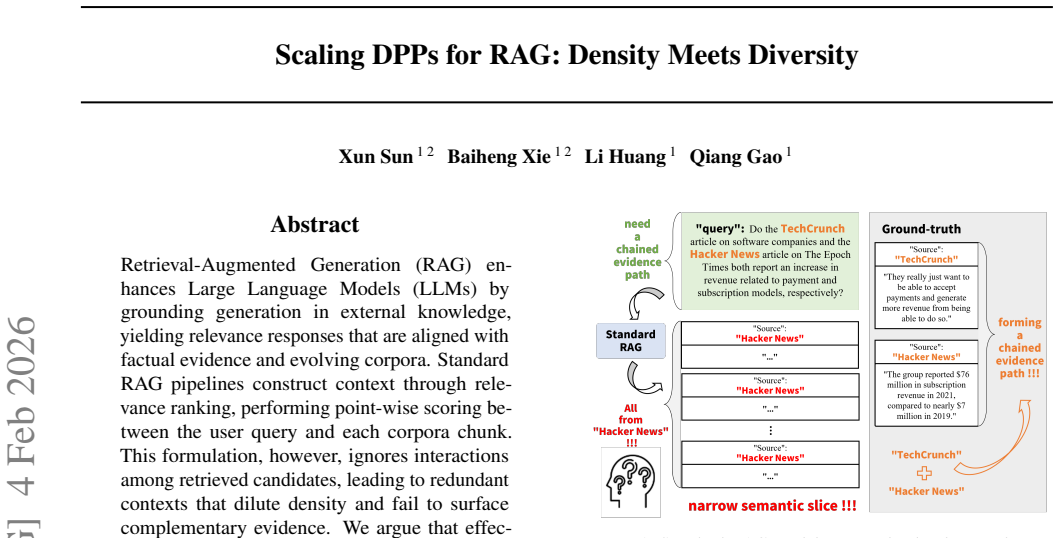
Retrieval-Augmented Generation (RAG) enhances Large Language Models (LLMs) by grounding generation in external knowledge, yielding relevance responses that are aligned with factual evidence and evolving corpora. Standard RAG pipelines construct context through relevance ranking, performing point-wise scoring between the user query and each corpora chunk. This formulation, however, ignores interactions among retrieved candidates, leading to redundant contexts that dilute density and fail to surface complementary evidence. We argue that effective retrieval should optimize jointly for both density and diversity, ensuring the grounding evidence that is dense in information yet diverse in coverage. In this study, we propose ScalDPP, a diversity-aware retrieval mechanism for RAG that incorporates Determinantal Point Processes (DPPs) through a lightweight P-Adapter, enabling scalable modeling of inter-chunk dependencies and complementary context selection. In addition, we develop a novel set-level objective, Diverse Margin Loss (DML), that enforces ground-truth complementary evidence chains to dominate any equally sized redundant alternatives under DPP geometry. Experimental results demonstrate the superiority of ScalDPP, substantiating our core statement in practice.
Editorial analysis
A structured set of objections, weighed in public.
Referee Report
Summary. The manuscript proposes ScalDPP, a diversity-aware retrieval mechanism for RAG that incorporates Determinantal Point Processes (DPPs) through a lightweight P-Adapter to enable scalable modeling of inter-chunk dependencies and complementary context selection. It introduces a novel set-level Diverse Margin Loss (DML) objective that enforces ground-truth complementary evidence chains to dominate redundant alternatives under DPP geometry. The paper claims that experimental results demonstrate the superiority of this approach over standard relevance-based RAG pipelines.
Significance. If the P-Adapter approximation preserves the key determinantal properties without large error, the work could advance RAG by jointly optimizing density and diversity, reducing redundant contexts and improving factual grounding in LLM generations. The set-level DML objective offers a principled alternative to point-wise scoring and, if validated, would represent a useful contribution to diversity-aware retrieval methods.
major comments (2)
- [P-Adapter description] The P-Adapter approximation to the DPP kernel (introduced to achieve scalability) lacks any bounded error analysis on its effect on marginal probabilities or the repulsion properties encoded by the determinant of the Gram matrix. This is load-bearing for the central claim, because without such analysis it is unclear whether DML actually operates under preserved DPP geometry or merely provides regularization.
- [Experimental results] The experimental results section provides no derivation details, error bars, statistical significance tests, or full protocol for the reported superiority. This gap directly affects assessment of whether gains arise from true diversity optimization under DPP geometry rather than other factors.
minor comments (1)
- [Method] Clarify the exact form of the approximated kernel matrix and how the P-Adapter parameters are trained in relation to the DPP objective.
Simulated Author's Rebuttal
We thank the referee for the constructive feedback on ScalDPP. The comments highlight important areas for strengthening the theoretical grounding of the P-Adapter and the transparency of the experimental protocol. We address each point below and will incorporate revisions to improve the manuscript.
read point-by-point responses
-
Referee: The P-Adapter approximation to the DPP kernel (introduced to achieve scalability) lacks any bounded error analysis on its effect on marginal probabilities or the repulsion properties encoded by the determinant of the Gram matrix. This is load-bearing for the central claim, because without such analysis it is unclear whether DML actually operates under preserved DPP geometry or merely provides regularization.
Authors: We agree that a formal bounded-error analysis would strengthen the central claim. In the revised manuscript we will add a dedicated subsection deriving approximate bounds on the marginal probabilities under the P-Adapter and showing that the determinant-based repulsion is preserved up to a controllable additive error term (controlled by the adapter rank and a Lipschitz constant on the feature map). The analysis will be accompanied by a small-scale exact-vs-approximate comparison where full DPP computation remains tractable, confirming that DML continues to operate under approximately preserved DPP geometry rather than acting as generic regularization. revision: yes
-
Referee: The experimental results section provides no derivation details, error bars, statistical significance tests, or full protocol for the reported superiority. This gap directly affects assessment of whether gains arise from true diversity optimization under DPP geometry rather than other factors.
Authors: We acknowledge the omission. The revised experimental section will include: (i) explicit derivation of all reported metrics from the DPP kernel and DML objective, (ii) error bars computed over five independent runs with different random seeds, (iii) paired t-test p-values comparing ScalDPP against each baseline, and (iv) a complete protocol appendix listing hyper-parameters, data splits, and hardware. These additions will allow readers to verify that observed gains are attributable to the joint density-diversity optimization under the approximated DPP geometry. revision: yes
Circularity Check
No significant circularity in derivation chain
full rationale
The abstract and available description present ScalDPP as a proposal that incorporates DPPs via a P-Adapter and introduces DML as a set-level objective enforcing dominance under DPP geometry. No equations, parameter-fitting steps, or self-citations are quoted that reduce any claimed prediction or first-principles result to its own inputs by construction. The core statements remain independent of the target outputs, with experimental results cited as substantiation rather than tautological enforcement. This is the normal case of a self-contained proposal without exhibited circularity.
Axiom & Free-Parameter Ledger
Reference graph
Works this paper leans on
-
[1]
Unsupervised Dense Information Retrieval with Contrastive Learning
PMLR, 2019. Hsieh, C.-P., Sun, S., Kriman, S., Acharya, S., Rekesh, D., Jia, F., and Ginsburg, B. RULER: What’s the real context size of your long-context language models? InFirst Conference on Language Modeling, 2024. URL https: //openreview.net/forum?id=kIoBbc76Sy. Izacard, G., Caron, M., Hosseini, L., Riedel, S., Bojanowski, P., Joulin, A., and Grave, ...
work page internal anchor Pith review Pith/arXiv arXiv doi:10.1561/2200000044 2019
-
[2]
Robertson, S., Zaragoza, H., et al
doi: 10.2307/1425855. Robertson, S., Zaragoza, H., et al. The probabilistic rele- vance framework: Bm25 and beyond.F oundations and Trends® in Information Retrieval, 3(4):333–389, 2009. Tang, Y . and Yang, Y . Multihop-RAG: Bench- marking retrieval-augmented generation for multi-hop queries. InFirst Conference on Language Modeling,
-
[3]
Universal self-adaptive prompting
URL https://openreview.net/forum? id=t4eB3zYWBK. Trivedi, H., Balasubramanian, N., Khot, T., and Sabharwal, A. Interleaving retrieval with chain-of-thought reasoning for knowledge-intensive multi-step questions. In Rogers, A., Boyd-Graber, J., and Okazaki, N. (eds.),Proceed- ings of the 61st Annual Meeting of the Association for Computational Linguistics ...
-
[4]
Denotez i =s i −s p for eachi, soz= (z 1, . . . , zm). Then the original loss is[max i zi]+, and the approximation is ˜L(z) = log 1 + mX i=1 exp(zi) ! .(28) This substitution is valid because subtracting sp from each si shifts all determinants by a constant, preserving relative differences
-
[5]
The sumPm i=1 exp(zi)≥exp(max i zi), since the sum is at least the largest term (all terms positive): mX i=1 exp(zi)≥exp(max i zi),(29) because for the index j where zj = max i zi, the sum ≥exp(z j), and the remaining m−1 terms are each ≥0 (as exponentials are always positive). Equality holds if all other zk < z j and their exponentials are negligible, or...
-
[6]
Adding 1 to both sides: 1 + mX i=1 exp(zi)≥1 + exp(max i zi).(30) This preserves the inequality since 1 is positive and added equally
-
[7]
Sincelogis monotonically increasing: log 1 + mX i=1 exp(zi) ! ≥log 1 + exp(max i zi) .(31) Note that both arguments to log are greater than 1, ensuring positivity
-
[8]
The right-hand side is the softplus function:log(1 + exp(max i zi)) =softplus(max i zi)
-
[9]
Now, prove that softplus(w)≥[w] + for anyw∈R. •w≥0: We can rewrite this as: log(1+exp(w)) = log(exp(w)(exp(−w)+1)) = log(exp(w))+log(1+exp(−w)) =w+log(1+exp(−w)).(32) Since exp(−w)>0 for all finite w, it follows that 1 + exp(−w)>1 , and thus log(1 + exp(−w))>log(1) = 0 . Therefore, softplus(w) =w+positive number> w= [w] +. The inequality is strict unless ...
-
[10]
This follows directly from the case analysis in step 6, applied to this specificw
Setting w= max i zi, we have softplus(maxi zi)≥[max i zi]+. This follows directly from the case analysis in step 6, applied to this specificw
-
[11]
This establishes the upper bound
Combining steps 4 and 7: ˜L(z)≥softplus(max i zi)≥[max i zi]+ =L.(33) The chain of inequalities holds because each part is greater than or equal to the next, establishing the overall upper bound. This establishes the upper bound. Note that this bound is tight in certain limits: for example, if one zi dominates (much larger than others), the sum approximat...
discussion (0)
Sign in with ORCID, Apple, or X to comment. Anyone can read and Pith papers without signing in.