ZipFold: Modular Actuators for Scaleable Adaptive Robots
Pith reviewed 2026-05-10 18:38 UTC · model grok-4.3
The pith
ZipFold actuators use compound folding and zipping of 3D-printed strips to create beams that switch between flexible and quasi-rigid states for modular robots.
A machine-rendered reading of the paper's core claim, the machinery that carries it, and where it could break.
Core claim
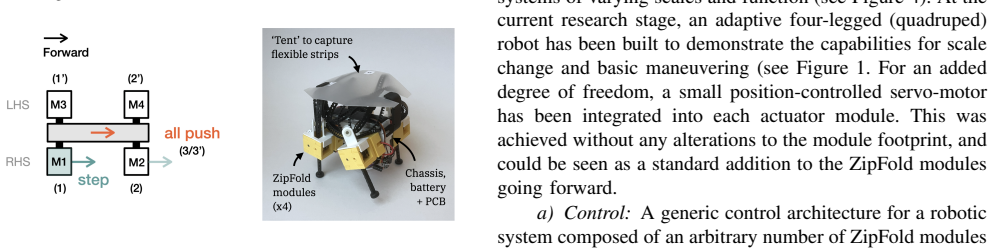
The ZipFold actuator achieves reversible scale and stiffness transformations through compound folding and zipping of flexible 3D-printed plastic strips into square-section deployable beams. The simple actuation method allows for smooth, continuous transitions between compact (flexible) and expanded (quasi-rigid) states, facilitating diverse shape and stiffness transformations when modules are combined into larger assemblies. The actuator's mechanical performance is characterized and an integrated system involving a four-module adaptive walking robot is demonstrated.
What carries the argument
The compound folding and zipping of 3D-printed strips that forms square-section deployable beams capable of reversible expansion and stiffening.
If this is right
- Multiple modules can be assembled into robots capable of continuous shape and stiffness adaptation.
- Shape-changing systems become easier to scale and reconfigure across different applications.
- The actuator supports smooth control of transitions between flexible and rigid states.
- Practical integration is shown by the four-module walking robot demonstration.
Where Pith is reading between the lines
- Robots using these modules could adjust rigidity on the fly to handle varied surfaces or loads without redesign.
- Because the parts are 3D-printed, the approach may allow rapid customization of module sizes for specific tasks.
- Combining the actuators with embedded sensors could enable closed-loop adaptation to environmental changes.
Load-bearing premise
Repeated folding, zipping, and unzipping of the 3D-printed strips will preserve consistent stiffness, deployment force, and structural integrity over many cycles without fatigue or slippage.
What would settle it
A durability test in which the beams lose more than a specified percentage of their expanded stiffness or fail to reach full deployment after a fixed number of actuation cycles would disprove reliable long-term reversibility.
Figures




read the original abstract
There is a growing need for robots that can change their shape, size and mechanical properties to adapt to evolving tasks and environments. However, current shape-changing systems generally utilize bespoke, system-specific mechanisms that can be difficult to scale, reconfigure or translate from one application to another. This paper introduces a compact, easy-to-fabricate deployable actuator that achieves reversible scale and stiffness transformations through compound folding and zipping of flexible 3D-printed plastic strips into square-section deployable beams. The simple actuation method allows for smooth, continuous transitions between compact (flexible) and expanded (quasi-rigid) states, facilitating diverse shape and stiffness transformations when modules are combined into larger assemblies. The actuator's mechanical performance is characterized and an integrated system involving a four-module adaptive walking robot is demonstrated.
Editorial analysis
A structured set of objections, weighed in public.
Referee Report
Summary. The paper introduces ZipFold, a compact modular actuator fabricated from flexible 3D-printed plastic strips that uses compound folding and zipping to form square-section deployable beams. It claims this enables smooth, continuous, reversible transitions between a compact flexible state and an expanded quasi-rigid state, supporting diverse shape and stiffness transformations in larger assemblies. Mechanical performance is stated to be characterized, and the approach is demonstrated via a four-module adaptive walking robot.
Significance. If the performance claims hold with supporting data, the modular, easy-to-fabricate design could provide a scalable alternative to bespoke shape-changing mechanisms in adaptive robotics, facilitating reconfigurable systems. The integration into a multi-module walker demonstrates practical assembly potential.
major comments (3)
- [Characterization section] Characterization section (referenced in abstract): The mechanical performance characterization is described but supplies no quantitative metrics such as force-displacement curves, measured stiffness values, expansion ratios, transition forces, or error bars. Without these, the central claims of smooth continuous transitions and quasi-rigid behavior cannot be evaluated.
- [Walking robot demonstration section] Walking robot demonstration section: The four-module walker is presented as an integrated system, yet no performance data (e.g., walking speed, load capacity, transition cycle times, or stability metrics) are reported. This leaves the claim that modules facilitate diverse transformations unsupported by evidence.
- [Reversibility and durability discussion] Reversibility and durability discussion: The weakest assumption—that repeated folding, zipping, and unzipping maintains consistent geometry, friction, and structural integrity—is not addressed with high-cycle fatigue tests (e.g., stiffness retention or slippage after hundreds of cycles). This is load-bearing for the reversibility claim.
minor comments (2)
- [Figures] Figure captions and labels could more explicitly link visual results to the claimed smooth transitions and quasi-rigid states.
- [Introduction] The abstract and introduction would benefit from a brief comparison table to existing deployable actuators to clarify the novelty of the zipping approach.
Simulated Author's Rebuttal
We thank the referee for their thorough review and constructive suggestions. We will revise the manuscript to provide the requested quantitative data and address the concerns regarding characterization, demonstration performance, and durability.
read point-by-point responses
-
Referee: [Characterization section] Characterization section (referenced in abstract): The mechanical performance characterization is described but supplies no quantitative metrics such as force-displacement curves, measured stiffness values, expansion ratios, transition forces, or error bars. Without these, the central claims of smooth continuous transitions and quasi-rigid behavior cannot be evaluated.
Authors: The referee is correct that the current version lacks explicit quantitative metrics in the characterization section. While the manuscript includes some experimental observations and figures illustrating the behavior, we did not provide the detailed curves and values. In the revised manuscript, we will add force-displacement data, stiffness measurements with error bars, expansion ratios, and transition forces to substantiate the claims of smooth, continuous, and reversible transformations. revision: yes
-
Referee: [Walking robot demonstration section] Walking robot demonstration section: The four-module walker is presented as an integrated system, yet no performance data (e.g., walking speed, load capacity, transition cycle times, or stability metrics) are reported. This leaves the claim that modules facilitate diverse transformations unsupported by evidence.
Authors: We agree that additional performance metrics for the walking robot would strengthen the demonstration. The current manuscript focuses on the qualitative integration and functionality of the four-module system. We will include quantitative data such as walking speeds under different configurations, load capacities, transition times, and stability assessments in the revised version to better support the claims. revision: yes
-
Referee: [Reversibility and durability discussion] Reversibility and durability discussion: The weakest assumption—that repeated folding, zipping, and unzipping maintains consistent geometry, friction, and structural integrity—is not addressed with high-cycle fatigue tests (e.g., stiffness retention or slippage after hundreds of cycles). This is load-bearing for the reversibility claim.
Authors: This is a valid point; the manuscript does not include high-cycle fatigue testing. We will conduct additional experiments to test durability over hundreds of cycles, reporting on stiffness retention, geometric consistency, and any slippage or wear. These results will be added to the revised manuscript, and if limitations are found, they will be discussed. revision: yes
Circularity Check
No circularity: purely descriptive hardware paper with no equations, derivations or fitted predictions
full rationale
The manuscript introduces a deployable actuator based on compound folding and zipping of 3D-printed strips, characterizes its mechanical performance through experiments, and demonstrates a four-module walker. No mathematical models, first-principles derivations, parameter fitting, or predictions appear in the abstract or described content. The work contains no equations that could reduce to their own inputs by construction, no self-citation chains supporting uniqueness theorems, and no renaming of known results as novel derivations. The derivation chain is therefore empty; the paper is self-contained descriptive engineering whose claims rest on fabrication and testing rather than any closed logical loop.
Axiom & Free-Parameter Ledger
Reference graph
Works this paper leans on
-
[1]
M. Polzin, Q. Guan, and J. Hughes, “Robotic locomotion through active and passive morphological adaptation in extreme outdoor environments,”Science Robotics, vol. 10, no. 99, p. eadp6419, Feb. 2025. [Online]. Available: https://www.science.org/doi/10.1126/ scirobotics.adp6419
work page 2025
-
[2]
Modular Self-Reconfigurable Robot Systems [Grand Challenges of Robotics],
M. Yim, W.-m. Shen, B. Salemi, D. Rus, M. Moll, H. Lipson, E. Klavins, and G. S. Chirikjian, “Modular Self-Reconfigurable Robot Systems [Grand Challenges of Robotics],”IEEE Robotics & Automation Magazine, vol. 14, no. 1, pp. 43–52, Mar. 2007. [Online]. Available: https://ieeexplore.ieee.org/document/4141032/
-
[3]
Reconfiguration Motion Planning for Variable Topology Truss,
C. Liu and M. Yim, “Reconfiguration Motion Planning for Variable Topology Truss,” in2019 IEEE/RSJ International Conference on Intelligent Robots and Systems (IROS), Nov. 2019, pp. 1941–1948. [Online]. Available: https://ieeexplore.ieee.org/document/8967640/
-
[4]
Modular shape-changing tensegrity-blocks enable self-assembling robotic structures,
L. Zhao, Y . Jiang, M. Chen, K. Bekris, and D. Balkcom, “Modular shape-changing tensegrity-blocks enable self-assembling robotic structures,”Nature Communications, vol. 16, no. 1, p. 5888, Jul. 2025. [Online]. Available: https://www.nature.com/articles/ s41467-025-60982-0
work page 2025
-
[5]
Strength and efficiency of deployable booms for space applications,
R. Crawford, “Strength and efficiency of deployable booms for space applications,” in12th Structures, Structural Dynamics and Materials Conference. American Institute of Aeronautics and Astronautics, 1971. [Online]. Available: https://arc.aiaa.org/doi/abs/ 10.2514/6.1971-396
-
[6]
K. Miura and S. Pellegrino,F orms and Concepts for Lightweight Structures. Cambridge University Press, Mar. 2020, google-Books- ID: U5fYDwAAQBAJ
work page 2020
-
[7]
Deployable and retractable telescoping tubular structure development,
M. W. Thomson, “Deployable and retractable telescoping tubular structure development,” May 1994, nTRS Author Affiliations: Astro Aerospace Corp. NTRS Document ID: 19940028811 NTRS Research Center: Legacy CDMS (CDMS). [Online]. Available: https://ntrs.nasa.gov/citations/19940028811
-
[8]
J. M. Fernandez, “Advanced Deployable Shell-Based Composite Booms for Small Satellite Structural Applications Including Solar Sails,” Kyoto, 2017, nTRS Author Affiliations: NASA Langley Research Center NTRS Report/Patent Number: NF1676L-25486 NTRS Document ID: 20170001569 NTRS Research Center: Langley Research Center (LaRC). [Online]. Available: https: //...
-
[9]
Multistable inflatable origami structures at the metre scale,
D. Melancon, B. Gorissen, C. J. Garc ´ıa-Mora, C. Hoberman, and K. Bertoldi, “Multistable inflatable origami structures at the metre scale,”Nature, vol. 592, no. 7855, pp. 545–550, Apr. 2021. [Online]. Available: https://www.nature.com/articles/s41586-021-03407-4
work page 2021
-
[10]
KinetiX - designing auxetic-inspired deformable material structures,
J. Ou, Z. Ma, J. Peters, S. Dai, N. Vlavianos, and H. Ishii, “KinetiX - designing auxetic-inspired deformable material structures,”Computers & Graphics, vol. 75, pp. 72–81, Oct. 2018. [Online]. Available: https://linkinghub.elsevier.com/retrieve/pii/S0097849318301006
work page 2018
-
[11]
Origami tubes assembled into stiff, yet reconfigurable structures and metamaterials,
E. T. Filipov, T. Tachi, and G. H. Paulino, “Origami tubes assembled into stiff, yet reconfigurable structures and metamaterials,” Proceedings of the National Academy of Sciences, vol. 112, no. 40, pp. 12 321–12 326, Oct. 2015. [Online]. Available: https: //www.pnas.org/doi/full/10.1073/pnas.1509465112
-
[12]
Flexible mechanical metamaterials,
K. Bertoldi, V . Vitelli, J. Christensen, and M. van Hecke, “Flexible mechanical metamaterials,”Nature Reviews Materials, vol. 2, no. 11, p. 17066, Oct. 2017. [Online]. Available: https://www.nature.com/articles/natrevmats201766
work page 2017
-
[13]
DropPop: Designing Drop-to-Deploy Mechanisms with Bistable Scissors Structures,
Y . Fu, E. Guan, J. Gu, D. K. Patel, J. U. Soza Soto, Y . Luo, C. Majidi, J. Hester, and L. Yao, “DropPop: Designing Drop-to-Deploy Mechanisms with Bistable Scissors Structures,” inProceedings of the 38th Annual ACM Symposium on User Interface Software and Technology, ser. UIST ’25. New York, NY , USA: Association for Computing Machinery, Sep. 2025, pp. 1...
-
[14]
M. M. Coad, L. H. Blumenschein, S. Cutler, J. A. R. Zepeda, N. D. Naclerio, H. El-Hussieny, U. Mehmood, J.-H. Ryu, E. W. Hawkes, and A. M. Okamura, “Vine Robots,”IEEE Robotics & Automation Magazine, vol. 27, no. 3, pp. 120–132, Sep. 2020. [Online]. Available: https://ieeexplore.ieee.org/abstract/document/8917931
-
[15]
Task-Driven Manipulation with Reconfigurable Parallel Robots,
D. Morton, M. Cutkosky, and M. Pavone, “Task-Driven Manipulation with Reconfigurable Parallel Robots,” in2024 IEEE/RSJ International Conference on Intelligent Robots and Systems (IROS), Oct. 2024, pp. 9924–9930, arXiv:2403.10768 [cs]. [Online]. Available: http://arxiv.org/abs/2403.10768
-
[16]
“Spiralift System Platform.” [Online]. Available: https://www.sofito. com.tr/en/l/14/Stage-Mechanics/159/Spiralift-System-Platform.html
-
[17]
Design of a spherical robot arm with the Spiral Zipper prismatic joint,
F. Collins and M. Yim, “Design of a spherical robot arm with the Spiral Zipper prismatic joint,” in2016 IEEE International Conference on Robotics and Automation (ICRA). Stockholm, Sweden: IEEE, May 2016, pp. 2137–2143. [Online]. Available: http://ieeexplore.ieee.org/document/7487363/
-
[18]
A Highly Compact Zip Chain Arm with Origami-Inspired Folding Chain Structures,
D.-K. Kim and G.-P. Jung, “A Highly Compact Zip Chain Arm with Origami-Inspired Folding Chain Structures,”Biomimetics, vol. 8, no. 2, p. 176, Jun. 2023. [Online]. Available: https: //www.mdpi.com/2313-7673/8/2/176
work page 2023
-
[19]
Designing Expandable-Structure Robots for Human- Robot Interaction,
H. Hedayati, R. Suzuki, W. Rees, D. Leithinger, and D. Szafir, “Designing Expandable-Structure Robots for Human- Robot Interaction,”Frontiers in Robotics and AI, vol. 9, Apr. 2022. [Online]. Available: https://www.frontiersin.org/journals/ robotics-and-ai/articles/10.3389/frobt.2022.719639/full
-
[20]
On the stability properties of quadruped creeping gaits,
R. B. McGhee and A. A. Frank, “On the stability properties of quadruped creeping gaits,”Mathematical Biosciences, vol. 3, pp. 331–351, Aug. 1968. [Online]. Available: https://www.sciencedirect. com/science/article/pii/0025556468900904
-
[21]
R. G. Budynas, K. J. Nisbett, J. K. Nisbett, and J. E. Shigley,Shigley’s mechanical engineering design, 10th ed., ser. Mcgraw-Hill series in mechanical engineering. New York, NY: McGraw-Hill Education, 2015
work page 2015
-
[22]
ReachBot: A Small Robot for Large Mobile Manipulation Tasks,
S. Schneider, A. Bylard, T. G. Chen, P. Wang, M. Cutkosky, M. Lap ˆotre, and M. Pavone, “ReachBot: A Small Robot for Large Mobile Manipulation Tasks,” in2022 IEEE Aerospace Conference (AERO), Mar. 2022, pp. 1–12. [Online]. Available: https://ieeexplore.ieee.org/document/9843346
discussion (0)
Sign in with ORCID, Apple, or X to comment. Anyone can read and Pith papers without signing in.