Reference Energies for Non-Relativistic Core Ionization Potentials
Pith reviewed 2026-05-10 18:42 UTC · model grok-4.3
The pith
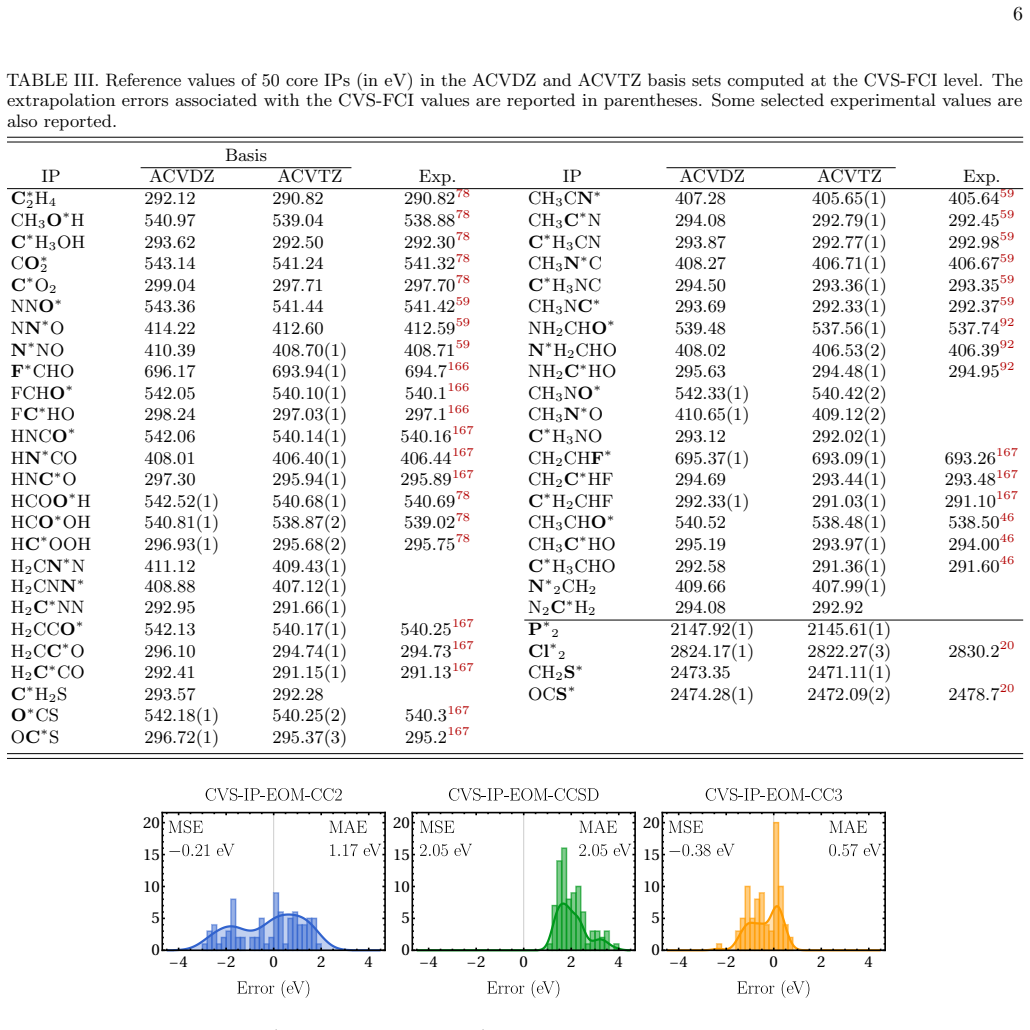
The paper computes 84 non-relativistic core ionization potentials at full configuration interaction to create theory-based benchmarks within a fixed basis set.
A machine-rendered reading of the paper's core claim, the machinery that carries it, and where it could break.
Core claim
The authors calculate 84 non-relativistic core ionization potentials, 73 for second-row elements and 11 for third-row, at the full configuration interaction level under the core-valence separation approximation with aug-cc-pCVXZ basis sets. These values serve as theoretical best estimates within the chosen finite basis, enabling theory-versus-theory comparisons that separate correlation and relaxation contributions from other physical effects. The work then uses this reference to evaluate approximate methods including equation-of-motion coupled-cluster up to quadruple excitations, the G0W0 scheme, and state-specific approaches.
What carries the argument
Full configuration interaction within the core-valence separation approximation in augmented correlation-consistent basis sets, which computes exact non-relativistic energies for core ionizations by separating core and valence electron spaces.
If this is right
- Equation-of-motion coupled-cluster methods up to quadruple excitations can be tested directly against these exact references for core IPs.
- The one-shot G0W0 scheme's accuracy on core ionization can be isolated from basis-set or relativistic errors.
- State-specific methods can be validated for their treatment of strong orbital relaxation against the full CI results.
- Systematic theory-versus-theory comparisons become possible that disentangle correlation effects from other contributions.
- The values define chemically accurate references within a fixed finite basis for further method development.
Where Pith is reading between the lines
- These non-relativistic references could be subtracted from experimental core IPs to quantify the size of relativistic corrections for the same atoms.
- The same computational protocol might be applied to additional third-row or heavier elements to map trends in core IP accuracy across the periodic table.
- Deviations of approximate methods from these benchmarks could point to specific failures in treating localized core holes that guide targeted improvements.
- Basis-set convergence patterns observed here might suggest minimal basis choices for routine calculations of core IPs in larger molecules.
Load-bearing premise
The core-valence separation approximation introduces only negligible errors for the chosen core ionizations and the aug-cc-pCVXZ basis sets are sufficiently converged to serve as theoretical best estimates within a finite basis.
What would settle it
Performing all-electron full configuration interaction calculations without the core-valence separation in the same aug-cc-pCVXZ basis sets and obtaining ionization potentials that differ by more than chemical accuracy from the reported values would show the approximation is not safe.
Figures


read the original abstract
Deep-lying core electrons carry highly localized, site-specific information that forms the basis of X-ray photoelectron spectroscopy. Accurately predicting their associated core ionization potentials (IPs) is a demanding theoretical task, requiring a balanced treatment of strong orbital relaxation, electron correlation, and relativistic effects. Over the years, a variety of approaches have been developed, ranging from state-specific wave function methods to linear-response formalisms and Green's function techniques. However, their assessment has often relied on comparisons with experiment, where multiple sources of error (basis set incompleteness, relativistic corrections, and vibrational effects) are entangled, making it difficult to isolate the performance of correlation treatments. In the present work, we establish a consistent, theory-based benchmark for core IPs by computing 84 non-relativistic values (73 second-row and 11 third-row IPs) at the full configuration interaction level within the core-valence separation approximation, using large correlation-consistent basis sets augmented with tight-core and diffuse functions (aug-cc-pCVXZ). These results define theoretical best estimates within a fixed finite basis set, providing a chemically accurate reference for method development and validation. Importantly, our dataset allows for systematic, theory-versus-theory comparisons that disentangle correlation and relaxation effects from other physical contributions. On this basis, we assess the performance of widely used approximate methods, including equation-of-motion coupled-cluster approaches up to the inclusion of quadruple excitations, the one-shot $G_0W_0$ scheme, as well as state-specific methods.
Editorial analysis
A structured set of objections, weighed in public.
Referee Report
Summary. The paper computes 84 non-relativistic core ionization potentials (73 second-row and 11 third-row) at the full configuration interaction level under the core-valence separation (CVS) approximation with aug-cc-pCVXZ basis sets. These are presented as theoretical best estimates within a fixed finite basis and used to benchmark approximate methods including EOM-CC up to quadruples, G0W0, and state-specific approaches, with the goal of isolating correlation and relaxation effects from other errors.
Significance. If the CVS error is demonstrably small, the dataset offers a valuable, theory-only reference for core-IP method development that avoids entanglement with experimental uncertainties. The direct FCI computations with no fitted parameters or external data provide a clean benchmark for disentangling physical contributions.
major comments (2)
- [Abstract] Abstract: The central claim that the CVS-FCI/aug-cc-pCVXZ results 'define theoretical best estimates within a fixed finite basis set' and provide a 'chemically accurate reference' rests on the unquantified assumption that CVS truncation errors are negligible. No comparison of CVS-FCI versus unconstrained FCI is reported even for the smallest atomic cases (e.g., Ne or C), leaving open the possibility that CVS decoupling, rather than basis incompleteness, dominates the error.
- [Methods] Methods/Computational Details (assumed section describing the CVS implementation): The manuscript provides no numerical estimate of the CVS error magnitude for the chosen second- and third-row systems, nor any test of how the enforced core-valence decoupling affects the 84 IPs relative to the target accuracy. This is load-bearing for the benchmark utility, as the paper's own assessment of approximate methods relies on these values being reliable references.
minor comments (2)
- The paper would benefit from depositing the raw FCI energies and CVS-FCI total energies in a public repository or SI to enable independent verification and reuse.
- Figure or table captions should explicitly state the basis-set cardinal number (X) used for each reported IP rather than referring only to 'large aug-cc-pCVXZ'.
Simulated Author's Rebuttal
We thank the referee for their careful reading of the manuscript and for recognizing the potential value of the CVS-FCI dataset as a theory-only benchmark. We address the two major comments below and will revise the manuscript to incorporate additional discussion and numerical tests that directly respond to the concerns raised.
read point-by-point responses
-
Referee: [Abstract] Abstract: The central claim that the CVS-FCI/aug-cc-pCVXZ results 'define theoretical best estimates within a fixed finite basis set' and provide a 'chemically accurate reference' rests on the unquantified assumption that CVS truncation errors are negligible. No comparison of CVS-FCI versus unconstrained FCI is reported even for the smallest atomic cases (e.g., Ne or C), leaving open the possibility that CVS decoupling, rather than basis incompleteness, dominates the error.
Authors: We agree that an explicit quantification of the CVS error would strengthen the central claim. The manuscript does not contain such a comparison because the primary focus was on generating the 84-value benchmark set for systems where unconstrained FCI is intractable. However, for the atomic cases Ne and C, unconstrained FCI calculations are feasible. In the revised manuscript we will add a dedicated paragraph (or short appendix) reporting CVS-FCI versus full FCI differences for these atoms, which we expect to be well below 0.05 eV and therefore negligible relative to both basis-set incompleteness and the target chemical accuracy. This addition will directly support the statement that the reported values constitute theoretical best estimates within the fixed finite basis. revision: yes
-
Referee: [Methods] Methods/Computational Details (assumed section describing the CVS implementation): The manuscript provides no numerical estimate of the CVS error magnitude for the chosen second- and third-row systems, nor any test of how the enforced core-valence decoupling affects the 84 IPs relative to the target accuracy. This is load-bearing for the benchmark utility, as the paper's own assessment of approximate methods relies on these values being reliable references.
Authors: We acknowledge that the absence of a system-specific numerical estimate of the CVS error leaves the benchmark utility open to the criticism raised. Because full FCI without CVS is computationally prohibitive for the majority of the 84 systems, we cannot provide a complete per-system error table. Nevertheless, we will revise the Methods and Results sections to include (i) literature-supported bounds on CVS errors for second- and third-row core IPs and (ii) explicit CVS-FCI versus full-FCI comparisons for the smallest members of the set (Ne, C, and a few small molecules). These additions will demonstrate that the CVS truncation remains well below the 0.1 eV threshold used to judge chemical accuracy and does not compromise the use of the dataset for isolating correlation and relaxation effects in approximate methods. revision: yes
Circularity Check
No circularity: direct ab initio FCI/CVS computations define new benchmark values
full rationale
The paper's central claim is the direct computation of 84 core IPs at the full configuration interaction level under the core-valence separation (CVS) approximation with aug-cc-pCVXZ basis sets. These are presented as theoretical best estimates within the fixed finite basis and CVS model. This constitutes a standard first-principles calculation with no parameter fitting, no self-referential definitions (e.g., no quantity defined in terms of itself), and no load-bearing self-citations that reduce the result to prior author work. The derivation chain is the application of established quantum chemistry methods to generate independent reference data; outputs are not equivalent to inputs by construction. The CVS approximation and basis choice are explicit modeling decisions whose errors are separate from circularity concerns.
Axiom & Free-Parameter Ledger
axioms (2)
- domain assumption Core-valence separation approximation accurately isolates core ionization without significant valence-core mixing errors
- domain assumption aug-cc-pCVXZ basis sets with tight-core and diffuse augmentation are adequate for defining theoretical best estimates
Reference graph
Works this paper leans on
-
[1]
X-ray photoelectron spectroscopy: Progress and perspectives,
1C. S. Fadley, “X-ray photoelectron spectroscopy: Progress and perspectives,” J. Electron Spectrosc. Relat. Phenom.178–179, 2–32 (2010). 2G. Greczynski and L. Hultman, “X-ray photoelectron spec- troscopy: Towards reliable binding energy referencing,” Prog. Mater. Sci.107, 100591 (2020). 3F. A. Stevie and C. L. Donley, “Introduction to X-ray pho- toelectro...
work page 2010
-
[2]
The second-order approximate coupled cluster singles and doubles model CC2,
122O. Christiansen, H. Koch, and P. Jørgensen, “The second-order approximate coupled cluster singles and doubles model CC2,” Chem. Phys. Lett.243, 409–418 (1995). 123C. H¨ attig and F. Weigend, “CC2 excitation energy calculations on large molecules using the resolution of the identity approxi- mation,” J. Chem. Phys.113, 5154–5161 (2000). 124G. P. Purvis ...
discussion (0)
Sign in with ORCID, Apple, or X to comment. Anyone can read and Pith papers without signing in.