Magnon harmonic generation in antiferromagnets: Dynamical symmetry enriched by symmetry breaking
Pith reviewed 2026-05-10 18:27 UTC · model grok-4.3
The pith
Magnetic orders and phase transitions in antiferromagnets modify the spectra of magnon harmonic generations, unlike in systems without spontaneous symmetry breaking.
A machine-rendered reading of the paper's core claim, the machinery that carries it, and where it could break.
Core claim
In ordered antiferromagnetic phases, incident THz or GHz waves drive magnon oscillations that generate radiation at harmonic frequencies; the allowed harmonics and their intensities obey selection rules set by dynamical symmetries of the driven system, and these rules shift when the underlying magnetic order changes across phases such as Néel to canted or weak ferromagnetic.
What carries the argument
Dynamical symmetries of the driven magnon system, which are enriched by the spontaneous symmetry breaking of the magnetic order and yield phase-dependent selection rules for harmonic generation.
If this is right
- Harmonic spectra differ distinctly between Néel, canted, and weak ferromagnetic phases under the same driving conditions.
- Crossing a phase transition produces abrupt changes in which harmonics appear or are suppressed.
- Selection rules apply to both single-color and two-color laser driving and reflect the broken symmetry of each phase.
- Measured harmonic spectra therefore supply information about magnetic symmetry or symmetry breaking that is not available from linear response.
Where Pith is reading between the lines
- The same symmetry-enrichment mechanism could be tested in other ordered magnets by driving with frequencies matched to their excitation gaps.
- Field- or temperature-tuned phase transitions in a single sample would allow direct observation of spectral switches predicted by the selection rules.
- Extension to include weak damping might reveal how linewidths interact with the symmetry-protected suppression of certain harmonics.
Load-bearing premise
Numerical simulations of magnon dynamics under driving and the derived selection rules capture experimental behavior without significant damping or omitted higher-order interactions.
What would settle it
An experimental spectrum of harmonic radiation from an antiferromagnet in a known phase that contains frequencies forbidden by the phase-specific selection rules would falsify the central claim.
Figures




read the original abstract
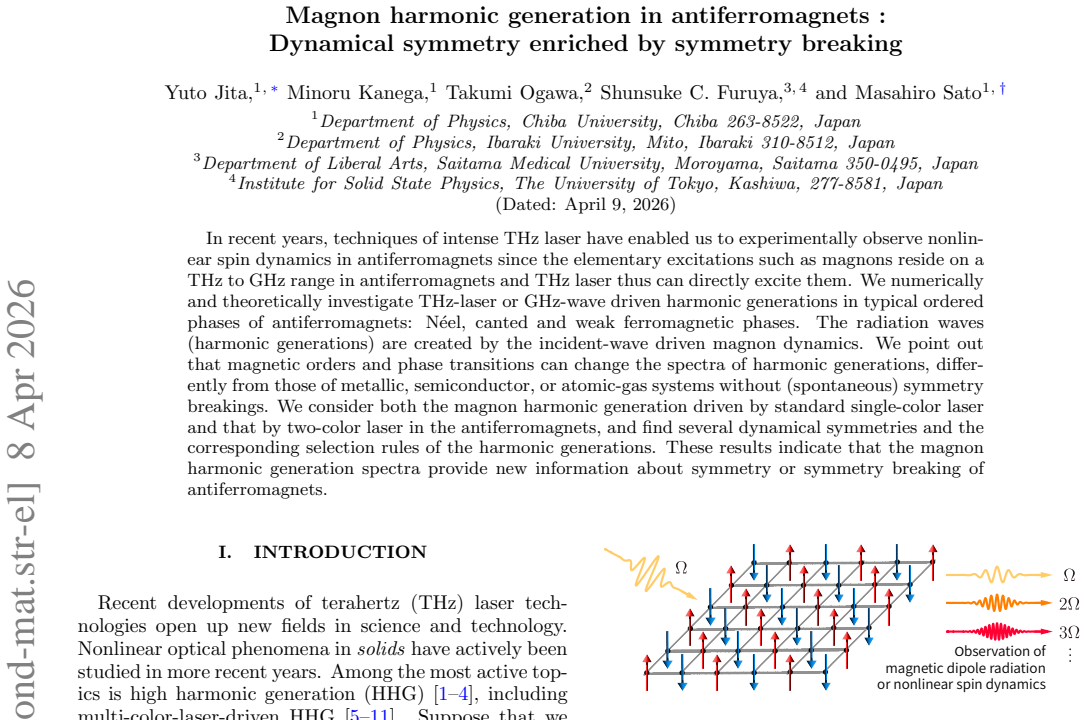
In recent years, techniques of intense THz laser have enabled us to experimentally observe nonlinear spin dynamics in antiferromagnets since the elementary excitations such as magnons reside on a THz to GHz range in antiferromagnets and THz laser thus can directly excite them. We numerically and theoretically investigate THz-laser or GHz-wave driven harmonic generations in typical ordered phases of antiferromagnets: N\'eel, canted and weak ferromagnetic phases. The radiation waves (harmonic generations) are created by the incident-wave driven magnon dynamics. We point out that magnetic orders and phase transitions can change the spectra of harmonic generations, differently from those of metallic, semiconductor, or atomic-gas systems without (spontaneous) symmetry breakings. We consider both the magnon harmonic generation driven by standard single-color laser and that by two-color laser in the antiferromagnets, and find several dynamical symmetries and the corresponding selection rules of the harmonic generations. These results indicate that the magnon harmonic generation spectra provide new information about symmetry or symmetry breaking of antiferromagnets.
Editorial analysis
A structured set of objections, weighed in public.
Referee Report
Summary. The manuscript numerically and theoretically examines THz-laser and GHz-wave driven magnon dynamics and the resulting harmonic-generation spectra in antiferromagnets, focusing on the Néel, canted, and weak-ferromagnetic phases. It identifies dynamical symmetries and associated selection rules that depend on the magnetic order, arguing that spontaneous symmetry breaking produces harmonic spectra distinct from those in systems without such breaking (e.g., metals or atomic gases). Both single-color and two-color driving are analyzed, with the central claim that these spectra furnish new information on symmetry or symmetry breaking.
Significance. If the selection rules prove robust, the work provides a concrete link between magnetic symmetry breaking and nonlinear magnon responses, potentially establishing harmonic generation as a spectroscopic probe for antiferromagnetic phases and transitions. The explicit use of dynamical symmetries to derive selection rules, combined with phase-specific numerical simulations, is a methodological strength that could guide future experiments in nonlinear magnonics.
major comments (2)
- [Numerical methods and results sections] Numerical integration of the driven magnon equations (presumably Landau-Lifshitz or LLG form): the simulations appear to be performed without a Gilbert damping term or with α set to zero. Finite damping (realistic values α ≈ 0.01–0.1) broadens resonances and can populate nominally forbidden harmonics through mode mixing, directly undermining the claim that the extracted spectra unambiguously encode symmetry-breaking information. Please state the damping value employed and show that the reported selection rules survive for experimentally relevant α.
- [Results for canted and weak-ferromagnetic phases] Extraction of selection rules in the weak-ferromagnetic and canted phases: the manuscript states that magnetic order changes the allowed harmonics relative to the unbroken-symmetry case, but does not quantify the effect size (e.g., intensity ratios of allowed vs. forbidden lines) or provide a direct side-by-side comparison of spectra with and without the order parameter. Without this, the distinction from metallic/semiconductor systems remains qualitative and the load-bearing claim that symmetry breaking “enriches” the dynamical symmetries is not fully substantiated.
minor comments (2)
- [Abstract and Model section] The abstract and introduction do not specify the microscopic Hamiltonian (e.g., easy-axis vs. easy-plane anisotropy, exchange constants) or the concrete material parameters used in the simulations.
- [Figures] Figure captions and axis labels should explicitly indicate whether the plotted spectra are steady-state Fourier transforms or time-averaged intensities, and whether any windowing or filtering was applied.
Simulated Author's Rebuttal
We appreciate the referee's insightful comments, which help improve the clarity and robustness of our work. Below we address the major comments point by point.
read point-by-point responses
-
Referee: [Numerical methods and results sections] Numerical integration of the driven magnon equations (presumably Landau-Lifshitz or LLG form): the simulations appear to be performed without a Gilbert damping term or with α set to zero. Finite damping (realistic values α ≈ 0.01–0.1) broadens resonances and can populate nominally forbidden harmonics through mode mixing, directly undermining the claim that the extracted spectra unambiguously encode symmetry-breaking information. Please state the damping value employed and show that the reported selection rules survive for experimentally relevant α.
Authors: We thank the referee for pointing this out. In the original manuscript, the Gilbert damping was set to zero (α = 0) to highlight the pure effects of dynamical symmetries without dissipative broadening. We agree that including realistic damping is important for experimental relevance. We have now performed additional simulations with α = 0.01 and α = 0.05. The selection rules are preserved, with forbidden harmonics remaining suppressed by at least two orders of magnitude compared to allowed ones, although weak leakage appears due to broadening. We will revise the manuscript to state the damping value explicitly, add a discussion on the effect of damping, and include supplementary figures demonstrating the robustness of the selection rules for small but finite α. revision: yes
-
Referee: [Results for canted and weak-ferromagnetic phases] Extraction of selection rules in the weak-ferromagnetic and canted phases: the manuscript states that magnetic order changes the allowed harmonics relative to the unbroken-symmetry case, but does not quantify the effect size (e.g., intensity ratios of allowed vs. forbidden lines) or provide a direct side-by-side comparison of spectra with and without the order parameter. Without this, the distinction from metallic/semiconductor systems remains qualitative and the load-bearing claim that symmetry breaking “enriches” the dynamical symmetries is not fully substantiated.
Authors: We agree that a more quantitative comparison would strengthen the central claim. In the revised version, we will add side-by-side plots of the harmonic generation spectra for the canted and weak-ferromagnetic phases with the magnetic order parameter present and artificially suppressed (while keeping the same driving conditions and parameters). Additionally, we will report the intensity ratios between allowed and forbidden harmonics, showing that the symmetry breaking leads to significant changes, such as the appearance of new harmonics with intensities comparable to or exceeding those in the symmetric case. This will make the enrichment of dynamical symmetries by symmetry breaking more quantitative and substantiate the distinction from systems without spontaneous symmetry breaking. revision: yes
Circularity Check
No significant circularity; derivation is self-contained
full rationale
The paper derives selection rules for magnon harmonic generation by applying dynamical symmetry analysis to the driven equations of motion in Néel, canted, and weak-ferromagnetic phases, then verifies via numerical integration. No step reduces a claimed prediction to a fitted parameter, self-citation chain, or definitional tautology; the symmetry arguments operate on standard Landau-Lifshitz dynamics and produce phase-dependent spectra as an output rather than an input. The central claim that magnetic order alters harmonic spectra differently from unbroken-symmetry systems therefore retains independent content.
Axiom & Free-Parameter Ledger
Lean theorems connected to this paper
-
IndisputableMonolith/Foundation/RealityFromDistinction.leanreality_from_one_distinction unclear?
unclearRelation between the paper passage and the cited Recognition theorem.
We numerically and theoretically investigate THz-laser or GHz-wave driven harmonic generations... find several dynamical symmetries and the corresponding selection rules
-
IndisputableMonolith/Cost/FunctionalEquation.leanwashburn_uniqueness_aczel unclear?
unclearRelation between the paper passage and the cited Recognition theorem.
The radiation waves (harmonic generations) are created by the incident-wave driven magnon dynamics... LLG equation
What do these tags mean?
- matches
- The paper's claim is directly supported by a theorem in the formal canon.
- supports
- The theorem supports part of the paper's argument, but the paper may add assumptions or extra steps.
- extends
- The paper goes beyond the formal theorem; the theorem is a base layer rather than the whole result.
- uses
- The paper appears to rely on the theorem as machinery.
- contradicts
- The paper's claim conflicts with a theorem or certificate in the canon.
- unclear
- Pith found a possible connection, but the passage is too broad, indirect, or ambiguous to say the theorem truly supports the claim.
Reference graph
Works this paper leans on
-
[1]
N´ eel phase The square lattice has two sublattices, say A and B. Any site in the A sublattice is surrounded by four nearest- neighbor sites in the B sublattice and vice versa. Letr A andr B be sites in the A sublattice and B sublattice, respectively. We can assume that the classical N´ eel or- der has ˆSz rA =Sand ˆSz rB =−S. Let us introduce the Holstei...
-
[2]
Canted phaseThe classical order in the canted phase is sketched in 22 Fig. 2 (a), that is, ˆSrA = −sinθ 0 cosθ , ˆSrB = sinθ 0 cosθ ,(A24) whereθis determined byB/Jto minimize the energy. We thus find θ= cos −1 B 2S(zJ−K) .(A25) We consider the canted order within theS z-Sx plane without loss of generality since the model (2.1) has the...
-
[3]
Weak ferromagnets As we mentioned in the main text, the ground state in the WF phase is akin to that in the canted phase. We thus reuse the Holstein-Primakoff transformation from the spin to magnon operators that we developed in the canted phase. In the linear spin-wave theory regime, we then approximate ˆSrA and ˆSrB as follows. ˆSx rA = ˆSξ rA cosθ− ˆSζ...
-
[4]
In this study, we mainly consider the ac Zeeman interaction as the spin-light cou- pling
Dynamical symmetry in quantum systems Let us consider a quantum spin model ˆHmag subject to a spin-light coupling ˆHext(t), whose temporal period isT ac: ˆHext(t) = ˆHext(t+T ac). In this study, we mainly consider the ac Zeeman interaction as the spin-light cou- pling. To discuss the dynamical symmetry, we focus on the ideal setup that the applied laser i...
-
[5]
The long-range magnetic order justifies the application of the semiclassical equation of motion
Dynamical symmetry in LL equation In the main text, we have adopted the LLG equation instead of the quantum Heisenberg equation because the system belongs to the magnetically ordered phase. The long-range magnetic order justifies the application of the semiclassical equation of motion. However, there is a pri- ori no guarantee that the dynamical symmetry ...
-
[6]
Selection rules in high-harmonic spectra: one-color laser case Let us derive the selection rule of the spectrum related to the dynamical symmetry in the case where the one- color laser field with the frequency Ω along thexaxis is applied to the magnetic Mott insulator (2.1) with the static magnetic field. The total Hamiltonian is given by ˆH(t) = ˆHN-C −B...
-
[7]
Selection rules in high-harmonic spectra: two-color laser case In this section, we consider the dynamical symmetries in antiferromagnets irradiated by two-color laser, and de- rive the selection rules of their harmonic generation spec- tra. a.C 3-symmetric case In this subsection, we derive the selection rules from the dynamical symmetries of ( ˆUz(2π/3),...
-
[8]
N´ eel phase Classically, magnetic resonance in magnetic Mott in- sulators occurs when the external ac magnetic field in- duces resonant precession of total magnetic momentm=P r mr. The magnetic resonance involves the total mag- netic moment since the external ac magnetic field (elec- tromagnetic wave) can be deemed the plane wave, as we mentioned already...
-
[9]
In theξηζcoordinate introduced in Appendix
Canted phase The precession in the canted phase draws elliptic or- bitals instead of the circular one, as we derive below. In theξηζcoordinate introduced in Appendix. A 2, the magnetic moment in theµ= A,B sublattice is given by mξ µ =M ξ cosωt,(D18) mη µ =M η sinωt,(D19) mζ µ = q S2 −(M ξ)2 −(M η)2.(D20) In this equation, we assume thatm A andm B follow t...
-
[10]
Weak-ferromagnetic phase The magnetic structure in the WF phase is akin to that in the canted phase. The precession in the WF phase as well as the canted phase draws the elliptic trajectory in theξηphase. The difference between these two phases arises from the Hamiltonian. We apply the mean-field approximation to the Hamil- tonian (2.2) and consider HWF;M...
-
[11]
S. Ghimire and D. A. Reis, High-harmonic generation from solids, Nat. Phys.15, 10 (2018)
work page 2018
- [12]
-
[13]
E. Goulielmakis and T. Brabec, High harmonic gen- eration in condensed matter, Nat. Photonics16, 411 (2022)
work page 2022
-
[14]
L. Li, P. Lan, X. Zhu, and P. Lu, High harmonic gen- eration in solids: particle and wave perspectives, Rep. Prog. Phys.86, 116401 (2023)
work page 2023
- [15]
-
[16]
T. T. Luu and H. J. W¨ orner, High-order harmonic gen- eration in solids: A unifying approach, Phys. Rev. B94, 115164 (2016)
work page 2016
-
[17]
T. T. Luu and H. J. W¨ orner, Observing broken inversion symmetry in solids using two-color high-order harmonic spectroscopy, Phys. Rev. A98, 041802 (2018)
work page 2018
-
[18]
N. Rana, M. S. Mrudul, and G. Dixit, Generation of Cir- cularly Polarized High Harmonics with Identical Helic- ity in Two-Dimensional Materials, Phys. Rev. Applied 18, 064049 (2022)
work page 2022
-
[19]
Y.-L. He, J. Guo, F.-Y. Gao, and X.-S. Liu, Dynamical symmetry and valley-selective circularly polarized high- harmonic generation in monolayer molybdenum disul- fide, Phys. Rev. B105, 024305 (2022)
work page 2022
-
[20]
M. Udono and M. Sato, Triplons, triplon pairs, and dy- namical symmetries in laser-driven Shastry-Sutherland magnets, Phys. Rev. B110, L201112 (2024)
work page 2024
-
[21]
M. Kanega and M. Sato, Two-color laser control of pho- tocurrent and high harmonics in graphene, Phys. Rev. B112, 045306 (2025)
work page 2025
-
[22]
A. McPherson, G. Gibson, H. Jara,et al., Studies of multiphoton production of vacuum-ultraviolet radiation in the rare gases, J. Opt. Soc. Am. B4, 595 (1987)
work page 1987
- [23]
-
[24]
S. Ghimire, G. Ndabashimiye, A. D. DiChiara,et al., Strong-field and attosecond physics in solids, J. Phys. B 47, 204030 (2014)
work page 2014
-
[25]
S. Ghimire, A. D. DiChiara, E. Sistrunk,et al., Ob- servation of high-order harmonic generation in a bulk crystal, Nat. Phys.7, 138 (2011)
work page 2011
-
[26]
O. Schubert, M. Hohenleutner, F. Langer,et al., Sub- cycle control of terahertz high-harmonic generation by dynamical bloch oscillations, Nat. Photonics8, 119 (2014)
work page 2014
-
[27]
M. Hohenleutner, F. Langer, O. Schubert,et al., Real- time observation of interfering crystal electrons in high- harmonic generation, Nature523, 572 (2015)
work page 2015
-
[28]
T. T. Luu, M. Garg, S. Y. Kruchinin,et al., Extreme ultraviolet high-harmonic spectroscopy of solids, Nature 521, 498 (2015)
work page 2015
-
[29]
G. Ndabashimiye, S. Ghimire, M. Wu,et al., Solid-state harmonics beyond the atomic limit, Nature534, 520 (2016)
work page 2016
- [30]
-
[31]
K. Kaneshima, Y. Shinohara, K. Takeuchi,et al., Polarization-resolved study of high harmonics from bulk semiconductors, Phys. Rev. Lett.120, 243903 (2018)
work page 2018
- [32]
-
[33]
M. Sato, T. Higuchi, N. Kanda,et al., Terahertz polar- ization pulse shaping with arbitrary field control, Nat. Photonics7, 724 (2013)
work page 2013
-
[34]
H. A. Hafez, X. Chai, A. Ibrahim,et al., Intense ter- ahertz radiation and their applications, J. Opt.18, 093004 (2016)
work page 2016
-
[35]
S. S. Dhillon, M. S. Vitiello, E. H. Linfield, A. G. Davies,et al., The 2017 terahertz science and technology roadmap, J. Phys. D: Appl. Phys.50, 043001 (2017)
work page 2017
-
[36]
B. Liu, H. Bromberger, A. Cartella,et al., Generation of narrowband, high-intensity, carrier-envelope phase- stable pulses tunable between 4 and 18 THz, Opt. Lett. 42, 129 (2017)
work page 2017
- [37]
-
[38]
S. Kovalev, Z. Wang, J.-C. Deinert,et al., Selective THz control of magnetic order: new opportunities from su- perradiant undulator sources, J. Phys. D: Appl. Phys. 36 51, 114007 (2018)
work page 2018
-
[39]
E. T. Papaioannou and R. Beigang, THz spintronic emitters: a review on achievements and future chal- lenges, Nanophotonics10, 1243 (2021)
work page 2021
-
[40]
A. Leitenstorfer, A. S. Moskalenko, T. Kampfrath, et al., The 2023 terahertz science and technology roadmap, J. Phys. D: Appl. Phys.56, 223001 (2023)
work page 2023
-
[41]
T. Kampfrath, A. Sell, G. Klatt,et al., Coherent tera- hertz control of antiferromagnetic spin waves, Nat. Pho- tonics5, 31 (2011)
work page 2011
-
[42]
T. Kampfrath, K. Tanaka, and K. A. Nelson, Resonant and nonresonant control over matter and light by in- tense terahertz transients, Nat. Photonics7, 680 (2013)
work page 2013
-
[43]
C. Vicario, C. Ruchert, F. Ardana-Lamas,et al., Off- resonant magnetization dynamics phase-locked to an in- tense phase-stable terahertz transient, Nat. Photonics7, 720 (2013)
work page 2013
-
[44]
J. Lu, X. Li, H. Y. Hwang,et al., Coherent two- dimensional terahertz magnetic resonance spectroscopy of collective spin waves, Phys. Rev. Lett.118, 207204 (2017)
work page 2017
- [45]
-
[46]
D. Bossini, S. Dal Conte, O. Gomonay,et al., Laser- driven quantum magnonics and terahertz dynamics of the order parameter in antiferromagnets, Phys. Rev. B 100, 024428 (2019)
work page 2019
-
[47]
J. Li, C. B. Wilson, R. Cheng,et al., Spin cur- rent from sub-terahertz-generated antiferromagnetic magnons, Nature578, 70 (2020)
work page 2020
-
[48]
J. Walowski and M. Muenzenberg, Perspective: Ultra- fast magnetism and THz spintronics, J. Appl. Phys. 120, 140901 (2016)
work page 2016
- [49]
-
[50]
A. R. Safin, S. A. Nikitov, D. V. Kalabin,et al., Excita- tion of terahertz magnons in antiferromagnetic nanos- tructures: Theory and experiment, J. Exp. Theor. Phys. 131, 71 (2020)
work page 2020
-
[51]
A. Pimenov, A. A. Mukhin, V. Y. Ivanov,et al., Possible evidence for electromagnons in multiferroic manganites, Nat. Phys.2, 97 (2006)
work page 2006
-
[52]
Y. Takahashi, R. Shimano, Y. Kaneko,et al., Magneto- electric resonance with electromagnons in a perovskite helimagnet, Nat. Phys.8, 121 (2012)
work page 2012
-
[53]
T. Kubacka, J. A. Johnson, M. C. Hoffmann,et al., Large-amplitude spin dynamics driven by a THz pulse in resonance with an electromagnon, Science343, 1333 (2014)
work page 2014
-
[54]
Z. Wang, J. Wu, W. Yang,et al., Experimental obser- vation of bethe strings, Nature554, 219 (2018)
work page 2018
-
[55]
A. Kirilyuk, A. V. Kimel, and T. Rasing, Ultrafast op- tical manipulation of magnetic order, Rev. Mod. Phys. 82, 2731 (2010)
work page 2010
-
[56]
K. Yamaguchi, M. Nakajima, and T. Suemoto, Coherent control of spin precession motion with impulsive mag- netic fields of half-cycle terahertz radiation, Phys. Rev. Lett.105, 237201 (2010)
work page 2010
- [57]
-
[58]
A. A. Sirenko, P. Marsik, C. Bernhard,et al., Terahertz vortex beam as a spectroscopic probe of magnetic exci- tations, Phys. Rev. Lett.122, 237401 (2019)
work page 2019
-
[59]
E. A. Mashkovich, K. A. Grishunin, R. M. Dubrovin, et al., Terahertz light-driven coupling of antiferromag- netic spins to lattice, Science374, 1608 (2021)
work page 2021
-
[60]
Y. Behovits, A. L. Chekhov, S. Y. Bodnar,et al., Ter- ahertz Neel spin-orbit torques drive nonlinear magnon dynamics in antiferromagnetic Mn 2Au, Nat. Commun. 14, 6038 (2023)
work page 2023
-
[61]
T. Kurihara, M. Bamba, H. Watanabe,et al., Observa- tion of terahertz-induced dynamical spin canting in or- thoferrite magnon by magnetorefractive probing, Com- mun. Phys.6, 51 (2023)
work page 2023
-
[62]
E. A. Mashkovich, K. A. Grishunin, R. V. Mikhaylovskiy,et al., Terahertz optomagnetism: Nonlinear THz excitation of GHz spin waves in anti- ferromagnetic FeBO 3, Phys. Rev. Lett.123, 157202 (2019)
work page 2019
- [63]
- [64]
-
[65]
S. Takayoshi, H. Aoki, and T. Oka, Magnetization and phase transition induced by circularly polarized laser in quantum magnets, Phys. Rev. B90, 085150 (2014)
work page 2014
-
[66]
S. Takayoshi, M. Sato, and T. Oka, Laser-induced mag- netization curve, Phys. Rev. B90, 214413 (2014)
work page 2014
-
[67]
M. Sato, S. Takayoshi, and T. Oka, Laser-driven mul- tiferroics and ultrafast spin current generation, Phys. Rev. Lett.117, 147202 (2016)
work page 2016
- [68]
-
[69]
H. Fujita and M. Sato, Encoding orbital angular mo- mentum of light in magnets, Phys. Rev. B96, 060407 (2017)
work page 2017
-
[70]
M. Mochizuki and N. Nagaosa, Theoretically predicted picosecond optical switching of spin chirality in multi- ferroics, Phys. Rev. Lett.105, 147202 (2010)
work page 2010
-
[71]
H. Ishizuka and M. Sato, Rectification of spin current in inversion-asymmetric magnets with linearly polarized electromagnetic waves, Phys. Rev. Lett.122, 197702 (2019)
work page 2019
-
[72]
T. N. Ikeda and M. Sato, High-harmonic generation by electric polarization, spin current, and magnetization, Phys. Rev. B100, 214424 (2019)
work page 2019
- [73]
-
[74]
M. Sato and Y. Morisaku, Two-photon driven magnon- pair resonance as a signature of spin-nematic order, Phys. Rev. B102, 060401 (2020)
work page 2020
- [75]
-
[76]
G. Sim, Microscopic details of two-dimensional spec- troscopy of one-dimensional quantum Ising mag- nets, Phys. Rev. B108, 10.1103/PhysRevB.108.134423 (2023). 37
- [77]
-
[78]
M. Yarmohammadi and M. H. Kolodrubetz, Terahertz high-harmonic generation in gapped antiferromagnetic chains, Phys. Rev. B110, 134442 (2024)
work page 2024
-
[79]
Y. Watanabe, Exploring two-dimensional coherent spec- troscopy with exact diagonalization: Spinons and con- finement in one-dimensional quantum magnets, Phys. Rev. B110, 10.1103/PhysRevB.110.134443 (2024)
-
[80]
H. Eichmann, A. Egbert, S. Nolte,et al., Polarization- dependent high-order two-color mixing, Phys. Rev. A 51, R3414 (1995)
work page 1995
discussion (0)
Sign in with ORCID, Apple, or X to comment. Anyone can read and Pith papers without signing in.