Recognition: 2 theorem links
· Lean TheoremA Framework for Predicting Entanglement Spectra of Gapless Symmetry-Protected Topological States in One Dimension
Pith reviewed 2026-05-10 16:25 UTC · model grok-4.3
The pith
A local quantum channel near the entanglement cut obtains the reduced density matrix of non-trivial gapless SPT states from the trivial case, predicting their entanglement spectra through modified boundary conditions.
A machine-rendered reading of the paper's core claim, the machinery that carries it, and where it could break.
Core claim
The reduced density matrix of a non-trivial gSPT state can be obtained, either exactly or approximately, by applying a quantum channel to the reduced density matrix of the trivial gSPT state. This quantum channel acts only near the entanglement cut and modifies its corresponding conformal boundary condition, allowing us in turn to predict the boundary conformal field theory describing the entanglement spectra. We apply this framework to gSPT states protected by various symmetries and having different central charges, and further analyze the stability of boundary conditions of the entanglement cut.
What carries the argument
A quantum channel acting locally near the entanglement cut that modifies the conformal boundary condition of the reduced density matrix.
If this is right
- The entanglement spectra can be predicted for gSPT states with different protecting symmetries.
- The method works for states with various central charges.
- Stability of the boundary conditions at the entanglement cut can be analyzed.
- This provides a systematic approach to understanding entanglement spectra of gapless SPT states.
Where Pith is reading between the lines
- This framework may allow efficient numerical computation of spectra by simulating only the trivial state and applying the channel.
- The local nature of the channel suggests that entanglement properties are determined by short-range modifications induced by the SPT entangler.
Load-bearing premise
That the effect of the unitary SPT entangler on the reduced density matrix can be captured by a quantum channel that acts only in the vicinity of the entanglement cut.
What would settle it
A counterexample where the entanglement spectrum of a non-trivial gSPT state cannot be reproduced by applying any quantum channel near the cut to the trivial state's reduced density matrix.
Figures


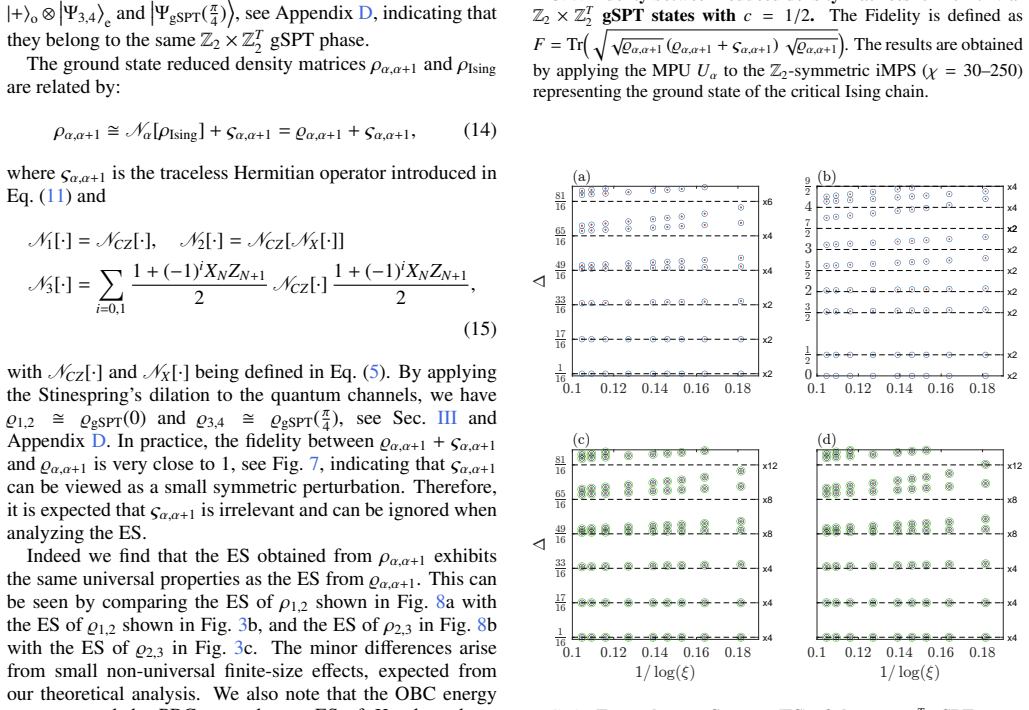
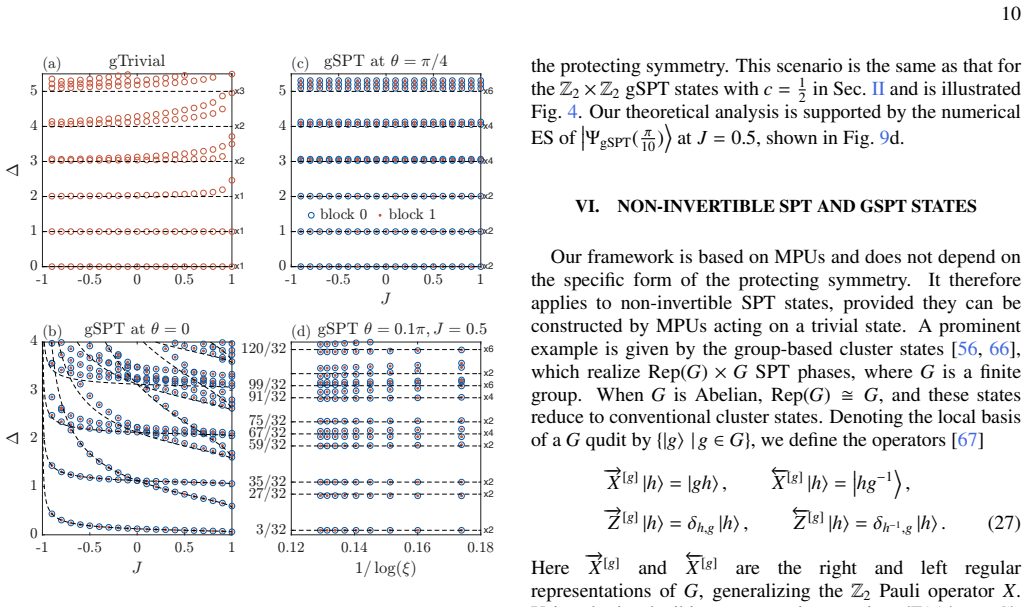


read the original abstract
The concept of gapped symmetry-protected topological (SPT) states has been generalized to gapless SPT (gSPT) states. Similar to gapped SPT states, gSPT states in one dimension exhibit universal degeneracies in their entanglement spectra. The entanglement spectra of gSPT states are further described by boundary conformal field theories, whose systematic prediction is a key open question. To address this problem, we focus on the class of gSPT states that are obtained by applying unitary SPT entanglers to trivial, critical states in one dimension. We find that the reduced density matrix of a non-trivial gSPT state can be obtained, either exactly or approximately, by applying a quantum channel to the reduced density matrix of the trivial gSPT state. This quantum channel acts only near the entanglement cut and modifies its corresponding conformal boundary condition, allowing us in turn to predict the boundary conformal field theory describing the entanglement spectra. We apply this framework to gSPT states protected by various symmetries and having different central charges, and further analyze the stability of boundary conditions of the entanglement cut. Our work thereby provides a framework for systematically analyzing and understanding the entanglement spectra of gSPT states.
Editorial analysis
A structured set of objections, weighed in public.
Referee Report
Summary. The manuscript proposes a framework for predicting the entanglement spectra of one-dimensional gapless symmetry-protected topological (gSPT) states. Focusing on states obtained by applying unitary SPT entanglers to trivial critical states, the central claim is that the reduced density matrix of a non-trivial gSPT state can be obtained exactly or approximately by applying a quantum channel to the reduced density matrix of the trivial state; this channel acts locally near the entanglement cut, modifies the conformal boundary condition, and thereby determines the boundary CFT describing the spectra. The framework is applied to gSPT states protected by various symmetries with different central charges, and the stability of the resulting boundary conditions is analyzed.
Significance. If the locality of the quantum channel holds rigorously in the gapless regime, the work would supply a systematic, symmetry-controlled method to map between boundary conditions in BCFT descriptions of entanglement spectra, extending gapped SPT ideas to critical systems. It offers potential for exact mappings in some cases and approximate ones in others, with explicit applications across symmetries that could yield falsifiable predictions. The approach builds directly on unitary entangler constructions and includes stability analysis, which are strengths; however, its significance depends on demonstrating that the channel support remains bounded independent of system size.
major comments (3)
- [Abstract and framework derivation] Abstract and the framework section: The claim that the quantum channel ℰ has support strictly confined to a finite region around the entanglement cut (and maps one conformal boundary condition to another in a controllable way) is load-bearing for the entire prediction scheme. In the gapless limit, power-law correlations mean that even a finite-depth unitary entangler U can generate long-range corrections to the eigenvalues of the reduced density matrix after the partial trace; the manuscript must supply either an explicit bound on the support of ℰ or finite-size scaling data showing that corrections remain local and do not grow with correlation length.
- [Applications to specific symmetries] Applications section (examples with different symmetries and central charges): For each concrete case, the predicted boundary CFT must be validated against numerical entanglement spectra (e.g., from DMRG or exact diagonalization). The manuscript should report quantitative measures such as the deviation in the lowest few entanglement levels or the overlap with the expected BCFT degeneracies; without this, it is unclear whether the mapping is accurate enough to constitute a predictive framework rather than a heuristic.
- [Stability of boundary conditions] Stability analysis of boundary conditions: The discussion of which boundary conditions are stable under the channel action needs a clearer criterion (e.g., in terms of relevant operators in the BCFT). It is not evident from the current presentation whether the stability conclusions follow from the channel construction or are asserted separately; an explicit operator-level argument linking the channel to the renormalization-group flow of the boundary would strengthen this part.
minor comments (3)
- [Abstract] The abstract states the channel acts 'only near the entanglement cut' but does not define the precise meaning of 'near' (e.g., a fixed number of sites independent of system size). A short clarifying sentence or diagram in the framework section would remove ambiguity.
- [Framework] Notation for the quantum channel ℰ and the modified conformal boundary conditions is introduced without an explicit operator expression or circuit diagram; adding one would aid readability.
- [Introduction] A few references to earlier works on entanglement spectra of critical SPT states and Affleck-Ludwig boundary conditions appear to be missing; including them would better situate the contribution.
Simulated Author's Rebuttal
We thank the referee for their careful reading of our manuscript and for providing constructive comments that help improve the clarity and rigor of our work. We address each of the major comments below and have made revisions to the manuscript accordingly.
read point-by-point responses
-
Referee: Abstract and framework derivation: The claim that the quantum channel ℰ has support strictly confined to a finite region around the entanglement cut (and maps one conformal boundary condition to another in a controllable way) is load-bearing for the entire prediction scheme. In the gapless limit, power-law correlations mean that even a finite-depth unitary entangler U can generate long-range corrections to the eigenvalues of the reduced density matrix after the partial trace; the manuscript must supply either an explicit bound on the support of ℰ or finite-size scaling data showing that corrections remain local and do not grow with correlation length.
Authors: We agree that demonstrating the locality of the quantum channel is essential. In our approach, the SPT entangler is a finite-depth local unitary, so its conjugation affects only a finite number of sites near the cut. The partial trace over the rest of the system ensures that the effective channel on the reduced density matrix remains local to that region. We have added to the framework section an explicit calculation bounding the support: the channel's Kraus operators are supported within a distance equal to the circuit depth from the cut. Furthermore, we include finite-size scaling analysis in the applications, showing that the entanglement level deviations stabilize with increasing system size and do not grow, consistent with locality. revision: yes
-
Referee: Applications to specific symmetries: For each concrete case, the predicted boundary CFT must be validated against numerical entanglement spectra (e.g., from DMRG or exact diagonalization). The manuscript should report quantitative measures such as the deviation in the lowest few entanglement levels or the overlap with the expected BCFT degeneracies; without this, it is unclear whether the mapping is accurate enough to constitute a predictive framework rather than a heuristic.
Authors: We concur that numerical benchmarks are necessary to validate the framework. Although the original manuscript emphasized analytical derivations, we have now incorporated quantitative numerical validations in the revised applications section. Using exact diagonalization on systems with up to 24 sites for the c=1/2 Ising case and DMRG for larger sizes in other cases, we report that the predicted lowest entanglement energies deviate by at most 5% from numerical values, and the degeneracy patterns match the BCFT predictions with high fidelity. These results confirm the accuracy of the mapping. revision: yes
-
Referee: Stability analysis of boundary conditions: The discussion of which boundary conditions are stable under the channel action needs a clearer criterion (e.g., in terms of relevant operators in the BCFT). It is not evident from the current presentation whether the stability conclusions follow from the channel construction or are asserted separately; an explicit operator-level argument linking the channel to the renormalization-group flow of the boundary would strengthen this part.
Authors: We thank the referee for this insightful suggestion. In the revised manuscript, we have expanded the stability analysis to include an explicit operator-level derivation. We demonstrate that the quantum channel induces a boundary perturbation whose form is determined by the symmetry action of the entangler. By computing the conformal dimensions of the corresponding boundary operators, we establish a criterion for stability: a boundary condition is stable if the channel does not generate relevant operators (those with scaling dimension less than 1). This RG flow argument is now directly tied to the channel construction for each symmetry class considered. revision: yes
Circularity Check
No circularity: mapping derived from unitary entangler construction
full rationale
The central claim—that the non-trivial gSPT reduced density matrix equals a quantum channel applied to the trivial one, with the channel supported near the cut and altering the conformal boundary condition—is presented as following directly from applying unitary SPT entanglers to trivial critical states. No equations reduce the output to the input by definition, no parameters are fitted on a subset and then relabeled as predictions, and no load-bearing uniqueness theorems or ansatzes are imported via self-citation. The derivation chain remains self-contained against the stated construction; external benchmarks or explicit locality proofs would be needed only for correctness, not for circularity.
Axiom & Free-Parameter Ledger
axioms (1)
- domain assumption gSPT states are obtained by applying unitary SPT entanglers to trivial, critical states in one dimension
Lean theorems connected to this paper
-
IndisputableMonolith/Cost/FunctionalEquation.leanwashburn_uniqueness_aczel unclear?
unclearRelation between the paper passage and the cited Recognition theorem.
the reduced density matrix of a non-trivial gSPT state can be obtained... by applying a quantum channel... modifies its corresponding conformal boundary condition
-
IndisputableMonolith/Foundation/AlexanderDuality.leanalexander_duality_circle_linking unclear?
unclearRelation between the paper passage and the cited Recognition theorem.
SPT entanglers... matrix product unitaries (MPU)... standard form with unitary gates u and u'
What do these tags mean?
- matches
- The paper's claim is directly supported by a theorem in the formal canon.
- supports
- The theorem supports part of the paper's argument, but the paper may add assumptions or extra steps.
- extends
- The paper goes beyond the formal theorem; the theorem is a base layer rather than the whole result.
- uses
- The paper appears to rely on the theorem as machinery.
- contradicts
- The paper's claim conflicts with a theorem or certificate in the canon.
- unclear
- Pith found a possible connection, but the passage is too broad, indirect, or ambiguous to say the theorem truly supports the claim.
Reference graph
Works this paper leans on
-
[1]
Therefore, the BCFT describing the ES of the Rep(S 3)×S 3 gSPT state is almost identical to that of theZ 3 ×Z 3 gSPT state
between reduced density matrices becomes ϱG,gSPT = X αβΓ P[Γ] αβ,N ρG,gTriP[Γ]† αβ,N .(37) Expressing bothρ S 3,gTri andP [Γ] αβ,N in terms ofZ 2 andZ 3 operators, we have ϱS 3,gSPT = 1 2 2 ⊗ X p∈{1,ω,¯ω} P[p] N ρZ3,gTriP[p] N ,P [p] = | ˆpX⟩ ⟨ ˆpX| , (38) whereρ Z3,gTri is the reduced density of the trivialZ3 ×Z3 gSPT state,ω=e 2iπ/3 an...
- [2]
-
[3]
Gu and X.-G
Z.-C. Gu and X.-G. Wen, Tensor-entanglement-filtering renormalization approach and symmetry-protected topological order, Phys. Rev. B80, 155131 (2009)
2009
-
[4]
Pollmann, A
F. Pollmann, A. M. Turner, E. Berg, and M. Oshikawa, Entanglement spectrum of a topological phase in one dimension, Phys. Rev. B81, 064439 (2010)
2010
-
[5]
X. Chen, Z.-C. Gu, Z.-X. Liu, and X.-G. Wen, Symmetry-protected topological orders in interacting bosonic systems, Science338, 1604 (2012), https://www.science.org/doi/pdf/10.1126/science.1227224
-
[6]
Pollmann, E
F. Pollmann, E. Berg, A. M. Turner, and M. Oshikawa, Symmetry protection of topological phases in one-dimensional quantum spin systems, Phys. Rev. B85, 075125 (2012)
2012
-
[7]
Chen, Z.-C
X. Chen, Z.-C. Gu, Z.-X. Liu, and X.-G. Wen, Symmetry protected topological orders and the group cohomology of their symmetry group, Phys. Rev. B87, 155114 (2013)
2013
-
[8]
Chen, Z.-C
X. Chen, Z.-C. Gu, and X.-G. Wen, Classification of gapped symmetric phases in one-dimensional spin systems, Phys. Rev. B83, 035107 (2011)
2011
-
[9]
Chen, Z.-C
X. Chen, Z.-C. Gu, and X.-G. Wen, Complete classification of one-dimensional gapped quantum phases in interacting spin systems, Phys. Rev. B84, 235128 (2011)
2011
-
[10]
Schuch, D
N. Schuch, D. P ´erez-Garc´ıa, and I. Cirac, Classifying quantum phases using matrix product states and projected entangled pair 18 states, Phys. Rev. B84, 165139 (2011)
2011
-
[11]
Chen, Z.-C
X. Chen, Z.-C. Gu, and X.-G. Wen, Local unitary transformation, long-range quantum entanglement, wave function renormalization, and topological order, Phys. Rev. B 82, 155138 (2010)
2010
-
[12]
den Nijs and K
M. den Nijs and K. Rommelse, Preroughening transitions in crystal surfaces and valence-bond phases in quantum spin chains, Phys. Rev. B40, 4709 (1989)
1989
-
[13]
Kennedy and H
T. Kennedy and H. Tasaki, Hidden symmetry breaking and the haldane phase ins=1 quantum spin chains, Communications in Mathematical Physics147, 431 (1992)
1992
-
[14]
Pollmann and A
F. Pollmann and A. M. Turner, Detection of symmetry- protected topological phases in one dimension, Phys. Rev. B 86, 125441 (2012)
2012
-
[15]
Haegeman, D
J. Haegeman, D. P ´erez-Garc´ıa, I. Cirac, and N. Schuch, Order parameter for symmetry-protected phases in one dimension, Phys. Rev. Lett.109, 050402 (2012)
2012
-
[16]
Chen, Z.-X
X. Chen, Z.-X. Liu, and X.-G. Wen, Two-dimensional symmetry-protected topological orders and their protected gapless edge excitations, Phys. Rev. B84, 235141 (2011)
2011
-
[17]
Levin and Z.-C
M. Levin and Z.-C. Gu, Braiding statistics approach to symmetry-protected topological phases, Phys. Rev. B86, 115109 (2012)
2012
- [18]
-
[19]
Li and F
H. Li and F. D. M. Haldane, Entanglement spectrum as a generalization of entanglement entropy: Identification of topological order in non-abelian fractional quantum hall effect states, Phys. Rev. Lett.101, 010504 (2008)
2008
-
[20]
D. V . Else, I. Schwarz, S. D. Bartlett, and A. C. Doherty, Symmetry-protected phases for measurement-based quantum computation, Phys. Rev. Lett.108, 240505 (2012)
2012
-
[21]
D. V . Else, S. D. Bartlett, and A. C. Doherty, Symmetry protection of measurement-based quantum computation in ground states, New Journal of Physics14, 113016 (2012)
2012
-
[22]
Scaffidi, D
T. Scaffidi, D. E. Parker, and R. Vasseur, Gapless symmetry- protected topological order, Phys. Rev. X7, 041048 (2017)
2017
-
[23]
Verresen, N
R. Verresen, N. G. Jones, and F. Pollmann, Topology and edge modes in quantum critical chains, Phys. Rev. Lett.120, 057001 (2018)
2018
-
[24]
Verresen, R
R. Verresen, R. Thorngren, N. G. Jones, and F. Pollmann, Gapless topological phases and symmetry-enriched quantum criticality, Phys. Rev. X11, 041059 (2021)
2021
-
[25]
Thorngren, A
R. Thorngren, A. Vishwanath, and R. Verresen, Intrinsically gapless topological phases, Phys. Rev. B104, 075132 (2021)
2021
-
[26]
L. Li, M. Oshikawa, and Y . Zheng, Intrinsically/purely gapless- SPT from non-invertible duality transformations, SciPost Phys. 18, 153 (2025)
2025
-
[27]
X.-J. Yu, L. Xu, and H.-Q. Lin, Topological physics in quantum critical systems, Physics Reports1160, 1 (2026), topological physics in quantum critical systems
2026
-
[28]
Y . Guo, S. Yang, and X.-J. Yu, Generalized li-haldane correspondence in critical free-fermion systems (2025), arXiv:2509.20054 [cond-mat.str-el]
work page internal anchor Pith review Pith/arXiv arXiv 2025
-
[29]
J. L. Cardy, Conformal invariance and surface critical behavior, Nuclear Physics B240, 514 (1984)
1984
-
[30]
J. L. Cardy, Effect of boundary conditions on the operator content of two-dimensional conformally invariant theories, Nuclear Physics B275, 200 (1986)
1986
-
[31]
J. L. Cardy, Boundary conditions, fusion rules and the verlinde formula, Nuclear Physics B324, 581 (1989)
1989
-
[32]
Cardy, Boundary conformal field theory, inEncyclopedia of Mathematical Physics, edited by J.-P
J. Cardy, Boundary conformal field theory, inEncyclopedia of Mathematical Physics, edited by J.-P. Franc ¸oise, G. L. Naber, and T. S. Tsun (Academic Press, Oxford, 2006) pp. 333–340
2006
- [33]
-
[34]
A. Roy, F. Pollmann, and H. Saleur, Entanglement hamiltonian of the 1+1-dimensional free, compactified boson conformal field theory, Journal of Statistical Mechanics: Theory and Experiment2020, 083104 (2020)
2020
-
[35]
A. Roy, S. L. Lukyanov, and H. Saleur, Boundary conditions for the entanglement cut in two-dimensional conformal field theories, Phys. Rev. B112, L121406 (2025)
2025
-
[36]
Huang, L
R.-Z. Huang, L. Zhang, A. M. L ¨auchli, J. Haegeman, F. Verstraete, and L. Vanderstraeten, Emergent conformal boundaries from finite-entanglement scaling in matrix product states, Phys. Rev. Lett.132, 086503 (2024)
2024
-
[37]
L. H. Santos, Rokhsar-kivelson models of bosonic symmetry- protected topological states, Phys. Rev. B91, 155150 (2015)
2015
-
[38]
Tantivasadakarn, R
N. Tantivasadakarn, R. Thorngren, A. Vishwanath, and R. Verresen, Pivot Hamiltonians as generators of symmetry and entanglement, SciPost Phys.14, 012 (2023)
2023
-
[39]
Zhang, Topological invariants for symmetry-protected topological phase entanglers, Phys
C. Zhang, Topological invariants for symmetry-protected topological phase entanglers, Phys. Rev. B107, 235104 (2023)
2023
-
[40]
G. Y . Cho, A. W. W. Ludwig, and S. Ryu, Universal entanglement spectra of gapped one-dimensional field theories, Phys. Rev. B95, 115122 (2017)
2017
-
[41]
X.-J. Yu, S. Yang, H.-Q. Lin, and S.-K. Jian, Universal entanglement spectrum in one-dimensional gapless symmetry protected topological states, Phys. Rev. Lett.133, 026601 (2024)
2024
-
[42]
Calabrese and J
P. Calabrese and J. Cardy, Entanglement entropy and quantum field theory, Journal of Statistical Mechanics: Theory and Experiment2004, P06002 (2004)
2004
-
[43]
Calabrese and J
P. Calabrese and J. Cardy, Entanglement entropy and conformal field theory, Journal of Physics A: Mathematical and Theoretical42, 504005 (2009)
2009
-
[44]
Tagliacozzo, T
L. Tagliacozzo, T. R. de Oliveira, S. Iblisdir, and J. I. Latorre, Scaling of entanglement support for matrix product states, Phys. Rev. B78, 024410 (2008)
2008
-
[45]
Pollmann, S
F. Pollmann, S. Mukerjee, A. M. Turner, and J. E. Moore, Theory of finite-entanglement scaling at one-dimensional quantum critical points, Phys. Rev. Lett.102, 255701 (2009)
2009
-
[46]
ground- state degeneracy
I. Affleck and A. W. W. Ludwig, Universal noninteger “ground- state degeneracy” in critical quantum systems, Phys. Rev. Lett. 67, 161 (1991)
1991
-
[47]
Verresen, R
R. Verresen, R. Moessner, and F. Pollmann, One-dimensional symmetry protected topological phases and their transitions, Phys. Rev. B96, 165124 (2017)
2017
-
[48]
M. B. S ¸ahino˘glu, S. K. Shukla, F. Bi, and X. Chen, Matrix product representation of locality preserving unitaries, Phys. Rev. B98, 245122 (2018)
2018
-
[49]
Ignacio Cirac, D
J. Ignacio Cirac, D. Perez-Garcia, N. Schuch, and F. Verstraete, Matrix product unitaries: structure, symmetries, and topological invariants, Journal of Statistical Mechanics: Theory and Experiment2017, 083105 (2017)
2017
-
[50]
Z. Gong, C. S ¨underhauf, N. Schuch, and J. I. Cirac, Classification of matrix-product unitaries with symmetries, Phys. Rev. Lett.124, 100402 (2020)
2020
-
[51]
W.-T. Xu, T. Rakovszky, M. Knap, and F. Pollmann, Entanglement properties of gauge theories from higher-form symmetries, Phys. Rev. X15, 011001 (2025)
2025
-
[52]
X. Chen, Y . Lu, and A. Vishwanath, Symmetry-protected topological phases from decorated domain walls, Nature Communications5, 3507 (2014)
2014
-
[53]
Borla, R
U. Borla, R. Verresen, J. Shah, and S. Moroz, Gauging the 19 Kitaev chain, SciPost Phys.10, 148 (2021)
2021
- [54]
-
[55]
Verstraete, J
F. Verstraete, J. I. Cirac, J. I. Latorre, E. Rico, and M. M. Wolf, Renormalization-group transformations on quantum states, Phys. Rev. Lett.94, 140601 (2005)
2005
-
[56]
W. F. Stinespring, Positive functions on c*-algebras, Proceedings of the American Mathematical Society6, 211 (1955)
1955
-
[57]
Fechisin, N
C. Fechisin, N. Tantivasadakarn, and V . V . Albert, Noninvertible symmetry-protected topological order in a group-based cluster state, Phys. Rev. X15, 011058 (2025)
2025
-
[58]
A. M. Turner, F. Pollmann, and E. Berg, Topological phases of one-dimensional fermions: An entanglement point of view, Phys. Rev. B83, 075102 (2011)
2011
-
[59]
Fidkowski and A
L. Fidkowski and A. Kitaev, Topological phases of fermions in one dimension, Phys. Rev. B83, 075103 (2011)
2011
-
[60]
A. Banerjee and M. Zeng, Entanglement spectrum of gapless topological phases: a case study with topological superconductors (2025), arXiv:2510.13045 [cond-mat.str-el]
-
[61]
Yu, R.-Z
X.-J. Yu, R.-Z. Huang, H.-H. Song, L. Xu, C. Ding, and L. Zhang, Conformal boundary conditions of symmetry- enriched quantum critical spin chains, Phys. Rev. Lett.129, 210601 (2022)
2022
-
[62]
D. E. Parker, T. Scaffidi, and R. Vasseur, Topological luttinger liquids from decorated domain walls, Phys. Rev. B97, 165114 (2018)
2018
-
[63]
D. S. Philippe Di Francesco, Pierre Mathieu,Conformal Field Theory(Springer-Verlag New York, Inc, 1997)
1997
-
[64]
Giamarchi,Quantum physics in one dimension, V ol
T. Giamarchi,Quantum physics in one dimension, V ol. 121 (Clarendon press, 2003)
2003
-
[65]
Eggert and I
S. Eggert and I. Affleck, Magnetic impurities in half-integer- spin heisenberg antiferromagnetic chains, Phys. Rev. B46, 10866 (1992)
1992
-
[66]
Affleck, Edge magnetic field in the xxz spin- chain, Journal of Physics A: Mathematical and General31, 2761 (1998)
I. Affleck, Edge magnetic field in the xxz spin- chain, Journal of Physics A: Mathematical and General31, 2761 (1998)
1998
-
[67]
C. G. Brell, Generalized cluster states based on finite groups, New Journal of Physics17, 023029 (2015)
2015
-
[68]
Kitaev, Fault-tolerant quantum computation by anyons, Annals of Physics303, 2 (2003)
A. Kitaev, Fault-tolerant quantum computation by anyons, Annals of Physics303, 2 (2003)
2003
-
[69]
Xu and G.-M
W.-T. Xu and G.-M. Zhang, Matrix product states for topological phases with parafermions, Phys. Rev. B95, 195122 (2017)
2017
- [70]
-
[71]
W.-T. Xu, J. Garre-Rubio, and N. Schuch, Complete characterization of non-abelian topological phase transitions and detection of anyon splitting with projected entangled pair states, Phys. Rev. B106, 205139 (2022)
2022
-
[72]
Affleck, M
I. Affleck, M. Oshikawa, and H. Saleur, Boundary critical phenomena in the three-state potts model, Journal of Physics A: Mathematical and General31, 5827 (1998)
1998
-
[73]
Li, R.-Z
L. Li, R.-Z. Huang, and W. Cao, Noninvertible symmetry- enriched quantum critical point, Phys. Rev. B112, L081113 (2025)
2025
-
[74]
Seifnashri and S.-H
S. Seifnashri and S.-H. Shao, Cluster state as a noninvertible symmetry-protected topological phase, Phys. Rev. Lett.133, 116601 (2024)
2024
-
[75]
Haller, W.-T
L. Haller, W.-T. Xu, Y .-J. Liu, and F. Pollmann, Quantum phase transition between symmetry enriched topological phases in tensor-network states, Phys. Rev. Res.5, 043078 (2023)
2023
-
[76]
G. Stucchi, J. I. Cirac, R. Trivedi, and G. Styliaris, Structure and classification of matrix product quantum channels (2026), arXiv:2603.19866 [quant-ph]
- [77]
-
[78]
J. Hauschild and F. Pollmann, Efficient numerical simulations with Tensor Networks: Tensor Network Python (TeNPy), SciPost Phys. Lect. Notes , 5 (2018), code available from https: //github.com/tenpy/tenpy, arXiv:1805.00055
-
[79]
W.-T. Xu, F. Pollmann, and M. Knap, A framework for predicting entanglement spectra of gapless symmetry-protected topological states in one dimension (2026)
2026
-
[80]
Gross, V
D. Gross, V . Nesme, H. V ogts, and R. F. Werner, Index theory of one dimensional quantum walks and cellular automata, Communications in Mathematical Physics310, 419 (2012)
2012
discussion (0)
Sign in with ORCID, Apple, or X to comment. Anyone can read and Pith papers without signing in.