Recognition: unknown
Long-Horizon Plan Execution in Large Tool Spaces through Entropy-Guided Branching
Pith reviewed 2026-05-10 15:13 UTC · model grok-4.3
The pith
Entropy-guided branching improves LLM agent success rates and efficiency when executing long plans over large tool libraries.
A machine-rendered reading of the paper's core claim, the machinery that carries it, and where it could break.
Core claim
The paper claims that dynamically expanding search branches only where the LLM's predictive entropy is high allows agents to optimize the exploration-exploitation trade-off, producing higher success rates and lower computational costs on long-horizon tasks than standard search baselines, as measured on the new SLATE benchmark of large-scale API tool use.
What carries the argument
Entropy-Guided Branching (EGB), an uncertainty-aware search algorithm that dynamically expands decision branches at steps where predictive entropy is high to manage exploration versus exploitation in tool selection.
If this is right
- Agents complete more multi-step tool-use tasks on SLATE by recovering from early poor choices.
- Total computation drops because branching occurs only at uncertain steps instead of uniformly.
- SLATE reveals that existing agents lack robust self-correction in long sequences.
- The dual release of benchmark and algorithm offers a concrete testbed for scaling agents to large tool libraries.
- Performance gains hold across diverse but functionally valid execution trajectories in the benchmark.
Where Pith is reading between the lines
- The entropy signal could be tested in non-LLM planners or hybrid systems that face similar sequential tool decisions.
- If the correlation between entropy and useful branching generalizes, the method might reduce reliance on hand-tuned search heuristics in other agent domains.
- Evaluating EGB on live production APIs rather than synthetic tasks would show whether benchmark gains survive real latency and error patterns.
Load-bearing premise
High predictive entropy from the language model reliably marks the decision points where extra branching will improve final plan outcomes rather than simply adding noise.
What would settle it
Applying EGB to SLATE tasks and observing no gain in success rate together with no reduction in average tool calls or runtime compared with fixed beam search or greedy decoding would disprove the claimed improvements.
Figures







read the original abstract
Large Language Models (LLMs) have significantly advanced tool-augmented agents, enabling autonomous reasoning via API interactions. However, executing multi-step tasks within massive tool libraries remains challenging due to two critical bottlenecks: (1) the absence of rigorous, plan-level evaluation frameworks and (2) the computational demand of exploring vast decision spaces stemming from large toolsets and long-horizon planning. To bridge these gaps, we first introduce SLATE (Synthetic Large-scale API Toolkit for E-commerce), a large-scale context-aware benchmark designed for the automated assessment of tool-integrated agents. Unlike static metrics, SLATE accommodates diverse yet functionally valid execution trajectories, revealing that current agents struggle with self-correction and search efficiency. Motivated by these findings, we next propose Entropy-Guided Branching (EGB), an uncertainty-aware search algorithm that dynamically expands decision branches where predictive entropy is high. EGB optimizes the exploration-exploitation trade-off, significantly enhancing both task success rates and computational efficiency. Extensive experiments on SLATE demonstrate that our dual contribution provides a robust foundation for developing reliable and scalable LLM agents in tool-rich environments.
Editorial analysis
A structured set of objections, weighed in public.
Referee Report
Summary. The paper introduces SLATE, a synthetic large-scale benchmark for tool-augmented LLM agents focused on e-commerce API interactions, and proposes Entropy-Guided Branching (EGB), an uncertainty-aware search algorithm that dynamically expands branches at high predictive-entropy decision points to improve long-horizon plan execution in large tool spaces. It claims EGB yields higher task success rates and better computational efficiency than baselines by optimizing the exploration-exploitation tradeoff, with supporting experiments on SLATE.
Significance. If the central claims hold after addressing validation gaps, the work offers a concrete benchmark and a lightweight mechanism for scaling LLM agents to large, realistic tool libraries without exhaustive enumeration. The entropy-guided approach is a natural fit for uncertainty in sequential decision-making and could influence planning modules in agent frameworks.
major comments (2)
- [§3] §3 (EGB algorithm): The claim that high predictive entropy reliably identifies points where additional branching produces net gains in success rate and efficiency is load-bearing for the central contribution, yet the manuscript provides no controlled ablation that holds total search budget fixed while comparing entropy-guided branching against uniform or random branching. Without this, the optimization of the exploration-exploitation tradeoff cannot be distinguished from a simple correlation between entropy and task difficulty.
- [§4] §4 (Experiments on SLATE): The reported improvements lack error bars, statistical significance tests, and ablations that vary branching budget independently of the entropy threshold; the synthetic nature of SLATE further requires explicit evidence that its entropy distributions and failure modes match those of real large-scale tool APIs, otherwise generalization claims remain unsupported.
minor comments (2)
- [Abstract] Abstract: replace the qualitative phrase 'significantly enhancing' with the actual quantitative deltas and baseline comparisons from the experiments section.
- [§3] Notation: define 'predictive entropy' explicitly (e.g., whether it is token-level, action-level, or trajectory-level) at first use in the method section.
Simulated Author's Rebuttal
We thank the referee for their detailed and constructive comments. We believe the suggested revisions will strengthen the paper and address the concerns regarding the validation of our claims. Below we respond point-by-point to the major comments.
read point-by-point responses
-
Referee: [§3] §3 (EGB algorithm): The claim that high predictive entropy reliably identifies points where additional branching produces net gains in success rate and efficiency is load-bearing for the central contribution, yet the manuscript provides no controlled ablation that holds total search budget fixed while comparing entropy-guided branching against uniform or random branching. Without this, the optimization of the exploration-exploitation tradeoff cannot be distinguished from a simple correlation between entropy and task difficulty.
Authors: We agree that a controlled ablation with a fixed total search budget is necessary to rigorously demonstrate the benefits of entropy-guided branching over simpler strategies. In the revised manuscript, we will add an ablation study that compares EGB to uniform branching and random branching while keeping the total number of LLM calls or search budget constant across methods. This will help isolate the effect of the entropy threshold in optimizing the exploration-exploitation tradeoff and rule out mere correlation with task difficulty. revision: yes
-
Referee: [§4] §4 (Experiments on SLATE): The reported improvements lack error bars, statistical significance tests, and ablations that vary branching budget independently of the entropy threshold; the synthetic nature of SLATE further requires explicit evidence that its entropy distributions and failure modes match those of real large-scale tool APIs, otherwise generalization claims remain unsupported.
Authors: We acknowledge these gaps in the experimental reporting. We will include error bars (standard deviations over multiple runs) and perform statistical significance tests (e.g., paired t-tests) for the reported improvements in the revised version. Additionally, we will conduct and report ablations where the branching budget is varied independently of the entropy threshold to further validate the design choices. For the synthetic SLATE benchmark, we will add a section providing comparative analysis of entropy distributions and common failure modes against real-world e-commerce API interactions, drawing from publicly available API logs or similar datasets where possible to support the generalization claims. revision: yes
Circularity Check
No circularity: empirical algorithm with standard entropy heuristic, no derivations or self-referential reductions
full rationale
The paper presents SLATE as a new benchmark and EGB as an algorithm that applies predictive entropy to decide where to branch during search. No equations, derivations, or parameter-fitting steps are described that would reduce a claimed prediction or result back to its own inputs by construction. Claims rest on experimental outcomes rather than any uniqueness theorem, ansatz smuggled via self-citation, or renaming of known patterns. The central idea is a heuristic search strategy whose performance is evaluated externally on the introduced tasks; this structure contains no load-bearing self-definition or fitted-input-as-prediction.
Axiom & Free-Parameter Ledger
Reference graph
Works this paper leans on
-
[1]
Emergent autonomous scientific research ca- pabilities of large language models.arXiv preprint arXiv:2304.05332. Chen Chen, Xinlong Hao, Weiwen Liu, Xu Huang, Xingshan Zeng, Shuai Yu, Dexun Li, Shuai Wang, Weinan Gan, Yuefeng Huang, Wulong Liu, Xinzhi Wang, Defu Lian, Baoqun Yin, Yasheng Wang, and Wu Liu. 2025. Acebench: Who wins the match point in tool u...
-
[2]
Llm-first search: Self-guided exploration of the solution space.arXiv preprint arXiv:2506.05213. Sirui Hong, Xiawu Zheng, Jonathan Chen, Yuheng Cheng, Jinlin Wang, Ceyao Zhang, Zili Wang, Steven Ka Shing Yau, Zijuan Lin, Liyang Zhou, and 1 others. 2023. Metagpt: Meta programming for multi-agent collaborative framework.arXiv preprint arXiv:2308.00352, 3(4)...
-
[3]
Use file writing 17 tool to create and write content
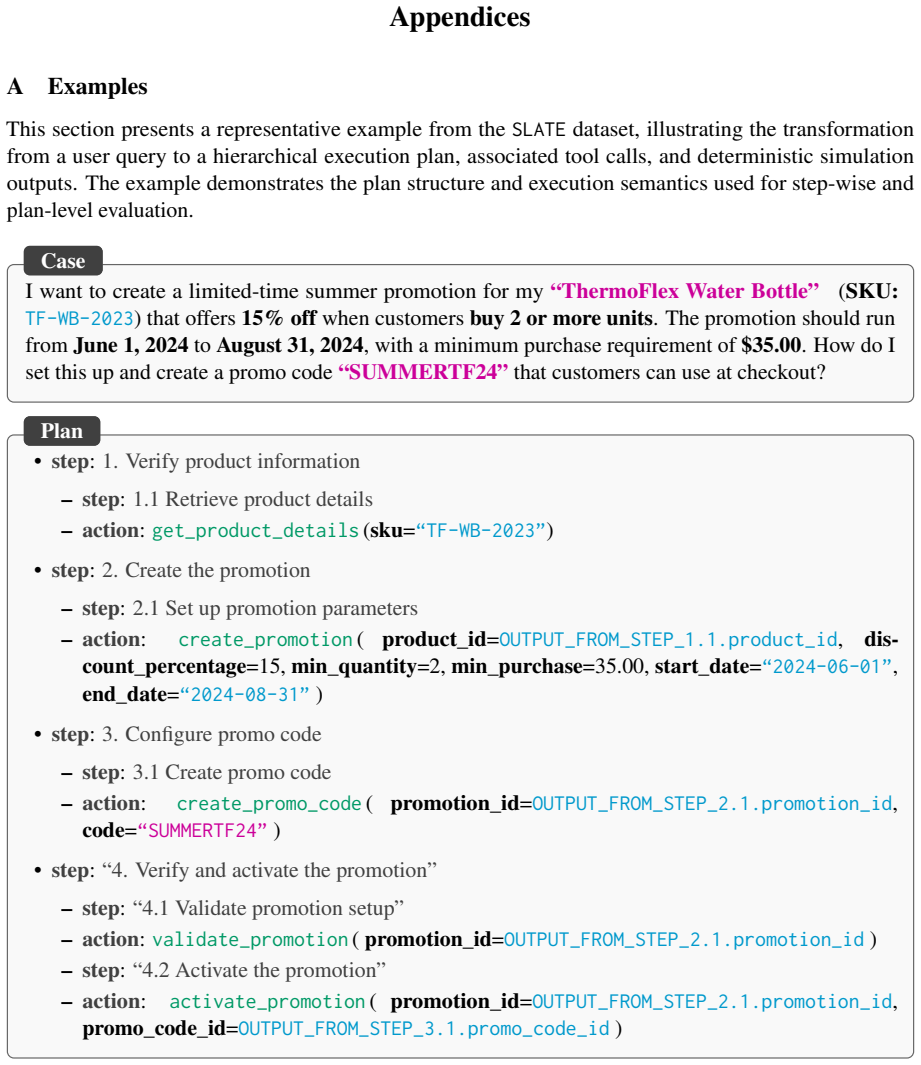
create_promotion (Args: product_id, discount_percentage, min_quantity, min_purchase, start_date, end_date) P-TF-WB-2023-001, 15, 2, 35, 2024-06-01, 2024-08-31⇒PROMO-TF-2024-S001 Other value⇒different default value 3.create_promo_code(Args: promotion_id, code) PROMO-TF-2024-S001, SUMMERTF24⇒PC-SUMMERTF24-001 Other value⇒different default value Figure 8: De...
2023
-
[4]
Sunset Yoga Mat (SKU: YM-2023-BL)
Include SPECIFIC DETAILS that can be used as direct arguments in tools: • Product names and identifiers (e.g., “Sunset Yoga Mat (SKU: YM-2023-BL)”) • Order numbers (e.g., “Order #AB-12345678”) • FULL DATES WITH YEARS (e.g., “January 15, 2023” not just “January 15”) • Prices with currency (e.g., “$49.99”) • Specific quantities (e.g., “3 units”)
2023
-
[5]
Include MULTIPLE DATA POINTS for tools to extract as parameters
-
[6]
I need to track my order #RT-78256391 for the Samsung Galaxy Buds that I ordered on May 3, 2023. When will it be delivered?
For COMPLEX and ADV ANCED queries, include: • Multiple constraints or conditions • Timing requirements or deadlines • Preferences with priorities • Historical context or previous actions • Special exceptions or unusual circumstances Examples of queries at different complexity levels: SIMPLE: “I need to track my order #RT-78256391 for the Samsung Galaxy Bu...
2023
-
[7]
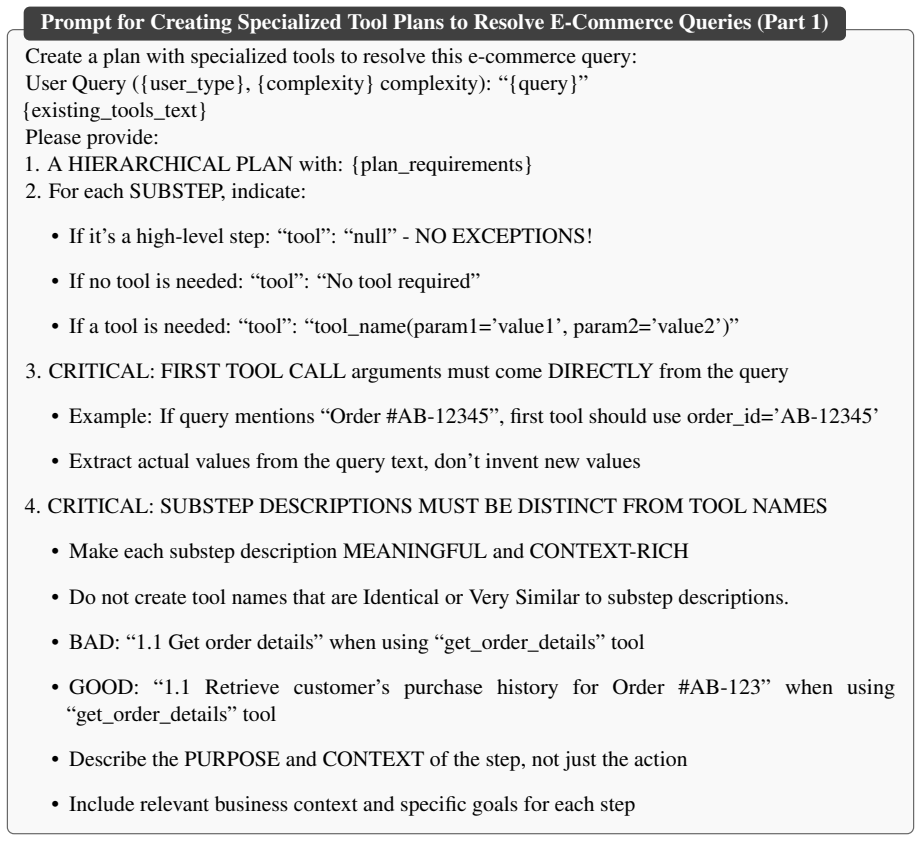
A HIERARCHICAL PLAN with: {plan_requirements}
-
[8]
tool”: “null
For each SUBSTEP, indicate: • If it’s a high-level step: “tool”: “null” - NO EXCEPTIONS! • If no tool is needed: “tool”: “No tool required” • If a tool is needed: “tool”: “tool_name(param1=’value1’, param2=’value2’)”
-
[9]
Order #AB-12345
CRITICAL: FIRST TOOL CALL arguments must come DIRECTLY from the query • Example: If query mentions “Order #AB-12345”, first tool should use order_id=’AB-12345’ • Extract actual values from the query text, don’t invent new values
-
[10]
1.1 Get order details
CRITICAL: SUBSTEP DESCRIPTIONS MUST BE DISTINCT FROM TOOL NAMES • Make each substep description MEANINGFUL and CONTEXT-RICH • Do not create tool names that are Identical or Very Similar to substep descriptions. • BAD: “1.1 Get order details” when using “get_order_details” tool • GOOD: “1.1 Retrieve customer’s purchase history for Order #AB-123” when using...
-
[11]
do everything
TOOL SELECTION AND DESIGN: • TRY REUSE EXISTING TOOLS whenever appropriate (from the list above) • If none of the existing tools are suitable, design NEW SPECIALIZED TOOLS that: –Have SPECIFIC, FOCUSED functionality (not general-purpose) –Use SIMPLE arguments (2-3 parameters maximum) –Return SIMPLE, FOCUSED results (1-3 fields maximum) –Follow snake_case ...
-
[12]
2.1 xxx tool_A; 2.2 xxx tool_A
CRITICAL - A VOID TOOL REPETITION: • DO NOT use the same tool in consecutive substeps (e.g., avoid “2.1 xxx tool_A; 2.2 xxx tool_A”) • If you need to call the same tool multiple times, space them out with other operations • Each substep should ideally use a DIFFERENT tool to create diversity • Create specialized tools for different aspects rather than reu...
-
[13]
IMPORTANT - SEQUENTIAL DEPENDENCIES: • Later steps should use results from previous steps for sequential dependencies • Use the format OUTPUT_FROM_STEP_X.Y .field to reference previous outputs • Example: product_id=OUTPUT_FROM_STEP_1.2.product_id • Create a CHAIN of dependencies where each step builds on previous results • Ensure that tool outputs from ea...
-
[14]
FINAL STEP should produce a DIRECT RESULT that resolves the query • The last tool should return a clear outcome or answer • For example: confirmation message, success status, or direct result • FINAL STEPS should utilize outputs from earlier steps
-
[15]
Focus on tool selection, reuse strategy, avoiding repetition, and establishing sequential dependencies between steps
FOR {complexity} COMPLEXITY: • {self._get_plan_complexity_guidelines(complexity)} Figure 11: Prompt for creating specialized tool plans (Part 2). Focus on tool selection, reuse strategy, avoiding repetition, and establishing sequential dependencies between steps. 26 Prompt for Creating Specialized Tool Plans to Resolve E-Commerce Queries (Part 3)
-
[16]
process_request
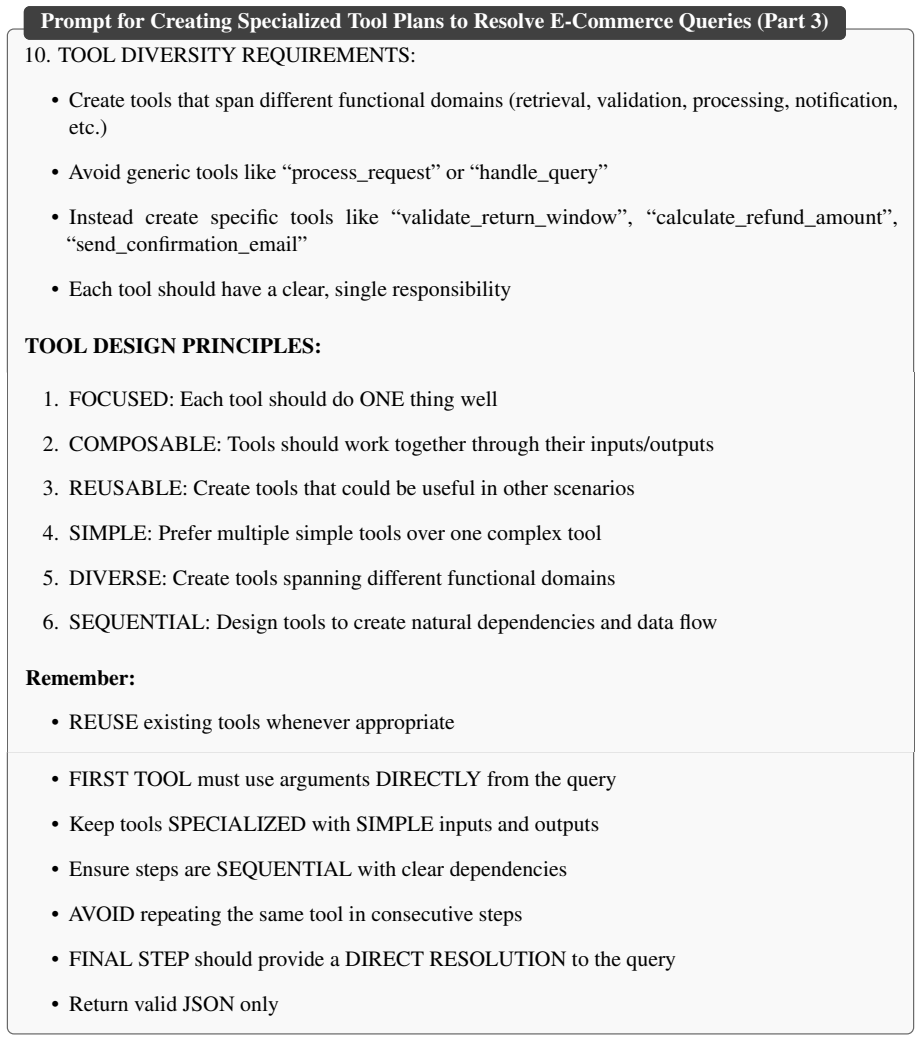
TOOL DIVERSITY REQUIREMENTS: • Create tools that span different functional domains (retrieval, validation, processing, notification, etc.) • Avoid generic tools like “process_request” or “handle_query” • Instead create specific tools like “validate_return_window”, “calculate_refund_amount”, “send_confirmation_email” • Each tool should have a clear, single...
-
[17]
FOCUSED: Each tool should do ONE thing well
-
[18]
COMPOSABLE: Tools should work together through their inputs/outputs
-
[19]
REUSABLE: Create tools that could be useful in other scenarios
-
[20]
SIMPLE: Prefer multiple simple tools over one complex tool
-
[21]
DIVERSE: Create tools spanning different functional domains
-
[22]
plan” array (high-level steps with “tool
SEQUENTIAL: Design tools to create natural dependencies and data flow Remember: • REUSE existing tools whenever appropriate • FIRST TOOL must use arguments DIRECTLY from the query • Keep tools SPECIALIZED with SIMPLE inputs and outputs • Ensure steps are SEQUENTIAL with clear dependencies • A VOID repeating the same tool in consecutive steps • FINAL STEP ...
-
[23]
Each tool name MUST be UNIQUE and use snake_case format
-
[24]
NEVER use any of these existing names: {names_str}
-
[25]
Create DISTINCTIVE names that avoid generic patterns
-
[26]
Consider these name patterns for inspiration: {name_pattern_text}
-
[27]
Each tool name should reflect its SPECIFIC FUNCTION and DOMAIN
-
[28]
VERIFY that each name is different from all others in your response TOOL ASSIGNMENTS- Create exactly one tool for EACH of these specific domains: {do- mains_text} SAMPLE TOOL STRUCTURE:{json.dumps(sample_tool, indent=2)} TOOL REQUIREMENTS:
-
[29]
Match each tool precisely to its assigned domain above
-
[30]
Include 1-3 SIMPLE arguments with clear purposes
-
[31]
Return 1-3 FOCUSED result fields
-
[32]
query_id
Include “query_id”: “dummy” in each tool
-
[33]
] ONLY return the JSON array with no additional text
Follow the exact JSON structure of the sample Return a JSON array containing {batch_size} tools with UNIQUE names: [ {tool1}, {tool2}, ... ] ONLY return the JSON array with no additional text. Figure 13: Prompt for generating diverse e-commerce tools with unique names.Example Variable Values: batch_size is configurable (typically 10 or 20, default 10). na...
-
[34]
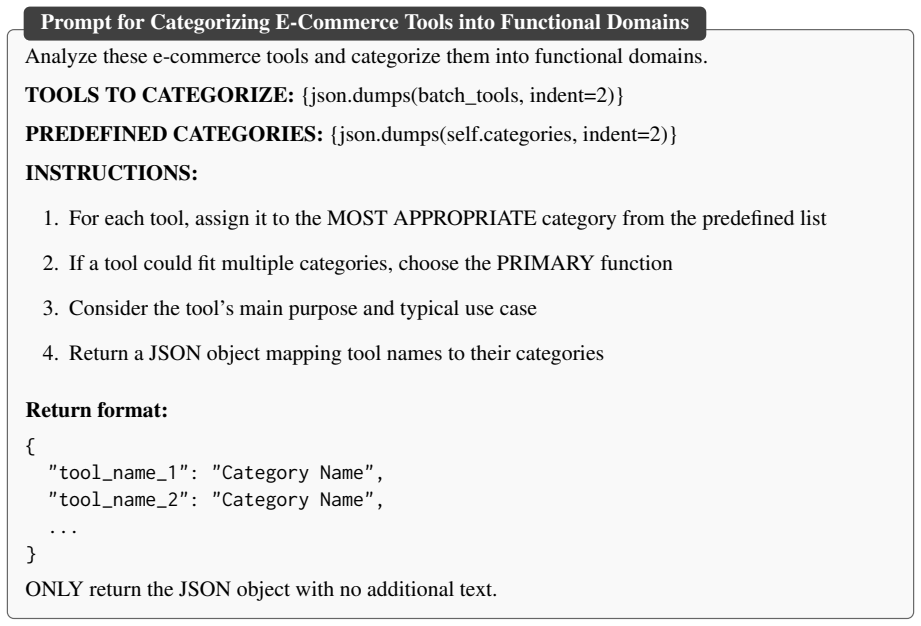
For each tool, assign it to the MOST APPROPRIATE category from the predefined list
-
[35]
If a tool could fit multiple categories, choose the PRIMARY function
-
[36]
Consider the tool’s main purpose and typical use case
-
[37]
tool_name_1
Return a JSON object mapping tool names to their categories Return format: { "tool_name_1": "Category Name", "tool_name_2": "Category Name", ... } ONLY return the JSON object with no additional text. Figure 14: Prompt for categorizing e-commerce tools into functional domains.Example Variable Values: batch_tools is a batch of 10-20 tools to categorize, eac...
-
[38]
Generate SPECIFIC, REALISTIC values consistent with the original query
-
[39]
Maintain CONSISTENCY with previous tool outputs
-
[40]
Include ALL required properties in the tool’s result schema
-
[41]
Values should match their expected data types
-
[42]
This is the FINAL TOOL in the plan. Make sure the output provides a DIRECT RESULT that clearly resolves the user’s request (e.g., confirmation, status, or answer)
{“This is the FINAL TOOL in the plan. Make sure the output provides a DIRECT RESULT that clearly resolves the user’s request (e.g., confirmation, status, or answer)” if is_final_step else “Keep output focused and relevant to the step”} RETURN ONLY THE JSON OUTPUT OBJECT. Figure 15: Prompt for generating tool simulation outputs.Example Variable Values: con...
discussion (0)
Sign in with ORCID, Apple, or X to comment. Anyone can read and Pith papers without signing in.