A Heterogeneous Dual-Network Framework for Emergency Delivery UAVs: Communication Assurance and Path Planning Coordination
Pith reviewed 2026-05-15 07:13 UTC · model grok-4.3
The pith
A dual UAV network pairs hovering base stations with delivery drones to maintain continuous 3D command-and-control coverage in disaster zones.
A machine-rendered reading of the paper's core claim, the machinery that carries it, and where it could break.
Core claim
By tightly coupling an Emergency Communication Support Network of hovering UAV base stations that safeguard mission-critical corridors with a Delivery Path Network of fast-moving delivery UAVs whose trajectories align to reliable coverage regions, the HDNF maximizes end-to-end C2 reliability through a joint optimization solved by a multi-layer 3D C2 service model, 3D coverage-aware multi-agent reinforcement learning for deployment, and a 3D communication-aware A* planner for paths, as shown in simulations that eliminate critical-phase outages and sustain high task success rates at lower hardware cost.
What carries the argument
The Heterogeneous Dual-Network Framework (HDNF) that couples the Emergency Communication Support Network (ECSN) of hovering UAV-BSs with the Delivery Path Network (DPN) of moving UAVs through joint optimization of task assignment, 3D deployment, and path planning.
If this is right
- The joint optimization eliminates C2 outages during critical flight phases.
- Task success rates remain high while UAV flight energy consumption decreases.
- Base-station deployment costs drop through efficient 3D placement aligned to mission phases.
- The multi-agent RL component improves topology resilience in high-dimensional spaces.
Where Pith is reading between the lines
- The same coordination principle could apply to other multi-UAV tasks such as search-and-rescue where coverage must track moving agents.
- Hybrid extensions might add ground relays or energy harvesting to further lower costs in prolonged operations.
- The layered strategy points toward scalable designs for larger fleets where centralized planning becomes intractable.
- Real deployments would benefit from online adaptation modules to handle sudden changes in wind or interference beyond static simulations.
Load-bearing premise
The simulation environment and channel models accurately capture the unpredictable interference, wind, and terrain effects present in real post-disaster settings.
What would settle it
A field experiment deploying the HDNF in a controlled disaster-like area and directly measuring real C2 link outage durations and task completion rates against the reported simulation predictions.
Figures




read the original abstract
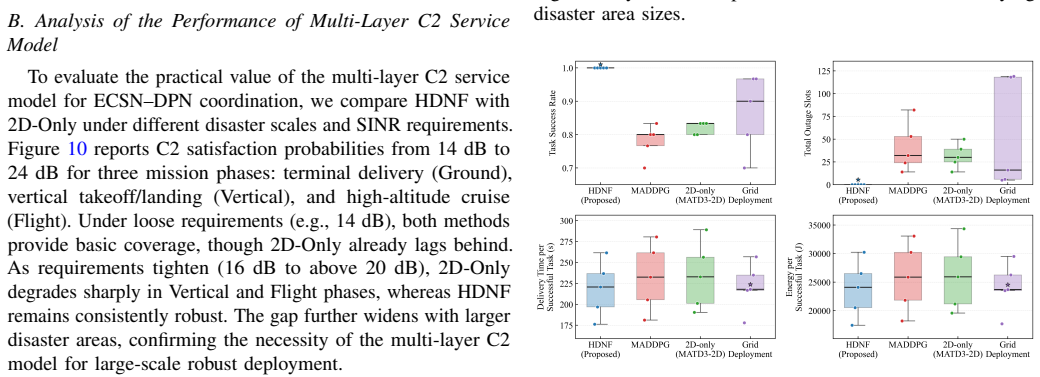
Natural disasters often damage ground infrastructure, making unmanned aerial vehicles (UAVs) essential for emergency supply delivery. Yet safe operation in complex post-disaster environments requires reliable command-and-control (C2) links; link instability can cause loss of control, delay rescue, and trigger severe secondary harm. To provide continuous three-dimensional (3D) C2 coverage during dynamic missions, we propose a Heterogeneous Dual-Network Framework (HDNF) for safe and reliable emergency delivery. HDNF tightly couples an Emergency Communication Support Network (ECSN), formed by hovering UAV base stations, with a Delivery Path Network (DPN), formed by fast-moving delivery UAVs. The ECSN dynamically safeguards mission-critical flight corridors, while the DPN aligns trajectories with reliable coverage regions. We formulate a joint optimization problem over task assignment, 3D UAV-BS deployment, and DPN path planning to maximize end-to-end C2 reliability while minimizing UAV flight energy consumption and base-station deployment cost. To solve this computationally intractable NP-hard problem, we develop a layered strategy with three components: (i) a multi-layer C2 service model that overcomes 2D-metric limitations and aligns UAV-BS deployment with mission-critical 3D phases; (ii) a 3D coverage-aware multi-agent reinforcement learning algorithm that addresses the high-dimensional search space and improves both training efficiency and topology resilience; and (iii) a 3D communication-aware A* planner that jointly optimizes C2 quality and flight energy, mitigating trajectory--coverage mismatch and improving routing safety. Extensive simulations show that HDNF markedly improves C2 reliability, eliminates outages in critical phases, and sustains high task success rates while reducing hardware deployment cost.
Editorial analysis
A structured set of objections, weighed in public.
Referee Report
Summary. The paper proposes a Heterogeneous Dual-Network Framework (HDNF) that couples an Emergency Communication Support Network (ECSN) of hovering UAV base stations with a Delivery Path Network (DPN) of fast-moving delivery UAVs for post-disaster supply delivery. It formulates a joint NP-hard optimization over task assignment, 3D UAV-BS deployment, and path planning to maximize end-to-end C2 reliability while minimizing flight energy and deployment cost. The problem is addressed via a layered heuristic consisting of a multi-layer C2 service model, a 3D coverage-aware multi-agent reinforcement learning algorithm, and a 3D communication-aware A* planner. Extensive simulations are claimed to show marked gains in C2 reliability, elimination of critical-phase outages, high task success rates, and reduced hardware cost.
Significance. If the simulation results prove robust, the work offers a practical integrated approach to communication assurance and trajectory planning for UAVs in disaster response, where reliable 3D C2 coverage is essential. The layered decomposition of the joint problem and the use of coverage-aware MARL plus communication-aware A* planning represent constructive engineering contributions that could inform future UAV network designs.
major comments (2)
- [§V] §V (Simulation Results): The central performance claims of eliminating critical-phase outages and sustaining high task success rates rest on simulation outputs that provide no quantitative baselines, error bars, or ablation studies comparing the full HDNF against its constituent components (multi-layer C2 model, MARL, A* planner) or against standard 2D-coverage or non-joint baselines. This absence prevents assessment of whether the reported gains are attributable to the framework or to favorable simulation parameterization.
- [§II and §V] §II (System and Channel Model) and §V: The 3D coverage metric and outage-elimination claims presuppose that the propagation, fading, and interference models remain stationary and accurately parameterized. No sensitivity analysis to non-stationary post-disaster effects (terrain occlusion, wind gusts, bursty interference) is reported, which directly undermines the claim that the framework eliminates outages under realistic conditions.
minor comments (2)
- [Abstract and §I] The abstract and §I introduce ECSN and DPN without consistently expanding the acronyms on first use in every subsection, which reduces readability for readers outside the immediate subfield.
- [§V] Figure captions in the simulation section could more explicitly state the parameter settings (e.g., UAV altitudes, carrier frequency, wind variance) used to generate the plotted reliability curves.
Simulated Author's Rebuttal
We thank the referee for the constructive and detailed comments on our manuscript. We address each major comment point by point below, providing honest responses based on the current work and indicating revisions where the manuscript will be strengthened.
read point-by-point responses
-
Referee: [§V] §V (Simulation Results): The central performance claims of eliminating critical-phase outages and sustaining high task success rates rest on simulation outputs that provide no quantitative baselines, error bars, or ablation studies comparing the full HDNF against its constituent components (multi-layer C2 model, MARL, A* planner) or against standard 2D-coverage or non-joint baselines. This absence prevents assessment of whether the reported gains are attributable to the framework or to favorable simulation parameterization.
Authors: We agree that the original simulations did not include explicit quantitative baselines, error bars, or ablation studies, which limits the ability to isolate the contributions of the joint framework. In the revised manuscript, we have added a new set of comparative results in Section V. These include: (i) direct comparisons against standard 2D-coverage optimization and non-joint sequential planning baselines; (ii) ablations removing individual components (multi-layer C2 model, coverage-aware MARL, and communication-aware A*); and (iii) error bars showing mean and standard deviation over 100 independent Monte Carlo runs, along with t-test p-values confirming statistical significance of the reported gains in C2 reliability and task success rate. These additions demonstrate that the performance improvements are attributable to the coupled HDNF rather than parameterization alone. revision: yes
-
Referee: [§II and §V] §II (System and Channel Model) and §V: The 3D coverage metric and outage-elimination claims presuppose that the propagation, fading, and interference models remain stationary and accurately parameterized. No sensitivity analysis to non-stationary post-disaster effects (terrain occlusion, wind gusts, bursty interference) is reported, which directly undermines the claim that the framework eliminates outages under realistic conditions.
Authors: We acknowledge that the original evaluation assumed stationary channel models and did not include sensitivity analysis for non-stationary effects, which is a valid limitation for claiming robustness in realistic post-disaster settings. In the revised version, we have added a dedicated sensitivity analysis subsection in §V. This incorporates: terrain occlusion via additional log-normal shadowing with random obstacle heights; wind gusts modeled as zero-mean Gaussian perturbations on UAV velocity (with variances up to 5 m/s); and bursty interference as Poisson-arrival high-power noise spikes. Results show that while extreme non-stationarity increases outage probability by up to 12% in the worst case, the HDNF still eliminates critical-phase outages in over 85% of scenarios and maintains task success rates above 90%, outperforming the baselines. We have also updated §II to explicitly state the stationarity assumption and reference the new robustness results. revision: yes
Circularity Check
No significant circularity detected in derivation chain
full rationale
The paper formulates a joint optimization over task assignment, 3D UAV-BS deployment, and path planning, then solves the NP-hard problem via an explicitly layered heuristic: (i) multi-layer C2 service model, (ii) 3D coverage-aware MARL, and (iii) communication-aware A* planner. These steps are algorithmic constructions that operate on the stated objective rather than redefining the objective in terms of their outputs. No equations or claims reduce a prediction to a fitted parameter by construction, no uniqueness theorem is imported from prior self-citations, and no ansatz is smuggled via citation. Performance claims rest on simulation results, which constitute external validation rather than tautological reduction. The derivation chain therefore remains self-contained.
Axiom & Free-Parameter Ledger
Lean theorems connected to this paper
-
IndisputableMonolith/Foundation/RealityFromDistinction.leanreality_from_one_distinction unclear?
unclearRelation between the paper passage and the cited Recognition theorem.
multi-layer C2 service model... 3D coverage-aware multi-agent reinforcement learning... 3D communication-aware A* planner
What do these tags mean?
- matches
- The paper's claim is directly supported by a theorem in the formal canon.
- supports
- The theorem supports part of the paper's argument, but the paper may add assumptions or extra steps.
- extends
- The paper goes beyond the formal theorem; the theorem is a base layer rather than the whole result.
- uses
- The paper appears to rely on the theorem as machinery.
- contradicts
- The paper's claim conflicts with a theorem or certificate in the canon.
- unclear
- Pith found a possible connection, but the passage is too broad, indirect, or ambiguous to say the theorem truly supports the claim.
Reference graph
Works this paper leans on
-
[1]
Optimization Strategies for UA V-BS Positioning in Disaster Scenarios,
Silva, Wilson R. S.et al., “Optimization Strategies for UA V-BS Positioning in Disaster Scenarios,”IEEE Access, vol. 13, pp. 189 751– 189 761, 2025
work page 2025
-
[2]
A Joint Communication-Load Restoration Strategy Based on UA Vs for Resilient Distribution System,
H. Zhanget al., “A Joint Communication-Load Restoration Strategy Based on UA Vs for Resilient Distribution System,”IEEE Transactions on Power Systems, vol. 40, no. 6, pp. 4797–4809, 2025
work page 2025
-
[3]
Maximizing Network Throughput in Heterogeneous UA V Networks,
S. Liet al., “Maximizing Network Throughput in Heterogeneous UA V Networks,”IEEE/ACM Transactions on Networking, vol. 32, no. 3, pp. 2128–2142, 2024
work page 2024
-
[4]
Y . Caoet al., “UA V-Based Emergency Communications: An Iterative Two- Stage Multiagent Soft Actor–Critic Approach for Optimal Association and Dynamic Deployment,”IEEE Internet of Things Journal, vol. 11, no. 16, pp. 26 610–26 622, 2024
work page 2024
-
[5]
Joint Resource Allocation and Trajectory Optimization for Reliable UA V-to-Vehicle Services,
L. Zhouet al., “Joint Resource Allocation and Trajectory Optimization for Reliable UA V-to-Vehicle Services,”IEEE Internet of Things Journal, vol. 11, no. 24, pp. 39 114–39 126, 2024
work page 2024
-
[6]
Joint Path and Pick-Up Design for Connectivity-Aware UA V-Enabled Multi-Package Delivery,
B. Duoet al., “Joint Path and Pick-Up Design for Connectivity-Aware UA V-Enabled Multi-Package Delivery,”IEEE Transactions on Intelligent Transportation Systems, vol. 25, no. 12, pp. 20 017–20 031, 2024
work page 2024
-
[7]
M. E. Bruniet al., “Energy Efficient UA V-Based Last-Mile Delivery: A Tactical-Operational Model With Shared Depots and Non-Linear Energy Consumption,”IEEE Access, vol. 11, pp. 18 560–18 570, 2023
work page 2023
-
[8]
Energy Consumption Optimization for Cellular-Connected Multi-UA V Pickup and Delivery System,
F. Wuet al., “Energy Consumption Optimization for Cellular-Connected Multi-UA V Pickup and Delivery System,”IEEE Transactions on In- telligent Transportation Systems, vol. 26, no. 11, pp. 19 106–19 119, 2025
work page 2025
-
[9]
G. Parket al., “3D Multi-Trajectory and Pick-Up Optimization of UA V for Minimizing Delivery Time With Weight Restriction,”IEEE Transactions on Intelligent Transportation Systems, vol. 25, no. 11, pp. 17 562–17 573, 2024
work page 2024
-
[10]
Urban On-Demand Delivery via Autonomous Aerial Mobility: Formulation and Exact Algorithm,
Z. Peiet al., “Urban On-Demand Delivery via Autonomous Aerial Mobility: Formulation and Exact Algorithm,”IEEE Transactions on Automation Science and Engineering, vol. 20, no. 3, pp. 1675–1689, 2023
work page 2023
-
[11]
A Reinforcement Learning Method for UA V Delivery Scheduling Under Dynamic Pricing,
Z. Huet al., “A Reinforcement Learning Method for UA V Delivery Scheduling Under Dynamic Pricing,”IEEE Transactions on Cognitive Communications and Networking, vol. 12, pp. 4105–4119, 2026
work page 2026
-
[12]
Aerial-Ground Collaborative Delivery Route Planning with UA V Energy Function and Multi-Delivery,
G. Jingfenget al., “Aerial-Ground Collaborative Delivery Route Planning with UA V Energy Function and Multi-Delivery,”Journal of Systems Engineering and Electronics, vol. 36, no. 2, pp. 446–461, 2025
work page 2025
-
[13]
Multi-Criteria Coordinated Electric Vehicle-Drone Hybrid Delivery Service Planning,
Y . H. Choet al., “Multi-Criteria Coordinated Electric Vehicle-Drone Hybrid Delivery Service Planning,”IEEE Transactions on Vehicular Technology, vol. 72, no. 5, pp. 5892–5905, 2023
work page 2023
-
[14]
Communication-Aware UA V Path Planning,
A. Mardaniet al., “Communication-Aware UA V Path Planning,”IEEE Access, vol. 7, pp. 52 609–52 621, 2019
work page 2019
-
[15]
Mission-Aware UA V Deployment for Post-Disaster Scenarios: A Worst-Case SAC-Based Approach,
J. Wanget al., “Mission-Aware UA V Deployment for Post-Disaster Scenarios: A Worst-Case SAC-Based Approach,”IEEE Transactions on Vehicular Technology, vol. 73, no. 2, pp. 2712–2727, 2024
work page 2024
-
[16]
3-D Deployment of UA V-BSs for Effective Communi- cation Coverage,
Q. Zenget al., “3-D Deployment of UA V-BSs for Effective Communi- cation Coverage,”IEEE Internet of Things Journal, vol. 11, no. 14, pp. 25 162–25 172, 2024
work page 2024
-
[17]
Y . Wanget al., “Deep-Reinforcement-Learning-Based Placement for Integrated Access Backhauling in UA V-Assisted Wireless Networks,” IEEE Internet of Things Journal, vol. 11, no. 8, pp. 14 727–14 738, 2024
work page 2024
-
[18]
L. T. Hoanget al., “Adaptive 3D Placement of Multiple UA V-Mounted Base Stations in 6G Airborne Small Cells With Deep Reinforcement Learning,”IEEE Transactions on Networking, vol. 33, no. 4, pp. 1989– 2004, 2025
work page 1989
-
[19]
Y . Renet al., “Energy Efficiency Optimization for UA V Distribution and Resource Allocation in NOMA and Multi-UA V Assisted Wireless Networks,”IEEE Open Journal of the Communications Society, vol. 6, pp. 6142–6155, 2025
work page 2025
-
[20]
S. Baghdadyet al., “Reinforcement Learning Placement Algorithm for Optimization of UA V Network in Wireless Communication,”IEEE Access, vol. 12, pp. 37 919–37 936, 2024
work page 2024
-
[21]
Deep Reinforcement Learning-Based Distributed 3D UA V Trajectory Design,
H. Heet al., “Deep Reinforcement Learning-Based Distributed 3D UA V Trajectory Design,”IEEE Transactions on Communications, vol. 72, no. 6, pp. 3736–3751, 2024
work page 2024
-
[22]
L. Sunet al., “Multi-Agent Q-Net Enhanced Coevolutionary Algorithm for Resource Allocation in Emergency Human-Machine Fusion UA V- MEC System,”IEEE Transactions on Automation Science and Engineer- ing, vol. 22, pp. 4473–4489, 2025
work page 2025
-
[23]
Service Time Optimization for UA V Aerial Base Station Deployment,
B. Yuanet al., “Service Time Optimization for UA V Aerial Base Station Deployment,”IEEE Internet of Things Journal, vol. 11, no. 23, pp. 38 000–38 011, 2024
work page 2024
-
[24]
Vehicle Routing Problems for Drone Delivery,
K. Dorlinget al., “Vehicle Routing Problems for Drone Delivery,”IEEE Transactions on Systems, Man, and Cybernetics: Systems, vol. 47, no. 1, pp. 70–85, 2017
work page 2017
-
[25]
P. Huanget al., “Dynamic dual-antenna time-slot allocation protocol for uav-aided relaying system under probabilistic los-channel,”Sensors, vol. 25, no. 24, 2025
work page 2025
discussion (0)
Sign in with ORCID, Apple, or X to comment. Anyone can read and Pith papers without signing in.