Converting non-Hermitian degeneracies of any order: Hierarchies of exceptional points and degeneracy manifolds
Pith reviewed 2026-05-10 08:16 UTC · model grok-4.3
The pith
Infinitesimal perturbations convert a derogatory exceptional point into one with a different Jordan-block structure while preserving the total degeneracy order.
A machine-rendered reading of the paper's core claim, the machinery that carries it, and where it could break.
Core claim
A derogatory exceptional point of total order n can be turned by infinitesimal perturbations into any other exceptional point whose Jordan blocks also sum to algebraic multiplicity n, including the fully non-derogatory case of a single n-by-n block, and the set of all such reachable structures forms a hierarchy that can be classified both in the generic case and when pseudo-Hermitian symmetry is imposed.
What carries the argument
The partition of Jordan-block sizes attached to a shared eigenvalue at an exceptional point; infinitesimal perturbations are shown to re-partition those sizes without changing their sum.
If this is right
- The sensitivity of the eigenvalue spectrum to parameter variation can be increased simply by enlarging the biggest Jordan block through such a conversion.
- Hierarchies of same-order degeneracies supply a systematic map for choosing which degeneracy structure to target in device design.
- The same conversion rules apply both to generic non-Hermitian systems and to systems constrained by pseudo-Hermitian symmetry.
- Engineering applications that rely on strong parameter response, such as sensors or amplifiers, can exploit the enlarged Jordan block after conversion.
Where Pith is reading between the lines
- The conversion rules could be used to switch a device between low- and high-sensitivity regimes on demand by applying a controlled perturbation.
- The hierarchies may intersect with PT-symmetry breaking thresholds, offering a route to combine degeneracy engineering with gain-loss balancing.
- The same perturbation analysis might be applied to time-periodic or driven non-Hermitian systems to see whether the hierarchies survive Floquet extensions.
Load-bearing premise
That there exist infinitesimal perturbations able to change the sizes of the Jordan blocks of a derogatory exceptional point while exactly preserving the total algebraic multiplicity of the eigenvalue, and that the enumeration of all such changes is complete both with and without pseudo-Hermitian symmetry.
What would settle it
A concrete derogatory exceptional point for which every possible infinitesimal perturbation either leaves the Jordan-block partition unchanged or alters the total algebraic multiplicity.
Figures



read the original abstract
The emergence of various types of degeneracies plays a crucial role in optimizing and engineering different physical phenomena in non-Hermitian physics. In our work, we focus on the derogatory Exceptional Points (EPs), which are characterized by multiple Jordan blocks corresponding to the same eigenvalue. We demonstrate that, under certain infinitesimal perturbations, a derogatory EP can be converted into an EP of different structure without varying the total order of degeneracy. In particular, such conversion can increase the size of the largest Jordan block and, hence, the sensitivity of the eigenspectrum to parameter variation, which is an important feature for practical applications. Furthermore, by analyzing all possible conversions, we introduce hierarchies of degeneracies of the same order that appear when perturbing non-Hermitian systems. We systematically explore hierarchies in the absence of any symmetry and when pseudo-Hermitian symmetry is present. Our study facilitates engineering various degeneracies of non-Hermitian systems, paving the way to extending the implications of non-Hermitian physics.
Editorial analysis
A structured set of objections, weighed in public.
Referee Report
Summary. The manuscript develops a perturbation-theoretic framework for converting derogatory exceptional points (EPs) of arbitrary order in non-Hermitian systems into EPs with altered Jordan-block partitions while exactly preserving the total algebraic multiplicity of the eigenvalue. Using the effective operator restricted to the degenerate subspace, the authors classify all admissible infinitesimal perturbations that realize such conversions, both in the generic (no-symmetry) case and under pseudo-Hermitian symmetry. They show that certain conversions can enlarge the largest Jordan block, thereby increasing the parametric sensitivity of the spectrum, and organize the reachable structures into explicit hierarchies of degeneracy manifolds.
Significance. If the constructions hold, the work supplies a systematic, exhaustive classification of EP conversions that directly enables engineering of higher-sensitivity degeneracies without increasing the overall order. The explicit case-by-case analysis of the effective operator on the degenerate subspace and the treatment of both symmetry-free and pseudo-Hermitian settings constitute concrete, usable results for non-Hermitian device design. These hierarchies provide a new organizational principle for degeneracy manifolds that could guide experimental realizations in optics, acoustics, and quantum sensors.
major comments (2)
- [§3.1] §3.1, effective-operator construction: the claim that every admissible coupling between existing Jordan chains is realized by an infinitesimal perturbation of the full non-Hermitian matrix is central to the hierarchy; the manuscript should exhibit the explicit lifting from the effective matrix back to a concrete perturbation of the original operator for at least one order-4 example to confirm that no hidden constraints arise from the non-degenerate complement.
- [§4.2] §4.2, pseudo-Hermitian case: the preservation of the pseudo-Hermitian symmetry under the chosen perturbations is asserted after the effective-matrix analysis; an explicit verification that the symmetry condition on the full Hamiltonian is compatible with the block-structure conversion (rather than being imposed only on the effective operator) is required, because any mismatch would restrict the reachable hierarchies.
minor comments (3)
- Notation: the symbol for the effective perturbation matrix is introduced without a consistent subscript indicating the order of the EP; adopting a uniform notation (e.g., V_k for order-k) would improve readability across sections.
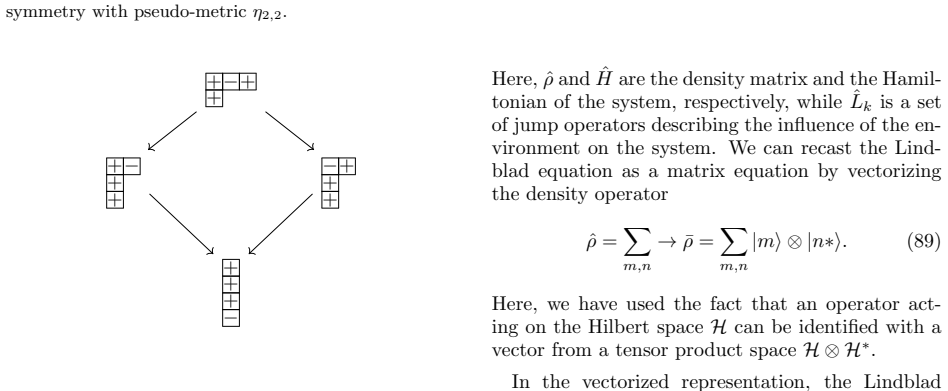
- Figure 3: the arrows indicating allowed conversions between partitions are difficult to trace for orders greater than 3; adding a small table of admissible block-size changes next to the diagram would clarify the hierarchy.
- References: several recent works on higher-order EPs in PT-symmetric systems are cited only in passing; a brief comparison paragraph in the introduction would better situate the new hierarchies relative to existing literature.
Circularity Check
No significant circularity
full rationale
The paper's derivation proceeds via explicit case-by-case perturbation analysis of the effective operator restricted to the degenerate subspace, classifying admissible Jordan-block conversions that preserve algebraic multiplicity. This rests on standard linear-algebraic constructions for non-Hermitian matrices and does not reduce any claimed hierarchy or conversion to a self-definition, a fitted parameter renamed as a prediction, or a load-bearing self-citation. The increase in largest block size follows directly from admissible inter-chain couplings without circularity.
Axiom & Free-Parameter Ledger
axioms (2)
- standard math Non-Hermitian matrices admit a Jordan canonical form that may contain multiple blocks sharing the same eigenvalue (derogatory case).
- domain assumption Infinitesimal perturbations can alter the Jordan-block structure of a degenerate eigenvalue while leaving its algebraic multiplicity unchanged.
Forward citations
Cited by 1 Pith paper
-
Characterizing all non-Hermitian degeneracies using algebraic approaches: Defectiveness and asymptotic behavior
An algebraic framework systematically characterizes the asymptotic dispersion of all multi-block non-Hermitian degeneracies, including n-bolical points and exceptional points of various orders.
Reference graph
Works this paper leans on
-
[1]
Can we convert type-𝐴EP into a type-𝐵EP by an infinitesimal perturbation?
Substituting this into the second equation gives the equation of the projected surface: 𝛿𝐽2,3𝛿𝐽3,1 +𝛿𝐽 3 3,3 = 0.(35) The resulting surface is shown in Fig. 2. C.𝑛×𝑛matrices In the case of an𝑛×𝑛matrix𝐻, the corresponding characteristic polynomial is ℱ𝜆 =𝜆 𝑛 −𝑝 1𝜆𝑛−1 −𝑝 2𝜆𝑛−2 −. . .−𝑝 𝑛,(36) where the coefficients𝑝 𝑘 can be found using Faddeev-LeVierre met...
-
[2]
Effective dissipative qubit As a concrete example, we will consider a three- level system with Hamiltonian ^𝐻= 3∑︁ 𝑙=1 𝜀𝑙 |𝑙⟩ ⟨𝑙|+ 3∑︁ 𝑙<𝑘 𝑡𝑙𝑘(|𝑙⟩ ⟨𝑘|+|𝑘⟩ ⟨𝑙|),(96) subject to the dissipation affecting different groups of levels: ℒ= (︁ −𝑖 ^𝐻 )︁ ⊗1+1⊗ (︁ 𝑖 ^𝐻 )︁ + 3∑︁ 𝑘=2 𝛾𝑘𝐷[|1⟩ ⟨𝑘|] + ∑︁ 𝑗 Γ𝑗 ^𝐷[𝐿𝑗],(97) 𝐷 [︁ ^𝐿 ]︁ =^𝐿⊗ ^𝐿* − ^𝐿† ^𝐿⊗1+1⊗ ^𝐿𝑇 ^𝐿* 2 .(98) ...
-
[3]
Effective non-Hermitian qutrit. In an analogous manner, we can consider a four- level system with dissipation into the ground state, which we project out to get an effective non- Hermitian qutrit. The projected Liouvillian has the same form (101) with a different ^𝐻eff which reads ^𝐻eff = ⎛ ⎝ 𝜀2 − 𝑖𝛾2 2 𝑡23 𝑡24 𝑡23 𝜀3 − 𝑖𝛾3 2 𝑡34 𝑡24 𝑡34 𝜀4 − 𝑖𝛾4 2 ⎞ ⎠ .(...
-
[4]
Yuto Ashida, Zongping Gong, and Masahito Ueda, “Non-hermitian physics,” Advances in Physics69, 249–435 (2020)
work page 2020
-
[5]
Topo- logical physics of non-hermitian optics and photon- ics: a review,
Hongfei Wang, Xiujuan Zhang, Jinguo Hua, Dan- gyuan Lei, Minghui Lu, and Yanfeng Chen, “Topo- logical physics of non-hermitian optics and photon- ics: a review,” Journal of Optics23, 123001 (2021)
work page 2021
-
[6]
Excep- tional points in optics and photonics,
Mohammad-Ali Miri and Andrea Alu, “Excep- tional points in optics and photonics,” Science363, eaar7709 (2019)
work page 2019
-
[7]
Restoring adiabatic state transfer in time- modulated non-hermitian systems,
Ievgen I. Arkhipov, Fabrizio Minganti, Adam Miranowicz, S ¸ahin K. ¨Ozdemir, and Franco Nori, “Restoring adiabatic state transfer in time- modulated non-hermitian systems,” Phys. Rev. Lett.133, 113802 (2024)
work page 2024
-
[8]
Shortcuts to adiabatic state transfer in time-modulated two-level non-hermitian systems,
Qi-Cheng Wu, Jun-Long Zhao, Yan-Hui Zhou, Biao-Liang Ye, Yu-Liang Fang, Zheng-Wei Zhou, and Chui-Ping Yang, “Shortcuts to adiabatic state transfer in time-modulated two-level non-hermitian systems,” Phys. Rev. A111, 022410 (2025)
work page 2025
-
[9]
Atlantic overturning inferred from air-sea heat fluxes indicates no decline since the 1960s,
Kai Bai, Chen Lin, Tao Liu, Jia-Zheng Li, Xin Lyu, and Meng Xiao, “Nonlinear chiral-like state trans- fer realized with a minimal set of parameters,” Na- ture Communications16(2025), 10.1038/s41467- 025-61372-2
-
[10]
Arnab Laha, Dinesh Beniwal, Somnath Ghosh, and Adam Miranowicz, “Programmable state switching based on higher-order exceptional points in anti- parity-time symmetric microcavity systems,” Scien- tific Reports15(2025), 10.1038/s41598-025-13797- 4
-
[11]
Selective chiral multistate switching via the dynamic interplay of diabolic and exceptional points,
Dengke Qu, Ievgen I. Arkhipov, Huixia Gao, Kunkun Wang, Lei Xiao, Franco Nori, and Peng Xue, “Selective chiral multistate switching via the dynamic interplay of diabolic and exceptional points,” Phys. Rev. Lett.136, 086603 (2026)
work page 2026
-
[12]
Enhanced sensitivity at higher-order ex- ceptional points,
Hossein Hodaei, Absar U. Hassan, Steffen Wit- tek, Hipolito Garcia-Gracia, Ramy El-Ganainy, Demetrios N. Christodoulides, and Mercedeh Kha- javikhan, “Enhanced sensitivity at higher-order ex- ceptional points,” Nature548, 187–191 (2017)
work page 2017
-
[13]
Observation of the exceptional-point-enhanced sagnac effect,
Yu-Hung Lai, Yu-Kun Lu, Myoung-Gyun Suh, Zhi- quan Yuan, and Kerry Vahala, “Observation of the exceptional-point-enhanced sagnac effect,” Nature 576, 65–69 (2019)
work page 2019
-
[14]
Exceptional-point-based accelerometers with en- hanced signal-to-noise ratio,
Rodion Kononchuk, Jizhe Cai, Fred Ellis, Ra- mathasan Thevamaran, and Tsampikos Kottos, “Exceptional-point-based accelerometers with en- hanced signal-to-noise ratio,” Nature607, 697–702 (2022)
work page 2022
-
[15]
Sensing applications of pt-symmetry in non- hermitian photonic systems,
Zuoxian Wang, Zihua Liang, Jinsheng Hu, Peng Zhou, Lu Liu, Gen Hu, Weiyi Wang, and Mao Ye, “Sensing applications of pt-symmetry in non- hermitian photonic systems,” Advanced Quantum Technologies8, 2400349 (2025)
work page 2025
-
[16]
Enhanced sensitivity via non-hermitian topology,
Midya Parto, Christian Leefmans, James Williams, Robert M Gray, and Alireza Marandi, “Enhanced sensitivity via non-hermitian topology,” Light: Sci- ence & Applications14, 6 (2025)
work page 2025
-
[17]
Single plasmonic exceptional point nanoantenna coupled to a photonic integrated circuit sensor,
Kamyar Behrouzi, Zhanni Wu, Liwei Lin, and Boubacar Kante, “Single plasmonic exceptional point nanoantenna coupled to a photonic integrated circuit sensor,” Photon. Res.13, 632–641 (2025)
work page 2025
-
[18]
Basudev Nag Chowdhury, Pooja Lahiri, Nigel P. Johnson, Richard M. De La Rue, and Basudev Lahiri, “Exceptional-point-enhanced superior sens- ing using asymmetric coupled-lossy-resonator based optical metasurface,” Laser & Photonics Reviews 19, 2401661 (2025)
work page 2025
-
[19]
Noise constraints for nonlinear exceptional point sensing,
Xu Zheng and Y. D. Chong, “Noise constraints for nonlinear exceptional point sensing,” Phys. Rev. Lett.134, 133801 (2025)
work page 2025
-
[20]
Fundamental limits of non-hermitian sensing from quantum fisher infor- mation,
Jan Wiersig and Stefan Rotter, “Fundamental limits of non-hermitian sensing from quantum fisher infor- mation,” (2026), arXiv:2603.10614
-
[21]
Topological field theory far from equilibrium,
F. Tonielli, J. C. Budich, A. Altland, and S. Diehl, “Topological field theory far from equilibrium,” Phys. Rev. Lett.124, 240404 (2020)
work page 2020
-
[22]
Entanglement spectrum crossings reveal non-hermitian dynamical topology,
Sharareh Sayyad, Jinlong Yu, Adolfo G. Grushin, and Lukas M. Sieberer, “Entanglement spectrum crossings reveal non-hermitian dynamical topology,” Phys. Rev. Res.3, 033022 (2021)
work page 2021
-
[23]
Elias Starchl and Lukas M. Sieberer, “Relaxation to a parity-time symmetric generalized gibbs ensem- ble after a quantum quench in a driven-dissipative kitaev chain,” Phys. Rev. Lett.129, 220602 (2022)
work page 2022
-
[24]
Symmetry- protected exceptional and nodal points in non- Hermitian systems,
Sharareh Sayyad, Marcus Stalhammar, Lukas Rødland, and Flore K. Kunst, “Symmetry- protected exceptional and nodal points in non- Hermitian systems,” SciPost Phys.15, 200 (2023). 20
work page 2023
-
[25]
Quantum quenches in driven-dissipative quadratic fermionic systems with parity-time symmetry,
Elias Starchl and Lukas M. Sieberer, “Quantum quenches in driven-dissipative quadratic fermionic systems with parity-time symmetry,” Phys. Rev. Res.6, 013016 (2024)
work page 2024
-
[26]
Alice March´ e, Hironobu Yoshida, Alberto Nardin, Hosho Katsura, and Leonardo Mazza, “Universality and two-body losses: Lessons from the effective non- hermitian dynamics of two particles,” Phys. Rev. A 110, 033321 (2024)
work page 2024
-
[27]
Anti-parity-time symmetric optical four-wave mix- ing in cold atoms,
Yue Jiang, Yefeng Mei, Ying Zuo, Yanhua Zhai, Jensen Li, Jianming Wen, and Shengwang Du, “Anti-parity-time symmetric optical four-wave mix- ing in cold atoms,” Phys. Rev. Lett.123, 193604 (2019)
work page 2019
-
[28]
Topological field theory of non-hermitian systems,
Kohei Kawabata, Ken Shiozaki, and Shinsei Ryu, “Topological field theory of non-hermitian systems,” Phys. Rev. Lett.126, 216405 (2021)
work page 2021
-
[29]
Non-hermitian chiral anoma- lies,
Sharareh Sayyad, Julia D. Hannukainen, and Adolfo G. Grushin, “Non-hermitian chiral anoma- lies,” Phys. Rev. Res.4, L042004 (2022)
work page 2022
-
[30]
Topological phase diagrams of exactly solvable non-hermitian in- teracting kitaev chains,
Sharareh Sayyad and Jose L. Lado, “Topological phase diagrams of exactly solvable non-hermitian in- teracting kitaev chains,” Phys. Rev. Res.5, L022046 (2023)
work page 2023
-
[31]
Non-hermitian mott skin ef- fect,
Tsuneya Yoshida, Song-Bo Zhang, Titus Neupert, and Norio Kawakami, “Non-hermitian mott skin ef- fect,” Phys. Rev. Lett.133, 076502 (2024)
work page 2024
-
[32]
Non-hermitian chiral anomalies in interacting systems,
Sharareh Sayyad, “Non-hermitian chiral anomalies in interacting systems,” Phys. Rev. Res.6, L012028 (2024)
work page 2024
-
[33]
Entanglement dynamics in monitored systems and the role of quantum jumps,
Youenn Le Gal, Xhek Turkeshi, and Marco Schir` o, “Entanglement dynamics in monitored systems and the role of quantum jumps,” PRX Quantum5, 030329 (2024)
work page 2024
-
[34]
We note that in this case the geometric multiplicity of the eigenvalue is one
-
[35]
Subhajyoti Bid and Henning Schomerus, “Uniform response theory of non-hermitian systems: Non- hermitian physics beyond the exceptional point,” Phys. Rev. Res.7, 023062 (2025)
work page 2025
- [36]
-
[37]
Multi-block exceptional points in open quantum systems
Aysel Shiralieva, Grigory A. Starkov, and Bj¨ orn Trauzettel, “Multi-block exceptional points in open quantum systems,” (2025), arXiv:2509.11856
work page internal anchor Pith review Pith/arXiv arXiv 2025
-
[38]
Higher-order ex- ceptional points in composite non-hermitian sys- tems,
Jan Wiersig and Weijian Chen, “Higher-order ex- ceptional points in composite non-hermitian sys- tems,” Phys. Rev. Res.7, 033034 (2025)
work page 2025
-
[39]
Sharareh Sayyad and Grigory A. Starkov, “Char- acterizing all non-hermitian degeneracies using al- gebraic approaches: Defectiveness and asymptotic behavior,” arXiv:2604.16140 (2026)
work page internal anchor Pith review Pith/arXiv arXiv 2026
-
[40]
Perturbation theory of non-conjugate operators,
V.B. Lidskii, “Perturbation theory of non-conjugate operators,” USSR Computational Mathematics and Mathematical Physics6, 73–85 (1966)
work page 1966
-
[41]
First order eigenvalue perturbation theory and the newton diagram,
Julio Moro and Froil´ an M. Dopico, “First order eigenvalue perturbation theory and the newton diagram,” inApplied Mathematics and Scientific Computing, edited by Zlatko Drmaˇ c, Vjeran Hari, Luka Sopta, Zvonimir Tutek, and Kreˇ simir Veseli´ c (Springer US, Boston, MA, 2003) pp. 143–175
work page 2003
-
[42]
We note that varying the trace merely adds a con- stant shift to the eigenvalues and does not affect the structure of degeneracies
-
[43]
On matrices depending on param- eters,
V I Arnold, “On matrices depending on param- eters,” Russian Mathematical Surveys26, 29–43 (1971)
work page 1971
-
[44]
F. R. Gantmakher,The theory of matrices, volume 1, AMS Chelsea Publishing (American Mathemati- cal Society, Providence, RI, 1998)
work page 1998
-
[45]
Realizing ex- ceptional points of any order in the presence of sym- metry,
Sharareh Sayyad and Flore K. Kunst, “Realizing ex- ceptional points of any order in the presence of sym- metry,” Phys. Rev. Res.4, 023130 (2022)
work page 2022
-
[46]
Symmetry and higher-order exceptional points,
Ipsita Mandal and Emil J. Bergholtz, “Symmetry and higher-order exceptional points,” Phys. Rev. Lett.127, 186601 (2021)
work page 2021
-
[47]
This is a direct consequence of the rank-nullity the- orem
-
[48]
To get the in- tersection, we need to extend the sheets by their closure
One should keep in mind that the lines themselves do not belong to the EP3 manifold. To get the in- tersection, we need to extend the sheets by their closure
-
[49]
A similarity transformation𝐴→𝑆𝐴𝑆 −1 with fixed 𝑆is a bounded linear operator on the space of ma- trices, hence it commutes with taking the limit
-
[50]
Note that 𝐴stands for the closure of set𝐴
-
[51]
On Nilalgebras and Lin- ear Varieties of Nilpotent Matrices, III,
Murray Gerstenhaber, “On Nilalgebras and Lin- ear Varieties of Nilpotent Matrices, III,” Annals of Mathematics70, 167–205 (1959), publisher: [An- nals of Mathematics, Trustees of Princeton Univer- sity on Behalf of the Annals of Mathematics, Math- ematics Department, Princeton University]
work page 1959
-
[52]
On the ge- ometry of conjugacy classes in classical groups,
Hanspeter Kraft and Claudio Procesi, “On the ge- ometry of conjugacy classes in classical groups,” Commentarii Mathematici Helvetici57, 539–602 (1982)
work page 1982
-
[53]
These structures are also known as the Young dia- gram lattices on the partition of an integer [51]
-
[54]
The lattice of integer partitions and its infinite exten- sion,
Matthieu Latapy and Thi Ha Duong Phan, “The lattice of integer partitions and its infinite exten- sion,” Discrete Mathematics309, 1357–1367 (2009)
work page 2009
-
[55]
Ali Mostafazadeh, “Pseudo-Hermiticity versus PT symmetry: The necessary condition for the real- ity of the spectrum of a non-Hermitian Hamilto- nian,” Journal of Mathematical Physics43, 205–214 (2002)
work page 2002
-
[56]
Ali Mostafazadeh, “Pseudo-Hermiticity versus PT- symmetry. II. A complete characterization of non- Hermitian Hamiltonians with a real spectrum,” Journal of Mathematical Physics43, 2814–2816 (2002)
work page 2002
-
[57]
Ali Mostafazadeh, “Pseudo-Hermiticity versus PT- symmetry III: Equivalence of pseudo-Hermiticity and the presence of antilinear symmetries,” Journal of Mathematical Physics43, 3944–3951 (2002)
work page 2002
-
[58]
Pseudo-Hermitian Representa- tion of Quantum Mechanics,
Ali Mostafazadeh, “Pseudo-Hermitian Representa- tion of Quantum Mechanics,” International Journal of Geometric Methods in Modern Physics07, 1191– 1306 (2010). 21
work page 2010
-
[59]
PT- symmetry entails pseudo-hermiticity regardless of diagonalizability,
Ruili Zhang, Hong Qin, and Jianyuan Xiao, “PT- symmetry entails pseudo-hermiticity regardless of diagonalizability,” Journal of Mathematical Physics 61, 012101 (2020)
work page 2020
-
[60]
Symmetry classification of many-body Lindbladi- ans: Tenfold way and beyond,
Lucas S´ a, Pedro Ribeiro, and Tomas Prosen, “Symmetry classification of many-body Lindbladi- ans: Tenfold way and beyond,” Phys. Rev. X13, 031019 (2023)
work page 2023
-
[61]
A Hermitian operator𝜂can be diagonalized by a unitary transformation:𝜂=𝑈 †𝐷𝑈, where𝑈is an invertible matrix and𝐷= diag (𝜀 1, 𝜀2, ...) with real eigenvalues𝜀 𝑖. Without the loss of generality let’s assume that the eigenvalues are ordered𝜀 𝑖 ⩾𝜀 𝑖 + 1, first𝑝eigenvalues are positive and the rest𝑞eigen- values are negative. Then𝜂=𝑆 † 0𝜂𝑝,𝑞𝑆0 with𝑆 0 = |𝐷|1/2𝑈...
-
[62]
Pseudounitary operators and pseudounitary quantum dynamics,
Ali Mostafazadeh, “Pseudounitary operators and pseudounitary quantum dynamics,” Journal of Mathematical Physics45, 932–946 (2004)
work page 2004
-
[63]
Israel Gohberg, Peter Lancaster, and Leiba Rod- man,Indefinite linear algebra and applications (Springer Science & Business Media, 2006)
work page 2006
-
[64]
See Theorem 5.1.1 in Ref.[60]
-
[65]
This matrix is also known as the standard involu- tory permutation (sip) matrix, or the reversal ma- trix [79]
-
[66]
For example, it follows from Theorem 9.1.1 in Ref. [60]
-
[67]
MG Krein, “A generalization of some investigations of linear differential equations with periodic coeffi- cients,” inDoklady Akad. Nauk SSSR, Vol. 73 (1950) pp. 445–448
work page 1950
-
[68]
Izrail Moiseevich Gel’fand and Viktor Borisovich Lidskii, “On the structure of the regions of stabil- ity of linear canonical systems of differential equa- tions with periodic coefficients,” Uspekhi Matem- aticheskikh Nauk10, 3–40 (1955)
work page 1955
-
[69]
Degeneracies and symmetry breaking in pseudo-hermitian matrices,
Abhijeet Melkani, “Degeneracies and symmetry breaking in pseudo-hermitian matrices,” Phys. Rev. Res.5, 023035 (2023)
work page 2023
-
[70]
Formation of exceptional points in pseudo- hermitian systems,
Grigory A. Starkov, Mikhail V. Fistul, and Ilya M. Eremin, “Formation of exceptional points in pseudo- hermitian systems,” Phys. Rev. A108, 022206 (2023)
work page 2023
-
[71]
Schrieffer-wolff transformation for non- hermitian systems: Application for𝒫𝒯-symmetric circuit qed,
Grigory A. Starkov, Mikhail V. Fistul, and Ilya M. Eremin, “Schrieffer-wolff transformation for non- hermitian systems: Application for𝒫𝒯-symmetric circuit qed,” Phys. Rev. B108, 235417 (2023)
work page 2023
-
[72]
Grigory A. Starkov, “Interplay of pseudo-hermitian symmetries and degenerate manifolds in the eigen- spectrum of non-hermitian systems,” (2024), arXiv:2402.07690
-
[73]
There is no contradiction here. Pseudo-Hermitian symmetry is still satisfied in the sense that the cor- responding degeneracy at the complex conjugate en- ergy behaves symmetrically
-
[74]
Closures of conjugacy classes in classical real linear lie groups,
Dragomir ˇZ Djokovi´ c, “Closures of conjugacy classes in classical real linear lie groups,” inAlgebra Car- bondale 1980: Lie Algebras, Group Theory, and Partially Ordered Algebraic Structures Proceedings of the Southern Illinois Algebra Conference, Car- bondale, April 18 and 19, 1980(Springer, 2006) pp. 63–83
work page 1980
-
[75]
Closures of conjugacy classes in classical real linear lie groups. ii,
Dragomir ˇZ Djokovi´ c, “Closures of conjugacy classes in classical real linear lie groups. ii,” Transactions of the American Mathematical Society270, 217–252 (1982)
work page 1982
-
[76]
David H Collingwood and William M McGovern, Nilpotent Orbits in Semisimple Lie Algebras(Rout- ledge, 2017)
work page 2017
-
[77]
A canonical basis for the matrix transformation x→ax + xb,
Anthony Trampus, “A canonical basis for the matrix transformation x→ax + xb,” Journal of Mathemat- ical Analysis and Applications14, 242–252 (1966)
work page 1966
-
[78]
Quantum state tomography across the exceptional point in a single dissipative qubit,
M. Naghiloo, M. Abbasi, Yogesh N. Joglekar, and K. W. Murch, “Quantum state tomography across the exceptional point in a single dissipative qubit,” Nature Physics15, 1232–1236 (2019)
work page 2019
-
[79]
Quantum jumps in the non- Hermitian dynamics of a superconducting qubit,
Weijian Chen, Maryam Abbasi, Yogesh N. Joglekar, and Kater W. Murch, “Quantum jumps in the non- Hermitian dynamics of a superconducting qubit,” Phys. Rev. Lett.127, 140504 (2021)
work page 2021
-
[80]
Conserved quantities in parity-time symmetric systems,
Zhihao Bian, Lei Xiao, Kunkun Wang, Xiang Zhan, Franck Assogba Onanga, Frantisek Ruzicka, Wei Yi, Yogesh N. Joglekar, and Peng Xue, “Conserved quantities in parity-time symmetric systems,” Phys. Rev. Res.2, 022039 (2020)
work page 2020
discussion (0)
Sign in with ORCID, Apple, or X to comment. Anyone can read and Pith papers without signing in.