Recognition: 2 theorem links
· Lean TheoremThe Breakthrough of Sleep: A Contactless Approach for Accurate Sleep Stage Detection Using the Sleepal AI Lamp
Pith reviewed 2026-05-10 19:38 UTC · model grok-4.3
The pith
A contactless radar lamp extracts breathing and motion patterns to classify sleep stages in high agreement with polysomnography experts.
A machine-rendered reading of the paper's core claim, the machinery that carries it, and where it could break.
Core claim
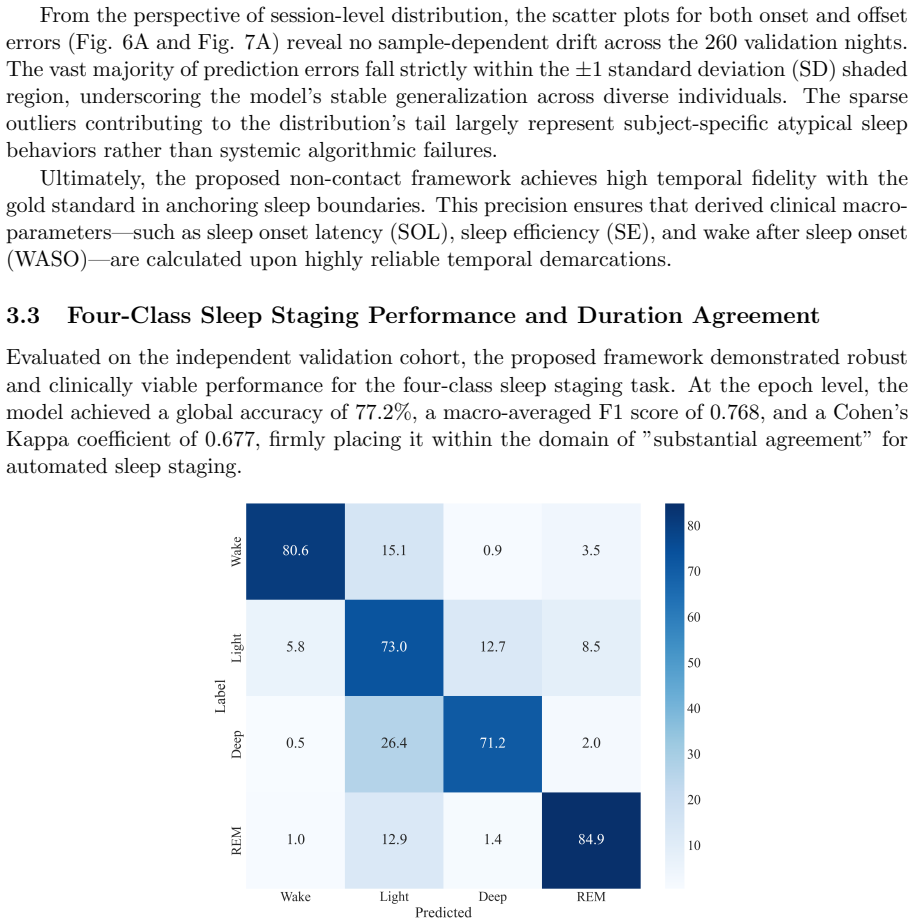
The Sleepal AI Lamp extracts multi-scale respiratory and motion-related features from consumer-grade radar signals and feeds them into a frequency-augmented deep learning model. On 1022 overnight recordings the model reaches 92.8 percent accuracy and 0.895 macro F1 for binary sleep-wake detection; for four stages it reaches 78.5 percent accuracy (kappa 0.695) in healthy subjects and 77.2 percent accuracy (kappa 0.677) in a mixed OSA population, matching expert PSG labels.
What carries the argument
Multi-scale respiratory and motion features from radar signals processed by a frequency-augmented deep learning model that performs temporal modeling of sleep stages.
If this is right
- Sleep staging becomes feasible for home use without any body-worn sensors or clinic visits.
- The same hardware can support repeated nights of monitoring because it requires no physical contact.
- Performance remains stable when moving from healthy volunteers to patients with obstructive sleep apnea of different severities.
- The approach opens the door to continuous longitudinal tracking rather than single-night snapshots.
Where Pith is reading between the lines
- Integration into everyday lighting fixtures could turn passive home monitoring into a default data source for sleep-related health tracking.
- Lowering the barrier to repeated measurement might allow earlier identification of sleep-pattern changes that precede other medical conditions.
- Future models could add environmental sensors already present in the lamp to further reduce population-specific biases.
Load-bearing premise
Radar signals captured by a consumer lamp contain enough distinct breathing and movement information to separate sleep stages reliably in both healthy people and patients with varying degrees of sleep apnea.
What would settle it
A new set of simultaneous radar and PSG recordings in which four-stage accuracy falls below 70 percent or kappa drops below 0.5 when the device is used on a fresh, demographically varied group.
Figures




read the original abstract
Sleep staging is essential for the assessment of sleep quality and the diagnosis of sleep-related disorders. Conventional polysomnography (PSG), while considered the gold standard, is intrusive, labor-intensive, and unsuitable for long-term monitoring. This study evaluates the performance of the Sleepal AI Lamp, a contactless, radar-based consumer-grade sleep tracker, in comparison with gold-standard polysomnography (PSG), using a large-scale dataset comprising 1022 overnight recordings. We extract multi-scale respiratory and motion-related features from radar signals to train a frequency-augmented deep learning model. For the binary sleep-wake classification task, experimental results demonstrated that the model achieved an accuracy of 92.8% alongside a macro-averaged F1 score of 0.895. For four-stage classification (wake, light NREM (N1 + N2), deep NREM (N3), REM), the model achieved an accuracy of 78.5% with a Cohen's kappa coefficient of 0.695 in healthy individuals and maintained a stable accuracy of 77.2% with a kappa of 0.677 in a heterogeneous population including patients with varying severities of obstructive sleep apnea (OSA). These experimental results demonstrate that the sleep staging performance of the contactless Sleepal AI Lamp is in high agreement with expert-labeled PSG sleep stages. Our findings suggest that non-contact radar sensing, combined with advanced temporal modeling, can provide reliable sleep staging performance without requiring physical contact or wearable devices. Owing to its unobtrusive nature, ease of deployment, and robustness to long-term use, the contactless Sleepal AI Lamp shows strong potential for clinical screening, home-based sleep assessment, and continuous longitudinal sleep monitoring in real-world medical and healthcare applications.
Editorial analysis
A structured set of objections, weighed in public.
Referee Report
Summary. The manuscript presents the Sleepal AI Lamp, a contactless radar-based consumer device that extracts multi-scale respiratory and motion features from radar signals to train a frequency-augmented deep learning model for sleep staging. On a dataset of 1022 overnight recordings, it reports 92.8% accuracy and 0.895 macro F1 for binary sleep-wake classification, and 78.5% accuracy (kappa 0.695) for four-stage classification (wake, light NREM, deep NREM, REM) in healthy subjects, with comparable performance (77.2% accuracy, kappa 0.677) in a heterogeneous OSA population, claiming high agreement with expert PSG labels and potential for clinical and home monitoring.
Significance. If the performance holds under rigorous subject-independent validation and the methods are fully specified, the work could advance non-contact sleep monitoring by demonstrating usable accuracy on a large dataset spanning healthy and clinical populations, supporting applications in longitudinal assessment where PSG is impractical.
major comments (3)
- [Methods] Methods section: No architecture details, feature definitions, training protocol, hyperparameters, or loss functions are provided for the 'frequency-augmented deep learning model,' preventing any assessment of how the reported metrics were obtained or whether they support the generalization claim.
- [Results] Results section: The data partitioning strategy (e.g., train/test split, cross-validation) is not described. With 1022 recordings that may include repeated nights from the same subjects, it is impossible to confirm subject-independent evaluation, leaving open the risk that metrics reflect subject-specific overfitting rather than robust radar features.
- [Results] Results/Abstract: No confusion matrices, per-stage F1 scores, error analysis, or subgroup breakdowns (e.g., by OSA severity) are supplied, so the stability of the four-stage kappa values (0.695 and 0.677) cannot be evaluated against the weakest assumption of feature sufficiency across populations.
minor comments (2)
- [Title] The title uses promotional language ('The Breakthrough of Sleep') atypical for archival publication; a descriptive title focused on the method and results would be more appropriate.
- [Abstract] Abstract and main text introduce 'multi-scale respiratory and motion-related features' and 'frequency-augmented' modeling without definitions or references to prior work; these should be expanded in the Methods for clarity.
Simulated Author's Rebuttal
We thank the referee for the constructive and detailed comments. We agree that the current version of the manuscript lacks sufficient methodological transparency and supplementary performance details. We will revise the paper to address these points directly.
read point-by-point responses
-
Referee: [Methods] Methods section: No architecture details, feature definitions, training protocol, hyperparameters, or loss functions are provided for the 'frequency-augmented deep learning model,' preventing any assessment of how the reported metrics were obtained or whether they support the generalization claim.
Authors: We acknowledge that the Methods section in the submitted manuscript does not contain the requested implementation details. In the revised version we will add a complete description of the frequency-augmented deep learning model, including the network architecture, precise definitions of the multi-scale respiratory and motion features extracted from the radar signals, the training protocol, all hyperparameters, and the loss function employed. revision: yes
-
Referee: [Results] Results section: The data partitioning strategy (e.g., train/test split, cross-validation) is not described. With 1022 recordings that may include repeated nights from the same subjects, it is impossible to confirm subject-independent evaluation, leaving open the risk that metrics reflect subject-specific overfitting rather than robust radar features.
Authors: We agree that the data-partitioning procedure must be explicitly stated. The revised Results section will describe the train/test split, any cross-validation scheme, and how recordings from the same subject (if present) were allocated to prevent leakage. We will also clarify whether the evaluation is strictly subject-independent. revision: yes
-
Referee: [Results] Results/Abstract: No confusion matrices, per-stage F1 scores, error analysis, or subgroup breakdowns (e.g., by OSA severity) are supplied, so the stability of the four-stage kappa values (0.695 and 0.677) cannot be evaluated against the weakest assumption of feature sufficiency across populations.
Authors: We recognize the value of these additional metrics for assessing per-stage performance and robustness across populations. The revised manuscript will include confusion matrices for both the binary and four-stage tasks, per-stage F1 scores, a brief error analysis, and subgroup results stratified by OSA severity in the heterogeneous cohort. revision: yes
Circularity Check
No circularity: empirical validation against independent PSG labels
full rationale
The paper extracts multi-scale radar features, trains a frequency-augmented deep learning model, and reports classification performance (accuracy, F1, kappa) directly against expert PSG sleep-stage labels on 1022 recordings. This chain is externally anchored and falsifiable; no equations or steps reduce the reported metrics to the model's own fitted outputs by construction. No self-citations, uniqueness theorems, or ansatzes are invoked as load-bearing premises in the abstract or described workflow. Data-split concerns (if present) would constitute a methodological risk rather than a definitional circularity.
Axiom & Free-Parameter Ledger
Lean theorems connected to this paper
-
IndisputableMonolith/Cost/FunctionalEquation.leanwashburn_uniqueness_aczel unclear?
unclearRelation between the paper passage and the cited Recognition theorem.
We extract multi-scale respiratory and motion-related features from radar signals to train a frequency-augmented deep learning model... BiLSTM layers... frequency domain... Layer Normalization... H-swish
-
IndisputableMonolith/Foundation/RealityFromDistinction.leanreality_from_one_distinction unclear?
unclearRelation between the paper passage and the cited Recognition theorem.
1022 overnight recordings... subject-level stratified random sampling... four-stage accuracy 77.2% (kappa 0.677)
What do these tags mean?
- matches
- The paper's claim is directly supported by a theorem in the formal canon.
- supports
- The theorem supports part of the paper's argument, but the paper may add assumptions or extra steps.
- extends
- The paper goes beyond the formal theorem; the theorem is a base layer rather than the whole result.
- uses
- The paper appears to rely on the theorem as machinery.
- contradicts
- The paper's claim conflicts with a theorem or certificate in the canon.
- unclear
- Pith found a possible connection, but the passage is too broad, indirect, or ambiguous to say the theorem truly supports the claim.
Reference graph
Works this paper leans on
-
[1]
J. Vensel Rundo and R. Downey III, “Polysomnography,” inHandbook of Clinical Neurol- ogy. Elsevier, 2019, vol. 160, pp. 381–392
work page 2019
-
[2]
O. Walch, Y. Huang, D. Forger, and C. Goldstein, “Sleep stage prediction with raw ac- celeration and photoplethysmography heart rate data derived from a consumer wearable device,”Sleep, vol. 42, no. 12, p. zsz180, Dec. 2019
work page 2019
-
[3]
Z. Beattie, Y. Oyang, A. Statan, A. Ghoreyshi, A. Pantelopoulos, A. Russell, and CJPM. Heneghan, “Estimation of sleep stages in a healthy adult population from optical plethysmography and accelerometer signals,”Physiological measurement, vol. 38, no. 11, pp. 1968–1979, 2017
work page 1968
-
[4]
DoppleSleep: A contactless unobtrusive sleep sensing system using short- range Doppler radar,
T. Rahman, A. T. Adams, R. V. Ravichandran, M. Zhang, S. N. Patel, J. A. Kientz, and T. Choudhury, “DoppleSleep: A contactless unobtrusive sleep sensing system using short- range Doppler radar,” inProceedings of the 2015 ACM International Joint Conference on Pervasive and Ubiquitous Computing. Osaka Japan: ACM, Sep. 2015, pp. 39–50
work page 2015
-
[5]
Sleep-wake detection with a contactless, bedside radar sleep sensing system,
M. Dixon, L. Schneider, J. Yu, J. Hsu, A. Pathak, D. Shin, R. S. Lee, M. R. Malhotra, K. Mixter, M. McConnell, J. Taylor, and S. Patel, “Sleep-wake detection with a contactless, bedside radar sleep sensing system,” Tech. Rep., 2021
work page 2021
-
[6]
Unsupervised Detection of Multiple Sleep Stages Using a Single FMCW Radar,
Y.-K. Yoo, C.-W. Jung, and H.-C. Shin, “Unsupervised Detection of Multiple Sleep Stages Using a Single FMCW Radar,”Applied Sciences, vol. 13, no. 7, p. 4468, Mar. 2023
work page 2023
-
[7]
Sleep stage classification by non-contact vital signs indices using Doppler radar sensors,
M. Kagawa, K. Suzumura, and T. Matsui, “Sleep stage classification by non-contact vital signs indices using Doppler radar sensors,” in2016 38th Annual International Conference of the IEEE Engineering in Medicine and Biology Society (EMBC). Orlando, FL, USA: IEEE, Aug. 2016, pp. 4913–4916
work page 2016
-
[8]
S. Toften, S. Pallesen, M. Hrozanova, F. Moen, and J. Grønli, “Validation of sleep stage classification using non-contact radar technology and machine learning (Somnofy®),”Sleep Medicine, vol. 75, pp. 54–61, Nov. 2020
work page 2020
-
[9]
J. H. Lee, H. Nam, D. H. Kim, D. L. Koo, J. W. Choi, S.-N. Hong, E.-T. Jeon, S. Lim, G. S. Jang, and B.-h. Kim, “Developing a deep learning model for sleep stage prediction in obstructive sleep apnea cohort using 60GHz frequency-modulated continuous- waveradar,”Journal of Sleep Research, vol. 33, no. 1, p. e14050, Feb. 2024
work page 2024
-
[10]
A coefficient of agreement for nominal scales,
J. Cohen, “A coefficient of agreement for nominal scales,”Educational and psychological measurement, vol. 20, no. 1, pp. 37–46, 1960
work page 1960
-
[11]
AASM scoring manual updates for 2017 (version 2.4),
R. B. Berry, R. Brooks, C. Gamaldo, S. M. Harding, R. M. Lloyd, S. F. Quan, M. T. Troester, and B. V. Vaughn, “AASM scoring manual updates for 2017 (version 2.4),” pp. 665–666, 2017
work page 2017
-
[12]
REM sleep estimation only using respiratory dynamics,
G. S. Chung, B. H. Choi, J.-S. Lee, J. S. Lee, D.-U. Jeong, and K. W. S. Park, “REM sleep estimation only using respiratory dynamics,”Physiological Measurement, vol. 30, no. 12, pp. 1327–1340, Dec. 2009
work page 2009
-
[13]
Dynamic programming algorithm optimization for spoken word recognition,
H. Sakoe and S. Chiba, “Dynamic programming algorithm optimization for spoken word recognition,”IEEE Transactions on Acoustics, Speech, and Signal Processing, vol. 26, no. 1, pp. 43–49, Feb. 1978
work page 1978
-
[14]
A two process model of sleep regulation,
A. A. Borb´ elyet al., “A two process model of sleep regulation,”Human neurobiology, vol. 1, no. 3, pp. 195–204, 1982. 19
work page 1982
-
[15]
Stability, Precision, and Near-24-Hour Period of the Human Circadian Pacemaker,
C. A. Czeisler, J. F. Duffy, T. L. Shanahan, E. N. Brown, J. F. Mitchell, D. W. Rimmer, J. M. Ronda, E. J. Silva, J. S. Allan, J. S. Emens, D.-J. Dijk, and R. E. Kronauer, “Stability, Precision, and Near-24-Hour Period of the Human Circadian Pacemaker,”Science, vol. 284, no. 5423, pp. 2177–2181, Jun. 1999
work page 1999
-
[16]
Bidirectional recurrent neural networks,
M. Schuster and K. Paliwal, “Bidirectional recurrent neural networks,”IEEE Transactions on Signal Processing, vol. 45, no. 11, pp. 2673–2681, Nov. 1997
work page 1997
-
[17]
J. L. Ba, J. R. Kiros, and G. E. Hinton, “Layer Normalization,” 2016
work page 2016
-
[18]
A. Howard, M. Sandler, G. Chu, L.-C. Chen, B. Chen, M. Tan, W. Wang, Y. Zhu, R. Pang, V. Vasudevan, Q. V. Le, and H. Adam, “Searching for MobileNetV3,” inProceedings of the IEEE/CVF International Conference on Computer Vision (ICCV), Oct. 2019
work page 2019
-
[19]
STATISTICAL METHODS FOR ASSESSING AGREEMENT BETWEEN TWO METHODS OF CLINICAL MEASUREMENT,
J. Martin Bland and DouglasG. Altman, “STATISTICAL METHODS FOR ASSESSING AGREEMENT BETWEEN TWO METHODS OF CLINICAL MEASUREMENT,”The Lancet, vol. 327, no. 8476, pp. 307–310, Feb. 1986
work page 1986
-
[20]
Obstructive Sleep Apnea Alters Sleep Stage Transition Dynamics,
M. T. Bianchi, S. S. Cash, J. Mietus, C.-K. Peng, and R. Thomas, “Obstructive Sleep Apnea Alters Sleep Stage Transition Dynamics,”PLoS ONE, vol. 5, no. 6, p. e11356, Jun. 2010
work page 2010
-
[21]
Accuracy of Three Commercial Wearable Devices for Sleep Tracking in Healthy Adults,
R. Robbins, M. D. Weaver, J. P. Sullivan, S. F. Quan, K. Gilmore, S. Shaw, A. Benz, S. Qadri, L. K. Barger, C. A. Czeisler, and J. F. Duffy, “Accuracy of Three Commercial Wearable Devices for Sleep Tracking in Healthy Adults,”Sensors, vol. 24, no. 20, p. 6532, Oct. 2024. 20
work page 2024
discussion (0)
Sign in with ORCID, Apple, or X to comment. Anyone can read and Pith papers without signing in.