Forecast Sports Outcomes under Efficient Market Hypothesis: Theoretical and Experimental Analysis of Odds-Only and Generalised Linear Models
Pith reviewed 2026-05-10 06:26 UTC · model grok-4.3
The pith
New odds-only and generalized linear models convert betting odds to outcome probabilities more accurately than existing methods.
A machine-rendered reading of the paper's core claim, the machinery that carries it, and where it could break.
Core claim
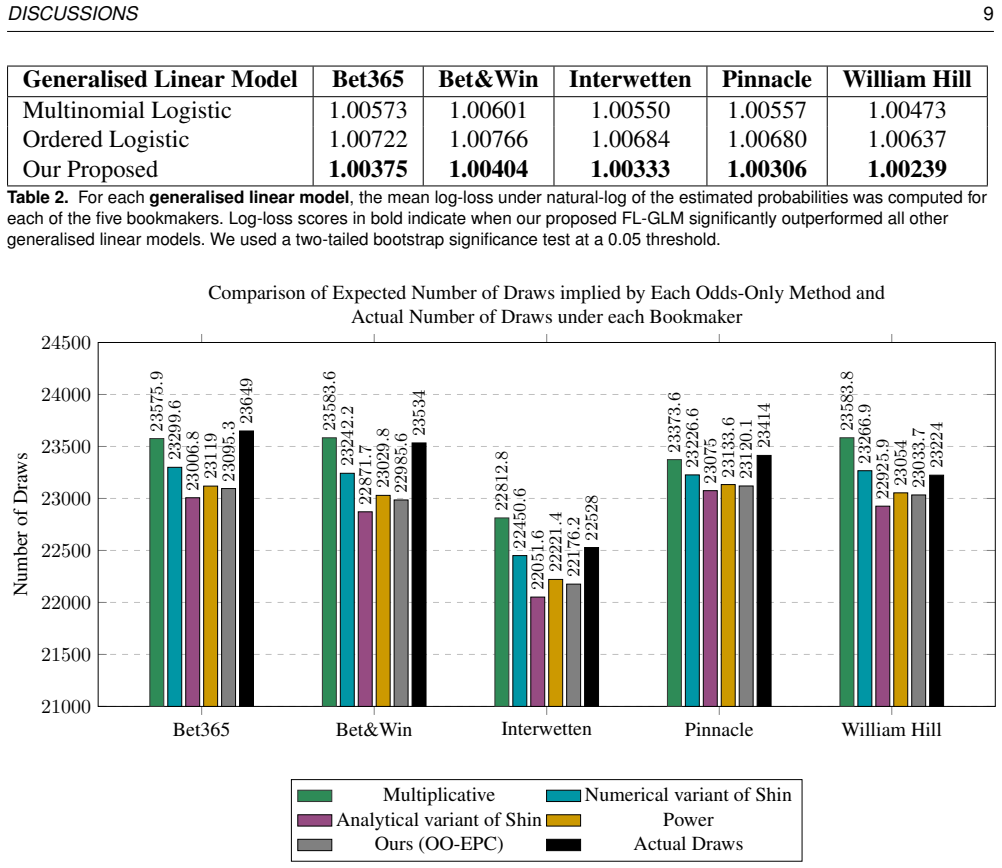
The authors propose the Odds-Only-Equal-Profitability-Confidence (OO-EPC) method for converting odds without historical fitting by enforcing equal confidence in profitability across outcomes, and the Favourite-Longshot-Bias-Adjusted GLM (FL-GLM) that fits a single parameter for bias. On a dataset of 90,014 football matches from five bookmakers, OO-EPC beats existing odds-only methods for the majority of bookmakers, and FL-GLM beats multinomial and logistic GLMs for all bookmakers. They also test OO-EPC in real basketball forecasting competitions.
What carries the argument
The OO-EPC method, which sets probabilities so that the implied profitability confidence is equal for each outcome, and the FL-GLM, which incorporates a single parameter to capture the favorite-longshot bias in odds.
If this is right
- Improved benchmarks for sports outcome forecasting models using betting odds.
- More reliable analysis of whether betting markets are efficient.
- Practical use in annual forecasting competitions without historical fitting for odds-only cases.
- Simpler interpretable models for probability conversion from odds.
Where Pith is reading between the lines
- These methods could extend to other sports if the observed biases are similar.
- Future work might test whether the equal profitability confidence assumption holds across different betting markets.
- Combining both methods or using them in ensemble could further improve forecasts.
- The real-world application in basketball competitions suggests robustness beyond the football training data.
Load-bearing premise
The patterns of bias and relationships found in the 90,014 football matches will hold for future matches and other sports, and that matching equal profitability confidence is the right goal for an odds-only converter.
What would settle it
Applying the OO-EPC and FL-GLM to a fresh dataset of matches from a different sport or later football seasons and checking whether they still outperform the baselines on accuracy metrics.
Figures

read the original abstract
Converting betting odds into accurate outcome probabilities is a fundamental challenge in order to use betting odds as a benchmark for sports forecasting and market efficiency analysis. In this study, we propose two methods to overcome the limitations of existing conversion methods. Firstly, we propose an odds-only method to convert betting odds to probabilities without using historical data for model fitting. While existing odds-only methods, such as Multiplicative, Shin, and Power exist, they do not adjust for biases or relationships we found in our betting odds dataset, which consists of 90014 football matches across five different bookmakers. To overcome these limitations, our proposed Odds-Only-Equal-Profitability-Confidence (OO-EPC) method aligns with the bookmakers' pricing objectives of having equal confidence in profitability for each outcome. We provide empirical evidence from our betting odds dataset that, for the majority of bookmakers, our proposed OO-EPC method outperforms the existing odds-only methods. Beyond controlled experiments, we applied the OO-EPC method under real-world uncertainty by using it for six iterations of an annual basketball outcome forecasting competition. Secondly, we propose a generalised linear model that utilises historical data for model fitting and then converts betting odds to probabilities. Existing generalised linear models attempt to capture relationships that the Efficient Market Hypothesis already captures. To overcome this shortcoming, our proposed Favourite-Longshot-Bias-Adjusted Generalised Linear Model (FL-GLM) fits just one parameter to capture the favourite-longshot bias, providing a more interpretable alternative. We provide empirical evidence from historical football matches where, for all bookmakers, our proposed FL-GLM outperforms the existing multinomial and logistic generalised linear models.
Editorial analysis
A structured set of objections, weighed in public.
Referee Report
Summary. The manuscript proposes two methods for converting betting odds to outcome probabilities under the Efficient Market Hypothesis. The first is an odds-only method (OO-EPC) that adjusts existing conversions to enforce equal profitability confidence across outcomes, derived from biases observed in a dataset of 90,014 football matches across five bookmakers. The second is a generalised linear model (FL-GLM) that fits a single parameter to capture the favourite-longshot bias. The paper claims OO-EPC outperforms existing odds-only methods (Multiplicative, Shin, Power) for the majority of bookmakers on this dataset, while FL-GLM outperforms existing multinomial and logistic GLMs for all bookmakers; OO-EPC is additionally evaluated in six iterations of a real basketball forecasting competition.
Significance. If the outperformance claims hold under proper out-of-sample validation, the work could strengthen the use of betting odds as benchmarks for market efficiency tests and improve practical sports forecasting pipelines. The large-scale dataset, the real-world competition application for OO-EPC, and the emphasis on interpretability via a single-parameter GLM are positive features. The odds-only nature of OO-EPC, if it generalises without historical fitting, would be particularly useful for settings where training data are unavailable.
major comments (4)
- [Experimental results / abstract] Experimental results section (and abstract): Both OO-EPC and FL-GLM performance claims are evaluated on the identical 90,014-match football dataset used to identify the biases/relationships and to fit the single FL-GLM parameter. No hold-out set, temporal split, or cross-validation is described, so the reported superiority over baselines may reflect in-sample fitting rather than genuine generalisation.
- [Methods (OO-EPC derivation)] Methods description of OO-EPC: Although presented as an odds-only converter with no historical model fitting, the functional form is explicitly derived from biases and relationships observed across the full 90,014-match dataset. This makes the outperformance claim on the same data circular and weakens the assertion that OO-EPC is independent of historical information.
- [FL-GLM definition and empirical comparison] FL-GLM specification and results: The model fits one parameter directly to the favourite-longshot bias present in the evaluation data. This reduces the procedure to an in-sample correction term; the reported outperformance over multinomial and logistic GLMs on the same data is therefore expected by construction and does not demonstrate superior modelling of the underlying probabilities.
- [Real-world application / results] Basketball competition evaluation: The six-iteration real-world test is reported only for OO-EPC and is narrow in scope; no equivalent external validation or statistical comparison is provided for FL-GLM, leaving the generalisation claim for the GLM unsupported.
minor comments (2)
- [Abstract / results] The abstract and results sections omit any mention of statistical significance tests, confidence intervals, or error bars on the performance differences, making it difficult to assess whether the reported gains are reliable.
- [Methods] Notation for the equal-profitability-confidence objective and the exact functional form of OO-EPC should be stated explicitly with equations to allow reproducibility.
Simulated Author's Rebuttal
We thank the referee for the constructive and detailed comments, which correctly identify the need for stronger validation to support the generalisation claims. We agree that the current presentation relies on in-sample evaluations and will revise the manuscript accordingly by adding temporal splits, cross-validation, parameter stability checks, and statistical comparisons. These changes will clarify the methods' applicability while preserving their core contributions.
read point-by-point responses
-
Referee: Experimental results section (and abstract): Both OO-EPC and FL-GLM performance claims are evaluated on the identical 90,014-match football dataset used to identify the biases/relationships and to fit the single FL-GLM parameter. No hold-out set, temporal split, or cross-validation is described, so the reported superiority over baselines may reflect in-sample fitting rather than genuine generalisation.
Authors: We acknowledge the validity of this concern. The full dataset was used to illustrate how the methods capture the observed biases and relationships. In the revision, we will add a dedicated out-of-sample evaluation section using chronological temporal splits (e.g., train on the first 70% of matches by date and test on the remainder) and 5-fold cross-validation. Both OO-EPC and FL-GLM will be assessed under these protocols, with performance metrics reported against the same baselines to confirm whether superiority holds out-of-sample. revision: yes
-
Referee: Methods description of OO-EPC: Although presented as an odds-only converter with no historical model fitting, the functional form is explicitly derived from biases and relationships observed across the full 90,014-match dataset. This makes the outperformance claim on the same data circular and weakens the assertion that OO-EPC is independent of historical information.
Authors: We agree that the functional form was identified through analysis of the full dataset to enforce equal profitability confidence. However, once derived, OO-EPC becomes a fixed, parameterised converter that requires only the current betting odds as input and no historical matches or refitting for new applications. This property distinguishes it from data-dependent GLMs. To address circularity, we will move the full derivation to an appendix, add a stability analysis of the derived parameters across random subsets and time periods of the data, and emphasise that the method can be applied without access to the original dataset. revision: partial
-
Referee: FL-GLM specification and results: The model fits one parameter directly to the favourite-longshot bias present in the evaluation data. This reduces the procedure to an in-sample correction term; the reported outperformance over multinomial and logistic GLMs on the same data is therefore expected by construction and does not demonstrate superior modelling of the underlying probabilities.
Authors: We concur that fitting the single favourite-longshot parameter on the evaluation data renders the reported results in-sample. In the revised manuscript, we will refit the FL-GLM parameter exclusively on a training subset (chronological first 70%) and evaluate on the held-out test subset. The multinomial and logistic baselines will be trained and evaluated identically. This provides a fair out-of-sample comparison and demonstrates whether the single-parameter adjustment yields superior probability estimates beyond in-sample correction. revision: yes
-
Referee: Basketball competition evaluation: The six-iteration real-world test is reported only for OO-EPC and is narrow in scope; no equivalent external validation or statistical comparison is provided for FL-GLM, leaving the generalisation claim for the GLM unsupported.
Authors: The basketball competition provides genuine external, real-world validation for OO-EPC under live conditions and without football-specific historical data. For FL-GLM, which requires historical fitting, we will incorporate the temporal-split evaluation described above as its primary out-of-sample test on the football data. We will also add paired statistical significance tests (e.g., Wilcoxon signed-rank) across bookmakers and iterations to strengthen the comparisons for both methods. revision: partial
Circularity Check
OO-EPC and FL-GLM outperformance claims reduce to in-sample adjustments on the 90014-match evaluation dataset
specific steps
-
fitted input called prediction
[Abstract]
"While existing odds-only methods, such as Multiplicative, Shin, and Power exist, they do not adjust for biases or relationships we found in our betting odds dataset, which consists of 90014 football matches across five different bookmakers. To overcome these limitations, our proposed Odds-Only-Equal-Profitability-Confidence (OO-EPC) method aligns with the bookmakers' pricing objectives of having equal confidence in profitability for each outcome. We provide empirical evidence from our betting odds dataset that, for the majority of bookmakers, our proposed OO-EPC method outperforms the existing"
The method form is explicitly constructed to correct biases and relationships observed across the entire evaluation dataset; its claimed superiority is then shown on that same dataset, so the performance gain is a direct consequence of the data-driven design rather than an independent odds-only derivation.
-
fitted input called prediction
[Abstract]
"our proposed Favourite-Longshot-Bias-Adjusted Generalised Linear Model (FL-GLM) fits just one parameter to capture the favourite-longshot bias, providing a more interpretable alternative. We provide empirical evidence from historical football matches where, for all bookmakers, our proposed FL-GLM outperforms the existing multinomial and logistic generalised linear models."
The single parameter is fitted directly to the favourite-longshot bias present in the historical football matches; the model's outperformance is then reported on those same matches, reducing the superiority claim to an in-sample fit rather than an independent GLM prediction.
full rationale
The paper derives OO-EPC by identifying and correcting biases/relationships in the full 90014-match football dataset (despite claiming no historical fitting), then demonstrates superiority on that same data. FL-GLM explicitly fits its single parameter to the favourite-longshot bias in the historical matches and evaluates outperformance on the identical data. Both central claims therefore rest on data-driven construction rather than independent, out-of-sample derivation. No self-citations or uniqueness theorems are load-bearing; the circularity is limited to the fitted-input pattern and lack of hold-out separation.
Axiom & Free-Parameter Ledger
free parameters (1)
- favourite-longshot bias parameter
axioms (1)
- domain assumption Efficient Market Hypothesis provides the baseline relationships that the GLM should not re-learn
Reference graph
Works this paper leans on
- [1]
-
[2]
Adjusting Bookmaker’s Odds to Allow for Overround , year =
Clarke, Stephen and Kovalchik, Stephanie and Ingram, Martin , journal =. Adjusting Bookmaker’s Odds to Allow for Overround , year =
-
[3]
A Family of Solutions Related to Shin’s Model for Probability Forecasts , year =
Kizildemir, Melis and Akin, Ertugrul and Alkan, Altug , journal =. A Family of Solutions Related to Shin’s Model for Probability Forecasts , year =
-
[4]
Constantinou, Anthony C , journal =. Investigating the Efficiency of the Asian Handicap Football Betting Market with Ratings and Bayesian networks , year =
-
[5]
International Journal of Applied Mathematics and Computer Science , title =. 2021 , number =
work page 2021
-
[6]
Weighted Elo Rating for Tennis Match Predictions , year =
Angelini, Giovanni and Candila, Vincenzo and De Angelis, Luca , journal =. Weighted Elo Rating for Tennis Match Predictions , year =
- [7]
-
[8]
Winkelmann, David and Deutscher, Christian and. Applied Economics , title =. 2021 , number =
work page 2021
-
[9]
Knottenbelt, William J and Spanias, Demetris and Madurska, Agnieszka M , journal =. A Common-Opponent Stochastic Model for Predicting the Outcome of Professional Tennis Matches , year =
-
[10]
Towards Smart-Data: Improving Predictive Accuracy in Long-Term Football Team Performance , year =
Constantinou, Anthony and Fenton, Norman , journal =. Towards Smart-Data: Improving Predictive Accuracy in Long-Term Football Team Performance , year =
-
[11]
Esme, Engin and Kiran, Mustafa Servet , journal =. Prediction of Football Match Outcomes Based on Bookmaker Odds by Using k-Nearest Neighbor Algorithm , year =
-
[12]
Kim, Changgyun and Park, Jae-Hyeon and Lee, Ji-Yong , journal =. AI-Based Betting Anomaly Detection System to Ensure Fairness in Sports and Prevent Illegal Gambling , year =
-
[13]
The Betting Odds Rating System: Using Soccer Forecasts to Forecast Soccer , year =
Wunderlich, Fabian and Memmert, Daniel , journal =. The Betting Odds Rating System: Using Soccer Forecasts to Forecast Soccer , year =
-
[14]
Hsu, Yu-Chia , journal =. Using Convolutional Neural Network and Candlestick Representation to Predict Sports Match Outcomes , year =
- [15]
-
[16]
Exploring and Modelling Team Performances of the Kaggle European Soccer Database , year =
Carpita, Maurizio and Ciavolino, Enrico and Pasca, Paola , journal =. Exploring and Modelling Team Performances of the Kaggle European Soccer Database , year =
- [17]
-
[18]
Yeung, Calvin CK and Bunker, Rory and Fujii, Keisuke , journal =. A Framework of Interpretable Match Results Prediction in Football with FIFA Ratings and Team Formation , year =
-
[19]
Leitner, Christoph and Zeileis, Achim and Hornik, Kurt , journal =. Forecasting Sports Tournaments by Ratings of (Prob)abilities: A Comparison for the EURO 2008 , year =
work page 2008
-
[20]
A Calibration Method with Dynamic Updates for Within-Match Forecasting of Wins in Tennis , year =
Kovalchik, Stephanie and Reid, Machar , journal =. A Calibration Method with Dynamic Updates for Within-Match Forecasting of Wins in Tennis , year =
-
[21]
da Costa, Igor Barbosa and Marinho, Leandro Balby and Pires, Carlos Eduardo Santos , journal =. Forecasting Football Results and Exploiting Betting Markets: The Case of “Both Teams to Score” , year =
-
[22]
Efficiency of Online Football Betting Markets , year =
Angelini, Giovanni and De Angelis, Luca , journal =. Efficiency of Online Football Betting Markets , year =
-
[23]
International Journal of Forecasting , title =
Hub. International Journal of Forecasting , title =. 2019 , number =
work page 2019
-
[24]
Interpretable Sports Team Rating Models Based on the Gradient Descent Algorithm , year =
Lasek, Jan and Gagolewski, Marek , journal =. Interpretable Sports Team Rating Models Based on the Gradient Descent Algorithm , year =
-
[25]
A Bradley-Terry Type Model for Forecasting Tennis Match Results , year =
McHale, Ian and Morton, Alex , journal =. A Bradley-Terry Type Model for Forecasting Tennis Match Results , year =
-
[26]
Are Betting Returns a Useful Measure of Accuracy in (Sports) Forecasting? , year =
Wunderlich, Fabian and Memmert, Daniel , journal =. Are Betting Returns a Useful Measure of Accuracy in (Sports) Forecasting? , year =
-
[27]
Brown, Alasdair and Yang, Fuyu , journal =. The Wisdom of Large and Small Crowds: Evidence from Repeated Natural Experiments in Sports Betting , year =
-
[28]
Sports Industry Overview , year =
Bayarslan, Bahad. Sports Industry Overview , year =. Innovat
-
[29]
Efficient market hypothesis , year =
Malkiel, Burton G , booktitle =. Efficient market hypothesis , year =
-
[30]
Spann, Martin and Skiera, Bernd , journal =. Sports Forecasting: a Comparison of the Forecast Accuracy of Prediction Markets, Betting Odds and Tipsters , year =
-
[31]
Odds Adjustments by American Horse-Race Bettors , year =
Griffith, Richard M , journal =. Odds Adjustments by American Horse-Race Bettors , year =
-
[32]
The Proposed USCF Rating System, its Development, Theory, and Applications , year =
Elo, Arpad E , journal =. The Proposed USCF Rating System, its Development, Theory, and Applications , year =
-
[33]
Hodges, Stewart D and Tompkins, Robert G and Ziemba, William T , publisher =. The favorite/long-shot bias in S&P 500 and FTSE 100 index futures options: the return to bets and the cost of insurance , year =
-
[34]
Goto, Kaito , month = aug, title =
-
[35]
Prediction with expert evaluators’ advice , year =
Chernov, Alexey and Vovk, Vladimir , booktitle =. Prediction with expert evaluators’ advice , year =
- [36]
-
[37]
Generalised linear models , by P
Baxter, Mike , journal =. Generalised linear models , by P. McCullagh and JA Nelder. Pp 511. 1990 , number =
work page 1990
-
[38]
Regression models for ordinal data , year =
McCullagh, Peter , journal =. Regression models for ordinal data , year =
-
[39]
Power-law distributions in empirical data , year =
Clauset, Aaron and Shalizi, Cosma Rohilla and Newman, Mark EJ , journal =. Power-law distributions in empirical data , year =
-
[40]
March Machine Learning Mania 2024 , year =
Jeff Sonas and Ryan Holbrook and Addison Howard and Anju Kandru , howpublished =. March Machine Learning Mania 2024 , year =
work page 2024
-
[41]
Google Cloud & NCAA® ML Competition 2019-Women's , year =
Addison Howard and Danielle Notaro and Eric Schmidt and Jeff Sonas and Jen Raulli and Rachel Ahn and Tiffany Martin and Will Cukierski , howpublished =. Google Cloud & NCAA® ML Competition 2019-Women's , year =
work page 2019
-
[42]
An essay towards solving a problem in the doctrine of chances
LII. An essay towards solving a problem in the doctrine of chances. By the late Rev. Mr. Bayes, FRS communicated by Mr. Price, in a letter to John Canton, AMFR S , author=. Philosophical transactions of the Royal Society of London , number=. 1763 , publisher=
-
[43]
Backpropagation: theory, architectures, and applications , year =
Chauvin, Yves and Rumelhart, David E , publisher =. Backpropagation: theory, architectures, and applications , year =
-
[44]
Applying goto\_conversion to Kaggle's Annual Basketball Outcome Prediction Competition , year =
Goto, Kaito , howpublished =. Applying goto\_conversion to Kaggle's Annual Basketball Outcome Prediction Competition , year =
- [45]
-
[46]
Soccermatics: Mathematical Adventures in the Beautiful Game , year =
David Sumpter , publisher =. Soccermatics: Mathematical Adventures in the Beautiful Game , year =
discussion (0)
Sign in with ORCID, Apple, or X to comment. Anyone can read and Pith papers without signing in.