Amplitude-Based Analysis of QED Radiative Corrections to Electroproduction of η-Mesons on Protons
Pith reviewed 2026-05-08 10:58 UTC · model grok-4.3
The pith
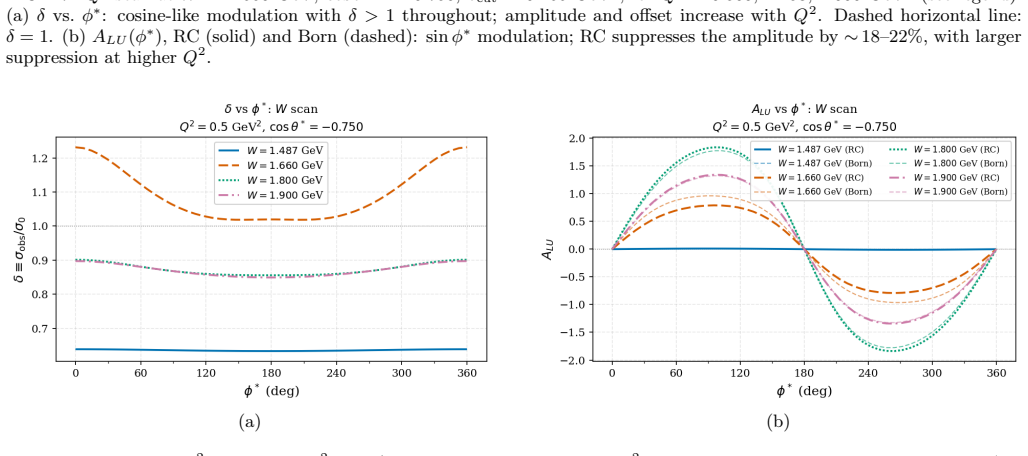
Radiative corrections to eta electroproduction vary by up to 30% across the resonance region and suppress beam-spin asymmetry by 15-25%.
A machine-rendered reading of the paper's core claim, the machinery that carries it, and where it could break.
Core claim
The paper presents a formalism for radiative correction calculations in exclusive η electroproduction on the proton, extending the pion treatment. Using the EXCLURAD code with EtaMAID-2023 multipole amplitudes, it finds that the cross-section correction factor δ varies by up to ∼30% for W = 1.49-2.0 GeV at E_beam = 6.535 GeV, with a local maximum near W ≃ 1.66 GeV driven by the S11(1535) and S11(1650) resonances. The beam-spin asymmetry is suppressed by 15-25% at the same kinematics, and numerical results are given for Q² = 0.3-4.0 GeV² and full angular range.
What carries the argument
The EXCLURAD code applied to EtaMAID-2023 multipole amplitudes, which evaluates the QED radiative correction factor δ for the eta electroproduction cross section and asymmetries.
If this is right
- Cross sections extracted from eta electroproduction data must be corrected by the calculated δ to avoid distortions of up to 30% in the resonance region.
- Beam-spin asymmetry measurements in this channel are reduced by 15-25%, changing the amplitudes that would be inferred without the correction.
- The provided numerical results for Q² = 0.3-4.0 GeV² and all angles enable consistent analysis of CLAS12 data across the resonance region.
- The same extended formalism can be applied to other exclusive meson channels once suitable multipole amplitudes are available.
Where Pith is reading between the lines
- Uncorrected eta production data from past or future experiments could carry systematic biases of order 30% near the S11 resonances when used to extract resonance parameters.
- The resonance-driven peak in the correction factor may affect comparisons of eta and pion channels when testing isospin relations or SU(3) flavor symmetry in baryon resonances.
Load-bearing premise
The EtaMAID-2023 multipole amplitudes provide a sufficiently accurate description of the eta electroproduction amplitudes for the computed radiative corrections to be reliable.
What would settle it
A direct comparison of measured eta electroproduction cross sections and beam-spin asymmetries at E_beam = 6.535 GeV and W near 1.66 GeV, before and after applying the calculated δ, would confirm or refute the predicted 30% variation and 15-25% asymmetry suppression.
Figures




read the original abstract
A formalism for radiative correction calculations in exclusive $\eta$ electroproduction on the proton is presented, extending the treatment developed for the pion channel. The EXCLURAD code is used in the radiative correction procedure with EtaMAID-2023 multipole amplitudes. The cross-section correction factor $\delta$ varies by up to ${\sim}\,30\%$ across the resonance region $W = 1.49$-$2.0$ GeV at $E_{\rm beam} = 6.535$ GeV, with a local maximum near $W \simeq 1.66$ GeV driven by the $S_{11}(1535)$ and $S_{11}(1650)$ resonances. The beam-spin asymmetry is suppressed by 15-25% at the same kinematics. Numerical results covering $Q^2 = 0.3$-$4.0$ GeV$^2$ and the full angular range are provided for kinematics relevant to CLAS12 experiments at Jefferson Lab.
Editorial analysis
A structured set of objections, weighed in public.
Referee Report
Summary. The manuscript develops a formalism for QED radiative corrections to exclusive η-meson electroproduction on the proton, extending the EXCLURAD code and treatment from the pion channel. Input amplitudes are taken from the EtaMAID-2023 multipole fit. The computed correction factor δ varies by up to ∼30% across the resonance region W=1.49–2.0 GeV at E_beam=6.535 GeV, with a local maximum near W≃1.66 GeV attributed to the S11(1535) and S11(1650) resonances; the beam-spin asymmetry is suppressed by 15–25% in the same kinematics. Numerical results are provided over Q²=0.3–4.0 GeV² and the full angular range for CLAS12-relevant kinematics.
Significance. If the numerical results are robust, the work supplies practical radiative-correction factors needed for the interpretation of CLAS12 η-electroproduction data in the resonance region. The amplitude-based approach correctly incorporates resonance structure into the hadronic tensor that enters the radiative integrals, which is an improvement over model-independent approximations. The extension of the established pion formalism to the η channel is a logical and useful step for the field.
major comments (1)
- [Numerical results] The central claims for the size (∼30%) and W-dependence of δ, including the local maximum near W≃1.66 GeV, are obtained by feeding EtaMAID-2023 multipoles directly into the radiative integrals. No variation of resonance couplings, widths, background terms, or comparison to alternative amplitude sets is shown, so it is impossible to determine whether the quoted magnitude and resonance-driven peak are stable features or artifacts of one particular fit (see abstract and numerical-results description).
Simulated Author's Rebuttal
We thank the referee for the careful review and the overall positive assessment of our work on QED radiative corrections to η-meson electroproduction. We provide a point-by-point response to the major comment below.
read point-by-point responses
-
Referee: The central claims for the size (∼30%) and W-dependence of δ, including the local maximum near W≃1.66 GeV, are obtained by feeding EtaMAID-2023 multipoles directly into the radiative integrals. No variation of resonance couplings, widths, background terms, or comparison to alternative amplitude sets is shown, so it is impossible to determine whether the quoted magnitude and resonance-driven peak are stable features or artifacts of one particular fit (see abstract and numerical-results description).
Authors: We acknowledge the validity of this observation. The numerical results presented in the manuscript are indeed computed using the EtaMAID-2023 multipole amplitudes without performing variations of the resonance parameters or comparisons to other amplitude models. This choice reflects the paper's primary focus on extending the established EXCLURAD formalism from the pion channel to η electroproduction and supplying practical correction factors based on the most comprehensive current multipole fit. The local maximum near W ≃ 1.66 GeV arises directly from the resonance content of the EtaMAID-2023 amplitudes, specifically the dominant S11(1535) and S11(1650) contributions. While a dedicated sensitivity study would strengthen the presentation, it lies outside the scope of the current work. In the revised manuscript we will add a concise discussion in the numerical-results section noting the model dependence on EtaMAID-2023 and indicating that the resonance-driven features are expected to be representative. We will also adjust the abstract wording accordingly. This amounts to a partial revision. revision: partial
Circularity Check
No significant circularity: radiative corrections computed directly from external multipole amplitudes
full rationale
The paper extends an existing radiative-correction framework (EXCLURAD) from the pion channel to eta electroproduction and evaluates the correction factor δ numerically using EtaMAID-2023 multipole amplitudes as input. The reported ~30% variation in δ and its resonance-driven features are direct outputs of this evaluation for chosen kinematics; they do not reduce to a self-definition, a fitted parameter renamed as a prediction, or a load-bearing self-citation chain. The amplitudes themselves are independent phenomenological fits to data, and the correction step is a separate QED calculation whose equations are not shown to be equivalent to those inputs by construction. No ansatz smuggling, uniqueness theorem, or renaming of known results is present in the derivation chain.
Axiom & Free-Parameter Ledger
axioms (2)
- domain assumption EtaMAID-2023 multipole amplitudes accurately represent the eta electroproduction process in the resonance region
- domain assumption The radiative-correction formalism developed for pions applies without modification to the eta channel
Reference graph
Works this paper leans on
-
[1]
L.-C. Liu, inProceedings of the Third International Sym- posium on Pion-Nucleon and Nucleon-Nucleon Physics (Leningrad Nuclear Physics Institute, Academy of Sci- ences of the USSR, Gatchina, USSR, 1989) report No. CONF-8904233-1, Los Alamos National Laboratory
work page 1989
-
[2]
D. Rönchen, M. Döring, H. Haberzettl, J. Haidenbauer, U.-G. Meißner, and K. Nakayama, Eur. Phys. J. A51, 70 (2015)
work page 2015
-
[3]
Navaset al.(Particle Data Group), Phys
S. Navaset al.(Particle Data Group), Phys. Rev. D110, 030001 (2024)
work page 2024
- [4]
- [5]
- [6]
- [7]
-
[8]
A. V. Klimenkoet al.(CLAS), Phys. Rev. C73, 035212 (2006)
work page 2006
-
[9]
H.Egiyanet al.(CLAS),Phys.Rev.C73,025204(2006)
work page 2006
- [10]
- [11]
-
[12]
G. V. Fedotovet al.(CLAS), Phys. Rev. C79, 015204 (2009)
work page 2009
- [13]
-
[14]
I. Bedlinskiyet al.(CLAS), Phys. Rev. Lett.109, 112001 (2012)
work page 2012
- [15]
-
[16]
I. Bedlinskiyet al.(CLAS), Phys. Rev. C90, 025205 (2014)
work page 2014
- [17]
- [18]
- [19]
- [20]
- [21]
- [22]
- [23]
-
[24]
A. Afanasev, I. Akushevich, V. Burkert, and K. Joo, Phys. Rev. D66, 074004 (2002)
work page 2002
-
[25]
A. Afanasev, A. Aleksejevs, and S. Barkanova, Phys. Rev. D88, 053008 (2013)
work page 2013
- [26]
-
[27]
W.-T. Chiang, S.-N. Yang, L. Tiator, and D. Drechsel, Nucl. Phys. A700, 429 (2002)
work page 2002
- [28]
-
[29]
I. Illari,Exclusiveηelectro-production beam spin asym- metry measurements using CLAS12 at Jefferson Lab, Tech. Rep. JLAB–PHY–24–4202 (George Washington 10 University, 2024)
work page 2024
-
[30]
J. P. Ellis, Comput. Phys. Commun.210, 103 (2017)
work page 2017
-
[31]
I. Illari, A. Afanasev, I. Strakovsky, W. Briscoe, V. Ka- shevarov, and A. Schmidt, “EXCLURAD forηelectro- production: source code, EtaMAID-2023 lookup tables, and radiative-correction output,” (2026), zenodo archive ofhttps://github.com/IzzyIllari/exclurad
work page 2023
-
[32]
G. F. Chew, M. L. Goldberger, F. E. Low, and Y. Nambu, Phys. Rev.106, 1337 (1957)
work page 1957
-
[33]
M. Mai, M. Döring, C. Granados, H. Haberzettl, U.-G. Meißner, D. Rönchen, I. Strakovsky, and R. Workman (Jülich-Bonn-Washington Collaboration), Phys. Rev. C 103, 065204 (2021)
work page 2021
-
[34]
M. Mai, M. Döring, C. Granados, H. Haberzettl, J. Her- genrather, U.-G. Meißner, D. Rönchen, I. Strakovsky, and R. Workman (Jülich-Bonn-Washington Collabora- tion), Phys. Rev. C106, 015201 (2022)
work page 2022
-
[35]
M. Mai, J. Hergenrather, M. Döring, T. Mart, U.-G. Meißner, D. Rönchen, and R. Workman (Jülich-Bonn- Washington Collaboration), Eur. Phys. J. A59, 286 (2023)
work page 2023
-
[36]
Y.-F. Wang, M. Döring, J. Hergenrather, M. Mai, T. Mart, U.-G. Meißner, D. Rönchen, and R. Workman (Jülich-Bonn-Washington Collaboration), Phys. Rev. Lett.133, 101901 (2024)
work page 2024
- [37]
-
[38]
Plotly.js open source graphing library,
Plotly Technologies Inc., “Plotly.js open source graphing library,” (2015)
work page 2015
-
[39]
M. Okabe and K. Ito, University of Tokyo Ecology and Civil Engineering (2002). 11 SUPPLEMENT AR Y MA TERIAL S1. Extendedv cut variations The main-text figure (Figure 8) shows the dependence of the RC factors on the inelasticity cutvcut at a single kinematic point:W= 1.900GeV,Q 2 = 0.4105 GeV 2,cosθ ∗ =−0.750,ϕ ∗ = 90◦. This section extends that scan to a ...
discussion (0)
Sign in with ORCID, Apple, or X to comment. Anyone can read and Pith papers without signing in.