Recognition: 3 theorem links
· Lean TheoremDesigning explicit functionals for the charge density in terms of a potential
Pith reviewed 2026-05-08 18:17 UTC · model grok-4.3
The pith
Charge density of inhomogeneous materials can be expressed explicitly as a functional of the Kohn-Sham potential using homogeneous electron gas response data.
A machine-rendered reading of the paper's core claim, the machinery that carries it, and where it could break.
Core claim
Approximations to the charge density expressed directly as functionals of the Kohn-Sham potential, constructed from the Lindhard response of the homogeneous electron gas and its extensions via Taylor series and Connector Theory, produce systematically better results for cubic helium as the approximation level is increased, all without solving the Schrödinger equation.
What carries the argument
The Lindhard density-density response function of the homogeneous electron gas, serving as the central building block to construct explicit functionals for the inhomogeneous charge density through nearsighted approximations, functional Taylor expansions, and Connector Theory refinements.
If this is right
- Charge density can be obtained without ever solving the Kohn-Sham Schrödinger equation.
- Higher levels of approximation based on the same building blocks lead to systematically better accuracy for prototypical inhomogeneous systems.
- The resulting expressions remain simple enough to calculate and analyze directly from the potential.
- The same model-data incorporation strategy used for exchange-correlation potentials can be applied to observables such as the density itself.
Where Pith is reading between the lines
- The method might be extended to other observables or to self-consistent calculations where the potential is updated iteratively using the explicit density functional.
- Transferability could be tested on additional strongly inhomogeneous systems such as surfaces or nanostructures to determine how far the homogeneous-gas starting point carries.
- If the approximations prove robust, they could reduce the computational cost of repeated density evaluations in large-scale simulations.
Load-bearing premise
Building blocks taken from the homogeneous electron gas Lindhard response remain sufficiently accurate when transferred to strongly inhomogeneous real materials such as cubic helium.
What would settle it
A direct numerical comparison in which even the highest-level Connector Theory approximation deviates substantially from the exact charge density of cubic helium obtained by solving the full Kohn-Sham equations would falsify the claim that this route yields useful improvements.
Figures


read the original abstract
One of the most powerful strategies to address properties of real many-body systems is to incorporate data obtained for models, for example, to use data of the homogeneous electron gas in order to build the Local Density Approximation for the Kohn-Sham exchange-correlation potential. In the present work, we examine to what extent we can use model data to design functionals directly for observables of materials. In particular, we study different approximations for the charge density of real inhomogeneous materials expressed as a simple, explicit functional of a given Kohn-Sham potential, using as central building block the Lindhard density-density response function of the homogeneous electron gas. Our increasingly realistic set of approximations includes a fully nearsighted expression equivalent to the Thomas-Fermi approximation, functional Taylor expansions, and different approximations to the Connector Theory developed in [Aouina \textit{et al.}, npj Computational Materials {\bf 11}, 242 (2025)]. In all cases, the charge density is obtained without ever solving the Kohn-Sham Schr\"odinger equation. Results for cubic helium, a prototypical strongly inhomogeneous material, systematically improve with higher levels of approximation, indicating that this is a promising route to obtain expressions that are relatively simple to calculate and to analyze.
Editorial analysis
A structured set of objections, weighed in public.
Referee Report
Summary. The paper develops explicit functionals for the charge density of inhomogeneous materials expressed directly in terms of a given Kohn-Sham potential. The central building block is the Lindhard density-density response function of the homogeneous electron gas, with successive approximations including a nearsighted Thomas-Fermi form, functional Taylor expansions, and several levels of Connector Theory from the authors' prior work. All expressions avoid solving the Kohn-Sham Schrödinger equation. The approach is illustrated on cubic helium, where the computed densities are reported to improve systematically as the level of approximation is increased.
Significance. If the transferability of the HEG-derived kernels holds for strongly inhomogeneous systems, the method could provide a route to simple, analyzable density expressions that bypass self-consistent KS calculations. The systematic internal improvement on cubic helium is a positive indicator, but the absence of external benchmarks (exact many-body densities or independent high-level calculations) limits the strength of the claim that this constitutes a promising general route.
major comments (2)
- [Abstract and results section on cubic helium] The headline claim that accuracy improves systematically with approximation level on cubic helium is presented without quantitative error metrics, baseline comparisons to exact or high-level reference densities, or implementation details for the helium test case. This makes it impossible to judge whether the observed trend reflects genuine convergence or merely internal consistency among the approximations.
- [Section describing Connector Theory approximations and the helium calculations] The central approximations rely on grafting HEG Lindhard response kernels onto the inhomogeneous problem via Connector Theory. No quantitative assessment is given of how well these kernels remain accurate when the density varies on the scale of the lattice constant in cubic helium, which is the precise regime highlighted as the test case.
minor comments (1)
- [Abstract] The abstract refers to 'different approximations to the Connector Theory' without specifying which variants are used or how they differ from the 2025 reference; a brief enumeration in the main text would improve clarity.
Simulated Author's Rebuttal
We thank the referee for the careful reading and constructive feedback. We address the two major comments point by point below. We will revise the manuscript to incorporate quantitative metrics, implementation details, and additional analysis of the approximations, thereby strengthening the presentation of the results on cubic helium.
read point-by-point responses
-
Referee: [Abstract and results section on cubic helium] The headline claim that accuracy improves systematically with approximation level on cubic helium is presented without quantitative error metrics, baseline comparisons to exact or high-level reference densities, or implementation details for the helium test case. This makes it impossible to judge whether the observed trend reflects genuine convergence or merely internal consistency among the approximations.
Authors: We agree that quantitative error metrics and explicit baseline comparisons would make the systematic improvement easier to assess. In the revised manuscript we will add a dedicated results subsection (or table) reporting quantitative measures such as the integrated absolute error and L2-norm difference between each approximated density and a reference density obtained from self-consistent Kohn-Sham DFT calculations on the same cubic-helium geometry and potential. Implementation details—including the discretization of the Lindhard function, the real-space grid, the cutoff parameters, and the precise connector mapping—will be moved from the supplementary material into the main text or a new appendix. While exact many-body densities are not computationally feasible for this system, the KS-DFT reference provides an independent, high-level benchmark that is standard in the field; the revised figures will therefore demonstrate that the observed trend is not merely internal consistency. revision: yes
-
Referee: [Section describing Connector Theory approximations and the helium calculations] The central approximations rely on grafting HEG Lindhard response kernels onto the inhomogeneous problem via Connector Theory. No quantitative assessment is given of how well these kernels remain accurate when the density varies on the scale of the lattice constant in cubic helium, which is the precise regime highlighted as the test case.
Authors: We acknowledge that a direct, quantitative test of the HEG-derived kernels under the strong inhomogeneity of cubic helium (density variation on the scale of the lattice constant) would strengthen the manuscript. The systematic improvement already shown in the helium results constitutes indirect evidence that the grafted kernels remain useful, but we will add an explicit discussion and, where possible, a supporting figure that quantifies the approximation error. Specifically, we will compare the connector-mapped Lindhard kernels against the actual density-density response extracted from the self-consistent KS calculation on the same system, and we will report the relative error as a function of wave-vector and real-space distance. This analysis will be placed in the section on Connector Theory approximations and will reference the nearsightedness properties established in our prior Connector Theory work. revision: yes
Circularity Check
Self-cited Connector Theory supplies load-bearing higher-order approximations without independent re-derivation
specific steps
-
self citation load bearing
[Abstract]
"different approximations to the Connector Theory developed in [Aouina et al., npj Computational Materials 11, 242 (2025)]"
The paper's increasingly realistic approximations for the charge density as an explicit functional of the KS potential include different levels of Connector Theory taken directly from the authors' prior work with overlapping authorship. The headline result—that accuracy improves systematically with approximation level on cubic helium—therefore depends on the transferability of this self-cited framework to strongly inhomogeneous systems, rather than re-deriving or externally validating the Connector Theory within the present manuscript.
full rationale
The derivation begins from the external HEG Lindhard response function and constructs explicit density functionals via successive approximations (TF, Taylor expansion, Connector Theory). Numerical tests on cubic helium show systematic improvement, supplying independent content against that benchmark. However, the higher approximations explicitly invoke Connector Theory from a 2025 paper with overlapping authors (Aouina et al.), making that framework load-bearing for the central claim of a promising route. This self-citation is not a full reduction by construction but warrants a moderate score because the improvement trend is measured inside the self-developed framework.
Axiom & Free-Parameter Ledger
axioms (1)
- domain assumption The Lindhard density-density response function of the homogeneous electron gas provides a usable building block for constructing density functionals in inhomogeneous materials.
Lean theorems connected to this paper
-
IndisputableMonolith.Cost.FunctionalEquationwashburn_uniqueness_aczel unclear?
unclearRelation between the paper passage and the cited Recognition theorem.
we study different approximations for the charge density of real inhomogeneous materials expressed as a simple, explicit functional of a given Kohn-Sham potential, using as central building block the Lindhard density-density response function of the homogeneous electron gas
What do these tags mean?
- matches
- The paper's claim is directly supported by a theorem in the formal canon.
- supports
- The theorem supports part of the paper's argument, but the paper may add assumptions or extra steps.
- extends
- The paper goes beyond the formal theorem; the theorem is a base layer rather than the whole result.
- uses
- The paper appears to rely on the theorem as machinery.
- contradicts
- The paper's claim conflicts with a theorem or certificate in the canon.
- unclear
- Pith found a possible connection, but the passage is too broad, indirect, or ambiguous to say the theorem truly supports the claim.
Reference graph
Works this paper leans on
-
[1]
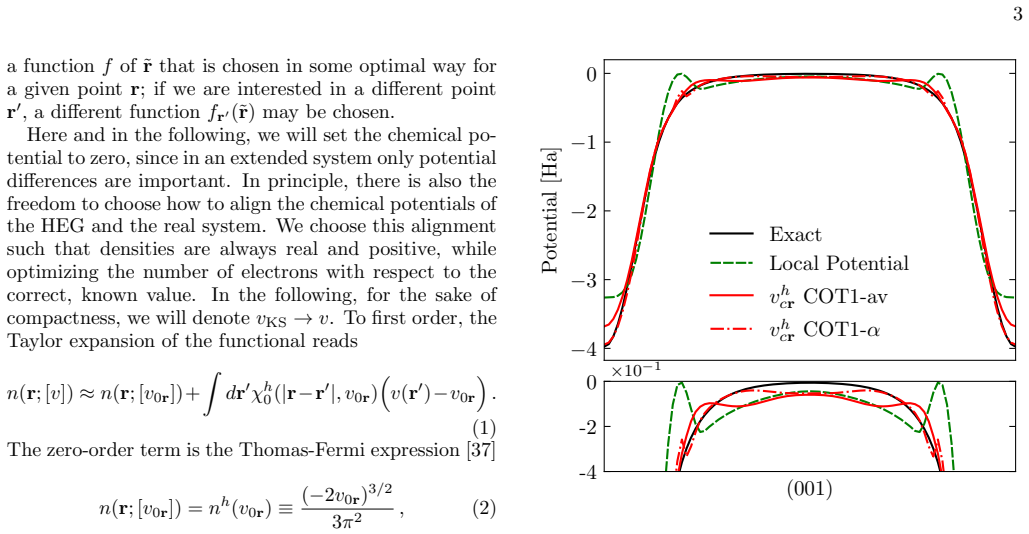
Local Potential Approximation A natural choice isv 0r =v(r), the local KS potential. This choice is motivated by the nearsightedness principle introduced by Walter Kohn [48, 49], which states that electronic properties at a given point are primarily influ- enced by the nearby environment. For our case, where we search for the density as a functional of th...
-
[2]
Moreover, the density is always positive, as opposed to Fig
Linear response and connector starting from LPA Figure 4 shows that the first-order correction brings the density on the atoms and its decay closer to the benchmark result, compared to this already significantly improved starting point. Moreover, the density is always positive, as opposed to Fig. 3. Still, the results of linear response are too similar to...
-
[3]
(8) with the connector approximation forχ 0 Eq
Improved termination of perturbation series Since linear response on top of the LPA is not power- ful enough, let us see how the improved Taylor expansion Eq. (8) with the connector approximation forχ 0 Eq. (10) using the approximation Eq. (13) will perform. The re- sult is shown in Figure 5. As in Fig. 3 and in comparison to Fig. 4, we find that the Cauc...
1919
-
[4]
Our aim in the following is to study strong compressions or expansions 9 1○ (001)
Compressed and expanded helium The above results were obtained for a lattice constant ofa= 8.016 Bohr (see Appendix A). Our aim in the following is to study strong compressions or expansions 9 1○ (001)
-
[5]
8 Density [Bohr −3] Reference COT1-av COT1-α 0.0 1.0 2.0 ×10⁻² FIG. 6. Charge density of helium calculated using Eq. (14) with Eq. (16) and the parametersAandBofα r = A(nLP A(r))B taken from a fit to the benchmark Kohn-Sham calculation. In black, the reference density. Red dash- dotted line, result of the fit. Red solid line, the most ad- vanced parameter...
-
[6]
8 Density [Bohr −3] Reference COT1-av COT1-α 1○ (001)
-
[7]
ANR-22-EXES-0013
8 Density [Bohr −3] Reference COT1-av COT1-α FIG. 8. Charge density of helium at different lattice con- stants. Upper panel: lattice constanta= 4 Bohr. Lower panel: lattice constanta= 15 Bohr. In black, the reference density. In solid, COT1-av result. Dash-dotted, COT1-αap- proximation usingα r with parameters taken from a fit to a Kohn-Sham calculation a...
2030
-
[8]
Since we deal with a non-interacting model, our input is the Kohn-Sham potential taken from the DFT calculation
General procedure To compare our calculations with the benchmark, we use a reference density from a DFT calculation. Since we deal with a non-interacting model, our input is the Kohn-Sham potential taken from the DFT calculation. Of course, one could in principle use any external poten- tial to benchmark the non-interacting case. Our test material is soli...
-
[9]
However, since the connector potential is essentially a suitable average of the KS potential, this problem arises only marginally, and only at a few points
Corrections In addition to the constant shift of density mentioned in the main text, which is used as exact constraint, it may happen that the connector potential becomes locally positive, which would lead to an imaginary density and therefore also requires a correction. However, since the connector potential is essentially a suitable average of the KS po...
-
[10]
Kohn, Reviews of Modern Physics71, 1253 (1999)
W. Kohn, Reviews of Modern Physics71, 1253 (1999)
1999
-
[11]
Hohenberg and W
P. Hohenberg and W. Kohn, Phys. Rev.136, B864 (1964)
1964
-
[12]
Kohn and L
W. Kohn and L. J. Sham, Phys. Rev.140, A1133 (1965)
1965
-
[13]
R. M. Martin, L. Reining, and D. M. Ceperley,Interact- ing Electrons(Cambridge University Press, 2016)
2016
-
[14]
A. M. Teale, T. Helgaker, A. Savin, C. Adamo, B. Aradi, A. V. Arbuznikov, P. W. Ayers, E. J. Baerends, V. Barone, P. Calaminici, E. Canc` es, E. A. Carter, P. K. Chattaraj, H. Chermette, I. Ciofini, T. D. Craw- ford, F. De Proft, J. F. Dobson, C. Draxl, T. Frauen- heim, E. Fromager, P. Fuentealba, L. Gagliardi, G. Galli, J. Gao, P. Geerlings, N. Gidopoulo...
2022
-
[15]
Zunger, Nature Reviews Chemistry2, 0121 (2018)
A. Zunger, Nature Reviews Chemistry2, 0121 (2018)
2018
-
[16]
Englert and J
B.-G. Englert and J. Schwinger, Phys. Rev. A29, 2339 (1984)
1984
-
[17]
Englert, Phys
B.-G. Englert, Phys. Rev. A45, 127 (1992)
1992
-
[18]
W. Yang, P. W. Ayers, and Q. Wu, Phys. Rev. Lett.92, 146404 (2004)
2004
-
[19]
Gross and C
E. Gross and C. Proetto, J. Chem. Theory Comput.5, 844 (2009)
2009
-
[20]
Elliott, D
P. Elliott, D. Lee, A. Cangi, and K. Burke, Phys. Rev. Lett.100, 256406 (2008)
2008
-
[21]
Cangi, D
A. Cangi, D. Lee, P. Elliott, and K. Burke, Phys. Rev. B 81, 235128 (2010)
2010
-
[22]
Cangi, D
A. Cangi, D. Lee, P. Elliott, K. Burke, and E. K. U. Gross, Phys. Rev. Lett.106, 236404 (2011)
2011
-
[23]
Cangi, E
A. Cangi, E. K. U. Gross, and K. Burke, Physical Review A88, 062505 (2013)
2013
-
[24]
W. C. Witt and E. A. Carter, Phys. Rev. B100, 125106 (2019)
2019
-
[25]
L. H. Thomas, Mathematical Proceedings of the Cam- bridge Philosophical Society23, 542–548 (1927)
1927
-
[26]
Fermi, Zeitschrift f¨ ur Physik48, 73 (1928)
E. Fermi, Zeitschrift f¨ ur Physik48, 73 (1928)
1928
-
[27]
W. Mi, K. Luo, S. B. Trickey, and M. Pavanello, Chemical Reviews123, 12039 (2023)
2023
-
[28]
Any observableOin equilibrium can be expressed as a trace involving the operator ˆOof the observable and the many-body Hamiltonian, O= 1 Z Tr e−β ˆH ˆO , withZ= Tre −β ˆH the partition function andβ= 1/(kBT)
-
[29]
D. M. Ceperley and B. J. Alder, Physical Review Letters 45, 566 (1980)
1980
-
[30]
Georges, G
A. Georges, G. Kotliar, W. Krauth, and M. J. Rozenberg, Rev. Mod. Phys.68, 13 (1996)
1996
-
[31]
Vanzini, A
M. Vanzini, A. Aouina, M. Panholzer, M. Gatti, and L. Reining, npj Computational Materials8, 98 (2022)
2022
-
[32]
Aouina, M
A. Aouina, M. Gatti, and L. Reining, npj Computational Materials11, 242 (2025)
2025
-
[33]
Lindhard, Kgl
J. Lindhard, Kgl. Danske Vidensk. Selsk. Mat.-Fys, Medd.28, 8 (1954)
1954
-
[34]
Lloyd and C
P. Lloyd and C. A. Sholl, Journal of Physics C: Solid State Physics1, 1620 (1968)
1968
-
[35]
Brovman, Y
G. Brovman, Y. Kagan, and A. Kholas, Zh. Eksp. Teor. Fiz.61, 737 (1971), [Sov. Phys. JETP34, 394 (1972)]
1971
-
[36]
Brovman and Y
G. Brovman and Y. Kagan, Zh. Eksp. Teor. Fiz.63, 1937 (1972), [Sov. Phys. JETP36, 1025 (1973)]
1937
-
[37]
Hammerberg and N
J. Hammerberg and N. W. Ashcroft, Phys. Rev. B9, 409 (1974)
1974
-
[38]
Pickenhain and A
R. Pickenhain and A. Milchev, physica status solidi (b) 77, 571 (1976)
1976
-
[39]
Milchev and R
A. Milchev and R. Pickenhain, physica status solidi (b) 79, 549 (1977)
1977
-
[40]
J. A. Porter, N. W. Ashcroft, and G. V. Chester, Phys. Rev. B81, 224113 (2010)
2010
-
[41]
Paasch and P
G. Paasch and P. Rennert, physica status solidi (b)83, 501 (1977)
1977
-
[42]
Paasch and A
G. Paasch and A. Heinrich, physica status solidi (b)102, 323 (1980)
1980
-
[43]
Heinrich and G
A. Heinrich and G. Paasch, physica status solidi (b)102, 521 (1980)
1980
-
[44]
P. K. W. Vinsome and D. Richardson, Journal of Physics C: Solid State Physics4, 3177 (1971)
1971
-
[45]
Baldereschi, K
A. Baldereschi, K. Maschke, A. Milchev, R. Pickenhain, and K. Unger, physica status solidi (b)108, 511 (1981)
1981
-
[46]
N. W. Ashcroft and N. D. Mermin,Solid state physics (Holt, Rinehart and Winston, New York, 1976)
1976
-
[47]
Giuliani and G
G. Giuliani and G. Vignale,Quantum theory of the elec- tron liquid(Cambridge University Press, 2005)
2005
-
[48]
Note that here we are working with a local pseudopo- tential, so the potential itself is not a measurable quan- tity, it only defines our Hamiltonian. For example, the strong wiggle at the bottom of the atoms appears in the pseudopotential used here, but other choices for the he- lium pseudopotential are possible that do not show these wiggles. The densit...
-
[49]
This problem is treated on a case-by-case basis
The fact that the exact connector exists does not guaran- tee that the approximate equations also have a solution. This problem is treated on a case-by-case basis
-
[50]
Hilton, N
D. Hilton, N. H. March, and A. R. Curtis, Proceedings of the Royal Society of London. A. Mathematical and Physical Sciences300, 391 (1967)
1967
-
[51]
N. H. March and J. C. Stoddart, Reports on Progress in Physics31, 303 (1968)
1968
-
[52]
G. P. Lawes and N. H. March, Physica Scripta21, 402 (1980)
1980
-
[53]
Unger, Annalen der Physik482, 161 (1971)
K. Unger, Annalen der Physik482, 161 (1971)
1971
-
[54]
Cauchy,R´ esum´ e des le¸ cons donn´ ees ` a l’´Ecole royale polytechnique sur le calcul infinit´ esimal(Imprimerie Royale, Paris, 1823) lecture notes 7,37
A.-L. Cauchy,R´ esum´ e des le¸ cons donn´ ees ` a l’´Ecole royale polytechnique sur le calcul infinit´ esimal(Imprimerie Royale, Paris, 1823) lecture notes 7,37
-
[55]
Lagrange,Th´ eorie des fonctions analytiques (Courcier, Paris, 1813) chapter VI
J.-L. Lagrange,Th´ eorie des fonctions analytiques (Courcier, Paris, 1813) chapter VI
-
[56]
A. F. Schuch and R. L. Mills, Phys. Rev. Lett.6, 596 (1961)
1961
-
[57]
Kohn, Phys
W. Kohn, Phys. Rev. Lett.76, 3168 (1996)
1996
-
[58]
Prodan and W
E. Prodan and W. Kohn, Proceedings of the National Academy of Sciences102, 11635 (2005)
2005
-
[59]
March, Advances in Physics6, 1 (1957)
N. March, Advances in Physics6, 1 (1957)
1957
-
[60]
E. H. Lieb and B. Simon, Advances in Mathematics23, 22 (1977)
1977
-
[61]
Parr and W
R. Parr and W. Yang,Density-Functional Theory of Atoms and Molecules, International Series of Monographs on Chemistry (Oxford University Press, 1994)
1994
-
[62]
Aouina, M
A. Aouina, M. Gatti, S. Chen, S. Zhang, and L. Reining, Phys. Rev. B107, 195123 (2023)
2023
-
[63]
S. Chen, M. Motta, F. Ma, and S. Zhang, Phys. Rev. B 103, 075138 (2021)
2021
-
[64]
Interestingly, [?] also found that Thomas-Fermi based approximations for the energy give improved results when one allows for too large number of electrons
-
[65]
Nagy, Journal of Computational Chemistry46, e70215 (2025)
´A. Nagy, Journal of Computational Chemistry46, e70215 (2025)
2025
-
[66]
C. F. v. Weizs¨ acker, Zeitschrift f¨ ur Physik96, 431 (1935)
1935
-
[67]
This connects to a rigorous result in DFT: the domain on which the Lieb universal func- tionalF[n] is finite is preciselyA N ={n≥0 : √n∈ H 1(R3), R n(r)dr=N}[? ?]
Equivalently, writingφ= √n, one obtainsI[n] = 4 N ∥∇φ∥2 L2, i.e.,I[n] is proportional to the square of the H 1 seminorm of √n. This connects to a rigorous result in DFT: the domain on which the Lieb universal func- tionalF[n] is finite is preciselyA N ={n≥0 : √n∈ H 1(R3), R n(r)dr=N}[? ?]. TheH 1 condition on √nis physically equivalent to requiring a fini...
-
[68]
J. P. Perdew and L. A. Constantin, Phys. Rev. B75, 155109 (2007)
2007
-
[69]
A. D. Kaplan, M. Levy, and J. P. Perdew, Annual Review of Physical Chemistry74, 193 (2023)
2023
-
[70]
Moroni, D
S. Moroni, D. M. Ceperley, and G. Senatore, Phys. Rev. Lett.69, 1837 (1992)
1992
-
[71]
Gonze, Zeitschrift f¨ ur Kristallographie - Crystalline Materials220, 558 (2005)
X. Gonze, Zeitschrift f¨ ur Kristallographie - Crystalline Materials220, 558 (2005)
2005
-
[72]
Troullier and J
N. Troullier and J. L. Martins, Phys. Rev. B43, 1993 (1991)
1993
discussion (0)
Sign in with ORCID, Apple, or X to comment. Anyone can read and Pith papers without signing in.