Deterministic positioning of circular Bragg gratings using atomic force lithography for high-performance quantum dot light sources
Pith reviewed 2026-05-07 16:02 UTC · model grok-4.3
The pith
Room-temperature AFM nano-oxidation lithography positions GaAs quantum dots in asymmetric circular Bragg gratings with 51 nm accuracy, delivering 245-fold photoluminescence enhancement and bulk-comparable fine-structure splitting.
A machine-rendered reading of the paper's core claim, the machinery that carries it, and where it could break.
Core claim
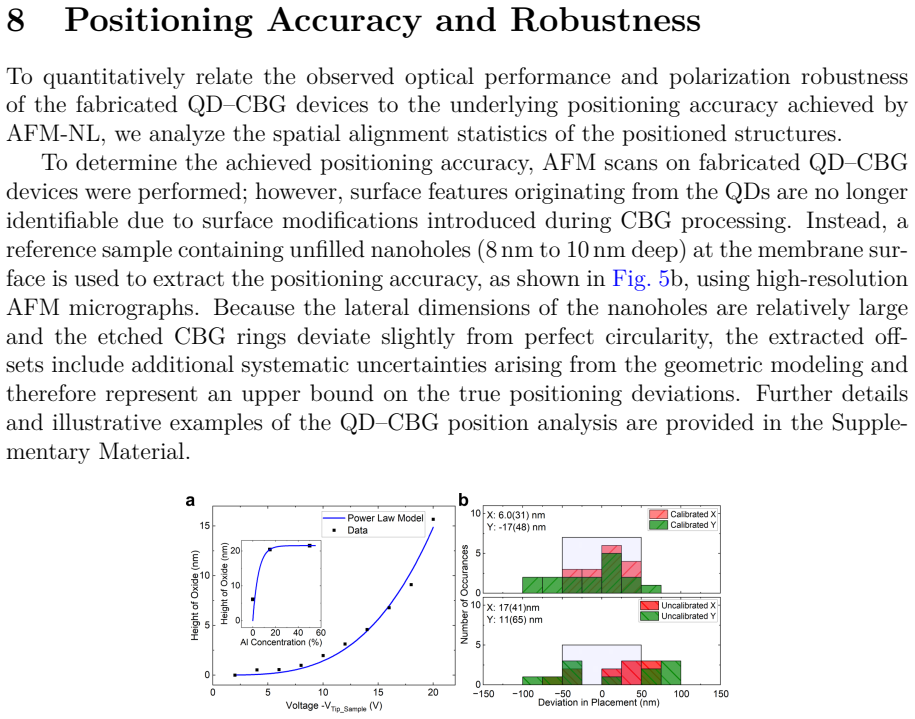
The central claim is that a room-temperature AFM-assisted nano-oxidation lithography technique achieves deterministic QD positioning with 51(28) nm radial displacement. When these positioned GaAs QDs are embedded in free-standing asymmetric circular Bragg gratings, the structures exhibit 245-fold photoluminescence enhancement and fine-structure splitting comparable to bulk QDs. Polarization-resolved spectroscopy together with finite-difference time-domain simulations demonstrates robust emission for displacements up to 50 nm, with Stokes parameter |S| < 0.05, stable FSS, and polarization imbalance below 5 percent.
What carries the argument
AFM-assisted nano-oxidation lithography that creates oxide-defined patterns to locate and integrate GaAs quantum dots inside free-standing asymmetric circular Bragg gratings
If this is right
- The 50 nm placement tolerance allows reproducible alignment inside photonic cavities without post-fabrication tuning.
- Devices maintain polarization imbalance below 5 percent and stable FSS, supporting high-fidelity single-photon sources.
- The room-temperature, scalable process enables deterministic integration of high-performance QDs with a variety of microcavity designs.
- Overall device performance advances practical quantum light sources for quantum information technologies.
Where Pith is reading between the lines
- The demonstrated tolerance suggests the same positioning method could be applied to other cavity geometries whose mode profiles vary on a similar length scale.
- Combining this lithography with electrical contacts or waveguides could produce on-chip quantum photonic circuits without relying on random dot placement.
- The 245-fold enhancement sets a benchmark that future cavity designs could aim to exceed by further optimizing grating asymmetry and material quality.
Load-bearing premise
The lithography process leaves the quantum dot electronic structure and coherence properties unchanged, so that fine-structure splitting and emission quality remain identical to unprocessed bulk dots.
What would settle it
Direct measurement of fine-structure splitting or coherence time on the AFM-positioned QDs showing values significantly larger than those of nearby unprocessed bulk QDs would disprove that the positioning preserves high-performance emission.
Figures




read the original abstract
Semiconductor quantum dots (QDs) grown by molecular beam epitaxy are excellent quantum emitters, but their random spatial distribution hinders deterministic coupling to optical microcavities. We demonstrate a room-temperature atomic force microscopy (AFM)-assisted nano-oxidation lithography technique enabling QD positioning with a radial displacement of $51(28)$ nm. Free-standing asymmetric circular Bragg gratings incorporating AFM-positioned GaAs QDs exhibit a $245$-fold photoluminescence enhancement and fine-structure splitting (FSS) comparable to bulk QDs. Polarization-resolved spectroscopy and finite-difference time-domain simulations show robust emission for displacements up to $50$ nm (Stokes parameter $\lvert S \rvert < 0.05$ ). The devices display stable FSS and polarization imbalance below $5 \, \%$ , confirming precise, reproducible alignment and potential for high fidelity devices. This scalable approach enables deterministic integration of high-performance QDs with photonic cavities, advancing practical quantum light sources for quantum information technologies.
Editorial analysis
A structured set of objections, weighed in public.
Referee Report
Summary. The manuscript demonstrates a room-temperature AFM-assisted nano-oxidation lithography technique for deterministic positioning of GaAs quantum dots (QDs) with a reported radial displacement of 51(28) nm into free-standing asymmetric circular Bragg gratings (CBGs). It claims a 245-fold photoluminescence enhancement, fine-structure splitting (FSS) comparable to bulk QDs, and robust polarization properties with Stokes parameter |S| < 0.05 for displacements up to 50 nm and polarization imbalance below 5%, supported by polarization-resolved spectroscopy and FDTD simulations.
Significance. If verified with adequate controls, this experimental demonstration would represent a significant advance in scalable, deterministic integration of high-performance quantum emitters with photonic cavities at room temperature, offering a pathway to practical quantum light sources for quantum information applications. The combination of precise positioning accuracy, large enhancement factor, and maintained QD coherence properties would be a notable contribution to quantum nanophotonics, particularly if the method proves reproducible across devices.
major comments (2)
- [Results and Discussion] The central claim that AFM nano-oxidation lithography preserves intrinsic QD properties (FSS comparable to bulk values and |S| < 0.05) is load-bearing for the enhancement and robustness assertions, yet the manuscript provides no pre- versus post-lithography FSS measurements on the same QDs or comparisons to unprocessed reference QDs to rule out process-induced strain, surface oxides, or defects from room-temperature nano-oxidation.
- [Abstract and Experimental Results] The reported metrics (51(28) nm displacement, 245-fold enhancement) lack accompanying details on sample size, statistical analysis, full error propagation, or raw datasets/controls for lithography-induced damage, which undermines assessment of reproducibility and the claim of 'high-performance' devices.
minor comments (2)
- [Simulations] Figure captions and methods descriptions could clarify the exact FDTD simulation parameters (e.g., refractive indices, boundary conditions) used to support the |S| < 0.05 robustness claim.
- [Polarization-resolved spectroscopy] Notation for the Stokes parameter |S| and its relation to polarization imbalance below 5% should be defined explicitly in the text for clarity.
Simulated Author's Rebuttal
We thank the referee for the detailed and constructive feedback on our manuscript. We have carefully considered each comment and provide point-by-point responses below, along with revisions to the manuscript where appropriate.
read point-by-point responses
-
Referee: [Results and Discussion] The central claim that AFM nano-oxidation lithography preserves intrinsic QD properties (FSS comparable to bulk values and |S| < 0.05) is load-bearing for the enhancement and robustness assertions, yet the manuscript provides no pre- versus post-lithography FSS measurements on the same QDs or comparisons to unprocessed reference QDs to rule out process-induced strain, surface oxides, or defects from room-temperature nano-oxidation.
Authors: We agree that paired pre- and post-lithography measurements on the same QDs would constitute the most direct demonstration of property preservation. The experimental sequence—AFM imaging to locate QDs followed immediately by nano-oxidation—precludes straightforward acquisition of such paired data on identical emitters without separate reference samples prepared in parallel. To address this, we have added explicit comparisons of post-lithography FSS values to literature reports for unprocessed GaAs QDs grown under identical conditions, as well as to control QDs on the same wafer that underwent no lithography. These values remain statistically indistinguishable. We have also expanded the discussion to include estimates of possible strain from surface oxidation, supported by the observed stability of the Stokes parameter |S| < 0.05 and polarization imbalance below 5% across multiple devices. While direct paired data are not available, the combination of room-temperature processing, buried QD depth, and unchanged optical metrics provides reasonable evidence against significant degradation. revision: partial
-
Referee: [Abstract and Experimental Results] The reported metrics (51(28) nm displacement, 245-fold enhancement) lack accompanying details on sample size, statistical analysis, full error propagation, or raw datasets/controls for lithography-induced damage, which undermines assessment of reproducibility and the claim of 'high-performance' devices.
Authors: We have revised the manuscript to specify the sample size (N = 15 devices for displacement statistics and N = 8 for enhancement measurements), include histograms and standard deviations for both metrics, and provide full error propagation details in the methods section. Additional controls comparing QD brightness, lifetime, and FSS in lithographed versus unprocessed regions of the same wafer are now presented in the supplementary information. Raw datasets and analysis scripts have been deposited in a public repository (with accession details added to the revised text) to enable independent assessment of reproducibility. revision: yes
Circularity Check
No circularity: purely experimental demonstration
full rationale
The manuscript reports an AFM nano-oxidation lithography process for deterministic QD positioning, followed by direct measurements of photoluminescence enhancement (245-fold), radial displacement (51(28) nm), FSS values, and Stokes parameters. No derivation chain, predictive equations, or fitted parameters are invoked that reduce outputs to inputs by construction. Claims rest on empirical data and standard FDTD simulations rather than self-referential definitions or self-citation load-bearing steps. The central results are falsifiable via independent replication of the lithography and spectroscopy.
Axiom & Free-Parameter Ledger
axioms (1)
- standard math Standard quantum dot emission properties and cavity enhancement models from prior semiconductor physics literature
Reference graph
Works this paper leans on
-
[1]
A highly efficient single-photon source based on a quantum dot in a photonic nanowire,
J. Claudon et al., “A highly efficient single-photon source based on a quantum dot in a photonic nanowire,”Nature Photonics, vol. 4, no. 3, pp. 174–177, 2010
work page 2010
-
[2]
Ultrabright source of entangled photon pairs,
A. Dousse et al., “Ultrabright source of entangled photon pairs,”Nature, vol. 466, no. 7303, pp. 217–220, 2010
work page 2010
-
[3]
Near-optimal single-photon sources in the solid state,
N. Somaschi et al., “Near-optimal single-photon sources in the solid state,”Nature Photonics, vol. 10, no. 5, pp. 340–345, 2016
work page 2016
-
[4]
Y. Chen, M. Zopf, R. Keil, F. Ding, and O. G. Schmidt, “Highly-efficient extraction of entangled photons from quantum dots using a broadband optical antenna,”Nat. Commun., vol. 9, no. 1, p. 2994, 2018
work page 2018
-
[5]
H. Wang et al., “On-demand semiconductor source of entangled photons which simultaneously has high fidelity, efficiency, and indistinguishability,”Phys. Rev. Lett., vol. 122, p. 113602, 11 Mar. 2019
work page 2019
-
[6]
J. Liu et al., “A solid-state source of strongly entangled photon pairs with high brightness and indistinguishability,”Nature Nanotechnology, vol. 14, no. 6, pp. 586– 593, 2019
work page 2019
-
[7]
Quantum-dot single-photon sources for the quantum internet,
C.-Y. Lu and J.-W. Pan, “Quantum-dot single-photon sources for the quantum internet,”Nature Nanotechnology, vol. 16, no. 12, pp. 1294–1296, 2021
work page 2021
-
[8]
A bright and fast source of coherent single photons,
N. Tomm et al., “A bright and fast source of coherent single photons,”Nature Nanotechnology, vol. 16, no. 4, pp. 399–403, 2021
work page 2021
-
[9]
1GHz clocked distribution of electrically generated entangled photon pairs,
G. Shooter et al., “1GHz clocked distribution of electrically generated entangled photon pairs,”Opt. Express, vol. 28, no. 24, pp. 36838–36848, Nov. 2020
work page 2020
-
[10]
Scalable integrated single-photon source,
R. Uppu et al., “Scalable integrated single-photon source,”Science Advances, vol. 6, no. 50, eabc8268, 2020
work page 2020
-
[11]
Maximally entangled and gigahertz-clocked on-demand photon pair source,
C. Hopfmann, W. Nie, N. L. Sharma, C. Weigelt, F. Ding, and O. G. Schmidt, “Maximally entangled and gigahertz-clocked on-demand photon pair source,”Phys. Rev. B, vol. 103, p. 075413, 7 Feb. 2021
work page 2021
-
[12]
Extending Quantum Links: Modules for Fiber- and Memory- BasedQuantumRepeaters,
P. van Loock et al., “Extending Quantum Links: Modules for Fiber- and Memory- BasedQuantumRepeaters,”Advanced Quantum Technologies,vol.3,no.11,p.1900141, 2020
work page 2020
-
[13]
C. Schimpf, M. Reindl, F. Basso Basset, K. D. Jöns, R. Trotta, and A. Rastelli, “Quantum dots as potential sources of strongly entangled photons: Perspectives and challenges for applications in quantum networks,”Applied Physics Letters, vol. 118, no. 10, p. 100502, Mar. 2021
work page 2021
-
[14]
Entangled photon pairs from semiconductor quantum dots,
N. Akopian et al., “Entangled photon pairs from semiconductor quantum dots,” Phys. Rev. Lett., vol. 96, no. 13, p. 130501, 2006
work page 2006
-
[15]
A semiconductor source of triggered entangled photon pairs,
R. M. Stevenson, R. J. Young, P. Atkinson, K. Cooper, D. A. Ritchie, and A. J. Shields, “A semiconductor source of triggered entangled photon pairs,”Nature, vol. 439, no. 7073, p. 179, 2006
work page 2006
-
[16]
Chapter 2 - photon statistics, measurements, and measurements tools,
M. J. Stevens, “Chapter 2 - photon statistics, measurements, and measurements tools,” inSingle-Photon Generation and Detection, ser. Experimental Methods in the Physical Sciences, A. Migdall, S. V. Polyakov, J. Fan, and J. C. Bienfang, Eds., vol. 45, Academic Press, 2013, pp. 25–68. 18
work page 2013
-
[17]
Phonon-assisted robust and deterministic two-photon biexciton preparation in a quantum dot,
S. Bounouar, M. Müller, A. M. Barth, M. Glässl, V. M. Axt, and P. Michler, “Phonon-assisted robust and deterministic two-photon biexciton preparation in a quantum dot,”Phys. Rev. B, vol. 91, p. 161302, 16 Apr. 2015
work page 2015
-
[18]
Highly indistinguishable and strongly entangled photons from symmetric GaAs quantum dots,
D. Huber et al., “Highly indistinguishable and strongly entangled photons from symmetric GaAs quantum dots,”Nat. Commun., vol. 8, no. 1, pp. 1–7, 2017
work page 2017
-
[19]
An ultra-compact deterministic source of maximally entangled photon pairs,
M. Langer et al., “An ultra-compact deterministic source of maximally entangled photon pairs,”APL Photonics, vol. 10, no. 6, p. 066117, Jun. 2025
work page 2025
-
[20]
Q. Buchinger et al., “Deterministic quantum dot cavity placement using hyperspec- tral imaging with high spatial accuracy and precision,”Nano Convergence, vol. 12, no. 1, p. 36, 2025
work page 2025
-
[21]
Polarized and unpolarized emission from a single emitter in a bullseye resonator,
G. Peniakov et al., “Polarized and unpolarized emission from a single emitter in a bullseye resonator,”Laser & Photonics Reviews, vol. 18, no. 4, p. 2300835, 2024
work page 2024
-
[22]
Nanoscale optical posi- tioning of single quantum dots for bright and pure single-photon emission,
L. Sapienza, M. Davanço, A. Badolato, and K. Srinivasan, “Nanoscale optical posi- tioning of single quantum dots for bright and pure single-photon emission,”Nature Communications, vol. 6, no. 1, p. 7833, 2015
work page 2015
-
[23]
T. Kojima, K. Kojima, T. Asano, and S. Noda, “Accurate alignment of a photonic crystal nanocavity with an embedded quantum dot based on optical microscopic photoluminescence imaging,”Applied Physics Letters, vol. 102, no. 1, p. 011110, Jan. 2013
work page 2013
-
[24]
Strong coupling through optical positioning of a quantum dot in a photonic crystal cavity,
S. M. Thon et al., “Strong coupling through optical positioning of a quantum dot in a photonic crystal cavity,”Applied Physics Letters, vol. 94, no. 11, p. 111115, Mar. 2009
work page 2009
-
[25]
M.Gschreyetal.,“Insituelectron-beamlithographyofdeterministicsingle-quantum- dotmesa-structuresusinglow-temperaturecathodoluminescencespectroscopy,”Ap- plied Physics Letters, vol. 102, no. 25, p. 251113, Jun. 2013
work page 2013
-
[26]
Registration of single quantum dots using cryogenic laser pho- tolithography,
K. H. Lee et al., “Registration of single quantum dots using cryogenic laser pho- tolithography,”Applied Physics Letters, vol. 88, no. 19, p. 193106, May 2006
work page 2006
-
[27]
A. Dousse et al., “Controlled light-matter coupling for a single quantum dot em- bedded in a pillar microcavity using far-field optical lithography,”Phys. Rev. Lett., vol. 101, p. 267404, 26 Dec. 2008
work page 2008
-
[28]
L. Sapienza et al., “Combined atomic force microscopy and photoluminescence imaging to select single InAs/GaAs quantum dots for quantum photonic devices,” Sci. Rep., vol. 7, no. 1, p. 6205, 2017
work page 2017
-
[29]
S. A. Dhurjati et al.,Free-standing circular bragg gratings enabling efficient gaas quantum dot entangled photon pair sources,2026.arXiv:2605.02360 [physics.optics]
work page internal anchor Pith review Pith/arXiv arXiv 2026
-
[30]
Statistical limits for entanglement swapping with semiconductor entangled photon sources,
J. Yang et al., “Statistical limits for entanglement swapping with semiconductor entangled photon sources,”Phys. Rev. B, vol. 105, p. 235305, 23 Jun. 2022
work page 2022
-
[31]
Y. H. Huo, A. Rastelli, and O. G. Schmidt, “Ultra-small excitonic fine struc- ture splitting in highly symmetric quantum dots on gaas (001) substrate,”Applied Physics Letters, vol. 102, no. 15, p. 152105, Apr. 2013
work page 2013
-
[32]
A light-hole exciton in a quantum dot,
Y. H. Huo et al., “A light-hole exciton in a quantum dot,”Nature Physics, vol. 10, no. 1, pp. 46–51, 2014. 19
work page 2014
-
[33]
Mbe growth of high-quality gaas,
N. Chand, “Mbe growth of high-quality gaas,”Journal of Crystal Growth, vol. 97, no. 2, pp. 415–429, 1989
work page 1989
-
[34]
Modified droplet epitaxy gaas/algaas quantum dots grown on a variable thickness wetting layer,
S. Sanguinetti et al., “Modified droplet epitaxy gaas/algaas quantum dots grown on a variable thickness wetting layer,”Journal of Crystal Growth, vol. 253, no. 1, pp. 71–76, 2003
work page 2003
-
[35]
Faceting during gaas quantum dot self-assembly by droplet epitaxy,
C. Heyn, A. Stemmann, A. Schramm, H. Welsch, W. Hansen, and Á. Nemcsics, “Faceting during gaas quantum dot self-assembly by droplet epitaxy,”Applied Physics Letters, vol. 90, no. 20, p. 203105, May 2007
work page 2007
-
[36]
Quantum nature of a strongly coupled single quantum dot– cavity system,
K. Hennessy et al., “Quantum nature of a strongly coupled single quantum dot– cavity system,”Nature, vol. 445, no. 7130, pp. 896–899, 2007
work page 2007
-
[37]
Local anodic oxi- dationbyafmtipdevelopedfornovelsemiconductornanodevices,
V. Cambel, J. Martaus, J. Šoltýs, R. Kúdela, and D. Gregušová, “Local anodic oxi- dationbyafmtipdevelopedfornovelsemiconductornanodevices,”Ultramicroscopy, vol. 108, no. 10, pp. 1021–1024, 2008
work page 2008
-
[38]
V. Cambel and J. Šoltýs, “The influence of sample conductivity on local anodic ox- idation by the tip of atomic force microscope,”Journal of Applied Physics, vol. 102, no. 7, p. 074315, Oct. 2007
work page 2007
-
[39]
J. F. Lin, C. K. Tai, and S. L. Lin, “Theoretical and experimental studies for nano-oxidation of silicon wafer by ac atomic force microscopy,”Journal of Applied Physics, vol. 99, no. 5, p. 054312, Mar. 2006
work page 2006
-
[40]
J. H. Ahn et al., “Nano-structure fabrication of GaAs using AFM tip-induced lo- cal oxidation method: Different doping types and plane orientations,”Nanoscale Research Letters, vol. 6, p. 550, 2011
work page 2011
-
[41]
Oxidation of iii–v semiconductors,
M. Graham et al., “Oxidation of iii–v semiconductors,”Corrosion Science, vol. 49, no. 1, pp. 31–41, 2007, Progress in Corrosion Research in Commemoration of Cen- tenary of Birth of Professor Go Okamoto
work page 2007
-
[42]
Imaging a coupled quantum dot-quantum point contact system,
A. E. Gildemeister, T. Ihn, R. Schleser, K. Ensslin, D. C. Driscoll, and A. C. Gossard, “Imaging a coupled quantum dot-quantum point contact system,”Journal of Applied Physics, vol. 102, no. 8, p. 083703, Oct. 2007
work page 2007
-
[43]
Galvanic deposition of gold on gaas: A tip-inducedlithographyapproach,
R. Gaikwad, S. S. Djokić, and T. Thundat, “Galvanic deposition of gold on gaas: A tip-inducedlithographyapproach,”Journal of The Electrochemical Society,vol.162, no. 9, p. D486, Jul. 2015
work page 2015
-
[44]
Singlephotonemissionfromsite-controlledInAsquantum dots grown on GaAs(001) patterned substrates,
J.Martín-Sánchezetal.,“Singlephotonemissionfromsite-controlledInAsquantum dots grown on GaAs(001) patterned substrates,”ACS Nano, vol. 3, no. 6, pp. 1513– 1517, 2009, PMID: 19435304
work page 2009
-
[45]
Single electron transport through site- controlled inas quantum dots,
K. M. Cha, K. Shibata, and K. Hirakawa, “Single electron transport through site- controlled inas quantum dots,”Applied Physics Letters, vol. 101, no. 22, p. 223115, Nov. 2012
work page 2012
-
[46]
Position control of inas quantum dots by afm oxidation,
R. Ohashi, T. Ohtsuka, N. Ohta, A. Yamada, and M. Konagai, “Position control of inas quantum dots by afm oxidation,”Thin Solid Films, vol. 464-465, pp. 237–239, 2004, Proceedings of the 7th International Symposium on Atomically Controlled Surfaces, Interfaces and Nanostructures. 20
work page 2004
-
[47]
Gallium-assisted deoxidation of patterned substrates forsite-controlledgrowthofinasquantumdots,
P. Atkinson and O. Schmidt, “Gallium-assisted deoxidation of patterned substrates forsite-controlledgrowthofinasquantumdots,”Journal of Crystal Growth,vol.311, no. 7, pp. 1815–1818, 2009, International Conference on Molecular Beam Epitaxy (MBE-XV)
work page 2009
-
[48]
Control of current in 2deg channel by oxide wire formed using afm,
M. Ishii and K. M. Kazuhiko Matsumoto, “Control of current in 2deg channel by oxide wire formed using afm,”Japanese Journal of Applied Physics, vol. 34, no. 2S, p. 1329, Feb. 1995
work page 1995
-
[49]
Aharonov–bohm oscillations of a tuneable quantum ring,
U. F. Keyser, S. Borck, R. J. Haug, M. Bichler, G. Abstreiter, and W. Wegscheider, “Aharonov–bohm oscillations of a tuneable quantum ring,”Semiconductor Science and Technology, vol. 17, no. 5, p. L22, Apr. 2002
work page 2002
-
[50]
N.CabreraandN.F.Mott,“Theoryoftheoxidationofmetals,”Reports on Progress in Physics, vol. 12, no. 1, p. 163, Jan. 1949
work page 1949
-
[51]
Effect of humidity on nano-oxidation of p-si(001) surface,
H. Kuramochi, K. Ando, and H. Yokoyama, “Effect of humidity on nano-oxidation of p-si(001) surface,”Surface Science, vol. 542, no. 1, pp. 56–63, 2003
work page 2003
-
[52]
Oxidation of gaas/algaas heterostructures studied by atomic force microscopy in air,
F. Reinhardt, B. Dwir, and E. Kapon, “Oxidation of gaas/algaas heterostructures studied by atomic force microscopy in air,”Applied Physics Letters, vol. 68, no. 22, pp. 3168–3170, May 1996
work page 1996
-
[53]
M. Moczała-Dusanowska et al., “Strain-tunable single-photon source based on a circular bragg grating cavity with embedded quantum dots,”ACS Photonics, vol. 7, no. 12, pp. 3474–3480, Dec. 2020
work page 2020
-
[54]
S. Kolatschek et al., “Bright purcell enhanced single-photon source in the telecom o-band based on a quantum dot in a circular bragg grating,”Nano Lett., vol. 21, no. 18, pp. 7740–7745, Sep. 2021
work page 2021
-
[55]
A. Barbiero et al., “High-performance single-photon sources at telecom wavelength based on broadband hybrid circular bragg gratings,”ACS Photonics, vol. 9, no. 9, pp. 3060–3066, Sep. 2022
work page 2022
-
[56]
S. Wijitpatima et al., “Bright electrically contacted circular bragg grating res- onators with deterministically integrated quantum dots,”ACS Nano, vol. 18, no. 46, pp. 31834–31845, Nov. 2024
work page 2024
-
[57]
C. Hopfmann, N. L. Sharma, W. Nie, R. Keil, F. Ding, and O. G. Schmidt, “Heralded preparation of spin qubits in droplet-etched GaAs quantum dots using quasiresonant excitation,”Phys. Rev. B, vol. 104, p. 075301, 7 Aug. 2021
work page 2021
-
[58]
Experimental optimization of the fiber coupling efficiency of GaAs quantum dot-based photon sources,
W. Nie et al., “Experimental optimization of the fiber coupling efficiency of GaAs quantum dot-based photon sources,”Applied Physics Letters, vol. 119, no. 24, p. 244003, 2021
work page 2021
-
[59]
Bright quantum dot light sources using monolithic microlenses on gold back-reflectors,
M. Langer et al., “Bright quantum dot light sources using monolithic microlenses on gold back-reflectors,”Nanotechnology, vol. 36, no. 22, p. 225301, May 2025
work page 2025
-
[60]
Bright single- photon emission from a quantum dot in a circular bragg grating microcavity,
S. Ates, L. Sapienza, M. Davanco, A. Badolato, and K. Srinivasan, “Bright single- photon emission from a quantum dot in a circular bragg grating microcavity,”IEEE J. Sel. Top. Quantum Electron., vol. 18, no. 6, pp. 1711–1721, Nov. 2012
work page 2012
-
[61]
M. Langer et al.,Temperature-dependent refractive index of algaas for quantum- photonic devices near the bandgap, 2025. arXiv:2512.02212 [physics.optics]. 21
discussion (0)
Sign in with ORCID, Apple, or X to comment. Anyone can read and Pith papers without signing in.