Efficient Quasi-Resonant, Polarization-Selective Excitation of GaN Quantum Emitters
Pith reviewed 2026-05-08 16:57 UTC · model grok-4.3
The pith
Tuning the excitation laser to specific resonances boosts photoluminescence from GaN defect centers by up to an order of magnitude while allowing polarization-selective control.
A machine-rendered reading of the paper's core claim, the machinery that carries it, and where it could break.
Core claim
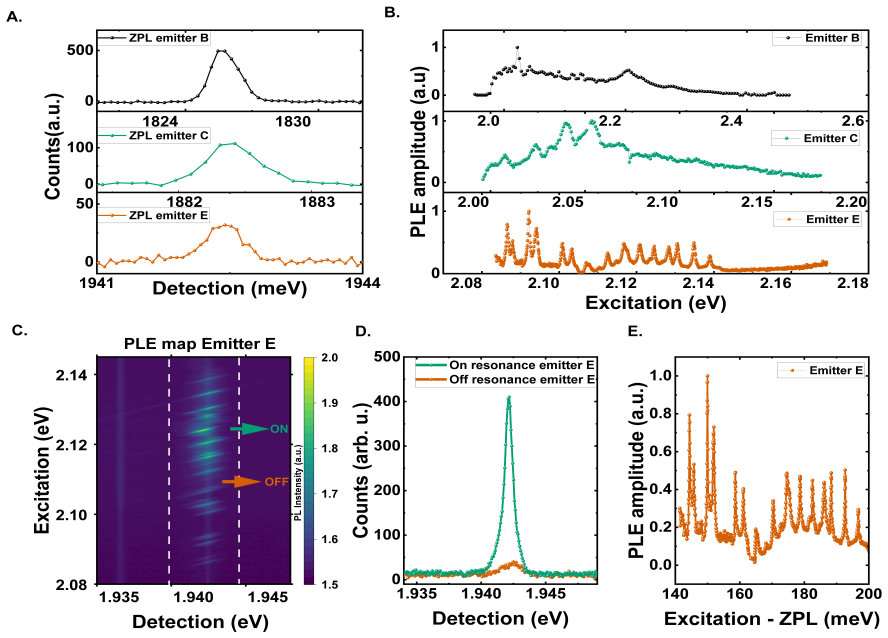
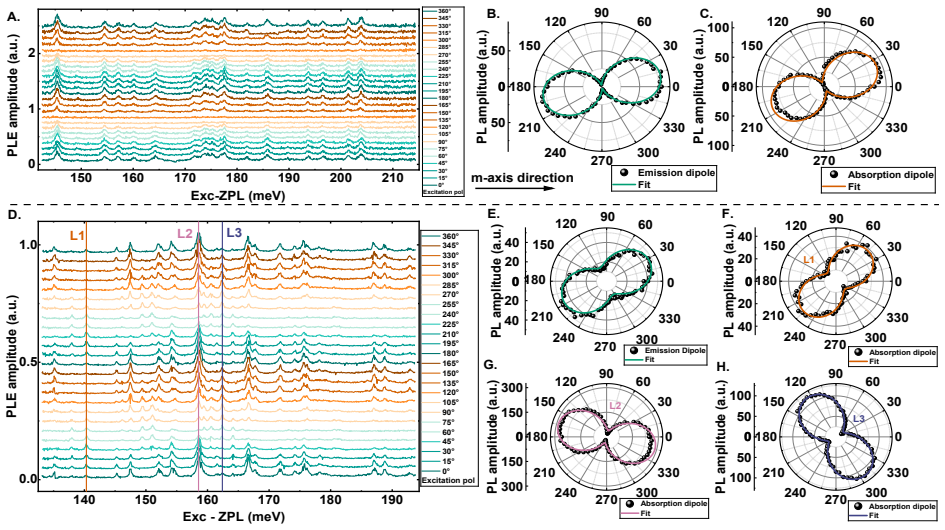
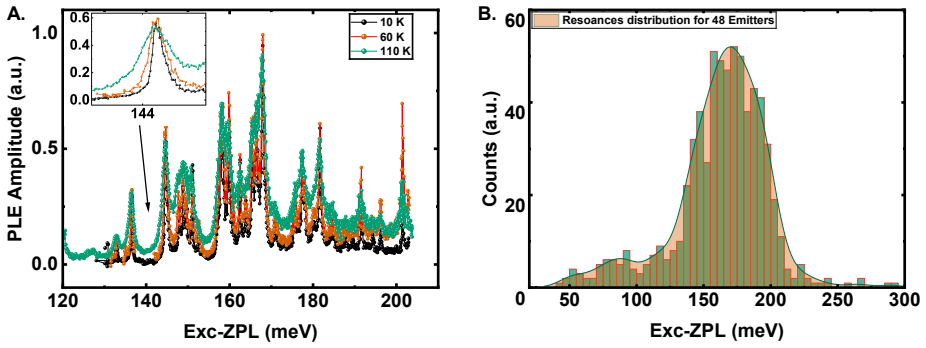
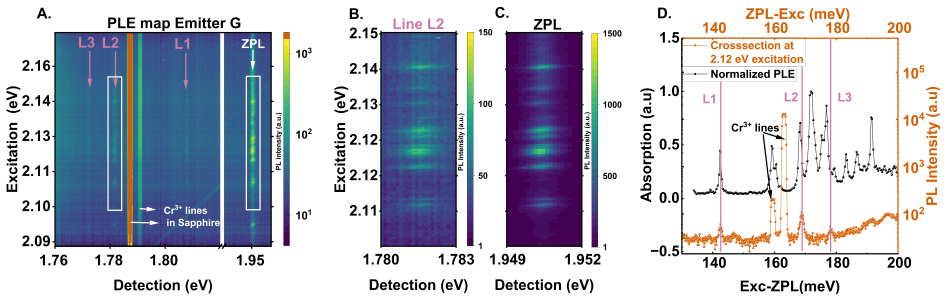
Defect centers in GaN emerge as bright sources of single photons that can optically interface with a localized spin. By tuning the excitation laser energy to specific resonance values the excitation efficiency can be enhanced, resulting in a relative increase of photoluminescence intensity by up to an order of magnitude. The resonances can be selectively addressed with linearly polarized light while the emission dipole remains unchanged, enabling polarization-controlled enhancement. These results establish an efficient way of excitation for GaN-based emitters that increases the generation rate of photons. The data are consistent with excitation via localized vibrational modes associated with
What carries the argument
Quasi-resonant excitation through localized vibrational modes of point-defect complexes, which produces polarization-dependent absorption enhancement while leaving the emission dipole orientation fixed.
If this is right
- Higher photon generation rates become available from existing GaN defect emitters without changing the sample or the collection optics.
- Polarization of the excitation laser can be used as a switch to turn the brightness enhancement on or off while the emitted light properties stay constant.
- The energy-level structure of the defects is clarified by the positions of the vibrational resonances.
- A practical quasi-resonant route exists for brighter, polarization-addressable operation of these single-photon sources.
Where Pith is reading between the lines
- The same resonance-tuning approach could be tested in other wide-bandgap host materials that host similar point defects to check whether comparable efficiency gains appear.
- Because the emission dipole is unaffected, the technique may allow independent optimization of excitation and collection polarizations in integrated devices.
- Mapping the resonant energies against calculated vibrational spectra of candidate defect complexes would provide a direct test of the proposed mechanism.
- If the enhancement scales with defect density, the method could be combined with controlled defect creation to reach still higher photon rates.
Load-bearing premise
The observed intensity increases arise entirely from resonant coupling to localized vibrational modes of point-defect complexes rather than from other optical processes.
What would settle it
A scan of excitation laser energy that finds no photoluminescence intensity peaks at the reported resonance positions when the laser polarization is aligned with the selective axis.
Figures
read the original abstract
Defect centers in GaN emerge as bright sources of single-photons which recently have been demonstrated to optically interface a localized spin. However, the structure and composition of these defects as well as their efficient excitation techniques were not a subject of thorough studies. This work presents evidence that by tuning the excitation laser energy to specific resonance values the excitation efficiency can be enhanced, resulting in relative increase of photoluminescence intensity by up to an order of magnitude. The resonances can be selectively addressed with linearly polarized light, while the emission dipole remains unchanged, enabling polarization-controlled enhancement. These results establish an efficient way of excitation for GaN-based emitters, thereby increasing the generation rate of photons. The data is consistent with excitation via localized vibrational modes associated with point-defect complexes, establishing a practical quasi-resonant route to brighter, polarization-addressable operation of GaN defect emitters and clarifying their energy-level structure.
Editorial analysis
A structured set of objections, weighed in public.
Referee Report
Summary. The manuscript reports experimental evidence that tuning the excitation laser energy to specific resonance values enhances the photoluminescence intensity of GaN defect centers by up to an order of magnitude. These resonances can be selectively addressed with linearly polarized excitation light while the emission dipole orientation remains unchanged, enabling polarization-controlled enhancement. The observations are described as consistent with quasi-resonant excitation via localized vibrational modes associated with point-defect complexes, providing an efficient excitation route and clarifying aspects of the defect energy-level structure.
Significance. If the experimental observations hold with adequate supporting data, the work demonstrates a practical method for increasing the brightness of GaN-based single-photon emitters through quasi-resonant excitation and adds polarization selectivity without modifying the emission properties. This could aid the development of brighter, controllable quantum light sources in a technologically relevant material system. The approach may also offer insights into defect physics, though its broader impact depends on the robustness and reproducibility of the reported intensity enhancements.
major comments (1)
- [Abstract] Abstract: The central interpretation that the resonances arise specifically from localized vibrational modes of point-defect complexes is stated only as consistency with the data. No quantitative matching to calculated or measured local-mode frequencies, Franck-Condon factors, or distinguishing experiments (such as temperature or magnetic-field dependence) is referenced, leaving alternative mechanisms (e.g., higher-lying electronic states) viable and weakening the claim of clarifying the energy-level structure.
minor comments (2)
- The abstract states an intensity increase 'by up to an order of magnitude' without reference to baseline conditions, error bars, or the number of emitters sampled; the main text should include these details along with sample statistics to support the quantitative claim.
- Polarization selectivity is described qualitatively; the manuscript should specify the angular resolution of the polarization data and any fitting procedures used to confirm that the emission dipole remains unchanged.
Simulated Author's Rebuttal
We are grateful to the referee for their thorough review and positive recommendation for minor revision. The feedback helps us strengthen the presentation of our results. Below, we address the major comment point by point.
read point-by-point responses
-
Referee: [Abstract] Abstract: The central interpretation that the resonances arise specifically from localized vibrational modes of point-defect complexes is stated only as consistency with the data. No quantitative matching to calculated or measured local-mode frequencies, Franck-Condon factors, or distinguishing experiments (such as temperature or magnetic-field dependence) is referenced, leaving alternative mechanisms (e.g., higher-lying electronic states) viable and weakening the claim of clarifying the energy-level structure.
Authors: We thank the referee for highlighting this important point about the interpretation in the abstract. Our manuscript presents the data as consistent with quasi-resonant excitation through localized vibrational modes of point-defect complexes, based on the observed resonance energies, polarization selectivity, and unchanged emission dipole. We do not claim definitive proof or quantitative matching to calculated frequencies, as such calculations for the specific defect complexes in GaN are not yet available in the literature to our knowledge. Alternative mechanisms, such as excitation to higher-lying electronic states, cannot be entirely ruled out without further experiments like temperature-dependent studies or magnetic field effects. In response, we will revise the abstract to replace 'clarifying their energy-level structure' with 'providing insights into their energy-level structure' to better reflect the consistency-based interpretation. Additionally, we will expand the discussion section to explicitly mention possible alternative explanations and the reasons why the vibrational mode model is a plausible fit, including the polarization behavior which would be unexpected for certain electronic transitions. We believe this addresses the concern while maintaining the manuscript's core message. revision: partial
Circularity Check
No circularity: purely observational claims with no derivations or self-referential fits
full rationale
The manuscript reports experimental PLE spectra, polarization dependence, and PL intensity enhancements in GaN defect emitters. It states only that the data are 'consistent with' excitation via localized vibrational modes of point-defect complexes, without any equations, parameter fitting, or derivations that would reduce the observed resonances or polarization selectivity to quantities defined by the same dataset. No self-citations are invoked as load-bearing uniqueness theorems, no ansatzes are smuggled in, and no predictions are made that collapse to the input measurements by construction. The results remain direct empirical observations.
Axiom & Free-Parameter Ledger
axioms (1)
- domain assumption Defect centers in GaN are bright single-photon sources that can optically interface a localized spin.
invented entities (1)
-
localized vibrational modes associated with point-defect complexes
no independent evidence
Reference graph
Works this paper leans on
-
[1]
Roccaforte, F. and Leszczynski, M. , title =. Nitride Semiconductor Technology: Power Electronics and Optoelectronic Devices , year =
- [2]
-
[3]
Bishop, S. and Hadden, J. and Hekmati, R. and Cannon, J. and Langbein, W. and Bennett, A. , title =. Appl. Phys. Lett. , year =
-
[4]
Lecaron, N. and Meunier, M. and Sauder, G. and Dalidet, R. and Pelet, Y. and Tanzilli, S. and Zúñiga-Pérez, J. and Alibart, O. , title =. Opt. Express , year =
-
[5]
Berhane, A. and Jeong, K. and Bodrog, Z. and Fiedler, S. and Schröder, T. and Triviño, N. and Palacios, T. and Gali, A. and Toth, M. and Englund, D. and Aharonovich, I. , title =. Adv. Mater. , year =
-
[6]
Luo, J. and Geng, Y. and Rana, F. and Fuchs, G. , title =. Nat. Mater. , year =
-
[7]
Eng, J. and Jiang, Z. and Meunier, M. and Rasmita, A. and Zhang, H. and Yang, Y. and Zhou, F. and Cai, H. and Dong, Z. and Zúñiga-Pérez, J. and Gao, W. , title =. Phys. Rev. Lett. , year =
-
[8]
Zhou, Y. and Wang, Z. and Rasmita, A. and Kim, S. and Berhane, A. and Bodrog, Z. and Adamo, G. and Gali, A. and Aharonovich, I. and Gao, W. , title =. Sci. Adv. , year =
-
[9]
Ferrenti, A. and De Leon, N. and Thompson, J. and Cava, R. , title =. npj Comput. Mater. , year =
-
[10]
Zhang, G. and Cheng, Y. and Chou, J. and Gali, A. , title =. Appl. Phys. Rev. , year =
-
[11]
Turiansky, M. and Parto, K. and Moody, G. and Van de Walle, C. , title =. APL Photonics , year =
-
[12]
Lyons, J. and Wickramaratne, D. and Van de Walle, C. , title =. J. Appl. Phys. , year =
-
[13]
Berhane, A. and Jeong, K. and Bradac, C. and Walsh, M. and Englund, D. and Toth, M. and Aharonovich, I. , title =. Phys. Rev. B , year =
-
[14]
Geng, Y. and Jena, D. and Fuchs, G. and Zipfel, W. and Rana, F. , title =. ACS Photonics , year =
-
[15]
Lyons, J. and Janotti, A. and Van de Walle, C. , title =. Appl. Phys. Lett. , year =
- [16]
- [17]
-
[18]
Gamov, I. and Richter, E. and Weyers, M. and Gärtner, G. and Irmscher, K. , title =. J. Appl. Phys. , year =
-
[19]
Yuan, J. and Hou, Y. and Yang, Z. and Chen, F. and Li, Q. , title =. Adv. Opt. Mater. , year =
-
[20]
Jasny, J. and Sepiol, J. and Irngartinger, T. and Traber, M. and Renn, A. and Wild, U. , title =. Rev. Sci. Instrum. , year =
-
[21]
Dalla, N. and Kulboka, P. and Kobecki, M. and Misiak, J. and Prystawko, P. and Turski, H. and Kossacki, P. and Jakubczyk, T. , title =. Solid State Commun. , year =
- [22]
-
[23]
Tan, Q. and Lai, J. and Liu, X. and Guo, D. and Xue, Y. and Dou, X. and Sun, B. and Deng, H. and Tan, P. and Aharonovich, I. and Gao, W. and Zhang, J. , title =. Nano Lett. , year =
-
[24]
Reshchikov, Michael A. and Morkoç, Hadis , date =. Luminescence Properties of Defects in. doi:10.1063/1.1868059 , url =
-
[25]
Geng, Y. and Luo, J. and Deurzen, L. and Xing, H. and Jena, D. and Fuchs, G. and Rana, F. , title =. Sci. Rep. , year =
-
[26]
Yu, P. and Clark, J. and Look, D. and Chen, C. and Yang, J. and Koutstis, E. and Khan, M. and Tsvertkov, D. and Dmitriev, V. , title =. Appl. Phys. Lett. , year =
-
[27]
Paskova, T. and Arnaudov, B. and Paskov, P. and Goldys, E. and Hautakangas, S. and Saarinen, K. and Södervall, U. and Monemar, B. , title =. J. Appl. Phys. , year =
-
[28]
Eggleton, Katie M. and Cannon, Joseph K. and Bishop, Sam G. and Hadden, John P. and Zhao, Chunyu and Kappers, Menno J. and Oliver, Rachel A. and Bennett, Anthony J. , title =. APL Photonics , volume =. 2026 , month =. doi:10.1063/5.0300338 , url =
-
[29]
Roccaforte, F. & Leszczynski, M. Introduction to gallium nitride properties and applications. Nitride Semiconductor Technology: Power Electronics And Optoelectronic Devices . pp. 1-39 (2020)
work page 2020
-
[30]
Alkauskas, A. First-Principles Calculations of Luminescence Spectrum Line Shapes for Defects in Semiconductors: The Example of GaN and ZnO. Physical Review Letters . 109 (2012)
work page 2012
-
[31]
Bishop, S., Hadden, J., Hekmati, R., Cannon, J., Langbein, W. & Bennett, A. Enhanced Light Collection from a Gallium Nitride Color Center Using a near Index-Matched Solid Immersion Lens. Applied Physics Letters . 120, 114001 (2022,3)
work page 2022
-
[32]
Lecaron, N., Meunier, M., Sauder, G., Dalidet, R., Pelet, Y., Tanzilli, S., Zúñiga-Pérez, J. & Alibart, O. All-Fibred, Telecom Technology Compatible, Room Temperature Single-Photon Source. Optics Express . 33, 33583-33592 (2025,8)
work page 2025
-
[33]
Berhane, A., Jeong, K., Bodrog, Z., Fiedler, S., Schröder, T., Triviño, N., Palacios, T., Gali, A., Toth, M., Englund, D. & Aharonovich, I. Bright Room-Temperature Single-Photon Emission from Defects in Gallium Nitride. Advanced Materials . 29, 1605092 (2017)
work page 2017
-
[34]
Luo, J., Geng, Y., Rana, F. & Fuchs, G. Room Temperature Optically Detected Magnetic Resonance of Single Spins in GaN. Nature Materials . 23, 512-518 (2024,4)
work page 2024
- [35]
-
[36]
& Wei-Gao Room temperature solid-state quantum emitters in the telecom range
Zhou, Y., Wang, Z., Rasmita, A., Kim, S., Berhane, A., Bodrog, Z., Adamo, G., Gali, A., Aharonovich, I. & Wei-Gao Room temperature solid-state quantum emitters in the telecom range. Science Advances . 4, eaar3580 (2018)
work page 2018
- [37]
- [38]
-
[39]
Turiansky, M., Parto, K., Moody, G. & Van de Walle, C. Rational Design of Efficient Defect-Based Quantum Emitters. APL Photonics . 9, 066117 (2024,6)
work page 2024
-
[40]
Lyons, J., Wickramaratne, D. & Van de Walle, C. A First-Principles Understanding of Point Defects and Impurities in GaN. Journal Of Applied Physics . 129, 111101 (2021,3)
work page 2021
-
[41]
Berhane, A., Jeong, K., Bradac, C., Walsh, M., Englund, D., Toth, M. & Aharonovich, I. Photophysics of GaN single-photon emitters in the visible spectral range. Phys. Rev. B . 97, 165202 (2018,4)
work page 2018
- [42]
-
[43]
Lyons, J., Janotti, A. & Van de Walle, C. Carbon Impurities and the Yellow Luminescence in GaN. Applied Physics Letters . 97, 152108 (2010,10)
work page 2010
-
[44]
Local Vibrational Modes of Impurities in Semiconductors
McCluskey, M. Local Vibrational Modes of Impurities in Semiconductors. Journal Of Applied Physics . 87, 3593-3617 (2000,4)
work page 2000
-
[45]
Reshchikov, M. & Morkoç, H. Luminescence Properties of Defects in GaN. Journal Of Applied Physics . 97, 061301 (2005,3)
work page 2005
-
[46]
Gamov, I., Richter, E., Weyers, M., Gärtner, G. & Irmscher, K. Carbon Doping of GaN: Proof of the Formation of Electrically Active Tri-Carbon Defects. Journal Of Applied Physics . 127, 205701 (2020,5)
work page 2020
-
[47]
Yuan, J., Hou, Y., Yang, Z., Chen, F. & Li, Q. GaN as a Material Platform for Single-Photon Emitters: Insights from Ab Initio Study. Advanced Optical Materials . 11, 2202158 (2023)
work page 2023
- [48]
-
[49]
Dalla, N., Kulboka, P., Kobecki, M., Misiak, J., Prystawko, P., Turski, H., Kossacki, P. & Jakubczyk, T. Off-Resonant Photoluminescence Spectroscopy of High-Optical Quality Single Photon Emitters in GaN. Solid State Communications . pp. 115845 (2025,1)
work page 2025
-
[50]
Fingerprints of Carbon Defects in Vibrational Spectra of GaN Considering the Isotope Effect
Gamov, I. Fingerprints of Carbon Defects in Vibrational Spectra of GaN Considering the Isotope Effect. Physical Review B . 106 (2022)
work page 2022
-
[51]
Tan, Q., Lai, J., Liu, X., Guo, D., Xue, Y., Dou, X., Sun, B., Deng, H., Tan, P., Aharonovich, I., Gao, W. & Zhang, J. Donor–Acceptor Pair Quantum Emitters in Hexagonal Boron Nitride. Nano Letters . 22, 1331-1337 (2022,2)
work page 2022
- [52]
-
[53]
Yu, P., Clark, J., Look, D., Chen, C., Yang, J., Koutstis, E., Khan, M., Tsvertkov, D. & Dmitriev, V. Below Band Gap Photoreflectance Transitions in Epitaxial GaN. Applied Physics Letters . 85, 1931-1933 (2004,9)
work page 1931
-
[54]
Paskova, T., Arnaudov, B., Paskov, P., Goldys, E., Hautakangas, S., Saarinen, K., Södervall, U. & Monemar, B. Donor-Acceptor Pair Emission Enhancement in Mass-Transport-Grown GaN. Journal Of Applied Physics . 98, 033508 (2005,8)
work page 2005
discussion (0)
Sign in with ORCID, Apple, or X to comment. Anyone can read and Pith papers without signing in.