Pontus-Mpemba effect in cavity quantum electrodynamics
Pith reviewed 2026-05-08 11:37 UTC · model grok-4.3
The pith
A sudden quench of cavity loss rate makes atomic excitation decay faster than constant loss in the Jaynes-Cummings model.
A machine-rendered reading of the paper's core claim, the machinery that carries it, and where it could break.
Core claim
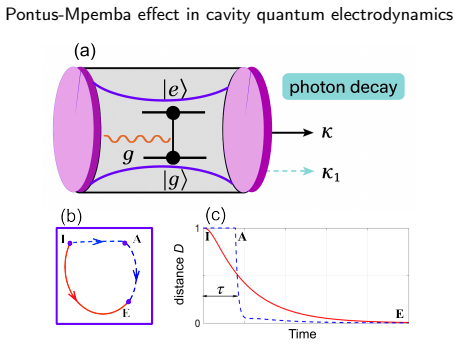
In the single-excitation sector of the Jaynes-Cummings model with photon loss, a sudden quench of the cavity decay rate produces non-monotonic accelerated decay of the atomic excitation probability, reaching the ground state faster than the monotonic decay under fixed loss. The effect follows from the coherent atom-photon exchange competing with cavity dissipation, and it holds across weak to strong dissipation regimes where the dynamics transition from damped Rabi oscillations to near-exponential decay.
What carries the argument
The sudden quench of the cavity decay rate, which switches the system between two distinct damped-evolution trajectories starting from the same initial atom-cavity state.
Load-bearing premise
The system remains in the single-excitation sector and the Jaynes-Cummings model with instantaneous change in photon loss rate continues to describe the dynamics accurately.
What would settle it
Time-resolved measurement of the atomic excitation probability after the quench; the central claim is false if the quenched curve does not reach near-zero excitation sooner than the fixed-loss curve.
Figures


read the original abstract
The quantum Pontus-Mpemba effect is a counterintuitive phenomenon in which a quantum system relaxes faster through a two-step evolution protocol than through a single, unquenched relaxation. This work proposes its realization in cavity quantum electrodynamics using the Jaynes-Cummings model with photon loss. The model captures the coherent interaction between a two-level atom and a single quantized mode of a lossy cavity, providing a minimal yet realistic setting to explore dissipative quantum dynamics. Restricting the analysis to the single-excitation sector, the dynamics feature damped vacuum Rabi oscillations for weak dissipation that transition to near-exponential atomic decay under strong dissipation. A sudden quench of the cavity decay rate generates distinct relaxation trajectories from the same initial atom-cavity state. The atomic excitation then displays a non-monotonic, accelerated decay, where a trajectory with a quenched dissipation relaxes faster than fixed-loss evolution. The effect originates from the interplay between coherent atom-photon exchange and cavity dissipation, establishing a clear and experimentally accessible realization of the quantum Pontus-Mpemba effect in both optical and circuit QED platforms.
Editorial analysis
A structured set of objections, weighed in public.
Referee Report
Summary. The manuscript proposes realizing the quantum Pontus-Mpemba effect in cavity QED via the lossy Jaynes-Cummings model restricted to the single-excitation sector. A sudden quench of the cavity decay rate produces a non-monotonic atomic excitation trajectory that reaches low values faster than the constant-rate evolution, arising from competition between coherent atom-photon exchange and tunable dissipation. The setting is minimal, uses the standard master equation, and is claimed to be experimentally accessible in optical or circuit QED.
Significance. If the reported dynamics hold, the work supplies a clean, parameter-free platform for anomalous relaxation in an open quantum system that is directly realizable with existing technology. The restriction to the standard JC Hamiltonian without invented terms or fitted parameters is a strength, as is the explicit link to tunable cavity loss.
major comments (1)
- [Section III] Section III (or equivalent dynamics section): the claim of accelerated relaxation requires a quantitative metric (e.g., time to reach 1/e of initial excitation or integrated area under the excitation curve) comparing the quenched and fixed-κ trajectories. Without this metric and the associated numerical or analytic evidence, the central 'faster' assertion remains qualitative.
minor comments (3)
- [Model section] The sudden-quench modeling of κ(t) as an ideal step function should be accompanied by a brief discussion of its physical realizability (e.g., finite switching time) to confirm it does not introduce extraneous decoherence.
- [Figures] Figure captions must list all parameter values (g, κ_initial, κ_final, initial state) used for each panel so that the plots are reproducible from the text alone.
- [Introduction] The abstract and introduction should cite the original Pontus-Mpemba literature and recent quantum realizations to clarify the precise novelty of the cavity-QED implementation.
Simulated Author's Rebuttal
We thank the referee for the careful reading of our manuscript and the constructive comment. We appreciate the positive assessment of the work's significance and experimental accessibility. We address the major comment below and have revised the manuscript accordingly.
read point-by-point responses
-
Referee: [Section III] Section III (or equivalent dynamics section): the claim of accelerated relaxation requires a quantitative metric (e.g., time to reach 1/e of initial excitation or integrated area under the excitation curve) comparing the quenched and fixed-κ trajectories. Without this metric and the associated numerical or analytic evidence, the central 'faster' assertion remains qualitative.
Authors: We agree that the claim of accelerated relaxation benefits from an explicit quantitative metric. In the revised manuscript we have added to Section III a direct comparison of the quenched and constant-κ trajectories using two standard measures: the time t_{1/e} at which the atomic excitation probability first drops to 1/e of its initial value, and the integrated area under the excitation curve. These quantities are evaluated from the numerical solution of the master equation in the single-excitation subspace and are now reported together with the existing dynamical plots. The added analysis converts the previously qualitative statement into a quantitatively supported assertion while leaving all other results unchanged. revision: yes
Circularity Check
No significant circularity; derivation follows directly from standard master equation
full rationale
The paper's central result—the non-monotonic accelerated atomic decay under a sudden quench of cavity loss—is obtained by direct integration of the time-dependent Lindblad master equation for the Jaynes-Cummings Hamiltonian restricted to the single-excitation manifold. No parameters are fitted to data and then relabeled as predictions; the quench is introduced explicitly as a step change in the decay rate; and no load-bearing uniqueness theorem or ansatz is imported via self-citation. The reported trajectories are therefore genuine dynamical consequences of the model rather than tautological restatements of its inputs.
Axiom & Free-Parameter Ledger
axioms (2)
- domain assumption The system remains in the single-excitation manifold throughout the evolution.
- ad hoc to paper The cavity decay rate can be quenched instantaneously without introducing extra decoherence channels.
Forward citations
Cited by 1 Pith paper
-
Quantum Mpemba effect for operators in open systems
Operators evolving under the adjoint Liouvillian in open quantum systems can exhibit a genuine Mpemba effect, with general conditions derived and validated across three setups.
Reference graph
Works this paper leans on
-
[1]
E. B. Mpemba, D. G. Osborne, Cool?, Phys. Educ. 4 (1969) 172
1969
-
[2]
G. S. Kell, The freezing of hot and cold water, Am. J. Phys. 37 (1969) 564
1969
-
[3]
Jeng, The Mpemba effect: when can hot water freeze faster than cold?, Am
M. Jeng, The Mpemba effect: when can hot water freeze faster than cold?, Am. J. Phys. 74 (2006) 514
2006
-
[4]
J.Bechhoefer,A.Kumar,R.Chetrite,AfreshunderstandingoftheMpembaeffect,Nat.Rev.Phys.3(2021)534
2021
-
[5]
A.Lasanta,F.VegaReyes,A.Prados,A.Santos,Whenthehottercoolsmorequickly:Mpembaeffectingranular fluids, Phys. Rev. Lett. 119 (2017) 148001
2017
-
[6]
Z. Lu, O. Raz, Nonequilibrium thermodynamics of the Markovian Mpemba effect and its inverse, Proc. Natl. Acad. Sci. USA 114 (2017) 5083
2017
-
[7]
Klich, O
I. Klich, O. Raz, O. Hirschberg, M. Vucelja, Mpemba index and anomalous relaxation, Phys. Rev. X 9 (2019) 021060
2019
-
[8]
Kumar, J
A. Kumar, J. Bechhoefer, Exponentially faster cooling in a colloidal system, Nature 584 (2020) 64
2020
-
[9]
Baity-Jesi, E
M. Baity-Jesi, E. Calore, A. Cruz, L. A. Fernandez, J. M. Gil-Narvion, A. Gordillo-Guerrero, D. Iniguez, A. Lasanta,A.Maiorano,E.Marinari,V.Martin-Mayor,J.Moreno-Gordo,A.Munoz-Sudupe,D.Navarro,G.Parisi, S. Perez-Gaviro, F. Ricci-Tersenghi, J. J. Ruiz-Lorenzo, S. F. Schifano, B. Seoane, A. Tarancon, R. Tripiccione, D. Yllanes, The Mpemba effect in spin gla...
2019
-
[10]
Biswas, V.V
A. Biswas, V.V. Prasad, O. Raz, R. Rajesh, Mpemba effect in driven granular Maxwell gases, Phys. Rev. E 102 (2020) 012906
2020
-
[11]
A.Biswas,V.V.Prasad,andR.Rajesh,Mpembaeffectindrivengranulargases:Roleofdistancemeasures,Phys. Rev. E 108 (2023) 024902. S. Longhi:Preprint submitted to ElsevierPage 11 of 15 Pontus-Mpemba effect in cavity quantum electrodynamics
2023
-
[12]
G. Teza, R. Yaacoby, O. Raz, Relaxation shortcuts through boundary coupling, Phys. Rev. Lett. 131 (2023) 017101
2023
-
[13]
T. V. Vu, H. Hayakawa, Thermomajorization Mpemba effect, Phys. Rev. Lett. 134 (2025) 107101
2025
-
[14]
G.Teza,J.Bechhoefer,A.Lasanta,O.Raz,M.Vucelja,Speedupsinnonequilibriumthermalrelaxation:Mpemba and related effects, Phys. Rep. 1164 (2026) 1–97
2026
-
[15]
F. Ares, P. Calabrese, S. Murciano, The quantum Mpemba effects, Nat. Rev. Phys. 7 (2025) 451–460
2025
-
[16]
A. Nava, M. Fabrizio, Lindblad dissipative dynamics in the presence of phase coexistence, Phys. Rev. B 100 (2019) 125102
2019
-
[17]
Carollo, A
F. Carollo, A. Lasanta, I. Lesanovsky, Exponentially accelerated approach to stationarity in Markovian open quantum systems through the Mpemba effect, Phys. Rev. Lett. 127 (2021) 060401
2021
-
[18]
S. K. Manikandan, Equidistant quenches in few-level quantum systems, Phys. Rev. Res. 3 (2021) 043108
2021
-
[19]
Kochsiek, F
S. Kochsiek, F. Carollo, I. Lesanovsky, Accelerating the approach of dissipative quantum spin systems towards stationarity through global spin rotations, Phys. Rev. A 106 (2022) 012207
2022
-
[20]
Ivander, N
F. Ivander, N. Anto-Sztrikacs, D. Segal, Hyperacceleration of quantum thermalization dynamics by bypassing long-lived coherences: An analytical treatment, Phys. Rev. E 108 (2023) 014130
2023
-
[21]
Zhou, X.-D
Y.-L. Zhou, X.-D. Yu, C.-W. Wu, X.-Q. Li, J. Zhang, W. Li, P. X. Chen, Accelerating relaxation through Liouvillian exceptional point, Phys. Rev. Res. 5 (2023) 043036
2023
-
[22]
A.K.Chatterjee,S.Takada,H.Hayakawa,QuantumMpembaeffectinaquantumdotwithreservoirs,Phys.Rev. Lett. 131 (2023) 080402
2023
-
[23]
Moroder, O
M. Moroder, O. Culhane, K. Zawadzki, J. Goold, Thermodynamics of the quantum Mpemba effect, Phys. Rev. Lett. 133 (2024) 140404
2024
-
[24]
A.K.Chatterjee,S.Takada,H.Hayakawa,MultiplequantumMpembaeffect:exceptionalpointsandoscillations, Phys. Rev. A 110 (2024) 022213
2024
-
[25]
Biswas, A
A. Biswas, A. Pal, Mpemba effect on nonequilibrium active Markov chains, Phys. Rev. E 111 (2025) 054136
2025
-
[26]
A.Nava,R.Egger,Mpembaeffectsinopennonequilibriumquantumsystems,Phys.Rev.Lett.133(2024)136302
2024
-
[27]
S.A.Shapira,Y.Shapira,J.Markov,G.Teza,N.Akerman,O.Raz,R.Ozeri,InverseMpembaeffectdemonstrated on a single trapped ion qubit, Phys. Rev. Lett. 133 (2024) 010403
2024
-
[28]
X. Wang, J. Wang, Mpemba effects in nonequilibrium open quantum systems, Phys. Rev. Res. 6 (2024) 033330
2024
-
[29]
D.Liu,J.Yuan,H.Ruan,Y.Xu,S.Luo,J.He,X.He,Y.Ma,J.Wang,Speedingupquantumheatenginesbythe Mpemba effect, Phys. Rev. A 110 (2024) 042218
2024
-
[30]
Longhi, Bosonic Mpemba effect with non-classical states of light, APL Quantum 1 (2024) 046110
S. Longhi, Bosonic Mpemba effect with non-classical states of light, APL Quantum 1 (2024) 046110
2024
-
[31]
Longhi, Laser Mpemba effect, Opt
S. Longhi, Laser Mpemba effect, Opt. Lett. 50 (2025) 2069
2025
-
[32]
Longhi, Mpemba effect and super-accelerated thermalization in the damped quantum harmonic oscillator, Quantum 9 (2025) 1677
S. Longhi, Mpemba effect and super-accelerated thermalization in the damped quantum harmonic oscillator, Quantum 9 (2025) 1677
2025
-
[33]
J.W.Dong,H.F.Mu,M.Qin,H.T.Cui,QuantumMpembaeffectoflocalizationinthedissipativemosaicmodel, Phys. Rev. A 111 (2025) 022215
2025
-
[34]
Zhang, G
J. Zhang, G. Xia, C.-W. Wu, T. Chen, Q. Zhang, Y. Xie, W.-B. Su, W. Wu, C.-W. Qiu, P. Chen, W. Li, H. Jing, Y.-L. Zhou, Observation of quantum strong Mpemba effect, Nat. Commun. 16 (2025) 301. S. Longhi:Preprint submitted to ElsevierPage 12 of 15 Pontus-Mpemba effect in cavity quantum electrodynamics
2025
-
[35]
Furtado and A
J. Furtado and A. C. Santos, Enhanced quantum Mpemba effect with squeezed thermal reservoirs,Ann. Phys. 480(2025) 170135
2025
-
[36]
D.Qian,H.Wang,J.Wang,IntrinsicquantumMpembaeffectinMarkoviansystemsandquantumcircuits,Phys. Rev. B 111 (2025) L220304
2025
-
[37]
S.Longhi,QuantumMpembaeffectfrominitialsystem-reservoirentanglement,APLQuantum2(2025)026133
2025
-
[38]
Boubakour, S
M. Boubakour, S. Endo, T. Fogarty, T. Busch, Dynamical invariant based shortcut to equilibration in open quantum systems, Quantum Sci. Technol.10(2025) 015036
2025
-
[39]
D.J.Strachan,A.Purkayastha,S.R.Clark,Non-MarkovianquantumMpembaeffect,Phys.Rev.Lett.134(2025) 220403
2025
-
[40]
Longhi, Quantum Mpemba effect from non-normal dynamics, Entropy 27 (2025) 581
S. Longhi, Quantum Mpemba effect from non-normal dynamics, Entropy 27 (2025) 581
2025
-
[41]
Medina, O
I. Medina, O. Culhane, F.C. Binder, G.T. Landi, J. Goold, Anomalous discharging of quantum batteries: The ergotropic Mpemba effect, Phys. Rev. Lett. 134 (2025) 220402
2025
-
[42]
Y. Li, W. Li, X. Li, Ergotropic Mpemba effect in non-Markovian quantum systems, Phys. Rev. A 112 (2025) 032209
2025
-
[43]
Mondal, U
S. Mondal, U. Sen, Mpemba effect in self-contained quantum refrigerators: accelerated cooling, Phys. Rev. A 113 (2026) 022211
2026
-
[44]
M. Xu, Z. Wei, X.-P. Jiang, L. Pan, Expedited thermalization dynamics in incommensurate systems, Phys. Rev. A 112 (2025) 042210
2025
-
[45]
Z. Wei, M. Xu, X.-P. Jiang, H. Hu, L. Pan, Quantum Mpemba effect in dissipative spin chains at criticality, Sci. China-Phys. Mech. Astron. 66 (4) (2026) 240315
2026
-
[46]
W. Ma, J. Liu, Quantum Mpemba effect in parity-time symmetric systems, Phys. Rev. B 112 (2025) 214310
2025
- [47]
-
[48]
F. Ares, S. Murciano, P. Calabrese, Entanglement asymmetry as a probe of symmetry breaking, Nat. Commun. 14 (2023) 2036
2023
-
[49]
L. Kh. Joshi, J. Franke, A. Rath, F. Ares, S. Murciano, F. Kranzl, R. Blatt, P. Zoller, B. Vermersch, P. Calabrese, C. F. Roos, M. K. Joshi, Observing the quantum Mpemba effect in quantum simulations, Phys. Rev. Lett. 133 (2024) 010402
2024
-
[50]
C.Rylands,K.Klobas,F.Ares,P.Calabrese,S.Murciano,B.Bertini,MicroscopicoriginofthequantumMpemba effect in integrable systems, Phys. Rev. Lett. 133 (2024) 010401
2024
-
[51]
Murciano, F
S. Murciano, F. Ares, I. Klich, P. Calabrese, Entanglement asymmetry and quantum Mpemba effect in the XY spin chain, J. Stat. Mech. 013103 (2024)
2024
-
[52]
Caceffo, S
F. Caceffo, S. Murciano, V. Alba, Entangled multiplets, asymmetry, and quantum Mpemba effect in dissipative systems, J. Stat. Mech. 063103 (2024)
2024
-
[53]
Liu, H.-K
S. Liu, H.-K. Zhang, S. Yin, S.-X. Zhang, Symmetry restoration and quantum Mpemba effect in symmetric random circuits, Phys. Rev. Lett. 133 (2024) 140405
2024
-
[54]
Chalas, F
K. Chalas, F. Ares, C. Rylands, P. Calabrese, Multiple crossing during dynamical symmetry restoration and implications for the quantum Mpemba effect, J. Stat. Mech. 103101 (2024)
2024
-
[55]
Yamashika, F
S. Yamashika, F. Ares, P. Calabrese, Entanglement asymmetry and quantum Mpemba effect in two-dimensional free-fermion systems, Phys. Rev. B 110 (2024) 085126. S. Longhi:Preprint submitted to ElsevierPage 13 of 15 Pontus-Mpemba effect in cavity quantum electrodynamics
2024
-
[56]
S.Yamashika,P.Calabrese,F.Ares,Quenchingfromsuperfluidtofreebosonsintwodimensions:entanglement, symmetries, and quantum Mpemba effect, Phys. Rev. A 111 (2025) 043304
2025
-
[57]
S.Liu,H.-K.Zhang,S.Yin,S.-X.Zhang,H.Yao,QuantumMpembaeffectsinmany-bodylocalizationsystems, Sci. Bull. 70 (23) (2025) 3991-3996
2025
-
[58]
B 112 (2025) L121109
T.Bhore,L.Su,I.Martin,A.A.Clerk,Z.Papic,QuantumMpembaeffectwithoutglobalsymmetries,Phys.Rev. B 112 (2025) L121109
2025
-
[59]
Yu, T.-R
Y.-H. Yu, T.-R. Jin, L. Zhang, K. Xu, H. Fan, Tuning the quantum Mpemba effect in an isolated system by initial-state engineering, Phys. Rev. B 112 (2025) 094315
2025
-
[60]
Observa- tion and modulation of the quantum Mpemba effect,
Y.Xu,C.-P.Fang,B.-J.Chen,M.-C.Wang,Z.-Y.Ge,Y.-H.Shi,Y.Liu,C.-L.Deng,K.Zhao,Z.-H.Liu,T.-M.Li, H.Li,Z.Wang,G.-H.Liang,D.Feng,X.Guo,X.-Y.Gu,Y.He,H.-T.Liu,Z.-Y.Mei,Y.Xiao,Y.Yan,Y.-H.Yu, W.-P. Yuan, J.-C. Zhang, Z.-A. Wang, G. Liu, X. Song, Y. Tian, Y.-R. Zhang, S.-X. Zhang, K. Huang, Z. Xiang, D. Zheng, K. Xu, H. Fan, Observation and modulation of the quantum...
-
[61]
S. Guo, S. Yin, S.-X. Zhang, Z.-X. Li, Skin effect induced anomalous dynamics from charge-fluctuating initial states, Phys. Rev. B 112 (2025) 155419
2025
-
[62]
Nava and R
A. Nava and R. Egger, Pontus-Mpemba effects, Phys. Rev. Lett. 135 (2025) 140404
2025
-
[63]
H. Yu, J. Hu, and S.-X. Zhang, Quantum Pontus-Mpemba Effects in Real and Imaginary-time Dynamics, arXiv:2509.01960 [quant-ph] (2025),
work page internal anchor Pith review Pith/arXiv arXiv 2025
-
[64]
A.Nava,R.Egger,B.Dey,andD.Giuliano,SpeedingupPontus-Mpembaeffectsviadynamicalphasetransitions, Phys. Rev. Research 7 (2025) 043332
2025
- [65]
-
[66]
Longhi, Quantum Pontus-Mpemba Effect Enabled by the Liouvillian Skin Effect, J
S. Longhi, Quantum Pontus-Mpemba Effect Enabled by the Liouvillian Skin Effect, J. Phys. A: Math. Theor. 59 (2026) 065304
2026
-
[67]
Jaynes, F.W
E.T. Jaynes, F.W. Cummings, Comparison of quantum and semiclassical radiation theories with application to the beam maser, Proc. IEEE 51 (1963) 89-109
1963
-
[68]
Shore, P.L
B.W. Shore, P.L. Knight, The Jaynes-Cummings model, J. Mod. Opt. 40 (1993) 1195-1238
1993
-
[69]
Scully, M.S
M.O. Scully, M.S. Zubairy,Quantum Optics, Cambridge University Press, Cambridge, 1997
1997
-
[70]
Haroche, J.-M
S. Haroche, J.-M. Raimond,Exploring the Quantum: Atoms, Cavities, and Photons, Oxford University Press, Oxford, 2006
2006
-
[71]
Brune, F
M. Brune, F. Schmidt-Kaler, A. Maali, J. Dreyer, E. Hagley, J. M. Raimond, S. Haroche, Quantum Rabi oscillation: A direct test of field quantization in a cavity, Phys. Rev. Lett. 76 (11) (1996) 1800-1803
1996
-
[72]
A 79 (3) (2009) 033836
M.Wilczewski,M.Czachor,TheoryversusexperimentforvacuumRabioscillationsinlossycavities,Phys.Rev. A 79 (3) (2009) 033836
2009
-
[73]
R.R.Puri,G.S.Agarwal,Finite-Qcavityelectrodynamics:Dynamicalandstatisticalaspects,Phys.Rev.A35(8) (1987) 3433-3449
1987
-
[74]
3 (1991) 13–32
P.Alsing,H.J.Carmichael,Spontaneousdressed-statepolarizationofacoupledatomandcavitymode,Quantum Opt. 3 (1991) 13–32
1991
-
[75]
J.Gea-Banacloche,Jaynes-Cummingsmodelwithquasiclassicalfields:theeffectofdissipation,Phys.Rev.A47 (3) (1993) 2221-2234. S. Longhi:Preprint submitted to ElsevierPage 14 of 15 Pontus-Mpemba effect in cavity quantum electrodynamics
1993
-
[76]
Briegel, B.-G
H.-J. Briegel, B.-G. Englert, Quantum optical master equations: The use of damping bases, Phys. Rev. A 47 (1993) 3311-3329
1993
-
[77]
J.G.P.deFaria,M.C.Nemes,DissipativedynamicsoftheJaynes-Cummingsmodelinthedispersiveapproxima- tion: Analytical results, Phys. Rev. A 59 (5) (1999) 3918-3925
1999
-
[78]
Scala, B
M. Scala, B. Militello, A. Messina, S. Maniscalco, J. Piilo, K.-A. Suominen, Cavity losses for the dissipative Jaynes-Cummings Hamiltonian beyond rotating wave approximation, J. Phys. A: Math. Theor. 40 (48) (2007) 14527-14536
2007
-
[79]
H. J. Carmichael, Breakdown of photon blockade: A dissipative quantum phase transition in zero dimensions, Phys. Rev. X 5 (2015) 031028
2015
-
[80]
Hwang, P
M.-J. Hwang, P. Rabl, M. B. Plenio, Dissipative phase transition in the open quantum Rabi model, Phys. Rev. A 97 (1) (2018) 013825
2018
discussion (0)
Sign in with ORCID, Apple, or X to comment. Anyone can read and Pith papers without signing in.