4DThinker: Thinking with 4D Imagery for Dynamic Spatial Understanding
Pith reviewed 2026-05-25 06:12 UTC · model grok-4.3
The pith
Vision-language models can reason about moving scenes by simulating 4D changes inside their hidden space.
A machine-rendered reading of the paper's core claim, the machinery that carries it, and where it could break.
Core claim
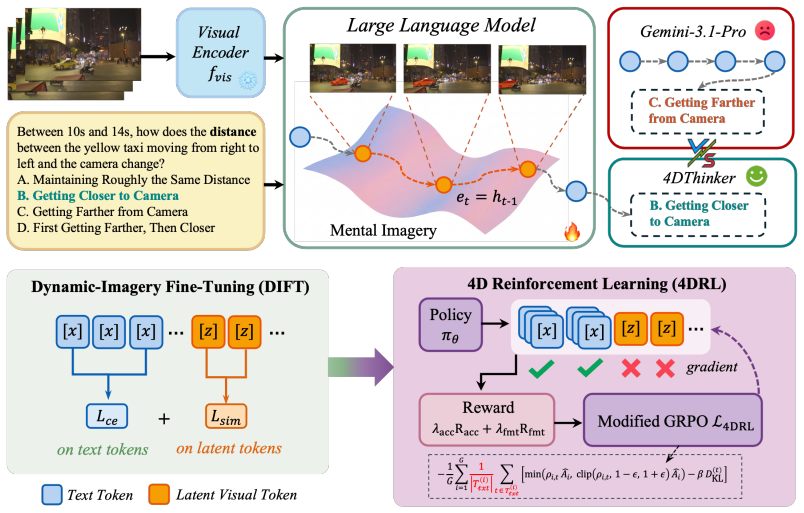
4DThinker is the first framework that lets VLMs think with 4D by internally simulating scene evolution inside the continuous hidden space; this is realized through a scalable data-generation pipeline from raw videos, Dynamic-Imagery Fine-Tuning that jointly supervises textual tokens and 4D latents, and 4D Reinforcement Learning that restricts policy gradients to text tokens for stable optimization on complex tasks.
What carries the argument
Dynamic latent mental imagery: the mechanism that lets the model simulate how scenes evolve within its continuous hidden space.
If this is right
- VLMs achieve higher accuracy on multiple dynamic spatial reasoning benchmarks without added inference cost.
- Reasoning stays inside the model rather than depending on separate geometry engines.
- The same training recipe scales to new raw video sources because the data pipeline requires no manual 4D labels.
- Policy optimization remains stable because gradients are confined to text tokens even when 4D latents are involved.
Where Pith is reading between the lines
- The approach could transfer to embodied agents that must predict object motion from onboard cameras.
- Removing the text-only gradient restriction might allow end-to-end 4D control signals but would require new stability techniques.
- The method opens a route to test whether other latent dimensions beyond 4D (such as force or material properties) can be learned the same way.
Load-bearing premise
The assumption that Dynamic-Imagery Fine-Tuning and 4D Reinforcement Learning can ground the model in dynamic visual semantics without any external geometric modules.
What would settle it
A controlled test in which 4DThinker is run on the same dynamic spatial reasoning benchmarks but with the 4D latent supervision removed; if accuracy stays the same as the full model, the claim that internal 4D simulation is necessary collapses.
Figures





read the original abstract
Dynamic spatial reasoning from monocular video is essential for bridging visual intelligence and the physical world, yet remains challenging for vision-language models (VLMs). Prior approaches either verbalize spatial-temporal reasoning entirely as text, which is inherently verbose and imprecise for complex dynamics, or rely on external geometric modules that increase inference complexity without fostering intrinsic model capability. In this paper, we present 4DThinker, the first framework that enables VLMs to "think with 4D" through dynamic latent mental imagery, i.e., internally simulating how scenes evolve within the continuous hidden space. Specifically, we first introduce a scalable, annotation-free data generation pipeline that synthesizes 4D reasoning data from raw videos. We then propose Dynamic-Imagery Fine-Tuning (DIFT), which jointly supervises textual tokens and 4D latents to ground the model in dynamic visual semantics. Building on this, 4D Reinforcement Learning (4DRL) further tackles complex reasoning tasks via outcome-based rewards, restricting policy gradients to text tokens to ensure stable optimization. Extensive experiments across multiple dynamic spatial reasoning benchmarks demonstrate that 4DThinker consistently outperforms strong baselines and offers a new perspective toward 4D reasoning in VLMs. Our code is available at https://github.com/zhangquanchen/4DThinker.
Editorial analysis
A structured set of objections, weighed in public.
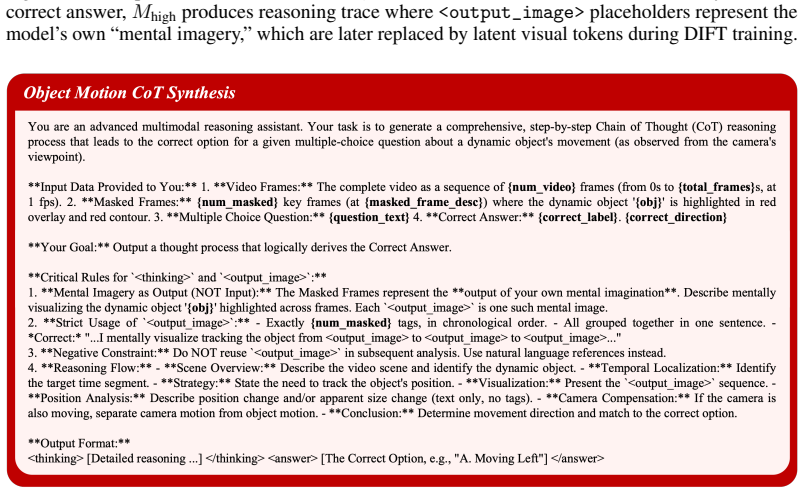
Referee Report
Summary. The paper presents 4DThinker as the first framework enabling VLMs to perform dynamic spatial reasoning from monocular video by 'thinking with 4D' via internally simulated dynamic latent mental imagery. It introduces an annotation-free pipeline to synthesize 4D reasoning data from raw videos, Dynamic-Imagery Fine-Tuning (DIFT) for joint supervision of textual tokens and 4D latents, and 4D Reinforcement Learning (4DRL) using outcome-based rewards with policy gradients restricted to text tokens. Experiments across multiple benchmarks show consistent outperformance over strong baselines, with code released at the provided GitHub repository.
Significance. If the central claims hold after addressing the optimization design, the work offers a meaningful advance by shifting from external geometric modules or purely textual reasoning to intrinsic 4D latent simulation in VLMs. The annotation-free synthesis and code release are strengths that support reproducibility and further exploration of latent imagery for physical reasoning tasks.
major comments (2)
- [4DRL] 4DRL description (following DIFT in the method): restricting policy gradients to text tokens only means the 4D latents receive no direct optimization signal from the outcome-based rewards on target reasoning tasks. This risks the imagery component remaining static after DIFT if the synthesized data distribution does not perfectly match benchmarks, directly undermining the claim that the model is 'thinking with 4D' during complex reasoning.
- [DIFT] DIFT section: the joint supervision on textual tokens and 4D latents from synthesized data is presented as grounding dynamic visual semantics, but no analysis is provided on whether the 4D latents continue to evolve or contribute causally during 4DRL inference on held-out benchmarks.
minor comments (1)
- [Abstract] Abstract: claims of outperformance are stated without even high-level metrics or baseline names; a one-sentence summary of key results would improve readability while full tables remain in the experiments section.
Simulated Author's Rebuttal
We thank the referee for the thoughtful review and for recognizing the potential significance of 4DThinker. We address each major comment below with the strongest honest defense supported by the manuscript's design and results. Where clarification or additional analysis is warranted, we commit to revisions.
read point-by-point responses
-
Referee: [4DRL] 4DRL description (following DIFT in the method): restricting policy gradients to text tokens only means the 4D latents receive no direct optimization signal from the outcome-based rewards on target reasoning tasks. This risks the imagery component remaining static after DIFT if the synthesized data distribution does not perfectly match benchmarks, directly undermining the claim that the model is 'thinking with 4D' during complex reasoning.
Authors: The restriction of policy gradients to text tokens in 4DRL is a deliberate design choice for training stability: applying outcome-based rewards directly to the high-dimensional 4D latent space risks unstable or noisy updates given the sparsity of the signal. The 4D latents are already grounded via joint supervision in DIFT on the synthesized data, and during inference the model generates and conditions on these latents as part of its forward pass for all reasoning steps. The empirical gains over strong baselines that lack any 4D component indicate that the imagery remains functional and beneficial on held-out tasks. We will revise the 4DRL section to explicitly articulate this rationale and the implicit role of the latents. revision: partial
-
Referee: [DIFT] DIFT section: the joint supervision on textual tokens and 4D latents from synthesized data is presented as grounding dynamic visual semantics, but no analysis is provided on whether the 4D latents continue to evolve or contribute causally during 4DRL inference on held-out benchmarks.
Authors: We agree that direct evidence of the 4D latents' causal contribution after DIFT would strengthen the central claim. In the revision we will add an analysis subsection with (i) an ablation that freezes the 4D latents after DIFT and measures the resulting drop on 4DRL benchmarks, and (ii) qualitative visualizations of latent trajectories on held-out videos to illustrate continued dynamic simulation. These additions will be placed after the 4DRL description. revision: yes
Circularity Check
No significant circularity; methods are independent training procedures
full rationale
The paper's core claims rest on a new annotation-free synthesis pipeline, DIFT joint supervision, and 4DRL with explicit gradient restriction to text tokens. These are presented as novel procedural contributions without any reduction of outputs to fitted inputs by construction, self-definitional loops, or load-bearing self-citations. No equations or derivations in the provided text equate a 'prediction' to its own training signal. The design choices (e.g., restricting gradients) are explicit engineering decisions, not hidden equivalences. This matches the default case of a self-contained methodological paper.
Axiom & Free-Parameter Ledger
axioms (1)
- domain assumption Internal 4D latent representations can capture dynamic spatial semantics better than text alone
invented entities (1)
-
4D latent mental imagery
no independent evidence
Lean theorems connected to this paper
-
IndisputableMonolith/Cost/FunctionalEquation.leanwashburn_uniqueness_aczel unclear?
unclearRelation between the paper passage and the cited Recognition theorem.
DIFT jointly supervises textual tokens and 4D latents … Lsim = 1 − (1/|Tlat|) Σ h⊤t−1 zt / (‖ht−1‖ ‖zt‖)
-
IndisputableMonolith/Foundation/RealityFromDistinction.leanreality_from_one_distinction unclear?
unclearRelation between the paper passage and the cited Recognition theorem.
first framework that enables VLMs to 'think with 4D' through dynamic latent mental imagery … internally simulating how scenes evolve within the continuous hidden space
What do these tags mean?
- matches
- The paper's claim is directly supported by a theorem in the formal canon.
- supports
- The theorem supports part of the paper's argument, but the paper may add assumptions or extra steps.
- extends
- The paper goes beyond the formal theorem; the theorem is a base layer rather than the whole result.
- uses
- The paper appears to rely on the theorem as machinery.
- contradicts
- The paper's claim conflicts with a theorem or certificate in the canon.
- unclear
- Pith found a possible connection, but the passage is too broad, indirect, or ambiguous to say the theorem truly supports the claim.
Reference graph
Works this paper leans on
-
[1]
Shuai Bai, Keqin Chen, Xuejing Liu, Jialin Wang, Wenbin Ge, Sibo Song, Kai Dang, Peng Wang, Shijie Wang, Jun Tang, et al. Qwen2. 5-vl technical report.arXiv preprint arXiv:2502.13923,
work page internal anchor Pith review Pith/arXiv arXiv
-
[2]
Wenxiao Cai, Iaroslav Ponomarenko, Jianhao Yuan, Xiaoqi Li, Wankou Yang, Hao Dong, and Bo Zhao. Spatialbot: Precise spatial understanding with vision language models.arXiv preprint arXiv:2406.13642,
-
[3]
SAM 3: Segment Anything with Concepts
Nicolas Carion, Laura Gustafson, Yuan-Ting Hu, Shoubhik Debnath, Ronghang Hu, Didac Suris, Chaitanya Ryali, Kalyan Vasudev Alwala, Haitham Khedr, Andrew Huang, et al. Sam 3: Segment anything with concepts.arXiv preprint arXiv:2511.16719,
work page internal anchor Pith review Pith/arXiv arXiv
-
[4]
Jiewen Chan, Zhenjun Zhao, and Yu-Lun Liu. Adagar: Adaptive gabor representation for dynamic scene reconstruction.arXiv preprint arXiv:2601.00796,
-
[5]
Zhangquan Chen, Manyuan Zhang, Xinlei Yu, Xufang Luo, Mingze Sun, Zihao Pan, Yan Feng, Peng Pei, Xunliang Cai, and Ruqi Huang. Think with 3d: Geometric imagination grounded spatial reasoning from limited views.arXiv preprint arXiv:2510.18632, 2025a. Zhangquan Chen, Ruihui Zhao, Chuwei Luo, Mingze Sun, Xinlei Yu, Yangyang Kang, and Ruqi Huang. Sifthinker: ...
-
[6]
Gheorghe Comanici, Eric Bieber, Mike Schaekermann, Ice Pasupat, Noveen Sachdeva, Inderjit Dhillon, Marcel Blistein, Ori Ram, Dan Zhang, Evan Rosen, et al. Gemini 2.5: Pushing the frontier with advanced reasoning, multimodality, long context, and next generation agentic capabilities.arXiv preprint arXiv:2507.06261,
work page internal anchor Pith review Pith/arXiv arXiv
-
[7]
From Explicit CoT to Implicit CoT: Learning to Internalize CoT Step by Step
Yuntian Deng, Yejin Choi, and Stuart Shieber. From explicit cot to implicit cot: Learning to internalize cot step by step.arXiv preprint arXiv:2405.14838,
work page internal anchor Pith review Pith/arXiv arXiv
-
[8]
VLM-3R: Vision-Language Models Augmented with Instruction-Aligned 3D Reconstruction
Zhiwen Fan, Jian Zhang, Renjie Li, Junge Zhang, Runjin Chen, Hezhen Hu, Kevin Wang, Huaizhi Qu, Dilin Wang, Zhicheng Yan, et al. Vlm-3r: Vision-language models augmented with instruction-aligned 3d reconstruction.arXiv preprint arXiv:2505.20279,
work page internal anchor Pith review Pith/arXiv arXiv
-
[9]
Think before you speak: Training language models with pause tokens.arXiv preprint arXiv:2310.02226,
Sachin Goyal, Ziwei Ji, Ankit Singh Rawat, Aditya Krishna Menon, Sanjiv Kumar, and Vaishnavh Nagarajan. Think before you speak: Training language models with pause tokens.arXiv preprint arXiv:2310.02226,
-
[10]
Training Large Language Models to Reason in a Continuous Latent Space
Shibo Hao, Sainbayar Sukhbaatar, DiJia Su, Xian Li, Zhiting Hu, Jason Weston, and Yuandong Tian. Training large language models to reason in a continuous latent space.arXiv preprint arXiv:2412.06769,
work page internal anchor Pith review Pith/arXiv arXiv
-
[11]
Yuzhi Huang, Kairun Wen, Rongxin Gao, Dongxuan Liu, Yibin Lou, Jie Wu, Jing Xu, Jian Zhang, Zheng Yang, Yunlong Lin, et al. Thinking in dynamics: How multimodal large language models perceive, track, and reason dynamics in physical 4d world.arXiv preprint arXiv:2603.12746,
-
[12]
Bangzheng Li, Ximeng Sun, Jiang Liu, Ze Wang, Jialian Wu, Xiaodong Yu, Hao Chen, Emad Barsoum, Muhao Chen, and Zicheng Liu. Latent visual reasoning.arXiv preprint arXiv:2509.24251, 2025a. Haoang Li, Ji Zhao, Jean-Charles Bazin, Pyojin Kim, Kyungdon Joo, Zhenjun Zhao, and Yun-Hui Liu. Hong kong world: Leveraging structural regularity for line-based slam.IE...
work page internal anchor Pith review Pith/arXiv arXiv
-
[13]
Llava-st: A multimodal large language model for fine-grained spatial-temporal understanding
Hongyu Li, Jinyu Chen, Ziyu Wei, Shaofei Huang, Tianrui Hui, Jialin Gao, Xiaoming Wei, and Si Liu. Llava-st: A multimodal large language model for fine-grained spatial-temporal understanding. InProceedings of the IEEE/CVF Conference on Computer Vision and Pattern Recognition, pages 8592–8603, 2025b. Hongxing Li, Dingming Li, Zixuan Wang, Yuchen Yan, Hang ...
-
[14]
Yuecheng Liu, Dafeng Chi, Shiguang Wu, Zhanguang Zhang, Yaochen Hu, Lingfeng Zhang, Yingxue Zhang, Shuang Wu, Tongtong Cao, Guowei Huang, et al. Spatialcot: Advancing spatial reasoning through coordinate alignment and chain-of-thought for embodied task planning.arXiv preprint arXiv:2501.10074, 2025a. Yuhong Liu, Beichen Zhang, Yuhang Zang, Yuhang Cao, Lon...
-
[15]
SpaceR: Reinforcing MLLMs in Video Spatial Reasoning
Kun Ouyang, Yuanxin Liu, Haoning Wu, Yi Liu, Hao Zhou, Jie Zhou, Fandong Meng, and Xu Sun. Spacer: Reinforcing mllms in video spatial reasoning.arXiv preprint arXiv:2504.01805,
work page internal anchor Pith review Pith/arXiv arXiv
-
[16]
DeepSeekMath: Pushing the Limits of Mathematical Reasoning in Open Language Models
Zhihong Shao, Peiyi Wang, Qihao Zhu, Runxin Xu, Junxiao Song, Xiao Bi, Haowei Zhang, Mingchuan Zhang, YK Li, Y Wu, et al. Deepseekmath: Pushing the limits of mathematical reasoning in open language models. arXiv preprint arXiv:2402.03300,
work page internal anchor Pith review Pith/arXiv arXiv
-
[17]
Aaditya Singh, Adam Fry, Adam Perelman, Adam Tart, Adi Ganesh, Ahmed El-Kishky, Aidan McLaughlin, Aiden Low, AJ Ostrow, Akhila Ananthram, et al. Openai gpt-5 system card.arXiv preprint arXiv:2601.03267,
work page internal anchor Pith review Pith/arXiv arXiv
-
[18]
Jiahao Wang, Yufeng Yuan, Rujie Zheng, Youtian Lin, Jian Gao, Lin-Zhuo Chen, Yajie Bao, Yi Zhang, Chang Zeng, Yanxi Zhou, et al. Spatialvid: A large-scale video dataset with spatial annotations.arXiv preprint arXiv:2509.09676, 2025a. 11 Weiyun Wang, Zhangwei Gao, Lixin Gu, Hengjun Pu, Long Cui, Xingguang Wei, Zhaoyang Liu, Linglin Jing, Shenglong Ye, Jie ...
-
[19]
Ningning Xu, Yuxuan Jiang, Shubhashis Roy Dipta, and Zhang Hengyuan. Learning how to use tools, not just when: Pattern-aware tool-integrated reasoning.MATH-AI @ NeurIPS 2025,
work page 2025
-
[20]
Thinking in space: How multimodal large language models see, remember, and recall spaces
Jihan Yang, Shusheng Yang, Anjali W Gupta, Rilyn Han, Li Fei-Fei, and Saining Xie. Thinking in space: How multimodal large language models see, remember, and recall spaces. InProceedings of the Computer Vision and Pattern Recognition Conference, pages 10632–10643, 2025a. Rui Yang, Ziyu Zhu, Yanwei Li, Jingjia Huang, Shen Yan, Siyuan Zhou, Zhe Liu, Xiangta...
-
[21]
Mllm-4d: Towards visual-based spatial-temporal intelligence.arXiv preprint arXiv:2603.00515,
Xingyilang Yin, Chengzhengxu Li, Jiahao Chang, Chi-Man Pun, and Xiaodong Cun. Mllm-4d: Towards visual-based spatial-temporal intelligence.arXiv preprint arXiv:2603.00515,
-
[22]
Xinlei Yu, Zhangquan Chen, Yongbo He, Tianyu Fu, Cheng Yang, Chengming Xu, Yue Ma, Xiaobin Hu, Zhe Cao, Jie Xu, et al. The latent space: Foundation, evolution, mechanism, ability, and outlook.arXiv preprint arXiv:2604.02029,
-
[23]
Dsi-bench: A benchmark for dynamic spatial intelligence.arXiv preprint arXiv:2510.18873,
Ziang Zhang, Zehan Wang, Guanghao Zhang, Weilong Dai, Yan Xia, Ziang Yan, Minjie Hong, and Zhou Zhao. Dsi-bench: A benchmark for dynamic spatial intelligence.arXiv preprint arXiv:2510.18873,
-
[24]
Duo Zheng, Shijia Huang, Yanyang Li, and Liwei Wang. Learning from videos for 3d world: Enhancing mllms with 3d vision geometry priors.arXiv preprint arXiv:2505.24625,
-
[25]
Shengchao Zhou, Yuxin Chen, Yuying Ge, Wei Huang, Jiehong Lin, Ying Shan, and Xiaojuan Qi. Learning to reason in 4d: Dynamic spatial understanding for vision language models.arXiv preprint arXiv:2512.20557, 2025a. Shengchao Zhou, Yuxin Chen, Yuying Ge, Wei Huang, Jiehong Lin, Ying Shan, and Xiaojuan Qi. Learning to reason in 4d: Dynamic spatial understand...
-
[26]
12 A Object Selection Rules As described in Sec. 3.1, we define a set of predefined rules R to guide Mhigh in selecting a representative static object os and a dynamic object od from each video. Specifically, we instruct Mhigh with the following criteria: Static object selection. • The object must bestationarythroughout the entire video (e.g., the traffic...
work page 2025
-
[27]
is appended before every question during DIFT training, 4DRL, and inference, specifying the output format that the model must follow. During 4DRL, the format reward Rfmt checks adherence to this think-answer structure. Table 6: Candidate question types, target objects, and descriptions in our data generation pipeline. Category Type Target Object Descripti...
work page 2026
-
[28]
DSR-Bench subtasks.DSR-Bench Zhou et al. (2025a) organizes its 13 subtasks along two axes: viewpoint mobility(Absolute vs. Relative) andspatial attribute type. “Absolute” (A.) denotes that the viewpoint is fixed at a specific timestamp, while “Relative” (R.) denotes that the viewpoint moves with the observing agent over time. The attribute types are: •Dis...
work page 2026
discussion (0)
Sign in with ORCID, Apple, or X to comment. Anyone can read and Pith papers without signing in.