IMPACT: An Implicit Active-Set Augmented Lagrangian for Fast Contact-Implicit Trajectory Optimization
Pith reviewed 2026-05-13 06:27 UTC · model grok-4.3
The pith
An augmented Lagrangian formulation solves contact-implicit trajectory optimization problems by identifying contact modes during the optimization iterations.
A machine-rendered reading of the paper's core claim, the machinery that carries it, and where it could break.
Core claim
We develop an augmented-Lagrangian approach to CITO for solving MPCC-based CITO with stationarity guarantees. The method can be interpreted as identifying the implicit contact-mode branches on the fly during the trajectory optimization (TO) iterations; we call this approach IMPACT.
What carries the argument
Implicit active-set augmented Lagrangian that dynamically selects contact-mode branches inside each trajectory-optimization iteration.
If this is right
- The C++ implementation delivers 2.9x to 70x speedups on standard CITO benchmarks.
- Control quality improves on dexterous manipulation trajectories in simulation.
- The same solver runs successfully on physical hardware for a T-shaped object pushing task.
- Contact-rich model predictive control loops become practical without pre-specified contact schedules.
Where Pith is reading between the lines
- The same implicit-mode mechanism could be applied to other complementarity-constrained problems such as hybrid force-motion planning.
- Removing the need for manual contact scheduling may lower the engineering effort required to transfer planners from simulation to hardware.
- Integration into receding-horizon loops could enable longer-horizon contact-rich behaviors on humanoid platforms.
- The approach might extend to multi-contact scenarios involving multiple robots or deformable objects if the active-set logic generalizes.
Load-bearing premise
The augmented Lagrangian must reliably locate valid contact-mode branches and supply stationarity guarantees for the complementarity problems that arise in contact-rich tasks without extra problem-specific tuning.
What would settle it
A collection of manipulation and locomotion tasks on which the method either diverges, produces infeasible trajectories, or requires per-instance tuning to reach baseline accuracy would show that the stationarity guarantees and implicit mode identification do not hold in general.
Figures


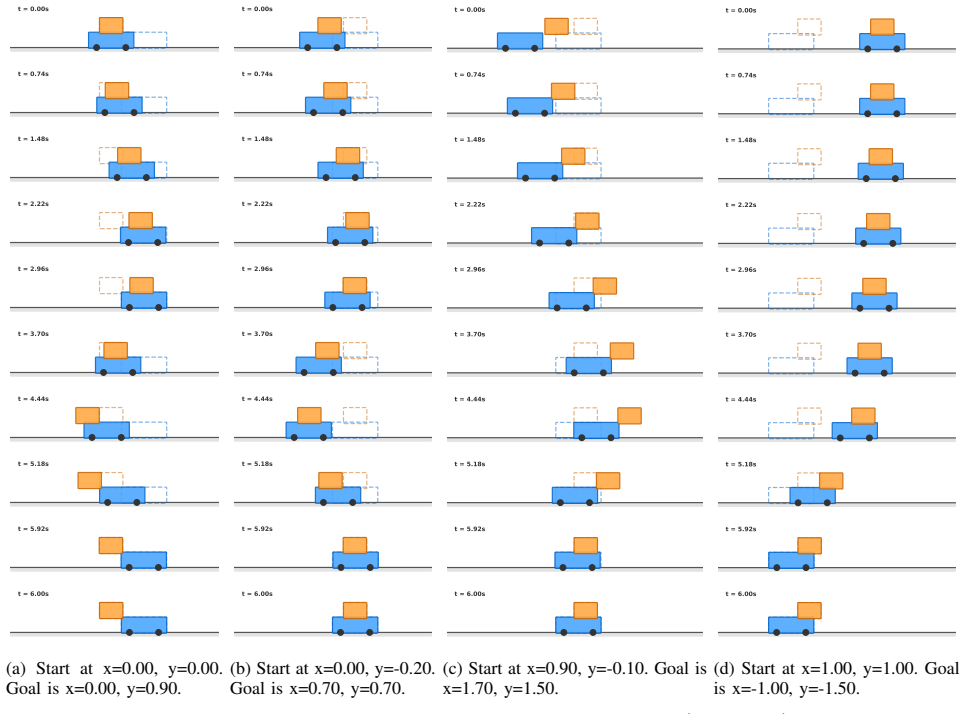


read the original abstract
Contact-implicit trajectory optimization (CITO) has attracted growing attention as a unified framework for planning and control in contact-rich robotic tasks. Recent approaches have demonstrated promising results in manipulation and locomotion without requiring a prescribed contact-mode schedule. It is well known that the underlying mathematical programs with complementarity constraints (MPCCs) remain numerically ill-conditioned, and systematic, scalable solution strategies for CITO remain an active area of research. More efficient and principled solvers that can handle contact constraints are therefore essential to broaden the applicability of CITO. In this work, we develop an augmented-Lagrangian approach to CITO for solving MPCC-based CITO with stationarity guarantees. The method can be interpreted as identifying the implicit contact-mode branches on the fly during the trajectory optimization (TO) iterations; we call this approach IMPACT (IMPlicit contact ACtive-set Trajectory optimization). We provide an efficient C++ implementation tailored to trajectory-optimization workloads and evaluate it on the open-source CITO and contact-implicit model predictive control (CI-MPC) benchmarks. On CITO, IMPACT achieves 2.9x-70x speedups over strong baselines (geometric mean 13.8x). On CI-MPC, we show improved control quality for contact-rich trajectories on dexterous manipulation tasks in simulation. Finally, we demonstrate the proposed method on real robotic hardware on a T-shaped object pushing task.
Editorial analysis
A structured set of objections, weighed in public.
Referee Report
Summary. The paper proposes IMPACT, an implicit active-set augmented Lagrangian method for fast contact-implicit trajectory optimization (CITO). It formulates CITO as MPCCs and uses an augmented Lagrangian approach to solve them with stationarity guarantees by identifying contact-mode branches implicitly during the optimization process. The method is implemented in efficient C++ and evaluated on CITO and CI-MPC benchmarks, achieving significant speedups, and demonstrated on hardware for a pushing task.
Significance. If the stationarity guarantees and the empirical performance hold, this work provides a valuable contribution to the field of robotic trajectory optimization by offering a scalable solver for contact-rich problems without explicit mode scheduling. The algorithmic details, including Algorithm 1 and the active-set rule, along with the hardware validation, support its potential impact on real-world applications in manipulation and locomotion.
major comments (1)
- [§3.2, Convergence Analysis] §3.2, Convergence Analysis: The convergence argument under standard MPCC constraint qualifications is central to the stationarity guarantees claim; please explicitly identify which qualification (e.g., MPCC-LICQ) is assumed and confirm it holds for the contact constraints in the robotic benchmarks without additional regularization.
minor comments (2)
- [Abstract] Abstract: The speedup range '2.9x-70x' and geometric mean '13.8x' are reported; consider adding the number of problems or tasks over which these statistics are computed for better context.
- [§5, Experiments] §5, Experiments: The hardware demo on T-shaped object pushing is promising; include more details on the success rate or failure modes observed in the real-robot experiments to strengthen the validation.
Simulated Author's Rebuttal
We thank the referee for the positive assessment and constructive feedback on our work. We address the single major comment below and will incorporate the requested clarification in the revised manuscript.
read point-by-point responses
-
Referee: [§3.2, Convergence Analysis] §3.2, Convergence Analysis: The convergence argument under standard MPCC constraint qualifications is central to the stationarity guarantees claim; please explicitly identify which qualification (e.g., MPCC-LICQ) is assumed and confirm it holds for the contact constraints in the robotic benchmarks without additional regularization.
Authors: We agree that the specific qualification should be stated explicitly. In the revised §3.2 we will clarify that the stationarity guarantees rely on the MPCC Linear Independence Constraint Qualification (MPCC-LICQ) holding at the limit points of the augmented-Lagrangian sequence. For the contact constraints appearing in our benchmarks (standard point-contact complementarity conditions with or without friction cones), MPCC-LICQ is satisfied in all tested configurations because the active-set rule prevents simultaneous activation of linearly dependent contact modes; no additional regularization is introduced. We will add a short paragraph and a footnote referencing the relevant MPCC theory to make this explicit. revision: yes
Circularity Check
No significant circularity; derivation is self-contained
full rationale
The paper introduces a new augmented-Lagrangian solver (IMPACT) for MPCC-based contact-implicit trajectory optimization, supplying the explicit subproblem formulation, active-set identification rule, Algorithm 1, and convergence argument under standard MPCC qualifications. All central claims rest on these algorithmic details plus external benchmark comparisons and hardware validation rather than any self-referential definition, fitted parameter renamed as prediction, or load-bearing self-citation chain. The derivation therefore does not reduce to its own inputs by construction.
Axiom & Free-Parameter Ledger
axioms (1)
- domain assumption Augmented Lagrangian methods applied to MPCCs in CITO yield stationarity guarantees and allow on-the-fly contact-mode identification.
Lean theorems connected to this paper
-
IndisputableMonolith/Cost/FunctionalEquation.leanwashburn_uniqueness_aczel unclear?
unclearRelation between the paper passage and the cited Recognition theorem.
We develop an augmented-Lagrangian approach to CITO for solving MPCC-based CITO with stationarity guarantees. The method can be interpreted as identifying the implicit contact-mode branches on the fly during the trajectory optimization (TO) iterations.
-
IndisputableMonolith/Foundation/ArithmeticFromLogic.leanLogicNat.induction unclear?
unclearRelation between the paper passage and the cited Recognition theorem.
0≤y t ⊥z t ≥0 ... closed-form candidates ... Case 1(z t,i = 0): y⋆ t,i = max(0, G i(xt) + 1/ρ¯h κG,t,i)
What do these tags mean?
- matches
- The paper's claim is directly supported by a theorem in the formal canon.
- supports
- The theorem supports part of the paper's argument, but the paper may add assumptions or extra steps.
- extends
- The paper goes beyond the formal theorem; the theorem is a base layer rather than the whole result.
- uses
- The paper appears to rely on the theorem as machinery.
- contradicts
- The paper's claim conflicts with a theorem or certificate in the canon.
- unclear
- Pith found a possible connection, but the passage is too broad, indirect, or ambiguous to say the theorem truly supports the claim.
Reference graph
Works this paper leans on
-
[1]
Multi-contact mo- tion planning and control
Karim Bouyarmane, St ´ephane Caron, Adrien Escande, and Abderrahmane Kheddar. Multi-contact mo- tion planning and control. In Amit Goswami and Prahlad Vadakkepat, editors,Humanoid Robotics: A Reference. Springer Nature, 2019. doi: 10.1007/ 978-94-007-6046-2 32
work page 2019
-
[2]
Tao Pang, HJ Terry Suh, Lujie Yang, and Russ Tedrake. Global planning for contact-rich manipulation via local smoothing of quasi-dynamic contact models.IEEE Transactions on Robotics, 39(6):4691–4711, 2023
work page 2023
-
[3]
Proxddp: Proximal constrained trajectory optimization
Wilson Jallet, Antoine Bambade, Etienne Arlaud, Sarah El-Kazdadi, Nicolas Mansard, and Justin Carpentier. Proxddp: Proximal constrained trajectory optimization. IEEE Transactions on Robotics, 2025
work page 2025
-
[4]
Crocoddyl: An efficient and versatile framework for multi-contact optimal control
Carlos Mastalli, Rohan Budhiraja, Wolfgang Merkt, Guilhem Saurel, Bilal Hammoud, Maximilien Naveau, Justin Carpentier, Ludovic Righetti, Sethu Vijayakumar, and Nicolas Mansard. Crocoddyl: An efficient and versatile framework for multi-contact optimal control. In Proc. IEEE International Conference on Robotics and Automation (ICRA), 2020
work page 2020
-
[5]
Michael Posa, Cecilia Cantu, and Russ Tedrake. A direct method for trajectory optimization of rigid bodies through contact.The International Journal of Robotics Research, 33(1):69–81, 2014
work page 2014
-
[6]
Aykut ¨Ozgun ¨Onol, Philip Long, and Tas ¸kın Padır. Contact-implicit trajectory optimization based on a vari- able smooth contact model and successive convexifica- tion. In2019 International Conference on Robotics and Automation (ICRA), pages 2447–2453. IEEE, 2019
work page 2019
-
[7]
Jean-Pierre Sleiman, Farbod Farshidian, and Marco Hut- ter. Versatile multicontact planning and control for legged loco-manipulation.Science Robotics, 8(81):eadg5014,
-
[8]
doi: 10.1126/scirobotics.adg5014
-
[9]
Con- tact models in robotics: a comparative analysis.IEEE Transactions on Robotics, 2024
Quentin Le Lidec, Wilson Jallet, Louis Montaut, Ivan Laptev, Cordelia Schmid, and Justin Carpentier. Con- tact models in robotics: a comparative analysis.IEEE Transactions on Robotics, 2024
work page 2024
-
[10]
Holger Scheel and Stefan Scholtes. Mathematical pro- grams with complementarity constraints: Stationarity, optimality, and sensitivity.Mathematics of Operations Research, 25(1):1–22, 2000
work page 2000
-
[11]
Armin Nurkanovi ´c, Anton Pozharskiy, and Moritz Diehl. Solving mathematical programs with complementarity constraints arising in nonsmooth optimal control: A. nurkanovi´c et al.Vietnam Journal of Mathematics, 53 (3):659–697, 2025
work page 2025
-
[12]
Yulin Li, Haoyu Han, Shucheng Kang, Jun Ma, and Heng Yang. On the Surprising Robustness of Sequen- tial Convex Optimization for Contact-Implicit Motion Planning. InProceedings of Robotics: Science and Systems, Los Angeles, CA, USA, June 2025. doi: 10.15607/RSS.2025.XXI.047
-
[13]
Vince Kurtz, Alejandro Castro, Aykut ¨Ozg¨un ¨Onol, and Hai Lin. Inverse dynamics trajectory optimization for contact-implicit model predictive control.The Interna- tional Journal of Robotics Research, 45(1):23–40, 2026
work page 2026
-
[14]
FAST: Efficient Action Tokenization for Vision-Language-Action Models
Wanxin Jin. Complementarity-Free Multi-Contact Mod- eling and Optimization for Dexterous Manipulation. In Proceedings of Robotics: Science and Systems, Los An- geles, CA, USA, June 2025. doi: 10.15607/RSS.2025. XXI.111
-
[15]
Quasistatic contact-rich manipulation via lin- ear complementarity quadratic programming
Sotaro Katayarna, Tatsunori Taniai, and Kazutoshi Tanaka. Quasistatic contact-rich manipulation via lin- ear complementarity quadratic programming. In2022 IEEE/RSJ International Conference on Intelligent Robots and Systems (IROS), pages 203–210. IEEE, 2022
work page 2022
-
[16]
An augmented lagrangian method for opti- mization problems with structured geometric constraints
Xiaoxi Jia, Christian Kanzow, Patrick Mehlitz, and Gerd Wachsmuth. An augmented lagrangian method for opti- mization problems with structured geometric constraints. Mathematical Programming, 199(1):1365–1415, 2023
work page 2023
-
[17]
Lei Guo and Zhibin Deng. A new augmented la- grangian method for mpccs—theoretical and numerical comparison with existing augmented lagrangian methods. Mathematics of Operations Research, 47(2):1229–1246, 2022
work page 2022
-
[18]
Alberto De Marchi, Xiaoxi Jia, Christian Kanzow, and Patrick Mehlitz. Constrained composite optimization and augmented lagrangian methods.Mathematical Program- ming, 201(1):863–896, 2023
work page 2023
-
[19]
Christian Kanzow and Patrick Mehlitz. Convergence properties of monotone and nonmonotone proximal gra- dient methods revisited.Journal of Optimization Theory and Applications, 195(2):624–646, 2022
work page 2022
-
[20]
Hyung Ju Terry Suh, Tao Pang, and Russ Tedrake. Bun- dled gradients through contact via randomized smooth- ing.IEEE Robotics and Automation Letters, 7(2):4000– 4007, 2022
work page 2022
-
[21]
Fast contact-implicit model predictive control.IEEE Transactions on Robotics, 40: 1617–1629, 2024
Simon Le Cleac’h, Taylor A Howell, Shuo Yang, Chi- Yen Lee, John Zhang, Arun Bishop, Mac Schwager, and Zachary Manchester. Fast contact-implicit model predictive control.IEEE Transactions on Robotics, 40: 1617–1629, 2024
work page 2024
-
[22]
Gijeong Kim, Dongyun Kang, Joon-Ha Kim, and Hae- Won Park. Contact-implicit differential dynamic pro- gramming for model predictive control with relaxed com- plementarity constraints. In2022 IEEE/RSJ International Conference on Intelligent Robots and Systems (IROS), pages 11978–11985. IEEE, 2022
work page 2022
-
[23]
Gijeong Kim, Dongyun Kang, Joon-Ha Kim, Seungwoo Hong, and Hae-Won Park. Contact-implicit model pre- dictive control: Controlling diverse quadruped motions without pre-planned contact modes or trajectories.The International Journal of Robotics Research, 44(3):486– 510, 2025
work page 2025
-
[24]
Towards Tight Convex Relax- ations for Contact-Rich Manipulation
Bernhard Paus Graesdal, Shao Yuan Chew Chia, Tobia Marcucci, Savva Morozov, Alexandre Amice, Pablo Par- rilo, and Russ Tedrake. Towards Tight Convex Relax- ations for Contact-Rich Manipulation. InProceedings of Robotics: Science and Systems, Delft, Netherlands, July
-
[25]
doi: 10.15607/RSS.2024.XX.132
-
[26]
Tuning-free contact-implicit trajectory optimization
Aykut ¨Ozgun ¨Onol, Radu Corcodel, Philip Long, and Tas ¸kın Padır. Tuning-free contact-implicit trajectory optimization. In2020 IEEE International Conference on Robotics and Automation (ICRA), pages 1183–1189. IEEE, 2020
work page 2020
-
[27]
Jonas Hall, Armin Nurkanovi ´c, Florian Messerer, and Moritz Diehl. LCQPow: a solver for linear complemen- tarity quadratic programs.Mathematical Programming Computation, 17(1):81–109, 2025
work page 2025
-
[28]
Real-time multi- contact model predictive control via admm
Alp Aydinoglu and Michael Posa. Real-time multi- contact model predictive control via admm. In2022 International Conference on Robotics and Automation (ICRA), pages 3414–3421. IEEE, 2022
work page 2022
-
[29]
Consensus complementarity control for multi-contact mpc.IEEE Transactions on Robotics, 2024
Alp Aydinoglu, Adam Wei, Wei-Cheng Huang, and Michael Posa. Consensus complementarity control for multi-contact mpc.IEEE Transactions on Robotics, 2024
work page 2024
-
[30]
Adaptive contact-implicit model predictive control with online residual learning
Wei-Cheng Huang, Alp Aydinoglu, Wanxin Jin, and Michael Posa. Adaptive contact-implicit model predictive control with online residual learning. In2024 IEEE International Conference on Robotics and Automation (ICRA), pages 5822–5828. IEEE, 2024
work page 2024
-
[31]
Sharanya Venkatesh, Bibit Bianchini, Alp Aydinoglu, William Yang, and Michael Posa. Approximating global contact-implicit mpc via sampling and local complemen- tarity.IEEE Robotics and Automation Letters, 2025
work page 2025
-
[32]
Hien Bui, Yufeiyang Gao, Haoran Yang, Eric Cui, Sid- dhant Mody, Brian Acosta, Thomas Stephen Felix, Bibit Bianchini, and Michael Posa. Push anything: Single- and multi-object pushing from first sight with contact-implicit mpc.arXiv preprint arXiv:2510.19974, 2025
-
[33]
Frictional Contact-Implicit Inverse Dynamics
Etienne M ´enager, Pierre Fabre, Antoine Bambade, Wil- son Jallet, Alberto de Marchi, and Justin Carpentier. Frictional Contact-Implicit Inverse Dynamics. working paper or preprint, August 2025. URL https://hal.science/ hal-05201780
work page 2025
-
[34]
Mihai Anitescu. Optimization-based simulation of non- smooth rigid multibody dynamics.Mathematical Pro- gramming, 105(1):113–143, 2006
work page 2006
-
[35]
Marc Toussaint. A novel augmented lagrangian approach for inequalities and convergent any-time non-central up- dates.arXiv preprint arXiv:1412.4329, 2014
-
[36]
Casadi: a software frame- work for nonlinear optimization and optimal control
Joel AE Andersson, Joris Gillis, Greg Horn, James B Rawlings, and Moritz Diehl. Casadi: a software frame- work for nonlinear optimization and optimal control. Mathematical Programming Computation, 11(1):1–36, 2019
work page 2019
-
[37]
Lorenz T Biegler and Victor M Zavala. Large-scale non- linear programming using ipopt: An integrating frame- work for enterprise-wide dynamic optimization.Com- puters & Chemical Engineering, 33(3):575–582, 2009
work page 2009
-
[38]
HJ Terry Suh, Tao Pang, Tong Zhao, and Russ Tedrake. Dexterous contact-rich manipulation via the contact trust region.The International Journal of Robotics Research, page 02783649251398875, 2025. SUPPLEMENTARYMATERIAL In the supplementary material, Appendices A and B clarify the theoretical stationarity interface used by IMPACT. Appendices C and D provide...
work page 2025
-
[39]
The sequence{w (j)}is bounded, and inf w: (Y,Z)∈C Φ(w)>−∞. Assumption 2(X-step sufficient decrease).There exists a constantc X >0such that every completed BCD sweep satisfies Φ(w(j+1))≤Φ(w (j))−c X GX(w(j)) 2 ∞.(13) This assumption covers both one-step and multi-stepX-updates. For example, it holds if the completedX-update is globalized by Armijo-type lin...
discussion (0)
Sign in with ORCID, Apple, or X to comment. Anyone can read and Pith papers without signing in.