PhysioSeq2Seq: A Hybrid Physiological Digital Twin and Sequence-to-Sequence LSTM for Long-Horizon Glucose Forecasting in Type 1 Diabetes
Pith reviewed 2026-05-19 20:39 UTC · model grok-4.3
The pith
PhysioSeq2Seq reduces long-horizon glucose forecast bias by injecting patient-matched physiological states into a sequence-to-sequence LSTM.
A machine-rendered reading of the paper's core claim, the machinery that carries it, and where it could break.
Core claim
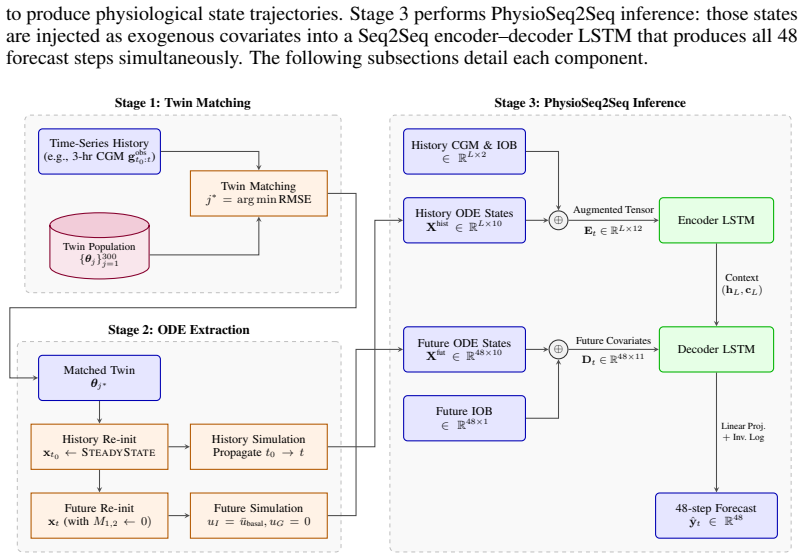
By matching a 3-hour CGM segment to one of 300 pre-parameterized digital twins and injecting the resulting 10 ODE state variables as exogenous covariates into the encoder and decoder of a Seq2Seq LSTM, the model performs simultaneous 48-step glucose prediction that eliminates recursive error compounding while bounding long-horizon drift within physiologically realistic ranges.
What carries the argument
The twin-matching step that identifies the best-fitting digital twin from a short CGM history and supplies its internal ODE states to constrain the LSTM decoder.
If this is right
- Simultaneous multi-step prediction removes the error-compounding loop that affects recursive LSTMs.
- Physiological state injection keeps long forecasts from drifting outside observed glucose ranges.
- Bias at four hours drops by nearly 14 mg/dL compared with a plain recursive LSTM.
- Mean absolute error at four hours drops by nearly 29 mg/dL compared with a standalone ODE digital twin.
Where Pith is reading between the lines
- The same matching of mechanistic states to short histories could be tested in other physiological time-series tasks such as heart-rate or blood-pressure forecasting.
- Expanding the twin library with more parameter combinations might further reduce mismatch errors on new patients.
- Real-time use would require an efficient search over the twin library that could be pre-computed from recent CGM features.
Load-bearing premise
Selecting one digital twin from a 3-hour CGM segment supplies internal ODE states accurate enough to constrain the LSTM without introducing new systematic errors or selection bias.
What would settle it
A test in which random twin selection or no twin injection at all produces equal or lower error and bias at the 240-minute horizon would show that the matching step adds no value.
Figures


read the original abstract
Accurate long-horizon glucose forecasting is critical for automated insulin delivery systems, which help people with type 1 diabetes (T1D) manage their glucose and avoid dangerous hypoglycemia. However, standard recursive long short-term memory (LSTM) networks suffer from systematic negative bias at longer horizons due to error compounding, while purely mechanistic ordinary differential equation (ODE) models fail to generalize across individuals when parameterized at the population level. We propose PhysioSeq2Seq, a hybrid architecture that combines patient-specific physiological modeling with a sequence-to-sequence (Seq2Seq) LSTM. For each glucose segment, twin matching searches a population of 300 parameterized digital twins to identify the best-fitting physiological match from a 3-hour continuous glucose monitoring (CGM) history. The 10 internal ODE state variables of the matched twin are injected as exogenous covariates into both the encoder and decoder of the Seq2Seq LSTM. This simultaneous 48-step prediction strategy eliminates recursive error compounding, while the ODE features provide a physics-grounded constraint that bounds long-horizon drift within physiologically plausible ranges. PhysioSeq2Seq was trained on CGM and insulin data from 348 participants in the Type 1 Diabetes Exercise Initiative (T1DEXI) dataset and evaluated on 74 held-out participants. At the 240-minute horizon, PhysioSeq2Seq achieves a mean absolute error of 39.28 mg/dL and a mean error of -10.62 mg/dL, reducing bias by 13.89 mg/dL over the recursive LSTM and reducing mean absolute error by 28.62 mg/dL over the ODE-based digital twin. These results show that eliminating architectural feedback and injecting patient-matched physiological states is an effective and clinically meaningful strategy for long-horizon glucose forecasting in T1D.
Editorial analysis
A structured set of objections, weighed in public.
Referee Report
Summary. The paper introduces PhysioSeq2Seq, a hybrid architecture that matches each 3-hour CGM segment to one of 300 pre-parameterized physiological digital twins and injects the 10 internal ODE states as exogenous covariates into a Seq2Seq LSTM encoder-decoder. This is intended to provide physics-grounded constraints that mitigate error compounding and bias in long-horizon (up to 240 min) glucose forecasts for T1D. The model is trained on 348 T1DEXI participants and evaluated on a held-out set of 74 participants, with headline results of MAE 39.28 mg/dL and mean error -10.62 mg/dL at 240 min, claimed to reduce bias by 13.89 mg/dL versus recursive LSTM and MAE by 28.62 mg/dL versus the ODE twin alone.
Significance. If the numerical claims are reproducible and the twin-matching step demonstrably supplies accurate internal states without introducing new mismatch errors, the work would offer a practical route to longer-horizon, physiologically constrained forecasts that could improve automated insulin delivery safety. The combination of mechanistic state injection with non-recursive sequence prediction directly targets two well-known failure modes in the field.
major comments (2)
- [Abstract] Abstract: the central performance claims (MAE = 39.28 mg/dL, ME = -10.62 mg/dL, bias reduction 13.89 mg/dL, MAE reduction 28.62 mg/dL at 240 min) are stated without error bars, confidence intervals, statistical tests, or participant-level variability; this prevents verification that the reported improvements over the recursive LSTM and population ODE baselines are reliable rather than artifacts of a single split.
- [Abstract] Abstract and method description: the claim that injecting states from a single best-matched twin (selected via 3-hour CGM from a library of 300 population-derived models) supplies an accurate, bias-reducing constraint at 240 min rests on an untested assumption; no validation is provided that the matching window resolves key individual parameters (e.g., time-varying insulin sensitivity) or that residual mismatch does not propagate systematic error into the decoder exactly where the hybrid benefit is asserted.
minor comments (1)
- [Abstract] The abstract would be clearer if it explicitly listed all forecast horizons evaluated and the precise definition of the 10 injected ODE states.
Simulated Author's Rebuttal
We thank the referee for their constructive and detailed comments. We address each major comment below, indicating where we agree and the specific revisions we have incorporated or will incorporate in the updated manuscript.
read point-by-point responses
-
Referee: [Abstract] Abstract: the central performance claims (MAE = 39.28 mg/dL, ME = -10.62 mg/dL, bias reduction 13.89 mg/dL, MAE reduction 28.62 mg/dL at 240 min) are stated without error bars, confidence intervals, statistical tests, or participant-level variability; this prevents verification that the reported improvements over the recursive LSTM and population ODE baselines are reliable rather than artifacts of a single split.
Authors: We agree that the original abstract and results presentation would benefit from explicit uncertainty quantification and statistical support. In the revised manuscript we have added bootstrap-derived 95% confidence intervals for the 240-minute MAE and mean error, computed by resampling over the 74 held-out participants. We also report the results of paired t-tests comparing PhysioSeq2Seq against the recursive LSTM and population ODE baselines, together with a supplementary table that summarizes per-participant error distributions (mean, standard deviation, and range) to illustrate inter-individual variability. revision: yes
-
Referee: [Abstract] Abstract and method description: the claim that injecting states from a single best-matched twin (selected via 3-hour CGM from a library of 300 population-derived models) supplies an accurate, bias-reducing constraint at 240 min rests on an untested assumption; no validation is provided that the matching window resolves key individual parameters (e.g., time-varying insulin sensitivity) or that residual mismatch does not propagate systematic error into the decoder exactly where the hybrid benefit is asserted.
Authors: The referee correctly identifies that we did not supply a direct validation of the twin-matching step. While the held-out performance gains provide indirect support for the utility of the injected states, an explicit check that the 3-hour window resolves time-varying parameters such as insulin sensitivity was absent. In the revision we have added a new results subsection that quantifies the temporal stability of the selected twin parameters across consecutive segments and reports their correlation with empirical proxies of insulin sensitivity derived from the test-set CGM and insulin data. We have also expanded the limitations discussion to acknowledge the possibility of residual mismatch and its potential effect on decoder drift. revision: partial
Circularity Check
No significant circularity detected
full rationale
The paper presents an empirical hybrid model: 300 pre-parameterized population digital twins are matched to a 3-hour CGM history segment to supply 10 ODE states as exogenous covariates to a Seq2Seq LSTM. Training occurs on 348 participants and evaluation on a separate 74 held-out participants. The reported MAE and bias reductions at 240 min are direct empirical comparisons against recursive LSTM and standalone ODE baselines. No equation or procedure reduces the future glucose target to the matching inputs by construction, no self-citation chain supports a load-bearing uniqueness claim, and no fitted parameter is relabeled as an independent prediction. The architecture and split evaluation are self-contained against external benchmarks.
Axiom & Free-Parameter Ledger
free parameters (2)
- Library size
- Matching window length
axioms (1)
- domain assumption A single best-matching digital twin from a short recent window supplies physiologically accurate internal states for the subsequent forecast horizon.
invented entities (1)
-
PhysioSeq2Seq architecture
no independent evidence
Lean theorems connected to this paper
-
IndisputableMonolith/Cost/FunctionalEquation.leanwashburn_uniqueness_aczel unclear?
unclearRelation between the paper passage and the cited Recognition theorem.
twin matching searches a population of 300 parameterized digital twins... The 10 internal ODE state variables of the matched twin are injected as exogenous covariates
-
IndisputableMonolith/Foundation/RealityFromDistinction.leanreality_from_one_distinction unclear?
unclearRelation between the paper passage and the cited Recognition theorem.
simultaneous 48-step prediction strategy eliminates recursive error compounding, while the ODE features provide a physics-grounded constraint
What do these tags mean?
- matches
- The paper's claim is directly supported by a theorem in the formal canon.
- supports
- The theorem supports part of the paper's argument, but the paper may add assumptions or extra steps.
- extends
- The paper goes beyond the formal theorem; the theorem is a base layer rather than the whole result.
- uses
- The paper appears to rely on the theorem as machinery.
- contradicts
- The paper's claim conflicts with a theorem or certificate in the canon.
- unclear
- Pith found a possible connection, but the passage is too broad, indirect, or ambiguous to say the theorem truly supports the claim.
Reference graph
Works this paper leans on
-
[1]
doi:10.1088/0967-3334/25/4/010 , year =
Roman Hovorka and Valentina Canonico and Ludovic J Chassin and Ulrich Haueter and Massimo Massi-Benedetti and Marco Orsini Federici and Thomas R Pieber and Helga C Schaller and Lukas Schaupp and Thomas Vering and Malgorzata E Wilinska , title =. doi:10.1088/0967-3334/25/4/010 , year =
-
[2]
and Wang, Fei and Haynes, Aveni and Gregory, Gabriel A
Ogle, Graham D. and Wang, Fei and Haynes, Aveni and Gregory, Gabriel A. and King, Thomas W. and Deng, Kylie and Dabelea, Dana and James, Steven and Jenkins, Alicia J. and Li, Xia and Ma, Ronald C.W. and Maahs, David M. and Oram, Richard A. and Pihoker, Catherine and Svensson, Jannet and Zhou, Zhiguang and Magliano, Dianna J. and Maniam, Jayanthi , title =...
-
[3]
Cobelli, Claudio and Renard, Eric and Kovatchev, Boris , title =. Diabetes , volume =. 2011 , issn =
work page 2011
-
[4]
Breton and Sriram Sankaranarayanan , journal =
Taisa Kushner and Marc D. Breton and Sriram Sankaranarayanan , journal =. 2020 , volume =
work page 2020
-
[5]
Li, Kezhi and Daniels, John and Liu, Chengyuan and Herrero, Pau and Georgiou, Pantelis , journal =. 2020 , volume =
work page 2020
-
[6]
Diederik P. Kingma and Jimmy Ba , title =. 3rd International Conference on Learning Representations,
-
[7]
Riddell, Michael C. and Li, Zoey and Gal, Robin L. and Calhoun, Peter and Jacobs, Peter G. and Clements, Mark A. and Martin, Corby K. and Doyle III, Francis J. and Patton, Susana R. and Castle, Jessica R. and Gillingham, Melanie B. and Beck, Roy W. and Rickels, Michael R. and T1DEXI Study Group , title =. Diabetes Care , volume =. 2023 , issn =
work page 2023
-
[8]
Mosquera-Lopez, Clara and Wilson, Leah M. and El Youssef, Joseph and Hilts, Wade and Leitschuh, Joseph and Branigan, Deborah and Gabo, Virginia and Eom, Jae H. and Castle, Jessica R. and Jacobs, Peter G. , title =. npj Digital Medicine , year =
-
[9]
and Mosquera-Lopez, Clara , title =
Roquemen-Echeverri, Valentina and Kushner, Taisa and Jacobs, Peter G. and Mosquera-Lopez, Clara , title =. Neural Computing and Applications , year =
-
[10]
Clara Mosquera-Lopez and Peter G. Jacobs , title =. Journal of Diabetes Science and Technology , volume =. 2022 , doi =
work page 2022
-
[11]
IFAC-PapersOnLine , volume =. 2025 , issn =. doi:10.1016/j.ifacol.2025.06.027 , author =
-
[12]
Chen, Ricky T. Q. and Rubanova, Yulia and Bettencourt, Jesse and Duvenaud, David K , booktitle =
-
[13]
Universal Differential Equations for Scientific Machine Learning
Christopher Rackauckas and Yingbo Ma and Julius Martensen and Collin Warner and Kirill Zubov and Rohit Supekar and Dominic Skinner and Ali Ramadhan and Alan Edelman , year =. 2001.04385 , archiveprefix =
work page internal anchor Pith review Pith/arXiv arXiv 2001
-
[14]
Generalized Score Functions for Causal Discovery , year =
Fox, Ian and Ang, Lynn and Jaiswal, Mamta and Pop-Busui, Rodica and Wiens, Jenna , title =. 2018 , isbn =. doi:10.1145/3219819.3220102 , booktitle =
-
[15]
Zou, Bob Junyi and Levine, Matthew E. and Zaharieva, Dessi P. and Johari, Ramesh and Fox, Emily B. , title =. 2024 , booktitle =
work page 2024
-
[16]
Mirshekarian, Sadegh and Shen, Hui and Bunescu, Razvan and Marling, Cindy , booktitle =. 2019 , pages =
work page 2019
- [17]
-
[18]
Journal of Diabetes Science and Technology , volume =
Giacomo Cappon and Andrea Facchinetti , title =. Journal of Diabetes Science and Technology , volume =. 2025 , doi =
work page 2025
-
[19]
Cappon, Giacomo and Vettoretti, Martina and Sparacino, Giovanni and Favero, Simone Del and Facchinetti, Andrea , journal =. 2023 , volume =
work page 2023
-
[20]
and Lu, Lu and Perdikaris, Paris and Wang, Sifan and Yang, Liu , title =
Karniadakis, George Em and Kevrekidis, Ioannis G. and Lu, Lu and Perdikaris, Paris and Wang, Sifan and Yang, Liu , title =. Nature Reviews Physics , year =
-
[21]
Atkinson, Mark A. and Eisenbarth, George S. and Michels, Aaron W. , title =. The Lancet , year =
-
[22]
PLOS ONE , title =. 2017 , volume =. doi:10.1371/journal.pone.0187754 , author =
-
[23]
R N Bergman AND L S Phillips AND C Cobelli , journal =. 1981 , volume =
work page 1981
-
[24]
and Cobelli, Claudio , journal =
Dalla Man, Chiara and Rizza, Robert A. and Cobelli, Claudio , journal =. 2007 , volume =
work page 2007
-
[25]
Journal of Diabetes Science and Technology , volume =
Chiara Dalla Man and Francesco Micheletto and Dayu Lv and Marc Breton and Boris Kovatchev and Claudio Cobelli , title =. Journal of Diabetes Science and Technology , volume =. 2014 , doi =
work page 2014
-
[26]
Trends in Endocrinology & Metabolism , volume =. 2024 , issn =. doi:10.1016/j.tem.2024.04.019 , author =
discussion (0)
Sign in with ORCID, Apple, or X to comment. Anyone can read and Pith papers without signing in.