Quantum Error Correction Assisted Axion Search in CMOS Spin Qubit Arrays
Pith reviewed 2026-05-20 12:53 UTC · model grok-4.3
The pith
Quantum error correction restores entanglement advantages in axion searches by reducing dephasing in spin qubit arrays.
A machine-rendered reading of the paper's core claim, the machinery that carries it, and where it could break.
Core claim
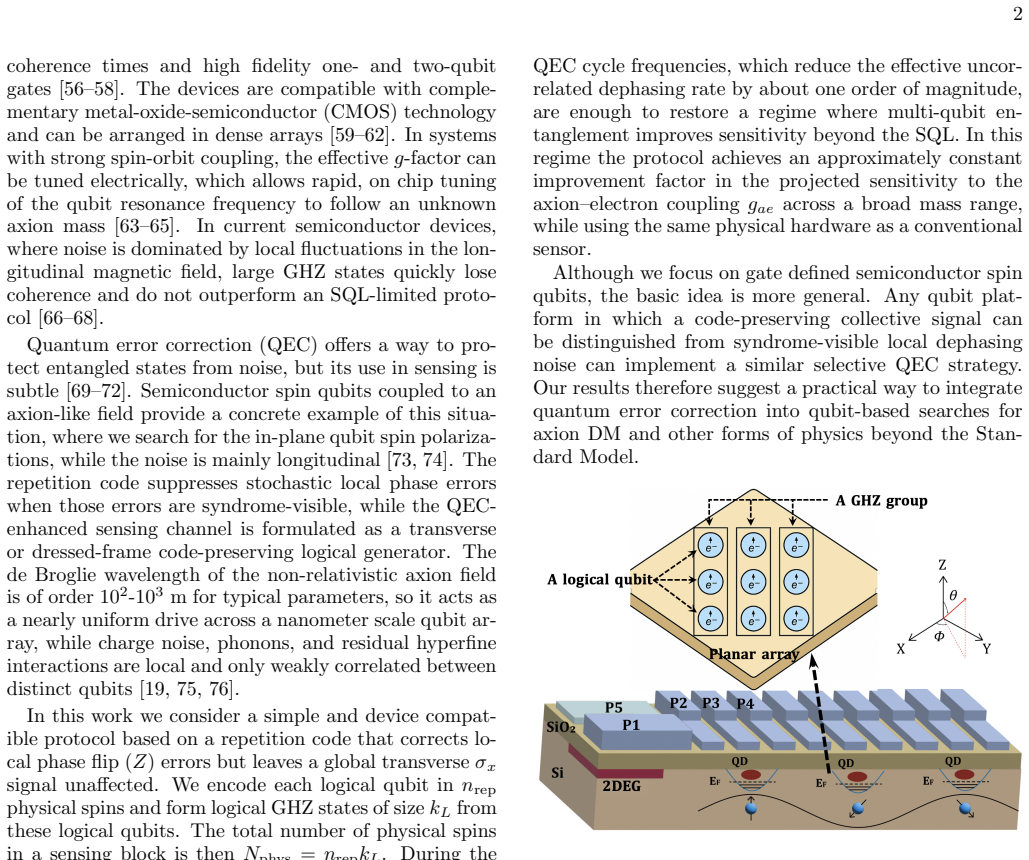
Integrating an optimally chosen repetition code QEC with logical GHZ block entanglement in CMOS spin qubit arrays mitigates strong longitudinal dephasing. Closed-form quantum Fisher information expressions that incorporate both the QEC process and the axion field's coherence time demonstrate that modest QEC cycle frequencies substantially lower the effective dephasing rate. This restores a broad parameter regime in which entanglement-enhanced sensing surpasses the standard quantum limit, projecting up to order-of-magnitude improvements in sensitivity to the axion-electron coupling g_ae.
What carries the argument
Repetition code quantum error correction applied to logical GHZ entangled blocks, which suppresses longitudinal dephasing while preserving the axion coherence time to sustain quantum Fisher information gains.
Load-bearing premise
Modest QEC cycle frequencies are sufficient to significantly reduce the effective dephasing rate while preserving the finite coherence time of the axion field.
What would settle it
An experiment on a CMOS spin qubit array that applies the proposed repetition-code QEC to entangled states and measures no improvement in sensitivity to axion-induced signals compared to the uncorrected case.
Figures


read the original abstract
Searches for axion and axionlike dark matter based on solid-state spin qubits are fundamentally limited by strong longitudinal dephasing, which rapidly suppresses the sensitivity gains offered by entanglement. Here we show that quantum error correction (QEC) can substantially enhance axion search sensitivity in realistic semiconductor spin qubit platforms by mitigating this dominant noise source. By integrating an optimally chosen repetition code QEC with logical GHZ block entanglement, we derive closed-form expressions for the quantum Fisher information that explicitly incorporate the finite coherence time of the axion field. Our analysis demonstrates that modest QEC cycle frequencies are sufficient to significantly reduce the effective dephasing rate, thereby restoring a broad parameter regime in which entanglement-enhanced sensing surpasses the standard quantum limit. Projecting these results onto CMOS-compatible device parameters, we find that QEC-protected entangled sensing can revive otherwise inaccessible quantum advantages, yielding up to order-of-magnitude improvements in sensitivity to the axion-electron coupling $g_{ae}$. These results establish a practical and theoretically controlled pathway for using QEC to improve qubit array searches for physics beyond the Standard Model.
Editorial analysis
A structured set of objections, weighed in public.
Referee Report
Summary. The paper claims that integrating repetition-code QEC with logical GHZ entanglement in CMOS spin qubit arrays can mitigate dominant longitudinal dephasing in axion searches. Closed-form expressions for the quantum Fisher information are derived that incorporate both the QEC cycle frequency and the axion field's finite coherence time T_a; the analysis concludes that modest f_QEC values suffice to reduce the effective dephasing rate enough to restore entanglement-enhanced sensitivity, yielding up to order-of-magnitude gains in reach for the axion-electron coupling g_ae when projected onto realistic device parameters.
Significance. If the QFI derivations are correct and the required f_QEC window is experimentally accessible, the result would provide a concrete, analytically tractable route to surpass the SQL in solid-state axion searches. The explicit inclusion of T_a in the QFI expressions and the focus on CMOS-compatible parameters are strengths that could guide near-term experiments.
major comments (3)
- [§3.3, Eq. (18)] §3.3, Eq. (18): the effective dephasing rate γ_eff(f_QEC) is obtained under a white-noise approximation for the longitudinal noise; it is unclear whether the same functional form holds for the 1/f-type spectra measured in CMOS spin qubits, which would alter the f_QEC values needed to bring γ_eff below the axion-induced rate.
- [§4.2] §4.2, paragraph following Eq. (25): the claim that 'modest QEC cycle frequencies' open a viable window relies on the inequality f_QEC > γ_deph but f_QEC << 1/T_a; no numerical scan over the projected CMOS parameters (T_2* ≈ 1 ms, gate times, axion velocity dispersion) is shown to confirm that this interval is non-empty for the axion masses of interest.
- [§5, Fig. 4] §5, Fig. 4: the plotted sensitivity gain assumes the QEC-protected regime derived in §4; if the f_QEC window is empty, the curves revert to the SQL-limited case, yet the figure does not include a 'no-QEC' reference trace for direct comparison.
minor comments (2)
- [Abstract] The abstract states 'up to order-of-magnitude improvements' without specifying the exact parameter point at which this occurs; a single sentence in the abstract or §5 clarifying the best-case g_ae reach would improve readability.
- [§2] Notation for the axion coherence time T_a is introduced in §2 but used interchangeably with T_φ in later sections; consistent use of one symbol would reduce confusion.
Simulated Author's Rebuttal
We thank the referee for their careful reading and constructive comments on our manuscript. We address each major comment below and have revised the manuscript accordingly to incorporate the suggested improvements.
read point-by-point responses
-
Referee: [§3.3, Eq. (18)] §3.3, Eq. (18): the effective dephasing rate γ_eff(f_QEC) is obtained under a white-noise approximation for the longitudinal noise; it is unclear whether the same functional form holds for the 1/f-type spectra measured in CMOS spin qubits, which would alter the f_QEC values needed to bring γ_eff below the axion-induced rate.
Authors: We acknowledge that the derivation in §3.3 employs a white-noise model for analytical closed-form expressions. For the 1/f spectra typical of CMOS spin qubits, the repetition-code QEC still functions as a high-pass filter. We have added a paragraph in the revised §3.3 that applies the filter-function formalism to 1/f noise, demonstrating that γ_eff is suppressed as ~ (f_QEC)^α with α ≈ 1–2 depending on the noise exponent. The required f_QEC to reach the axion-limited regime remains modest (tens of kHz) and within experimental reach; the qualitative conclusions of the paper are unchanged. revision: yes
-
Referee: [§4.2] §4.2, paragraph following Eq. (25): the claim that 'modest QEC cycle frequencies' open a viable window relies on the inequality f_QEC > γ_deph but f_QEC << 1/T_a; no numerical scan over the projected CMOS parameters (T_2* ≈ 1 ms, gate times, axion velocity dispersion) is shown to confirm that this interval is non-empty for the axion masses of interest.
Authors: We agree that an explicit numerical check strengthens the claim. In the revised manuscript we have inserted a new paragraph and accompanying table in §4.2 that scans over T_2* = 1 ms, gate times of 10–100 ns, and axion coherence times T_a set by velocity dispersion for masses 0.1–10 μeV. The scan confirms a non-empty window with f_QEC between approximately 5 kHz and 500 kHz, comfortably satisfying both f_QEC > γ_deph and f_QEC ≪ 1/T_a for the parameter range of interest. revision: yes
-
Referee: [§5, Fig. 4] §5, Fig. 4: the plotted sensitivity gain assumes the QEC-protected regime derived in §4; if the f_QEC window is empty, the curves revert to the SQL-limited case, yet the figure does not include a 'no-QEC' reference trace for direct comparison.
Authors: This is a valid observation for clarity. We have revised Fig. 4 to include a dashed 'no-QEC' reference curve that shows the SQL-limited sensitivity in the absence of error correction. The updated figure now allows immediate visual comparison between the QEC-protected entangled case and the unprotected baseline across the plotted axion-mass range. revision: yes
Circularity Check
No significant circularity; derivation uses external parameters
full rationale
The paper derives closed-form QFI expressions by combining standard repetition-code QEC on logical GHZ states with the axion field's finite coherence time T_a treated as an independent input. Effective dephasing rates are modeled as functions of QEC cycle frequency under explicit assumptions about the regime where f_QEC suppresses longitudinal noise without averaging out the axion signal. These steps build on conventional quantum sensing and error-correction frameworks with coherence times and CMOS noise spectra supplied externally rather than fitted or defined by the target sensitivity gain to g_ae. No load-bearing step reduces the claimed order-of-magnitude improvement to a quantity defined by the authors' own prior work or by construction from the result itself. The analysis therefore remains self-contained against external benchmarks.
Axiom & Free-Parameter Ledger
free parameters (1)
- QEC cycle frequency
axioms (1)
- domain assumption Finite coherence time of the axion field limits the usable sensing window
Lean theorems connected to this paper
-
IndisputableMonolith/Cost/FunctionalEquation.leanwashburn_uniqueness_aczel unclear?
unclearRelation between the paper passage and the cited Recognition theorem.
We derive closed-form expressions for the quantum Fisher information that explicitly incorporate the finite coherence time of the axion field... modest QEC cycle frequencies are sufficient to significantly reduce the effective dephasing rate
-
IndisputableMonolith/Foundation/ArithmeticFromLogic.leanembed_strictMono_of_one_lt unclear?
unclearRelation between the paper passage and the cited Recognition theorem.
optimal logical GHZ size k_L^* = 1/(2(γ_eff + γ_cor)T_seg)
What do these tags mean?
- matches
- The paper's claim is directly supported by a theorem in the formal canon.
- supports
- The theorem supports part of the paper's argument, but the paper may add assumptions or extra steps.
- extends
- The paper goes beyond the formal theorem; the theorem is a base layer rather than the whole result.
- uses
- The paper appears to rely on the theorem as machinery.
- contradicts
- The paper's claim conflicts with a theorem or certificate in the canon.
- unclear
- Pith found a possible connection, but the passage is too broad, indirect, or ambiguous to say the theorem truly supports the claim.
Reference graph
Works this paper leans on
-
[1]
If we evaluateσ x expectation value, we will obtain⟨σ x(t)⟩= cos(ω0t−βsin(ω at))
Under the influence of the axion effective magnetic field, the qubit state will pick up a total time-dependent phase: ϕa(t) =ω 0t−βsin(ω at),(17) where we have selected the initial phaseϕ= 0 for sim- plicity, and the modulation indexβis defined as: β≡ 2gaev√2ρDM ma .(18) This is a standard frequency modulation form, with the carrier frequencyω 0, and modu...
-
[2]
J. L. Feng, Dark matter candidates from particle physics and methods of detection, Annual Review of Astronomy and Astrophysics48, 495 (2010)
work page 2010
-
[3]
D. J. Marsh, Axion cosmology, Physics Reports643, 1 (2016), axion cosmology
work page 2016
-
[4]
L. Di Luzio, M. Giannotti, E. Nardi, and L. Visinelli, The landscape of qcd axion models, Physics Reports870, 1 (2020), the landscape of QCD axion models
work page 2020
-
[5]
K. Choi, S. H. Im, and C. S. Shin, Recent progress in the physics of axions and axion-like particles, Annual Review of Nuclear and Particle Science71, 225 (2021)
work page 2021
-
[6]
A. Arbey and F. Mahmoudi, Dark matter and the early universe: A review, Progress in Particle and Nuclear Physics119, 103865 (2021)
work page 2021
-
[7]
R. D. Peccei and H. R. Quinn, CP conservation in the presence of pseudoparticles, Phys. Rev. Lett.38, 1440 (1977)
work page 1977
-
[8]
R. D. Peccei and H. R. Quinn, Constraints imposed by CP conservation in the presence of pseudoparticles, Phys. Rev. D16, 1791 (1977)
work page 1977
-
[9]
Weinberg, A new light boson?, Phys
S. Weinberg, A new light boson?, Phys. Rev. Lett.40, 223 (1978)
work page 1978
-
[10]
Wilczek, Problem of strongpandtinvariance in the presence of instantons, Phys
F. Wilczek, Problem of strongpandtinvariance in the presence of instantons, Phys. Rev. Lett.40, 279 (1978)
work page 1978
-
[11]
Z. G. Berezhiani and M. Y. Khlopov, Cosmology of spon- taneously broken gauge family symmetry with axion so- lution of strong cp-problem, Zeitschrift f¨ ur Physik C Par- ticles and Fields49, 73 (1991)
work page 1991
-
[12]
M. Khlopov, A. Sakharov, and D. Sokoloff, The nonlinear modulation of the density distribution in standard ax- ionic cdm and its cosmological impact, Nuclear Physics B - Proceedings Supplements72, 105 (1999), proceedings of the 5th IFT Workshop on Axions
work page 1999
-
[13]
J. E. Kim and G. Carosi, Axions and the strongcpprob- lem, Rev. Mod. Phys.82, 557 (2010)
work page 2010
-
[14]
I. G. Irastorza and J. Redondo, New experimental ap- proaches in the search for axion-like particles, Progress in Particle and Nuclear Physics102, 89 (2018)
work page 2018
-
[15]
L. D. Duffy and K. v. Bibber, Axions as dark matter particles, New Journal of Physics11, 105008 (2009)
work page 2009
-
[16]
J. Preskill, M. B. Wise, and F. Wilczek, Cosmology of the invisible axion, Physics Letters B120, 127 (1983)
work page 1983
-
[17]
L. Abbott and P. Sikivie, A cosmological bound on the invisible axion, Physics Letters B120, 133 (1983)
work page 1983
-
[18]
M. Dine and W. Fischler, The not-so-harmless axion, Physics Letters B120, 137 (1983)
work page 1983
-
[19]
F. Chadha-Day, J. Ellis, and D. J. E. Marsh, Axion dark matter: What is it and why now?, Science Advances8, eabj3618 (2022), https://www.science.org/doi/pdf/10.1126/sciadv.abj3618
-
[20]
A. J. Brady, C. Gao, R. Harnik, Z. Liu, Z. Zhang, and Q. Zhuang, Entangled sensor-networks for dark-matter searches, PRX Quantum3, 030333 (2022)
work page 2022
-
[21]
S.-Y. Guo, M. Khlopov, X. Liu, L. Wu, Y. Wu, and B. Zhu, Footprints of axion-like particle in pulsar tim- ing array data and james webb space telescope observa- tions, Science China Physics, Mechanics & Astronomy 67, 111011 (2024)
work page 2024
-
[22]
Y. V. Stadnik and V. V. Flambaum, Axion-induced ef- fects in atoms, molecules, and nuclei: Parity nonconser- vation, anapole moments, electric dipole moments, and spin-gravity and spin-axion momentum couplings, Phys. Rev. D89, 043522 (2014)
work page 2014
-
[23]
Y. K. Semertzidis and S. Youn, Axion dark matter: How to see it?, Science Advances8, eabm9928 (2022), https://www.science.org/doi/pdf/10.1126/sciadv.abm9928
-
[24]
A. B. Balakin and V. A. Popov, Spin-axion coupling, Phys. Rev. D92, 105025 (2015)
work page 2015
- [25]
-
[26]
A. Garcon, D. Aybas, J. W. Blanchard, G. Centers, N. L. Figueroa, P. W. Graham, D. F. J. Kimball, S. Rajen- dran, M. G. Sendra, A. O. Sushkov, L. Trahms, T. Wang, A. Wickenbrock, T. Wu, and D. Budker, The cosmic ax- ion spin precession experiment (casper): a dark-matter search with nuclear magnetic resonance, Quantum Sci- ence and Technology3, 014008 (2017)
work page 2017
-
[27]
A. Garcon, J. W. Blanchard, G. P. Centers, N. L. Figueroa, P. W. Graham, D. F. J. Kimball, S. Ra- jendran, A. O. Sushkov, Y. V. Stadnik, A. Wick- enbrock, T. Wu, and D. Budker, Constraints on bosonic dark matter from ultralow-field nuclear mag- netic resonance, Science Advances5, eaax4539 (2019), https://www.science.org/doi/pdf/10.1126/sciadv.aax4539
-
[28]
J. A. Dror, S. Gori, J. M. Leedom, and N. L. Rodd, Sensitivity of spin-precession axion experiments, Phys. Rev. Lett.130, 181801 (2023)
work page 2023
-
[29]
Z. Xu, X. Ma, K. Wei, Y. He, X. Heng, X. Huang, T. Ai, J. Liao, W. Ji, J. Liu, X.-P. Wang, and D. Budker, Con- straining ultralight dark matter through an accelerated resonant search, Communications Physics7, 226 (2024)
work page 2024
-
[30]
X. Tan, Z. Wang, W. Bai, and H. Zhu, Canceling second-order frequency shifts in ge hole spin qubits via bichromatic control, Applied Physics Letters128, 124001 (2026)
work page 2026
-
[31]
T. Wu, J. W. Blanchard, G. P. Centers, N. L. Figueroa, A. Garcon, P. W. Graham, D. F. J. Kimball, S. Rajen- dran, Y. V. Stadnik, A. O. Sushkov, A. Wickenbrock, and D. Budker, Search for axionlike dark matter with a liquid-state nuclear spin comagnetometer, Phys. Rev. Lett.122, 191302 (2019)
work page 2019
- [32]
-
[33]
D. Aybas, J. Adam, E. Blumenthal, A. V. Gramolin, D. Johnson, A. Kleyheeg, S. Afach, J. W. Blanchard, G. P. Centers, A. Garcon, M. Engler, N. L. Figueroa, M. G. Sendra, A. Wickenbrock, M. Lawson, T. Wang, T. Wu, H. Luo, H. Mani, P. Mauskopf, P. W. Graham, S. Rajendran, D. F. J. Kimball, D. Budker, and A. O. Sushkov, Search for axionlike dark matter using ...
work page 2021
-
[34]
D. Aybas, H. Bekker, J. W. Blanchard, D. Budker, G. P. Centers, N. L. Figueroa, A. V. Gramolin, D. F. Jack- son Kimball, A. Wickenbrock, and A. O. Sushkov, Quan- tum sensitivity limits of nuclear magnetic resonance ex- periments searching for new fundamental physics, Quan- tum Science and Technology6, 034007 (2021). 12
work page 2021
-
[35]
J. W. Blanchard, A. O. Sushkov, and A. Wickenbrock, Magnetic resonance searches, inThe Search for Ultralight Bosonic Dark Matter, edited by D. F. Jackson Kimball and K. van Bibber (Springer International Publishing, Cham, 2023) pp. 173–200
work page 2023
- [36]
-
[37]
R. Barbieri, C. Braggio, G. Carugno, C. Gallo, A. Lom- bardi, A. Ortolan, R. Pengo, G. Ruoso, and C. Speake, Searching for galactic axions through magnetized media: The quax proposal, Physics of the Dark Universe15, 135 (2017)
work page 2017
-
[38]
N. Crescini, D. Alesini, C. Braggio, G. Carugno, D. Di Gioacchino, C. S. Gallo, U. Gambardella, C. Gatti, G. Iannone, G. Lamanna, C. Ligi, A. Lombardi, A. Or- tolan, S. Pagano, R. Pengo, G. Ruoso, C. C. Speake, and L. Taffarello, Operation of a ferromagnetic axion halo- scope at ma=58uev, The European Physical Journal C 78, 703 (2018)
work page 2018
-
[39]
N. Crescini, D. Alesini, C. Braggio, G. Carugno, D. D’Agostino, D. Di Gioacchino, P. Falferi, U. Gam- bardella, C. Gatti, G. Iannone, C. Ligi, A. Lombardi, A. Ortolan, R. Pengo, G. Ruoso, and L. Taffarello (QUAX Collaboration), Axion search with a quantum- limited ferromagnetic haloscope, Phys. Rev. Lett.124, 171801 (2020)
work page 2020
-
[40]
S. Chigusa, T. Moroi, and K. Nakayama, Detecting light boson dark matter through conversion into a magnon, Phys. Rev. D101, 096013 (2020)
work page 2020
-
[41]
S. Chigusa, A. Ito, K. Nakayama, and V. Takhistov, Ef- fects of finite material size on axion-magnon conversion, Journal of High Energy Physics2024, 185 (2024)
work page 2024
- [42]
-
[43]
A. A. Clerk, M. H. Devoret, S. M. Girvin, F. Marquardt, and R. J. Schoelkopf, Introduction to quantum noise, measurement, and amplification, Rev. Mod. Phys.82, 1155 (2010)
work page 2010
- [44]
- [45]
-
[46]
A. V. Dixit, S. Chakram, K. He, A. Agrawal, R. K. Naik, D. I. Schuster, and A. Chou, Searching for dark mat- ter with a superconducting qubit, Phys. Rev. Lett.126, 141302 (2021)
work page 2021
-
[47]
S. Chen, H. Fukuda, T. Inada, T. Moroi, T. Nitta, and T. Sichanugrist, Detecting hidden photon dark matter using the direct excitation of transmon qubits, Phys. Rev. Lett.131, 211001 (2023)
work page 2023
-
[48]
A. K. Yi, S. Ahn, i. m. c. b. u. Kutlu, J. Kim, B. R. Ko, B. I. Ivanov, H. Byun, A. F. van Loo, S. Park, J. Jeong, O. Kwon, Y. Nakamura, S. V. Uchaikin, J. Choi, S. Lee, M. Lee, Y. C. Shin, J. Kim, D. Lee, D. Ahn, S. Bae, J. Lee, Y. Kim, V. Gkika, K. W. Lee, S. Oh, T. Seong, D. Kim, W. Chung, A. Matlashov, S. Youn, and Y. K. Semertzidis, Axion dark matter...
work page 2023
-
[49]
S. Ahn, J. Kim, B. I. Ivanov, O. Kwon, H. Byun, A. F. van Loo, S. Park, J. Jeong, S. Lee, J. Kim, i. m. c. b. u. Kutlu, A. K. Yi, Y. Nakamura, S. Oh, D. Ahn, S. Bae, H. Choi, J. Choi, Y. Chong, W. Chung, V. Gkika, J. E. Kim, Y. Kim, B. R. Ko, L. Miceli, D. Lee, J. Lee, K. W. Lee, M. Lee, A. Matlashov, P. Parashar, T. Seong, Y. C. Shin, S. V. Uchaikin, S. ...
work page 2024
-
[50]
S. Chen, H. Fukuda, T. Inada, T. Moroi, T. Nitta, and T. Sichanugrist, Quantum enhancement in dark matter detection with quantum computation, Phys. Rev. Lett. 133, 021801 (2024)
work page 2024
-
[51]
S. Ahn, i. m. c. b. u. Kutlu, S. Lee, S. Youn, S. V. Uchaikin, S. Bae, J. Jeong, A. F. van Loo, Y. Naka- mura, S. Oh, J. E. Kim, and Y. K. Semertzidis, Probing kim-shifman-vainshtein-zakharov axion dark matter near 5.9 ghz using an 8-cell cavity haloscope, Phys. Rev. Lett. 135, 211801 (2025)
work page 2025
-
[52]
S. Bae, J. Jeong, Y. Kim, S. Youn, J. Kim, A. F. van Loo, Y. Nakamura, S. Oh, T. Seong, S. Uchaikin, J. E. Kim, and Y. K. Semertzidis, Axion dark matter search with sensitivity near the kim-shifman-vainshtein- zakharov benchmark using the tm 020 mode, Phys. Rev. Lett.135, 091804 (2025)
work page 2025
-
[53]
C. Braggio, L. Balembois, R. Di Vora, Z. Wang, J. Trav- esedo, L. Pallegoix, G. Carugno, A. Ortolan, G. Ruoso, U. Gambardella, D. D’Agostino, P. Bertet, and E. Flurin, Quantum-enhanced sensing of axion dark matter with a transmon-based single microwave photon counter, Phys. Rev. X15, 021031 (2025)
work page 2025
-
[54]
F. A. Zwanenburg, A. S. Dzurak, A. Morello, M. Y. Sim- mons, L. C. L. Hollenberg, G. Klimeck, S. Rogge, S. N. Coppersmith, and M. A. Eriksson, Silicon quantum elec- tronics, Rev. Mod. Phys.85, 961 (2013)
work page 2013
-
[55]
G. Burkard, T. D. Ladd, A. Pan, J. M. Nichol, and J. R. Petta, Semiconductor spin qubits, Rev. Mod. Phys.95, 025003 (2023)
work page 2023
-
[56]
G. Hu, W. W. Huang, R. Cai, L. Wang, C. H. Yang, G. Cao, X. Xue, P. Huang, and Y. He, Single-electron spin qubits in silicon for quantum computing, Intelligent Computing4, 0115 (2025), https://spj.science.org/doi/pdf/10.34133/icomputing.0115
-
[57]
R. Zhao, T. Tanttu, K. Y. Tan, B. Hensen, K. W. Chan, J. C. C. Hwang, R. C. C. Leon, C. H. Yang, W. Gilbert, F. E. Hudson, K. M. Itoh, A. A. Kiselev, T. D. Ladd, A. Morello, A. Laucht, and A. S. Dzurak, Single-spin qubits in isotopically enriched silicon at low magnetic field, Nature Communications10, 5500 (2019)
work page 2019
- [58]
-
[59]
X. Xue, M. Russ, N. Samkharadze, B. Undseth, A. Sam- mak, G. Scappucci, and L. M. K. Vandersypen, Quantum logic with spin qubits crossing the surface code threshold, Nature601, 343 (2022)
work page 2022
-
[60]
A. M. J. Zwerver, T. Kr¨ ahenmann, T. F. Watson, L. Lampert, H. C. George, R. Pillarisetty, S. A. Bojarski, P. Amin, S. V. Amitonov, J. M. Boter, R. Caudillo, D. Correas-Serrano, J. P. Dehollain, G. Droulers, E. M. Henry, R. Kotlyar, M. Lodari, F. L¨ uthi, D. J. Michalak, 13 B. K. Mueller, S. Neyens, J. Roberts, N. Samkharadze, G. Zheng, O. K. Zietz, G. S...
work page 2022
-
[61]
W. I. L. Lawrie, M. Rimbach-Russ, F. v. Riggelen, N. W. Hendrickx, S. L. d. Snoo, A. Sammak, G. Scappucci, J. Helsen, and M. Veldhorst, Simultaneous single-qubit driving of semiconductor spin qubits at the fault-tolerant threshold, Nature Communications14, 3617 (2023)
work page 2023
-
[62]
X. Peetroons, X. Luo, T.-Y. Yang, N. Mertig, S. Beyne, J. Jussot, Y. Shimura, C. Godfrin, B. Raes, R. Li, R. Loo, S. Baudot, S. Kubicek, S. Kaushik, D. Wan, T. Utsugi, T. Kuno, N. Lee, I. Yanagi, T. Mine, S. Mu- raoka, S. Saito, D. Hisamoto, R. Tsuchiya, H. Mizuno, K. D. Greve, C. Smith, H. Knowles, and A. Ramsay, High fidelity qubit control in a natural ...
-
[63]
P. Steinacker, N. Dumoulin Stuyck, W. H. Lim, T. Tanttu, M. Feng, S. Serrano, A. Nickl, M. Candido, J. D. Cifuentes, E. Vahapoglu, S. K. Bartee, F. E. Hud- son, K. W. Chan, S. Kubicek, J. Jussot, Y. Canvel, S. Beyne, Y. Shimura, R. Loo, C. Godfrin, B. Raes, S. Baudot, D. Wan, A. Laucht, C. H. Yang, A. Saraiva, C. C. Escott, K. De Greve, and A. S. Dzurak, ...
work page 2025
-
[64]
S. D. Liles, F. Martins, D. S. Miserev, A. A. Kiselev, I. D. Thorvaldson, M. J. Rendell, I. K. Jin, F. E. Hudson, M. Veldhorst, K. M. Itoh, O. P. Sushkov, T. D. Ladd, A. S. Dzurak, and A. R. Hamilton, Electrical control of thegtensor of the first hole in a silicon mos quantum dot, Phys. Rev. B104, 235303 (2021)
work page 2021
-
[65]
I. K. Jin, J. Hillier, S. D. Liles, Z. Wang, A. Shamim, I. Vorreiter, R. Li, C. Godfrin, S. Kubicek, K. D. Greve, D. Culcer, and A. R. Hamilton, Probing g-tensor re- producibility and spin-orbit effects in planar silicon hole quantum dots (2024), arXiv:2411.06016 [cond-mat.mes- hall]
- [66]
-
[67]
S. F. Huelga, C. Macchiavello, T. Pellizzari, A. K. Ekert, M. B. Plenio, and J. I. Cirac, Improvement of frequency standards with quantum entanglement, Phys. Rev. Lett. 79, 3865 (1997)
work page 1997
-
[68]
R. Demkowicz-Dobrza´ nski, J. Ko lody´ nski, and M. Gut ¸˘ a, The elusive heisenberg limit in quantum-enhanced metrology, Nature Communications3, 1063 (2012)
work page 2012
-
[69]
J. Yoneda, K. Takeda, T. Otsuka, T. Nakajima, M. R. Delbecq, G. Allison, T. Honda, T. Kodera, S. Oda, Y. Hoshi, N. Usami, K. M. Itoh, and S. Tarucha, A quantum-dot spin qubit with coherence limited by charge noise and fidelity higher than 99.9%, Nature Nanotech- nology13, 102 (2018)
work page 2018
-
[70]
V. Giovannetti, S. Lloyd, and L. Maccone, Quantum metrology, Phys. Rev. Lett.96, 010401 (2006)
work page 2006
-
[71]
E. M. Kessler, I. Lovchinsky, A. O. Sushkov, and M. D. Lukin, Quantum error correction for metrology, Phys. Rev. Lett.112, 150802 (2014)
work page 2014
- [72]
-
[73]
C. L. Degen, F. Reinhard, and P. Cappellaro, Quantum sensing, Rev. Mod. Phys.89, 035002 (2017)
work page 2017
- [74]
- [75]
-
[76]
G. P. Centers, J. W. Blanchard, J. Conrad, N. L. Figueroa, A. Garcon, A. V. Gramolin, D. F. J. Kim- ball, M. Lawson, B. Pelssers, J. A. Smiga, A. O. Sushkov, A. Wickenbrock, D. Budker, and A. Derevianko, Stochas- tic fluctuations of bosonic dark matter, Nature Commu- nications12, 7321 (2021)
work page 2021
-
[77]
W. Chen, Y. Gao, and Q. Yang, Broadband dark mat- ter axion detection using a cylindrical capacitor, Nuclear Physics B1005, 116602 (2024)
work page 2024
-
[78]
A. V. Gramolin, A. Wickenbrock, D. Aybas, H. Bekker, D. Budker, G. P. Centers, N. L. Figueroa, D. F. Jack- son Kimball, and A. O. Sushkov, Spectral signatures of axionlike dark matter, Phys. Rev. D105, 035029 (2022)
work page 2022
-
[79]
S. Chen, H. Fukuda, T. Inada, T. Moroi, T. Nitta, and T. Sichanugrist, Search for qcd axion dark matter with transmon qubits and quantum circuit, Phys. Rev. D110, 115021 (2024)
work page 2024
-
[80]
A. Quiskamp, B. T. McAllister, P. Altin, E. N. Ivanov, M. Goryachev, and M. E. Tobar, Direct search for dark matter axions excluding alp coge- nesis in the 63- to 67-muev range with the organ experiment, Science Advances8, eabq3765 (2022), https://www.science.org/doi/pdf/10.1126/sciadv.abq3765
discussion (0)
Sign in with ORCID, Apple, or X to comment. Anyone can read and Pith papers without signing in.