A Cloud-Based Tool for Meteorite Recovery Using Drones and Machine Learning
Pith reviewed 2026-05-20 07:04 UTC · model grok-4.3
The pith
A cloud-based tool combines drone flights and machine learning to help recover meteorites from instrumentally observed falls.
A machine-rendered reading of the paper's core claim, the machinery that carries it, and where it could break.
Core claim
The authors present a cloud-based tool that uses drones and machine learning to help recover instrumentally observed meteorite falls, showcasing improvements upon previous iterations and detailing successes and limitations when applied to observed meteorite falls in South and Western Australia.
What carries the argument
The cloud-based platform for processing drone imagery with machine learning to detect meteorites.
If this is right
- The system has been tested on real meteorite falls in Australia with some successes.
- Limitations arise under varying terrain and lighting conditions.
- The tool is offered to the meteoritics community for use on future falls.
- Enhancements have been made to earlier versions of the recovery system.
Where Pith is reading between the lines
- Similar drone and machine learning methods might assist in searching for other small objects on planetary surfaces.
- Wider adoption could lead to more meteorites being recovered and studied before they degrade.
- Combining this with additional sensors on drones could improve detection accuracy in challenging environments.
Load-bearing premise
The machine learning models can reliably detect meteorites in real-world drone imagery without excessive false positives or missed detections under varying terrain and lighting conditions.
What would settle it
Observing the system miss a confirmed meteorite or produce too many incorrect alerts during a drone survey of a known fall site would challenge the central claim.
Figures

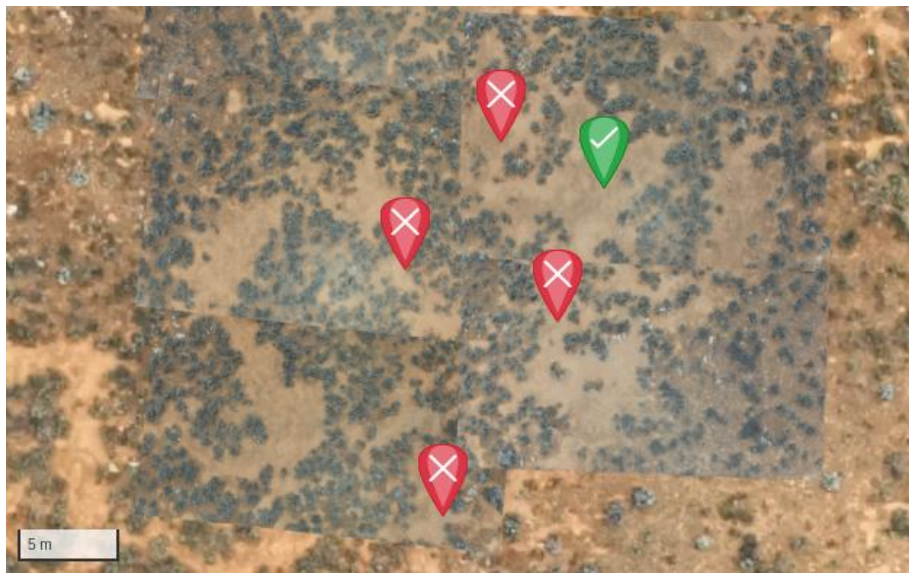

read the original abstract
We present a cloud-based tool that uses drones and machine learning to help recover instrumentally observed meteorite falls. We showcase a collection of improvements made upon previous iterations of our system, as well as detail the successes and limitations of this technique when applied to observed meteorite falls in South and Western Australia. This tool is available to the meteoritics research community upon request at https://find.gfo.rocks.
Editorial analysis
A structured set of objections, weighed in public.
Referee Report
Summary. The manuscript presents a cloud-based tool integrating drone surveys with machine learning for recovering meteorites from instrumentally observed falls. It describes iterative improvements to the system and evaluates its application to real events in South and Western Australia, outlining both successes and limitations. The tool is made available to the community upon request.
Significance. If the full case studies include concrete detection statistics, terrain-specific performance data, and explicit false-positive analysis, the work offers a practical systems contribution to meteorite recovery. The emphasis on real-world deployment and community access strengthens its utility for the meteoritics community, though the absence of quantitative benchmarks in the provided abstract limits immediate assessment of impact.
major comments (1)
- [Abstract] Abstract: the claim to 'detail the successes and limitations' is not supported by any reported detection rates, precision-recall values, false-positive rates under varying lighting/terrain, or dataset sizes. Without these metrics the central performance assertions cannot be evaluated.
minor comments (1)
- The link to the tool (https://find.gfo.rocks) should be accompanied by a brief description of access requirements or usage examples to aid readers.
Simulated Author's Rebuttal
We thank the referee for the positive summary and recommendation for minor revision. We address the single major comment below and will update the manuscript accordingly.
read point-by-point responses
-
Referee: [Abstract] Abstract: the claim to 'detail the successes and limitations' is not supported by any reported detection rates, precision-recall values, false-positive rates under varying lighting/terrain, or dataset sizes. Without these metrics the central performance assertions cannot be evaluated.
Authors: We agree that the abstract's phrasing overstates the quantitative detail provided. The full manuscript presents case studies from South and Western Australia that describe specific successes (e.g., recoveries achieved) and limitations (e.g., terrain and lighting challenges) through narrative examples rather than formal performance metrics such as precision-recall or false-positive rates. To resolve the mismatch, we will revise the abstract to replace 'detail the successes and limitations' with a more accurate description such as 'illustrate the practical successes and limitations observed' and, space permitting, add one or two key qualitative outcomes from the deployments. This change will be incorporated in the revised version. revision: yes
Circularity Check
No significant circularity in applied tool description
full rationale
The manuscript is an applied systems paper describing a deployed cloud-based drone+ML tool for meteorite recovery, including incremental improvements over prior versions and concrete outcomes from real observed falls in Australia. No equations, derivations, fitted parameters, or mathematical predictions appear in the provided text or abstract. The central claims rest on empirical field results and performance details rather than any internal reduction to inputs or self-citation chains, rendering the work self-contained against external benchmarks with no load-bearing circular steps.
Axiom & Free-Parameter Ledger
Lean theorems connected to this paper
-
IndisputableMonolith/Foundation/RealityFromDistinction.leanreality_from_one_distinction unclear?
unclearRelation between the paper passage and the cited Recognition theorem.
We present a cloud-based tool that uses drones and machine learning to help recover instrumentally observed meteorite falls... YOLOv8... Stage 1–4 false-positive elimination... RTK georeferencing.
What do these tags mean?
- matches
- The paper's claim is directly supported by a theorem in the formal canon.
- supports
- The theorem supports part of the paper's argument, but the paper may add assumptions or extra steps.
- extends
- The paper goes beyond the formal theorem; the theorem is a base layer rather than the whole result.
- uses
- The paper appears to rely on the theorem as machinery.
- contradicts
- The paper's claim conflicts with a theorem or certificate in the canon.
- unclear
- Pith found a possible connection, but the passage is too broad, indirect, or ambiguous to say the theorem truly supports the claim.
Reference graph
Works this paper leans on
-
[1]
In: 2019 2nd International Conference on Signal Processing and Information Security (ICSPIS), pp.1–
Meteorite hunting using deep learning and UA Vs. In: 2019 2nd International Conference on Signal Processing and Information Security (ICSPIS), pp.1–
work page 2019
-
[2]
Meteoritics & Planetary Science 55(11): 2461–2471
Machine learning for semi-automated meteorite recovery. Meteoritics & Planetary Science 55(11): 2461–2471. https://doi.org/10.1111/maps.13593 Anderson, S. L., Towner, M. C., Fairweather, J., Bland, P. A., Devillepoix, H. A. R., Sansom, E. K., Cupák, M., Shober, P. M., and Benedix, G.K
-
[3]
The Astrophysical Journal Letters 930(2): L25
Successful recovery of an observed meteorite fall using drones and machine learning. The Astrophysical Journal Letters 930(2): L25. https://doi.org/10.3847/2041-8213/ac66d4 18 Anderson, S. L., Devillepoix, H. A. R., Tomkins, A.G., Brand, H. E. A., Tait, A., Winchester, L., Soderholm, J., Sansom, E. K., Towner, M. C., and Cupák, M
-
[4]
Meteoritics & Planetary Science 58(10): 1385–1398
Saint- Pierre-le-Viger (L5-6) from asteroid 2023 CX1 recovered in Normandy, France—220 years after the historic fall of L’Aigle (L6 breccia) in the neighborhood. Meteoritics & Planetary Science 58(10): 1385–1398. Bland, P. A., Spurný, P., Bevan, A. W. R., Howard, K. T., Towner, M. C., Benedix, G. K., Greenwood, R. C., Shrbený, L., Franchi, I. A., Deacon, ...
work page 2023
-
[5]
Antarctica: A deep-freeze storehouse for meteorites. Science 198(4318): 727–731. https://doi.org/10.1126/science.198.4318.727 Ceplecha, Z
-
[6]
Available at: https://keras.io [Accessed 7 May 2026]
Keras [software]. Available at: https://keras.io [Accessed 7 May 2026]. Citron, R. I., Shah, A., Sinha, S., Watkins, C. and Jenniskens, P.,
work page 2026
-
[7]
In: 48th Annual Lunar and Planetary Science Conference, abstract #1964, pp.2528
Meteorite recovery using an autonomous drone and machine learning. In: 48th Annual Lunar and Planetary Science Conference, abstract #1964, pp.2528. 19 Citron, R. I., Jenniskens, P., Watkins, C., Sinha, S., Shah, A., Raissi, C., Devillepoix, H., Albers, J., and Zolensky, M
work page 1964
-
[8]
Meteoritics & Planetary Science 56(6): 1073–1085
Recovery of meteorites using an autonomous drone and machine learning. Meteoritics & Planetary Science 56(6): 1073–1085. https://doi.org/10.1111/maps.13663 Colas, F., Zanda, B., Bouley, S., Jeanne, S., Malgoyre, A., Birlan, M., Blanpain, C., Gattacceca, J., Jorda, L., Lecubin, J. and others,
-
[9]
In: Proceedings of the International Meteor Conference, 30th IMC, Sibiu, Romania, 2011, pp.9–12
The status of the NASA all sky fireball network. In: Proceedings of the International Meteor Conference, 30th IMC, Sibiu, Romania, 2011, pp.9–12. Devillepoix, H. A. R., Sansom, E. K., Bland, P. A., Towner, M. C., Cupák, M., Howie, R. M., Jansen-Sturgeon, T., Cox, M. A., Hartig, B. A. D., Benedix, G. K., and Paxman, J
work page 2011
-
[10]
Nature Astronomy 9(11): 1624–1637
Catastrophic disruption of asteroid 2023 CX1 and implications for planetary defence. Nature Astronomy 9(11): 1624–1637. https://doi.org/10.1038/s41550-025-02659-8 Fries, M., and Fries, J
-
[11]
Meteoritics & Planetary Science 49(11): 1989–1996
Detection and rapid recovery of the Sutter’s Mill meteorite fall as a model for future recoveries worldwide. Meteoritics & Planetary Science 49(11): 1989–1996. 20 Gardiol, D., Barghini, D., Buzzoni, A., Carbognani, A., Di Carlo, M., Di Martino, M., Knapic, C., Londero, E., Pratesi, G., Rasetti, S. et al
work page 1989
-
[12]
https://doi.org/10.1111/j.1945-5100.2011.01229.x Gritsevich, M., Lyytinen, E., Moilanen, J., Kohout, T., Dmitriev, V ., Lupovka, V ., Midtskogen, V ., Kruglikov, N., Ischenko, A., Yakovlev, G. et al
-
[13]
Drone-Footprints [software]. GitHub repository. Available at: https://github.com/spifftek70/Drone- Footprints/tree/86f918064d5684e895c66bd397c968a235bdafa5 [Accessed 7 May 2026]. Hill, P. J. A., Tunney, L. D., and Herd, C. D. K
work page 2026
-
[14]
Meteoritics & Planetary Science 58(3): 421–432
Application of drone-captured thermal imagery in aiding in the recovery of meteorites within a snow-covered strewn field. Meteoritics & Planetary Science 58(3): 421–432. https://doi.org/10.1111/maps.13963 Hofmann, B. A., and Gnos, E
-
[15]
Geological Society of London Special Publications, 550(1): 469–492
The meteoritic record of Arabia. Geological Society of London Special Publications, 550(1): 469–492. https://doi.org/10.1144/SP550-2024-8 Howie, R. M., Paxman, J., Bland, P. A., Towner, M. C., Cupak, M., Sansom, E. K., and Devillepoix, H.A.R
-
[16]
Available at: https://github.com/ultralytics/ultralytics [Accessed 7 May 2026]
Ultralytics YOLOv8 [software], version 8.0.0. Available at: https://github.com/ultralytics/ultralytics [Accessed 7 May 2026]. 21 King, A. J., Daly, L., Rowe, J., Joy, K. H., Greenwood, R. C., Devillepoix, H. A. R., Suttle, M. D., Chan, Q. H. S., Russell, S. S., Bates, H. C. et al
work page 2026
-
[17]
In: Proceedings of the International Meteor Conference, 24th IMC, Oostmalle, Belgium, 2005, pp.53–62
Polish fireball network. In: Proceedings of the International Meteor Conference, 24th IMC, Oostmalle, Belgium, 2005, pp.53–62. Pons Recasens, G.,
work page 2005
-
[18]
Available at: https://github.com/roboflow/rf-detr [Accessed 7 May 2026]
RF-DETR [software]. Available at: https://github.com/roboflow/rf-detr [Accessed 7 May 2026]. Russell, S. S., King, A. J., Bates, H. C., Almeida, N. V ., Greenwood, R. C., Daly, L., Joy, K. H., Rowe, J., Salge, T., Smith, C. L., et al
work page 2026
-
[19]
Meteoritics & Planetary Science 60(2): 308–323
Systematic meteorite collection in the Catalina Dense Collection area (Chile): Description and statistics. Meteoritics & Planetary Science 60(2): 308–323. https://doi.org/10.1111/maps.14307 Sadaka, C., Gattacceca, J., Dumas, F., Braucher, R., ASTER Team, Leya, I., Tauseef, M., Blard, P.-H., Bekaert, D., Füri, E., Zimmermann, L., Lagain, A., Devillepoix, H...
-
[20]
Meteoritics & Planetary Science
Terrestrial ages of meteorites from the Atacama Desert (Chile) and insights into the past meteorite flux to Earth. Meteoritics & Planetary Science. https://doi.org/10.1111/maps.70125 Sansom, E. K., Bland, P. A., Towner, M. C., Devillepoix, H. A. R., Cupák, M., Howie, R. M., Jansen-Sturgeon, T., Cox, M. A., Hartig, B. A. D., Paxman, J. P, et al
-
[21]
Astronomy & Astrophysics 686: A67
Atmospheric entry and fragmentation of the small asteroid 2024 BX1: Bolide trajectory, orbit, dynamics, light curve, and spectrum. Astronomy & Astrophysics 686: A67. Spurný, P., Bland, P. A., Shrbený, L., Borovička, J., Ceplecha, Z., Singleton, A., Bevan, A. W. R., Vaughan, D., Towner, M. C., McClafferty, T. P., et al
work page 2024
-
[22]
Drag-line sensor for drone assisted meteorite detection
“Drag-line sensor for drone assisted meteorite detection”. Bachelor thesis. Macquarie University. https://doi.org/10.25949/19428392 Towner, M. C., Jansen-Sturgeon, T., Cupak, M., Sansom, E. K., Devillepoix, H. A. R., Bland, P. A., Howie, R. M., Paxman, J. P., Benedix, G. K., and Hartig, B. A. D
-
[23]
M., Llorca, J., Castro-Tirado, A
https://doi.org/10.3847/PSJ/ac3df5 Trigo-Rodríguez, J. M., Llorca, J., Castro-Tirado, A. J., Ortiz, J. L., Docobo, J. A., and Fabregat, J
-
[24]
In: MetSoc 2023 – 86th Annual Meeting of the Meteoritical Society
Recovery and planned study of the Saint-Pierre- Le-Viger meteorite: An achievement of the FRIPON/Vigie-Ciel citizen science program. In: MetSoc 2023 – 86th Annual Meeting of the Meteoritical Society. Zappatini, A., Gnos, E., Hofmann, B. A., Eggenberger, U., Kruttasch, P. M., Gfeller, F., Tauseef, M., Leya, I., Devillepoix, H. A. R., Sansom, E. K., Cupák, ...
work page 2023
-
[25]
Meteoritics & Planetary Science
Al-Khadhaf: The first camera-observed (H5–6) meteorite fall from Oman. Meteoritics & Planetary Science. https://doi.org/10.1111/maps.70110 Zender, J., Rudawska, R., Koschny, D., Drolshagen, G., Netjes, G.-J., Bosch, M., Bijl, R., Crevecoeur, R., and Bettonvil, F
discussion (0)
Sign in with ORCID, Apple, or X to comment. Anyone can read and Pith papers without signing in.