Scattered light signatures of flyby-induced warps in protoplanetary discs
Pith reviewed 2026-05-22 01:50 UTC · model grok-4.3
The pith
Stellar flybys warp protoplanetary discs and produce long-lasting oscillating shadows in scattered light images.
A machine-rendered reading of the paper's core claim, the machinery that carries it, and where it could break.
Core claim
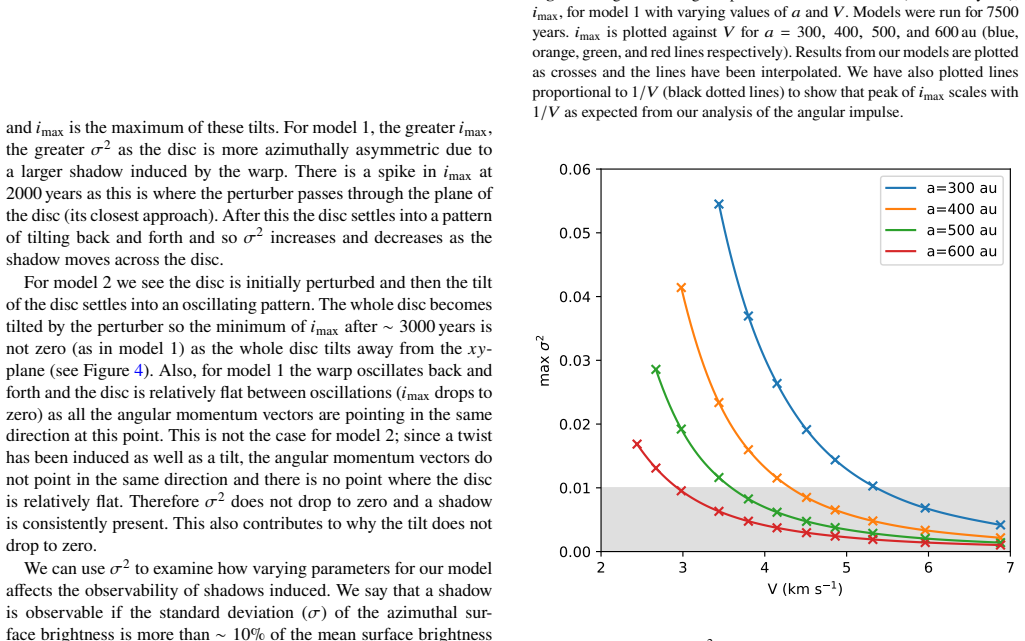
Flybys tilt and warp the outer disc, producing a broad shadow in scattered light while the inner disc tilts without warping or shadowing. The warp wave travels inward and outward, causing the shadow to oscillate across the disc. For viscosity parameter α equal to 10 to the minus 4 the warp endures for about 10^6 years, and for half that interval the azimuthal variance of surface brightness exceeds 0.01, marking a detectable shadow. Consequently a significant fraction of discs in nearby regions are expected to show flyby-induced warps, and surveys of such shadowed discs can constrain disc viscosity.
What carries the argument
One-dimensional linear warp propagation theory coupled to a fast radiative transfer code that generates the shadows induced by the warped surface.
If this is right
- The inner disc remains tilted but unwarped and therefore produces no shadow.
- The shadow moves back and forth as the warp wave propagates across the disc.
- In low-viscosity discs the warp and shadow last for most of the disc lifetime.
- A substantial fraction of discs in nearby star-forming regions should exhibit observable flyby-induced shadows.
- Surveys that count shadowed discs can place limits on average disc viscosity.
Where Pith is reading between the lines
- The fraction of discs showing these shadows would directly indicate how often flybys occur in typical birth clusters.
- Periodic changes in outer-disc illumination from moving shadows could affect the growth or migration of forming planets.
- Comparing the observed lifetime of shadows across different star-forming regions could reveal regional differences in disc viscosity.
- Time-domain imaging over several years could detect the predicted back-and-forth motion of the shadow.
Load-bearing premise
One-dimensional linear warp propagation theory accurately reproduces the warp shape and resulting shadow geometry for the chosen flyby distances, angles, and disc properties.
What would settle it
A large survey of discs in a young cluster that finds either no shadows at all or shadows whose lifetimes and oscillation periods fall well below the predicted million-year scale would falsify the central claim.
Figures




read the original abstract
We explore the observational signatures of flybys in scattered light images of protostellar discs. The warps are modelled using 1D warp propagation theory coupled to a fast radiative transfer code that simulates the shadows induced. We consider two scenarios, namely a flyby in a plane orthogonal to, and at an angle with, the disc plane. In both models the outer disc becomes warped (leading to a broad shadow in the outer disc) and the warp wave propagates back and forth (causing the shadow to oscillate). We find that the inner disc, although tilted, is not warped and is therefore not shadowed. For a low viscosity disc ($\alpha=10^{-4}$) the warp lasts for most of the disc's lifetime ($\tau \sim 10^6\,$years), and for $50\%$ of the time the azimuthal variance of the surface brightness from the scattered light images, $\sigma^2$, is above $0.01$, meaning that the shadow in the disc is significant. We find that a significant fraction of discs in nearby star forming regions should have undergone a flyby sufficient to induce an observable warp, and that surveys of shadowed discs could provide a valuable probe of disc viscosity.
Editorial analysis
A structured set of objections, weighed in public.
Referee Report
Summary. The paper models flyby-induced warps in protoplanetary discs using 1D linear warp propagation theory coupled to a fast radiative transfer code. It examines orthogonal and inclined flyby scenarios, finding that the outer disc warps produce broad oscillating shadows while the inner disc remains unshadowed. For α=10^{-4}, the warp persists for most of the disc lifetime (∼10^6 yr) and σ² exceeds 0.01 for 50% of the time, implying observable shadows; the authors suggest this fraction of discs in nearby regions may show such signatures and that shadow surveys could constrain viscosity.
Significance. If the modeling assumptions hold, the work supplies quantitative, observationally testable predictions linking flybys to scattered-light shadows and offers a potential viscosity diagnostic via the duty cycle of high-σ² states. Credit is due for the efficient 1D-plus-RT framework that permits long-term evolution tracking and for the clear definition of the σ²>0.01 threshold as a significance metric.
major comments (1)
- [§2 (modeling approach)] §2 (modeling approach): the central lifetime (τ∼10^6 yr) and 50% duty-cycle claims rest on the 1D linear bending-wave equations plus post-processed RT accurately reproducing both the radial warp profile and the azimuthal surface-brightness variance. No demonstration is given that the adopted flyby inclinations and impact parameters keep tilt angles and gradients inside the small-amplitude regime assumed by the linear theory (cf. Lubow & Ogilvie 2000), nor is a comparison to 3D hydrodynamics provided to confirm that non-axisymmetric density perturbations do not alter the shadow contrast. This is load-bearing for the headline quantitative results.
minor comments (2)
- [Abstract and §3] Abstract and §3: the exact numerical values of the flyby inclination, impact parameter, and disc mass ratio should be stated explicitly rather than described qualitatively, to allow reproducibility of the 50% time fraction.
- [Figure captions] Figure captions: several panels lack labels for the time at which each snapshot is taken; adding these would clarify the oscillation period of the shadow.
Simulated Author's Rebuttal
We thank the referee for their constructive review and for recognizing the potential observational implications of our work. We address the major comment on the modeling assumptions below and have revised the manuscript to strengthen the justification for the linear theory.
read point-by-point responses
-
Referee: [§2 (modeling approach)] §2 (modeling approach): the central lifetime (τ∼10^6 yr) and 50% duty-cycle claims rest on the 1D linear bending-wave equations plus post-processed RT accurately reproducing both the radial warp profile and the azimuthal surface-brightness variance. No demonstration is given that the adopted flyby inclinations and impact parameters keep tilt angles and gradients inside the small-amplitude regime assumed by the linear theory (cf. Lubow & Ogilvie 2000), nor is a comparison to 3D hydrodynamics provided to confirm that non-axisymmetric density perturbations do not alter the shadow contrast. This is load-bearing for the headline quantitative results.
Authors: We appreciate the referee highlighting the importance of validating the linear regime assumptions. In the revised manuscript we have added an explicit verification in §2, based on the flyby torque and resulting warp amplitudes in our 1D models, confirming that maximum tilt angles and radial gradients remain well within the small-amplitude limit of Lubow & Ogilvie (2000). This directly supports the reliability of the reported lifetimes and duty cycles. A full side-by-side comparison with 3D hydrodynamics lies beyond the scope of the present study; however, we have expanded the discussion to explain that transient non-axisymmetric perturbations from the flyby do not substantially modify the broad, radially extended shadows that dominate the scattered-light variance metric. These additions address the core concern while preserving the efficiency of the 1D-plus-RT approach for long-term evolution. revision: partial
Circularity Check
No significant circularity; results are forward-model outputs
full rationale
The paper models warp evolution via 1D linear bending-wave equations (standard in the literature) and couples them to radiative-transfer post-processing to generate scattered-light images. The reported τ ∼ 10^6 yr lifetime at α=10^{-4} and the 50 % duty cycle with σ² > 0.01 are direct numerical outputs of the chosen viscosity, flyby geometry, and disc parameters run through that forward model. No equation or result is defined in terms of itself, no fitted parameter is relabeled as a prediction, and no load-bearing step reduces to a self-citation chain. The derivation chain is self-contained as a simulation study whose quantitative claims follow from the input setup rather than by tautology.
Axiom & Free-Parameter Ledger
free parameters (2)
- viscosity parameter α
- flyby inclination and impact parameter
axioms (1)
- domain assumption One-dimensional linear warp propagation theory accurately describes the warp evolution and shadow geometry after a flyby.
Lean theorems connected to this paper
-
IndisputableMonolith/Foundation/AbsoluteFloorClosure.leanreality_from_one_distinction unclear?
unclearRelation between the paper passage and the cited Recognition theorem.
We treat the disc as a series of annuli... the evolution of the warp can be described using the 1-D equations 12 and 13 from Lubow & Ogilvie (2000)
-
IndisputableMonolith/Cost/FunctionalEquation.leanJ_uniquely_calibrated_via_higher_derivative unclear?
unclearRelation between the paper passage and the cited Recognition theorem.
the azimuthal variance of the surface brightness... σ² is above 0.01
What do these tags mean?
- matches
- The paper's claim is directly supported by a theorem in the formal canon.
- supports
- The theorem supports part of the paper's argument, but the paper may add assumptions or extra steps.
- extends
- The paper goes beyond the formal theorem; the theorem is a base layer rather than the whole result.
- uses
- The paper appears to rely on the theorem as machinery.
- contradicts
- The paper's claim conflicts with a theorem or certificate in the canon.
- unclear
- Pith found a possible connection, but the passage is too broad, indirect, or ambiguous to say the theorem truly supports the claim.
Reference graph
Works this paper leans on
-
[1]
Optical Properties of Interstellar Graphite and Silicate Grains. , keywords =. doi:10.1086/162480 , adsurl =
-
[2]
, year = 1941, month = jan, volume =
Diffuse radiation in the Galaxy. , year = 1941, month = jan, volume =. doi:10.1086/144246 , adsurl =
-
[3]
The evolution of a warped disc around a Kerr black hole. , keywords =. doi:10.1046/j.1365-8711.2002.05949.x , archivePrefix =. astro-ph/0208206 , primaryClass =
-
[4]
Black holes in binary systems. Observational appearance. , year = 1973, month = jan, volume =
work page 1973
-
[5]
Lecture Notes in Physics, Berlin Springer Verlag , year = 2016, editor =
Warp Propagation in Astrophysical Discs. Lecture Notes in Physics, Berlin Springer Verlag , year = 2016, editor =. doi:10.1007/978-3-319-19416-5_2 , adsurl =
-
[6]
Warp diffusion in accretion discs: a numerical investigation. , keywords =. doi:10.1111/j.1365-2966.2007.12332.x , archivePrefix =. 0708.1124 , primaryClass =
-
[7]
Warping Away Gravitational Instabilities in Protoplanetary Discs. , keywords =. doi:10.3847/1538-4357/ac3975 , archivePrefix =. 2110.06227 , primaryClass =
-
[8]
On the tilting of protostellar disks by resonant tidal effects
On the Tilting of Protostellar Disks by Resonant Tidal Effects. , keywords =. doi:10.1086/309101 , archivePrefix =. astro-ph/0003028 , primaryClass =
work page internal anchor Pith review Pith/arXiv arXiv doi:10.1086/309101
-
[9]
Generalised warped disk equations
Generalized Warped Disk Equations. , keywords =. doi:10.3847/1538-4357/ab0bb7 , archivePrefix =. 1902.11073 , primaryClass =
work page internal anchor Pith review Pith/arXiv arXiv doi:10.3847/1538-4357/ab0bb7 1902
-
[10]
Shadows cast by a warp in the HD 142527 protoplanetary disk
Shadows Cast by a Warp in the HD 142527 Protoplanetary Disk. , keywords =. doi:10.1088/2041-8205/798/2/L44 , archivePrefix =. 1412.4632 , primaryClass =
work page internal anchor Pith review Pith/arXiv arXiv doi:10.1088/2041-8205/798/2/l44 2041
-
[11]
Shadows and spirals in the protoplanetary disk HD 100453
Shadows and spirals in the protoplanetary disk HD 100453. , keywords =. doi:10.1051/0004-6361/201629798 , archivePrefix =. 1610.10089 , primaryClass =
work page internal anchor Pith review Pith/arXiv arXiv doi:10.1051/0004-6361/201629798
-
[12]
An inner warp in the DoAr 44 T Tauri transition disk
An inner warp in the DoAr 44 T Tauri transition disc. , keywords =. doi:10.1093/mnras/sty894 , archivePrefix =. 1804.02360 , primaryClass =
work page internal anchor Pith review Pith/arXiv arXiv doi:10.1093/mnras/sty894
-
[13]
Shadows and asymmetries in the T Tauri disk HD 143006: Evidence for a misaligned inner disk
Shadows and asymmetries in the T Tauri disk HD 143006: evidence for a misaligned inner disk. , keywords =. doi:10.1051/0004-6361/201833913 , archivePrefix =. 1809.01082 , primaryClass =
work page internal anchor Pith review Pith/arXiv arXiv doi:10.1051/0004-6361/201833913
-
[14]
Discovery of a directly imaged disk in scattered light around the Sco-Cen member Wray 15-788. , keywords =. doi:10.1051/0004-6361/201834523 , archivePrefix =. 1902.07723 , primaryClass =
-
[15]
Shadowing and multiple rings in the protoplanetary disk of HD 139614. , keywords =. doi:10.1051/0004-6361/201936509 , archivePrefix =. 1911.09612 , primaryClass =
-
[16]
Magnetically Driven Warping, Precession and Resonances in Accretion Disks
Magnetically Driven Warping, Precession, and Resonances in Accretion Disks. , keywords =. doi:10.1086/307850 , archivePrefix =. astro-ph/9904110 , primaryClass =
work page internal anchor Pith review Pith/arXiv arXiv doi:10.1086/307850
-
[17]
On the dynamics of tilted discs around young stars. , keywords =. doi:10.1093/mnras/274.4.987 , adsurl =
-
[18]
2010, MNRAS, 406, 1379, doi: 10.1111/j.1365-2966.2010.16776.x
The observable effects of tidally induced warps in protostellar discs. , keywords =. doi:10.1111/j.1365-2966.2010.16331.x , archivePrefix =. 1001.2570 , primaryClass =
-
[19]
JWST Imaging of Edge-on Protoplanetary Disks. II. Appearance of Edge-on Disks with a Tilted Inner Region: Case Study of IRAS04302+2247. , keywords =. doi:10.3847/1538-4357/ad0c4b , archivePrefix =. 2311.07668 , primaryClass =
-
[20]
Asymmetric signatures of warps in edge-on disks. , keywords =. doi:10.1051/0004-6361/202453313 , archivePrefix =. 2504.05399 , primaryClass =
-
[21]
Accretion disc response to a stellar fly-by. , keywords =. doi:10.1093/mnras/261.1.190 , adsurl =
-
[22]
Stellar Encounters with Massive Star-Disk Systems
Stellar Encounters with Massive Star-Disk Systems. , keywords =. doi:10.1086/508145 , archivePrefix =. astro-ph/0608070 , primaryClass =
work page internal anchor Pith review Pith/arXiv arXiv doi:10.1086/508145
-
[23]
A Spatially Resolved Inner Hole in the Disk around GM Aurigae
A Spatially Resolved Inner Hole in the Disk Around GM Aurigae. , keywords =. doi:10.1088/0004-637X/698/1/131 , archivePrefix =. 0903.4455 , primaryClass =
work page internal anchor Pith review Pith/arXiv arXiv doi:10.1088/0004-637x/698/1/131
-
[24]
Tidal stripping and disk kinematics in the RW Aurigae system. , keywords =. doi:10.1051/0004-6361:20054047 , adsurl =
-
[25]
American Astronomical Society Meeting Abstracts , year = 1995, series =
HST Observations of the Beta Pictoris Circumstellar Disk. American Astronomical Society Meeting Abstracts , year = 1995, series =
work page 1995
-
[26]
Space Telescope Imaging Spectrograph Coronagraphic Observations of Pictoris. , keywords =. doi:10.1086/309188 , archivePrefix =. astro-ph/9911363 , primaryClass =
-
[27]
Hubble Space Telescope Advanced Camera for Surveys Coronagraphic Imaging of the AU Microscopii Debris Disk. , keywords =. doi:10.1086/426755 , adsurl =
-
[28]
The Warped Circumstellar Disk of HD100546
The Warped Circumstellar Disk of HD 100546. , keywords =. doi:10.1086/500165 , archivePrefix =. astro-ph/0505088 , primaryClass =
work page internal anchor Pith review Pith/arXiv arXiv doi:10.1086/500165
-
[29]
The Formation of Stellar Clusters
The Formation of Stellar Clusters. Protostars and Planets IV , year = 2000, editor =. doi:10.48550/arXiv.astro-ph/9903323 , archivePrefix =. astro-ph/9903323 , primaryClass =
work page internal anchor Pith review Pith/arXiv arXiv doi:10.48550/arxiv.astro-ph/9903323 2000
-
[30]
On the diversity and statistical properties of protostellar discs
On the diversity and statistical properties of protostellar discs. , keywords =. doi:10.1093/mnras/sty169 , archivePrefix =. 1801.07721 , primaryClass =
work page internal anchor Pith review Pith/arXiv arXiv doi:10.1093/mnras/sty169
-
[31]
Early evolution of the birth cluster of the solar system
Early evolution of the birth cluster of the solar system. , keywords =. doi:10.1051/0004-6361/201218792 , archivePrefix =. 1210.8255 , primaryClass =
work page internal anchor Pith review Pith/arXiv arXiv doi:10.1051/0004-6361/201218792
-
[32]
Protoplanetary disc truncation mechanisms in stellar clusters: comparing external photoevaporation and tidal encounters. , keywords =. doi:10.1093/mnras/sty984 , archivePrefix =. 1804.00013 , primaryClass =
work page internal anchor Pith review Pith/arXiv arXiv doi:10.1093/mnras/sty984
-
[33]
Multiple Stellar Fly-Bys Sculpting the Circumstellar Architecture in RW Aurigae
Multiple Stellar Flybys Sculpting the Circumstellar Architecture in RW Aurigae. , keywords =. doi:10.3847/1538-4357/aac08f , archivePrefix =. 1804.09190 , primaryClass =
work page internal anchor Pith review Pith/arXiv arXiv doi:10.3847/1538-4357/aac08f
-
[34]
Flybys in protoplanetary discs: I. Gas and dust dynamics
Flybys in protoplanetary discs: I. Gas and dust dynamics. , keywords =. doi:10.1093/mnras/sty3325 , archivePrefix =. 1812.00961 , primaryClass =
work page internal anchor Pith review Pith/arXiv arXiv doi:10.1093/mnras/sty3325
-
[35]
Sizes of protoplanetary discs after star-disc encounters
Sizes of protoplanetary discs after star-disc encounters. , keywords =. doi:10.1051/0004-6361/201323043 , archivePrefix =. 1403.8099 , primaryClass =
work page internal anchor Pith review Pith/arXiv arXiv doi:10.1051/0004-6361/201323043
-
[36]
From star-disc encounters to numerical solutions for a subset of the restricted three-body problem
From star-disc encounters to numerical solutions for a subset of the restricted three-body problem. , keywords =. doi:10.1051/0004-6361/201526068 , archivePrefix =. 1701.00855 , primaryClass =
work page internal anchor Pith review Pith/arXiv arXiv doi:10.1051/0004-6361/201526068
-
[37]
Effects of inclined star-disk encounter on protoplanetary disk size
Effects of inclined star-disk encounter on protoplanetary disk size. , keywords =. doi:10.1051/0004-6361/201628086 , archivePrefix =. 1608.03239 , primaryClass =
work page internal anchor Pith review Pith/arXiv arXiv doi:10.1051/0004-6361/201628086
-
[38]
Disentangling the independently controllable factors of variation by interacting with the world
Embedded Clusters in Molecular Clouds. , keywords =. doi:10.1146/annurev.astro.41.011802.094844 , archivePrefix =. astro-ph/0301540 , primaryClass =
work page internal anchor Pith review Pith/arXiv arXiv doi:10.1146/annurev.astro.41.011802.094844
-
[39]
Generation of highly inclined protoplanetary discs through single stellar flybys
Generation of highly inclined protoplanetary discs through single stellar flybys. , keywords =. doi:10.1093/mnras/stv2514 , archivePrefix =. 1510.07458 , primaryClass =
work page internal anchor Pith review Pith/arXiv arXiv doi:10.1093/mnras/stv2514
-
[40]
Tidally-induced in T Tauri disks. I. First-order perturbation theory. , keywords =
-
[41]
A parametric study of spectral energy distributions
Tidally induced WARPS in T Tauri discs - II. A parametric study of spectral energy distributions. , keywords =. doi:10.1093/mnras/279.2.415 , adsurl =
-
[42]
European Physical Journal Plus , keywords =
Close encounters: How stellar flybys shape planet-forming discs. European Physical Journal Plus , keywords =. doi:10.1140/epjp/s13360-022-03602-w , archivePrefix =. 2207.09752 , primaryClass =
-
[44]
On the massive stellar population of the super star cluster Westerlund 1 , DOI= "10.1051/0004-6361:20042413", url= "https://doi.org/10.1051/0004-6361:20042413", journal =
-
[45]
The Astrophysical Journal Letters , abstract =
Rochau, Boyke and Brandner, Wolfgang and Stolte, Andrea and Gennaro, Mario and Gouliermis, Dimitrios and Da Rio, Nicola and Dzyurkevich, Natalia and Henning, Thomas , title =. The Astrophysical Journal Letters , abstract =. 2010 , month =. doi:10.1088/2041-8205/716/1/L90 , url =
-
[46]
Clarkson, W. I. and Ghez, A. M. and Morris, M. R. and Lu, J. R. and Stolte, A. and McCrady, N. and Do, T. and Yelda, S. , title =. The Astrophysical Journal , abstract =. 2012 , month =. doi:10.1088/0004-637X/751/2/132 , url =
-
[47]
Courant, Richard and Friedrichs, Kurt and Lewy, Hans , journal=. 1928 , publisher=
work page 1928
-
[48]
Shadows cast on the transition disk of HD 135344B. Multiwavelength VLT/SPHERE polarimetric differential imaging. , keywords =. doi:10.1051/0004-6361/201528039 , archivePrefix =. 1603.00481 , primaryClass =
work page internal anchor Pith review Pith/arXiv arXiv doi:10.1051/0004-6361/201528039
-
[49]
Disk Evolution Study Through Imaging of Nearby Young Stars (DESTINYS): Late Infall Causing Disk Misalignment and Dynamic Structures in SU Aur. , keywords =. doi:10.3847/2041-8213/abdf57 , archivePrefix =. 2102.08781 , primaryClass =
-
[50]
The Surprising Evolution of the Shadow on the TW Hya Disk. , keywords =. doi:10.3847/1538-4357/acbdf1 , archivePrefix =. 2305.03611 , primaryClass =
-
[51]
Tidal torques on accretion discs in close binary systems. , keywords =. doi:10.1093/mnras/181.3.441 , adsurl =
-
[52]
A model of accretion disks in close binaries. , keywords =. doi:10.1086/155526 , adsurl =
-
[53]
Debes, John H. and Poteet, Charles A. and Jang-Condell, Hannah and Gaspar, Andras and Hines, Dean and Kastner, Joel H. and Pueyo, Laurent and Rapson, Valerie and Roberge, Aki and Schneider, Glenn and Weinberger, Alycia J. , title =. The Astrophysical Journal , abstract =. 2017 , month =. doi:10.3847/1538-4357/835/2/205 , url =
-
[54]
Hornbeck, J. B. and Swearingen, J. R. and Grady, C. A. and Williger, G. M. and Brown, A. and Sitko, M. L. and Wisniewski, J. P. and Perrin, M. D. and Lauroesch, J. T. and Schneider, G. and Apai, D. and Brittain, S. and Brown, J. M. and Champney, E. H. and Hamaguchi, K. and Henning, Th. and Lynch, D. K. and Petre, R. and Russell, R. W. and Walter, F. M. an...
-
[55]
A likely flyby of binary protostar Z CMa caught in action , volume=
Dong, Ruobing and Liu, Hauyu Baobab and Cuello, Nicolás and Pinte, Christophe and Ábrahám, Péter and Vorobyov, Eduard and Hashimoto, Jun and Kóspál, Ágnes and Chiang, Eugene and Takami, Michihiro and Chen, Lei and Dunham, Michael and Fukagawa, Misato and Green, Joel and Hasegawa, Yasuhiro and Henning, Thomas and Pavlyuchenkov, Yaroslav and Pyo, Tae-Soo an...
-
[56]
Kurtovic, Nicolás T. and Pérez, Laura M. and Benisty, Myriam and Zhu, Zhaohuan and Zhang, Shangjia and Huang, Jane and Andrews, Sean M. and Dullemond, Cornelis P. and Isella, Andrea and Bai, Xue-Ning and Carpenter, John M. and Guzmán, Viviana V. and Ricci, Luca and Wilner, David J. , year=. The Disk Substructures at High Angular Resolution Project (DSHARP...
-
[57]
Lu, Xing and Li, Guang-Xing and Zhang, Qizhou and Lin, Yuxin , year=. A massive Keplerian protostellar disk with flyby-induced spirals in the Central Molecular Zone , volume=. Nature Astronomy , publisher=. doi:10.1038/s41550-022-01681-4 , number=
-
[58]
Radiative Transfer Modeling of a Shadowed Protoplanetary Disk assisted by a Neural Network , author=. 2025 , eprint=
work page 2025
-
[59]
Allgemeine Naturgeschichte und Theorie des Himmels
-
[60]
doi:10.3931/e-rara-497 , adsurl =
Exposition du syst \`e me du monde. doi:10.3931/e-rara-497 , adsurl =
-
[61]
Close Stellar Flybys Common in Low-mass Clusters. , keywords =. doi:10.3847/1538-4357/ac19aa , archivePrefix =. 2108.10296 , primaryClass =
-
[62]
Bailer-Jones, C. A. L. , year=. The completeness-corrected rate of stellar encounters with the Sun from the firstGaiadata release , volume=. doi:10.1051/0004-6361/201731453 , journal=
-
[63]
New stellar encounters discovered in the second Gaia data release⋆ , DOI= "10.1051/0004-6361/201833456", url= "https://doi.org/10.1051/0004-6361/201833456", journal =
-
[64]
Hansen, Bradley M. S. , title =. The Astronomical Journal , abstract =. 2022 , month =. doi:10.3847/1538-3881/ac3a8b , url =
-
[65]
Flybys in debris disk systems with Gaia eDR3⋆ , DOI= "10.1051/0004-6361/202245415", url= "https://doi.org/10.1051/0004-6361/202245415", journal =
-
[66]
Ma 马, Yilun 逸伦 and De Rosa, Robert J. and Kalas, Paul , year=. Search for Stellar Flybys in the Sco-Cen OB Association with the Gaia DR2 , volume=. The Astronomical Journal , publisher=. doi:10.3847/1538-3881/ac5ab9 , number=
-
[67]
彬 and Dong 董, Ruobing 若冰 and Zhou 周, Xingyu 星宇 and Pueyo, Laurent and De Rosa, Robert J
Shuai 帅, Linling 琳玲 and Ren 任, Bin B. 彬 and Dong 董, Ruobing 若冰 and Zhou 周, Xingyu 星宇 and Pueyo, Laurent and De Rosa, Robert J. and Fang 方, Taotao 陶陶 and Mawet, Dimitri , year=. Stellar Flyby Analysis for Spiral Arm Hosts with Gaia DR3 , volume=. The Astrophysical Journal Supplement Series , publisher=. doi:10.3847/1538-4365/ac98fd , number=
-
[68]
Protostars and Planets VII , year = 2023, editor =
Optical and Near-infrared View of Planet-forming Disks and Protoplanets. Protostars and Planets VII , year = 2023, editor =. doi:10.48550/arXiv.2203.09991 , archivePrefix =. 2203.09991 , primaryClass =
-
[69]
Asymmetry and Variability in the HH 30 Circumstellar Disk. , keywords =. doi:10.1086/510455 , adsurl =
-
[70]
Dynamical Evolution of Young Embedded Clusters: A Parameter Space Survey
Dynamical Evolution of Young Embedded Clusters: A Parameter Space Survey. , keywords =. doi:10.1088/0067-0049/185/2/486 , archivePrefix =. 0910.4679 , primaryClass =
work page internal anchor Pith review Pith/arXiv arXiv doi:10.1088/0067-0049/185/2/486
-
[71]
Stripping a debris disk by close stellar encounters in an open stellar cluster
Stripping a debris disk by close stellar encounters in an open stellar cluster. , keywords =. doi:10.1051/0004-6361/201014730 , archivePrefix =. 1107.0970 , primaryClass =
work page internal anchor Pith review Pith/arXiv arXiv doi:10.1051/0004-6361/201014730
-
[72]
A Preliminary Study of the Orion Nebula Cluster Structure and Dynamics. , keywords =. doi:10.1086/305076 , adsurl =
-
[73]
The Initial Mass Function of Low-Mass Stars and Brown Dwarfs in Young Clusters
The Initial Mass Function of Low-Mass Stars and Brown Dwarfs in Young Clusters. , keywords =. doi:10.1086/309365 , archivePrefix =. astro-ph/0004386 , primaryClass =
work page internal anchor Pith review Pith/arXiv arXiv doi:10.1086/309365
-
[74]
The distance to the Orion Nebula
The distance to the Orion Nebula. , keywords =. doi:10.1051/0004-6361:20078247 , archivePrefix =. 0709.0485 , primaryClass =
work page internal anchor Pith review Pith/arXiv arXiv doi:10.1051/0004-6361:20078247
-
[75]
Protoplanetary Disk Properties in the Orion Nebula Cluster: Initial Results from Deep, High-resolution ALMA Observations. , keywords =. doi:10.3847/1538-4357/aac3e2 , archivePrefix =. 1805.03669 , primaryClass =
work page internal anchor Pith review Pith/arXiv arXiv doi:10.3847/1538-4357/aac3e2
-
[76]
Multi-epoch VLBA observations of T Tauri South
Multiepoch VLBA Observations of T Tauri South. , keywords =. doi:10.1086/428349 , archivePrefix =. astro-ph/0501062 , primaryClass =
work page internal anchor Pith review Pith/arXiv arXiv doi:10.1086/428349
-
[77]
A New Optical Extinction Law and Distance Estimate for the Taurus-Auriga Molecular Cloud. , keywords =. doi:10.1086/117200 , adsurl =
-
[78]
Running with the bulls - The frequency of star-disc encounters in the Taurus star-forming region , DOI= "10.1051/0004-6361/202450842", url= "https://doi.org/10.1051/0004-6361/202450842", journal =
-
[79]
The Initial Mass Function of Low-Mass Stars and Brown Dwarfs in Taurus. , keywords =. doi:10.1086/317232 , adsurl =
-
[80]
Multiplicity and clustering in Taurus star forming region. II. From ultra-wide pairs to dense NESTs. , keywords =. doi:10.1051/0004-6361/201833042 , archivePrefix =. 1809.02380 , primaryClass =
work page internal anchor Pith review Pith/arXiv arXiv doi:10.1051/0004-6361/201833042
-
[81]
On the Spatial Distribution of pre-Main-Sequence Stars in Taurus. , keywords =. doi:10.1086/116567 , adsurl =
discussion (0)
Sign in with ORCID, Apple, or X to comment. Anyone can read and Pith papers without signing in.