Evaluation and Modeling of Pneumatic Percussive Drill for Martian Subsurface Access
Pith reviewed 2026-05-25 00:23 UTC · model grok-4.3
The pith
A wireline pneumatic drill using Martian CO2 achieves repeatable percussive impacts with specific energies from 74 to 360 MJ per cubic meter.
A machine-rendered reading of the paper's core claim, the machinery that carries it, and where it could break.
Core claim
The architecture study, validated model, and drilling experiments support the wireline pneumatic drill as a candidate for low-power deep drilling on Mars. Experiments show repeatable percussive impacts and mechanical specific energy values from 74 to 360 MJ/m3, with lower values in weaker simulant and higher values in stronger basalt. The results indicate that the system is most effective in a percussion-dominant mode with bit geometry matched to available impact energy.
What carries the argument
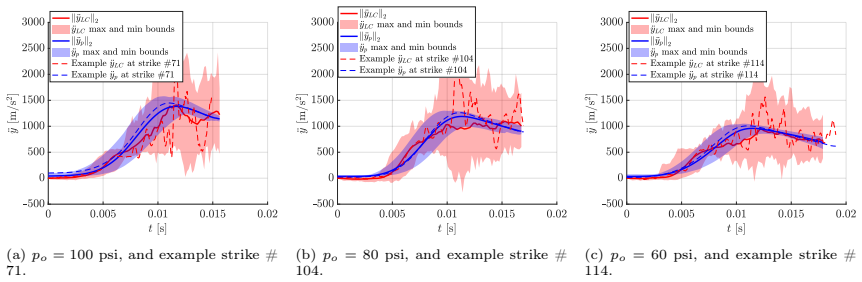
Reduced-order model of hammer and chamber dynamics that captures coupled pressure, flow, and impact behavior to interpret hammer velocity, displacement, strike timing, and impact energy.
If this is right
- The drill concept enables deep subsurface access on Mars with low power consumption using atmospheric CO2.
- Drilling efficiency is highest in percussion-dominant mode rather than rotary-dominant mode.
- Bit geometry must be chosen to match the available impact energy for optimal performance.
- Mechanical specific energy scales with material strength, lower in weak sandstone simulants and higher in strong basalt.
Where Pith is reading between the lines
- Full-system integration tests would be needed to confirm cuttings transport works reliably at depth.
- The same pneumatic architecture could be tested for other planetary bodies with thin atmospheres.
- Extending the model to include temperature effects on CO2 properties would clarify performance margins.
Load-bearing premise
Benchtop experiments using terrestrial rock simulants and standard atmospheric conditions accurately predict performance under Martian gravity, temperature, pressure, and actual subsurface rock properties.
What would settle it
A drilling test in a vacuum chamber under simulated Martian gravity and pressure that produces mechanical specific energy values outside the reported 74 to 360 MJ/m3 range would falsify the translation from benchtop results.
Figures




read the original abstract
Deep subsurface access on Mars could enable sampling of ancient lacustrine deposits, volatile-rich horizons, and other geologic targets beyond the reach of current shallow drilling systems. This study evaluates a wireline pneumatic rotary-percussive drill concept that uses compressed atmospheric CO2 as both the actuation and transport fluid. The architecture combines a pneumatically driven hammer, magnetic flapper-valve, and incremental bit-indexing mechanism in a compact bottom-hole assembly for low-power deployment. We develop a reduced-order model of the hammer and chamber dynamics that captures coupled pressure, flow, and impact behavior during each strike. The model is compared with benchtop percussion experiments and used to interpret hammer velocity, displacement, strike timing, and impact energy. A modified testbed is then used to drill Martian rock simulants spanning weaker sandstone and stronger Saddleback basalt cases, linking drilling response to operating pressure and material properties. The experiments show repeatable percussive impacts and mechanical specific energy values from 74 to 360 MJ/m3, with lower values in weaker simulant and higher values in stronger basalt. The results indicate that the system is most effective in a percussion-dominant mode with bit geometry matched to available impact energy. Together, the architecture study, validated model, and drilling experiments support the wireline pneumatic drill as a candidate for low-power deep drilling on Mars, while identifying remaining work in robustness, cuttings removal, and full-system integration.
Editorial analysis
A structured set of objections, weighed in public.
Referee Report
Summary. The manuscript evaluates a wireline pneumatic rotary-percussive drill concept for Martian subsurface access that uses compressed CO2 as both actuation and cuttings transport fluid. It presents a reduced-order model of hammer and chamber dynamics that captures coupled pressure, flow, and impact behavior, compares the model to benchtop percussion experiments, and reports drilling tests on weaker sandstone and stronger Saddleback basalt simulants that yield mechanical specific energy (MSE) values from 74 to 360 MJ/m³. The results are interpreted to show effectiveness in percussion-dominant mode with matched bit geometry, and the combined architecture study, model, and experiments are claimed to support the system as a candidate for low-power deep drilling on Mars.
Significance. The work addresses a key technical barrier in planetary exploration by proposing a compact, low-power pneumatic system that avoids heavy terrestrial-style drilling hardware. The reduced-order model and repeatable MSE measurements on simulants provide a useful empirical baseline for percussion performance. However, the significance for actual Martian deployment is constrained by the absence of any scaling analysis or auxiliary data addressing the translation from 1 g / 1 atm benchtop conditions to Martian gravity, pressure, and temperature.
major comments (3)
- [Abstract] Abstract: the statement that the model is 'compared with benchtop percussion experiments' supplies no quantitative agreement metrics (e.g., RMS error on impact velocity or timing), error bars, number of trials, or description of data-exclusion criteria, leaving the validation claim unsupported by reported evidence.
- [Drilling experiments and model sections] Drilling experiments and model sections: the central claim that the architecture supports low-power deep drilling on Mars rests on an untested extrapolation; the benchtop tests occur at 1 atm and 1 g, yet no scaling analysis, auxiliary simulation, or experiment addresses how reduced back-pressure (~0.6 kPa CO2) alters valve timing, impact energy, or how 0.38 g affects cuttings transport in the wireline architecture.
- [Abstract and results interpretation] Abstract and results interpretation: the reported MSE range (74–360 MJ/m³) is linked to material strength and operating pressure, but without reported variability statistics or controls for bit wear, the assertion that the system is 'most effective in a percussion-dominant mode' cannot be evaluated for robustness.
minor comments (1)
- [Abstract] Abstract: the phrase 'repeatable percussive impacts' would be strengthened by a brief statement of the number of strikes or runs performed.
Simulated Author's Rebuttal
We thank the referee for the constructive comments, which have helped clarify the presentation of validation evidence and limitations. We address each major comment below and indicate revisions made to the manuscript.
read point-by-point responses
-
Referee: [Abstract] Abstract: the statement that the model is 'compared with benchtop percussion experiments' supplies no quantitative agreement metrics (e.g., RMS error on impact velocity or timing), error bars, number of trials, or description of data-exclusion criteria, leaving the validation claim unsupported by reported evidence.
Authors: We agree that quantitative metrics strengthen the validation claim. The revised manuscript now reports 15 trials, RMS error of 12% on peak impact velocity, timing agreement within 5 ms, error bars on all velocity and energy data, and data-exclusion criteria (outliers >3σ after inspection for sensor malfunction). revision: yes
-
Referee: [Drilling experiments and model sections] Drilling experiments and model sections: the central claim that the architecture supports low-power deep drilling on Mars rests on an untested extrapolation; the benchtop tests occur at 1 atm and 1 g, yet no scaling analysis, auxiliary simulation, or experiment addresses how reduced back-pressure (~0.6 kPa CO2) alters valve timing, impact energy, or how 0.38 g affects cuttings transport in the wireline architecture.
Authors: We acknowledge the tests are at terrestrial conditions and that the manuscript does not include scaling analysis for Martian back-pressure or gravity. The paper frames the system as a 'candidate' and already flags remaining work on cuttings removal and integration. We have added an explicit limitations paragraph in the discussion describing the expected effects of reduced back-pressure on valve timing and the role of gravity in cuttings transport, while clarifying that these require dedicated future study. revision: partial
-
Referee: [Abstract and results interpretation] Abstract and results interpretation: the reported MSE range (74–360 MJ/m³) is linked to material strength and operating pressure, but without reported variability statistics or controls for bit wear, the assertion that the system is 'most effective in a percussion-dominant mode' cannot be evaluated for robustness.
Authors: We have added standard deviations to the MSE values (e.g., 74 ± 8 MJ/m³) based on five replicates per condition. Bit wear was controlled by replacing bits after every three tests and confirming stable penetration rates; no measurable wear affected the reported data. These additions support evaluation of the percussion-dominant mode claim. revision: yes
- Comprehensive scaling analysis or auxiliary experiments addressing Martian back-pressure (~0.6 kPa) effects on valve timing and impact energy, and 0.38 g effects on cuttings transport, which lie outside the scope of the current benchtop study.
Circularity Check
No circularity; empirical measurements and model validation are independent of target claims
full rationale
The paper reports direct benchtop measurements of percussive impacts, hammer dynamics, and MSE values (74–360 MJ/m³) on terrestrial simulants, plus a reduced-order model validated by comparison to those same runs. No equation or claim reduces by construction to a fitted parameter renamed as prediction, no self-citation chain is load-bearing, and no ansatz is smuggled. The Martian-candidate conclusion is an interpretive extrapolation from the Earth data rather than a derivation that loops back to its own inputs. This is the normal case of a self-contained experimental study.
Axiom & Free-Parameter Ledger
Reference graph
Works this paper leans on
-
[1]
Drilling systems for extraterrestrial subsurface exploration.Astro- biology, 8(3):665–706, 2008
Kris Zacny, Y Bar-Cohen, M Brennan, G Briggs, G Cooper, K Davis, B Dolgin, D Glaser, B Glass, S Gorevan, et al. Drilling systems for extraterrestrial subsurface exploration.Astro- biology, 8(3):665–706, 2008
work page 2008
-
[2]
A review of different aspects of off-earth drilling
D Knez and M Khalilidermani. A review of different aspects of off-earth drilling. energies, 14 (21), 7351, 2021
work page 2021
-
[3]
BJ Glass, M New, and MA Voytek. Future space drilling and sample acquisition: A collabo- rative industry-government workshop.Icarus, 338:113378, 2020
work page 2020
-
[4]
Drilling and excavation for construction and in-situ resource utilization
Kris Zacny and Yoseph Bar-Cohen. Drilling and excavation for construction and in-situ resource utilization. InMars: prospective energy and material resources, pages 431–459. Springer, 2009
work page 2009
-
[5]
Thomson, Scott Stanley, Peter Thomas, Nicholas Lan, Christopher McKay, Tullis C
Kris Zacny, Yoseph Bar-Cohen, Kiel Davis, Pierre Coste, Gale Paulsen, Stewart Sherrit, Jef- frey George, Brian Derkowski, Steve Gorevan, Dale Boucher, Jose Guerrero, Takashi Kub- ota, Bradley J. Thomson, Scott Stanley, Peter Thomas, Nicholas Lan, Christopher McKay, Tullis C. Onstot, Carol Stoker, Brian Glass, Sachiko Wakabayashi, Lyle Whyte, Gianfranco Vi...
work page 2009
-
[6]
Reaching 1 m deep on mars: the icebreaker drill.Astrobiology, 13(12):1166–1198, 2013
K Zacny, G Paulsen, CP McKay, B Glass, A Davé, AF Davila, M Marinova, B Mellerowicz, J Heldmann, C Stoker, et al. Reaching 1 m deep on mars: the icebreaker drill.Astrobiology, 13(12):1166–1198, 2013
work page 2013
-
[7]
Robotic drill systems for plane- tary exploration
Gale Paulsen, Kris Zacny, Phil Chu, Erik Mumm, Kiel Davis, Seth Frader-Thompson, Kyle Petrich, David Glaser, Paul Bartlett, Howard Cannon, et al. Robotic drill systems for plane- tary exploration. InSpace 2006, page 7512. 2006
work page 2006
-
[8]
Marte: technology development and lessons learned from a mars drilling mission simulation
Howard N Cannon, Carol R Stoker, Stephen E Dunagan, Kiel Davis, Javier Gómez-Elvira, Brian J Glass, Lawrence G Lemke, David Miller, Rosalba Bonaccorsi, Mark Branson, et al. Marte: technology development and lessons learned from a mars drilling mission simulation. Journal of Field Robotics, 24(10):877–905, 2007
work page 2007
-
[9]
Carol R Stoker, Howard N Cannon, Stephen E Dunagan, Lawrence G Lemke, Brian J Glass, David Miller, Javier Gomez-Elvira, Kiel Davis, Jhony Zavaleta, Alois Winterholler, et al. The 2005 marte robotic drilling experiment in río tinto, spain: objectives, approach, and results of a simulated mission to search for life in the martian subsurface.Astrobiology, 8(...
work page 2005
-
[10]
Trident drill validation at mars and lunar analog field sites
B Glass, C Stoker, H Battah, S Boelter, C Fortuin, I King, T Stevenson, and T Stucky. Trident drill validation at mars and lunar analog field sites. In55th Lunar and Planetary Science Conference (LPSC), 2024
work page 2024
-
[11]
Carol R Stoker, Brian J Glass, Thomas R Stucky, Arwen I Dave, Linda T Kobayashi, Richard C Quinn, Mercedes Moreno-Paz, Laura Sánchez-García, Maria F Mora, Florian Kehl, et al. A mission simulating the search for life on mars with automated drilling, sample han- dling, and life detection instruments performed in the hyperarid core of the atacama desert, ch...
work page 2023
-
[12]
Deep drill (deedri) for mars application.Planetary and Space Science, 52(1-3):79–82, 2004
PG Magnani, E Re, T Ylikorpi, G Cherubini, and A Olivieri. Deep drill (deedri) for mars application.Planetary and Space Science, 52(1-3):79–82, 2004
work page 2004
-
[13]
Development of the esa exomars rover
M Van Winnendael, P Baglioni, and J Vago. Development of the esa exomars rover. InProc. 8th int. symp. artif. intell., robot. automat. Space, pages 5–8. Citeseer Munich, 2005
work page 2005
-
[14]
P Magnani, E Re, A Fumagalli, S Senese, GG Ori, A Gily, and P Baglioni. Testing of exomars em drill tool in mars analogous materials.Proceedings Advanced Space Technologies for Robotics and Automation (ASTRA). Noordwijk, The Netherlands: European Space Agency, 2011. 47
work page 2011
-
[15]
Final report: Hardware base technology task modular planetary drill system (mpds), jpl contract no
Jose Guerrero. Final report: Hardware base technology task modular planetary drill system (mpds), jpl contract no. 1264531. 2008
work page 2008
-
[16]
Gale Paulsen, Kris Zacny, Chris Mckay, Brian Glass, Mateusz Szczesiak, Jack Craft, Chris Santoro, Jeff Shasho, Alfonso Davila, Margarita Marinova, et al. Testing of a 1 meter mars icebreaker drill in a 3.5 meter vacuum chamber and in an antarctic mars analog site. InAIAA space 2011 conference & exposition, page 7236, 2011
work page 2011
-
[17]
Planetary drilling and resources at the moon and mars
Jeffrey A George. Planetary drilling and resources at the moon and mars. InPioneer Natural Resources Geoscience, Engineering and Drilling Technology Conference, number JSC-CN- 27285, 2012
work page 2012
-
[18]
M Badescu, S Sherrit, A Olorunsola, J Aldrich, X Bao, Y Bar-Cohen, Z Chang, PT Doran, CH Fritsen, F Kenig, et al. Ultrasonic/sonic gopher for subsurface ice and brine sampling: analysis and fabrication challenges and testing results. InSmart Structures and Materials 2006: Industrial and Commercial Applications of Smart Structures Technologies, volume 6171...
work page 2006
-
[19]
Yoseph Bar-Cohen, Kris Zacny, Mircea Badescu, Hyeong Jae Lee, Stewart Sherrit, Xiaoqi Bao, Gale L. Paulsen, and Luther Beegle. The Auto-Gopher: a wireline rotary-percussive deep sampler. InASCE Earth and Space 2016 Conference, Orlando, Florida, April 11-15, 2016. Pasadena, CA: Jet Propulsion Laboratory, National Aeronautics and Space Administration, 2016, 2016
work page 2016
-
[20]
Auto-gopher: a wireline deep sampler driven by piezoelectric percussive actuator and em rotary motor
Mircea Badescu, Aaron Ressa, Hyeong Jae Lee, Yoseph Bar-Cohen, Stewart Sherrit, Kris Zacny, Gale L Paulsen, Luther Beegle, and Xiaoqi Bao. Auto-gopher: a wireline deep sampler driven by piezoelectric percussive actuator and em rotary motor. InSensors and Smart Structures Technologies for Civil, Mechanical, and Aerospace Systems 2013, volume 8692, pages 78...
work page 2013
-
[21]
Yoseph Bar-Cohen, Kris Zacny, Mircea Badescu, Hyeong Jae Lee, Stewart Sherrit, Xiao Qi Bao, DavidFreeman, GaleLPaulsen, andLutherBeegle. Auto-gopher-2-wirelinedeepsampler driven by percussive piezoelectric actuator and rotary em motors.Advances in science and technology, 100:207–212, 2017
work page 2017
-
[22]
Auto- gopher-ii: an autonomous wireline rotary-hammer ultrasonic drill test results
Mircea Badescu, Yoseph Bar-Cohen, Stewart Sherrit, Xiaoqi Bao, Hyeong Jae Lee, Shannon Jackson, Brandon Metz, Zachary C Valles, Kris Zacny, Boleslaw Mellerowicz, et al. Auto- gopher-ii: an autonomous wireline rotary-hammer ultrasonic drill test results. InSensors and Smart Structures Technologies for Civil, Mechanical, and Aerospace Systems 2019, volume 1...
work page 2019
-
[23]
Joram Shenhar, T. Barfield, B. Dolgin, J. Farrand, B. Goldstein, J. Hill, M. Tucker, R. Wal- lace, and S. Lee. Autonomous tethered corer (atc) for deep drilling - basalt field test, idaho falls, id. 2006
work page 2006
-
[24]
Final report: Phase ii autonomous tethered corer for deep drilling contract: Nnc04cb04c
Joram Shenhar, Matthew Tucker, and Jennifer Farrand. Final report: Phase ii autonomous tethered corer for deep drilling contract: Nnc04cb04c. 2005
work page 2005
-
[25]
Redwater: Extraction of water from mars’ ice deposits
Joseph Palmowski, Kris Zacny, Boleslaw Mellerowicz, Brian Vogel, Andrew Bocklund, Leo Stolov, Bernice Yen, Dara Sabahi, Lilly Ware, David Faris, et al. Redwater: Extraction of water from mars’ ice deposits. InEarth and Space 2022, pages 355–362. 2022
work page 2022
-
[26]
Torben Wippermann, Troy L Hudson, Tilman Spohn, Lars Witte, Marco Scharringhausen, Georgios Tsakyridis, Mark Fittock, Olaf Krömer, Simon Hense, Matthias Grott, et al. Pene- tration and performance testing of the hp3 mole for the insight mars mission.Planetary and Space Science, 181:104780, 2020
work page 2020
-
[27]
Mitra Khalilidermani and Dariusz Knez. A survey of application of mechanical specific energy in petroleum and space drilling.Energies, 15(9):3162, 2022
work page 2022
-
[28]
M Enamul Hossain and Abdulaziz Abdullah Al-Majed.Fundamentals of sustainable drilling engineering. John Wiley & Sons, 2015. 48
work page 2015
-
[29]
The concept of specific energy in rock drilling
Robert Teale. The concept of specific energy in rock drilling. InInternational journal of rock mechanics and mining sciences & geomechanics abstracts, volume 2, pages 57–73. Elsevier, 1965
work page 1965
-
[30]
Michael S Bruno. Fundamental research on percussion drilling: improved rock mechanics analysis, advanced simulation technology, and full-scale laboratory investigations. Technical report, Terralog Technologies Inc., 2005
work page 2005
-
[31]
Dynamically modelling rock failure in percussion drilling
Gang Han, Mike Bruno, and Maurice B Dusseault. Dynamically modelling rock failure in percussion drilling. InARMA US Rock Mechanics/Geomechanics Symposium, pages ARMA–
-
[32]
Tomasz Śliwa and Paweł Śnieżek. Drilling bits in percussive-rotary drilling technology (down the hole dth).AGH Drilling, Oil, Gas, 29(4):453–462, 2012
work page 2012
-
[33]
X Li, G Rupert, David A Summers, P Santi, and D Liu. Analysis of impact hammer rebound to estimate rock drillability.Rock Mechanics and Rock Engineering, 33:1–13, 2000
work page 2000
-
[34]
Weiji Liu, Xiaohua Zhu, and Bo Li. The rock breaking mechanism analysis of rotary percussive cutting by single pdc cutter.Arabian Journal of Geosciences, 11:1–11, 2018
work page 2018
-
[35]
VN Oparin, VN Karpov, VV Timonin, and AI Konurin. Evaluation of the energy efficiency of rotary percussive drilling using dimensionless energy index.Journal of Rock Mechanics and Geotechnical Engineering, 14(5):1486–1500, 2022
work page 2022
-
[36]
US Department of the Interior, Bureau of Mines, 1975
Sathit Tandanand and Harold F Unger.Drillability determination: a drillability index for percussion drills, volume 8073. US Department of the Interior, Bureau of Mines, 1975
work page 1975
-
[37]
Zong-Xian Zhang and Finn Ouchterlony. Energy requirement for rock breakage in laboratory experiments and engineering operations: A review.Rock mechanics and rock engineering, 55(2):629–667, 2022
work page 2022
-
[38]
S. Kahraman, N. Bilgin, and C. Feridunoglu. Dominant rock properties affecting the penetra- tion rate of percussive drills.International Journal of Rock Mechanics and Mining Sciences, 40(5):711–723, 2003. Reports UCS values for various sandstones ranging from 20 MPa to 149 MPa
work page 2003
-
[39]
University of California, Berkeley, 2015
Mera Fayez Horne.Drilling on mars–mathematical model for rotary-ultrasonic core drilling of brittle materials. University of California, Berkeley, 2015
work page 2015
-
[40]
Strategies for drilling on mars.American Geophysical, 2005
KA Zacny and GA Cooper. Strategies for drilling on mars.American Geophysical, 2005
work page 2005
-
[41]
Yoseph Bar-Cohen, Mircea Badescu, Stewart Sherrit, Kris Zacny, Gale L Paulsen, Luther Beegle, and Xiaoqi Bao. Deep drilling and sampling via the wireline auto-gopher driven by piezoelectric percussive actuator and em rotary motor. InSensors and smart structures technologies for civil, mechanical, and aerospace systems 2012, volume 8345, pages 590–597. SPIE, 2012
work page 2012
-
[42]
Planetary deep drill for mars, europa, and enceladus
G Paulsen, M Shara, K Zacny, B Mellerowicz, J Spring, A Ridilla, R Sharpe, J Bowsher, N Hoisington, and J Abrashkin. Planetary deep drill for mars, europa, and enceladus. In47th Annual Lunar and Planetary Science Conference, number 1903, page 1077, 2016
work page 1903
-
[43]
Deep access subsurface extraction & retrieval (daser)
Luis Phillipe C Tosi, Kristopher Sherrill, A Scott Howe, Scott M Perl, Marcel Veismann, Marcello Gori, Ceth W Parker, and Isabel King. Deep access subsurface extraction & retrieval (daser). In2024 IEEE Aerospace Conference, pages 1–14. IEEE, 2024
work page 2024
-
[44]
Charles D Edwards, Vlada Stamenković, Penelope J Boston, Kennda L Lynch, Edgard G Rivera-Valentín, et al. Deep trek: Mission concepts for exploring subsurface habitability & life on mars: A window into subsurface life in the solar system. 2020
work page 2020
-
[45]
Stresses around a deep well.Transactions of the AIME, 179(01):186–191, 1949
AJ Miles and AD Topping. Stresses around a deep well.Transactions of the AIME, 179(01):186–191, 1949
work page 1949
-
[46]
M Enamul Hossain and Muhammad Rafiqul Islam.Drilling Engineering Problems and Solu- tions: A Field Guide for Engineers and Students. John Wiley & Sons, 2018. 49
work page 2018
-
[47]
Plastic state of stress around a deep well
Harold Malcolm Westergaard. Plastic state of stress around a deep well. 1940
work page 1940
-
[48]
Gulf professional publishing, 2022
Bernt S Aadnoy and Reza Looyeh.Petroleum rock mechanics: drilling operations and well design, volume 2nd Edition. Gulf professional publishing, 2022
work page 2022
-
[49]
Boston: McGraw-Hill Higher Education, 2010
Frank M White.Fluid mechanics. Boston: McGraw-Hill Higher Education, 2010
work page 2010
-
[50]
Hermann Schlichting and Klaus Gersten.Boundary-layer theory. springer, 2016
work page 2016
-
[51]
Environmental Protection Agency
U.S. Environmental Protection Agency. Handbook of chemical hazard analysis procedures. 1 1993
work page 1993
-
[52]
Sung Gong Choe, Tong Ho Choe, In Chol Ho, Myong Hak Mun, Il Jun Kim, Jong Hun Ri, Ryong Uhn Jong, and Yong Chol Kim. Effect of the geometrical shapes of the helical-spiral shroud intake valve on swirl generation in cylinder of diesel engine.Results in Engineering, 18:101132, 2023
work page 2023
-
[53]
A Abd El-Sabor Mohamed, Saleh Abo-Elfadl, and Abd El-Moneim M Nassib. Effect of shroud and orientation angles of inlet valve on flow characteristic through helical–spiral inlet port in diesel engine.Journal of Engineering for Gas Turbines and Power, 139(10):102802, 2017
work page 2017
-
[54]
Benny Paul and V Ganesan. Flow field development in a direct injection diesel engine with different manifolds.International Journal of Engineering, Science and Technology, 2(1):80–91, 2010
work page 2010
-
[55]
DavidVokoun, MarcoBeleggia, LuděkHeller, andPetrŠittner. Magnetostaticinteractionsand forces between cylindrical permanent magnets.Journal of magnetism and Magnetic Materials, 321(22):3758–3763, 2009
work page 2009
-
[56]
I. E. Idelchik.Handbook of Hydraulic Resistance. Begell House, New York, NY, 3rd edition, 1996
work page 1996
-
[57]
The influence of anisotropy on hard rock drilling and cutting
N Schormair, K Thuro, and RJ Plinninger. The influence of anisotropy on hard rock drilling and cutting. In10th Congress of the International Association for Engineering Geology and the Environment (IAEG 2006), Nottingham, United Kingdom, 2006. Geological Society of London
work page 2006
-
[58]
The effect of stress rate and temperature on the strength of basalt and granite
A Kumar. The effect of stress rate and temperature on the strength of basalt and granite. Geophysics Research Letters, 95:2757–2772, 1968
work page 1968
-
[59]
US Lindholm, LM Yeakley, and A Nagy. The dynamic strength and fracture properties of dresser basalt.International Journal of Rock Mechanics and Mining Science, 11(10):339–349, 1974
work page 1974
-
[60]
X Zhang, YW Chiu, H Hao, A Hsieh, P Dight, and K Liu. Dynamic compressive proper- ties of kalgoorlie basalt rock.International Journal of Rock Mechanics and Mining Science, 134:104492, 2020
work page 2020
-
[61]
A Malik, T Chakraborty, and KS Rao. Strain rate effect on the mechanical behavior of basalt: Observations from static and dynamic tests.Thin-Walled Structures, 157:107049, 2018
work page 2018
-
[62]
F Shangxin, W Yujie, Z Guolai, Z Yufei, W Shanyong, C Ruilang, and X Enshang. Estimation of optimal drilling efficiency and rock strength by using controllable drilling parameters in rotary non-percussive drilling.Journal of Petroleum Science and Engineering, 186:106704, 2020
work page 2020
-
[63]
F Gong, J Yan, X Li, and S Luo. A peak-strength strain energy storage index for rock burst proneness of rock materials.International Journal of Rock Mechanics and Mining Science, 117:76–89, 2019
work page 2019
-
[64]
The effect of strain rate on rock strength.Rock Mechanics and Rock Engineering, 24(2):99–109, 1991
EZ Lajtai, EJS Duncan, and BJ Carter. The effect of strain rate on rock strength.Rock Mechanics and Rock Engineering, 24(2):99–109, 1991
work page 1991
-
[65]
C Qi, M Wang, and Q Qian. Strain-rate effects on the strength and fragmentation size of rocks.International Journal of Impact Engineering, 36(12):1355–1364, 2009. 50
work page 2009
-
[66]
Limits on strength and deformation properties of jointed basaltic rock masses
RA Schultz. Limits on strength and deformation properties of jointed basaltic rock masses. Rock Mechanics and Rock Engineering, 28(1):1–15, 1995
work page 1995
-
[67]
Colin M. Dundas, Michael T. Mellon, Katarina Miljković, Gareth S. Collins, et al. A large new crater exposes the limits of water ice on mars.Geophysical Research Letters, 50(2):e2022GL100747, 2023. Cites the compressive strength of intact ice at approximately 10 MPa
work page 2023
-
[68]
M. Z. Abu Bakar and M. A. Qureshi. Penetration rate and specific energy prediction of rotary- percussive drills: Contributions of rock properties.Journal of Mining Science, 54(2):233–245,
-
[69]
Characterizes Murree Sandstone with a UCS of 125 MPa. 51 Appendix A. Algorithm Descriptions This appendix provides a list and details of key algorithms used for data processing in this manuscript. Appendix A.1. Individual Strike Search Algorithm Algorithm 2 outlines the steps used to find strike events. It references threshold values in Table A.17 that we...
discussion (0)
Sign in with ORCID, Apple, or X to comment. Anyone can read and Pith papers without signing in.