REVIEW 1 major objections 1 minor 44 references
A neural surrogate for helium-argon scattering preserves transport cross sections to within 1.5 percent and matches DSMC diffusion and viscosity to 1-2 percent.
Reviewed by Pith at T0; open to challenge. T0 means a machine referee read the full paper against a public rubric. the ladder, T0–T4 →
T0 review · grok-4.3
2026-06-30 11:51 UTC pith:GJHBRFOE
load-bearing objection The paper gives a practical multiscale validation framework for neural DSMC kernels on He-Ar with concrete low-error numbers, but the DSMC checks stay inside periodic boxes. the 1 major comments →
Transport-preserving neural ab initio scattering kernels for rarefied binary gas mixtures
The pith
A machine-rendered reading of the paper's core claim, the machinery that carries it, and where it could break.
Core claim
For He-Ar over Er/kb ≥10 K, the neural equal-area scattering surrogate preserves QD, Qμ, Qμ/QD, RCS, and SigVSS within 0.75%, 1.37%, 0.84%, 1.21%, and 1.46%, respectively. The cumulative angular measure agrees within 1.43%, the median relative L2 error of χ(q) is 3.4×10^{-3}, and the high-mode spectral-energy ratio is essentially unbiased. The same kernel embedded in periodic DSMC mixture problems reproduces a sinusoidal composition mode with mean normalized-history error 1.28±0.22% and D_NN/D_EPAPS=1.015±0.013, and a transverse shear wave with 1.58% history error and ν_NN/ν_EPAPS=0.989.
What carries the argument
The multiscale validation framework that combines angular regression, transport cross sections, Ohr-style representative quantities, cumulative angular measures, Fourier spectral content, impact-grid and angular-noise robustness tests, loss-ablation diagnostics, and three solver-level DSMC mixture tests.
Load-bearing premise
Agreement on the listed transport cross sections, cumulative angular measures, and three specific periodic DSMC mixture tests is sufficient evidence that the neural kernel is kinetically reliable for general rarefied binary mixture flows.
What would settle it
A DSMC simulation of a rarefied binary mixture flow configuration outside the three periodic tests, such as a normal shock or plane Couette flow, in which the neural kernel produces diffusion or viscosity coefficients that deviate by more than a few percent from the EPAPS reference values.
If this is right
- The neural kernel can be inserted directly into DSMC codes for rarefied binary mixture problems while preserving the macroscopic transport coefficients that govern mass and momentum diffusion.
- Periodic DSMC tests for composition relaxation, shear-wave decay, and two-dimensional field-level mixing all stay within 1-2 percent of the reference EPAPS behavior across independent realizations.
- High-mode spectral content of the deflection-angle distribution remains unbiased, supporting use in flows that sample a wide range of collision energies.
- The same framework supplies quantitative diagnostics (loss ablation, grid robustness, spectral bias) that can be applied to neural kernels for other gas pairs.
Where Pith is reading between the lines
- If the framework extends to additional mixtures, neural surrogates could replace full ab initio tables for any binary pair once the multiscale checks are passed.
- Continuous differentiability of the learned kernel opens the possibility of gradient-based calibration against experimental mixture transport data.
- Application to polyatomic or reactive mixtures would require analogous checks on rotational relaxation and chemical reaction cross sections to maintain the same level of kinetic fidelity.
Editorial analysis
A structured set of objections, weighed in public.
Referee Report
Summary. The paper develops a multiscale validation framework for neural ab initio scattering kernels in rarefied binary gas mixtures, combining angular regression, transport cross sections (QD, Qμ, RCS, SigVSS), cumulative angular measures, spectral content, and three periodic DSMC mixture tests. It demonstrates the framework on a neural equal-area surrogate for He-Ar based on EPAPS data, reporting preservation of QD, Qμ, Qμ/QD, RCS, and SigVSS within 0.75%, 1.37%, 0.84%, 1.21%, and 1.46% respectively for Er/kB ≥ 10 K, with DSMC tests yielding D_NN/D_EPAPS = 1.015 ± 0.013 and ν_NN/ν_EPAPS = 0.989.
Significance. If the reported agreements hold under independent scrutiny, the work provides a concrete, multi-functional validation approach for neural scattering surrogates that preserves key transport properties and reproduces DSMC mixture dynamics in periodic settings; this is a useful step toward differentiable, continuously evaluable kernels for rarefied-flow simulations.
major comments (1)
- [Abstract (multiscale validation framework paragraph)] Abstract (paragraph on multiscale validation framework): the central claim that the neural kernel is kinetically reliable for general rarefied binary mixture flows rests on agreement for transport cross sections plus three periodic DSMC tests (sinusoidal composition, transverse shear, 2D mixing); these setups do not exercise boundary conditions or non-periodic forcing, so the nonlinear dependence of the functionals on the kernel means the reported metrics do not automatically transfer. A concrete test would be to embed the NN kernel in a DSMC problem with solid walls and compare steady-state profiles or relaxation rates against the EPAPS reference.
minor comments (1)
- [Abstract] The abstract states concrete percentage agreements but provides no information on training procedure, data splits, or whether any of the reported functionals entered the loss; this information is needed to confirm the validations are independent.
Simulated Author's Rebuttal
We thank the referee for the constructive comment on the validation framework. We address the major point below.
read point-by-point responses
-
Referee: the central claim that the neural kernel is kinetically reliable for general rarefied binary mixture flows rests on agreement for transport cross sections plus three periodic DSMC tests (sinusoidal composition, transverse shear, 2D mixing); these setups do not exercise boundary conditions or non-periodic forcing, so the nonlinear dependence of the functionals on the kernel means the reported metrics do not automatically transfer. A concrete test would be to embed the NN kernel in a DSMC problem with solid walls and compare steady-state profiles or relaxation rates against the EPAPS reference.
Authors: The referee is correct that the DSMC tests use periodic domains without solid boundaries or non-periodic forcing. The transport cross sections QD, Qμ, RCS and SigVSS are geometry-independent collision integrals that determine the transport coefficients for arbitrary flow configurations. Their preservation (within the reported 0.75–1.46 %) therefore directly supports kinetic reliability independent of boundaries. The three periodic DSMC tests then confirm that these integrals produce correct mixture dynamics under nonlinear evolution, including the 2D mixing case. While wall-bounded tests would provide supplementary evidence for applications with surfaces, they are not required to validate the kernel itself, which is the focus of the framework. We therefore do not plan to add such tests in the present manuscript. revision: no
Circularity Check
No circularity: training on angular data, validation on independent nonlinear functionals
full rationale
The paper trains a neural equal-area surrogate via angular regression on ab initio scattering tables. It then evaluates the resulting kernel on transport cross sections (QD, Qμ, RCS, SigVSS), cumulative angular measures, spectral content, and DSMC mixture simulations. These quantities are nonlinear functionals of the kernel and are explicitly not part of the training loss. No equation reduces to its own input by construction, no fitted parameter is relabeled as a prediction, and no load-bearing premise rests on self-citation. The reported percentage agreements are therefore independent checks, not tautologies. This is the normal, non-circular case for a surrogate-validation study.
Axiom & Free-Parameter Ledger
Cite this review
Pith. "Pith review of Transport-preserving neural ab initio scattering kernels for rarefied binary gas mixtures." pith.science (2026). https://pith.science/paper/GJHBRFOE
@misc{pith2026260524744,
  author       = {Pith},
  title        = {Pith review of: Transport-preserving neural ab initio scattering kernels for rarefied binary gas mixtures},
  year         = {2026},
  howpublished = {\url{https://pith.science/paper/GJHBRFOE}},
  note         = {Machine review of arXiv:2605.24744}
}
read the original abstract
Neural surrogates for molecular scattering provide a route to continuously evaluable and differentiable direct simulation Monte Carlo (DSMC) collision kernels, but a small pointwise deflection-angle error is not sufficient evidence that a learned map is kinetically reliable. Diffusion, viscosity, representative collision rates, angular redistribution, and mixture relaxation are nonlinear functionals of the same scattering measure. We therefore develop a multiscale validation framework for neural ab initio scattering kernels that combines angular regression, transport cross sections, Ohr-style representative quantities, cumulative angular measures, Fourier spectral content, impact-grid and angular-noise robustness, loss-ablation diagnostics, and three solver-level DSMC mixture tests. The framework is demonstrated on a refined argon--argon J\"ager table and on helium--argon ab initio EPAPS data of Sharipov and Benites represented by a neural equal-area scattering surrogate. For He--Ar over $\Er/\kb\ge10~\mathrm{K}$, the surrogate preserves $\QD$, $\Qmu$, $\Qmu/\QD$, $\RCS$, and $\SigVSS$ within $0.75\%$, $1.37\%$, $0.84\%$, $1.21\%$, and $1.46\%$, respectively. The cumulative angular measure agrees within $1.43\%$, the median relative $L_2$ error of $\chi(q)$ is $3.4\times10^{-3}$, and the high-mode spectral-energy ratio is essentially unbiased. The same neural He--Ar kernel is then embedded in periodic DSMC mixture problems that separately probe mass diffusion, momentum diffusion, and two-dimensional field-level mixing. A sinusoidal composition mode is reproduced over three independent realizations with a mean normalized-history error of $1.28\pm0.22\%$ and $D_{\NN}/D_{\EPAPS}=1.015\pm0.013$. A transverse shear wave is reproduced with a $1.58\%$ history error and $\nu_{\NN}/\nu_{\EPAPS}=0.989$.
Figures





Reference graph
Works this paper leans on
-
[1]
Input and output representation The neural scattering surrogate approximates Gθ : (logE r, q)7→(cosχ,sinχ).(17) The trigonometric output is used because direct regression onχcan introduce artificial discontinuities near angular wrapping points. The angle is reconstructed as χθ = atan2 (sθ, cθ),(18) with appropriate mapping to the physical interval used by...
-
[2]
Pointwise, transport, and measure losses The basic angular loss is Lχ = 1 Nb NbX n=1 (cθ,n −c ref n )2 + (sθ,n −s ref n )2 ,(19) wherec= cosχands= sinχ. A transport-augmented objective adds batch estimates of QD andQ µ: LQ = 1 NE NEX ℓ=1 QD,θ(Er,ℓ) QD,ref(Er,ℓ) −1 2 + Qµ,θ(Er,ℓ) Qµ,ref(Er,ℓ) −1 2 . (20) 12 TABLE I. Loss-ablation study for the He–Ar neural...
-
[3]
Spectral content of the scattering map To connect with spectrally informed flow reconstruction, we define a Fourier-amplitude diagnostic in the equal-area coordinateq. For each energy level, theq-mean is subtracted: χ′(q, Er) =χ(q, E r)− ⟨χ(q, E r)⟩q.(23) The discrete Fourier coefficients are bχk(Er) = Nq−1X m=0 χ′(qm, Er) exp −2πikm Nq ,(24) with spectra...
-
[4]
The native table contains 900 energy levels and 100 equal-area samples
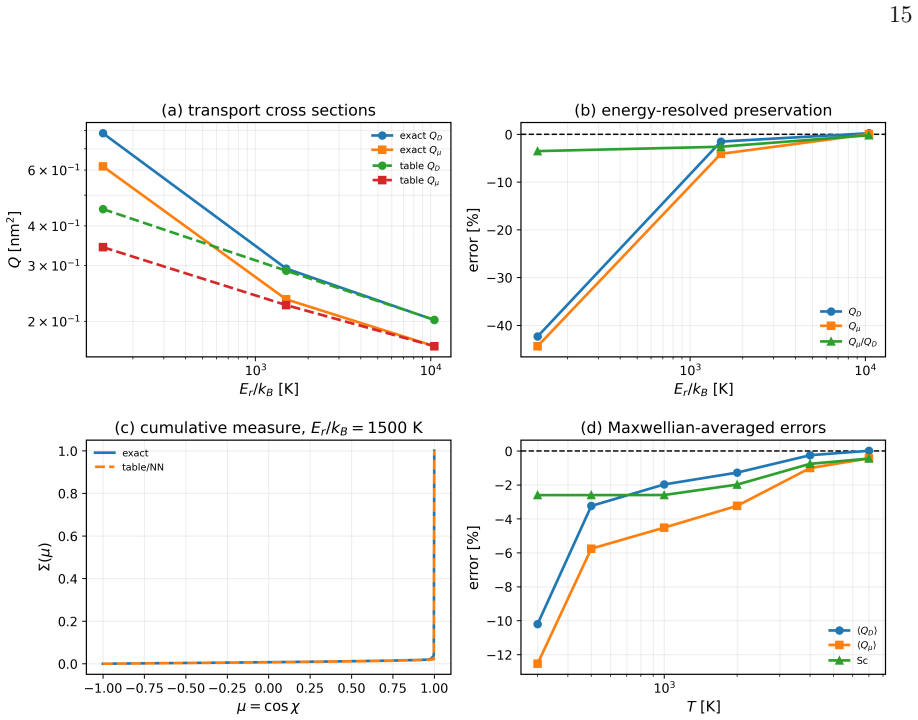
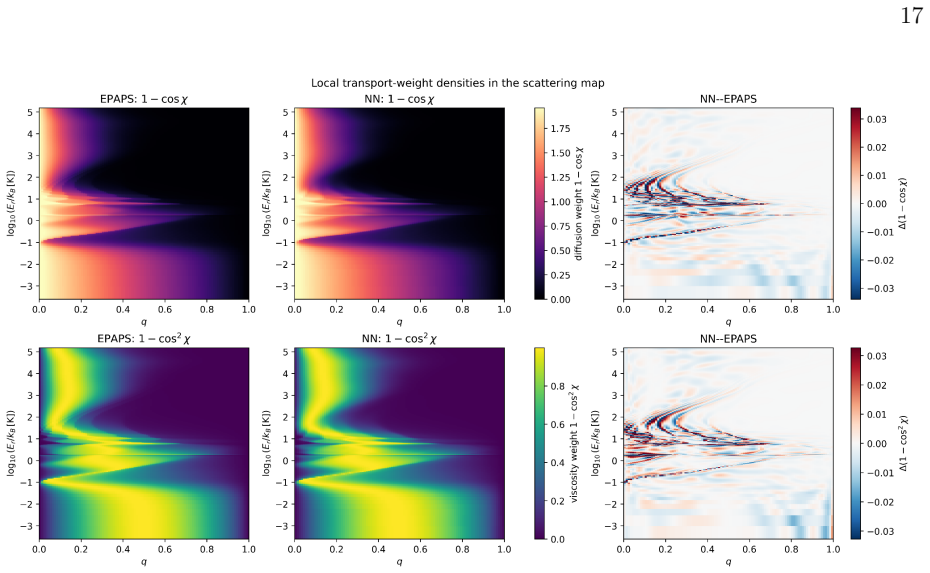
Deflection maps and transport cross sections The He–Ar reference data are based on the ab initio EPAPS table of Sharipov and Benites. The native table contains 900 energy levels and 100 equal-area samples. The neural surrogate is exported on the same coordinate, which allows one-to-one comparison ofχ(q, E) and direct evaluation of Eqs. (8) and (9). Figure...
-
[5]
Cumulative angular measure Figure 4 compares Σ(µ) for the same four energies. The cumulative measure is partic- ularly useful at low energy because it does not require branch identification or numerical differentiation. Its physical trend mirrors the cross-section behavior. At lower energy, Σ(µ) rises over a wider range ofµ, indicating that a non-negligib...
-
[6]
Ohr-style representative collision quantities Figure 6 tests the representative quantities defined by Eqs. (12)–(15). These quantities are important because they connect the full scattering map to reduced DSMC collision models. They also reveal how the angular distribution changes with energy. When the representative deflection diagnostic cosχ RDA =Q µ/QD...
-
[7]
Spectral preservation of the scattering map Figure 7 compares the Fourier-mode energy of the EPAPS and neural scattering maps. The low modes dominate, as expected for a smooth impact-area map, but high modes carry the sharp low-energy features. This separation has a direct physical meaning. Low modes represent the slowly varying deflection produced by the...
-
[8]
Coarse-impact and angular-noise robustness A practical DSMC collision table cannot have infinite resolution. Figure 9 therefore asks how much transport error is introduced if the EPAPS map is reconstructed from coarserq 22 FIG. 9. Robustness tests inspired by coarse/noisy-input validation in flow reconstruction. Top: transport errors induced by reconstruc...
-
[9]
G. A. Bird, Physics of Fluids6, 1518 (1963)
work page 1963
-
[10]
G. A. Bird, Physics of Fluids13, 2676 (1970)
work page 1970
-
[11]
Nanbu, Journal of the Physical Society of Japan49, 2042 (1980)
K. Nanbu, Journal of the Physical Society of Japan49, 2042 (1980)
work page 2042
- [12]
- [13]
-
[14]
R. A. Aziz, A. R. Janzen, and M. R. Moldover, Physical Review Letters74, 1586 (1995)
work page 1995
-
[15]
P. J. Bertoncini and A. C. Wahl, Physical Review Letters25, 991 (1970)
work page 1970
- [16]
- [17]
-
[18]
F. Sharipov and V. J. Benites, Journal of Chemical Physics143, 154104 (2015)
work page 2015
- [19]
- [20]
-
[21]
Sharipov, International Journal of Heat and Mass Transfer220, 124906 (2024)
F. Sharipov, International Journal of Heat and Mass Transfer220, 124906 (2024)
work page 2024
- [22]
- [23]
-
[24]
J. L. Strapasson and F. Sharipov, International Journal of Heat and Mass Transfer71, 91 (2014)
work page 2014
- [25]
-
[26]
Sharipov, Physics of Fluids34, 097114 (2022)
F. Sharipov, Physics of Fluids34, 097114 (2022)
work page 2022
-
[27]
L. Guastoni, M. P. Encinar, P. Schlatter, H. Azizpour, and R. Vinuesa, Journal of Fluid Mechanics928, A27 (2021)
work page 2021
-
[28]
A. G. Balasubramanian, A. Cremades, R. Vinuesa, and O. Tammisola, Physical Review Fluids 11, 044907 (2026)
work page 2026
- [29]
-
[30]
G. E. Karniadakis, I. G. Kevrekidis, L. Lu, P. Perdikaris, S. Wang, and L. Yang, Nature Reviews Physics3, 422 (2021)
work page 2021
-
[31]
L. Lu, P. Jin, G. Pang, Z. Zhang, and G. E. Karniadakis, Nature Machine Intelligence3, 218 (2021)
work page 2021
-
[32]
N. Kovachki, Z. Li, B. Liu, K. Azizzadenesheli, K. Bhattacharya, A. M. Stuart, and A. Anand- kumar, Acta Numerica32, 1 (2023)
work page 2023
-
[33]
S. L. Brunton, B. R. Noack, and P. Koumoutsakos, Annual Review of Fluid Mechanics52, 477 (2020)
work page 2020
-
[34]
K. Duraisamy, G. Iaccarino, and H. Xiao, Annual Review of Fluid Mechanics51, 357 (2019)
work page 2019
-
[35]
D. Kochkov, J. A. Smith, A. Alieva, Q. Wang, M. P. Brenner, and S. Hoyer, Proceedings of the National Academy of Sciences118, e2101784118 (2021)
work page 2021
- [36]
-
[37]
S. T. Miller, N. V. Roberts, and E. C. Cyr, Journal of Computational Physics470, 111541 (2022)
work page 2022
-
[38]
A. Corbetta, E. van den Eijnden, and F. Toschi, The European Physical Journal E46, 20 (2023)
work page 2023
-
[39]
N. D. Ball, J. F. MacArt, and J. Sirignano, Journal of Computational Physics524, 113681 (2025)
work page 2025
-
[40]
E. Roohi and A. Shoja-Sani, Aerospace Science and Technology168, 110785 (2026)
work page 2026
- [41]
- [42]
- [43]
-
[44]
Y. G. Ohr, Physical Review E108, 035301 (2023)
work page 2023
discussion (0)
Sign in with ORCID, Apple, or X to comment. Anyone can read and Pith papers without signing in.