Kepler Discovery of GW Vir Pulsations of the Central Star of Planetary Nebula Kn 61
Pith reviewed 2026-06-29 23:25 UTC · model grok-4.3
The pith
Pulsations detected in Kn 61's central star yield an asteroseismic mass of 0.551 solar masses.
A machine-rendered reading of the paper's core claim, the machinery that carries it, and where it could break.
Core claim
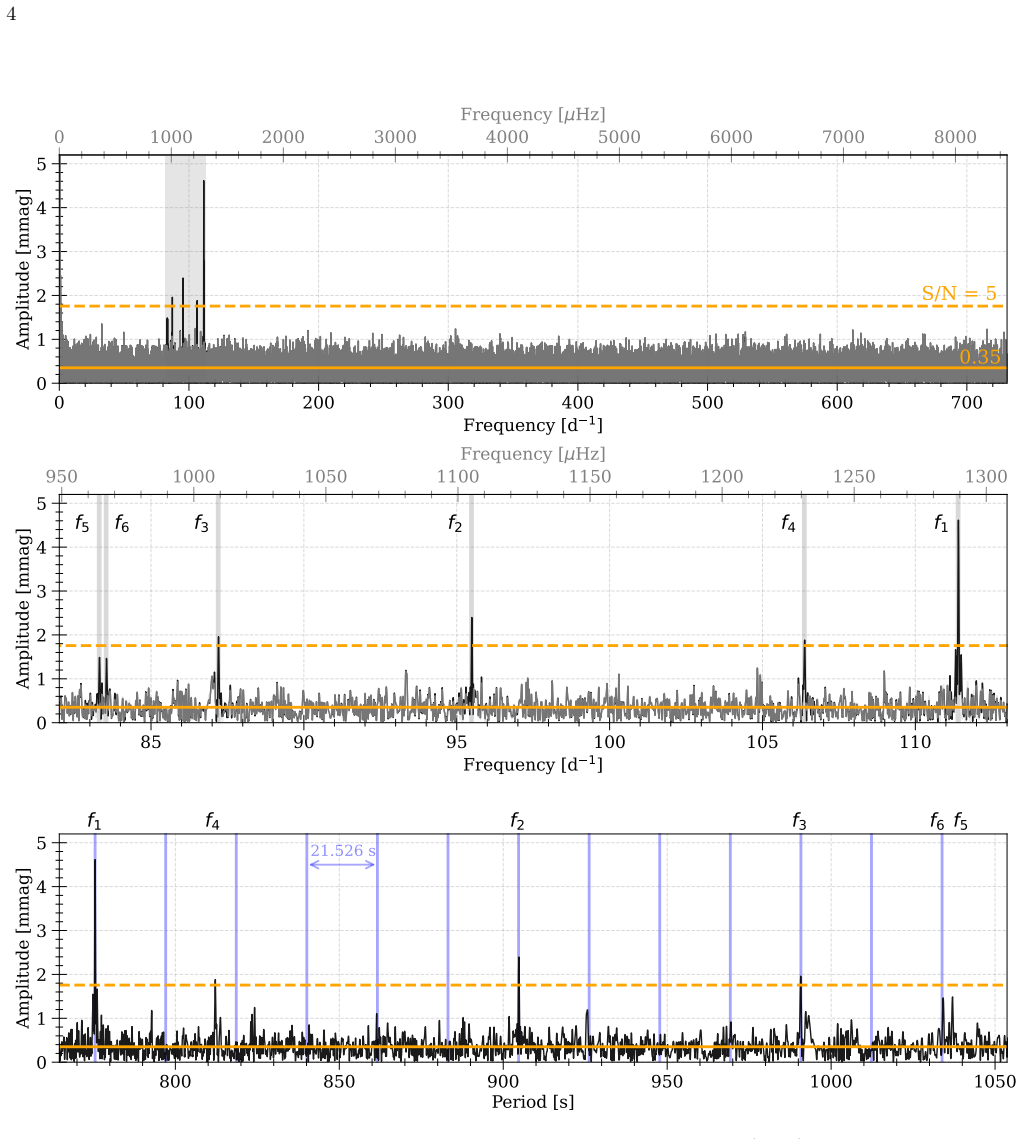
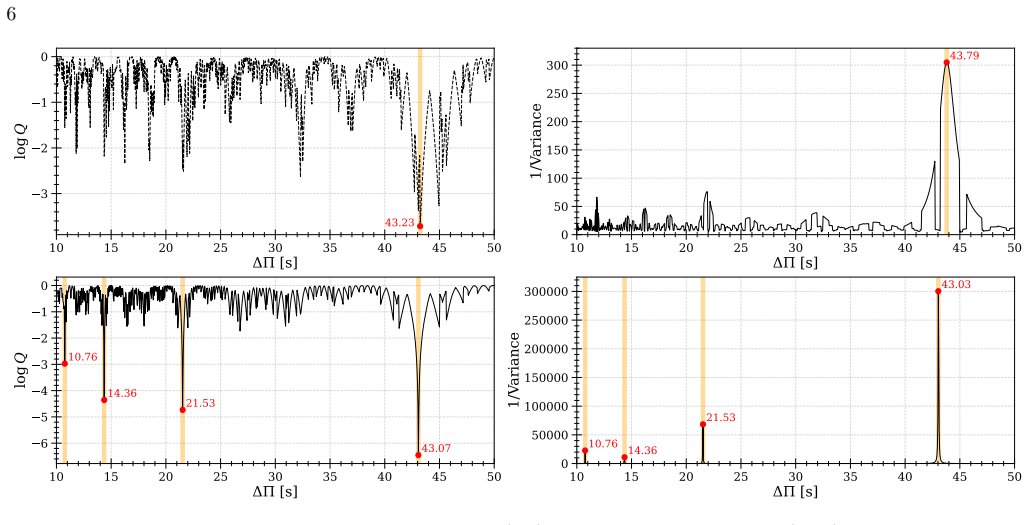
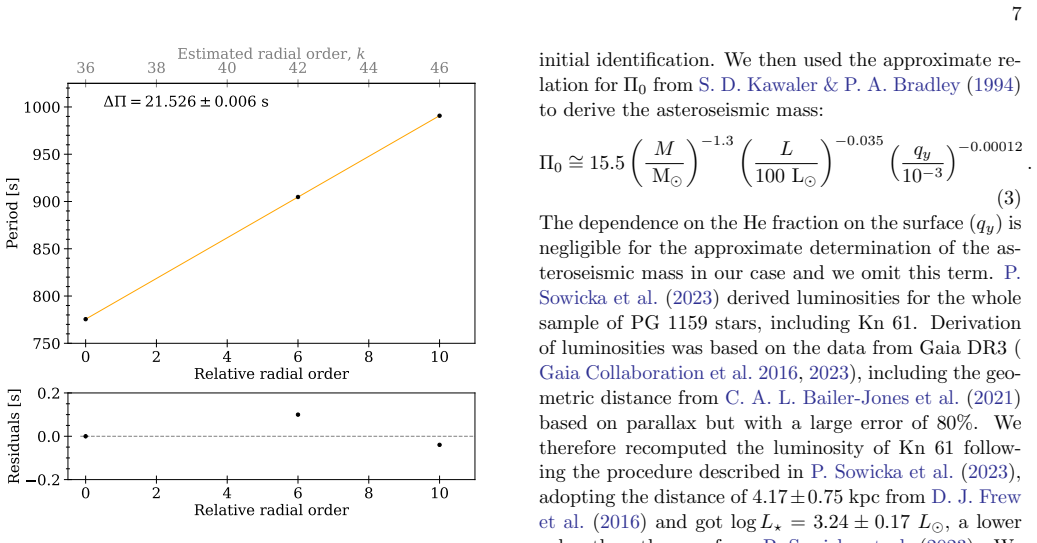
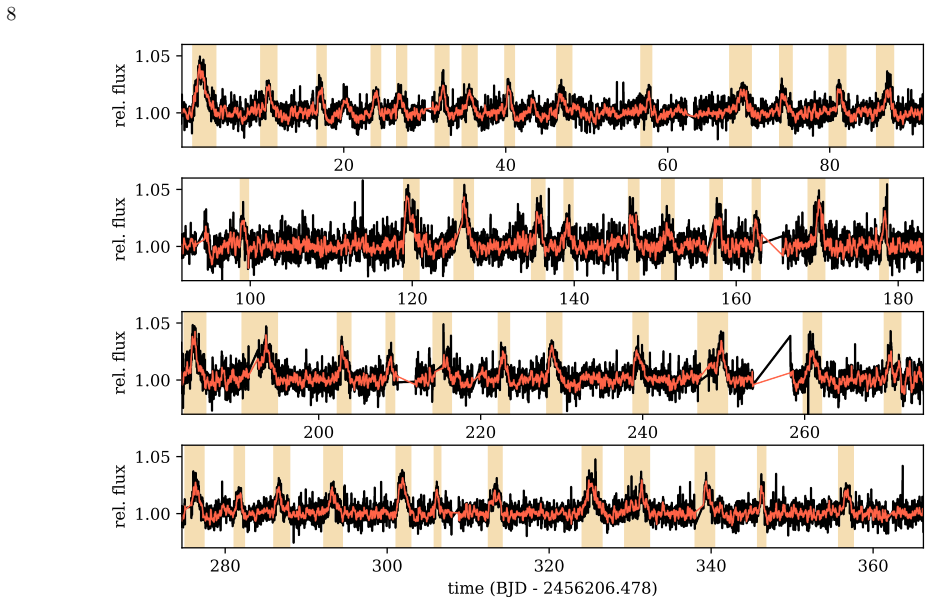
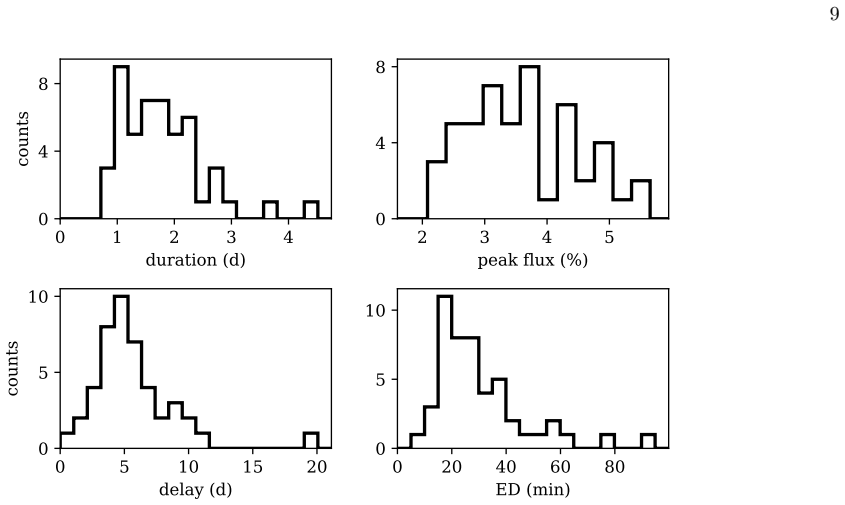
Based on Kepler Short Cadence observations, four significant peaks are detected in the frequency range consistent with g-modes excited in GW Vir stars. From the detected modes, a mean period spacing of 21.526(6) s is identified for a sequence of three ℓ=1 modes, allowing derivation of an asteroseismic mass of 0.551(6) M⊙ that is consistent with the one derived from evolutionary tracks. Sporadic brightening events in the Long Cadence light curve are characterized with estimated energies of about 10^40 erg under the assumption of temperature increases.
What carries the argument
The mean period spacing of 21.526 seconds measured from three ℓ=1 g-modes, which is inserted into the standard asteroseismic mass relation for GW Vir stars to obtain the stellar mass.
If this is right
- The star's mass is independently confirmed near 0.55 solar masses by both asteroseismology and evolutionary models.
- GW Vir-type g-mode pulsations occur in at least one planetary-nebula central star of PG 1159 type.
- The measured period spacing supplies a benchmark for testing g-mode excitation models in hot post-AGB stars.
- The brightening events indicate episodic energy releases of order 10^40 erg whose physical cause is still unidentified.
Where Pith is reading between the lines
- Asteroseismology could now be applied to other planetary-nebula central stars that display similar pulsation spectra.
- The mass agreement may help calibrate the timing and amount of mass loss on the asymptotic giant branch for stars of this type.
- Multi-wavelength monitoring of the brightening events could distinguish between temperature changes and other possible causes such as accretion or shell flashes.
Load-bearing premise
The detected frequency peaks correspond to a sequence of ℓ=1 g-modes whose period spacing can be directly interpreted with the standard asteroseismic mass relation for GW Vir stars without significant corrections for this object's specific properties or evolutionary state.
What would settle it
A spectroscopic or independent mass measurement that differs by more than the stated 0.006 solar-mass uncertainty, or additional photometry showing the modes are not ℓ=1, would invalidate the derived asteroseismic mass.
Figures
read the original abstract
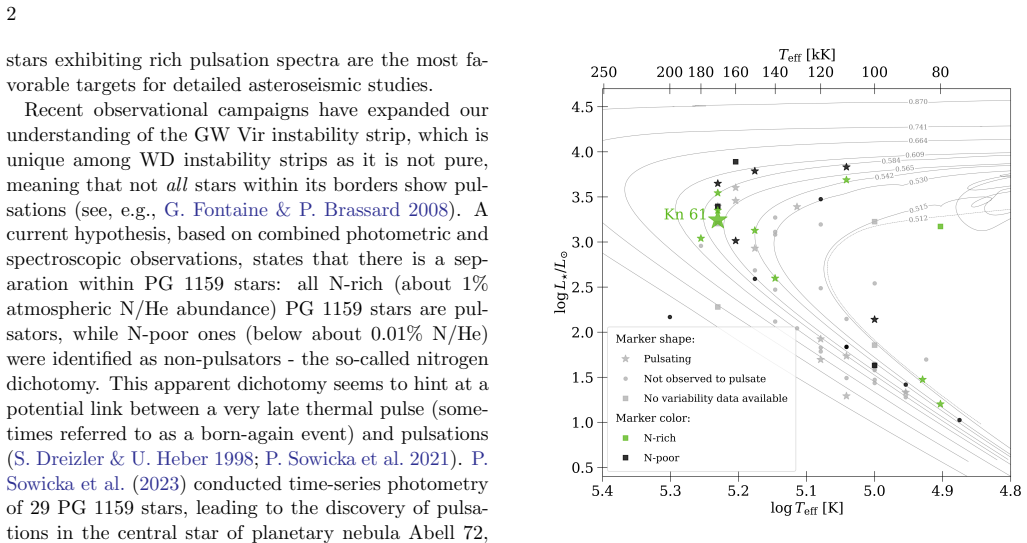
We report the discovery of pulsations in the N-rich PG 1159-type central star of the planetary nebula Kn 61 based on one month of Kepler Short Cadence observations. We detect four significant peaks in the frequency range consistent with g-modes excited in GW Vir stars. From the detected modes, we identify a mean period spacing of $\Delta\Pi=21.526(6)$ s for a sequence of three $\ell=1$ modes. This allows us to derive the asteroseismic mass of the star, which we estimate to be $0.551(6)~\mathrm{M}_{\odot}$, consistent with the one derived from the evolutionary tracks. We also characterize sporadic brightening events in the Long Cadence Kepler light curve of Kn 61. If we assume these are caused by increases in effective temperature, we estimate their energies to be $\sim10^{40}$ erg, though this may not be accurate as the mechanism for releasing so much energy is still unknown.
Editorial analysis
A structured set of objections, weighed in public.
Referee Report
Summary. The manuscript reports the discovery of GW Vir-type g-mode pulsations in the N-rich PG 1159 central star of planetary nebula Kn 61 from one month of Kepler Short Cadence photometry. Four significant frequency peaks are detected; three are identified as consecutive ℓ=1 modes yielding a mean period spacing ΔΠ=21.526(6) s, from which an asteroseismic mass of 0.551(6) M⊙ is derived and stated to be consistent with evolutionary-track masses. Sporadic brightening events in the Long Cadence light curve are also characterized, with an estimated energy scale of ~10^40 erg under an assumed temperature-increase interpretation.
Significance. If the mode identification and period-spacing measurement are robust, the result adds a new pulsating central star of a planetary nebula to a still-small sample and supplies an independent mass for an N-rich PG 1159 object. Such masses help calibrate the post-AGB evolutionary timescale and the location of the GW Vir instability strip.
major comments (2)
- [Mass derivation paragraph] The paragraph deriving the asteroseismic mass from ΔΠ=21.526(6) s applies the standard GW Vir asymptotic mass–period-spacing calibration without quantitative assessment of possible shifts arising from the elevated nitrogen abundance or the planetary-nebula evolutionary state explicitly noted in the abstract; even a 2–3 s change in the expected spacing would move the mass outside the quoted 0.006 M⊙ uncertainty and weaken the claimed consistency with evolutionary tracks.
- [Pulsation analysis section] The identification of the three ℓ=1 modes as a clean consecutive sequence (and the exclusion of ℓ=2 or trapped modes) is stated without the individual periods, the frequency-resolution value, or the S/N thresholds used; with only three modes the mean spacing is sensitive to even one misidentification, directly affecting the central mass claim.
minor comments (2)
- The abstract gives the period spacing to three decimal places but does not state the individual periods or the exact arithmetic used to obtain the mean; adding a short table of the detected periods would allow independent verification.
- The energy estimate for the brightening events assumes a temperature increase whose amplitude is not quantified; a brief statement of the adopted ΔT or the bolometric correction would clarify the ~10^40 erg figure.
Simulated Author's Rebuttal
We thank the referee for their careful reading and constructive comments on our manuscript. We respond point-by-point to the major comments below. We agree that additional details and caveats are warranted and have revised the manuscript to address them where possible.
read point-by-point responses
-
Referee: [Mass derivation paragraph] The paragraph deriving the asteroseismic mass from ΔΠ=21.526(6) s applies the standard GW Vir asymptotic mass–period-spacing calibration without quantitative assessment of possible shifts arising from the elevated nitrogen abundance or the planetary-nebula evolutionary state explicitly noted in the abstract; even a 2–3 s change in the expected spacing would move the mass outside the quoted 0.006 M⊙ uncertainty and weaken the claimed consistency with evolutionary tracks.
Authors: We agree that the manuscript applies the standard calibration without a quantitative assessment of shifts due to elevated nitrogen abundance or the planetary-nebula evolutionary state. The standard relations are based on models that may not fully incorporate these factors, and we acknowledge that even modest changes in spacing could affect the derived mass. Without performing new tailored asteroseismic models for N-rich compositions, we cannot provide a numerical estimate of the shift. In the revised manuscript we will add an explicit discussion of this limitation, note that the quoted uncertainty does not include composition effects, and reference relevant literature on composition influences in PG 1159 stars. The claimed consistency with evolutionary tracks will be qualified accordingly. revision: partial
-
Referee: [Pulsation analysis section] The identification of the three ℓ=1 modes as a clean consecutive sequence (and the exclusion of ℓ=2 or trapped modes) is stated without the individual periods, the frequency-resolution value, or the S/N thresholds used; with only three modes the mean spacing is sensitive to even one misidentification, directly affecting the central mass claim.
Authors: We agree that the pulsation analysis section does not supply the individual periods, the frequency resolution from the one-month baseline, or the S/N thresholds. With only three modes the mean spacing is indeed sensitive to misidentification. We will revise the manuscript to include a table of the four detected frequencies and periods, the frequency resolution, the S/N values for each peak, and an expanded explanation of the criteria used to assign the three modes as consecutive ℓ=1 g-modes while disfavoring ℓ=2 or trapped-mode interpretations based on the observed frequency pattern and typical GW Vir expectations. revision: yes
Circularity Check
No circularity: asteroseismic mass obtained from observed ΔΠ via external standard GW Vir relation
full rationale
The derivation chain identifies four frequency peaks, assigns three as consecutive ℓ=1 g-modes, computes their mean period spacing ΔΠ=21.526(6) s directly from the data, and inserts that observed value into the pre-existing literature calibration for GW Vir asteroseismic mass. The calibration itself is not redefined, fitted, or justified inside the paper; the resulting 0.551(6) M⊙ is therefore an independent output rather than a tautology. No self-citation chain, ansatz smuggling, or renaming of a fitted quantity occurs in the provided text. The paper remains self-contained against external benchmarks.
Axiom & Free-Parameter Ledger
axioms (1)
- domain assumption Standard asteroseismic period-spacing to mass conversion for GW Vir stars applies without modification to this object
Reference graph
Works this paper leans on
-
[1]
Demleitner, M., & Andrae, R. 2021, AJ, 161, 147, doi: 10.3847/1538-3881/abd806
work page internal anchor Pith review doi:10.3847/1538-3881/abd806 2021
-
[2]
Baran, A. S., Koen, C., & Pokrzywka, B. 2015, MNRAS, 448, L16, doi: 10.1093/mnrasl/slu194
-
[3]
2021,, v2.0.9 Zenodo, doi: 10.5281/zenodo.1181928
Barentsen, G., Hedges, C., Vin´ ıcius, Z., et al. 2021,, v2.0.9 Zenodo, doi: 10.5281/zenodo.1181928
-
[4]
Bell, K. J., Hermes, J. J., Bischoff-Kim, A., et al. 2015, ApJ, 809, 14, doi: 10.1088/0004-637X/809/1/14
-
[5]
Bell, K. J., Hermes, J. J., Montgomery, M. H., et al. 2016, ApJ, 829, 82, doi: 10.3847/0004-637X/829/2/82
-
[6]
Bond, H. E. 2014, AJ, 148, 44, doi: 10.1088/0004-6256/148/3/44
-
[7]
Bond, H. E., & Meakes, M. G. 1990, AJ, 100, 788, doi: 10.1086/115560
-
[8]
Bond, H. E., Werner, K., Jacoby, G. H., & Zeimann, G. R. 2023, MNRAS, 521, 668, doi: 10.1093/mnras/stad524
-
[9]
Calcaferro, L. M., C´ orsico, A. H., Uzundag, M., et al. 2024, A&A, 691, A194, doi: 10.1051/0004-6361/202450582 C´ orsico, A. H., & Althaus, L. G. 2006, A&A, 454, 863, doi: 10.1051/0004-6361:20054199 C´ orsico, A. H., Althaus, L. G., Miller Bertolami, M. M., &
-
[10]
Kepler, S. O. 2019, A&A Rv, 27, 7, doi: 10.1007/s00159-019-0118-4 C´ orsico, A. H., Uzundag, M., Kepler, S. O., et al. 2021, A&A, 645, A117, doi: 10.1051/0004-6361/202039202 De Marco, O., Long, J., Jacoby, G. H., et al. 2015, MNRAS, 448, 3587, doi: 10.1093/mnras/stv249
-
[11]
1998, A&A, 334, 618
Dreizler, S., & Heber, U. 1998, A&A, 334, 618
1998
-
[12]
1977, AcA, 27, 203
Dziembowski, W. 1977, AcA, 27, 203
1977
-
[13]
2008, PASP, 120, 1043, doi: 10.1086/592788
Fontaine, G., & Brassard, P. 2008, PASP, 120, 1043, doi: 10.1086/592788
-
[14]
Frew, D. J., Parker, Q. A., & Bojiˇ ci´ c, I. S. 2016, MNRAS, 455, 1459, doi: 10.1093/mnras/stv1516 Gaia Collaboration, Prusti, T., de Bruijne, J. H. J., et al. 2016, A&A, 595, A1, doi: 10.1051/0004-6361/201629272 Gaia Collaboration, Vallenari, A., Brown, A. G. A., et al. 2023, A&A, 674, A1, doi: 10.1051/0004-6361/202243940 Garc´ ıa-D´ ıaz, M. T., Gonz´ a...
-
[15]
Gershberg, R. E. 1972, Ap&SS, 19, 75, doi: 10.1007/BF00643168
-
[16]
1997, MNRAS, 286, 303, doi: 10.1093/mnras/286.2.303
Handler, G., Pikall, H., O’Donoghue, D., et al. 1997, MNRAS, 286, 303, doi: 10.1093/mnras/286.2.303
-
[17]
Harris, C. R., Millman, K. J., van der Walt, S. J., et al. 2020, Nature, 585, 357, doi: 10.1038/s41586-020-2649-2
-
[18]
Hermes, J. J., Montgomery, M. H., Bell, K. J., et al. 2015, ApJL, 810, L5, doi: 10.1088/2041-8205/810/1/L5
-
[19]
Hermes, J. J., G¨ ansicke, B. T., Kawaler, S. D., et al. 2017, ApJS, 232, 23, doi: 10.3847/1538-4365/aa8bb5
-
[20]
arXiv , author =:1906.00966 , journal =
Hippke, M., David, T. J., Mulders, G. D., & Heller, R. 2019, AJ, 158, 143, doi: 10.3847/1538-3881/ab3984
-
[21]
Hunter, J. D. 2007, Computing in Science & Engineering, 9, 90, doi: 10.1109/MCSE.2007.55
-
[22]
Kawaler, S. D. 1988, in IAU Symposium, Vol. 123, Advances in Helio- and Asteroseismology, ed. J. Christensen-Dalsgaard & S. Frandsen, 329
1988
-
[23]
Kawaler, S. D., & Bradley, P. A. 1994, ApJ, 427, 415, doi: 10.1086/174152
-
[24]
2011,, Tech
Kjeldsen, H., & Handberg, R. 2011,, Tech. rep., available online at: http://kasoc.phys.au.dk/docs/DASC KASOC 0039 4.pdf
2011
-
[25]
Koch, D. G., Borucki, W. J., Basri, G., et al. 2010, ApJL, 713, L79, doi: 10.1088/2041-8205/713/2/L79
-
[26]
Kronberger, M., Jacoby, G. H., Ciardullo, R., et al. 2012, IAU Symposium, 283, 414, doi: 10.1017/S1743921312011696
-
[27]
1958, Handbuch der Physik, 51, 353, doi: 10.1007/978-3-642-45908-5 6
Ledoux, P., & Walraven, T. 1958, Handbuch der Physik, 51, 353, doi: 10.1007/978-3-642-45908-5 6
-
[28]
2005, Communications in Asteroseismology, 146, 53, doi: 10.1553/cia146s53
Lenz, P., & Breger, M. 2005, Communications in Asteroseismology, 146, 53, doi: 10.1553/cia146s53
-
[29]
Loumos, G. L., & Deeming, T. J. 1978, Ap&SS, 56, 285, doi: 10.1007/BF01879560
-
[30]
2018, ApJ, 863, 82, doi: 10.3847/1538-4357/aad0f4 Miller Bertolami, M
Luan, J., & Goldreich, P. 2018, ApJ, 863, 82, doi: 10.3847/1538-4357/aad0f4 Miller Bertolami, M. M., & Althaus, L. G. 2006, A&A, 454, 845, doi: 10.1051/0004-6361:20054723 O’Donoghue, D. 1994, MNRAS, 270, 222, doi: 10.1093/mnras/270.2.222 Oliveira da Rosa, G., Kepler, S. O., C´ orsico, A. H., et al. 2022, ApJ, 936, 187, doi: 10.3847/1538-4357/ac8871
-
[31]
2018, MNRAS, 475, 3896, doi: 10.1093/mnras/sty056 12
Rauch, T., Demleitner, M., Hoyer, D., & Werner, K. 2018, MNRAS, 475, 3896, doi: 10.1093/mnras/sty056 12
-
[32]
2021, ApJL, 918, L1, doi: 10.3847/2041-8213/ac1c08
Sowicka, P., Handler, G., Jones, D., & van Wyk, F. 2021, ApJL, 918, L1, doi: 10.3847/2041-8213/ac1c08
-
[33]
2023, ApJS, 269, 32, doi: 10.3847/1538-4365/acfbe4
Sowicka, P., Handler, G., Jones, D., et al. 2023, ApJS, 269, 32, doi: 10.3847/1538-4365/acfbe4
-
[34]
Starrfield, S., Cox, A. N., Kidman, R. B., & Pesnell, W. D. 1984, ApJ, 281, 800, doi: 10.1086/162158
-
[35]
Starrfield, S. G., Cox, A. N., Hodson, S. W., & Pesnell, W. D. 1983, ApJL, 268, L27, doi: 10.1086/184023
-
[36]
1980, ApJS, 43, 469, doi: 10.1086/190678
Tassoul, M. 1980, ApJS, 43, 469, doi: 10.1086/190678
-
[37]
Virtanen, P., Gommers, R., Oliphant, T. E., et al. 2020, Nature Methods, 17, 261, doi: 10.1038/s41592-019-0686-2
-
[38]
1992, A&A, 259, L69
Werner, K., Hamann, W.-R., Heber, U., et al. 1992, A&A, 259, L69
1992
-
[39]
2006, PASP, 118, 183, doi: 10.1086/500443
Werner, K., & Herwig, F. 2006, PASP, 118, 183, doi: 10.1086/500443
discussion (0)
Sign in with ORCID, Apple, or X to comment. Anyone can read and Pith papers without signing in.