REVIEW 2 major objections 1 minor 96 references
In the three-dimensional Anderson model the fidelity susceptibility develops a second peak exactly at the critical disorder for localization.
Reviewed by Pith at T0; open to challenge. T0 means a machine referee read the full paper against a public rubric. the ladder, T0–T4 →
T0 review · grok-4.3
2026-06-29 19:46 UTC pith:XIA3RXSU
load-bearing objection The paper finds two peaks in fidelity susceptibility for the 3D Anderson model, one shifting to zero disorder and the second aligning with the known critical point with submaximal scaling tied to fractality. the 2 major comments →
Sensitivity to perturbations in the three-dimensional Anderson model
The pith
A machine-rendered reading of the paper's core claim, the machinery that carries it, and where it could break.
Core claim
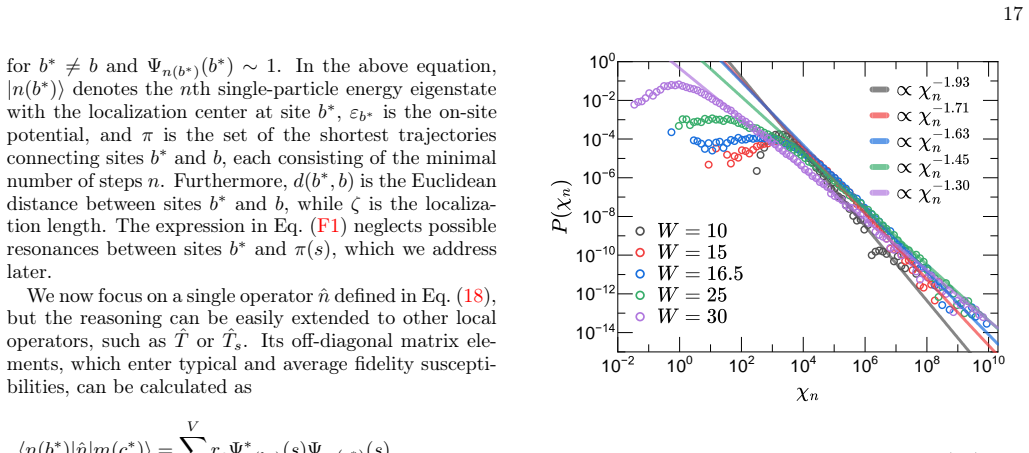
Fidelity susceptibility versus disorder strength W shows two peaks. The first signals the crossover at weak disorder from plane-wave states to single-particle quantum chaos and shifts toward W to 0 in the thermodynamic limit. The second emerges at the critical disorder strength of the Anderson localization transition to high numerical accuracy. Its divergence is submaximal and is tied to the fractal structure of eigenstates at criticality. Scaling of typical fidelity susceptibilities above the transition indicates two distinct regimes of nonergodic behavior.
What carries the argument
fidelity susceptibility, which quantifies the sensitivity of single-particle eigenstates to perturbations
Load-bearing premise
Finite-size effects together with the chosen frequency cutoff leave the apparent location of the second peak unshifted from the true thermodynamic critical disorder.
What would settle it
A computation on substantially larger lattices that places the second peak position systematically away from the independently established Anderson critical disorder value.
If this is right
- The first peak position approaches zero disorder in the infinite-volume limit.
- The first peak diverges maximally, scaling as the square of the inverse frequency cutoff.
- The second peak diverges submaximally because of the fractal eigenstates that appear at criticality.
- Two separate regimes of nonergodic behavior exist on the delocalized side of the Anderson transition.
Where Pith is reading between the lines
- Fidelity susceptibility could locate localization transitions in other disordered single-particle models without direct inspection of wave-function support.
- Submaximal divergence at a critical point may serve as a diagnostic for multifractal states in a wider class of disordered systems.
- The reported distinction between two nonergodic regimes could be tested by comparing eigenstate statistics or level-spacing distributions in the same parameter window.
Editorial analysis
A structured set of objections, weighed in public.
Referee Report
Summary. The manuscript investigates the fidelity susceptibility in the three-dimensional Anderson model as a function of disorder strength W. It reports two peaks: the first at weak disorder, interpreted as a crossover from plane-wave states to single-particle quantum chaos and shifting to W=0 in the thermodynamic limit; the second coinciding with the Anderson localization critical point W_c to high numerical accuracy. The first peak's divergence with frequency cutoff is maximal (scaling as 1/ω²), while the second is submaximal and linked to the fractal structure of critical eigenstates. Two scenarios for the peaks are discussed, and scaling of typical fidelity susceptibilities above the transition indicates two distinct nonergodic regimes.
Significance. If the numerical identification of the second peak holds, the work provides a new diagnostic for the Anderson transition via eigenstate sensitivity to perturbations and connects the suppressed divergence to multifractality at criticality. The distinction between maximal and submaximal divergences, together with evidence for two nonergodic regimes, would be of interest to the disordered-systems community if supported by detailed finite-size analysis.
major comments (2)
- [Abstract] Abstract: the central claim that the second peak coincides with the Anderson critical disorder 'to high numerical accuracy' is load-bearing but rests on an unshown finite-size extrapolation. No system sizes L, number of disorder realizations, error bars on peak locations, or extrapolation form (e.g., |W_peak(L) - W_c| scaling) are supplied, leaving open whether finite-size shifts or the frequency cutoff u move the apparent maximum away from the thermodynamic W_c.
- [Numerical results (assumed §4)] The protocol used to locate the second peak (direct maximum versus fit, choice of frequency cutoff) and the quantitative comparison to independently known W_c values must be specified; without this the identification cannot be assessed independently of the data used to define the peak.
minor comments (1)
- [Abstract] Abstract: the phrase 'high numerical accuracy' is used without a quantitative measure (e.g., relative error or number of decades in L); a brief parenthetical statement would improve clarity.
Simulated Author's Rebuttal
We thank the referee for the careful reading and constructive comments. We address the two major points below and will revise the manuscript accordingly to include the requested details on finite-size analysis and numerical protocols.
read point-by-point responses
-
Referee: [Abstract] Abstract: the central claim that the second peak coincides with the Anderson critical disorder 'to high numerical accuracy' is load-bearing but rests on an unshown finite-size extrapolation. No system sizes L, number of disorder realizations, error bars on peak locations, or extrapolation form (e.g., |W_peak(L) - W_c| scaling) are supplied, leaving open whether finite-size shifts or the frequency cutoff u move the apparent maximum away from the thermodynamic W_c.
Authors: We agree that the supporting finite-size data and extrapolation were not presented with sufficient detail. In the revised manuscript we will add the system sizes L employed, the number of disorder realizations per size, error bars on the extracted peak locations, and the explicit extrapolation form (including any scaling of |W_peak(L) - W_c|) that demonstrates convergence to the accepted thermodynamic W_c. This will allow the reader to assess the robustness of the identification independently of the frequency cutoff. revision: yes
-
Referee: [Numerical results (assumed §4)] The protocol used to locate the second peak (direct maximum versus fit, choice of frequency cutoff) and the quantitative comparison to independently known W_c values must be specified; without this the identification cannot be assessed independently of the data used to define the peak.
Authors: We concur that the precise numerical protocol must be stated explicitly. The revised manuscript will describe whether the peak position is obtained from a direct maximum search or from a fit, the concrete value(s) of the frequency cutoff u employed, and a direct quantitative comparison of the extrapolated peak location against independently established literature values of W_c. These additions will make the identification reproducible and verifiable. revision: yes
Circularity Check
No circularity: numerical peaks identified against external Anderson critical point
full rationale
The paper reports direct numerical computation of fidelity susceptibility in the 3D Anderson model, finding two peaks as a function of disorder W. The second peak is stated to coincide with the known Anderson localization critical disorder to high numerical accuracy. No equations, fitted parameters, or self-citations are shown that reduce this identification to a quantity defined by the same data or by prior work of the authors; the result rests on independent numerical evaluation against the externally established W_c. The derivation chain is therefore self-contained and does not exhibit any of the enumerated circularity patterns.
Axiom & Free-Parameter Ledger
axioms (2)
- domain assumption Fidelity susceptibility is a well-defined linear-response quantity that quantifies eigenstate sensitivity to perturbations
- domain assumption The Anderson localization transition occurs at a known critical disorder strength W_c in 3D
read the original abstract
We investigate the fidelity susceptibility, which quantifies the sensitivity of single-particle eigenstates to perturbations, in the three-dimensional Anderson model. As a function of disorder strength $W$, it exhibits two distinct peaks. The first peak signals a crossover at weak disorder strength from plane-wave states to single-particle quantum chaos, and its position shifts toward $W\to 0$ in the thermodynamic limit. The second peak emerges, to high numerical accuracy, at the critical disorder strength associated with the Anderson localization transition. We further show that the divergence of the first peak is maximal, scaling as the square of the inverse frequency cutoff, whereas the divergence of the second peak is submaximal. We relate the latter suppression to the fractal structure of single-particle eigenstates at criticality. We discuss two distinct scenarios that give rise to the peaks in the fidelity susceptibilities. Moreover, studying the scaling of typical fidelity susceptibilities above the Anderson transition, we find evidence of two distinct regimes of nonergodic behavior.
Figures



Reference graph
Works this paper leans on
-
[1]
fidelity suscep- tibilities
In this section, we focus ex- clusively on the rescaled quantities and therefore refer to ˜χtyp and˜χr typ/av from Eq. (19) simply as “fidelity suscep- tibilities”. In contrast, we invoke the unscaled quantities to study the localized phase in Sec. IV. We parametrize ˜χr typ/av ∝µ −a, wherea= 1−¯ain Eq. (14). Weplottheunregularizedtypicalfidelitysusceptib...
-
[2]
All results were established from second-order polynomial fits to numerical results from Fig
(b)˜χr typ evaluated atW ∗ 1 and plotted againstµ−1. All results were established from second-order polynomial fits to numerical results from Fig. 1(b). Lines in (a) and (b) are least-squares fits ofcxandbx a toV≥18 3, respectively. We obtainc≈41anda≈0.98. from the discussion of the weak-disorder crossover. As expected, the peak of˜χ r typ for ˆTs, which ...
-
[3]
(d)˜χr typ evaluated atW ∗ 2 and plotted versusµ −1
(b)˜χ typ evaluated at W ∗ 2 and plotted versusω −1 typ. (d)˜χr typ evaluated atW ∗ 2 and plotted versusµ −1. Lines in panels (a,c) and (d) are least- squares fits ofdx+candbx a, respectively. These fits are performed forV≥18 3 [with the exception ofˆnin panels (a,b), whereV≥30 3 is considered]. For ˆTs, ˆT ,ˆn, we obtain c= 16.42,16.45,16.48in (a),c= 16....
-
[4]
Conversely, in the lo- calized regime, the results indicate that the ratio remains different from unity even for large frequency cutoffs, i.e., µ≫ω typ. This observation suggests that the lack of self averaging of the spectral functions (and so the fi- delity susceptibilities) is not only related to the lowest frequency scales associated withωtyp. The dif...
-
[5]
9.log[χ r typ]plotted versus (a,b)Wand (c)log 10 µ
Perturbation theory To quantify the effects of resonances on the typical fi- delity susceptibility, we compare numerical results with perturbation theory, which is expected to be valid at 11 20 33 55 90 W 0 5 10log[χr typ] (a) ˆTs, µ = 0 L = 20 L = 24 L = 28 L = 32 L = 36 20 33 55 90 W −2 −1 0 1 log[χr typ] (b) ˆTs, µ = 10 −1 −5 −4 −3 −2 −1 log10 µ 2 4 6 ...
-
[6]
In this case,χ r typ is ex- pectedtobecomeµ-independentatsmallµ, whichinturn implies that˜χr typ =µχ r typ vanishes atµ→0. This occurs because the single-particle orbitals are strongly localized around individual sites, and resonances atEn ≈E m are very rare, so they do not contribute significantly to the typical fidelity susceptibility. Onecansupportthis...
-
[7]
For this reason, we determine W ∗ 3 from the crossing points of˜χr typ (again rescaled) for neighboringµ, which are equally spaced in the logarith- mic scale
Finite-size scaling ofW ∗ 3 Finally, we investigate whether the described crossover atW ∗ 3 shifts towardW ∗ 2, saturates at a value greater thanW ∗ 2, or diverges toward infinite disorder strength in the thermodynamic limit. For this reason, we determine W ∗ 3 from the crossing points of˜χr typ (again rescaled) for neighboringµ, which are equally spaced ...
-
[8]
10(b), and it appears to closely follow max(W ∗ 3 ) =a 1 +b 1L−1 witha 1 ≈27.92
The latter is plotted againstL−1 in the inset of Fig. 10(b), and it appears to closely follow max(W ∗ 3 ) =a 1 +b 1L−1 witha 1 ≈27.92. V. CONCLUSIONS In this work, we studied the behavior of fidelity suscep- tibilities as the system evolves through the chaotic and non-chaotic regimes of the 3D Anderson model. This model hosts the crossover at weak disorde...
-
[9]
In particular, we find evidence of two dis- tinct regimes of nonergodic behavior within the localized phase, and the crossover between them, emerging at the disorder strengthW ∗ 3 > W ∗ 2, is defined by the scale in- variant point of˜χr typ. These two regimes may be referred to as a trivial insulator [atW > W ∗ 3] and a nontrivial Anderson insulator [atW ...
-
[10]
However, for certain system sizes, the slope of its left shoulder changes abruptly
Without this term, the peak is still visible. However, for certain system sizes, the slope of its left shoulder changes abruptly. These are the same system sizes for which the average gap ratio saturates at a different value in the zero-disorder limit, see Fig. 13 in App. E. 15 1 0/s8722 /s521 0/s8722 /s501 00 1 02 0 .40 .51 0/s8722 /s511 0/s8722 /s491 01...
-
[11]
Otherwise, level repulsion would be observed
We note that such reso- nances are rare deep in the localized regime and occur ford(b ∗, c∗)∼L. Otherwise, level repulsion would be observed. The off-diagonal matrix element of interest is given by ⟨+|ˆn|−⟩= VX s=1 rs 2 |Ψn(b∗)(s)|2 +|Ψ m(c∗)(s)|2 ∼ rb∗ +r c∗ 2 , (F4) 1 0/s8722 /s501 00 1 02 1 04 1 06 1 08 1 01 010/s8722 /s49/s5210/s8722 /s49/s5010/s8722 ...
-
[12]
J. M. Deutsch, Quantum statistical mechanics in a closed system, Phys. Rev. A43, 2046 (1991)
2046
-
[13]
Srednicki, Chaos and quantum thermalization, Phys
M. Srednicki, Chaos and quantum thermalization, Phys. Rev. E50, 888 (1994)
1994
-
[14]
Rigol, V
M. Rigol, V. Dunjko, and M. Olshanii, Thermalization and its mechanism for generic isolated quantum systems, Nature452, 854 (2008)
2008
-
[15]
D’Alessio, Y
L. D’Alessio, Y. Kafri, A. Polkovnikov, and M. Rigol, From quantum chaos and eigenstate thermalization to statistical mechanics and thermodynamics, Adv. Phys. 65, 239 (2016)
2016
-
[16]
T. Mori, T. N. Ikeda, E. Kaminishi, and M. Ueda, Ther- malization and prethermalization in isolated quantum systems: a theoretical overview, J. Phys. B: At. Mol. Opt. Phys.51, 112001 (2018)
2018
-
[17]
J. M. Deutsch, Eigenstate thermalization hypothesis, Rep. Prog. Phys.81, 082001 (2018)
2018
-
[18]
Pandey, P
M. Pandey, P. W. Claeys, D. K. Campbell, A. Polkovnikov, and D. Sels, Adiabatic eigenstate deformations as a sensitive probe for quantum chaos, Phys. Rev. X10, 041017 (2020)
2020
-
[19]
Kolodrubetz, D
M. Kolodrubetz, D. Sels, P. Mehta, and A. Polkovnikov, Geometry and non-adiabatic response in quantum and classical systems, Physics Reports697, 1–87 (2017)
2017
-
[20]
Kim and A
H. Kim and A. Polkovnikov, Integrability as an attractor ofadiabaticflows, PhysicalReviewB109, 195162(2024)
2024
-
[21]
Sels and A
D. Sels and A. Polkovnikov, Dynamical obstruction to localization in a disordered spin chain, Phys. Rev. E104, 054105 (2021)
2021
-
[22]
LeBlond, D
T. LeBlond, D. Sels, A. Polkovnikov, and M. Rigol, Uni- versality in the onset of quantum chaos in many-body systems, Phys. Rev. B104, L201117 (2021)
2021
-
[23]
P.Orlov, A.Tiutiakina, R.Sharipov, E.Petrova, V.Grit- sev, and D. V. Kurlov, Adiabatic eigenstate deformations and weak integrability breaking of Heisenberg chain, Phys. Rev. B107, 184312 (2023)
2023
-
[24]
Pozsgay, R
B. Pozsgay, R. Sharipov, A. Tiutiakina, and I. Vona, Adi- abatic gauge potential and integrability breaking with free fermions, SciPost Physics17, 075 (2024)
2024
-
[25]
Abdelshafy, R
M. Abdelshafy, R. Mondaini, and M. Rigol, Onset of quantumchaosandergodicityinspinsystemswithhighly degenerate hilbert spaces, Phys. Rev. B112, L161108 (2025)
2025
-
[26]
Maksymov, P
A. Maksymov, P. Sierant, and J. Zakrzewski, Energy level dynamics across the many-body localization tran- sition, Phys. Rev. B99, 224202 (2019)
2019
-
[27]
M. A. Skvortsov, M. Amini, and V. E. Kravtsov, Sen- sitivity of (multi)fractal eigenstates to a perturbation of 19 the hamiltonian, Physical Review B106, 054208 (2022)
2022
-
[28]
Świ¸ etek, P
R. Świ¸ etek, P. Łydżba, and L. Vidmar, Fading ergodicity meets maximal chaos, Phys. Rev. B111, 184203 (2025)
2025
-
[29]
Bhattacharjee, S
S. Bhattacharjee, S. Bandyopadhyay, and A. Polkovnikov, Sharp detection of the onset of floquet heating using eigenstate sensitivity, The European Physical Journal B97, 151 (2024)
2024
-
[30]
Lisiecki, J
M. Lisiecki, J. Bonča, M. Mierzejewski, J. Herbrych, and P. Łydżba, Tunable hilbert space fragmentation and ex- tended critical regime, Phys. Rev. B112, 195116 (2025)
2025
-
[31]
H. Kim, C. Lim, K. Matirko, A. Polkovnikov, and M. O. Flynn, Definingclassicalandquantumchaosthroughadi- abatic transformations, Journal of Physics A: Mathemat- ical and Theoretical59, 075702 (2026)
2026
-
[32]
Šuntajs and L
J. Šuntajs and L. Vidmar, Ergodicity Breaking Transi- tion in Zero Dimensions, Phys. Rev. Lett.129, 060602 (2022)
2022
-
[33]
Świętek, M
R. Świętek, M. Hopjan, C. Vanoni, A. Scardicchio, and L. Vidmar, Scaling Theory of Fading Ergodicity, Phys. Rev. Lett.135, 170401 (2025)
2025
-
[34]
Rev.109, 1492 (1958)
P.W.Anderson, AbsenceofDiffusioninCertainRandom Lattices, Phys. Rev.109, 1492 (1958)
1958
-
[35]
Evers and A
F. Evers and A. D. Mirlin, Anderson transitions, Rev. Mod. Phys.80, 1355 (2008)
2008
-
[36]
Šuntajs, T.Prosen, and L.Vidmar, Spectral properties of three-dimensional Anderson model, Annals of Physics 435, 168469 (2021)
J. Šuntajs, T.Prosen, and L.Vidmar, Spectral properties of three-dimensional Anderson model, Annals of Physics 435, 168469 (2021)
2021
-
[37]
Ohtsuki and T
T. Ohtsuki and T. Kawarabayashi, Anomalous Diffusion at the Anderson Transitions, Journal of the Physical So- ciety of Japan66, 314–317 (1997)
1997
-
[38]
P.Sierant, D.Delande, andJ.Zakrzewski, ThoulessTime Analysis of Anderson and Many-Body Localization Tran- sitions, Physical Review Letters124, 186601 (2020)
2020
-
[39]
Hopjan and L
M. Hopjan and L. Vidmar, Critical Dynamics in Short- Range Quadratic Hamiltonians, Phys. Rev. Lett.135, 060401 (2025)
2025
-
[40]
D. A. Parshin and H. R. Schober, Distribution of fractal dimensions at the Anderson transition, Phys. Rev. Lett. 83, 4590 (1999)
1999
-
[41]
A.Rodriguez, L.J.Vasquez, andR.A.Römer, Multifrac- tal analysis with the probability density function at the three-dimensional anderson transition, Phys. Rev. Lett. 102, 106406 (2009)
2009
-
[42]
Rodriguez, L
A. Rodriguez, L. J. Vasquez, K. Slevin, and R. A. Römer, Critical parameters from a generalized multifractal anal- ysis at the anderson transition, Phys. Rev. Lett.105, 046403 (2010)
2010
-
[43]
Hopjan and L
M. Hopjan and L. Vidmar, Scale-invariant survival prob- ability at eigenstate transitions, Phys. Rev. Lett.131, 060404 (2023)
2023
-
[44]
Jiricek, M
S. Jiricek, M. Hopjan, V. Kravtsov, B. Altshuler, and L. Vidmar, Universal relation between spectral and wave- function properties at criticality, Proc. Natl. Acad. Sci. U.S.A123, e2518027123 (2026)
2026
-
[45]
Kliczkowski, R
M. Kliczkowski, R. Świętek, M. Hopjan, and L. Vidmar, Fading ergodicity, Phys. Rev. B110, 134206 (2024)
2024
-
[46]
Zanardi and N
P. Zanardi and N. Paunković, Ground state overlap and quantum phase transitions, Physical Review E74, 031123 (2006)
2006
-
[47]
You, Y.-W
W.-L. You, Y.-W. Li, and S.-J. Gu, Fidelity, dynamic structure factor, andsusceptibilityin criticalphenomena, Phys. Rev. E76, 022101 (2007)
2007
-
[48]
Buonsante and A
P. Buonsante and A. Vezzani, Ground-state fidelity and bipartite entanglement in the Bose-Hubbard model, Phys. Rev. Lett.98, 110601 (2007)
2007
-
[49]
S. Chen, L. Wang, Y. Hao, and Y. Wang, Intrinsic re- lation between ground-state fidelity and the characteri- zation of a quantum phase transition, Phys. Rev. A77, 032111 (2008)
2008
-
[50]
Schwandt, F
D. Schwandt, F. Alet, and S. Capponi, Quantum Monte Carlo simulations of fidelity at magnetic quantum phase transitions, Phys. Rev. Lett.103, 170501 (2009)
2009
-
[51]
Wang, Y.-H
L. Wang, Y.-H. Liu, J. Imriška, P. N. Ma, and M. Troyer, Fidelity susceptibility made simple: A unified quantum Monte Carlo approach, Phys. Rev. X5, 031007 (2015)
2015
-
[52]
Łącki, B
M. Łącki, B. Damski, and J. Zakrzewski, Numerical stud- ies of ground-state fidelity of the Bose-Hubbard model, Phys. Rev. A89, 033625 (2014)
2014
-
[53]
Sierant, A
P. Sierant, A. Maksymov, M. Kuś, and J. Zakrzewski, Fidelity susceptibility in Gaussian random ensembles, Physical Review E99, 050102(R) (2019)
2019
-
[54]
Łydżba, Y
P. Łydżba, Y. Zhang, M. Rigol, and L. Vidmar, Single- particle eigenstate thermalization in quantum-chaotic quadratic Hamiltonians, Phys. Rev. B104, 214203 (2021)
2021
-
[55]
Ulčakar and L
I. Ulčakar and L. Vidmar, Tight-binding billiards, Phys- ical Review E106, 034118 (2022)
2022
-
[56]
Tokarczyk, L
P. Tokarczyk, L. Vidmar, and P. Łydżba, Single- quasiparticle eigenstate thermalization, Phys. Rev. E 109, 024102 (2024)
2024
-
[57]
Karve, N
N. Karve, N. Rose, and D. Campbell, Adiabatic gauge potentialasatoolfordetectingchaosinclassicalsystems, Physical Review Research7, 033006 (2025)
2025
-
[59]
R. Świętek, M. Kliczkowski, M. Hopjan, and L. Vidmar, Fading ergodicity and quantum dynamics in random ma- trix ensembles, arXiv:2603.23616
- [60]
-
[61]
P. C. Hohenberg and B. I. Halperin, Theory of dynamic critical phenomena, Reviews of Modern Physics49, 435 (1977)
1977
-
[62]
Paladino, Y
E. Paladino, Y. M. Galperin, G. Falci, and B. L. Alt- shuler, 1/f noise: implications for solid–state quantum information, Reviews of Modern Physics86, 361 (2014)
2014
-
[63]
B. I. Shklovskii, B. Shapiro, B. R. Sears, P. Lambrian- ides, and H. B. Shore, Statistics of spectra of disordered systems near the metal-insulator transition, Phys. Rev. B47, 11487 (1993)
1993
-
[64]
Mirlin, Statistics of energy levels and eigenfunctions in disordered systems, Physics Reports326, 259–382 (2000)
A. Mirlin, Statistics of energy levels and eigenfunctions in disordered systems, Physics Reports326, 259–382 (2000)
2000
-
[65]
Łydżba, M
P. Łydżba, M. Rigol, and L. Vidmar, Entanglement in many-body eigenstates of quantum-chaotic quadratic hamiltonians, Phys. Rev. B103, 104206 (2021)
2021
-
[66]
Slevin and T
K. Slevin and T. Ohtsuki, Critical Exponent of the An- dersonTransitionUsingMassivelyParallelSupercomput- ing, Journal of the Physical Society of Japan87, 094703 (2018)
2018
-
[67]
Schubert, A
G. Schubert, A. Weiße, G. Wellein, and H. Fehske, HQS@HPC: Comparative numerical study of Anderson localisation in disordered electron systems,High Perfor- mance Computing in Science and Engineering, Garching, 237–249 (Springer-Verlag, 2004)
2004
-
[68]
Slevin and T
K. Slevin and T. Ohtsuki, Critical exponent for the An- derson transition in the three-dimensional orthogonal 20 universality class, New Journal of Physics16, 015012 (2014)
2014
-
[69]
Lemarié, H
G. Lemarié, H. Lignier, D. Delande, P. Szriftgiser, and J. C. Garreau, Critical State of the Anderson Transition: Between a Metal and an Insulator, Phys. Rev. Lett.105, 090601 (2010)
2010
-
[70]
Łydżba, R
P. Łydżba, R. Świętek, M. Mierzejewski, M. Rigol, and L. Vidmar, Normal weak eigenstate thermalization, Phys. Rev. B110, 104202 (2024)
2024
-
[71]
Jung and A
P. Jung and A. Rosch, Spin conductivity in almost inte- grable spin chains, Phys. Rev. B76, 245108 (2007)
2007
-
[72]
Mierzejewski, T
M. Mierzejewski, T. c. v. Prosen, and P. Prelovšek, Ap- proximate conservation laws in perturbed integrable lat- tice models, Phys. Rev. B92, 195121 (2015)
2015
-
[73]
Bertini, F
B. Bertini, F. H. L. Essler, S. Groha, and N. J. Robin- son, Prethermalization and thermalization in models with weak integrability breaking, Phys. Rev. Lett.115, 180601 (2015)
2015
-
[74]
Mallayya and M
K. Mallayya and M. Rigol, Quantum quenches and relax- ation dynamics in the thermodynamic limit, Phys. Rev. Lett.120, 070603 (2018)
2018
-
[75]
Mierzejewski, J
M. Mierzejewski, J. Pawłowski, P. Prelovsek, and J. Her- brych, MultiplerelaxationtimesinperturbedXXZchain, SciPost Physics13, 013 (2022)
2022
-
[76]
E. H. Lieb and D. W. Robinson, The finite group velocity of quantum spin systems, Communications in Mathemat- ical Physics28, 251 (1972)
1972
-
[77]
When definingˆni, we ensured that it is traceless and normalized within the single-particle sector of the Hilbert space [43]
-
[78]
J. T. Chalker and G. J. Daniell, Scaling, Diffusion, and the Integer Quantized Hall Effect, Phys. Rev. Lett.61, 593 (1988)
1988
-
[79]
Ketzmerick, G
R. Ketzmerick, G. Petschel, and T. Geisel, Slow decay of temporal correlations in quantum systems with Cantor spectra, Phys. Rev. Lett.69, 695 (1992)
1992
-
[80]
Huckestein and L
B. Huckestein and L. Schweitzer, Relation between the correlation dimensions of multifractal wave functions and spectralmeasuresinintegerquantumHallsystems, Phys. Rev. Lett.72, 713 (1994)
1994
-
[81]
Ketzmerick, K
R. Ketzmerick, K. Kruse, S. Kraut, and T. Geisel, What determines the spreading of a wave packet?, Phys. Rev. Lett.79, 1959 (1997)
1959
discussion (0)
Sign in with ORCID, Apple, or X to comment. Anyone can read and Pith papers without signing in.