Adversarial Water-Filling: Theory, Algorithms and Foundation Model
Pith reviewed 2026-06-29 23:31 UTC · model grok-4.3
The pith
Adversarial water-filling formulates competitive spectrum allocation as a minimax problem solved by a learned graph neural network with linear convergence.
A machine-rendered reading of the paper's core claim, the machinery that carries it, and where it could break.
Core claim
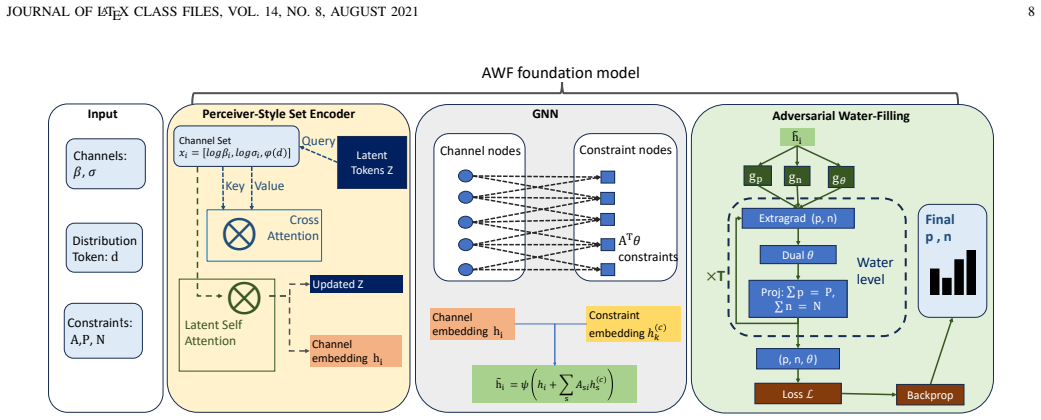
Under Gaussian channels AWF is strongly convex-concave on nondegenerate active channels while discrete constellations produce nonconvex mercury/water-filling problems; the proposed model encodes channels with permutation-invariant representations and a constraint-aware GNN with sparse message passing plus latent variables for the implied water level, then learns projected extragradient steps that approximate stationary solutions of the resulting constrained minimax problem, with local linear convergence guaranteed around regular stationary points when regularity and contractivity hold.
What carries the argument
The Adversarial Water-Filling (AWF) constrained minimax problem between power and interference, approximated via learned projected extragradient iterations inside a permutation-invariant graph neural network that carries global latent water-level variables.
If this is right
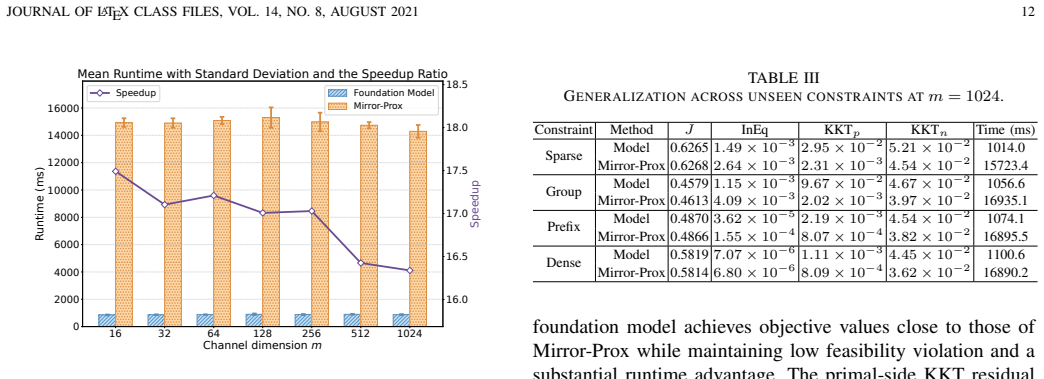
- The learned model generalizes empirically across unseen problem sizes, different constraints, and multiple discrete constellations.
- Runtime improves by more than one order of magnitude relative to iterative baselines.
- Stationary solutions of the constrained minimax problem are approximated by the learned dynamics.
Where Pith is reading between the lines
- The same learned-dynamics approach could be tested on time-varying interference scenarios that arise in actual LEO constellation handovers.
- Similar GNN architectures might be applied to other competitive allocation problems outside wireless spectrum, such as power markets with adversarial participants.
- The latent water-level variables could be inspected to derive new closed-form insights into the structure of AWF equilibria.
Load-bearing premise
Local regularity and contractivity conditions hold for the constrained minimax problem that arises under mercury/water-filling.
What would settle it
A numerical example in which the learned AWF dynamics diverge or converge sub-linearly at a regular stationary point while the regularity and contractivity conditions are satisfied would disprove the local linear convergence claim.
Figures
read the original abstract
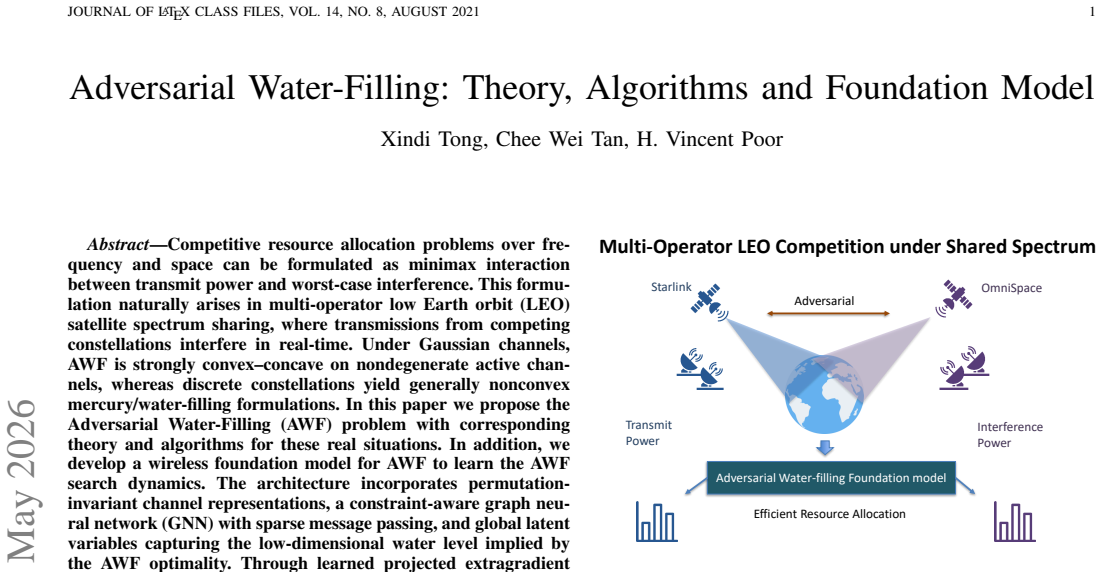
Competitive resource allocation problems over frequency and space can be formulated as minimax interaction between transmit power and worst-case interference. This formulation naturally arises in multi-operator low Earth orbit (LEO) satellite spectrum sharing, where transmissions from competing constellations interfere in real-time. Under Gaussian channels, AWF is strongly convex--concave on nondegenerate active channels, whereas discrete constellations yield generally nonconvex mercury/water-filling formulations. In this paper we propose the Adversarial Water-Filling (AWF) problem with corresponding theory and algorithms for these real situations. In addition, we develop a wireless foundation model for AWF to learn the AWF search dynamics. The architecture incorporates permutation-invariant channel representations, a constraint-aware graph neural network (GNN) with sparse message passing, and global latent variables capturing the low-dimensional water level implied by the AWF optimality. Through learned projected extragradient iterations, the model approximates stationary solutions of the constrained minimax problem arising under mercury/water-filling. We further show that, under local regularity and contractivity conditions, the learned AWF dynamics converge locally linearly around regular stationary points. Experiments demonstrate empirical generalization across unseen problem sizes, different constraints, and multiple discrete constellations, while achieving more than one-order-of-magnitude runtime improvements over iterative baselines. The related code can be found at https://github.com/convexsoft/AWF.
Editorial analysis
A structured set of objections, weighed in public.
Referee Report
Summary. The manuscript formulates competitive resource allocation in multi-operator LEO satellite spectrum sharing as the Adversarial Water-Filling (AWF) minimax problem. For Gaussian channels it is strongly convex-concave on nondegenerate active sets; for discrete constellations it yields generally nonconvex mercury/water-filling. The paper develops theory and algorithms together with a foundation model that uses permutation-invariant channel representations, a constraint-aware GNN with sparse message passing, and global latent variables to learn projected extragradient iterations approximating stationary solutions. It asserts that, under local regularity and contractivity conditions, the learned dynamics converge locally linearly around regular stationary points, and reports empirical generalization across problem sizes and constellations together with more than 10× runtime gains over iterative baselines.
Significance. If the local convergence guarantee can be shown to hold for the target nonconvex regime and the empirical generalization claims are placed on a statistically sound footing, the work would supply a practical route to equilibrium computation in constrained minimax wireless problems and demonstrate the viability of foundation-model approaches in information-theoretic resource allocation. The public code release is a clear strength.
major comments (2)
- [Abstract (convergence paragraph)] Abstract (convergence paragraph): the local-linear-convergence claim for the learned projected extragradient dynamics is conditioned on local regularity and contractivity, yet the manuscript supplies neither an explicit verification nor sufficient conditions that map the problem data (channel matrices, discrete alphabets, power/interference constraints) to the required Lipschitz or strong-convexity parameters for the generally nonconvex mercury/water-filling minimax; without this step the convergence statement remains conditional on an assumption whose satisfaction for the stated regime is not established.
- [Experiments section] Experiments section: the claims of generalization across unseen problem sizes, different constraints, and multiple discrete constellations, together with >10× runtime improvement, rest on reported numerical results, but the manuscript provides no dataset descriptions, number of Monte-Carlo trials, error bars, or statistical tests, rendering it impossible to assess whether the observed performance differences are reliable or merely anecdotal.
minor comments (2)
- The abstract states that 'the related code can be found at https://github.com/convexsoft/AWF' but does not indicate the license, commit hash, or instructions for reproducing the reported timing and generalization figures.
- Notation for the global latent variables that capture the low-dimensional water level is introduced without an explicit equation linking them to the KKT conditions of the AWF problem.
Simulated Author's Rebuttal
We thank the referee for the constructive feedback. We address the two major comments point by point below and will incorporate revisions to strengthen both the theoretical presentation and the experimental reporting.
read point-by-point responses
-
Referee: [Abstract (convergence paragraph)] Abstract (convergence paragraph): the local-linear-convergence claim for the learned projected extragradient dynamics is conditioned on local regularity and contractivity, yet the manuscript supplies neither an explicit verification nor sufficient conditions that map the problem data (channel matrices, discrete alphabets, power/interference constraints) to the required Lipschitz or strong-convexity parameters for the generally nonconvex mercury/water-filling minimax; without this step the convergence statement remains conditional on an assumption whose satisfaction for the stated regime is not established.
Authors: We agree that the local-linear convergence is presented under local regularity and contractivity conditions and that the manuscript does not supply explicit sufficient conditions mapping concrete problem data (channel matrices, alphabets, power/interference limits) to the required Lipschitz or strong-convexity moduli in the nonconvex mercury/water-filling setting. The core claim remains that the learned dynamics converge locally linearly around regular stationary points whenever those conditions hold; we do not assert unconditional convergence for arbitrary nonconvex instances. In the revision we will add a short subsection (and supporting references to standard results on variational inequalities) that states verifiable sufficient conditions on channel gains, minimum constellation separation, and constraint tightness under which the regularity assumptions are satisfied for both the Gaussian and discrete cases. This addition will make the scope of the guarantee more transparent without altering the stated theorem. revision: yes
-
Referee: [Experiments section] Experiments section: the claims of generalization across unseen problem sizes, different constraints, and multiple discrete constellations, together with >10× runtime improvement, rest on reported numerical results, but the manuscript provides no dataset descriptions, number of Monte-Carlo trials, error bars, or statistical tests, rendering it impossible to assess whether the observed performance differences are reliable or merely anecdotal.
Authors: The referee is correct that the current experimental section omits dataset generation details, the number of Monte-Carlo trials, error bars, and statistical tests, which prevents a rigorous assessment of the reported generalization and runtime gains. We will revise the Experiments section to include: (i) precise descriptions of the synthetic dataset construction, including the distributions and ranges used for channel matrices, power budgets, interference constraints, and constellation cardinalities; (ii) the exact number of independent Monte-Carlo trials performed for each configuration (e.g., 100 runs); (iii) error bars or standard deviations on all plotted metrics; and (iv) results of appropriate statistical tests (paired t-tests or Wilcoxon signed-rank tests) comparing the foundation model against the iterative baselines. These additions will place the empirical claims on a statistically sound footing. revision: yes
Circularity Check
No significant circularity detected
full rationale
The paper's central convergence claim is a conditional mathematical statement: under explicitly stated local regularity and contractivity conditions, the learned projected extragradient dynamics converge locally linearly. This does not reduce to its inputs by construction, nor does it rename a fitted quantity as a prediction, smuggle an ansatz via self-citation, or rely on a load-bearing self-citation chain. The model is trained on problem instances and the theorem is presented separately as an analysis under those assumptions; no equation or derivation in the abstract equates the claimed result to the training data or the assumptions themselves. The derivation chain is therefore self-contained as a conditional result, consistent with the default expectation that most papers exhibit no circularity.
Axiom & Free-Parameter Ledger
Reference graph
Works this paper leans on
-
[1]
On the road to 6G: Visions, requirements, key technologies, and testbeds,
C.-X. Wang, X. You, X. Gao, X. Zhu, Z. Li, C. Zhang, H. Wang, Y . Huang, Y . Chen, H. Haas, J. S. Thompson, E. G. Larsson, M. D. Renzo, W. Tong, P. Zhu, X. Shen, H. V . Poor, and L. Hanzo, “On the road to 6G: Visions, requirements, key technologies, and testbeds,”IEEE Communications Surveys & Tutorials, vol. 25, no. 2, pp. 905–974, 2023
2023
-
[2]
Dynamic task offloading and resource allocation for ultra-reliable low-latency edge computing,
C.-F. Liu, M. Bennis, M. Debbah, and H. V . Poor, “Dynamic task offloading and resource allocation for ultra-reliable low-latency edge computing,”IEEE Transactions on Communications, vol. 67, no. 6, pp. 4132–4150, 2019
2019
-
[3]
Adversarial machine learning threat analysis and remediation in open radio access network (O-RAN),
E. Habler, R. Bitton, D. Avraham, D. Mimran, E. Klevansky, O. Brodt, H. Lehmann, Y . Elovici, and A. Shabtai, “Adversarial machine learning threat analysis and remediation in open radio access network (O-RAN),”
-
[4]
Available: https://arxiv.org/abs/2201.06093
[Online]. Available: https://arxiv.org/abs/2201.06093
-
[5]
ColO- RAN: Developing machine learning-based xApps for open RAN closed- loop control on programmable experimental platforms,
M. Polese, L. Bonati, S. D’Oro, S. Basagni, and T. Melodia, “ColO- RAN: Developing machine learning-based xApps for open RAN closed- loop control on programmable experimental platforms,”IEEE Transac- tions on Mobile Computing, vol. 22, no. 10, pp. 5787–5800, Oct. 2023. JOURNAL OF LATEX CLASS FILES, VOL. 14, NO. 8, AUGUST 2021 13
2023
-
[6]
OrchestRAN: Network automation through orchestrated intelligence in the open RAN,
S. D’Oro, L. Bonati, M. Polese, and T. Melodia, “OrchestRAN: Network automation through orchestrated intelligence in the open RAN,” inPro- ceedings of the 2022 IEEE Conference on Computer Communications (INFOCOM), London, United Kingdom, 2022, pp. 270––279
2022
-
[7]
S. Chen, C. W. Tan, X. Zhai, and H. V . Poor, “OpenRANet: Neuralized spectrum access by joint subcarrier and power allocation with optimization-based deep learning,” 2025. [Online]. Available: https://arxiv.org/abs/2409.12964
-
[8]
Space exploration holdings, LLC request for deployment and operating authority for the spaceX Gen2 NGSO satellite system,
Federal Communications Commission, “Space exploration holdings, LLC request for deployment and operating authority for the spaceX Gen2 NGSO satellite system,” Order and Authorization, DA 24-1193, 2024, accessed: 2026-05-13. [Online]. Available: https://docs.fcc.gov/public/attachments/DA-24-1193A1.pdf
2024
-
[9]
Coded water-filling for multi-user interference cancellation,
Y . Li, Z. Ye, H. Zhang, J. Wang, J. Ma, and W. Tong, “Coded water-filling for multi-user interference cancellation,” 2024. [Online]. Available: https://arxiv.org/abs/2410.14136
-
[10]
A survey on nongeostationary satellite systems: The communication perspective,
H. Al-Hraishawi, H. Chougrani, S. Kisseleff, E. Lagunas, and S. Chatzinotas, “A survey on nongeostationary satellite systems: The communication perspective,”IEEE Communications Surveys & Tutori- als, vol. 25, no. 1, pp. 101–132, 2023
2023
-
[11]
Satellite-5G integration: A network perspective,
G. Giambene, S. Kota, and P. Pillai, “Satellite-5G integration: A network perspective,”IEEE Network, vol. 32, no. 5, pp. 25–31, 2018
2018
-
[12]
Exploring the
S. Kassing, D. Bhattacherjee, A. B. ´Aguas, J. E. Saethre, and A. Singla, “Exploring the ”Internet from space” with Hypatia,” inProceedings of the ACM Internet Measurement Conference, New York, NY , USA, 2020, p. 214–229
2020
-
[13]
An O-RAN approach to spectrum sharing between commercial 5G and government satellite systems,
R. Smith, C. Freeberg, T. Machacek, and V . Ramaswamy, “An O-RAN approach to spectrum sharing between commercial 5G and government satellite systems,” inProceedings of the 2021 IEEE Military Communi- cations Conference (MILCOM), San Diego, CA, USA, Nov. 2021, pp. 739–744
2021
-
[14]
R. G. Gallager,Information theory and reliable communication. Springer, 1968, vol. 588
1968
-
[15]
Optimum power allocation for parallel Gaussian channels with arbitrary input distributions,
A. Lozano, A. M. Tulino, and S. Verd ´u, “Optimum power allocation for parallel Gaussian channels with arbitrary input distributions,”IEEE Transactions on Information Theory, vol. 52, no. 7, pp. 3033–3051, 2006
2006
-
[16]
Practical algorithms for a family of waterfilling solutions,
D. P. Palomar and J. R. Fonollosa, “Practical algorithms for a family of waterfilling solutions,”IEEE Transactions on Signal Processing, vol. 53, no. 2, pp. 686–695, 2005
2005
-
[17]
New viewpoint and algorithms for water-filling solutions in wireless communications,
C. Xing, Y . Jing, S. Wang, S. Ma, and H. V . Poor, “New viewpoint and algorithms for water-filling solutions in wireless communications,” IEEE Transactions on Signal Processing, vol. 68, pp. 1618–1634, 2020
2020
-
[18]
Wireless max–min utility fairness with general monotonic constraints by Perron–Frobenius theory,
L. Zheng, Y .-W. P. Hong, C. W. Tan, C.-L. Hsieh, and C.-H. Lee, “Wireless max–min utility fairness with general monotonic constraints by Perron–Frobenius theory,”IEEE Transactions on Information Theory, vol. 62, no. 12, pp. 7283–7298, 2016
2016
-
[19]
A first-order primal-dual algorithm for convex problems with applications to imaging,
A. Chambolle and T. Pock, “A first-order primal-dual algorithm for convex problems with applications to imaging,”Journal of Mathematical Imaging and Vision, vol. 40, no. 1, pp. 120–145, May 2011
2011
-
[20]
Adaptive Primal-Dual Hybrid Gradient Methods for Saddle-Point Problems
T. Goldstein, M. Li, X. Yuan, E. Esser, and R. Baraniuk, “Adaptive primal-dual hybrid gradient methods for saddle-point problems,” 2015. [Online]. Available: https://arxiv.org/abs/1305.0546
work page internal anchor Pith review Pith/arXiv arXiv 2015
-
[21]
B. Yang and M. Johansson,Distributed Optimization and Games: A Tutorial Overview. London: Springer London, 2010, pp. 109–148. [Online]. Available: https://doi.org/10.1007/978-0-85729-033-5 4
-
[22]
Learning to optimize: Training deep neural networks for interference management,
H. Sun, X. Chen, Q. Shi, M. Hong, X. Fu, and N. D. Sidiropoulos, “Learning to optimize: Training deep neural networks for interference management,”IEEE Transactions on Signal Processing, vol. 66, no. 20, p. 5438–5453, Oct. 2018
2018
-
[23]
WirelessLLM: Empowering large language models towards wireless intelligence,
J. Shao, J. Tong, Q. Wu, W. Guo, Z. Li, Z. Lin, and J. Zhang, “WirelessLLM: Empowering large language models towards wireless intelligence,” 2024. [Online]. Available: https://arxiv.org/abs/2405.17053
-
[24]
Adversarial water-filling: Minimax resource allocation optimization with proximal decomposition in open ran,
X. Tong, C. W. Tan, and H. V . Poor, “Adversarial water-filling: Minimax resource allocation optimization with proximal decomposition in open ran,” inGLOBECOM 2025 - 2025 IEEE Global Communications Conference, 2025, pp. 3933–3938
2025
-
[25]
T. M. Cover,Elements of Information Theory. John Wiley & Sons, 1999
1999
-
[26]
Tse and P
D. Tse and P. Viswanath,Fundamentals of Wireless Communication. Cambridge university press, 2005
2005
-
[27]
Iterative water-filling for Gaus- sian vector multiple-access channels,
W. Yu, W. Rhee, S. Boyd, and J. Cioffi, “Iterative water-filling for Gaus- sian vector multiple-access channels,”IEEE Transactions on Information Theory, vol. 50, no. 1, pp. 145–152, 2004
2004
-
[28]
Dual methods for nonconvex spectrum optimization of multicarrier systems,
W. Yu and R. Lui, “Dual methods for nonconvex spectrum optimization of multicarrier systems,”IEEE Transactions on communications, vol. 54, no. 7, pp. 1310–1322, 2006
2006
-
[29]
Minimax and convex-concave games,
A. Ghosh and S. Boyd, “Minimax and convex-concave games,” 2003, EE392o Lecture course notes, Stanford University, Stanford, CA
2003
-
[30]
Max-min resource alloca- tion with application to anti-jamming,
A. Garnaev, W. Trappe, and H. Vincent Poor, “Max-min resource alloca- tion with application to anti-jamming,”IEEE Wireless Communications Letters, vol. 15, pp. 1405–1409, 2026
2026
-
[31]
An anti-jamming multiple access channel game using latency as metric,
A. Garnaev, A. Petropulu, W. Trappe, and H. V . Poor, “An anti-jamming multiple access channel game using latency as metric,”IEEE Wireless Communications Letters, vol. 11, no. 9, pp. 1800–1804, 2022
2022
-
[32]
Learning to continuously optimize wireless resource in a dynamic environment: A bilevel optimization perspective,
H. Sun, W. Pu, X. Fu, T.-H. Chang, and M. Hong, “Learning to continuously optimize wireless resource in a dynamic environment: A bilevel optimization perspective,”IEEE Transactions on Signal Process- ing, vol. 70, p. 1900–1917, 2022
1900
-
[33]
Multi-agent deep reinforcement learning for dynamic power allocation in wireless networks,
Y . S. Nasir and D. Guo, “Multi-agent deep reinforcement learning for dynamic power allocation in wireless networks,”IEEE Journal on Selected Areas in Communications, vol. 37, no. 10, p. 2239–2250, Oct. 2019
2019
-
[34]
Graph neural networks for scalable radio resource management: Architecture design and theoretical analysis,
Y . Shen, Y . Shi, J. Zhang, and K. B. Letaief, “Graph neural networks for scalable radio resource management: Architecture design and theoretical analysis,”IEEE Journal on Selected Areas in Communications, vol. 39, no. 1, pp. 101–115, 2021
2021
-
[35]
Knowledge-driven resource allocation for wireless networks: A WMMSE unrolled graph neural network ap- proach,
H. Yang, N. Cheng, R. Sun, W. Quan, R. Chai, K. Aldubaikhy, A. Alqasir, and X. Shen, “Knowledge-driven resource allocation for wireless networks: A WMMSE unrolled graph neural network ap- proach,”IEEE Internet of Things Journal, vol. 11, no. 10, pp. 18 902– 18 916, 2024
2024
-
[36]
M. Zaheer, S. Kottur, S. Ravanbakhsh, B. Poczos, R. Salakhutdinov, and A. Smola, “Deep sets,” 2018. [Online]. Available: https: //arxiv.org/abs/1703.06114
work page internal anchor Pith review Pith/arXiv arXiv 2018
-
[37]
Set transformer: A framework for attention-based permutation-invariant neu- ral networks,
J. Lee, Y . Lee, J. Kim, A. Kosiorek, S. Choi, and Y . W. Teh, “Set transformer: A framework for attention-based permutation-invariant neu- ral networks,” inProceedings of the 36th International Conference on Machine Learning, ser. Proceedings of Machine Learning Research, K. Chaudhuri and R. Salakhutdinov, Eds., vol. 97, 09–15 Jun 2019, pp. 3744–3753
2019
-
[38]
Perceiver: General perception with iterative attention,
A. Jaegle, F. Gimeno, A. Brock, O. Vinyals, A. Zisserman, and J. Carreira, “Perceiver: General perception with iterative attention,” in Proceedings of the 38th International Conference on Machine Learning, ser. Proceedings of Machine Learning Research, M. Meila and T. Zhang, Eds., vol. 139, 18–24 Jul 2021, pp. 4651–4664
2021
-
[39]
OpenRAN gym: AI/ML development, data collection, and testing for O-RAN on PAWR platforms,
L. Bonati, M. Polese, S. D’Oro, S. Basagni, and T. Melodia, “OpenRAN gym: AI/ML development, data collection, and testing for O-RAN on PAWR platforms,”Computer Networks, vol. 220, p. 109502, 2023
2023
-
[40]
Boyd and L
S. Boyd and L. Vandenberghe,Convex Optimization. Cambridge University Press, 2004
2004
-
[41]
Spectrum management in multiuser cognitive wireless networks: Optimality and algorithm,
C. W. Tan, S. Friedland, and S. H. Low, “Spectrum management in multiuser cognitive wireless networks: Optimality and algorithm,”IEEE Journal on Selected Areas in Communications, vol. 29, no. 2, pp. 421– 430, 2011
2011
-
[42]
Mutual information and minimum mean-square error in Gaussian channels,
D. Guo, S. Shamai, and S. Verd ´u, “Mutual information and minimum mean-square error in Gaussian channels,”IEEE Transactions on Infor- mation Theory, vol. 51, no. 4, pp. 1261–1282, 2005
2005
-
[43]
Proximal algorithms,
N. Parikh and S. Boyd, “Proximal algorithms,”Foundations and Trends® in Optimization, vol. 1, no. 3, pp. 127–239, 2014
2014
-
[44]
Prox-method with rate of convergence O(1/t) for variational inequalities with Lipschitz continuous monotone operators and smooth convex-concave saddle point problems,
A. Nemirovski, “Prox-method with rate of convergence O(1/t) for variational inequalities with Lipschitz continuous monotone operators and smooth convex-concave saddle point problems,”SIAM Journal on Optimization, vol. 15, no. 1, pp. 229–251, 2004
2004
discussion (0)
Sign in with ORCID, Apple, or X to comment. Anyone can read and Pith papers without signing in.