Trade-off Relation for Black Hole Entropy Fluctuations
Pith reviewed 2026-06-29 20:34 UTC · model grok-4.3
The pith
Black hole entropy fluctuations cannot be made arbitrarily small while recording relevant quantum information.
A machine-rendered reading of the paper's core claim, the machinery that carries it, and where it could break.
Core claim
Within stochastic semiclassical gravity, the entropy change of a black hole due to infalling photons that encode which-path information satisfies a trade-off relation between the stochastic variance of the entropy change and the photon number, implying that a horizon cannot record relevant quantum information with arbitrarily small entropy fluctuations.
What carries the argument
The trade-off relation between the stochastic variance of black hole entropy change and the number of infalling photons, derived in stochastic semiclassical gravity.
Load-bearing premise
Stochastic semiclassical gravity is sufficient to describe the black hole entropy response to quantum fluctuations of infalling matter.
What would settle it
A calculation within a more complete quantum gravity theory showing entropy variance smaller than the derived bound for a given photon number would falsify the trade-off.
Figures
read the original abstract
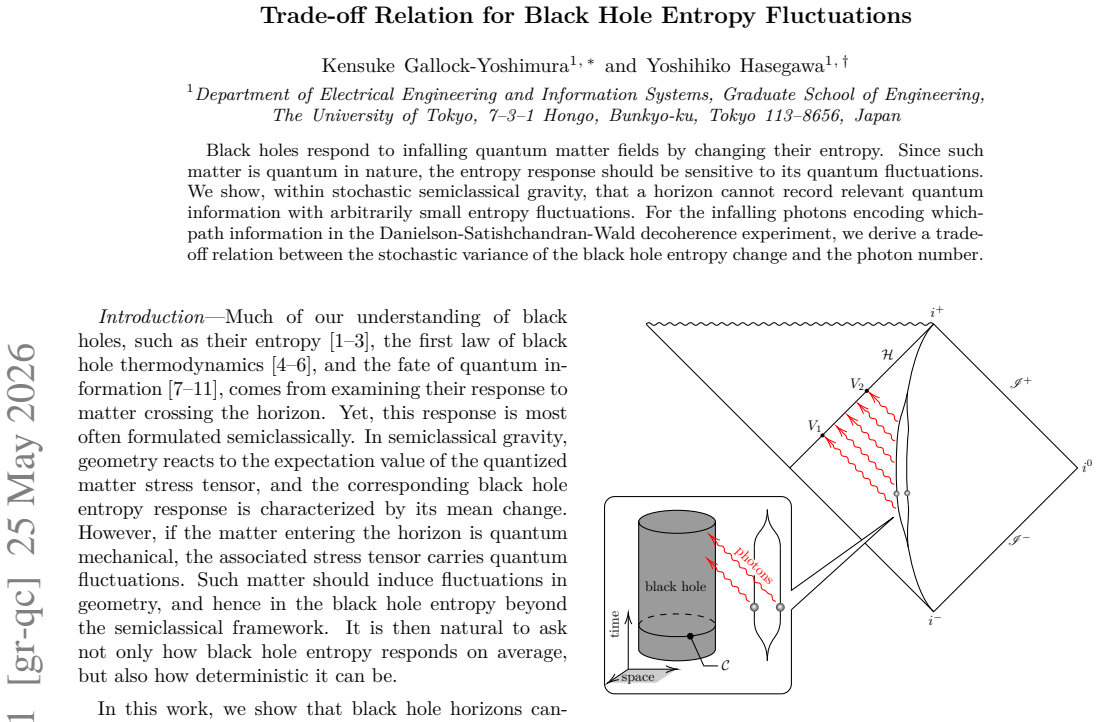
Black holes respond to infalling quantum matter fields by changing their entropy. Since such matter is quantum in nature, the entropy response should be sensitive to its quantum fluctuations. We show, within stochastic semiclassical gravity, that a horizon cannot record relevant quantum information with arbitrarily small entropy fluctuations. For the infalling photons encoding which-path information in the Danielson-Satishchandran-Wald decoherence experiment, we derive a trade-off relation between the stochastic variance of the black hole entropy change and the photon number.
Editorial analysis
A structured set of objections, weighed in public.
Referee Report
Summary. The paper claims that, within stochastic semiclassical gravity, black hole horizons cannot record relevant quantum information with arbitrarily small entropy fluctuations. For infalling photons in the Danielson-Satishchandran-Wald which-path decoherence experiment, it derives an explicit trade-off relating the stochastic variance of the black-hole entropy change to the photon number.
Significance. If the central derivation holds, the result supplies a concrete, quantitative bound on the precision of horizon information recording in an effective theory, with direct applicability to a specific decoherence protocol. The use of stochastic semiclassical gravity yields a falsifiable relation sourced by stress-tensor two-point functions, which is a methodological strength when the framework's regime is clearly delimited.
major comments (2)
- [§2 (framework) and §4 (derivation of the trade-off)] The load-bearing assumption that stochastic semiclassical gravity fully captures the horizon's entropy response to infalling quantum matter (including all relevant fluctuations) is not accompanied by error estimates or bounds on omitted higher-order quantum-gravitational corrections and possible non-local horizon-photon correlations. This directly affects whether the derived trade-off precludes arbitrarily small fluctuations.
- [§4] Eq. (trade-off relation, presumably in §4): the variance-photon number relation is obtained by treating metric fluctuations as classical noise; without a quantitative assessment of when this effective description remains faithful to the information-recording capacity, the claim that 'arbitrarily small entropy fluctuations' are impossible cannot be assessed as robust.
minor comments (2)
- [Introduction] Clarify the precise definition of 'relevant quantum information' and how it maps onto the which-path photons in the DSW setup.
- [Discussion] Add a short paragraph comparing the stochastic-semiclassical result to any existing bounds from other approaches (e.g., holographic or fully quantum-gravity treatments) to contextualize the approximation.
Simulated Author's Rebuttal
We thank the referee for the careful reading and constructive comments. Our results are derived strictly within the stochastic semiclassical gravity framework; we will revise the manuscript to more explicitly delimit the effective-theory regime and acknowledge the lack of quantitative bounds on corrections from full quantum gravity.
read point-by-point responses
-
Referee: [§2 (framework) and §4 (derivation of the trade-off)] The load-bearing assumption that stochastic semiclassical gravity fully captures the horizon's entropy response to infalling quantum matter (including all relevant fluctuations) is not accompanied by error estimates or bounds on omitted higher-order quantum-gravitational corrections and possible non-local horizon-photon correlations. This directly affects whether the derived trade-off precludes arbitrarily small fluctuations.
Authors: We agree that stochastic semiclassical gravity is an effective description and does not incorporate higher-order quantum-gravitational corrections or all possible non-local horizon-photon correlations. The trade-off is obtained within this framework from the noise kernel of the stress-tensor two-point function. We do not claim the result holds in a complete quantum gravity theory. In the revision we will expand §2 to state the effective nature of the approach and note that error estimates for omitted terms lie outside the present scope, as they would require a more fundamental calculation. revision: partial
-
Referee: [§4] Eq. (trade-off relation, presumably in §4): the variance-photon number relation is obtained by treating metric fluctuations as classical noise; without a quantitative assessment of when this effective description remains faithful to the information-recording capacity, the claim that 'arbitrarily small entropy fluctuations' are impossible cannot be assessed as robust.
Authors: Treating metric fluctuations as classical noise is intrinsic to the stochastic semiclassical formalism. The relation follows from the integrated noise kernel on the horizon. We will revise §4 to add an explicit statement that the result holds inside the validity domain of this effective theory and that a quantitative assessment of faithfulness to full quantum information recording would require physics beyond the semiclassical approximation, which is outside the paper's scope. The claim is therefore limited to the framework employed. revision: partial
- Quantitative bounds on higher-order quantum-gravitational corrections and the regime of faithfulness to full quantum information recording, both of which require a theory beyond stochastic semiclassical gravity.
Circularity Check
Derivation of trade-off is self-contained within stochastic semiclassical gravity framework
full rationale
The paper states it derives the trade-off relation inside the stochastic semiclassical gravity framework for the specific Danielson-Satishchandran-Wald setup. No quoted equations or self-citations in the abstract or description reduce the variance-photon number relation to a fitted input, self-definition, or prior author result by construction. The central claim follows from applying the framework's stress-tensor fluctuations to entropy response, which is an independent calculation rather than a renaming or tautology. This is the normal case of a paper whose math is self-contained against external benchmarks.
Axiom & Free-Parameter Ledger
Reference graph
Works this paper leans on
-
[1]
J. D. Bekenstein, Black holes and the second law, Lett. Nuovo Cimento4, 737 (1972)
1972
-
[2]
J. D. Bekenstein, Black Holes and Entropy, Phys. Rev. D7, 2333 (1973)
1973
-
[3]
J. D. Bekenstein, Generalized second law of thermo- dynamics in black-hole physics, Phys. Rev. D9, 3292 (1974)
1974
-
[4]
R. M. Wald,Quantum field theory in curved spacetime and black hole thermodynamics(University of Chicago Press, 1994)
1994
-
[5]
Physical process version
S. Gao and R. M. Wald, “Physical process version” of the first law and the generalized second law for charged and rotating black holes, Phys. Rev. D64, 084020 (2001)
2001
-
[6]
Hollands, R
S. Hollands, R. M. Wald, and V. G. Zhang, Entropy of dynamical black holes, Phys. Rev. D110, 024070 (2024)
2024
-
[7]
Dimensional Reduction in Quantum Gravity
G. ‘t Hooft, Dimensional reduction in quantum gravity, Conf. Proc. C930308, 284 (1993), arXiv:gr-qc/9310026
work page internal anchor Pith review Pith/arXiv arXiv 1993
-
[8]
Susskind, The world as a hologram, J
L. Susskind, The world as a hologram, J. Math. Phys. 36, 6377 (1995)
1995
-
[9]
Susskind, L
L. Susskind, L. Thorlacius, and J. Uglum, The stretched horizon and black hole complementarity, Phys. Rev. D 48, 3743 (1993)
1993
-
[10]
Hayden and J
P. Hayden and J. Preskill, Black holes as mirrors: quan- tum information in random subsystems, Journal of High Energy Physics09, 120 (2007)
2007
-
[11]
Almheiri, D
A. Almheiri, D. Marolf, J. Polchinski, and J. Sully, Black holes: complementarity or firewalls?, Journal of High En- ergy Physics02, 062 (2013)
2013
-
[12]
B. L. Hu and E. Verdaguer, Stochastic gravity: a primer with applications, Classical and Quantum Gravity20, R1 (2003)
2003
-
[13]
B. L. Hu and E. Verdaguer, Stochastic Gravity: Theory and Applications, Living Rev. Relativ.11, 3 (2008)
2008
-
[14]
D. L. Danielson, G. Satishchandran, and R. M. Wald, Black holes decohere quantum superpositions, Interna- tional Journal of Modern Physics D31, 2241003 (2022)
2022
-
[15]
D. L. Danielson, G. Satishchandran, and R. M. Wald, Killing horizons decohere quantum superpositions, Phys. Rev. D108, 025007 (2023)
2023
-
[16]
S. E. Gralla and H. Wei, Decoherence from horizons: General formulation and rotating black holes, Phys. Rev. D109, 065031 (2024)
2024
-
[17]
D. L. Danielson, G. Satishchandran, and R. M. Wald, Local description of decoherence of quantum superposi- tions by black holes and other bodies, Phys. Rev. D111, 6 025014 (2025)
2025
-
[18]
Li, Decoherence of quantum superpositions by Reissner-Nordström black holes, Phys
R. Li, Decoherence of quantum superpositions by Reissner-Nordström black holes, Phys. Rev. D111, 024040 (2025)
2025
-
[19]
D. L. Danielson, J. Kudler-Flam, G. Satishchandran, and R. M. Wald, How to minimize the decoherence caused by black holes, Phys. Rev. D112, 025012 (2025)
2025
-
[20]
Wilson-Gerow, A
J. Wilson-Gerow, A. Dugad, and Y. Chen, Decoherence by warm horizons, Phys. Rev. D110, 045002 (2024)
2024
-
[21]
Tjoa, Nonperturbative simple-generated interactions with a quantum field for arbitrary Gaussian states, Phys
E. Tjoa, Nonperturbative simple-generated interactions with a quantum field for arbitrary Gaussian states, Phys. Rev. D108, 045003 (2023)
2023
-
[22]
Blanes, F
S. Blanes, F. Casas, J. Oteo, and J. Ros, The Magnus expansion and some of its applications, Physics Reports 470, 151 (2009)
2009
-
[23]
A.G.S.Landulfo,Nonperturbativeapproachtorelativis- tic quantum communication channels, Phys. Rev. D93, 104019 (2016)
2016
-
[24]
Matsas, Uniformly accelerated classical sources as limits of Unruh-DeWitt detectors, Phys
G.Cozzella, S.A.Fulling, A.G.S.Landulfo,andG.E.A. Matsas, Uniformly accelerated classical sources as limits of Unruh-DeWitt detectors, Phys. Rev. D102, 105016 (2020)
2020
-
[25]
Gallock-Yoshimura, Y
K. Gallock-Yoshimura, Y. Osawa, and Y. Nambu, Acceleration-induced radiation from a qudit particle de- tector model, Phys. Rev. D111, 105012 (2025)
2025
-
[26]
A. C. Barato and U. Seifert, Thermodynamic Uncer- tainty Relation for Biomolecular Processes, Phys. Rev. Lett.114, 158101 (2015)
2015
-
[27]
T. R. Gingrich, J. M. Horowitz, N. Perunov, and J. L. England, Dissipation Bounds All Steady-State Current Fluctuations, Phys. Rev. Lett.116, 120601 (2016)
2016
-
[28]
Hasegawa, Quantum Thermodynamic Uncertainty Relation for Continuous Measurement, Phys
Y. Hasegawa, Quantum Thermodynamic Uncertainty Relation for Continuous Measurement, Phys. Rev. Lett. 125, 050601 (2020)
2020
-
[29]
Hasegawa, Thermodynamic Uncertainty Relation for General Open Quantum Systems, Phys
Y. Hasegawa, Thermodynamic Uncertainty Relation for General Open Quantum Systems, Phys. Rev. Lett.126, 010602 (2021)
2021
-
[30]
Iyer and R
V. Iyer and R. M. Wald, Some properties of the Noether charge and a proposal for dynamical black hole entropy, Phys. Rev. D50, 846 (1994)
1994
-
[31]
con- served quantities
R. M. Wald and A. Zoupas, General definition of “con- served quantities” in general relativity and other theories of gravity, Phys. Rev. D61, 084027 (2000)
2000
-
[32]
Hollands and R
S. Hollands and R. M. Wald, Stability of Black Holes and Black Branes, Communications in Mathematical Physics 321, 629–680 (2012)
2012
-
[33]
See Supplemental Material for details
-
[34]
Parikh and J
M. Parikh and J. Pereira, Quantum uncertainty in the area of a black hole, J. High Energy Phys.09(2025), 137
2025
-
[35]
Ciambelli, T
L. Ciambelli, T. He, and K. M. Zurek, Quantum area fluctuations from gravitational phase space, J. High En- ergy Phys.08(2025), 199
2025
-
[36]
R. D. Sorkin, How Wrinkled is the Surface of a Black Hole?, inProceedings of the First Australasian Confer- ence on General Relativity and Gravitation, edited by D. Wiltshire (University of Adelaide, 1996) pp. 163–174, arXiv:gr-qc/9701056
work page internal anchor Pith review Pith/arXiv arXiv 1996
-
[37]
Marolf, On the Quantum Width of a Black Hole Hori- zon, Springer Proc
D. Marolf, On the Quantum Width of a Black Hole Hori- zon, Springer Proc. Phys.98, 99 (2005)
2005
-
[38]
Bousso and G
R. Bousso and G. Penington, Islands far outside the hori- zon, Journal of High Energy Physics11, 164 (2024)
2024
-
[39]
Banks, P
T. Banks, P. Draper, and M. Karydas, Breakdown of field theory in near-horizon regions, Journal of High Energy Physics06, 153 (2024)
2024
-
[40]
Casher, F
A. Casher, F. Englert, N. Itzhaki, S. Massar, and R. Parentani, Black hole horizon fluctuations, Nuclear Physics B484, 419 (1997)
1997
-
[41]
B. L. Hu and A. Roura, Metric fluctuations of an evapo- rating black hole from backreaction of stress tensor fluc- tuations, Phys. Rev. D76, 124018 (2007)
2007
-
[42]
R. T. Thompson and L. H. Ford, Enhanced black hole horizon fluctuations, Phys. Rev. D78, 024014 (2008). END MA TTER Appendix: Derivation of Eq.(15)—We provide rele- vant calculations needed for deriving Eq. (15). From the commutation relation[ ˆϕ(f),ϕ(f′)] = iE(f,f ′)1, we obtain the relation[ ˆϕ(f),∇αˆϕ(x)] =−i∂α(Ef)1, where∇αis the covariant derivative ...
2008
discussion (0)
Sign in with ORCID, Apple, or X to comment. Anyone can read and Pith papers without signing in.