Dirac-Line Criticality and Emergent Horizons in Weyl Lifshitz Transitions
Pith reviewed 2026-06-29 20:52 UTC · model grok-4.3
The pith
The Lifshitz transition between type-I and type-II Weyl fermions behaves like a black hole horizon.
A machine-rendered reading of the paper's core claim, the machinery that carries it, and where it could break.
Core claim
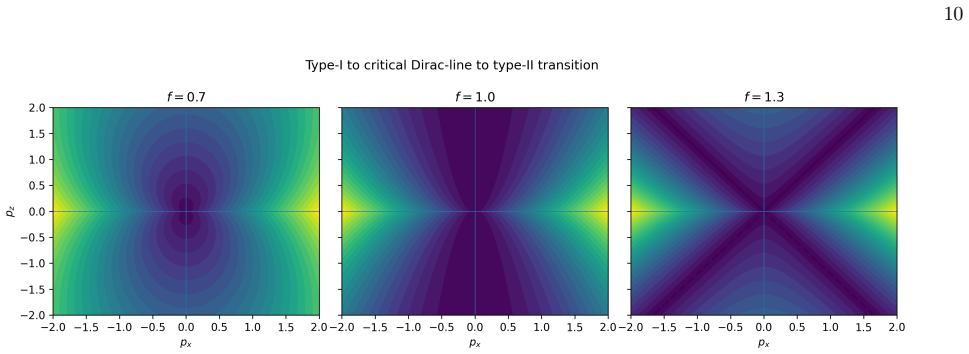
The transition state from type-I to type-II Dirac fermions can be viewed as a black-hole horizon using the Painlevé-Gullstrand metric. This horizon exhibits a Dirac-line Fermi surface with a nontrivial topological invariant and a critical chiral anomaly effect. The surface is equivalent to the interface separating type-I and type-II Weyl states, and the emergence of Hawking radiation in Weyl semimetals is discussed.
What carries the argument
The Painlevé-Gullstrand metric applied to the Lifshitz transition surface, which identifies it with a black hole horizon separating type-I from type-II Weyl fermions.
If this is right
- The Lifshitz transition surface carries symmetry-protected topological order.
- A Dirac-line Fermi surface with nontrivial topological invariant appears at the transition.
- A critical chiral anomaly effect occurs at this horizon-like surface.
- Hawking radiation may emerge in Weyl semimetals due to the analogy.
Where Pith is reading between the lines
- If the metric mapping is valid, condensed matter experiments could simulate aspects of black hole horizons.
- The topological invariant at the Dirac line might be measurable through transport or spectroscopy in real materials.
- Extensions could explore whether other gravitational analogies hold in Lifshitz transitions of different semimetals.
Load-bearing premise
The Painlevé-Gullstrand metric from general relativity can be directly applied to model the Lifshitz transition surface in Weyl semimetals as a black hole horizon.
What would settle it
An experimental measurement at the Lifshitz transition point that fails to detect a Dirac-line Fermi surface or shows no signature of the predicted chiral anomaly would undermine the horizon analogy.
Figures
read the original abstract
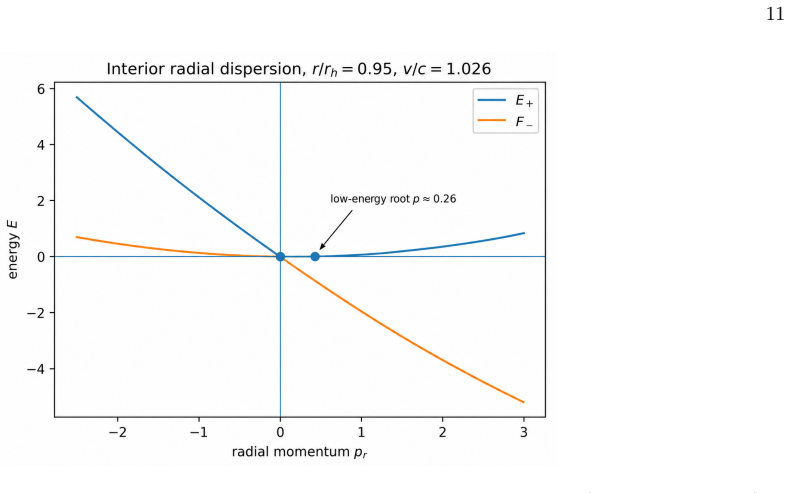
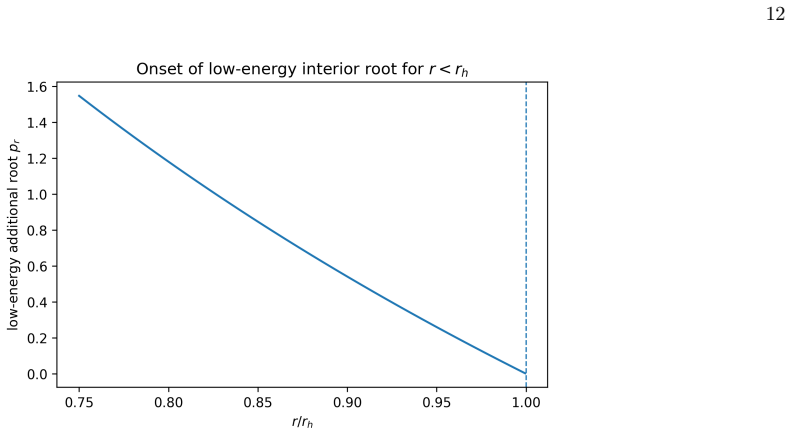
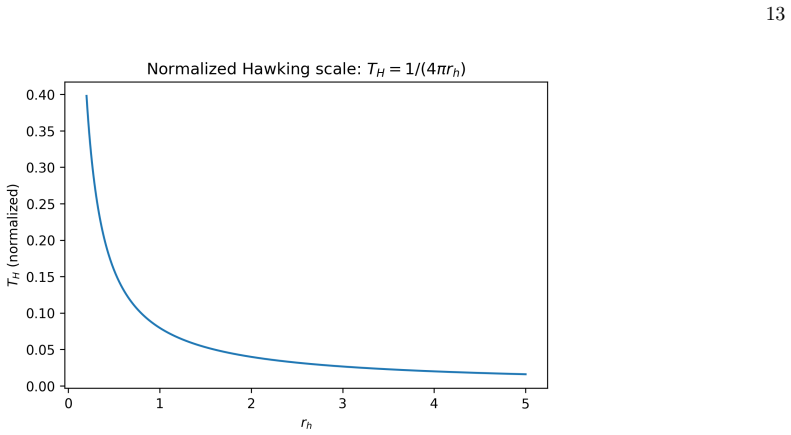
Type-II Weyl fermions may emerge behind the event horizon of black holes. We employ the Painlev\'e-Gullstrand metric to study the surface of the Lifshitz transition at the horizon, equivalent to the interface separating the type-I and type-II Weyl states. We find several analogies between the black hole horizon and the transformation of type-I to type-II Weyl fermions through the Dirac line. We analyze the symmetry-protected topological order at the Lifshitz transition originating in semimetals. The emergence of Hawking radiation in Weyl semimetals is discussed. We show that the transition state from type-I to type-II Dirac fermions can be viewed as a black-hole horizon, which exhibits unique characteristics, including a Dirac-line Fermi surface with a nontrivial topological invariant and a critical chiral anomaly effect.
Editorial analysis
A structured set of objections, weighed in public.
Referee Report
Summary. The manuscript claims that the Lifshitz transition surface separating type-I and type-II Weyl fermions can be identified with a black-hole horizon by direct use of the Painlevé-Gullstrand metric. At this critical surface a Dirac-line Fermi surface appears, carrying a nontrivial topological invariant protected by symmetry; the transition also hosts a critical chiral anomaly and permits an emergent Hawking radiation effect in the Weyl semimetal.
Significance. If the metric equivalence is rigorously derived from the microscopic Hamiltonian, the work would furnish a concrete condensed-matter platform for analog gravity, allowing laboratory study of horizon physics and Hawking radiation. The topological characterization of the Dirac line would further enrich the classification of Weyl semimetals. The significance is therefore conditional on the missing step that maps the tilted Dirac Hamiltonian onto an effective geometry whose null geodesics and causal structure reproduce the Painlevé-Gullstrand form.
major comments (2)
- [section introducing the Painlevé-Gullstrand mapping] The central equivalence between the Lifshitz transition and the black-hole horizon is introduced by invoking the Painlevé-Gullstrand metric, yet no derivation is supplied that begins with the tilted Weyl Hamiltonian, extracts the emergent quasiparticle metric, and verifies that its component structure, null geodesics, and causal structure coincide with the Painlevé-Gullstrand line element at the critical tilt. Because the subsequent statements on the Dirac-line topological invariant and the critical chiral anomaly are presented as consequences of this horizon analogy, the absence of the derivation renders those claims unsupported.
- [paragraphs discussing topological order and chiral anomaly] The assertion of a 'nontrivial topological invariant' for the Dirac-line Fermi surface is stated without an explicit calculation of the invariant (e.g., via Berry curvature integration or symmetry-indicator methods) evaluated on the critical surface. The same holds for the 'critical chiral anomaly effect'; no response-function or anomaly polynomial computation is indicated that would demonstrate criticality at the Lifshitz point.
minor comments (1)
- Notation for the tilt parameter and the Lifshitz critical value should be defined once and used consistently; the abstract and main text currently employ slightly different symbols for the same quantity.
Simulated Author's Rebuttal
We thank the referee for the thorough review and valuable comments, which help strengthen the manuscript. We agree that explicit derivations and calculations are needed to support the central claims and will revise the manuscript accordingly.
read point-by-point responses
-
Referee: [section introducing the Painlevé-Gullstrand mapping] The central equivalence between the Lifshitz transition and the black-hole horizon is introduced by invoking the Painlevé-Gullstrand metric, yet no derivation is supplied that begins with the tilted Weyl Hamiltonian, extracts the emergent quasiparticle metric, and verifies that its component structure, null geodesics, and causal structure coincide with the Painlevé-Gullstrand line element at the critical tilt. Because the subsequent statements on the Dirac-line topological invariant and the critical chiral anomaly are presented as consequences of this horizon analogy, the absence of the derivation renders those claims unsupported.
Authors: We acknowledge that the original manuscript invokes the Painlevé-Gullstrand metric without providing a self-contained derivation from the tilted Weyl Hamiltonian. In the revision we will add a dedicated subsection (or appendix) that starts from the microscopic Hamiltonian, derives the effective quasiparticle metric, and explicitly verifies that its components, null geodesics, and causal structure match the Painlevé-Gullstrand line element precisely at the critical tilt. This derivation will then underpin the subsequent statements on the Dirac line and critical anomaly. revision: yes
-
Referee: [paragraphs discussing topological order and chiral anomaly] The assertion of a 'nontrivial topological invariant' for the Dirac-line Fermi surface is stated without an explicit calculation of the invariant (e.g., via Berry curvature integration or symmetry-indicator methods) evaluated on the critical surface. The same holds for the 'critical chiral anomaly effect'; no response-function or anomaly polynomial computation is indicated that would demonstrate criticality at the Lifshitz point.
Authors: We agree that explicit computations are required. The revised manuscript will include (i) a direct evaluation of the topological invariant of the Dirac-line Fermi surface via Berry-curvature integration over a suitable surface enclosing the line, and (ii) a calculation of the chiral anomaly (via Kubo response or anomaly polynomial) that demonstrates its critical behavior exactly at the Lifshitz transition point. revision: yes
Circularity Check
No significant circularity; central analogy is an external mapping, not a self-referential reduction
full rationale
The provided abstract and skeptic summary show the paper adopts the Painlevé-Gullstrand metric to equate the Lifshitz transition surface with a black-hole horizon, then lists resulting analogies (Dirac-line Fermi surface, topological invariant, critical chiral anomaly). No quoted equation or step reduces a claimed prediction to a fitted input by construction, nor does any load-bearing premise collapse to a self-citation whose content is itself unverified. The mapping is presented as an employed tool rather than derived from the microscopic Hamiltonian within the paper, but this is an assumption imported from prior literature, not a circular redefinition or renaming of a known result inside the present work. The derivation chain therefore remains self-contained against external benchmarks (GR metrics, Weyl band topology) and receives the default non-finding.
Axiom & Free-Parameter Ledger
axioms (2)
- domain assumption Standard properties of type-I and type-II Weyl fermions and Lifshitz transitions in semimetals hold as background
- ad hoc to paper Painlevé-Gullstrand metric applies equivalently to the condensed-matter Lifshitz surface
Forward citations
Cited by 1 Pith paper
-
DC conductivity of tilted Dirac Fermions across the Lifshitz Transition: short- versus long-range impurities
Theoretical study finds impurity-dependent DC conductivity behaviors, including a dip for short-range and peak for long-range impurities at the Lifshitz transition, plus extreme anisotropy in the overcritical regime.
Reference graph
Works this paper leans on
-
[1]
Weyl, Elektron und gravitation, I
H. Weyl, Elektron und gravitation, I. Z. Phys. 56, 330 352 (1929)
1929
-
[2]
Nielsen, M
H.B. Nielsen, M. Ninomiya: Absence of neutrinos on a lattice. I - Proof by homotopy theory, Nucl. Phys. B 185, 20 (1981); Absence of neutrinos on a lattice. II - Intuitive homotopy proof, Nucl. Phys. B 193, 173 (1981)
1981
-
[3]
Volovik, The Universe in a Helium Droplet, Clarendon Press, Oxford (2003)
G.E. Volovik, The Universe in a Helium Droplet, Clarendon Press, Oxford (2003)
2003
-
[4]
von Neumann and E
J. von Neumann and E. Wigner, \"Uber das Verhalten von Eigenwerten bei adiabatischen Prozessen, Phys. Z. 30, 467 (1929)
1929
-
[5]
Novikov, Magnetic Bloch functions and vector bundles
S.P. Novikov, Magnetic Bloch functions and vector bundles. Typical dispersion laws and their quantum numbers, Sov. Math., Dokl. 23, 298 303 (1981)
1981
-
[6]
Simon, Holonomy, the quantum adiabatic theorem, and Berry's phase, Phys
B. Simon, Holonomy, the quantum adiabatic theorem, and Berry's phase, Phys. Rev. Lett. 51, 2167 (1983)
1983
-
[7]
Volovik, Zeros in the fermion spectrum in superfluid systems as diabolical points, JETP Lett
G.E. Volovik, Zeros in the fermion spectrum in superfluid systems as diabolical points, JETP Lett. 46, 98 102 (1987)
1987
-
[8]
Bevan, A.J
T.D.C. Bevan, A.J. Manninen, J.B. Cook, J.R. Hook, H.E. Hall, T. Vachaspati and G.E. Volovik, Momentum creation by vortices in superfluid ^ 3 He as a model of primordial baryogenesis, Nature 386, 689-692 (1997)
1997
-
[9]
Flow instability in 3He-A as analog of generation of hypermagnetic field in early Universe
M. Krusius, T. Vachaspati and G.E. Volovik, Flow instability in 3He-A as analog of generation of hypermagnetic field in early Universe, cond-mat/9802005
work page internal anchor Pith review Pith/arXiv arXiv
-
[10]
G.E. Volovik, Axial anomaly in 3He-A: Simulation of baryogenesis and generation of primordial magnetic field in Manchester and Helsinki, Physica B 255, 86 107 (1998); cond-mat/9802091
work page internal anchor Pith review Pith/arXiv arXiv 1998
-
[11]
Herring, Accidental degeneracy in the energy bands of crystals, Phys
C. Herring, Accidental degeneracy in the energy bands of crystals, Phys. Rev. 52, 365 373 (1937)
1937
-
[12]
Abrikosov and S.D
A.A. Abrikosov and S.D. Beneslavskii, Possible existence of substances intermediate between metals and dielectrics, JETP 32, 699 798 (1971)
1971
-
[13]
Abrikosov, Some properties of gapless semiconductors of the second kind, J
A.A. Abrikosov, Some properties of gapless semiconductors of the second kind, J. Low Temp. Phys. 5, 141 154 (1972)
1972
-
[14]
Nielsen and M
H.B. Nielsen and M. Ninomiya, The Adler-Bell-Jackiw anomaly and Weyl fermions in a crystal, Phys. Lett. B 130, 389 396 (1983)
1983
-
[15]
Burkov and L
A.A. Burkov and L. Balents, Weyl semimetal in a topological insulator multilayer, Phys. Rev. Lett. 107, 127205 (2011)
2011
-
[16]
Burkov, M.D
A.A. Burkov, M.D. Hook, L. Balents, Topological nodal semimetals, Phys. Rev. B 84, 235126 (2011)
2011
-
[17]
Bernevig, Xi Dai, Weyl semimetal phase in noncentrosymmetric transition-metal monophosphides, Phys
Hongming Weng, Chen Fang, Zhong Fang, B.A. Bernevig, Xi Dai, Weyl semimetal phase in noncentrosymmetric transition-metal monophosphides, Phys. Rev. X 5, 011029 (2015)
2015
-
[18]
Belopolski, Chi-Cheng Lee, Guoqing Chang, Bao Kai Wang, N
Shin-Ming Huang, Su-Yang Xu, I. Belopolski, Chi-Cheng Lee, Guoqing Chang, Bao Kai Wang, N. Alidoust, Guang Bian, M. Neupane, Chenglong Zhang, Shuang Jia, Arun Bansil, Hsin Lin and M.Z. Hasan, A Weyl fermion semimetal with surface Fermi arcs in the transition metal monopnictide TaAs class, Nat. Commun. 6, 7373 (2015)
2015
-
[19]
B.Q. Lv, H.M. Weng, B.B. Fu, X.P. Wang, H. Miao, J. Ma, P. Richard, X.C. Huang, L.X. Zhao, G.F. Chen, Z. Fang, X. Dai, T. Qian, and H. Ding, Experimental discovery of Weyl semimetal TaAs, Phys. Rev. X 5, 031013 (2015)
2015
-
[20]
Belopolski, N
Su-Yang Xu, I. Belopolski, N. Alidoust, M. Neupane, Guang Bian, Chenglong Zhang, R. Sankar, Guoqing Chang, Zhujun Yuan, Chi-Cheng Lee, Shin-Ming Huang, Hao Zheng, Jie Ma, D.S. Sanchez, BaoKai Wang, A. Bansil, Fangcheng Chou, P.P. Shibayev, Hsin Lin, Shuang Jia, M. Zahid Hasan, Discovery of a Weyl fermion semimetal and topological Fermi arcs, Science 349, ...
2015
-
[21]
Joannopoulos, Marin Soljacic, Experimental observation of Weyl points, Science 349, 622 624 (2015)
Ling Lu, Zhiyu Wang, Dexin Ye, Lixin Ran, Liang Fu, John D. Joannopoulos, Marin Soljacic, Experimental observation of Weyl points, Science 349, 622 624 (2015)
2015
-
[22]
Discovery of Weyl fermion semimetals and topological Fermi arc states
M. Zahid Hasan, Su-Yang Xu, I. Belopolski, Shin-Ming Huang, Discovery of Weyl fermion semimetals and topological Fermi arc states, arXiv:1702.07310
work page internal anchor Pith review Pith/arXiv arXiv
-
[23]
Volovik, V.A
G.E. Volovik, V.A. Konyshev, Properties of the superfluid systems with multiple zeros in fermion spectrum, JETP Lett. 47, 250 254 (1988)
1988
-
[24]
Pardo and W.E
V. Pardo and W.E. Pickett, Half-metallic semi-Dirac-point generated by quantum confinement in TiO _2 /VO _2 nanostructures, Phys. Rev. Lett. 102 , 166803 (2009)
2009
-
[25]
Banerjee and W
S. Banerjee and W. E. Pickett, Phenomenology of a semi-Dirac semi-Weyl semimetal, Phys. Rev. B 86 , 075124 (2012)
2012
-
[26]
Soluyanov, D
A.A. Soluyanov, D. Gresch, Zhijun Wang, QuanSheng Wu, M. Troyer, Xi Dai, B.A. Bernevig, Type-II Weyl semimetals, Nature 527, 495 498 (2015)
2015
-
[27]
Yong Xu, Fan Zhang, and Chuanwei Zhang, Structured Weyl points in spin-orbit coupled fermionic superfluids, Phys. Rev. Lett. 115, 265304 (2015)
2015
-
[28]
Sanchez, Ilya Belopolski, Nasser Alidoust, Madhab Neupane, Arun Bansil, Horng-Tay Jeng, Hsin Lin, and M
Tay-Rong Chang, Su-Yang Xu, Guoqing Chang, Chi-Cheng Lee, Shin-Ming Huang, BaoKai Wang, Guang Bian, Hao Zheng, Daniel S. Sanchez, Ilya Belopolski, Nasser Alidoust, Madhab Neupane, Arun Bansil, Horng-Tay Jeng, Hsin Lin, and M. Zahid Hasan, Prediction of an arc-tunable Weyl Fermion metallic state in Mo _ x W _ 1-x Te _ 2 , Nature Com.7, 10639 (2016)
2016
-
[29]
Robust Type-II Weyl Semimetal Phase in Transition Metal Diphosphides XP$_2$ (X = Mo, W)
G. Autes, D. Gresch, A. A. Soluyanov, M. Troyer and O.V. Yazyev, Robust type-II Weyl semimetal phase in transition metal diphosphides XP _ 2 (X = Mo, W), arXiv:1603.04624
work page internal anchor Pith review Pith/arXiv arXiv
-
[30]
Discovery of Lorentz-violating Weyl fermion semimetal state in LaAlGe materials
Su-Yang Xu, Nasser Alidoust, Guoqing Chang, Hong Lu, Bahadur Singh, Ilya Belopolski, Daniel S. Sanchez, Xiao Zhang, Guang Bian, Hao Zheng, Marius-Adrian Husanu, Yi Bian, Shin-Ming Huang, Chuang-Han Hsu, Tay-Rong Chang, Horng-Tay Jeng, Arun Bansil, Vladimir N. Strocov, Hsin Lin, Shuang Jia, and M. Zahid Hasan, Discovery (theoretical and experimental) of Lo...
work page internal anchor Pith review Pith/arXiv arXiv
-
[31]
Observation of the Type-II Weyl Semimetal Phase in MoTe2
J. Jiang, Z. K. Liu, Y. Sun, H. F. Yang, R. Rajamathi, Y.P. Qi, L.X. Yang, C. Chen, H. Peng, C.-C. Hwang, S. Z. Sun, S.-K. Mo, I. Vobornik, J. Fujii, S.S.P. Parkin, C. Felser, B.H. Yan, and Y. L. Chen, Observation of the type-II Weyl semimetal phase in MoTe _ 2 , arXiv:1604.00139
work page internal anchor Pith review Pith/arXiv arXiv
-
[32]
Magnetic breakdown and Klein tunneling in a type-II Weyl semimetal
T.E. O'Brien, M. Diez, C.W.J. Beenakker, Magnetic breakdown and Klein tunneling in a type-II Weyl semimetal, arXiv:1604.01028
work page internal anchor Pith review Pith/arXiv arXiv
-
[33]
Topological Lifshitz transitions
G.E. Volovik, Topological Lifshitz transitions, Fizika Nizkikh Temperatur 43 , 57--67 (2017), arXiv:1606.08318; Exotic Lifshitz transitions in topological materials, arXiv:1701.06435
work page internal anchor Pith review Pith/arXiv arXiv 2017
-
[34]
Fermionic microstates within Painlev\'e-Gullstrand black hole
P. Huhtala and G.E. Volovik, Fermionic microstates within Painlev\'e-Gullstrand black hole, ZhETF 121, 995-1003; JETP 94, 853-861 (2002); gr-qc/0111055
work page internal anchor Pith review Pith/arXiv arXiv 2002
-
[35]
Emergent CPT violation from the splitting of Fermi points
F.R. Klinkhamer and G.E. Volovik, Emergent CPT violation from the splitting of Fermi points, Int. J. Mod. Phys. A 20, 2795 2812 (2005); hep-th/0403037
work page internal anchor Pith review Pith/arXiv arXiv 2005
-
[36]
Quantum Analogues: From Phase Transitions to Black Holes and Cosmology `\
G.E. Volovik, Quantum phase transitions from topology in momentum space, in: `\" Quantum Analogues: From Phase Transitions to Black Holes and Cosmology `\" , eds. William G. Unruh and Ralf Sch\"utzhold, Springer Lecture Notes in Physics 718, 31 73 (2007)
2007
-
[37]
Volovik and M.A
G.E. Volovik and M.A. Zubkov, Emergent Weyl spinors in multi-fermion systems, Nuclear Physics B 881, 514 (2014)
2014
-
[38]
Froggatt and H.B
C.D. Froggatt and H.B. Nielsen, Origin of Symmetry , World Scientific, Singapore (1991)
1991
-
[39]
Ho r ava, Stability of Fermi surfaces and K -theory, Phys
P. Ho r ava, Stability of Fermi surfaces and K -theory, Phys. Rev. Lett. 95, 016405 (2005)
2005
-
[40]
Rosenstein, B.Ya
Dingping Li, B. Rosenstein, B.Ya. Shapiro and I. Shapiro, Effect of the type-I to type-II Weyl semimetal topological transition on superconductivity, Phys. Rev. B 95 , 094513 (2017)
2017
-
[41]
L. Kimme and T. Hyart, Existence of zero-energy impurity states in different classes of topological insulators and superconductors and their relation to topological phase transitions, Phys. Rev. B 93, 035134 (2016), arXiv:1510.05909
work page internal anchor Pith review Pith/arXiv arXiv 2016
-
[42]
Heikkil\"a and G.E
T.T. Heikkil\"a and G.E. Volovik, Nexus and Dirac lines in topological materials, New J. Phys. 17, 093019 (2015)
2015
-
[43]
L. H. Kauffman, Knots and Physics , World Scientific, Singapore (2001)
2001
-
[44]
Ren Bi, Zhongbo Yan, Ling Lu, and Zhong Wang, Nodal-knot semimetals, arXiv:1704.06849
work page internal anchor Pith review Pith/arXiv arXiv
-
[45]
osung des statischen Eink\
P. Painlev\'e, La m\'ecanique classique et la th\'eorie de la relativit\'e, C. R. Hebd. Acad. Sci. (Paris) 173, 677-680 (1921); A. Gullstrand, Allgemeine L\"osung des statischen Eink\"orper\-problems in der Einsteinschen Gravitations\-theorie, Arkiv. Mat. Astron. Fys. 16, 1-15 (1922)
1921
-
[46]
Unruh, Experimental Black-Hole Evaporation, Phys
W.G. Unruh, Experimental Black-Hole Evaporation, Phys. Rev. Lett. 46, 1351 (1981)
1981
-
[47]
Unruh, Sonic analogue of black holes and the effects of high frequencies on black hole evaporation, Phys
W.G. Unruh, Sonic analogue of black holes and the effects of high frequencies on black hole evaporation, Phys. Rev. D 51, 2827 2838 (1995)
1995
-
[48]
Per Kraus and Frank Wilczek, Some applications of a simple stationary line element for the Schwarzschild geometry, Mod. Phys. Lett. A 9, 3713 3719 (1994)
1994
-
[49]
Doran, New form of the Kerr solution, Phys
C. Doran, New form of the Kerr solution, Phys. Rev. D 61, 067503 (2000)
2000
-
[50]
Kostelecky and N
A. Kostelecky and N. Russell, Data Tables for Lorentz and CPT Violation, Rev. Mod. Phys. 83 , 11 (2011)
2011
-
[51]
G. Rubtsov, P. Satunin and S. Sibiryakov, Constraints on violation of Lorentz invariance from atmospheric showers initiated by multi-TeV photons, arXiv:1611.10125
work page internal anchor Pith review Pith/arXiv arXiv
-
[52]
Topological invariants for Standard Model: from semi-metal to topological insulator
G.E. Volovik, Topological invariants for Standard Model: from semi-metal to topological insulator, JETP Lett. 91, 55 61 (2010); arXiv:0912.0502
work page internal anchor Pith review Pith/arXiv arXiv 2010
-
[53]
Visser, Acoustic black holes: horizons, ergospheres, and Hawking radiation, Class
M. Visser, Acoustic black holes: horizons, ergospheres, and Hawking radiation, Class. Quant. Grav. 15 , 1767-1791 (1998)
1998
-
[54]
Volovik, Simulation of Panleve-Gullstrand black hole in thin ^3 He-A film, JETP Lett
G.E. Volovik, Simulation of Panleve-Gullstrand black hole in thin ^3 He-A film, JETP Lett. 69 ,705--713 (1999)
1999
-
[55]
Parikh and F
M.K. Parikh and F. Wilczek, Hawking radiation as tunneling, Phys. Rev. Lett. 85 5042 (2000)
2000
-
[56]
Chiral degeneracies and Fermi-surface Chern numbers in bcc Fe
D. Gosalbez-Martinez, I. Souza, D. Vanderbilt, Chiral degeneracies and Fermi-surface Chern numbers in bcc Fe, Phys. Rev. B 92, 085138 (2015); arXiv:1505.07727
work page internal anchor Pith review Pith/arXiv arXiv 2015
-
[57]
Khodel and V.R
V.A. Khodel and V.R. Shaginyan, Superfluidity in system with fermion condensate, JETP Letters 51 , 553 (1990)
1990
-
[58]
Volovik, A new class of normal Fermi liquids, JETP Lett
G.E. Volovik, A new class of normal Fermi liquids, JETP Lett. 53 , 222 (1991)
1991
-
[59]
Nozieres, Properties of Fermi liquids with a finite range interaction, J
P. Nozieres, Properties of Fermi liquids with a finite range interaction, J. Phys. (Fr.) 2 , 443 (1992)
1992
-
[60]
Belyaev, On the nature of the first excited states of even-even spherical nuclei, JETP 12 , 968--976 (1961)
S.T. Belyaev, On the nature of the first excited states of even-even spherical nuclei, JETP 12 , 968--976 (1961)
1961
-
[61]
Flat bands as a route to high-temperature superconductivity in graphite
T.T. Heikkil\"a and G.E. Volovik, Flat bands as a route to high-temperature superconductivity in graphite, in: Basic Physics of Functionalized Graphite , Springer 2016, pp. 123--143, arXiv:1504.05824
work page internal anchor Pith review Pith/arXiv arXiv 2016
-
[62]
Shashkin, V.T
A.A. Shashkin, V.T. Dolgopolov, J.W. Clark, V.R. Shaginyan, M.V. Zverev and V.A. Khodel, Merging of Landau levels in a strongly-interacting two-dimensional electron system in silicon, Phys. Rev. Lett. 112 , 186402 (2014)
2014
-
[63]
Yudin, D
D. Yudin, D. Hirschmeier, H. Hafermann, O. Eriksson, A.I. Lichtenstein, M.I. Katsnelson, Fermi condensation near van Hove singularities within the Hubbard model on the triangular lattice, Phys. Rev. Lett. 112 , 070403 (2014)
2014
-
[64]
Volovik, On Fermi condensate: near the saddle point and within the vortex core, JETP Lett
G.E. Volovik, On Fermi condensate: near the saddle point and within the vortex core, JETP Lett. 59 , 830 (1994)
1994
-
[65]
Conventional superconductivity at 190 K at high pressures
A.P. Drozdov, M.I. Eremets, and I.A. Troyan, Conventional superconductivity at 190 K at high pressures, IEEE/CSC & ESAS SUPERCONDUCTIVITY NEWS FORUM (global edition), January 2015, arXiv:1412.0460
work page internal anchor Pith review Pith/arXiv arXiv 2015
-
[66]
Drozdov, M.I
A.P. Drozdov, M.I. Eremets, I.A. Troyan, V. Ksenofontov, S.I. Shylin, Conventional superconductivity at 203 K at high pressures, Nature 525 , 73 (2015)
2015
-
[67]
Pickett, Impact of van Hove singularities in the strongly coupled high temperature superconductor H _3 S, Phys.Rev
Yundi Quan and W.E. Pickett, Impact of van Hove singularities in the strongly coupled high temperature superconductor H _3 S, Phys.Rev. B 93 104526 (2016)
2016
-
[68]
Bianconi and T
A. Bianconi and T. Jarlborg, Superconductivity above the lowest Earth temperature in pressurized sulfur hydride, EPL 112 , 37001 (2015); A. Bianconi and T. Jarlborg, Lifshitz transitions and zero point lattice fluctuations in sulfur hydride showing near room temperature superconductivity, Novel Superconducting Materials 1 , 15 (2015); T. Jarlborg and A. B...
2015
-
[69]
McClure, Band structure of graphite and de Haas-van Alphen effect, Phys
J.W. McClure, Band structure of graphite and de Haas-van Alphen effect, Phys. Rev. 108, 612-618 (1957)
1957
-
[70]
Mikitik and Yu.V
G.P. Mikitik and Yu.V. Sharlai, Band-contact lines in the electron energy spectrum of graphite, Phys. Rev. B 73, 235112 (2006)
2006
-
[71]
Mikitik and Yu.V
G.P. Mikitik and Yu.V. Sharlai, The Berry phase in graphene and graphite multilayers, Low Temp. Phys. 34, 794 780 (2008)
2008
-
[72]
T. Hyart and T.T. Heikkil\"a, Momentum-space structure of surface states in a topological semimetal with a nexus point of Dirac lines, Phys. Rev. B 93, 235147 (2016), arXiv:1604.06357
work page internal anchor Pith review Pith/arXiv arXiv 2016
-
[73]
Type-III and IV interacting Weyl points
J. Nissinen and G.E. Volovik, Type-III and IV interacting Weyl points, arXiv:1702.04624
work page internal anchor Pith review Pith/arXiv arXiv
discussion (0)
Sign in with ORCID, Apple, or X to comment. Anyone can read and Pith papers without signing in.