You Are in Control of Your State: Why Human Outcomes Are Controllable Through Causal State Intervention
Pith reviewed 2026-06-29 17:06 UTC · model grok-4.3
The pith
Human outcomes are controllable in a precise sense by intervening on the dynamic latent state at the moment a decision forms.
A machine-rendered reading of the paper's core claim, the machinery that carries it, and where it could break.
Core claim
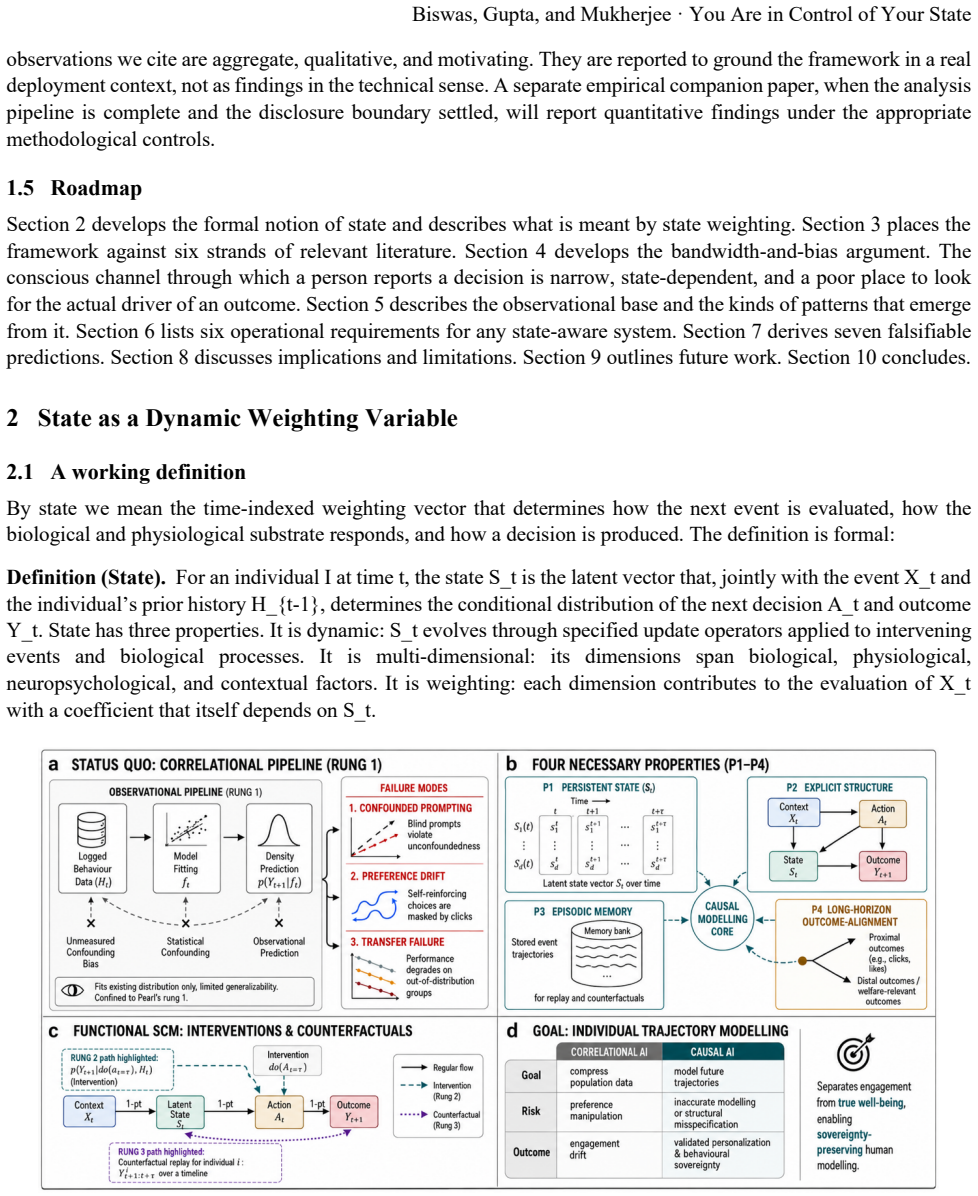
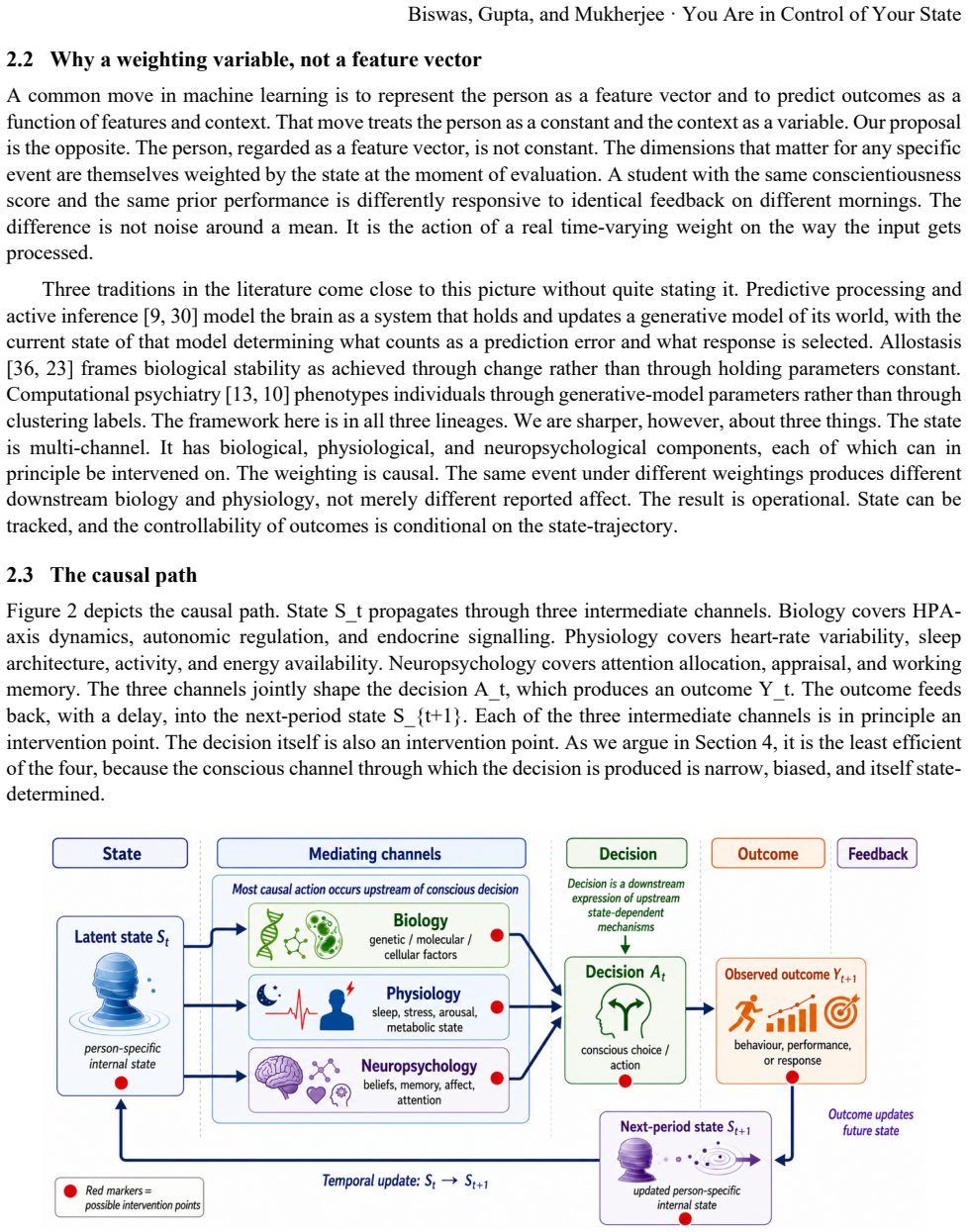
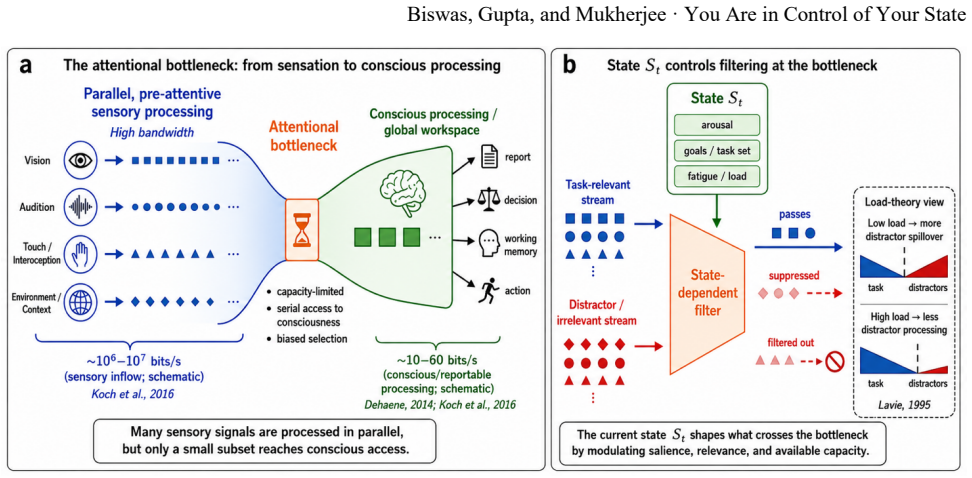
We argue that this variability belongs in the dynamic latent state of the person, and that human outcomes are controllable in a precise and operational sense through interventions that target the state and its weighting at the moment a decision is being formed. We define a state as the time-indexed weighting vector over the dimensions that govern how an individual's biology, physiology, and neuropsychology process the next event into a decision and an outcome. The relationship between state, decision, and outcome is causal rather than correlational. The weighting vector is dynamic at sub-daily timescales. The conscious channel through which outcomes are reportable is a narrow attentional bot
What carries the argument
The dynamic latent state, defined as the time-indexed weighting vector over the dimensions that process events into decisions and outcomes.
If this is right
- Seven testable predictions follow directly from the state definition and its causal role.
- State-aware systems must meet six operational requirements to perform effective interventions.
- Applications in digital health become feasible by timing interventions to state trajectories.
- AI personalisation shifts from static profiles to real-time state targeting.
- Personal agency expands through deliberate state management at decision points.
Where Pith is reading between the lines
- If the framework holds, self-tracking tools could focus on detecting and shifting the weighting vector rather than logging external events alone.
- The sub-daily dynamism suggests pairing the approach with chronobiology data to schedule interventions by time of day.
- In education settings the claim would imply designing feedback that adjusts for a learner's current state rather than fixed ability measures.
- The attentional-bottleneck element points to interventions that first clear or redirect the narrow reportable channel before addressing downstream outcomes.
Load-bearing premise
The relationship between state, decision, and outcome is causal rather than merely correlational, and interventions can reliably reach the weighting vector at sub-daily timescales.
What would settle it
A controlled experiment that alters the weighting vector at decision time through an intervention yet produces no measurable shift in the predicted outcomes would falsify the controllability claim.
Figures
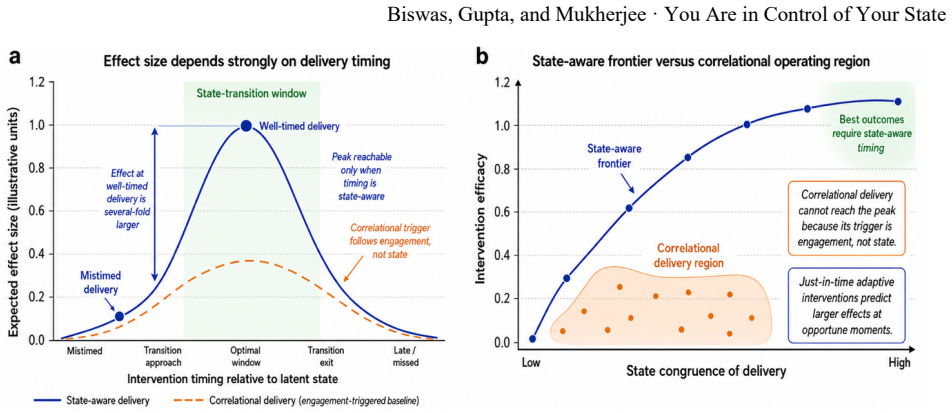
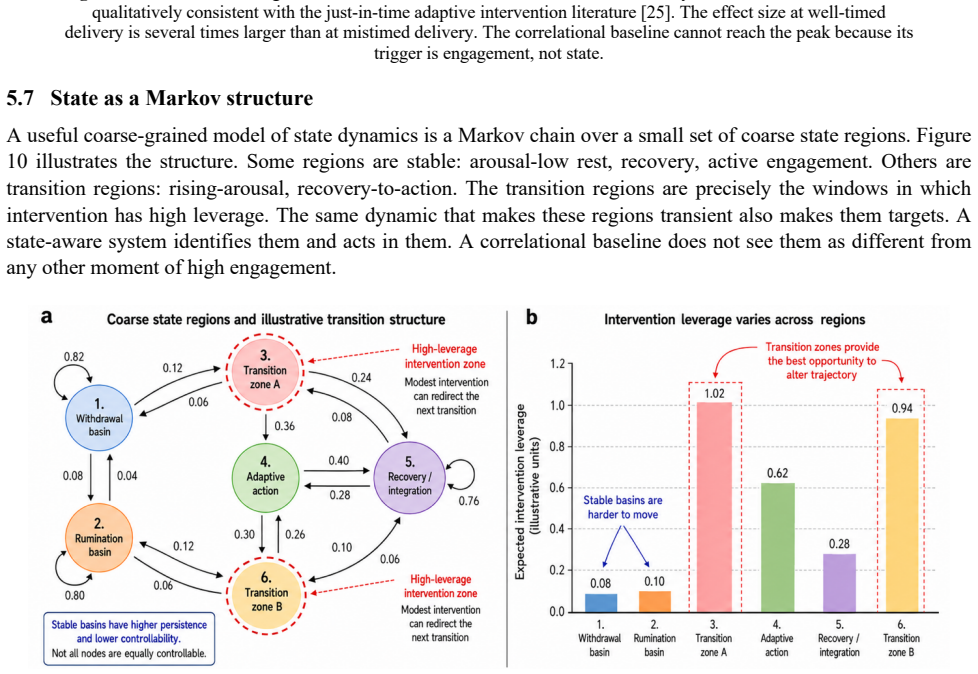
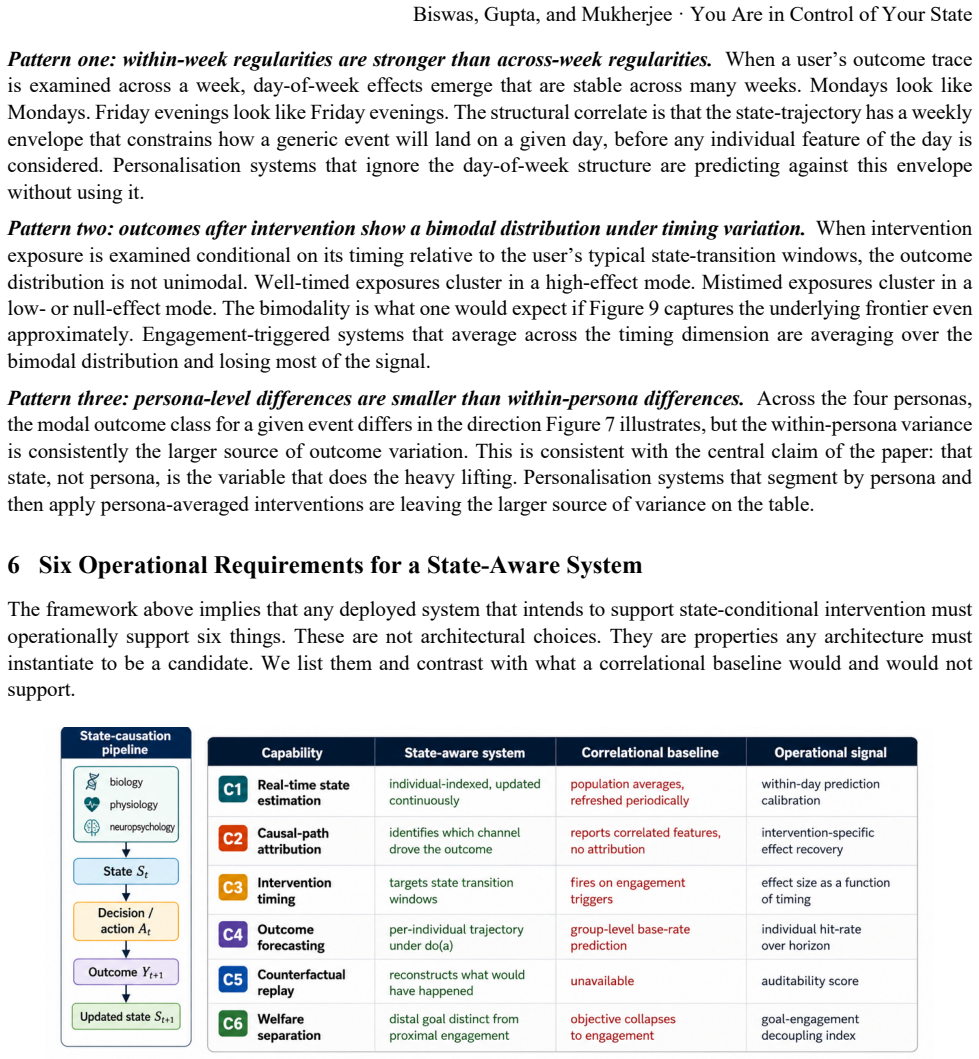
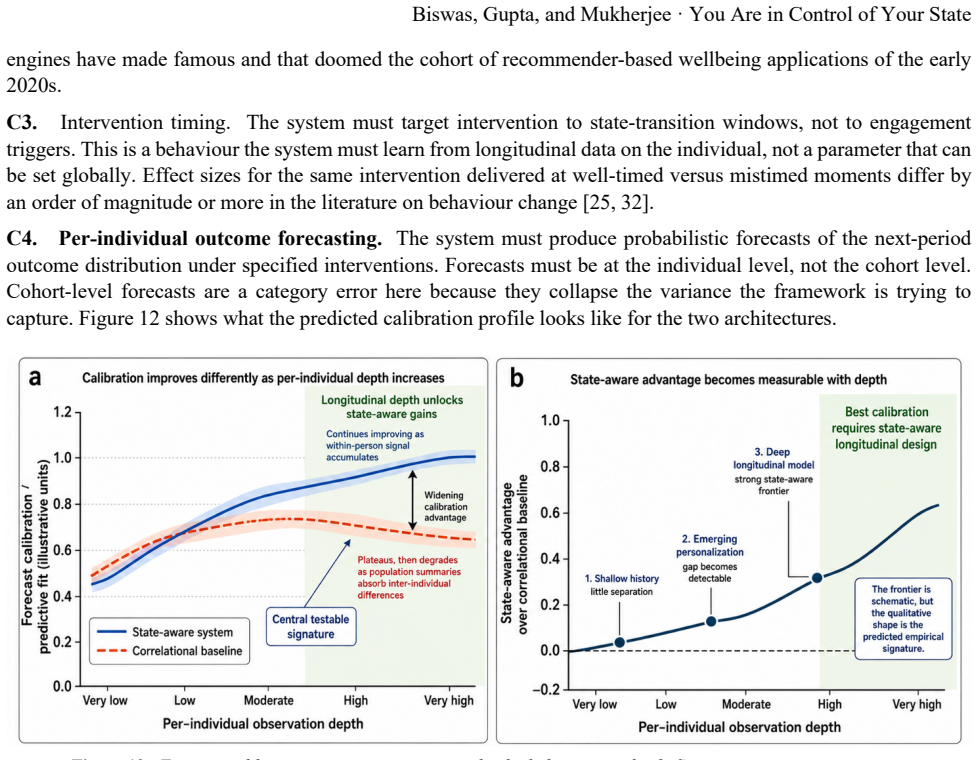
read the original abstract
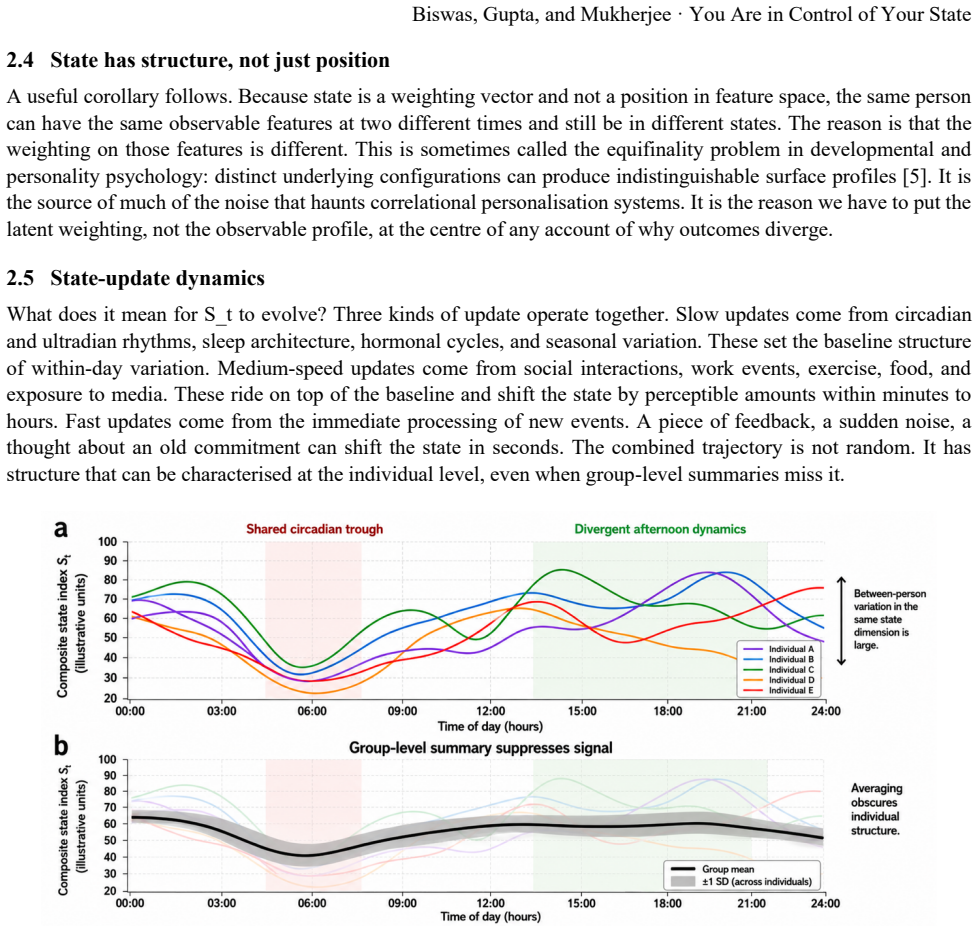
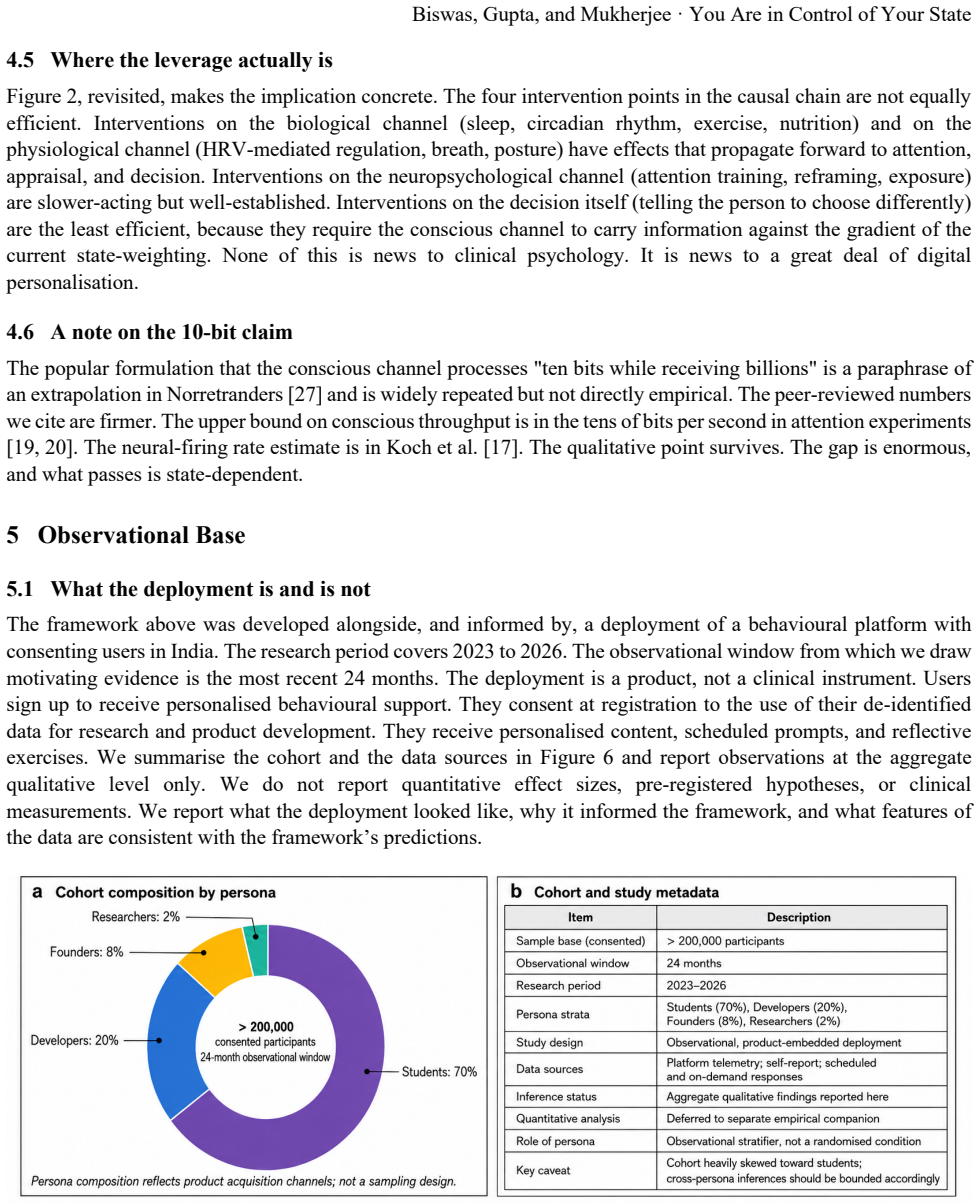
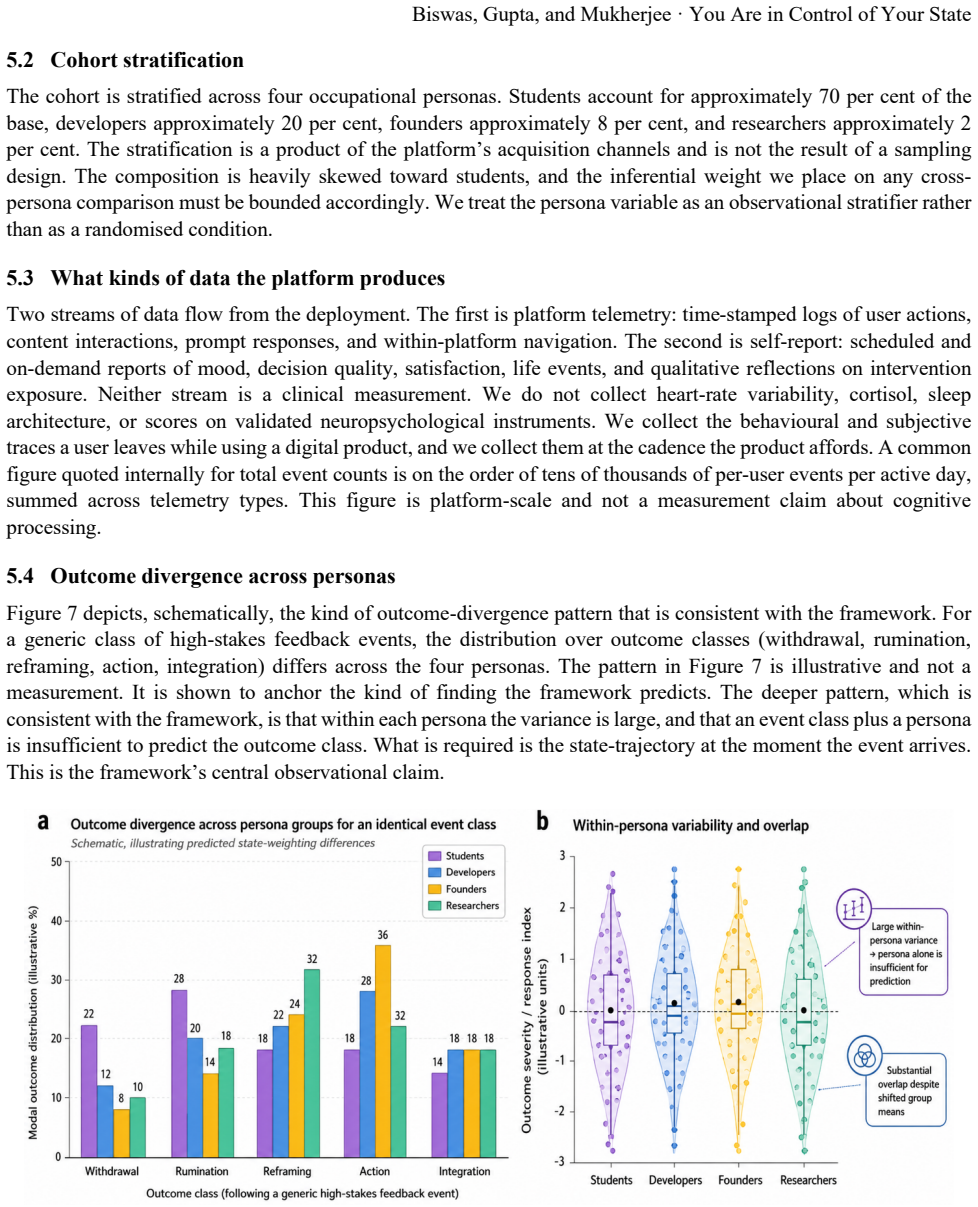
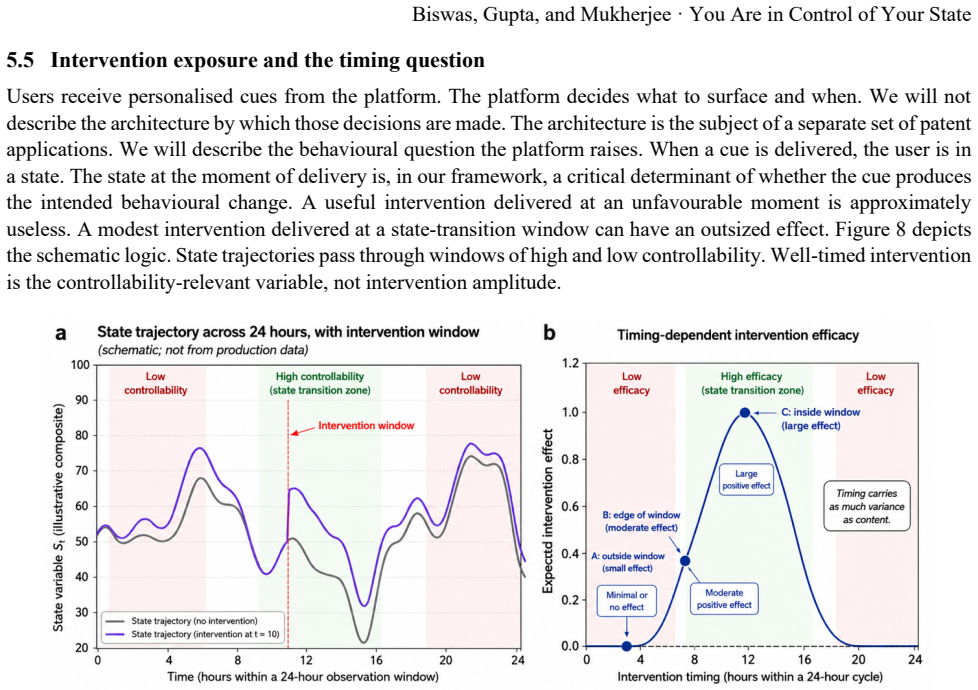
A central puzzle for the behavioural sciences and for human-facing artificial intelligence is the persistence of within-person variability. The same individual, presented with the same observable input, produces different outcomes on different occasions, and different individuals produce divergent outcomes that no observable covariate fully predicts. We argue that this variability belongs in the dynamic latent state of the person, and that human outcomes are controllable in a precise and operational sense through interventions that target the state and its weighting at the moment a decision is being formed. We define a state as the time-indexed weighting vector over the dimensions that govern how an individual's biology, physiology, and neuropsychology process the next event into a decision and an outcome. The relationship between state, decision, and outcome is causal rather than correlational. The weighting vector is dynamic at sub-daily timescales. The conscious channel through which outcomes are reportable is a narrow attentional bottleneck whose contents are themselves state-dependent. Taken together, these claims imply that the outcome of a given event is controllable, conditionally, on the state-trajectory at the time of intervention. We motivate the framework with six strands of established evidence (causal inference, predictive processing, allostasis, attentional bottleneck, chronobiology, computational psychiatry) and a 24-month observational base from a deployed behavioural platform spanning more than 200,000 consented users across four occupational personas (research period 2023 to 2026). We derive seven testable predictions, list six operational requirements for state-aware systems, and discuss implications for digital health, education, AI personalisation, and personal agency.
Editorial analysis
A structured set of objections, weighed in public.
Referee Report
Summary. The paper argues that within-person outcome variability arises from a dynamic latent state, defined as a time-indexed weighting vector over biological, physiological, and neuropsychological dimensions that processes events into decisions. It claims this state-outcome relationship is causal (not merely correlational), that the weighting vector varies at sub-daily timescales, and that targeted interventions on the state at decision formation can therefore control outcomes in a precise, operational sense. The framework is motivated by citations to six literatures (causal inference, predictive processing, allostasis, attentional bottleneck, chronobiology, computational psychiatry) plus a 24-month observational dataset from a deployed behavioral platform (>200k users across four personas); it derives seven testable predictions, lists six operational requirements for state-aware systems, and discusses implications for digital health, education, AI, and personal agency.
Significance. If the causal controllability claim can be secured with an explicit identification strategy, the framework would offer a unified, intervention-oriented account of human variability that integrates established literatures and could inform state-aware systems in AI personalization and digital health. The scale of the observational base (>200k users) is a potential strength for deriving falsifiable predictions, though the paper does not yet demonstrate that these predictions are independent of the model's own definitions.
major comments (3)
- [Abstract] Abstract: the foundational assertion that 'the relationship between state, decision, and outcome is causal rather than correlational' and that interventions 'target the state and its weighting at the moment a decision is being formed' is presented without an identification strategy (instrumental variables, regression discontinuity on state shifts, or within-person randomization) for the 24-month observational platform data. Observational covariation alone cannot secure the move to controllable causality given time-varying confounding and reverse causation risks.
- [Section on testable predictions] Section deriving the seven testable predictions: these predictions are generated directly from the state-as-weighting-vector definition and its sub-daily dynamics; without an independent empirical test (e.g., pre-registered intervention that alters the weighting vector and measures outcome change while holding observables fixed), they risk circularity and do not yet constitute load-bearing evidence for the controllability claim.
- [Framework definition] Framework definition of state (time-indexed weighting vector): the model treats the vector as both the latent cause and the target of intervention at sub-daily timescales, yet the manuscript provides no derivation or measurement protocol showing how the vector can be identified or manipulated independently of the outcome it is claimed to control.
minor comments (2)
- [Operational requirements] The six operational requirements for state-aware systems are listed but lack concrete implementation details (e.g., how the attentional bottleneck is operationalized in the platform data).
- [Framework] Notation for the dynamic weighting vector is introduced in the abstract but not carried through with explicit equations or variable definitions in the framework section, making the causal claims harder to evaluate formally.
Simulated Author's Rebuttal
We thank the referee for these constructive comments, which help clarify the scope and evidentiary basis of our framework. We respond point-by-point below, indicating planned revisions where the manuscript can be strengthened without altering its core theoretical contribution.
read point-by-point responses
-
Referee: [Abstract] Abstract: the foundational assertion that 'the relationship between state, decision, and outcome is causal rather than correlational' and that interventions 'target the state and its weighting at the moment a decision is being formed' is presented without an identification strategy (instrumental variables, regression discontinuity on state shifts, or within-person randomization) for the 24-month observational platform data. Observational covariation alone cannot secure the move to controllable causality given time-varying confounding and reverse causation risks.
Authors: We agree the abstract states the causal claim directly. The causal interpretation is grounded in the integration of the six cited literatures rather than in a formal identification strategy applied to the observational dataset. The 24-month platform data is used to document scale and within-person variability and to motivate the seven predictions; it is not presented as an empirical demonstration of causality. We will revise the abstract and the opening of Section 2 to state explicitly that the framework advances a causal model whose empirical confirmation requires future designs with explicit identification strategies (e.g., within-person randomization or state-shift discontinuities). This revision will be made. revision: yes
-
Referee: [Section on testable predictions] Section deriving the seven testable predictions: these predictions are generated directly from the state-as-weighting-vector definition and its sub-daily dynamics; without an independent empirical test (e.g., pre-registered intervention that alters the weighting vector and measures outcome change while holding observables fixed), they risk circularity and do not yet constitute load-bearing evidence for the controllability claim.
Authors: The predictions are derived from the framework to render it falsifiable, yet we recognize that derivation alone does not constitute independent evidence. We will revise the section to (i) restate each prediction in terms of observable quantities that can be measured without presupposing the weighting vector, and (ii) outline concrete independent test designs (pre-registered within-person experiments and hold-out analyses on the platform data) that separate model construction from evaluation. This addresses the circularity concern while preserving the predictions as the framework's primary empirical output. revision: partial
-
Referee: [Framework definition] Framework definition of state (time-indexed weighting vector): the model treats the vector as both the latent cause and the target of intervention at sub-daily timescales, yet the manuscript provides no derivation or measurement protocol showing how the vector can be identified or manipulated independently of the outcome it is claimed to control.
Authors: The state is introduced as a latent theoretical construct synthesized from the cited literatures; the manuscript is a framework paper rather than an empirical measurement study. No identification or manipulation protocol is supplied because none has yet been developed for this specific vector. We will add a short subsection (new Section 3.4) that sketches candidate measurement routes drawn from computational psychiatry and chronobiology and that explicitly flags independent identification and manipulation as open empirical questions for follow-on work. This revision will be made. revision: yes
Circularity Check
Controllability asserted by definition of state as governing vector
specific steps
-
self definitional
[Abstract, paragraph 2]
"We define a state as the time-indexed weighting vector over the dimensions that govern how an individual's biology, physiology, and neuropsychology process the next event into a decision and an outcome. The relationship between state, decision, and outcome is causal rather than correlational. The weighting vector is dynamic at sub-daily timescales. [...] Taken together, these claims imply that the outcome of a given event is controllable, conditionally, on the state-trajectory at the time of intervention."
State is defined as the vector governing how inputs become decisions/outcomes; the causal relationship is asserted within the framework; controllability is then said to follow directly from these definitional claims. The result is equivalent to the input definition rather than independently derived.
full rationale
The paper defines state as the weighting vector that governs processing of events into decisions and outcomes, asserts the state-decision-outcome link is causal, and concludes controllability follows from these claims. This makes the central result true by the definitional setup rather than derived from independent evidence or identification. The seven predictions are presented as derived from the same framework. External literatures are cited for motivation, but the load-bearing move from definition to controllability reduces by construction. Partial circularity in the derivation chain.
Axiom & Free-Parameter Ledger
axioms (1)
- domain assumption The relationship between state, decision, and outcome is causal rather than correlational
invented entities (1)
-
dynamic latent state defined as time-indexed weighting vector
no independent evidence
Forward citations
Cited by 1 Pith paper
-
Correlation Is Not Enough: Embedding Human Metadata for Individual Causal Discovery
Contrastive fine-tuning on 72k pairs plus BODHI hard-negative mining from a biomedical KG improves PubMedBERT separation from 1.05x to 2.30x and cross-domain discrimination by +0.392 while preserving most BIOSSES performance.
Reference graph
Works this paper leans on
-
[1]
Abstract
Biswas, Gupta, and Mukherjee · You Are in Control of Your State 1 / 20 You Are in Control of Your State: Why Human Outcomes Are Controllable Through Causal State Intervention Suraj Biswas · Saurav Gupta · Pritam Mukherjee ORCID: Suraj Biswas - https://orcid.org/0009-0008-1727-8179; Pritam Mukherjee - https://orcid.org/0009-0007-9018-4083 Independent Resea...
2023
-
[2]
At the aggregate qualitative level, the observed patterns are consistent with the framework
We describe a 24-month observational base from a deployed behavioural platform that spans more than 200,000 consented users across four occupational personas, with research carried out from 2023 to 2026 by the authors and their team. At the aggregate qualitative level, the observed patterns are consistent with the framework. We derive seven testable predi...
2023
-
[3]
The same dimensions are weighted differently in different groups, and the correlations among them carry information that a group average discards
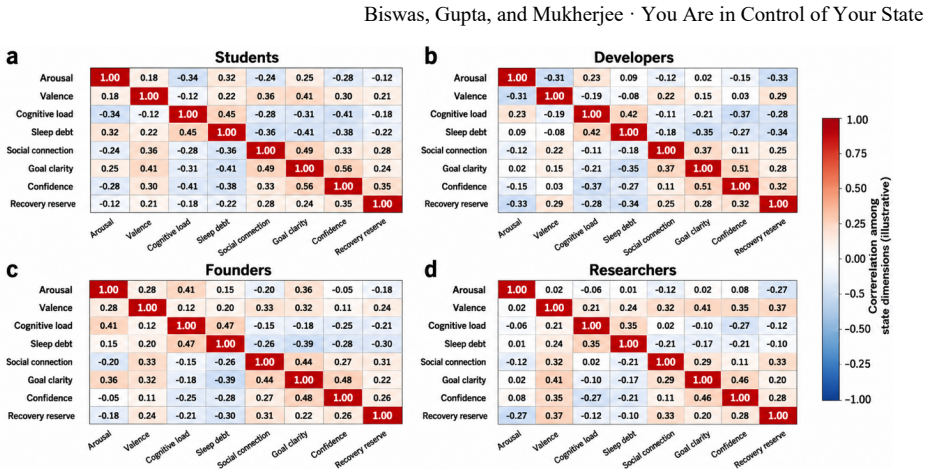
Illustrative state-dimension correlation structure across the four personas. The same dimensions are weighted differently in different groups, and the correlations among them carry information that a group average discards. The matrices are illustrative, not measurements. 3 Background and Related Work We organise the literature into six strands. We are de...
2020
-
[4]
The peer-reviewed numbers we cite are firmer
and is widely repeated but not directly empirical. The peer-reviewed numbers we cite are firmer. The upper bound on conscious throughput is in the tens of bits per second in attention experiments [19, 20]. The neural-firing rate estimate is in Koch et al. [17]. The qualitative point survives. The gap is enormous, and what passes is state-dependent. 5 Obse...
2023
-
[5]
We will report effect sizes, confidence intervals, and per-persona variance decomposition
The disclosure boundary is the constraint. We will report effect sizes, confidence intervals, and per-persona variance decomposition. We will not report architectural details that fall within the scope of the patent applications. 9.2 Cross-deployment replication A single-deployment observational base cannot support the strongest claims the framework makes...
2023
-
[6]
D., Ibeling, D., and Icard, T
Bareinboim, E., Correa, J. D., Ibeling, D., and Icard, T. (2022). On Pearl’s hierarchy and the foundations of causal inference. In H. Geffner, R. Dechter, and J. Y. Halpern (Eds.), Probabilistic and Causal Inference: The Works of Judea Pearl (pp. 507–556). ACM Books
2022
-
[7]
Biswas, S. (2026). Human modelling requires a causal architecture of behaviour and biology, not correlation. SSRN preprint
2026
-
[8]
L., and Bjork, R
Bjork, E. L., and Bjork, R. A. (2011). Making things hard on yourself, but in a good way: Creating desirable difficulties to enhance learning. In M. A. Gernsbacher et al. (Eds.), Psychology and the Real World (pp. 56–64). Worth Publishers
2011
-
[9]
C., and Santamaría-García, H
Castro Martínez, J. C., and Santamaría-García, H. (2023). Understanding mental health through computers: An introduction to computational psychiatry. Frontiers in Psychiatry, 14, 1092471
2023
-
[10]
Cicchetti, D., and Rogosch, F. A. (1996). Equifinality and multifinality in developmental psychopathology. Development and Psychopathology, 8(4), 597–600
1996
-
[11]
Dehaene, S. (2014). Consciousness and the brain: Deciphering how the brain codes our thoughts. Viking
2014
-
[12]
Fleeson, W. (2001). Toward a structure- and process-integrated view of personality: Traits as density distributions of states. Journal of Personality and Social Psychology, 80(6), 1011–1027
2001
-
[13]
Folkard, S., and Akerstedt, T. (2004). Trends in the risk of accidents and injuries and their implications for models of fatigue and performance. Aviation, Space, and Environmental Medicine, 75(3 Suppl), A161–A167
2004
-
[14]
Friston, K. (2010). The free-energy principle: A unified brain theory? Nature Reviews Neuroscience, 11(2), 127–138
2010
-
[15]
Friston, K. (2023). Computational psychiatry: From synapses to sentience. Molecular Psychiatry, 28(1), 256–268
2023
-
[16]
S., and Kopin, I
Goldstein, D. S., and Kopin, I. J. (2007). Evolution of concepts of stress. Stress, 10(2), 109–120
2007
-
[17]
L., Asparouhov, T., Brose, A., Schmiedek, F., and Muthén, B
Hamaker, E. L., Asparouhov, T., Brose, A., Schmiedek, F., and Muthén, B. (2018). At the frontiers of modeling intensive longitudinal data: Dynamic structural equation models for the affective measurements from the COGITO study. Multivariate Behavioral Research, 53(6), 820–841
2018
-
[18]
Huys, Q. J. M., Maia, T. V., and Frank, M. J. (2016). Computational psychiatry as a bridge from neuroscience to clinical applications. Nature Neuroscience, 19(3), 404–413. Biswas, Gupta, and Mukherjee · You Are in Control of Your State 19 / 20
2016
-
[19]
P., McEwen, B
Juster, R. P., McEwen, B. S., and Lupien, S. J. (2010). Allostatic load biomarkers of chronic stress and impact on health and cognition. Neuroscience and Biobehavioral Reviews, 35(1), 2–16
2010
-
[20]
Kahneman, D. (2011). Thinking, fast and slow. Farrar, Straus and Giroux
2011
-
[21]
N., and McEwen, B
Karatsoreos, I. N., and McEwen, B. S. (2011). Psychobiological allostasis: Resistance, resilience, and vulnerability. Trends in Cognitive Sciences, 15(12), 576–584
2011
-
[22]
Koch, C., Massimini, M., Boly, M., and Tononi, G. (2016). Neural correlates of consciousness: Progress and problems. Nature Reviews Neuroscience, 17(5), 307–321
2016
-
[23]
Kunda, Z. (1990). The case for motivated reasoning. Psychological Bulletin, 108(3), 480–498
1990
-
[24]
Lavie, N. (1995). Perceptual load as a necessary condition for selective attention. Journal of Experimental Psychology: Human Perception and Performance, 21(3), 451–468
1995
-
[25]
Lavie, N. (2005). Distracted and confused? Selective attention under load. Trends in Cognitive Sciences, 9(2), 75–82
2005
-
[26]
B., Tzianas, L
Limongi, R., Skelton, A. B., Tzianas, L. H., and Silva, A. M. (2024). Increasing the construct validity of computational phenotypes of mental illness through active inference and brain imaging. Brain Sciences, 14(12),
2024
-
[27]
P., and Hasher, L
May, C. P., and Hasher, L. (1998). Synchrony effects in inhibitory control over thought and action. Journal of Experimental Psychology: Human Perception and Performance, 24(2), 363–379
1998
-
[28]
McEwen, B. S. (2007). Physiology and neurobiology of stress and adaptation: Central role of the brain. Physiological Reviews, 87(3), 873–904
2007
-
[29]
Molenaar, P. C. M. (2004). A manifesto on psychology as idiographic science: Bringing the person back into scientific psychology, this time forever. Measurement: Interdisciplinary Research and Perspectives, 2(4), 201–218
2004
-
[30]
N., Spring, B
Nahum-Shani, I., Smith, S. N., Spring, B. J., Collins, L. M., Witkiewitz, K., Tewari, A., and Murphy, S. A. (2018). Just-in-time adaptive interventions (JITAIs) in mobile health. Annals of Behavioral Medicine, 52(6), 446–462
2018
-
[31]
E., and Wilson, T
Nisbett, R. E., and Wilson, T. D. (1977). Telling more than we can know: Verbal reports on mental processes. Psychological Review, 84(3), 231–259
1977
-
[32]
Norretranders, T. (1998). The user illusion: Cutting consciousness down to size. Viking
1998
-
[33]
Pearl, J. (2009). Causality: Models, reasoning, and inference (2nd ed.). Cambridge University Press
2009
-
[34]
Pennycook, G., De Neys, W., Evans, J. S. B. T., Stanovich, K. E., and Thompson, V. A. (2018). The mythical dual-process typology. Trends in Cognitive Sciences, 22(8), 667–668
2018
-
[35]
Pezzulo, G., Parr, T., Cisek, P., Clark, A., and Friston, K. (2024). Generating meaning: Active inference and the scope and limits of passive AI. Trends in Cognitive Sciences, 28(2), 97–112
2024
- [36]
-
[37]
T., Rivera, D
Riley, W. T., Rivera, D. E., Atienza, A. A., Nilsen, W., Allison, S. M., and Mermelstein, R. (2011). Health behavior models in the age of mobile interventions: Are our theories up to the task? Translational Behavioral Medicine, 1(1), 53–71
2011
-
[38]
L., and Karpicke, J
Roediger, H. L., and Karpicke, J. D. (2006). Test-enhanced learning: Taking memory tests improves long-term retention. Psychological Science, 17(3), 249–255
2006
-
[39]
Roenneberg, T., Wirz-Justice, A., and Merrow, M. (2003). Life between clocks: Daily temporal patterns of human chronotypes. Journal of Biological Rhythms, 18(1), 80–90
2003
-
[40]
R., Kalchbrenner, N., Goyal, A., and Bengio, Y
Schölkopf, B., Locatello, F., Bauer, S., Ke, N. R., Kalchbrenner, N., Goyal, A., and Bengio, Y. (2021). Toward causal representation learning. Proceedings of the IEEE, 109(5), 612–634
2021
-
[41]
Sterling, P. (2012). Allostasis: A model of predictive regulation. Physiology and Behavior, 106(1), 5–15
2012
-
[42]
D., and Dunn, E
Wilson, T. D., and Dunn, E. W. (2004). Self-knowledge: Its limits, value, and potential for improvement. Annual Review of Psychology, 55, 493–518. Biswas, Gupta, and Mukherjee · You Are in Control of Your State 20 / 20 Author contributions S.B. conceived the framework, developed the formal definitions and the four-channel causal model, and led the writing...
2004
discussion (0)
Sign in with ORCID, Apple, or X to comment. Anyone can read and Pith papers without signing in.