Controllable Lung Nodule Synthesis via Histogram-Regularized Latent Diffusion Models
Pith reviewed 2026-06-29 07:32 UTC · model grok-4.3
The pith
A latent diffusion model adds histogram regularization to match subtype-specific intensity distributions when synthesizing lung nodules in CT volumes.
A machine-rendered reading of the paper's core claim, the machinery that carries it, and where it could break.
Core claim
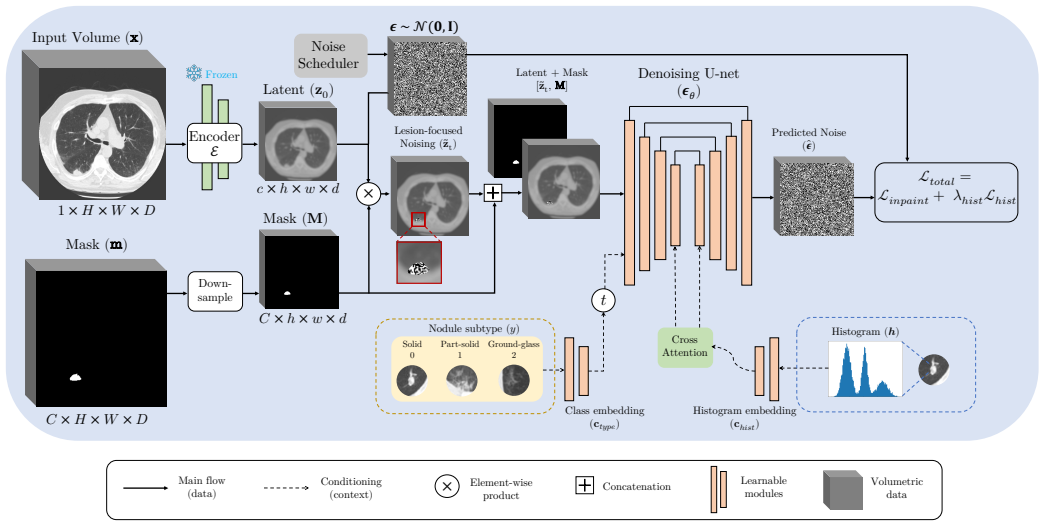
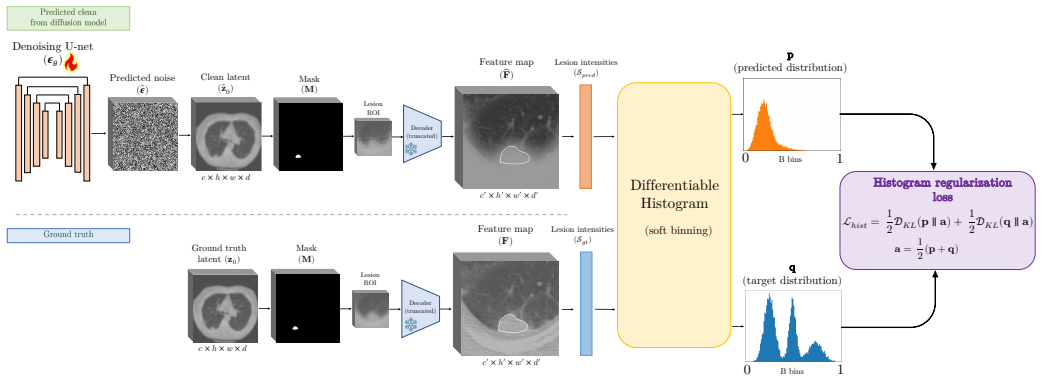
The central claim is that a controllable latent diffusion model that combines subtype, spatial-mask, and Hounsfield-unit histogram conditioning with a differentiable feature-space histogram regularization term produces synthesized nodules whose voxel intensity distributions align more closely with real lesions than models relying solely on spatial reconstruction losses, yielding stronger visual realism and improved utility for downstream clinical tasks.
What carries the argument
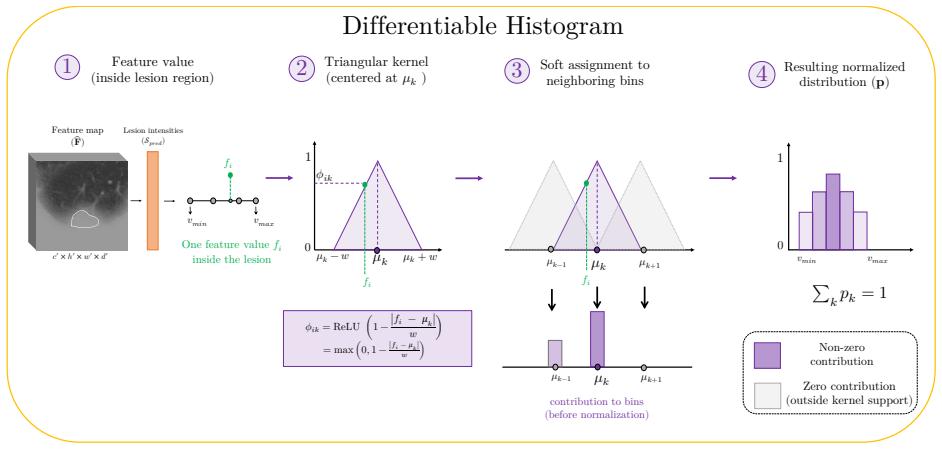
The differentiable feature-space histogram regularization term that constrains voxel intensity distributions during the generative process.
If this is right
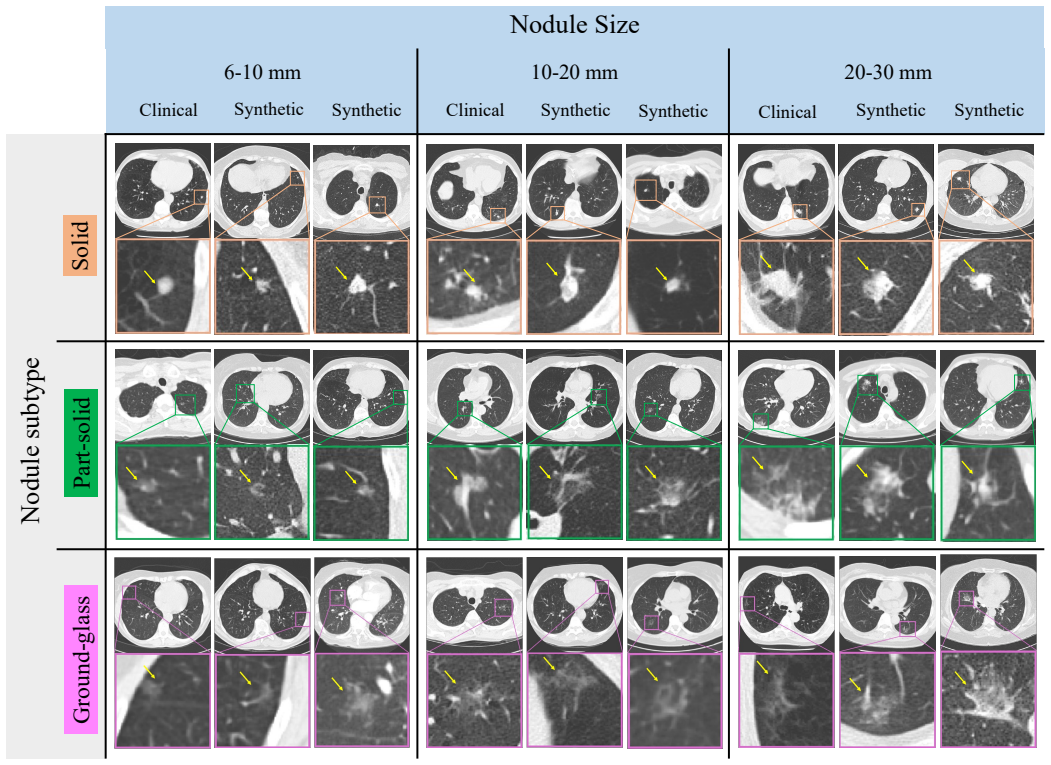
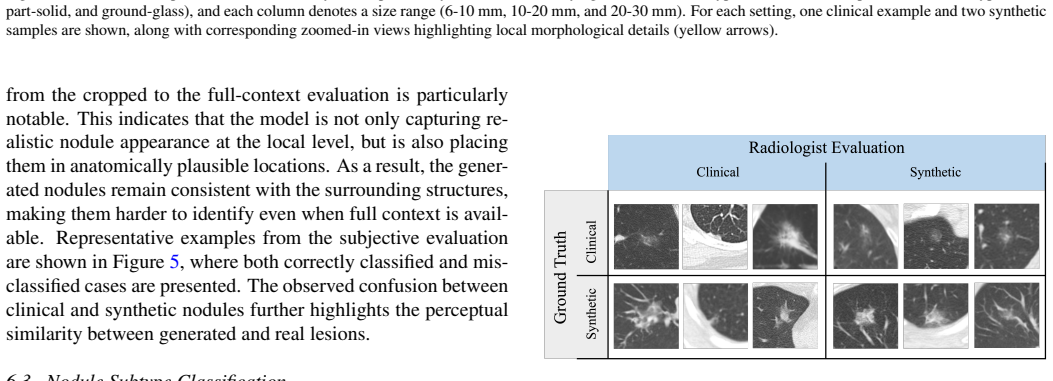
- Synthesized nodules achieve strong visual realism according to quantitative metrics and a visual Turing test.
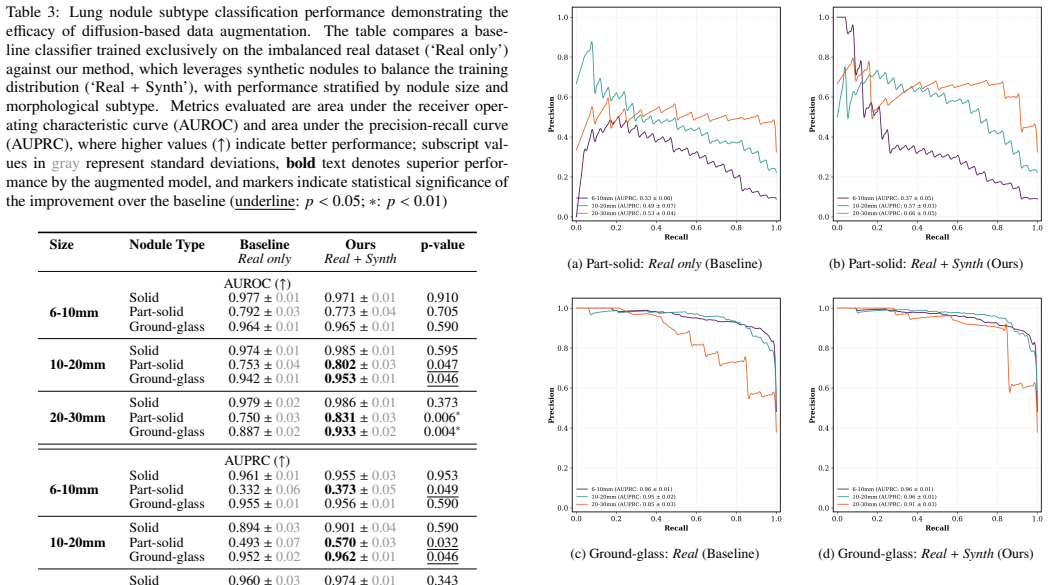
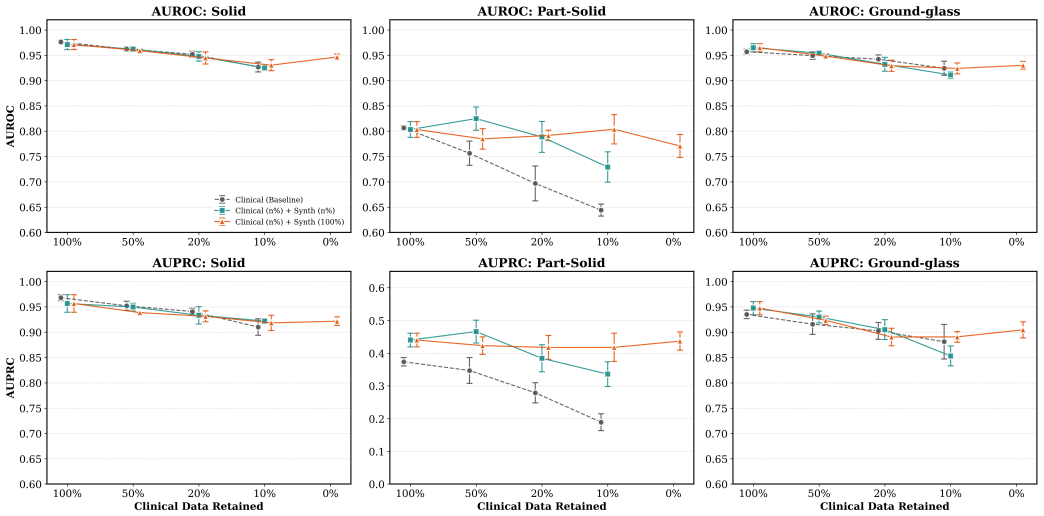
- Data augmentation with the generated nodules improves performance on downstream clinical tasks.
- Performance gains are largest for underrepresented nodule subtypes.
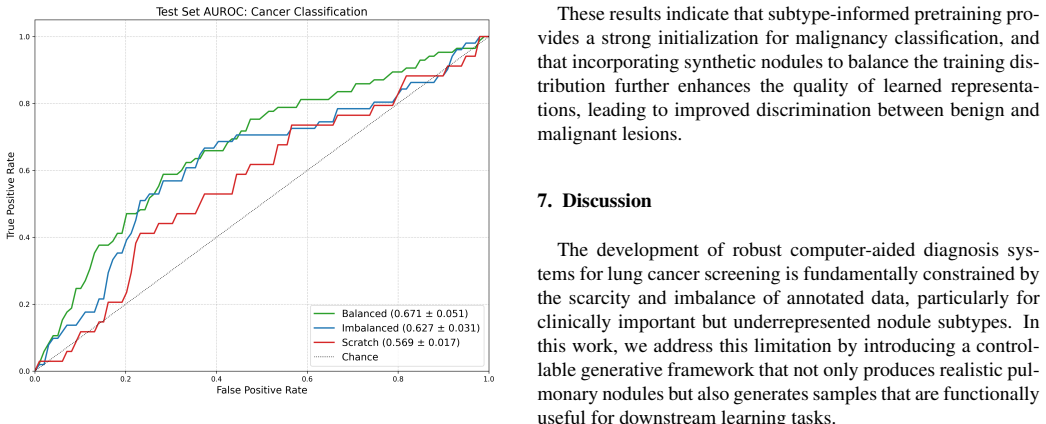
- The generated data shows potential benefit for subtype-informed malignancy classification.
Where Pith is reading between the lines
- The same regularization idea could be tested on other intensity-critical modalities such as MRI or ultrasound where distribution mismatch also limits generative utility.
- If the method preserves diversity, it might be used to synthesize rare pathological variants that are difficult to collect in real cohorts.
- Integration into active-learning loops could be explored to decide which real cases still need annotation once synthetic examples are available.
Load-bearing premise
The histogram regularization term will reliably align lesion-level intensity distributions without reducing sample diversity or introducing new artifacts.
What would settle it
A side-by-side evaluation in which the histogram-regularized model shows no gain in subtype consistency metrics, visual Turing test scores, or downstream task accuracy over an otherwise identical conditional diffusion baseline would falsify the central claim.
Figures
read the original abstract
While automated diagnosis systems have achieved remarkable success in computed tomography (CT)-based lung cancer screening, their development remains limited by the scarcity of diverse, annotated pulmonary nodule datasets. Diffusion-based generative models offer a promising strategy for data synthesis; however, many existing conditional approaches primarily optimize spatial reconstruction losses, which encourage voxel-wise similarity but may inadequately constrain lesion-level intensity distributions. As a result, these methods may produce over-smoothed texture profiles and underrepresent the distinct attenuation characteristics of different nodule subtypes, including solid, part-solid, and ground-glass nodules. To address this challenge, we propose a controllable latent diffusion model that synthesizes pulmonary nodules within full 3D CT volumes while accurately modeling nodule-specific intensity distributions. Specifically, rather than relying solely on spatial losses, we introduce a histogram-based regularization term that constrains voxel intensity distributions during the generative process. The model combines subtype, spatial mask, and Hounsfield unit (HU) histogram conditioning with the differentiable feature-space histogram regularization term to better align lesion-level intensity distributions, improving the visual plausibility and subtype consistency of synthesized nodules. Extensive experiments on lung CT data demonstrate that our framework achieves strong visual realism, validated through both quantitative metrics and a visual Turing test. Furthermore, when used for data augmentation, the generated nodules improve performance in downstream clinical tasks, particularly for underrepresented nodule subtypes, and show a potential benefit for subtype-informed malignancy classification.
Editorial analysis
A structured set of objections, weighed in public.
Referee Report
Summary. The paper introduces a controllable latent diffusion model for synthesizing pulmonary nodules in full 3D CT volumes. It augments standard spatial losses with a differentiable feature-space histogram regularization term, conditioned on nodule subtype (solid/part-solid/GGN), spatial mask, and HU histogram, to better match lesion-level intensity distributions. The authors claim this yields higher visual realism (quantitative metrics plus visual Turing test) and improves downstream tasks such as data augmentation for underrepresented subtypes and subtype-informed malignancy classification.
Significance. If the central claims hold after verification, the work would offer a practical advance in medical image synthesis by addressing intensity-distribution mismatches that spatial-loss-only diffusion models often exhibit. This could meaningfully alleviate data scarcity for rare nodule subtypes in lung-cancer screening pipelines and support more reliable augmentation for clinical AI systems.
major comments (1)
- [Methods / Experiments] The manuscript's central differentiator is the histogram regularization term. No ablation isolating its effect from the subtype/mask/HU conditioning is reported, nor are diversity metrics (intra-class histogram variance, perceptual diversity) shown before/after its addition. Consequently it remains unclear whether gains in Turing-test scores and downstream augmentation trace to the regularization or to the conditioning alone (see stress-test concern).
Simulated Author's Rebuttal
We thank the referee for the detailed review and constructive feedback on our work. We agree that isolating the contribution of the histogram regularization term is important for clarifying its role relative to the conditioning inputs, and we will strengthen the manuscript with additional experiments as detailed below.
read point-by-point responses
-
Referee: [Methods / Experiments] The manuscript's central differentiator is the histogram regularization term. No ablation isolating its effect from the subtype/mask/HU conditioning is reported, nor are diversity metrics (intra-class histogram variance, perceptual diversity) shown before/after its addition. Consequently it remains unclear whether gains in Turing-test scores and downstream augmentation trace to the regularization or to the conditioning alone (see stress-test concern).
Authors: We acknowledge this is a valid concern and that the current experiments do not fully isolate the regularization term's contribution. In the revised manuscript we will add an ablation study that trains and evaluates an otherwise identical model with the subtype/mask/HU conditioning but without the differentiable feature-space histogram regularization. We will also report intra-class histogram variance and perceptual diversity metrics (e.g., LPIPS-based diversity) for both the baseline and regularized versions to quantify the effect on distribution matching and sample variety. These additions will directly address whether the observed improvements in visual Turing tests and downstream tasks are attributable to the regularization. revision: yes
Circularity Check
No circularity; histogram regularization is an independent additive term
full rationale
The paper extends standard latent diffusion models by introducing a differentiable feature-space histogram regularization term alongside subtype/mask/HU conditioning. This term is presented as an explicit addition to address spatial-loss limitations, not derived from or equivalent to the inputs by construction. No self-citations, self-definitional equations, fitted parameters renamed as predictions, or uniqueness theorems from prior author work appear in the provided text. The derivation chain consists of standard LDM components plus the new regularization, with claims resting on empirical metrics and Turing tests rather than tautological reductions. This is the common case of an honest non-finding.
Axiom & Free-Parameter Ledger
Reference graph
Works this paper leans on
-
[1]
MONAI: An open-source framework for deep learning in healthcare
Monai: An open-source framework for deep learning in healthcare. arXiv preprint arXiv:2211.02701 . Chen, Q., Chen, X., Song, H., Xiong, Z., Yuille, A., Wei, C., Zhou, Z., 2024. Towards generalizable tumor synthesis, in: Proceedings of the IEEE/CVF conference on computer vi- sion and pattern recognition, pp. 11147–11158. Çiçek, Ö., Abdulkadir, A., Lienkamp...
work page internal anchor Pith review Pith/arXiv arXiv 2024
-
[2]
Radiology 293, 441–448
Cancer risk in subsolid nodules in the national lung screening trial. Radiology 293, 441–448. Han, C., Hayashi, H., Rundo, L., Araki, R., Shimoda, W., Mu- ramatsu, S., Furukawa, Y ., Mauri, G., Nakayama, H., 2018. Gan-based synthetic brain mr image generation, in: 2018 IEEE 15th international symposium on biomedical imaging (ISBI 2018), IEEE. pp. 734–738....
2018
-
[3]
Auto-Encoding Variational Bayes
Densely connected convolutional networks, in: Pro- ceedings of the IEEE conference on computer vision and pat- tern recognition, pp. 4700–4708. Isensee, F., Jaeger, P.F., Kohl, S.A., Petersen, J., Maier- Hein, K.H., 2021. nnu-net: a self-configuring method for deep learning-based biomedical image segmentation. Nature methods 18, 203–211. Jin, Q., Cui, H.,...
work page internal anchor Pith review Pith/arXiv arXiv 2021
-
[4]
Radiology: Ar- tificial Intelligence 4, e210315
Radimagenet: an open radiologic deep learning re- search dataset for effective transfer learning. Radiology: Ar- tificial Intelligence 4, e210315. Mortani Barbosa Jr, E.J., Kim, Y ., Zhang, Y ., Setio, A.A., Mel- lot, F., Grenier, P.A., Zimmermann, M., Georgescu, B., Gr- bic, S., Gefter, W.B., 2026. Deep learning-based pulmonary nodule risk assessment out...
2026
-
[5]
Class-aware adversarial lung nodule synthesis in ct images, in: 2019 IEEE 16th International Symposium on Biomedical Imaging (ISBI 2019), IEEE. pp. 1348–1352. Yu, J., Li, X., Koh, J.Y ., Zhang, H., Pang, R., Qin, J., Ku, A., Xu, Y ., Baldridge, J., Wu, Y ., 2022. Vector-quantized image modeling with improved VQGAN, in: International Conference on Learning...
2019
-
[6]
The unreasonable effectiveness of deep features as a perceptual metric, in: Proceedings of the IEEE conference on computer vision and pattern recognition, pp. 586–595. Zhao, C., Guo, P., Yang, D., He, Y ., Tang, Y ., Simon, B., Belue, M., Harmon, S., Turkbey, B., Xu, D., 2026. Maisi-v2: Accel- erated 3d high-resolution medical image synthesis with rec- ti...
2026
discussion (0)
Sign in with ORCID, Apple, or X to comment. Anyone can read and Pith papers without signing in.