Perception First: A Frontier Native-Video Model with Self-Consistency for Implicit Video Question Answering
Pith reviewed 2026-06-28 17:01 UTC · model grok-4.3
The pith
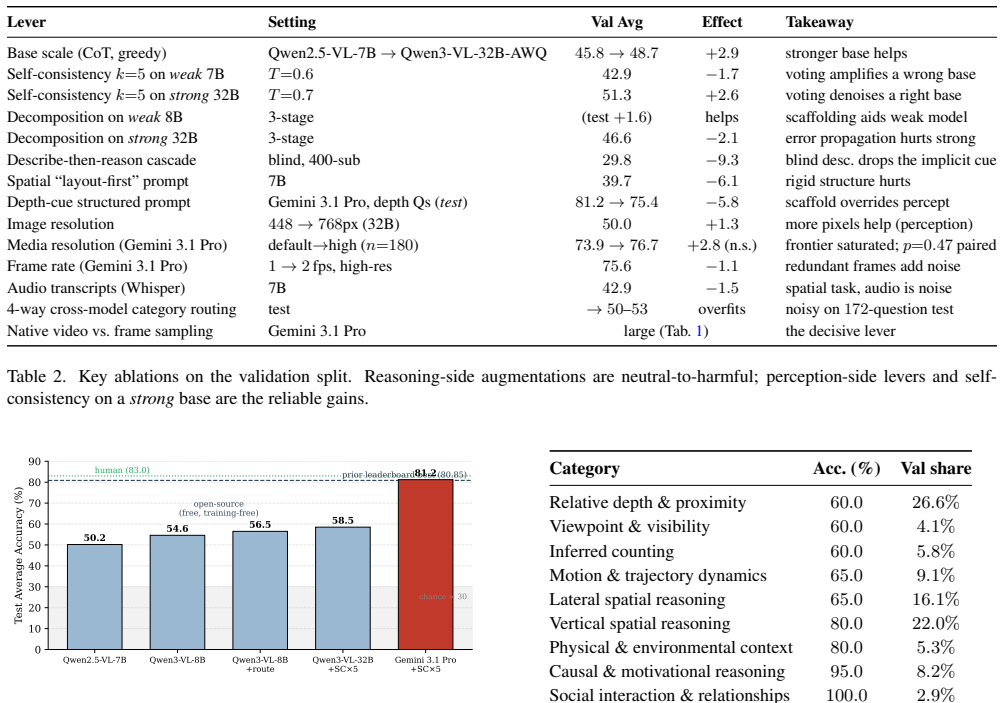
The ImplicitQA benchmark is perception-bound rather than reasoning-bound for video models.
A machine-rendered reading of the paper's core claim, the machinery that carries it, and where it could break.
Core claim
On the ImplicitQA benchmark, reasoning-side augmentations are neutral-to-harmful while base-model perceptual capability and lightweight test-time denoising are the only reliable levers. A per-category error analysis localizes difficulty to low-level perception, with relative depth, viewpoint, and counting hardest and causal and social reasoning nearly solved. Explicitly injecting monocular depth cues lowers test accuracy by 5.8 points.
What carries the argument
Self-consistency applied as lightweight test-time denoising on video large multimodal models to stabilize perceptual outputs without added reasoning procedures.
If this is right
- Base models with stronger low-level perceptual capabilities will achieve higher accuracy on implicit video QA tasks.
- Reasoning prompts, decomposition, and similar augmentations will remain neutral or harmful on this benchmark.
- Development effort focused on depth, viewpoint, and counting perception will address the main performance bottlenecks.
- Causal and social reasoning categories are already near saturation in current models.
- Lightweight test-time denoising methods such as self-consistency will continue to provide consistent gains across models.
Where Pith is reading between the lines
- Pretraining objectives that emphasize monocular depth and motion estimation could raise performance ceilings on similar implicit-reasoning benchmarks.
- The same perception-versus-reasoning diagnostic could be applied to other multimodal tasks to identify binding constraints.
- Scaling reasoning capacity alone is unlikely to advance results on tasks where perception is the limiter.
- Test-time consistency checks may generalize as a low-cost way to improve reliability in other video understanding settings.
Load-bearing premise
The tested open-source Video-LMMs and inference strategies adequately represent the space of possible perceptual and reasoning capabilities.
What would settle it
A video model with measurably higher accuracy on standalone depth estimation, viewpoint prediction, and counting tasks would show substantial gains on ImplicitQA while a model improved only in reasoning chains would not.
Figures

read the original abstract
We describe our submission to the VRR Challenge @ CVPR 2026, built on the \emph{ImplicitQA} / \emph{VRR-QA} benchmark~\cite{implicitqa}: multiple-choice video question answering in which answers are deliberately \emph{not} observable in any single frame and must be inferred from spatial layout, motion, depth, viewpoint, causality, and social context across discontinuous frames of creative video. We conduct a systematic, training-free study spanning open-source Video-LMMs (Qwen2.5-VL~\cite{qwen25vl}, Qwen3-VL~\cite{qwen3vl}, InternVL3, Gemma-3, and the RL-tuned video reasoners Video-R1~\cite{videor1} and VideoChat-R1.5~\cite{videochatr15}) and a battery of inference-time strategies (chain-of-thought, question decomposition, describe-then-reason cascades, audio transcripts, spatial state prompting, self-consistency~\cite{selfconsistency}, multi-model ensembling, and category routing). Our central finding is that this benchmark is \emph{perception-bound rather than reasoning-bound}: reasoning-side augmentations are neutral-to-harmful, whereas base-model perceptual capability and lightweight test-time denoising are the only reliable levers. A per-category error analysis localizes the difficulty to low-level perception -- relative depth, viewpoint, and counting are the hardest categories, while causal and social reasoning are nearly solved -- and a prompt that explicitly injects monocular depth cues to attack the weakest category \emph{lowers} test accuracy by $5.8$ points, confirming that the model needs a better \emph{percept}, not a better \emph{procedure}.
Editorial analysis
A structured set of objections, weighed in public.
Referee Report
Summary. The manuscript reports a training-free empirical evaluation of open-source Video-LMMs (Qwen2.5-VL, Qwen3-VL, InternVL3, Gemma-3, Video-R1, VideoChat-R1.5) on the ImplicitQA/VRR-QA benchmark for multiple-choice video QA requiring cross-frame inference. It tests inference strategies including CoT, decomposition, self-consistency, ensembling, and depth prompting, concluding that the benchmark is perception-bound: reasoning augmentations are neutral-to-harmful while base perceptual capability and test-time denoising are the reliable levers. A per-category error analysis identifies relative depth, viewpoint, and counting as hardest, with depth prompting lowering accuracy by 5.8 points.
Significance. If substantiated, the result would usefully redirect attention toward perceptual improvements in video models for implicit tasks. The systematic comparison across multiple models and strategies supplies concrete empirical baselines that could inform VRR Challenge submissions and future Video-LMM development.
major comments (3)
- [Abstract / Results] Abstract and Results: the claim that depth prompting lowers accuracy by 5.8 points is presented without sample size, error bars, or statistical significance testing. This detail is load-bearing for the per-category error analysis that localizes difficulty to low-level perception.
- [Discussion / Conclusion] Discussion / Conclusion: the assertion that the benchmark is inherently 'perception-bound rather than reasoning-bound' rests on the tested open-source cohort (Qwen2.5-VL, InternVL3, Video-R1, etc.). Without evidence that frontier closed-source models or stronger elicitation methods (agentic search, program-of-thoughts) also fail to benefit from reasoning procedures, the generalization from 'these models' to 'the task' is not yet supported.
- [Methods] Methods: no quantitative details are supplied on the number of questions, category distribution, exact prompting templates, or controls for model scale and temperature. These omissions undermine reproducibility of the neutral-to-harmful finding for reasoning augmentations.
minor comments (2)
- [Tables / Figures] Table or figure captions should explicitly state the number of samples underlying each accuracy number and the 5.8-point delta.
- [Experimental Setup] The manuscript would benefit from a short paragraph clarifying whether the listed models were evaluated at their largest available scale or with consistent decoding parameters.
Simulated Author's Rebuttal
We thank the referee for the constructive and detailed comments, which highlight important aspects of clarity, reproducibility, and scope. We address each major comment below and indicate the revisions planned for the next version of the manuscript.
read point-by-point responses
-
Referee: [Abstract / Results] Abstract and Results: the claim that depth prompting lowers accuracy by 5.8 points is presented without sample size, error bars, or statistical significance testing. This detail is load-bearing for the per-category error analysis that localizes difficulty to low-level perception.
Authors: We agree that the presentation of the 5.8-point drop requires additional statistical support. The result is computed on the complete ImplicitQA test set; we will report the exact sample size, add bootstrap-derived 95% confidence intervals, and include a paired statistical test (McNemar's test) for significance. These elements will be added to the Results section and the per-category analysis table in the revision. revision: yes
-
Referee: [Discussion / Conclusion] Discussion / Conclusion: the assertion that the benchmark is inherently 'perception-bound rather than reasoning-bound' rests on the tested open-source cohort (Qwen2.5-VL, InternVL3, Video-R1, etc.). Without evidence that frontier closed-source models or stronger elicitation methods (agentic search, program-of-thoughts) also fail to benefit from reasoning procedures, the generalization from 'these models' to 'the task' is not yet supported.
Authors: We accept the scope limitation. The manuscript evaluates only publicly available open-source models to ensure reproducibility. We will revise the Discussion and Conclusion to state explicitly that the perception-bound finding applies to the six evaluated open-source Video-LMMs and to note that testing closed-source frontier models and advanced elicitation methods remains an important direction for future work. No claim of universality beyond the tested cohort will be retained. revision: partial
-
Referee: [Methods] Methods: no quantitative details are supplied on the number of questions, category distribution, exact prompting templates, or controls for model scale and temperature. These omissions undermine reproducibility of the neutral-to-harmful finding for reasoning augmentations.
Authors: We agree that these details are necessary for reproducibility. The revised Methods section will report the total number of questions, the per-category distribution, the exact prompting templates (with full text moved to the appendix), model parameter counts, and the generation settings (temperature fixed at 0.0 with other hyperparameters listed). These additions will be made in the next version. revision: yes
Circularity Check
No circularity: empirical evaluation with external benchmark
full rationale
The paper reports an empirical comparison of open-source Video-LMMs and a list of inference-time strategies (CoT, decomposition, self-consistency, ensembling, depth prompting, etc.) on the external ImplicitQA/VRR-QA benchmark. The perception-bound conclusion is drawn directly from measured accuracy differences (reasoning augmentations neutral-to-harmful; depth cue injection lowers accuracy by 5.8 points). No equations, fitted parameters, or derivations appear; no self-citation chain is invoked to justify uniqueness or forbid alternatives; the tested models and strategies are presented as the experimental sample without any claim that they are definitionally exhaustive. The result is therefore self-contained against the reported observations.
Axiom & Free-Parameter Ledger
Reference graph
Works this paper leans on
-
[1]
S. Swetha, R. Gupta, P. Kulkarni, et al. ImplicitQA / VRR- QA: Visual Relational Reasoning in Videos Beyond Explicit Cues.arXiv:2506.21742, 2026
-
[2]
Qwen Team. Qwen2.5-VL Technical Report. arXiv:2502.13923, 2025
work page internal anchor Pith review Pith/arXiv arXiv 2025
-
[3]
Qwen3-VL
Qwen Team. Qwen3-VL. Model card / technical overview, 2025–2026
2025
-
[4]
Video-R1: Reinforcing Video Reasoning in MLLMs
Y . Feng, et al. Video-R1: Reinforcing Video Reasoning in MLLMs.arXiv:2503.21776, 2025
work page internal anchor Pith review Pith/arXiv arXiv 2025
-
[5]
OpenGVLab. VideoChat-R1.5: Visual Test-Time Scaling via Iterative Perception.arXiv:2509.21100, 2025
-
[6]
Wang, et al
X. Wang, et al. Self-Consistency Improves Chain-of-Thought Reasoning in Language Models.ICLR, 2023
2023
-
[7]
Kwon, et al
W. Kwon, et al. Efficient Memory Management for Large Language Model Serving with PagedAttention (vLLM). SOSP, 2023
2023
-
[8]
Gemini 3 Technical Report
Google DeepMind. Gemini 3 Technical Report. 2025–2026
2025
discussion (0)
Sign in with ORCID, Apple, or X to comment. Anyone can read and Pith papers without signing in.