Estimating Mutual Information between Time Series and Temporal Event Sequences Across Diverse Analysis Tasks
Pith reviewed 2026-06-28 15:51 UTC · model grok-4.3
The pith
A nonparametric estimator directly measures mutual information between time series and event sequences.
A machine-rendered reading of the paper's core claim, the machinery that carries it, and where it could break.
Core claim
The estimator directly measures dependence between time series and event sequences by modeling their continuous-discrete duality and applying latent event clustering to reduce bias, yielding a framework that bridges discrete and continuous mutual information without transformations or discretization.
What carries the argument
Nonparametric mutual information estimator that models continuous-discrete duality and latent event clustering to avoid quantization and redundancy artifacts.
If this is right
- Enables accurate discrete-continuous time-delayed mutual information for causality analysis.
- Supports global and local temporal repetition discovery across heterogeneous sequences.
- Improves discrete covariate selection for time series forecasting.
- Enhances continuous feature selection for classification on temporal data.
Where Pith is reading between the lines
- The estimator could extend to dependence measurement in non-temporal mixed data such as spatial and categorical variables.
- It may enable direct strength comparisons of dependence across different datasets without task-specific parameter choices.
- Integration with forecasting or classification pipelines could be tested for end-to-end performance gains.
Load-bearing premise
The latent event clustering strategy reduces bias from event co-occurrence and redundancy without introducing new artifacts or requiring domain-specific tuning.
What would settle it
On synthetic data with known ground-truth dependence and high event redundancy, the estimator fails to recover mutual information values more accurately than existing discretization-based methods.
Figures


read the original abstract
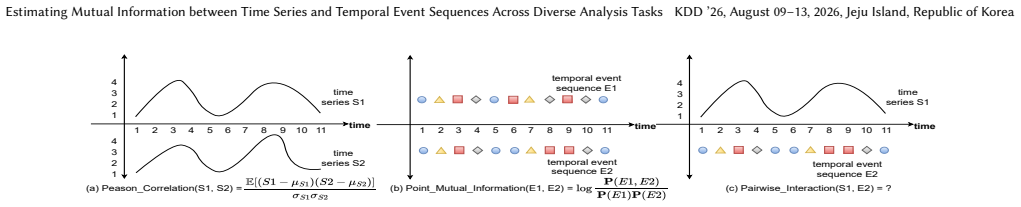
Pairwise dependence measures such as correlation and causality are fundamental to temporal data mining, yet there is still no principled and robust way to quantify dependence between heterogeneous data types, especially between continuous time series and discrete temporal event sequences. Existing approaches rely on ad hoc transformations or mutual-information estimators that are highly sensitive to quantization, repeated values, and event redundancy, leading to biased or unstable results in practice. We propose a nonparametric mutual information estimator that directly measures the dependence between time series and event sequences without data transformation, learning, or ad hoc discretization. Our method models the continuous-discrete duality of real-world time series to handle quantization and repeated-value artifacts and introduces a latent event clustering strategy to mitigate bias from event co-occurrence and redundancy. Together, these yield a robust and unified framework that bridges discrete and continuous mutual information. We evaluate the proposed estimator on four representative tasks: discrete-continuous time-delayed mutual information for causality analysis, global and local temporal repetition discovery, discrete covariate selection for time series forecasting, and continuous feature selection for classification. Experiments on synthetic and real-world datasets show consistent improvements over existing methods in accuracy, robustness, and interpretability, positioning our approach as a general-purpose dependence operator for heterogeneous temporal data, similar to Pearson correlation for homogeneous time series. Code available at: https://github.com/HaojiHu/Multimodal-Temporal-Data-Quantification
Editorial analysis
A structured set of objections, weighed in public.
Referee Report
Summary. The paper proposes a nonparametric mutual information estimator for quantifying dependence between continuous time series and discrete temporal event sequences. It models the continuous-discrete duality to address quantization and repeated-value issues and introduces a latent event clustering strategy to reduce bias from event co-occurrence and redundancy. The method is evaluated on four tasks—time-delayed MI for causality, global/local repetition discovery, discrete covariate selection for forecasting, and continuous feature selection for classification—showing improved accuracy, robustness, and interpretability over baselines on synthetic and real data, with code released.
Significance. If the estimator is verifiably nonparametric, free of ad hoc discretization or task-specific tuning, and the clustering strategy demonstrably mitigates redundancy bias without introducing new artifacts, the work would provide a general-purpose dependence operator for heterogeneous temporal data analogous to Pearson correlation, with direct applicability to causality, forecasting, and feature selection tasks.
major comments (2)
- [Method description (latent event clustering)] The central claim that the latent event clustering strategy mitigates co-occurrence/redundancy bias without new artifacts or domain-specific tuning (as required for the nonparametric guarantee across the four tasks) is not supported by any derivation, objective function, inference procedure, or sensitivity analysis for the number of clusters K. This is load-bearing for the 'no transformation, no learning, no ad hoc discretization' positioning.
- [Method section] No equations or algorithmic pseudocode are provided for the continuous-discrete duality modeling or the overall MI estimator, preventing verification that the estimator is truly direct and nonparametric rather than implicitly relying on post-hoc choices that could affect results on the causality, repetition, and selection tasks.
minor comments (2)
- [Introduction] The abstract and introduction would benefit from explicit comparison to prior MI estimators for mixed data types (e.g., those using kernel density or copulas) to clarify novelty.
- [Experiments] Figure captions and experimental tables should include error bars or statistical significance tests for the reported improvements to strengthen the robustness claims.
Simulated Author's Rebuttal
We thank the referee for the constructive feedback on the method description. The comments correctly identify areas where additional detail is required to support the nonparametric claims, and we will revise the manuscript accordingly.
read point-by-point responses
-
Referee: [Method description (latent event clustering)] The central claim that the latent event clustering strategy mitigates co-occurrence/redundancy bias without new artifacts or domain-specific tuning (as required for the nonparametric guarantee across the four tasks) is not supported by any derivation, objective function, inference procedure, or sensitivity analysis for the number of clusters K. This is load-bearing for the 'no transformation, no learning, no ad hoc discretization' positioning.
Authors: We agree that the manuscript requires additional support for the latent event clustering claims. In the revision we will add a derivation showing how clustering reduces co-occurrence and redundancy bias, the explicit objective function and inference procedure, and a sensitivity analysis over K. These additions will demonstrate that the strategy operates without domain-specific tuning or new artifacts while preserving the nonparametric character across the four tasks. revision: yes
-
Referee: [Method section] No equations or algorithmic pseudocode are provided for the continuous-discrete duality modeling or the overall MI estimator, preventing verification that the estimator is truly direct and nonparametric rather than implicitly relying on post-hoc choices that could affect results on the causality, repetition, and selection tasks.
Authors: We acknowledge that the method section lacks explicit equations and pseudocode. The revised manuscript will include the full mathematical formulation of the continuous-discrete duality modeling, the overall MI estimator, and algorithmic pseudocode. This will allow direct verification that the estimator is nonparametric and does not depend on post-hoc choices affecting the reported tasks. revision: yes
Circularity Check
No circularity: nonparametric estimator presented without self-referential fitting or load-bearing self-citations
full rationale
The abstract and description present a nonparametric MI estimator that directly measures dependence between time series and event sequences without transformation, learning, or discretization. It models continuous-discrete duality and introduces latent event clustering to mitigate bias, but no equations, derivation steps, or self-citations are shown that would reduce the central claim to fitted inputs by construction or rename known results. The four-task evaluation is framed as empirical validation on synthetic and real-world data rather than tautological prediction. No patterns matching self-definitional, fitted-input-called-prediction, or uniqueness-imported-from-authors are identifiable from the provided text. The method is positioned as a general-purpose operator with code available externally, making the derivation self-contained against external benchmarks.
Axiom & Free-Parameter Ledger
Reference graph
Works this paper leans on
-
[1]
Hirotugu Akaike. 1976. Canonical correlation analysis of time series and the use of an information criterion. InMathematics in science and engineering. Vol. 126. Elsevier, 27–96
1976
-
[2]
Abdul Fatir Ansari, Oleksandr Shchur, Jaris Küken, Andreas Auer, Boran Han, Pedro Mercado, Syama Sundar Rangapuram, Huibin Shen, Lorenzo Stella, Xiyuan Zhang, et al. 2025. Chronos-2: From univariate to universal forecasting.arXiv preprint arXiv:2510.15821(2025)
work page internal anchor Pith review Pith/arXiv arXiv 2025
-
[3]
Mohamed Ishmael Belghazi, Aristide Baratin, Sai Rajeshwar, Sherjil Ozair, Yoshua Bengio, Aaron Courville, and Devon Hjelm. 2018. Mutual information neural estimation. InInternational conference on machine learning. PMLR, 531–540
2018
-
[4]
Miguel AG Belmonte, Gary Koop, and Dimitris Korobilis. 2014. Hierarchical shrinkage in time-varying parameter models.Journal of Forecasting33, 1 (2014), 80–94
2014
- [5]
-
[6]
George EP Box, Gwilym M Jenkins, Gregory C Reinsel, and Greta M Ljung. 2015. Time series analysis: forecasting and control. John Wiley & Sons
2015
-
[7]
2001.Time series: data analysis and theory
David R Brillinger. 2001.Time series: data analysis and theory. SIAM
2001
-
[8]
Jiawei Chen and Chunhui Zhao. 2024. Addressing spatial-temporal heterogeneity: General mixed time series analysis via latent continuity recovery and alignment. Advances in Neural Information Processing Systems37 (2024), 17910–17946
2024
-
[9]
Lakshmi P Chitta, Andrei N Zhukov, David Berghmans, Hardi Peter, Susanna Parenti, Sudip Mandal, Regina Aznar Cuadrado, Udo Schühle, Luca Teriaca, Frédéric Auchère, et al. 2023. Picoflare jets power the solar wind emerging from a coronal hole on the Sun.Science381, 6660 (2023), 867–872
2023
-
[10]
Kenneth Church and Patrick Hanks. 1990. Word association norms, mutual information, and lexicography.Computational linguistics16, 1 (1990), 22–29
1990
-
[11]
Robert B Cleveland, William S Cleveland, Jean E McRae, Irma Terpenning, et al
-
[12]
STL: A seasonal-trend decomposition.J. Off. Stat6, 1 (1990), 3–73
1990
-
[13]
Abhimanyu Das, Weihao Kong, Rajat Sen, and Yichen Zhou. 2024. A decoder- only foundation model for time-series forecasting. InForty-first International Conference on Machine Learning
2024
-
[14]
James Dougherty, Ron Kohavi, and Mehran Sahami. 1995. Supervised and unsu- pervised discretization of continuous features. InMachine learning proceedings
1995
-
[15]
Weihao Gao, Sreeram Kannan, Sewoong Oh, and Pramod Viswanath. 2017. Esti- mating mutual information for discrete-continuous mixtures.Advances in neural information processing systems30 (2017)
2017
-
[16]
2024.Performance Evaluation of Different Detection Technologies for Signalized Intersections in Minnesota
Malcolm Grossman, Yuankun Jiao, Haoji Hu, John Hourdos, Yao-Yi Chiang, et al. 2024.Performance Evaluation of Different Detection Technologies for Signalized Intersections in Minnesota. Technical Report. Minnesota. Department of Trans- portation
2024
-
[17]
Isabelle Guyon and Andre Elisseeff. 2003. An Introduction to Variable and Feature Selection.Journal of Machine Learning Research(2003), 1157–1182
2003
-
[18]
Edwin T Jaynes. 1968. Prior probabilities.IEEE Transactions on systems science and cybernetics4, 3 (1968), 227–241
1968
-
[19]
Lyudmyla F Kozachenko and Nikolai N Leonenko. 1987. Sample estimate of the entropy of a random vector.Problemy Peredachi Informatsii23, 2 (1987), 9–16
1987
-
[20]
Alexander Kraskov, Harald Stögbauer, and Peter Grassberger. 2004. Estimating mutual information.Physical Review E—Statistical, Nonlinear, and Soft Matter Physics69, 6 (2004), 066138
2004
-
[21]
2013.Statistical Physics: Volume 5
Lev Davidovich Landau and Evgenii Mikhailovich Lifshitz. 2013.Statistical Physics: Volume 5. Vol. 5. Elsevier
2013
-
[22]
Oliver F Lange and Helmut Grubmüller. 2006. Generalized correlation for biomolecular dynamics.Proteins: Structure, Function, and Bioinformatics62, 4 (2006), 1053–1061
2006
-
[23]
Jundong Li, Kewei Cheng, Suhang Wang, Fred Morstatter, Robert P Trevino, Jiliang Tang, and Huan Liu. 2018. Feature selection: A data perspective.ACM Computing Surveys (CSUR)50, 6 (2018), 94
2018
-
[24]
Huan Liu, Farhad Hussain, Chew Lim Tan, and Manoranjan Dash. 2002. Dis- cretization: An enabling technique.Data mining and knowledge discovery6 (2002), 393–423
2002
-
[25]
Chen Luo, Jian-Guang Lou, Qingwei Lin, Qiang Fu, Rui Ding, Dongmei Zhang, and Zhe Wang. 2014. Correlating events with time series for incident diagnosis. InProceedings of the 20th ACM SIGKDD international conference on Knowledge discovery and data mining. 1583–1592
2014
-
[26]
Jessica Magallanes, Tony Stone, Paul D Morris, Suzanne Mason, Steven Wood, and Maria-Cruz Villa-Uriol. 2021. Sequen-c: A multilevel overview of temporal event sequences.IEEE Transactions on Visualization and Computer Graphics28, 1 KDD ’26, August 09–13, 2026, Jeju Island, Republic of Korea Haoji Hu et al. (2021), 901–911
2021
- [27]
-
[28]
Fabian Pedregosa, Gaël Varoquaux, Alexandre Gramfort, Vincent Michel, Bertrand Thirion, Olivier Grisel, Mathieu Blondel, Peter Prettenhofer, Ron Weiss, Vincent Dubourg, Jake Vanderplas, Alexandre Passos, David Cournapeau, Matthieu Brucher, Matthieu Perrot, and Édouard Duchesnay. 2011. Scikit-learn: Machine Learning in Python.Journal of Machine Learning Re...
2011
-
[29]
Liudmila Prokhorenkova, Gleb Gusev, Aleksandr Vorobev, Anna Veronika Doro- gush, and Andrey Gulin. 2018. CatBoost: unbiased boosting with categorical features.Advances in neural information processing systems31 (2018)
2018
-
[30]
Brian C Ross. 2014. Mutual information between discrete and continuous data sets.PloS one9, 2 (2014), e87357
2014
-
[31]
David Salinas, Valentin Flunkert, Jan Gasthaus, and Tim Januschowski. 2020. DeepAR: Probabilistic forecasting with autoregressive recurrent networks.Inter- national journal of forecasting36, 3 (2020), 1181–1191
2020
-
[32]
Janett Walters-Williams and Yan Li. 2009. Estimation of mutual information: A survey. InRough Sets and Knowledge Technology: 4th International Conference, RSKT 2009, Gold Coast, Australia, July 14-16, 2009. Proceedings 4. Springer, 389– 396. A Proof of the Measurement’s Non-negativity The classical Shannon mutual information (i.e., the mutual informa- tio...
discussion (0)
Sign in with ORCID, Apple, or X to comment. Anyone can read and Pith papers without signing in.