Fair Finetuning Mitigates Distribution Inference Attacks
Pith reviewed 2026-06-28 16:03 UTC · model grok-4.3
The pith
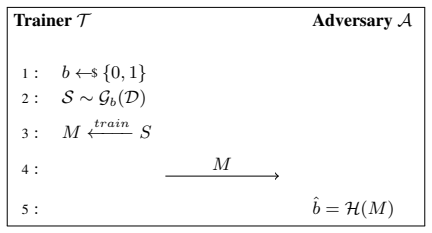
Fine-tuning under equalized odds on complementary distributions bounds adversarial advantage in distribution inference attacks
A machine-rendered reading of the paper's core claim, the machinery that carries it, and where it could break.
Core claim
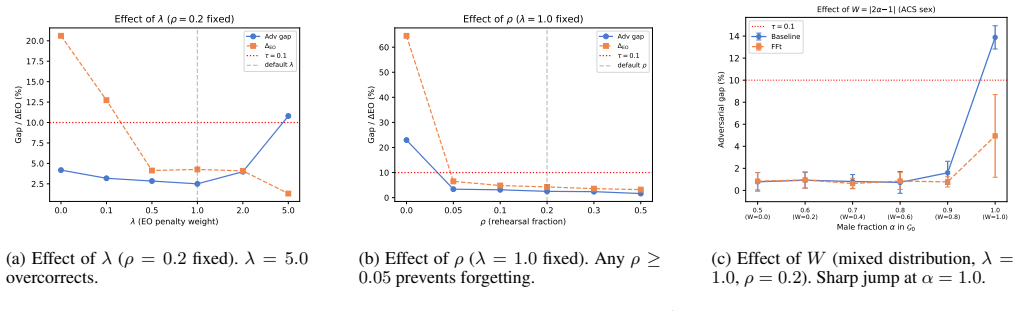
Fair Fine-tuning (FFt) achieves Adv(A, M_f) ≤ Δ_EO · W with the bound proven tight, where W quantifies distinguishability of the two training distributions by their sensitive-attribute composition, and a necessary condition for reducing adversarial advantage is established.
What carries the argument
The bound Adv(A, M_f) ≤ Δ_EO · W that directly connects a model's equalized odds disparity to its advantage in the distribution inference attack game
If this is right
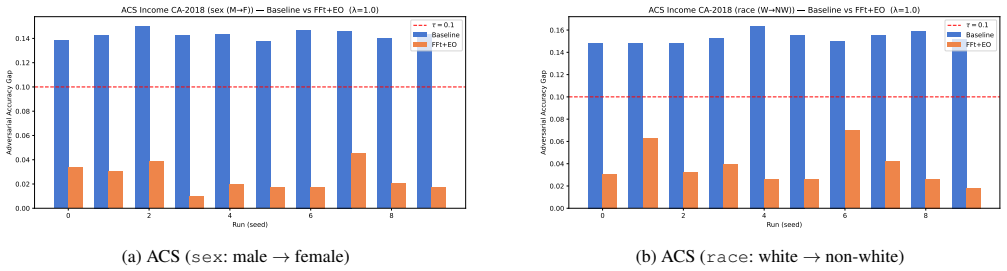
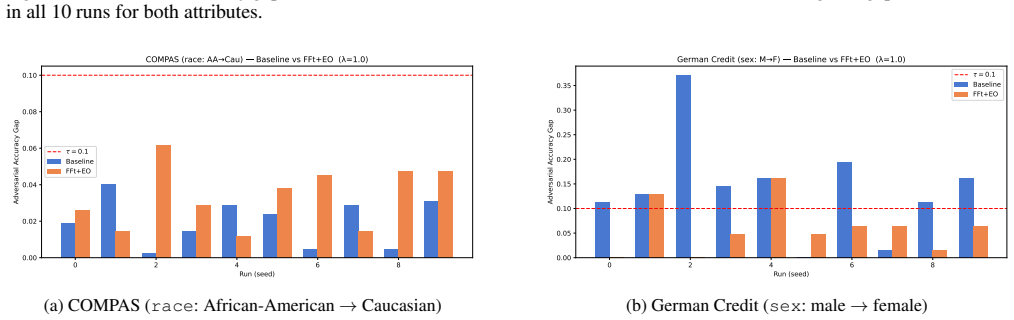
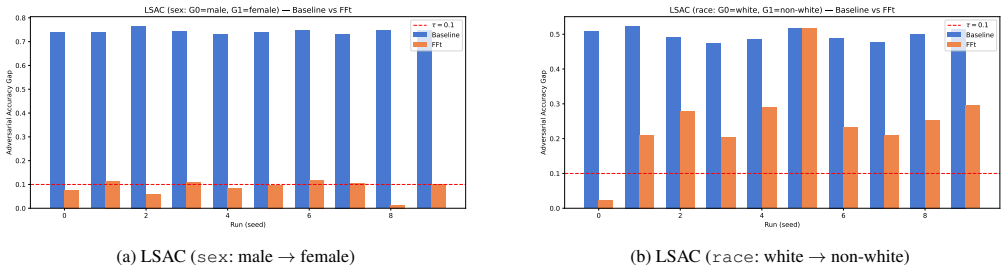
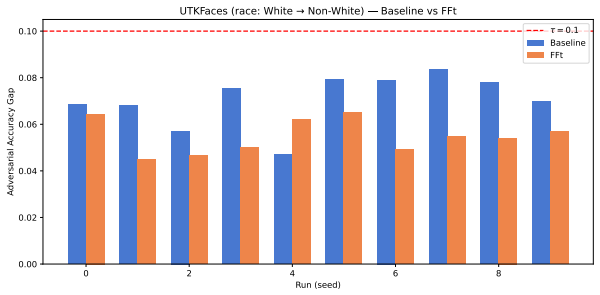
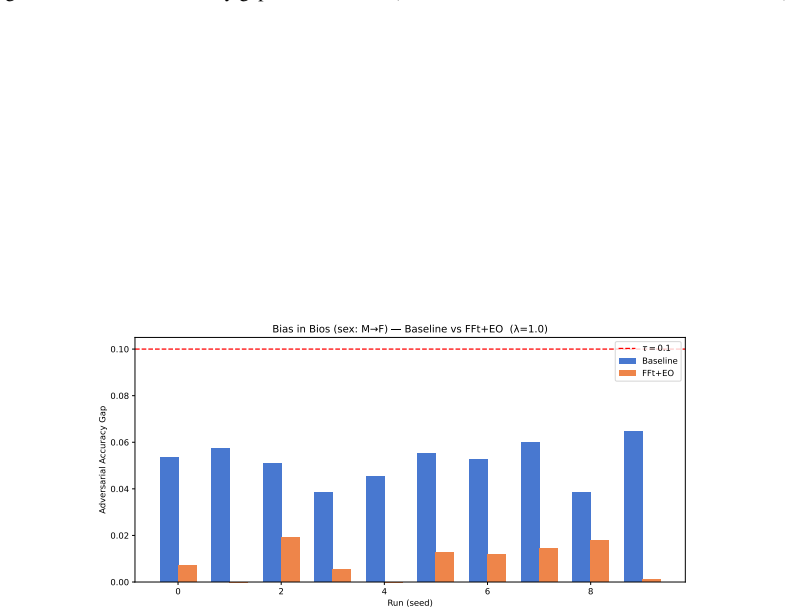
- The adversarial accuracy gap falls below the 0.1 detection threshold across six datasets spanning tabular, image, and text data
- Rehearsal-based FFt reduces the gap from roughly 15 percent to under 4 percent on ACS Income
- The bound supplies the first formal connection between measured equalized odds disparity and adversarial advantage in the DIA setting
Where Pith is reading between the lines
- Fairness constraints might serve as privacy tools against other distributional leakage risks
- Methods to approximate the complementary distribution could broaden applicability when direct samples are unavailable
- Similar bounds may hold for fairness notions other than equalized odds
Load-bearing premise
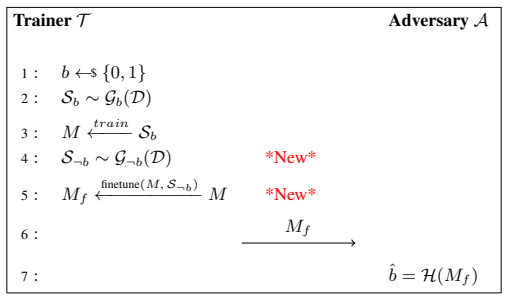
Samples from the complementary distribution with inverted sensitive-attribute proportions can be accessed or approximated during fine-tuning
What would settle it
A case where the adversarial advantage after applying FFt exceeds Δ_EO · W would disprove the bound
Figures
read the original abstract
Machine learning models trained on sensitive data can inadvertently leak population-level information about their training distributions -- a threat known as distribution inference attack (DIA). An adversary with black-box access can infer sensitive demographic properties, such as subgroup proportions, without observing any training data directly. While defenses such as differential privacy and property unlearning have been proposed, the link between fairness constraints and distributional leakage remains unexplored. We propose Fair Fine-tuning (FFt): a trained model is fine-tuned on samples from the complementary distribution under an Equalized Odds (EO) constraint. We provide a complete theoretical characterization, proving the tight bound $\text{Adv}(\mathcal{A},M_f) \le \Delta_{\text{EO}} \cdot W$, where $W$ quantifies how distinguishable the two training distributions are by their sensitive-attribute composition. We also establish a necessary condition for FFt to reduce adversarial advantage and prove tightness of the bound. We evaluate across six datasets spanning tabular (ACS Income, COMPAS, German Credit), image (UTKFaces), and NLP (Bias in Bios) modalities. Rehearsal-based FFt consistently reduces the adversarial accuracy gap below the detection threshold $\tau!=!0.1$ across all settings; on ACS Income, the gap falls from $\sim!15%$ to under $4%$. Our work provides the first formal bound connecting a model's measured EO disparity directly to its adversarial advantage in the DIA game, opening a new avenue for unified fairness-and-privacy defenses.
Editorial analysis
A structured set of objections, weighed in public.
Referee Report
Summary. The paper proposes Fair Fine-tuning (FFt), which fine-tunes a pre-trained model on samples from a complementary distribution (with inverted sensitive-attribute proportions) subject to an Equalized Odds constraint, as a defense against distribution inference attacks (DIA). It claims a complete theoretical characterization including the tight bound Adv(A, M_f) ≤ Δ_EO · W (where W measures distinguishability of the two distributions by sensitive-attribute composition), a necessary condition for FFt to reduce adversarial advantage, and a proof of tightness. Empirical evaluation on six datasets (ACS Income, COMPAS, German Credit, UTKFaces, Bias in Bios) reports that rehearsal-based FFt reduces the adversarial accuracy gap below the τ=0.1 detection threshold.
Significance. If the bound and necessary condition are rigorously derived and the sampling assumption is non-circular, the work would establish the first formal link between a model's measured EO disparity and its vulnerability to DIA, enabling unified fairness-privacy defenses. The multi-modal evaluation across tabular, image, and NLP tasks is a concrete strength.
major comments (2)
- [Abstract and §3] Abstract and §3: the claim of a 'complete theoretical characterization' together with a 'tight bound' Adv(A,M_f) ≤ Δ_EO · W and a proof of tightness is not supported by any derivation steps, intermediate lemmas, or the precise formal definition of W inside the equations; W is introduced only descriptively as a distinguishability measure.
- [§3] §3 (FFt construction): the procedure is defined as fine-tuning on samples drawn from the complementary distribution D' under an EO constraint, yet no construction, approximation, or sampling method for D' is supplied that avoids already knowing the sensitive-attribute proportions the defense is intended to protect; this assumption is load-bearing for both the method and the claimed necessary condition for advantage reduction.
minor comments (2)
- [Experiments] Experiments section: results are reported without error bars or ablation studies on the complementary-sampling assumption.
- Notation: the symbol W is used without an explicit equation defining it in terms of the distributions or the adversary's advantage.
Simulated Author's Rebuttal
We thank the referee for the detailed and constructive report. We address each major comment below and indicate planned revisions to strengthen the manuscript.
read point-by-point responses
-
Referee: [Abstract and §3] Abstract and §3: the claim of a 'complete theoretical characterization' together with a 'tight bound' Adv(A,M_f) ≤ Δ_EO · W and a proof of tightness is not supported by any derivation steps, intermediate lemmas, or the precise formal definition of W inside the equations; W is introduced only descriptively as a distinguishability measure.
Authors: We agree that the main text would benefit from greater explicitness. The appendix contains the full proofs, including intermediate lemmas establishing the bound Adv(A, M_f) ≤ Δ_EO · W, the formal definition of W as the total variation distance between the sensitive-attribute marginals of the original and complementary distributions, and the argument for tightness. In the revision we will move the key derivation steps and the precise definition of W into Section 3. revision: yes
-
Referee: [§3] §3 (FFt construction): the procedure is defined as fine-tuning on samples drawn from the complementary distribution D' under an EO constraint, yet no construction, approximation, or sampling method for D' is supplied that avoids already knowing the sensitive-attribute proportions the defense is intended to protect; this assumption is load-bearing for both the method and the claimed necessary condition for advantage reduction.
Authors: The construction assumes access to auxiliary data whose sensitive-attribute proportions are known independently (e.g., public census or benchmark datasets with different demographic balances). D' is then formed by reweighting or subsampling these auxiliary samples to realize the inverted proportions; no information about the private training distribution is required. We will add an explicit sampling procedure and a short discussion of auxiliary-data sources to Section 3. revision: partial
Circularity Check
No circularity detected in derivation chain
full rationale
The paper presents a theoretical bound Adv(A,M_f) ≤ Δ_EO · W as a proved characterization, with W defined externally as a distinguishability measure between training distributions based on sensitive-attribute composition. No quoted equations or steps in the abstract or description reduce this bound, the necessary condition for FFt, or any prediction to the inputs by construction. No self-definitional definitions, fitted parameters renamed as predictions, or load-bearing self-citations are exhibited. The assumption of access to a complementary distribution D' is a stated precondition of the method rather than a circular reduction within the mathematical derivation itself. The result is treated as self-contained against the provided definitions.
Axiom & Free-Parameter Ledger
axioms (2)
- domain assumption Equalized Odds is a well-defined, enforceable constraint during fine-tuning
- domain assumption The two training distributions differ only in sensitive-attribute composition in a quantifiable way captured by W
Reference graph
Works this paper leans on
-
[1]
Distribution Inference Risks: Identifying and Mitigating Sources of Leakage , year=
Hartmann, Valentin and Meynent, Léo and Peyrard, Maxime and Dimitriadis, Dimitrios and Tople, Shruti and West, Robert , booktitle=. Distribution Inference Risks: Identifying and Mitigating Sources of Leakage , year=
-
[2]
ArXiv , year=
Formalizing and Estimating Distribution Inference Risks , author=. ArXiv , year=
-
[3]
Privacy risk in machine learning: Analyzing the connection to overfitting
Yeom, Samuel and Giacomelli, Irene and Fredrikson, Matt and Jha, Somesh , booktitle =. 2018 , volume =. doi:10.1109/CSF.2018.00027 , url =
-
[4]
Property Inference from Poisoning , year=
Mahloujifar, Saeed and Ghosh, Esha and Chase, Melissa , booktitle=. Property Inference from Poisoning , year=
-
[5]
Suri, Anshuman and Lu, Yifu and Chen, Yanjin and Evans, David , booktitle =. 2023 , volume =. doi:10.1109/SaTML54575.2023.00019 , url =
-
[6]
, title =
Tople, Shruti and Sharma, Amit and Nori, Aditya V. , title =. Proceedings of the 37th International Conference on Machine Learning , articleno =. 2020 , publisher =
2020
-
[7]
Proceedings of the 2018 International Conference on Management of Data , pages =
Cormode, Graham and Jha, Somesh and Kulkarni, Tejas and Li, Ninghui and Srivastava, Divesh and Wang, Tianhao , title =. Proceedings of the 2018 International Conference on Management of Data , pages =. 2018 , isbn =. doi:10.1145/3183713.3197390 , abstract =
-
[8]
1996 , howpublished =
Becker, Barry and Kohavi, Ronny , title =. 1996 , howpublished =
1996
-
[9]
, title =
Wightman, Linda F. , title =. 1998 , type =
1998
-
[10]
Retiring
Ding, Frances and Hardt, Moritz and Miller, John and Schmidt, Ludwig , booktitle =. Retiring
-
[11]
Proceedings of the Third Conference on Theory of Cryptography , pages =
Dwork, Cynthia and McSherry, Frank and Nissim, Kobbi and Smith, Adam , title =. Proceedings of the Third Conference on Theory of Cryptography , pages =. 2006 , isbn =. doi:10.1007/11681878_14 , abstract =
-
[12]
Brendan and Mironov, Ilya and Talwar, Kunal and Zhang, Li , title =
Abadi, Martin and Chu, Andy and Goodfellow, Ian and McMahan, H. Brendan and Mironov, Ilya and Talwar, Kunal and Zhang, Li , title =. Proceedings of the 2016 ACM SIGSAC Conference on Computer and Communications Security , pages =. 2016 , isbn =. doi:10.1145/2976749.2978318 , abstract =
-
[13]
, title =
Chaudhuri, Kamalika and Monteleoni, Claire and Sarwate, Anand D. , title =. J. Mach. Learn. Res. , month = jul, pages =. 2011 , issue_date =
2011
-
[14]
Proceedings of the 36th International Conference on Neural Information Processing Systems , articleno =
Tran, Cuong and Fioretto, Ferdinando and Kim, Jung-Eun and Naidu, Rakshit , title =. Proceedings of the 36th International Conference on Neural Information Processing Systems , articleno =. 2022 , isbn =
2022
-
[15]
Hu, Hongsheng and Salcic, Zoran and Sun, Lichao and Dobbie, Gillian and Yu, Philip S. and Zhang, Xuyun , title =. ACM Comput. Surv. , month = sep, articleno =. 2022 , issue_date =. doi:10.1145/3523273 , abstract =
-
[16]
Proceedings of the 2022 ACM Conference on Fairness, Accountability, and Transparency , pages =
Zhang, Wanrong and Ohrimenko, Olga and Cummings, Rachel , title =. Proceedings of the 2022 ACM Conference on Fairness, Accountability, and Transparency , pages =. 2022 , isbn =. doi:10.1145/3531146.3533139 , abstract =
-
[17]
Shokri, Reza and Stronati, Marco and Song, Congzheng and Shmatikov, Vitaly , booktitle =. 2017 , volume =. doi:10.1109/SP.2017.41 , url =
-
[18]
International Conference on Learning Representations , year=
mixup: Beyond Empirical Risk Minimization , author=. International Conference on Learning Representations , year=
-
[19]
Salem, Ahmed and Cherubin, Giovanni and Evans, David and Kopf, Boris and Paverd, Andrew and Suri, Anshuman and Tople, Shruti and Zanella-Beguelin, Santiago , booktitle =. 2023 , volume =. doi:10.1109/SP46215.2023.10179281 , url =
-
[20]
Proceedings of the 30th International Conference on Neural Information Processing Systems , pages =
Hardt, Moritz and Price, Eric and Srebro, Nathan , title =. Proceedings of the 30th International Conference on Neural Information Processing Systems , pages =. 2016 , isbn =
2016
-
[21]
Proceedings of the 20th International Conference on Security and Cryptography - SECRYPT , year=
Joshua Stock and Jens Wettlaufer and Daniel Demmler and Hannes Federrath , title=. Proceedings of the 20th International Conference on Security and Cryptography - SECRYPT , year=. doi:10.5220/0012049200003555 , isbn=
-
[22]
Companion Proceedings of the ACM Web Conference 2024 , pages =
Xu, Yichang and Yin, Ming and Fang, Minghong and Gong, Neil Zhenqiang , title =. Companion Proceedings of the ACM Web Conference 2024 , pages =. 2024 , isbn =. doi:10.1145/3589335.3651555 , abstract =
-
[23]
Dongxiao Yu and Hengming Zhang and Yan Huang and Zhenzhen Xie , keywords =. Data distribution inference attack in federated learning via reinforcement learning support , journal =. 2025 , issn =. doi:https://doi.org/10.1016/j.hcc.2024.100235 , url =
-
[24]
33rd USENIX Security Symposium (USENIX Security 24) , year =
Sayedeh Leila Noorbakhsh and Binghui Zhang and Yuan Hong and Binghui Wang , title =. 33rd USENIX Security Symposium (USENIX Security 24) , year =
-
[25]
ArXiv , year=
Privacy Inference Attacks and Defenses in Cloud-based Deep Neural Network: A Survey , author=. ArXiv , year=
-
[26]
ProPublica , year =
Machine Bias , author =. ProPublica , year =
-
[27]
Proceedings of the 31st ACM SIGMOD-SIGACT-SIGAI Symposium on Principles of Database Systems (PODS) , year =
Kifer, Daniel and Machanavajjhala, Ashwin , title =. Proceedings of the 31st ACM SIGMOD-SIGACT-SIGAI Symposium on Principles of Database Systems (PODS) , year =
-
[28]
IEEE European Symposium on Security and Privacy (EuroS&P) , year =
Chang, Hongyan and Shokri, Reza , title =. IEEE European Symposium on Security and Privacy (EuroS&P) , year =
-
[29]
2019 , institution =
Dua, Dheeru and Graff, Casey , title =. 2019 , institution =
2019
-
[30]
Proceedings of the Conference on Fairness, Accountability, and Transparency (FAccT) , year =
De-Arteaga, Maria and Romanov, Alexey and Wallach, Hanna and Chayes, Jennifer and Borgs, Christian and Chouldechova, Alexandra and Geyik, Sahin and Kenthapadi, Krishnaram and Kalai, Adam Tauman , title =. Proceedings of the Conference on Fairness, Accountability, and Transparency (FAccT) , year =
-
[31]
Proceedings of the IEEE Conference on Computer Vision and Pattern Recognition (CVPR) , year =
Zhang, Zhifei and Song, Yang and Qi, Hairong , title =. Proceedings of the IEEE Conference on Computer Vision and Pattern Recognition (CVPR) , year =
-
[33]
Communication, Simulation, and Intelligent Agents: Implications of Personal Intelligent Machines for Medical Education
Clancey, William J. Communication, Simulation, and Intelligent Agents: Implications of Personal Intelligent Machines for Medical Education. Proceedings of the Eighth International Joint Conference on Artificial Intelligence (IJCAI-83)
-
[34]
Classification Problem Solving
Clancey, William J. Classification Problem Solving. Proceedings of the Fourth National Conference on Artificial Intelligence
-
[35]
, title =
Robinson, Arthur L. , title =. 1980 , doi =. https://science.sciencemag.org/content/208/4447/1019.full.pdf , journal =
1980
-
[36]
New Ways to Make Microcircuits Smaller---Duplicate Entry
Robinson, Arthur L. New Ways to Make Microcircuits Smaller---Duplicate Entry. Science
-
[37]
Clancey and Glenn Rennels , abstract =
Diane Warner Hasling and William J. Clancey and Glenn Rennels , abstract =. Strategic explanations for a diagnostic consultation system , journal =. 1984 , issn =. doi:https://doi.org/10.1016/S0020-7373(84)80003-6 , url =
-
[38]
and Rennels, Glenn R
Hasling, Diane Warner and Clancey, William J. and Rennels, Glenn R. and Test, Thomas. Strategic Explanations in Consultation---Duplicate. The International Journal of Man-Machine Studies
-
[39]
Poligon: A System for Parallel Problem Solving
Rice, James. Poligon: A System for Parallel Problem Solving
-
[40]
Transfer of Rule-Based Expertise through a Tutorial Dialogue
Clancey, William J. Transfer of Rule-Based Expertise through a Tutorial Dialogue
-
[41]
The Engineering of Qualitative Models
Clancey, William J. The Engineering of Qualitative Models
-
[42]
2017 , eprint=
Attention Is All You Need , author=. 2017 , eprint=
2017
-
[43]
Pluto: The 'Other' Red Planet
NASA. Pluto: The 'Other' Red Planet
-
[44]
B.; Mironov, I.; Talwar, K.; and Zhang, L
Abadi, M.; Chu, A.; Goodfellow, I.; McMahan, H. B.; Mironov, I.; Talwar, K.; and Zhang, L. 2016. Deep Learning with Differential Privacy. In Proceedings of the 2016 ACM SIGSAC Conference on Computer and Communications Security, CCS '16, 308–318. New York, NY, USA: Association for Computing Machinery. ISBN 9781450341394
2016
-
[45]
Angwin, J.; Larson, J.; Mattu, S.; and Kirchner, L. 2016. Machine Bias. ProPublica
2016
-
[46]
Chang, H.; and Shokri, R. 2021. On the Privacy Risks of Algorithmic Fairness. In IEEE European Symposium on Security and Privacy (EuroS&P), 292--303
2021
-
[47]
Chaudhuri, K.; Monteleoni, C.; and Sarwate, A. D. 2011. Differentially Private Empirical Risk Minimization. J. Mach. Learn. Res., 12(null): 1069–1109
2011
-
[48]
Cormode, G.; Jha, S.; Kulkarni, T.; Li, N.; Srivastava, D.; and Wang, T. 2018. Privacy at Scale: Local Differential Privacy in Practice. In Proceedings of the 2018 International Conference on Management of Data, SIGMOD '18, 1655–1658. New York, NY, USA: Association for Computing Machinery. ISBN 9781450347037
2018
-
[49]
De-Arteaga, M.; Romanov, A.; Wallach, H.; Chayes, J.; Borgs, C.; Chouldechova, A.; Geyik, S.; Kenthapadi, K.; and Kalai, A. T. 2019. Bias in Bios: A Case Study of Semantic Representation Bias in a High-Stakes Setting. In Proceedings of the Conference on Fairness, Accountability, and Transparency (FAccT), 120--128
2019
-
[50]
Ding, F.; Hardt, M.; Miller, J.; and Schmidt, L. 2021. Retiring Adult : New Datasets for Fair Machine Learning. In Advances in Neural Information Processing Systems, volume 34, 6478--6490
2021
-
[51]
Dua, D.; and Graff, C. 2019. UCI Machine Learning Repository
2019
-
[52]
Dwork, C.; McSherry, F.; Nissim, K.; and Smith, A. 2006. Calibrating noise to sensitivity in private data analysis. In Proceedings of the Third Conference on Theory of Cryptography, TCC'06, 265–284. Berlin, Heidelberg: Springer-Verlag. ISBN 3540327312
2006
-
[53]
Hardt, M.; Price, E.; and Srebro, N. 2016. Equality of opportunity in supervised learning. In Proceedings of the 30th International Conference on Neural Information Processing Systems, NIPS'16, 3323–3331. Red Hook, NY, USA: Curran Associates Inc. ISBN 9781510838819
2016
-
[54]
Hartmann, V.; Meynent, L.; Peyrard, M.; Dimitriadis, D.; Tople, S.; and West, R. 2023. Distribution Inference Risks: Identifying and Mitigating Sources of Leakage. In 2023 IEEE Conference on Secure and Trustworthy Machine Learning (SaTML), 136--149
2023
-
[55]
S.; and Zhang, X
Hu, H.; Salcic, Z.; Sun, L.; Dobbie, G.; Yu, P. S.; and Zhang, X. 2022. Membership Inference Attacks on Machine Learning: A Survey. ACM Comput. Surv., 54(11s)
2022
-
[56]
Kifer, D.; and Machanavajjhala, A. 2012. A Rigorous and Customizable Framework for Privacy. In Proceedings of the 31st ACM SIGMOD-SIGACT-SIGAI Symposium on Principles of Database Systems (PODS), 77--88
2012
-
[57]
Mahloujifar, S.; Ghosh, E.; and Chase, M. 2022. Property Inference from Poisoning. In 2022 IEEE Symposium on Security and Privacy (SP), 1120--1137
2022
-
[58]
L.; Zhang, B.; Hong, Y.; and Wang, B
Noorbakhsh, S. L.; Zhang, B.; Hong, Y.; and Wang, B. 2024. Inf2Guard : An Information-Theoretic Framework for Learning Privacy-Preserving Representations against Inference Attacks. In 33rd USENIX Security Symposium (USENIX Security 24), 2405--2422. Philadelphia, PA: USENIX Association. ISBN 978-1-939133-44-1
2024
-
[59]
Salem, A.; Cherubin, G.; Evans, D.; Kopf, B.; Paverd, A.; Suri, A.; Tople, S.; and Zanella-Beguelin, S. 2023. SoK: Let the Privacy Games Begin! A Unified Treatment of Data Inference Privacy in Machine Learning . In 2023 IEEE Symposium on Security and Privacy (SP), 327--345. Los Alamitos, CA, USA: IEEE Computer Society
2023
-
[60]
Shokri, R.; Stronati, M.; Song, C.; and Shmatikov, V. 2017. Membership Inference Attacks Against Machine Learning Models . In 2017 IEEE Symposium on Security and Privacy (SP), 3--18. Los Alamitos, CA, USA: IEEE Computer Society
2017
-
[61]
Stock, J.; Wettlaufer, J.; Demmler, D.; and Federrath, H. 2023. Lessons Learned: Defending Against Property Inference Attacks. In Proceedings of the 20th International Conference on Security and Cryptography - SECRYPT, 312--323. INSTICC, SciTePress. ISBN 978-989-758-666-8
2023
-
[62]
Suri, A.; and Evans, D. 2021. Formalizing and Estimating Distribution Inference Risks. ArXiv, abs/2109.06024
arXiv 2021
-
[63]
Suri, A.; Lu, Y.; Chen, Y.; and Evans, D. 2023. Dissecting Distribution Inference . In 2023 IEEE Conference on Secure and Trustworthy Machine Learning (SaTML), 150--164. Los Alamitos, CA, USA: IEEE Computer Society
2023
-
[64]
Tran, C.; Fioretto, F.; Kim, J.-E.; and Naidu, R. 2022. Pruning has a disparate impact on model accuracy. In Proceedings of the 36th International Conference on Neural Information Processing Systems, NIPS '22. Red Hook, NY, USA: Curran Associates Inc. ISBN 9781713871088
2022
-
[65]
Wightman, L. F. 1998. LSAC National Longitudinal Bar Passage Study. Research report, Law School Admission Council
1998
-
[66]
Xu, Y.; Yin, M.; Fang, M.; and Gong, N. Z. 2024. Robust Federated Learning Mitigates Client-side Training Data Distribution Inference Attacks. In Companion Proceedings of the ACM Web Conference 2024, WWW '24, 798–801. New York, NY, USA: Association for Computing Machinery. ISBN 9798400701726
2024
-
[67]
Yeom, S.; Giacomelli, I.; Fredrikson, M.; and Jha, S. 2018. Privacy Risk in Machine Learning: Analyzing the Connection to Overfitting . In 2018 IEEE 31st Computer Security Foundations Symposium (CSF), 268--282. Los Alamitos, CA, USA: IEEE Computer Society
2018
-
[68]
Yousefpour, A.; Shilov, I.; Sablayrolles, A.; Testuggine, D.; Prasad, K.; Malek, M.; Nguyen, J.; Ghosh, S.; Bharadwaj, A.; Zhao, J.; Fernandes, G.; Foley, S.; and Annamalai, A. 2021. Opacus: User-Friendly Differential Privacy Library in PyTorch . arXiv preprint arXiv:2109.12298
arXiv 2021
-
[69]
Yu, D.; Zhang, H.; Huang, Y.; and Xie, Z. 2025. Data distribution inference attack in federated learning via reinforcement learning support. High-Confidence Computing, 5(1): 100235
2025
-
[70]
Zhang, W.; Ohrimenko, O.; and Cummings, R. 2022. Attribute Privacy: Framework and Mechanisms. In Proceedings of the 2022 ACM Conference on Fairness, Accountability, and Transparency, FAccT '22, 757–766. New York, NY, USA: Association for Computing Machinery. ISBN 9781450393522
2022
-
[71]
Zhang, X.; Chen, C.; Xie, Y.; Chen, X.; Zhang, J.; and Xiang, Y. 2021. Privacy Inference Attacks and Defenses in Cloud-based Deep Neural Network: A Survey. ArXiv, abs/2105.06300
arXiv 2021
-
[72]
Zhang, Z.; Song, Y.; and Qi, H. 2017. Age Progression/Regression by Conditional Adversarial Autoencoder. In Proceedings of the IEEE Conference on Computer Vision and Pattern Recognition (CVPR)
2017
discussion (0)
Sign in with ORCID, Apple, or X to comment. Anyone can read and Pith papers without signing in.