Reduce dimensional quantum criticality for Non-Fermi liquids
Pith reviewed 2026-06-28 12:39 UTC · model grok-4.3
The pith
Placing bosons in a (d+1)-dimensional bulk and fermions on a d-dimensional boundary renders tree-level exchanges finite and reduces log-squared and log-cubed divergences to single logs in non-Fermi liquid models.
A machine-rendered reading of the paper's core claim, the machinery that carries it, and where it could break.
Core claim
In the reduced-dimension scheme, bosonic fields reside in a (d+1)-dimensional bulk while fermionic fields are confined on a d-dimensional boundary. This dimensional separation makes the tree-level boson exchange contributions finite. Furthermore, the log squared and log cubed divergences that characterize one-loop four-fermion interactions in conventional treatments are reduced to logarithmic divergences, substantially improving the convergence properties of the perturbative expansion and allowing controlled theoretical analysis of NFL physics.
What carries the argument
The reduced-dimension scheme that confines fermions to a d-dimensional boundary and bosons to a (d+1)-dimensional bulk.
If this is right
- Tree-level boson exchange contributions become finite rather than logarithmically divergent.
- One-loop four-fermion interactions exhibit only logarithmic divergences instead of log squared and log cubed terms.
- The perturbative expansion for non-Fermi liquid behavior acquires improved convergence properties.
- Renormalization group analysis of gapless boson-fermion coupling near quantum phase transitions becomes tractable.
Where Pith is reading between the lines
- The same dimensional mismatch could be tested on other gapless fermion-boson models to check whether divergence reduction is generic.
- If the resulting effective couplings remain stable under higher-loop corrections, the scheme might yield concrete predictions for specific heat or resistivity in candidate materials.
- One could examine whether the boundary fermions inherit any new symmetry constraints from the bulk propagation that standard treatments miss.
Load-bearing premise
Separating the spatial dimensions of bosons and fermions this way produces a model of finite-density quantum field theories that does not introduce uncontrolled artifacts into the non-Fermi liquid physics.
What would settle it
An explicit one-loop calculation of the four-fermion vertex in both the standard (d+1)-dimensional theory and the reduced-dimension scheme, verifying whether the highest power of the logarithm drops from three to one.
Figures
read the original abstract
We present a reduced dimension theoretical framework for studying quantum field theories at finite density, providing a tractable model for investigating non-Fermi liquid (NFL) behavior near quantum phase transitions. Our approach departs from the standard paradigm by placing bosons and fermions in different spatial dimensions: bosonic fields reside in a $(d+1)$-dimensional bulk, while fermionic fields are confined on a $d$-dimensional boundary. This dimensional separation significantly simplifies the renormalization group (RG) analysis of gapless boson-fermion coupling. We demonstrate that the tree-level boson exchange contributions, which typically exhibit logarithmic divergences, become finite in our reduced-dimension scheme. Furthermore, the $\log^2$ and $\log^3$ divergences that characterize 1-loop four-fermion interactions in conventional treatments are reduced to logarithmic divergences within this framework, substantially improving the convergence properties of the perturbative expansion and allowing controlled theoretical analysis of NFL physics.
Editorial analysis
A structured set of objections, weighed in public.
Referee Report
Summary. The manuscript proposes a reduced-dimension framework for finite-density QFTs and NFL physics near quantum phase transitions. Bosons reside in a (d+1)-dimensional bulk while fermions are confined to a d-dimensional boundary; the authors claim this renders tree-level boson-exchange diagrams finite and reduces the characteristic log² and log³ divergences of one-loop four-fermion vertices to ordinary logarithmic divergences, thereby improving the convergence of the perturbative RG expansion.
Significance. If the dimensional mismatch preserves the IR scaling, Fermi-surface kinematics, and Landau damping of conventional NFL models, the framework would supply a controlled perturbative window into a class of problems that are otherwise intractable. The explicit reduction of higher-order divergences is a concrete technical improvement whose utility depends on the physical fidelity of the setup.
major comments (2)
- [Abstract (central claim paragraph)] The central claim that the reduced-dimension construction yields the same NFL fixed-point structure as the standard d-dimensional theory is not supported by any explicit comparison of scaling dimensions or boson propagator momentum dependence. The extra bulk dimension necessarily modifies the phase space for momentum transfer parallel to the Fermi surface and the form of Landau damping; without a calculation showing that these modifications leave the IR exponents unchanged, the perturbative improvement cannot be claimed to describe the original physical problem.
- [Abstract (divergence-reduction statement)] No derivation is supplied demonstrating that the tree-level boson exchange remains finite while the four-fermion vertex retains the same marginality or relevance as in the equal-dimension case. The reduction of log²/log³ to log is presented as a direct geometric consequence, yet the altered dispersion or |q|-power in the bulk propagator could shift the power counting and invalidate the comparison.
minor comments (2)
- The title contains a grammatical error ('Reduce dimensional' should read 'Reduced-dimensional').
- The abstract does not specify the range of d for which the construction is intended or whether explicit results are given for d=2 or d=3.
Simulated Author's Rebuttal
We thank the referee for the detailed report and the opportunity to clarify our work. We address the major comments below and will revise the manuscript accordingly to strengthen the presentation of our results.
read point-by-point responses
-
Referee: [Abstract (central claim paragraph)] The central claim that the reduced-dimension construction yields the same NFL fixed-point structure as the standard d-dimensional theory is not supported by any explicit comparison of scaling dimensions or boson propagator momentum dependence. The extra bulk dimension necessarily modifies the phase space for momentum transfer parallel to the Fermi surface and the form of Landau damping; without a calculation showing that these modifications leave the IR exponents unchanged, the perturbative improvement cannot be claimed to describe the original physical problem.
Authors: We clarify that our manuscript proposes a new framework as a tractable model for NFL physics, rather than claiming exact equivalence to the standard theory in all aspects. The dimensional reduction is motivated by preserving the d-dimensional Fermi surface kinematics for the fermions while allowing the bosons to propagate in an extra dimension, which modifies the propagator but maintains the qualitative Landau damping from the particle-hole continuum. However, we agree that an explicit comparison of the scaling dimensions and IR exponents would be valuable to demonstrate the fidelity of the model. We will add such a calculation in the revised version. revision: yes
-
Referee: [Abstract (divergence-reduction statement)] No derivation is supplied demonstrating that the tree-level boson exchange remains finite while the four-fermion vertex retains the same marginality or relevance as in the equal-dimension case. The reduction of log²/log³ to log is presented as a direct geometric consequence, yet the altered dispersion or |q|-power in the bulk propagator could shift the power counting and invalidate the comparison.
Authors: The divergence reduction is a direct consequence of the dimensional mismatch, as the integration over the extra bulk momentum regularizes the tree-level diagram, making it finite. For the one-loop four-fermion vertex, the power counting is altered by the bulk boson propagator, reducing the degree of divergence. We acknowledge that the manuscript presents this as a geometric effect without a full step-by-step derivation in the abstract, but the full text includes the relevant calculations. To address the concern about possible shifts in power counting, we will include an explicit derivation of the power counting in the revised manuscript to confirm that the marginality is preserved. revision: yes
Circularity Check
No circularity: new dimensional ansatz yields explicit divergence reduction by direct calculation
full rationale
The paper introduces a boundary-bulk dimensional mismatch as an explicit modeling choice and then computes its consequences for boson exchange and four-fermion diagrams. The reduction of log²/log³ divergences to single logs follows immediately from the extra integration dimension available to the boson propagator; this is a straightforward phase-space effect of the stated setup rather than a redefinition or fit of the target NFL quantities. No self-citations are invoked to justify uniqueness or to close the derivation, and the central claims are not equivalent to the inputs by construction. The framework is therefore self-contained against external benchmarks.
Axiom & Free-Parameter Ledger
Reference graph
Works this paper leans on
-
[1]
Reduce dimensional quantum criticality for Non-Fermi liquids
and so on, shown something in common: the presence of a superconducting dome near the QCP. In order to reveal the exact location of this QCP is required to sup- press superconductivity by tuning the control parameter to its critical value e.g. by strong magnetic field. The theoretical approach to understanding NFL typ- ically employs effective low-energy ...
work page internal anchor Pith review Pith/arXiv arXiv 2026
-
[2]
For simplicity, the caseL= 0 was used, and the integral was treated in a Wilsonian approach by integrating out only the fast bosonic modes over the momentum shell (Λ−dΛ)< q < Λ
It has been shown in [23] that there is a logarithmic divergence embedded in this tree-level propagator, which is revealed by decomposing the propagator into angular momentum harmonics VL = 1 2 Z 1 −1 d(cosθ)V k,k′PL(cosθ),(11) whereθis the angle betweenkandk ′. For simplicity, the caseL= 0 was used, and the integral was treated in a Wilsonian approach by...
2019
-
[3]
The calculations below directly support the claims made in Section 2 regarding the finiteness of tree-level boson exchange and the absence of log 2 and log3 divergences at 1-loop
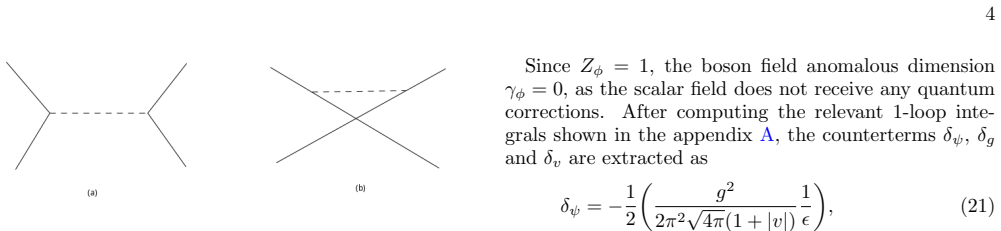
Absence of strong divergences in reduced-dimension framework This subsection demonstrates the crucial advantage of our reduced-dimension approach by explicitly comparing the degree of divergences in tree-level and 1-loop processes with those found in conventional treatments. The calculations below directly support the claims made in Section 2 regarding th...
-
[4]
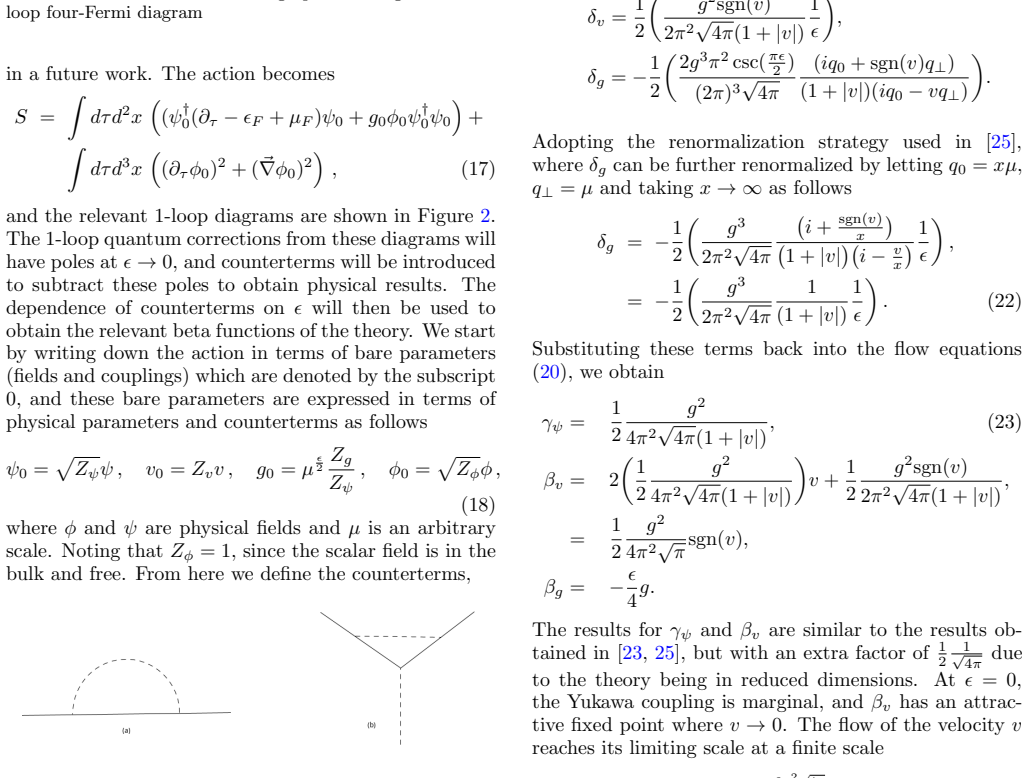
F ermion self-energy loop calculations This subsection presents the detailed calculation of the 1-loop fermion self-energy correction shown in Fig. 2(a). This diagram contributes to the fermion anomalous dimensionγ ψ and is essential for determining the renormalization group flow of the theory. The calculation employs dimensional regularization ind= 3−ϵdi...
-
[5]
1-loop vertex calculations for Y ukawa interactions This subsection presents the calculation of the 1-loop vertex correction to the Yukawa coupling shown in Fig. 2(b). This three-point function determines the renormalization of the Yukawa coupling constant and contributes to the beta functionβ g. The calculation demonstrates another instance where the red...
-
[6]
The Theory of a Fermi Liquid,
L. D. Landau, “The Theory of a Fermi Liquid,”Zh. Eksp. Teor. Fiz.30no. 6, (1956) 1058
1956
-
[7]
Sachdev,Quantum Phase Transitions
S. Sachdev,Quantum Phase Transitions. Cambridge University Press, 2 ed., 2011
2011
-
[8]
Fermi-liquid instabilities at magnetic quantum phase transitions,
H. v. L¨ ohneysen, A. Rosch, M. Vojta, and P. W¨ olfle, “Fermi-liquid instabilities at magnetic quantum phase transitions,”Rev. Mod. Phys.79(Aug, 2007) 1015–1075.https: //link.aps.org/doi/10.1103/RevModPhys.79.1015
-
[9]
Non-fermi-liquid behavior ind- and f-electron metals,
G. R. Stewart, “Non-fermi-liquid behavior ind- and f-electron metals,”Rev. Mod. Phys.73(Oct, 2001) 797–855.https: //link.aps.org/doi/10.1103/RevModPhys.73.797
-
[10]
What lies beneath the dome?,
D. Broun, “What lies beneath the dome?,”Nature Physics4no. 3, (2008) 170–172
2008
-
[11]
A quantum critical point lying beneath the superconducting dome in iron pnictides,
T. Shibauchi, A. Carrington, and Y. Matsuda, “A quantum critical point lying beneath the superconducting dome in iron pnictides,”Annu. Rev. Condens. Matter Phys.5no. 1, (2014) 113–135
2014
-
[12]
Quantum criticality in organic conductors? fermi liquid versus non-fermi-liquid behaviour,
M. Dressel, “Quantum criticality in organic conductors? fermi liquid versus non-fermi-liquid behaviour,”Journal of Physics: Condensed Matter23no. 29, (2011) 293201
2011
-
[13]
Heavy-fermion systems,
S. G. Stewart, “Heavy-fermion systems,”Reviews of Modern Physics56no. 4, (1984) 755
1984
-
[14]
R. Shankar, “Renormalization group for interacting fermions ind >1,”Physica A: Statistical Mechanics and its Applications177no. 1, (1991) 530–536. https://www.sciencedirect.com/science/article/ pii/037843719190197K
-
[15]
Effective Field Theory and the Fermi Surface
J. Polchinski, “Effective field theory and the fermi surface,” 1999. https://arxiv.org/abs/hep-th/9210046
work page internal anchor Pith review Pith/arXiv arXiv 1999
-
[16]
Renormalization-group approach to interacting fermions,
R. Shankar, “Renormalization-group approach to interacting fermions,”Rev. Mod. Phys.66(Jan, 1994) 129–192.https: //link.aps.org/doi/10.1103/RevModPhys.66.129
-
[17]
On finite-density qcd at large nc,
E. Shuster and D. Son, “On finite-density qcd at large nc,”Nuclear Physics B573no. 1–2, (May, 2000) 434–446. http://dx.doi.org/10.1016/S0550-3213(99)00615-X
-
[18]
Superconductivity due to massless boson exchange in the strong-coupling limit,
A. V. Chubukov and J. Schmalian, “Superconductivity due to massless boson exchange in the strong-coupling limit,”Phys. Rev. B72(Nov, 2005) 174520.https: //link.aps.org/doi/10.1103/PhysRevB.72.174520
-
[19]
Bcs superconductivity in quantum critical metals,
J.-H. She and J. Zaanen, “Bcs superconductivity in quantum critical metals,”Phys. Rev. B80(Nov, 2009) 184518.https: //link.aps.org/doi/10.1103/PhysRevB.80.184518
-
[20]
Renormalization group approach to low temperature properties of a non-fermi liquid metal,
C. Nayak and F. Wilczek, “Renormalization group approach to low temperature properties of a non-fermi liquid metal,”Nuclear Physics B430no. 3, (1994) 534–562. 10
1994
-
[21]
Superconductivity from perturbative one-gluon exchange in high density quark matter,
T. Sch¨ afer and F. Wilczek, “Superconductivity from perturbative one-gluon exchange in high density quark matter,”Phys. Rev. D60(Nov, 1999) 114033.https: //link.aps.org/doi/10.1103/PhysRevD.60.114033
-
[22]
Superconductivity at the onset of spin-density-wave order in a metal,
Y. Wang and A. V. Chubukov, “Superconductivity at the onset of spin-density-wave order in a metal,”Phys. Rev. Lett.110(Mar, 2013) 127001.https://link.aps. org/doi/10.1103/PhysRevLett.110.127001
-
[23]
Perturbative non-fermi liquids from dimensional regularization,
D. Dalidovich and S.-S. Lee, “Perturbative non-fermi liquids from dimensional regularization,”Phys. Rev. B 88(Dec, 2013) 245106.https: //link.aps.org/doi/10.1103/PhysRevB.88.245106
-
[24]
Low-energy effective theory of fermi surface coupled with u(1) gauge field in 2 + 1 dimensions,
S.-S. Lee, “Low-energy effective theory of fermi surface coupled with u(1) gauge field in 2 + 1 dimensions,” Phys. Rev. B80(Oct, 2009) 165102.https: //link.aps.org/doi/10.1103/PhysRevB.80.165102
-
[25]
Quantum critical metals ind= 3 + 1 dimensions,
R. Mahajan, D. M. Ramirez, S. Kachru, and S. Raghu, “Quantum critical metals ind= 3 + 1 dimensions,” Phys. Rev. B88(Sep, 2013) 115116.https: //link.aps.org/doi/10.1103/PhysRevB.88.115116
-
[26]
Quantum critical metals in $4-\epsilon$ dimensions
G. Torroba and H. Wang, “Quantum critical metals in 4−ϵdimensions,”Phys. Rev. B90no. 16, (2014) 165144,arXiv:1406.3029 [cond-mat.str-el]
work page internal anchor Pith review Pith/arXiv arXiv 2014
-
[27]
Non-fermi-liquid behavior of large-N B quantum critical metals,
A. L. Fitzpatrick, S. Kachru, J. Kaplan, and S. Raghu, “Non-fermi-liquid behavior of large-N B quantum critical metals,”Phys. Rev. B89(Apr, 2014) 165114.https: //link.aps.org/doi/10.1103/PhysRevB.89.165114
-
[28]
Enhanced pairing of quantum critical metals neard= 3 + 1,
A. L. Fitzpatrick, S. Kachru, J. Kaplan, S. Raghu, G. Torroba, and H. Wang, “Enhanced pairing of quantum critical metals neard= 3 + 1,”Phys. Rev. B 92(Jul, 2015) 045118.https: //link.aps.org/doi/10.1103/PhysRevB.92.045118
-
[29]
Slow fermions in quantum critical metals,
A. L. Fitzpatrick, S. Kachru, J. Kaplan, S. A. Kivelson, and S. Raghu, “Slow fermions in quantum critical metals,” 2014
2014
-
[30]
Aspects of renormalization in finite-density field theory,
A. L. Fitzpatrick, G. Torroba, and H. Wang, “Aspects of renormalization in finite-density field theory,” Physical Review B91no. 19, (May, 2015) . http://dx.doi.org/10.1103/PhysRevB.91.195135
-
[31]
O(N) models with boundary interactions and their long range generalizations,
S. Giombi and H. Khanchandani, “O(N) models with boundary interactions and their long range generalizations,”JHEP08no. 08, (2020) 010, arXiv:1912.08169 [hep-th]
-
[32]
Quantum critical point in graphene approached in the limit of infinitely strong coulomb interaction,
D. T. Son, “Quantum critical point in graphene approached in the limit of infinitely strong coulomb interaction,”Physical Review B75no. 23, (Jun, 2007) . http://dx.doi.org/10.1103/PhysRevB.75.235423
-
[33]
S. Teber and A. Kotikov, “Field theoretic renormalization study of reduced quantum electrodynamics and applications to the ultrarelativistic limit of dirac liquids,”Physical Review D97no. 7, (Apr, 2018) . http://dx.doi.org/10.1103/PhysRevD.97.074004
-
[34]
Dynamical chiral symmetry breaking on a brane in reduced qed,
E. V. Gorbar, V. P. Gusynin, and V. A. Miransky, “Dynamical chiral symmetry breaking on a brane in reduced qed,”Physical Review D64no. 10, (Oct, 2001) .http://dx.doi.org/10.1103/PhysRevD.64.105028
-
[35]
D. B. Kaplan, J.-W. Lee, D. T. Son, and M. A. Stephanov, “Conformality lost,”Physical Review D80 no. 12, (Dec, 2009) . http://dx.doi.org/10.1103/PhysRevD.80.125005
-
[36]
Metallic quantum critical points with finite BCS couplings
S. Raghu, G. Torroba, and H. Wang, “Metallic quantum critical points with finite BCS couplings,”Phys. Rev. B 92no. 20, (2015) 205104,arXiv:1507.06652 [cond-mat.str-el]
work page internal anchor Pith review Pith/arXiv arXiv 2015
-
[37]
D. B. Kaplan, J.-W. Lee, D. T. Son, and M. A. Stephanov, “Conformality lost,”Phys. Rev. D80 (2009) 125005,arXiv:0905.4752 [hep-th]
work page internal anchor Pith review Pith/arXiv arXiv 2009
-
[38]
Renormalization group theory of nematic ordering ind-wave superconductors,
Y. Huh and S. Sachdev, “Renormalization group theory of nematic ordering ind-wave superconductors,”Phys. Rev. B78(Aug, 2008) 064512.https: //link.aps.org/doi/10.1103/PhysRevB.78.064512
discussion (0)
Sign in with ORCID, Apple, or X to comment. Anyone can read and Pith papers without signing in.