Demonstration of a Spherical Penning Trap for Single Electrons
Pith reviewed 2026-06-28 07:31 UTC · model grok-4.3
The pith
A spherical Penning trap traps single electrons and yields clean microwave resonances for precision work.
A machine-rendered reading of the paper's core claim, the machinery that carries it, and where it could break.
Core claim
We demonstrate single-electron trapping in a spherical Penning trap and characterize its microwave resonance structure. The design, single-electron detection, microwave mode characterization, and advantages of this geometry are presented.
What carries the argument
The spherical Penning trap, a device that confines charged particles with combined electric and magnetic fields in spherical geometry to produce separated microwave resonances.
If this is right
- Single-electron detection becomes feasible inside the spherical geometry.
- Microwave modes can be mapped and used for controlled interactions with the trapped electron.
- The trap offers a path to reduced systematic errors in electron magnetic moment measurements.
- The same resonances support searches for dark photons or axions coupled to the electron.
Where Pith is reading between the lines
- The spherical design might reduce the number of electrodes needed compared with cylindrical traps, simplifying fabrication.
- Clean resonances could extend coherence times for quantum state manipulation of the trapped electron.
- The approach may generalize to precision experiments with other charged particles such as positrons.
Load-bearing premise
The spherical shape itself produces well-separated and clean microwave resonances without extra complications from the trap boundaries.
What would settle it
Observation of overlapping or broadened microwave resonances when a single electron is loaded into the spherical trap would show the geometry does not deliver the claimed separation.
Figures
read the original abstract
A spherical Penning trap has well-separated, clean microwave resonances, making it attractive for precision measurements of the electron magnetic moment and for dark-photon and axion searches with trapped electrons. We demonstrate single-electron trapping in a spherical Penning trap and characterize its microwave resonance structure. The design, single-electron detection, microwave mode characterization, and advantages of this geometry are presented.
Editorial analysis
A structured set of objections, weighed in public.
Referee Report
Summary. The manuscript claims to demonstrate single-electron trapping in a spherical Penning trap, along with characterization of its microwave resonance structure. It presents the trap design, single-electron detection method, microwave mode characterization, and argues that the geometry yields well-separated clean resonances advantageous for precision electron magnetic moment measurements and dark-photon/axion searches.
Significance. If the experimental results hold, the work supplies a new trap geometry with potentially cleaner microwave modes than conventional cylindrical designs, which could benefit g-factor metrology and trapped-electron searches for light dark matter. The direct demonstration of single-electron loading and resonance data constitutes the core contribution.
minor comments (2)
- The abstract states the demonstration but the main text should explicitly cross-reference the specific figures or sections containing the single-electron detection signals and resonance spectra to allow immediate evaluation of the central claim.
- Notation for the spherical trap parameters (e.g., electrode radii, applied voltages) should be defined once in §2 and used consistently thereafter to avoid ambiguity when comparing to cylindrical Penning trap literature.
Simulated Author's Rebuttal
We thank the referee for their supportive summary and recommendation of minor revision. The report does not enumerate any specific major comments, so we have no point-by-point responses to provide. We are prepared to address any minor editorial or clarification requests that may arise.
Circularity Check
No significant circularity; experimental demonstration only
full rationale
The paper reports an experimental demonstration of single-electron trapping and microwave resonance characterization in a spherical Penning trap. No derivation chain, predictions, parameter fits, or self-referential theoretical steps are present. Claims rest on direct measurements of design, detection, and modes, with no reduction of outputs to inputs by construction or self-citation load-bearing.
Axiom & Free-Parameter Ledger
Forward citations
Cited by 1 Pith paper
-
Single Electrons in a Dual-Plane Printed-Circuit-Board Penning Trap
Demonstrates single-electron trapping and detection in a two-dimensionally scalable dual-plane PCB Penning trap with characterization of loading, damping, temperature, and magnetron growth.
Reference graph
Works this paper leans on
-
[1]
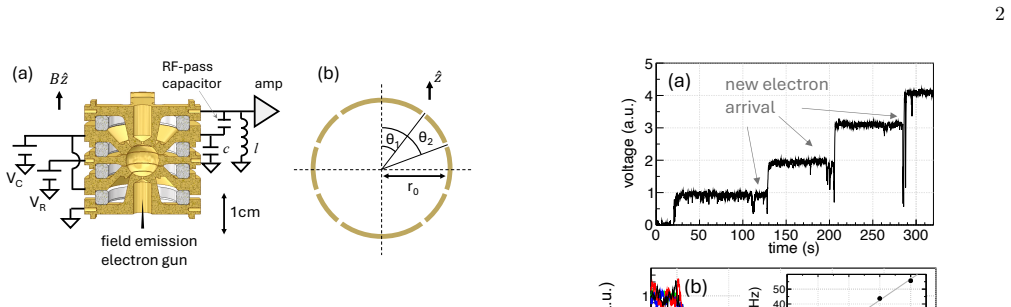
A helical inductor withl= 200 nH, made of oxygen- free high-conductivity copper, is attached to the top end- cap and compensation electrodes
(me: electron’s mass ande: ele- mentary charge). A helical inductor withl= 200 nH, made of oxygen- free high-conductivity copper, is attached to the top end- cap and compensation electrodes. These two electrodes are connected by a 5 nF RF-pass capacitor to collect image charge from both of them. Together with these electrodes’ parasitic capacitance to gro...
-
[2]
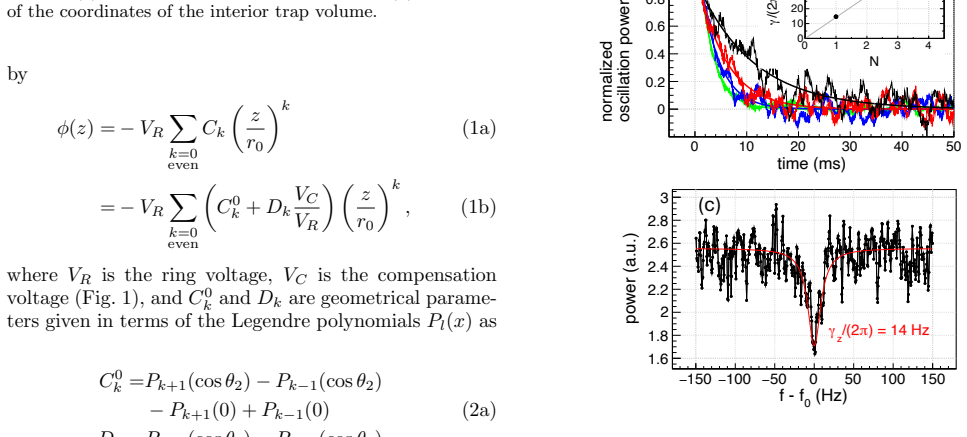
(Hz)π/(2γ (b) (c) 050100150200250300time (s)0 1 2 3 4 5voltage (a.u.) (a)new electronarrival FIG. 2. (a) Counting the number of loaded electrons by moni- toring the oscillation amplitude with a parametric drive while firing the electron gun. (b) Direct measurement ofγ=N γ z by exciting to a large amplitude and monitoring its decay. Different colors corres...
2023
-
[3]
4(c) shows the calculatedκ 2 for the demonstrated spherical trap as well as the enhancement factor used in the 2022 dark-photon search[6]
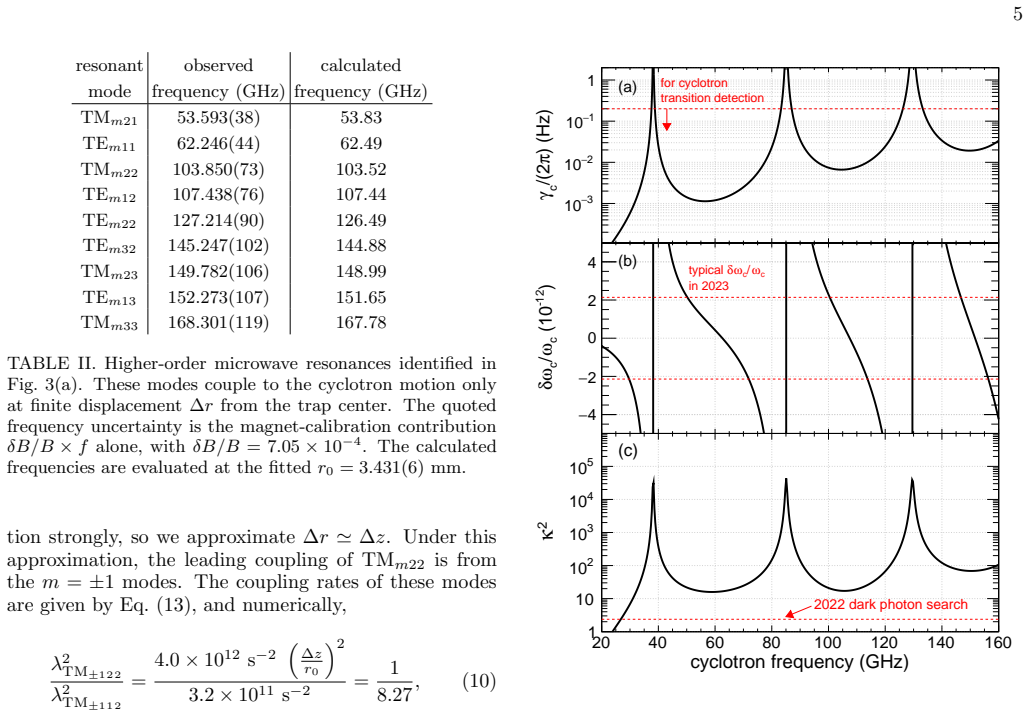
sin 2u′ 1p − 1 + cos(2u′ 1p) u′ 1p 2 −1 + cos(2u ′ 1p) 2 .(14) Fig. 4(c) shows the calculatedκ 2 for the demonstrated spherical trap as well as the enhancement factor used in the 2022 dark-photon search[6]. Over a wide frequency range,κ 2 is larger by 2–3 orders of magnitude in the spherical trap. Due to the scalingκ 2 ∝(r 0ωc/c)2, a larger spherical trap...
2022
-
[4]
Measurement of the electron magnetic moment,
X. Fan, T. G. Myers, B. A. D. Sukra, and G. Gabrielse, “Measurement of the electron magnetic moment,” Phys. Rev. Lett.130, 071801 (2023)
2023
-
[5]
New mea- surement of the electron magnetic moment and the fine structure constant,
D. Hanneke, S. Fogwell, and G. Gabrielse, “New mea- surement of the electron magnetic moment and the fine structure constant,” Phys. Rev. Lett.100, 120801 (2008)
2008
-
[6]
New measurement of the electron magnetic moment us- ing a one-electron quantum cyclotron,
B. Odom, D. Hanneke, B. D’Urso, and G. Gabrielse, “New measurement of the electron magnetic moment us- ing a one-electron quantum cyclotron,” Phys. Rev. Lett. 97, 030801 (2006)
2006
-
[7]
New high-precision comparison of electron 7 and positrongfactors,
Robert S. Van Dyck, Paul B. Schwinberg, and Hans G. Dehmelt, “New high-precision comparison of electron 7 and positrongfactors,” Phys. Rev. Lett.59, 26–29 (1987)
1987
-
[8]
Highly excited electron cyclotron for QCD axion and dark-photon detection,
Xing Fan, Gerald Gabrielse, Peter W. Graham, Harikr- ishnan Ramani, Samuel S. Y. Wong, and Yawen Xiao, “Highly excited electron cyclotron for QCD axion and dark-photon detection,” Phys. Rev. D111, 075022 (2025)
2025
-
[9]
One-electron quantum cyclotron as a milli-eV dark- photon detector,
Xing Fan, Gerald Gabrielse, Peter W. Graham, Roni Harnik, Thomas G. Myers, Harikrishnan Ramani, Bene- dict A. D. Sukra, Samuel S. Y. Wong, and Yawen Xiao, “One-electron quantum cyclotron as a milli-eV dark- photon detector,” Phys. Rev. Lett.129, 261801 (2022)
2022
-
[10]
A Penning trap single-photon counter for axion detection,
Jack A. Devlin, Marko L. Wojtkowiak, Shreyak R. Ban- hatti, He Zhang, Jiacheng Shi, Toren S. Dofher, Jonathan M. H. Gosling, Michael R. Tarbutt, and Richard C. Thompson, “A Penning trap single-photon counter for axion detection,” (2026), arXiv:2601.05472 [hep-ph]
arXiv 2026
-
[11]
High-precision calculation of the 4- loop contribution to the electrong−2 in QED,
Stefano Laporta, “High-precision calculation of the 4- loop contribution to the electrong−2 in QED,” Physics Letters B772, 232 – 238 (2017)
2017
-
[12]
Tenth-order electron anoma- lous magnetic moment: Contribution of diagrams with- out closed lepton loops,
Tatsumi Aoyama, Masashi Hayakawa, Toichiro Ki- noshita, and Makiko Nio, “Tenth-order electron anoma- lous magnetic moment: Contribution of diagrams with- out closed lepton loops,” Phys. Rev. D91, 033006 (2015)
2015
-
[13]
Revised and improved value of the QED tenth-order electron anomalous magnetic moment,
Tatsumi Aoyama, Toichiro Kinoshita, and Makiko Nio, “Revised and improved value of the QED tenth-order electron anomalous magnetic moment,” Phys. Rev. D97, 036001 (2018)
2018
-
[14]
Theory of the anomalous magnetic moment of the elec- tron,
Tatsumi Aoyama, Toichiro Kinoshita, and Makiko Nio, “Theory of the anomalous magnetic moment of the elec- tron,” Atoms7(2019), 10.3390/atoms7010028
-
[15]
Numerical calculation of high-order QED contributions to the electron anomalous magnetic moment,
Sergey Volkov, “Numerical calculation of high-order QED contributions to the electron anomalous magnetic moment,” Phys. Rev. D98, 076018 (2018)
2018
-
[16]
New method of computing the contri- butions of graphs without lepton loops to the electron anomalous magnetic moment in QED,
Sergey Volkov, “New method of computing the contri- butions of graphs without lepton loops to the electron anomalous magnetic moment in QED,” Phys. Rev. D96, 096018 (2017)
2017
-
[17]
Calculating the five-loop QED contri- bution to the electron anomalous magnetic moment: Graphs without lepton loops,
Sergey Volkov, “Calculating the five-loop QED contri- bution to the electron anomalous magnetic moment: Graphs without lepton loops,” Phys. Rev. D100, 096004 (2019)
2019
-
[18]
Calculation of lepton magnetic moments in quantum electrodynamics: A justification of the flex- ible divergence elimination method,
Sergey Volkov, “Calculation of lepton magnetic moments in quantum electrodynamics: A justification of the flex- ible divergence elimination method,” Phys. Rev. D109, 036012 (2024)
2024
-
[19]
QED five-loop on the lattice,
Ryuichiro Kitano, “QED five-loop on the lattice,” Progress of Theoretical and Experimental Physics2025, 013B02 (2025)
2025
-
[20]
Towards an improved test of the Standard Model’s most precise prediction,
G. Gabrielse, S. E. Fayer, T. G. Myers, and X. Fan, “Towards an improved test of the Standard Model’s most precise prediction,” Atoms7, 45 (2019)
2019
-
[21]
New determination of the fine-structure con- stant from the electrongvalue and QED,
G. Gabrielse, D. Hanneke, T. Kinoshita, M. Nio, and B. Odom, “New determination of the fine-structure con- stant from the electrongvalue and QED,” Phys. Rev. Lett.97, 030802 (2006)
2006
-
[22]
Determination of the fine-structure constant with an accuracy of 81 parts per trillion,
L´ eo Morel, Zhibin Yao, Pierre Clad´ e, and Sa¨ ıda Guellati- Kh´ elifa, “Determination of the fine-structure constant with an accuracy of 81 parts per trillion,” Nature (Lon- don)588, 61–65 (2020)
2020
-
[23]
Measurement of the fine- structure constant as a test of the Standard Model,
Richard H. Parker, Chenghui Yu, Weicheng Zhong, Brian Estey, and Holger M¨ uller, “Measurement of the fine- structure constant as a test of the Standard Model,” Sci- ence360, 191–195 (2018)
2018
-
[24]
Cyclotron motion in a microwave cav- ity: Lifetime and frequency shifts,
Lowell S. Brown, Gerald Gabrielse, Kristian Helmerson, and Joseph Tan, “Cyclotron motion in a microwave cav- ity: Lifetime and frequency shifts,” Phys. Rev. A32, 3204–3218 (1985)
1985
-
[25]
Cyclotron motion in a microwave cav- ity: Possible shifts of the measured electrongfactor,
Lowell S. Brown, Gerald Gabrielse, Kristian Helmerson, and Joseph Tan, “Cyclotron motion in a microwave cav- ity: Possible shifts of the measured electrongfactor,” Phys. Rev. Lett.55, 44–47 (1985)
1985
-
[26]
Cavity control of a single-electron quantum cyclotron: Measuring the electron magnetic moment,
D. Hanneke, S. Fogwell Hoogerheide, and G. Gabrielse, “Cavity control of a single-electron quantum cyclotron: Measuring the electron magnetic moment,” Phys. Rev. A83, 052122 (2011)
2011
-
[27]
thesis, Harvard University (2022)
Xing Fan,An improved measurement of the electron mag- netic moment, Ph.D. thesis, Harvard University (2022)
2022
-
[28]
Searching for WISPy cold dark matter with a dish an- tenna,
Dieter Horns, Joerg Jaeckel, Axel Lindner, Andrei Lobanov, Javier Redondo, and Andreas Ringwald, “Searching for WISPy cold dark matter with a dish an- tenna,” Journal of Cosmology and Astroparticle Physics 2013, 016–016 (2013)
2013
-
[29]
Cylindrical Penning traps with orthogonalized anharmonicity com- pensation,
Gerald Gabrielse and F.Colin Mackintosh, “Cylindrical Penning traps with orthogonalized anharmonicity com- pensation,” International Journal of Mass Spectrometry and Ion Processes57, 1–17 (1984)
1984
-
[30]
One electron in an or- thogonalized cylindrical Penning trap,
Joseph Tan and Gerald Gabrielse, “One electron in an or- thogonalized cylindrical Penning trap,” Applied Physics Letters55, 2144–2146 (1989)
1989
-
[31]
Cyclotron motion in a spherical microwave cavity,
Lowell S. Brown, Kristian Helmerson, and Joseph Tan, “Cyclotron motion in a spherical microwave cavity,” Phys. Rev. A34, 2638–2645 (1986)
1986
-
[32]
Hill,Electromagnetic fields in cavities: Deter- ministic and statistical theories(Wiley, 2009)
David A. Hill,Electromagnetic fields in cavities: Deter- ministic and statistical theories(Wiley, 2009)
2009
-
[33]
Principles of the stored ion calorimeter,
D. J. Wineland and H. G. Dehmelt, “Principles of the stored ion calorimeter,” Journal of Applied Physics46, 919–930 (1975)
1975
-
[34]
Parametrically pumped elec- tron oscillators,
J. Tan and G. Gabrielse, “Parametrically pumped elec- tron oscillators,” Phys. Rev. A48, 3105–3122 (1993)
1993
-
[35]
Synchronization of parametri- cally pumped electron oscillators with phase bistability,
J. Tan and G. Gabrielse, “Synchronization of parametri- cally pumped electron oscillators with phase bistability,” Phys. Rev. Lett.67, 3090–3093 (1991)
1991
-
[36]
Microwave-cavity modes directly observed in a Penning trap,
R. S. Van Dyck, F. L. Moore, D. L. Farnham, P. B. Schwinberg, and H. G. Dehmelt, “Microwave-cavity modes directly observed in a Penning trap,” Phys. Rev. A36, 3455–3456 (1987)
1987
-
[37]
Ultrastable superconducting magnet system for a Penning trap mass spectrometer,
Jr. Van Dyck, R. S., D. L. Farnham, S. L. Zafonte, and P. B. Schwinberg, “Ultrastable superconducting magnet system for a Penning trap mass spectrometer,” Review of Scientific Instruments70, 1665–1671 (1999)
1999
-
[38]
Gaseous 3He nuclear magnetic resonance probe for cryogenic envi- ronments,
X. Fan, S. E. Fayer, and G. Gabrielse, “Gaseous 3He nuclear magnetic resonance probe for cryogenic envi- ronments,” Review of Scientific Instruments90, 083107 (2019)
2019
-
[39]
Geonium theory: Physics of a single electron or ion in a Penning trap,
Lowell S. Brown and Gerald Gabrielse, “Geonium theory: Physics of a single electron or ion in a Penning trap,” Rev. Mod. Phys.58, 233–311 (1986)
1986
-
[40]
Single-particle self-excited oscillator,
B. D’Urso, R. Van Handel, B. Odom, D. Hanneke, and G. Gabrielse, “Single-particle self-excited oscillator,” Phys. Rev. Lett.94, 113002 (2005)
2005
-
[41]
Quantum-logic spectroscopy of an electron or positron for precise tests of the Standard Model,
Xing Fan, Atsushi Noguchi, and Kento Taniguchi, “Quantum-logic spectroscopy of an electron or positron for precise tests of the Standard Model,” Phys. Rev. A 111, 042806 (2025)
2025
discussion (0)
Sign in with ORCID, Apple, or X to comment. Anyone can read and Pith papers without signing in.