Evolution of the stellar mass function in open clusters from a universal and unsegregated initial state
Pith reviewed 2026-06-28 01:03 UTC · model grok-4.3
The pith
Young open clusters share a universal IMF slope of -2.29 with minimal early mass segregation.
A machine-rendered reading of the paper's core claim, the machinery that carries it, and where it could break.
Core claim
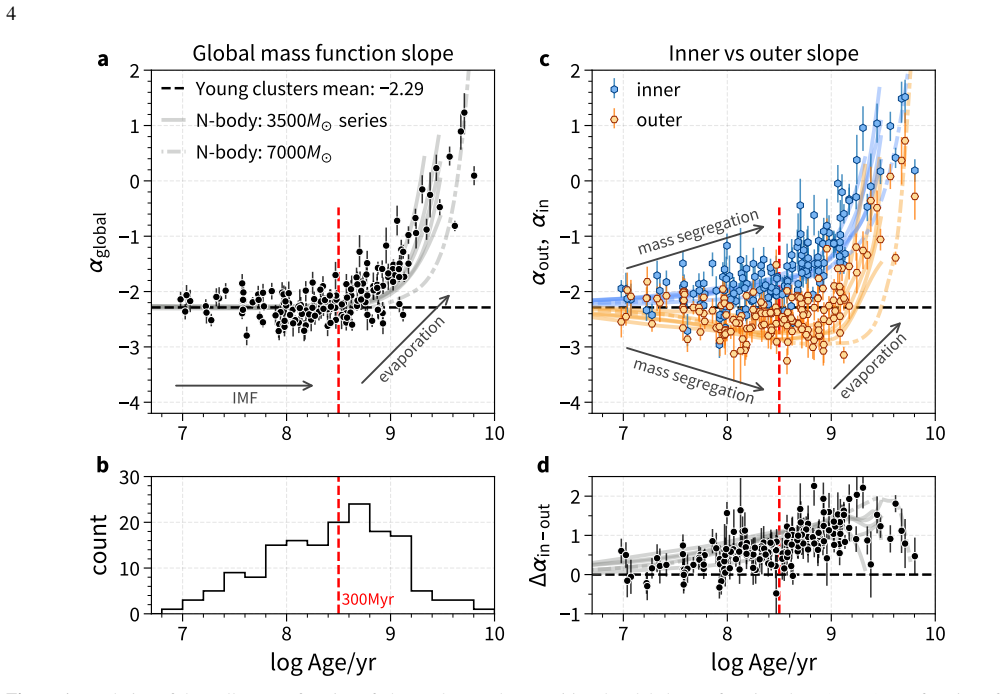
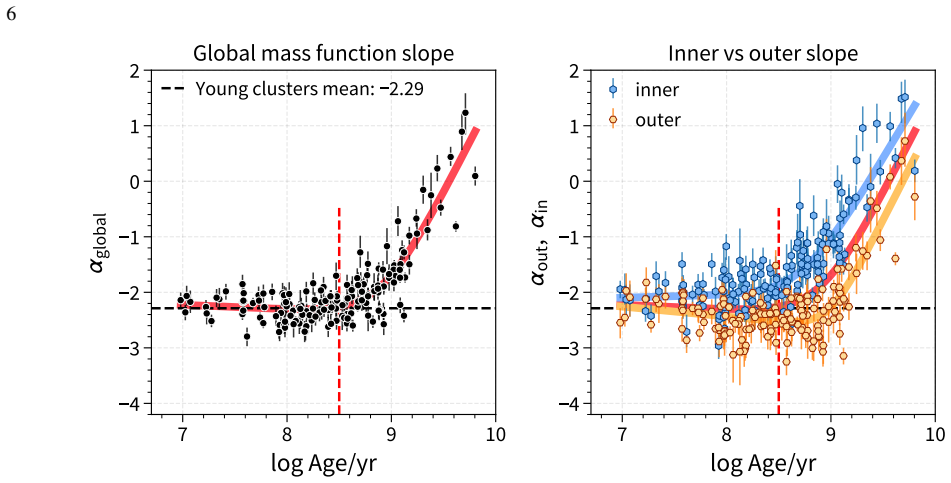
Young clusters (≲300 Myr) share a mean IMF slope of −2.29 in the mass range M≥0.5M⊙, consistent with the Salpeter slope but with an intrinsic scatter of 0.17, and exhibit minimal mass segregation at the onset of gas-free evolution (∼10 Myr). This universal zero-point for secular evolution is derived after correcting observational biases, and subsequent dynamical processing separates into rapid internal mass segregation and slower global MF flattening after ∼600 Myr.
What carries the argument
Bayesian forward-modeling framework that corrects for unresolved binaries, field contamination, and completeness bias to recover the initial mass function slope and spatial distribution.
If this is right
- Mass segregation develops quickly through two-body relaxation after gas expulsion.
- Global flattening of the mass function from tidal evaporation becomes dominant only after approximately 600 million years.
- Star-forming scenarios that predict strong primordial mass segregation or large IMF variations across clusters are disfavored.
- The measured initial state supplies an empirical baseline for simulations of cluster dynamical evolution.
Where Pith is reading between the lines
- If the zero-point holds, star formation must produce similar conditions even in different galactic environments.
- Observations of clusters younger than 10 Myr could test whether any primordial inhomogeneities are erased even earlier.
- The separation of timescales suggests that internal dynamics and external tides can be modeled independently in cluster evolution codes.
Load-bearing premise
The Bayesian corrections fully remove all systematic errors from binaries, contamination, and incompleteness so that the recovered IMF slopes and segregation signals reflect the true initial conditions.
What would settle it
A new sample of young clusters analyzed with independent bias corrections that yields a mean slope differing by more than the reported 0.17 scatter or shows strong primordial mass segregation.
Figures
read the original abstract
The stellar mass function (MF) and its spatial variation (mass segregation) within star clusters encode signatures of early formation physics and subsequent secular evolution. Yet, a coherent evolutionary picture remains elusive due to conflicting reports regarding the universality of the initial mass function (IMF) and the prevalence of primordial mass segregation. These discrepancies often arise from unresolved binaries, field contamination, and completeness bias. Here, we resolve these issues by analyzing 163 high-fidelity open clusters via a Bayesian forward-modeling framework. We reveal a remarkably simple initial state: young clusters ($\lesssim 300$ Myr) share a mean IMF slope of $-2.29$ in the mass range $M \geq 0.5 M_\odot$, consistent with the Salpeter slope but with an intrinsic scatter of 0.17, and exhibit minimal mass segregation at the onset of gas-free evolution ($\sim$10 Myr). This broadly universal "zero-point" for secular evolution disfavors star-forming scenarios that predict strong primordial segregation or significant IMF variations, and suggests that chaotic cluster assembly and gas expulsion efficiently erase any mild primordial inhomogeneities. By tracing the evolutionary sequence from $10^7$ to $10^{9.8}$ yr, we demonstrate that dynamical processing operates on distinct timescales: mass segregation proceeds rapidly via internal relaxation, whereas global MF flattening due to tidal evaporation becomes dominant only after $\sim$600 Myr. These findings impose robust observational constraints on the physics of star formation and early feedback and establish an empirical baseline for modeling secular stellar dynamics.
Editorial analysis
A structured set of objections, weighed in public.
Referee Report
Summary. The manuscript analyzes the stellar mass function (MF) and mass segregation in 163 open clusters using a Bayesian forward-modeling framework that corrects for unresolved binaries, field contamination, and completeness. It reports that young clusters (≲300 Myr) share a mean IMF slope of −2.29 (M ≥ 0.5 M⊙) consistent with Salpeter, with intrinsic scatter 0.17 and minimal mass segregation at the onset of gas-free evolution (~10 Myr). The work then traces secular evolution, finding rapid mass segregation via internal relaxation but global MF flattening from tidal evaporation only after ~600 Myr, implying a universal unsegregated initial state.
Significance. If the forward-modeling corrections are validated as unbiased, the large sample size and claimed universality would provide a valuable empirical zero-point for cluster evolution models, constraining star-formation scenarios that predict strong primordial segregation or IMF variations. The separation of dynamical timescales (segregation vs. evaporation) is a potentially useful observational benchmark.
major comments (1)
- [Methods (Bayesian forward-modeling framework)] The headline results (mean slope −2.29, scatter 0.17, minimal segregation at ~10 Myr) are obtained only after the Bayesian forward model subtracts binaries, contamination, and incompleteness. The manuscript must demonstrate that the posterior on IMF slope and segregation metric remains unbiased when nuisance parameters (binary fraction, mass-ratio distribution, field density) are marginalized; without explicit recovery tests on mock clusters that inject known slopes and radial distributions, residual covariance between these parameters and the recovered power-law index cannot be ruled out.
minor comments (2)
- [Abstract] Clarify whether the mass range M ≥ 0.5 M⊙ is uniformly applied or adjusted per cluster based on completeness limits.
- [Results (evolutionary sequence)] The evolutionary timeline references ~10 Myr, ~300 Myr, and ~600 Myr; a figure or table explicitly mapping these to the age bins used in the sample would improve traceability.
Simulated Author's Rebuttal
We thank the referee for their careful and constructive review. We address the single major comment below and agree that additional validation is warranted.
read point-by-point responses
-
Referee: The headline results (mean slope −2.29, scatter 0.17, minimal segregation at ~10 Myr) are obtained only after the Bayesian forward model subtracts binaries, contamination, and incompleteness. The manuscript must demonstrate that the posterior on IMF slope and segregation metric remains unbiased when nuisance parameters (binary fraction, mass-ratio distribution, field density) are marginalized; without explicit recovery tests on mock clusters that inject known slopes and radial distributions, residual covariance between these parameters and the recovered power-law index cannot be ruled out.
Authors: We agree that explicit recovery tests on mock clusters are necessary to demonstrate that the posteriors on the IMF slope and segregation metric remain unbiased after marginalization over nuisance parameters. Although the forward-modeling framework is constructed to jointly sample all parameters, the original manuscript did not include such end-to-end recovery experiments. In the revised version we will add a dedicated subsection presenting recovery tests on synthetic clusters. These mocks will be generated with known input IMF slopes, segregation levels, binary fractions, mass-ratio distributions, and field densities, then analyzed with the identical pipeline; recovered posteriors and any residual biases or covariances will be reported. This addition will directly address the concern. revision: yes
Circularity Check
No circularity; results are direct empirical fits to cluster observations
full rationale
The paper reports an observational measurement of the IMF slope (-2.29 mean, 0.17 scatter) and minimal mass segregation in young clusters, obtained by applying a Bayesian forward-modeling framework to a sample of 163 open clusters. No load-bearing step reduces the quoted slope, scatter, or segregation metric to a quantity defined by the authors' own prior equations, self-citations, or fitted inputs renamed as predictions. The abstract and described method treat the framework as a correction tool whose outputs are the fitted parameters themselves; no self-definitional, uniqueness-imported, or ansatz-smuggled reductions appear. The derivation is therefore self-contained against external data.
Axiom & Free-Parameter Ledger
free parameters (2)
- mean IMF slope =
-2.29
- intrinsic scatter =
0.17
axioms (2)
- domain assumption The stellar mass function above 0.5 solar masses follows a single power-law form in young clusters.
- ad hoc to paper The Bayesian forward-modeling framework removes all effects of binaries, contamination, and incompleteness without introducing new biases.
Reference graph
Works this paper leans on
-
[1]
Alfonso, J., Vieira, K., & Garcia-Varela, A. 2024, arXiv e-prints, arXiv:2410.23527, doi: 10.48550/arXiv.2410.23527
work page internal anchor Pith review Pith/arXiv arXiv doi:10.48550/arxiv.2410.23527 2024
-
[2]
Allison, R. J., Goodwin, S. P., Parker, R. J., et al. 2009, MNRAS, 395, 1449, doi: 10.1111/j.1365-2966.2009.14508.x
-
[3]
Angelo, M. S., Santos, Jr., J. F. C., Maia, F. F. S., & Corradi, W. J. B. 2023, MNRAS, 522, 956, doi: 10.1093/mnras/stad1038 Bastian,N.,Covey,K.R.,&Meyer,M.R.2010,ARA&A,48,339, doi: 10.1146/annurev-astro-082708-101642
-
[4]
2008, ApJ, 685, 247, doi: 10.1086/590488
Baumgardt, H., De Marchi, G., & Kroupa, P. 2008, ApJ, 685, 247, doi: 10.1086/590488
-
[5]
Baumgardt, H., & Kroupa, P. 2007, MNRAS, 380, 1589, doi: 10.1111/j.1365-2966.2007.12209.x
-
[6]
Baumgardt, H., & Makino, J. 2003, MNRAS, 340, 227, doi: 10.1046/j.1365-8711.2003.06286.x
-
[7]
Bonnell, I. A., & Davies, M. B. 1998, MNRAS, 295, 691, doi: 10.1046/j.1365-8711.1998.01372.x Bressan,A., Marigo,P., Girardi,L.,et al.2012, MNRAS,427,127, doi: 10.1111/j.1365-2966.2012.21948.x
-
[8]
2019, A&A, 632, A105, doi: 10.1051/0004-6361/201936612
Chen, Y., Girardi, L., Fu, X., et al. 2019, A&A, 632, A105, doi: 10.1051/0004-6361/201936612
-
[9]
Dib, S. 2014, MNRAS, 444, 1957, doi: 10.1093/mnras/stu1521 Domínguez, R., Fellhauer, M., Blaña, M., Farias, J. P., &
-
[10]
2017, MNRAS, 472, 465, doi: 10.1093/mnras/stx1883
Dabringhausen, J. 2017, MNRAS, 472, 465, doi: 10.1093/mnras/stx1883
-
[11]
2022, MNRAS, 516, 5637, doi: 10.1093/mnras/stac2562
Ebrahimi, H., Sollima, A., & Haghi, H. 2022, MNRAS, 516, 5637, doi: 10.1093/mnras/stac2562
-
[12]
Giersz, M., & Heggie, D. C. 1996, MNRAS, 279, 1037, doi: 10.1093/mnras/279.3.1037
-
[13]
Girichidis, P., Federrath, C., Allison, R., Banerjee, R., & Klessen, R. S. 2012, MNRAS, 420, 3264, doi: 10.1111/j.1365-2966.2011.20250.x Grudić, M. Y., Guszejnov, D., Hopkins, P. F., Offner, S. S. R., & Faucher-Giguère, C.-A. 2021, MNRAS, 506, 2199, doi: 10.1093/mnras/stab1347
-
[14]
Guszejnov, D., Markey, C., Offner, S. S. R., et al. 2022, MNRAS, 515, 167, doi: 10.1093/mnras/stac1737
-
[15]
2008, ApJ, 675, 1319, doi: 10.1086/524650
Harayama, Y., Eisenhauer, F., & Martins, F. 2008, ApJ, 675, 1319, doi: 10.1086/524650
-
[16]
Hennebelle, P., & Grudić, M. Y. 2024, ARA&A, 62, 63, doi: 10.1146/annurev-astro-052622-031748
-
[17]
Hosek, Jr., M. W., Lu, J. R., Anderson, J., et al. 2019, ApJ, 870, 44, doi: 10.3847/1538-4357/aaef90 8
-
[18]
L., Cantat-Gaudin, T., Anders, F., et al
Hunt, E. L., Cantat-Gaudin, T., Anders, F., et al. 2026, A&A, 706, A341, doi: 10.1051/0004-6361/202557781
-
[19]
Krause, M. G. H., Charbonnel, C., Bastian, N., & Diehl, R. 2016, A&A, 587, A53, doi: 10.1051/0004-6361/201526685
-
[20]
Kroupa, P. 2001, MNRAS, 322, 231, doi: 10.1046/j.1365-8711.2001.04022.x
-
[21]
Disentangling the independently controllable factors of variation by interacting with the world
Lada, C. J., & Lada, E. A. 2003, ARA&A, 41, 57, doi: 10.1146/annurev.astro.41.011802.094844
work page internal anchor Pith review Pith/arXiv arXiv doi:10.1146/annurev.astro.41.011802.094844 2003
-
[22]
Lamers, H. J. G. L. M., Baumgardt, H., & Gieles, M. 2013, MNRAS, 433, 1378, doi: 10.1093/mnras/stt808
-
[23]
2023, Nature, 613, 460, doi: 10.1038/s41586-022-05488-1
Li, J., Liu, C., Zhang, Z.-Y., et al. 2023, Nature, 613, 460, doi: 10.1038/s41586-022-05488-1
-
[24]
2022, ApJ, 930, 44, doi: 10.3847/1538-4357/ac5f4f
Li, L., & Shao, Z. 2022, ApJ, 930, 44, doi: 10.3847/1538-4357/ac5f4f
-
[25]
2025, AJ, 170, 288, doi: 10.3847/1538-3881/ae0cb6
Li, L., Shao, Z., Li, Z., & Fu, X. 2025, AJ, 170, 288, doi: 10.3847/1538-3881/ae0cb6
-
[26]
Li, L., Shao, Z., Li, Z., & Fu, X. 2025, MiMO Open Cluster catalog, 1.0 National Astronomical Data Center of China, doi: 10.12149/101693
-
[27]
2020, ApJ, 901, 49, doi: 10.3847/1538-4357/abaef3 Maíz Apellániz, J
Li, L., Shao, Z., Li, Z.-Z., et al. 2020, ApJ, 901, 49, doi: 10.3847/1538-4357/abaef3 Maíz Apellániz, J. 2008, ApJ, 677, 1278, doi: 10.1086/533525
-
[28]
Marks, M., Kroupa, P., & Baumgardt, H. 2008, MNRAS, 386, 2047, doi: 10.1111/j.1365-2966.2008.13165.x
-
[29]
McMillan, S. L. W., Vesperini, E., & Portegies Zwart, S. F. 2007, ApJL, 655, L45, doi: 10.1086/511763
-
[30]
2002, ApJ, 576, 870, doi: 10.1086/341790
Padoan, P., & Nordlund, Å. 2002, ApJ, 576, 870, doi: 10.1086/341790
-
[31]
Parker, R. J. 2014, in Astrophysics and Space Science Proceedings, Vol. 36, The Labyrinth of Star Formation, ed. D. Stamatellos, S. Goodwin, & D. Ward-Thompson, 431, doi: 10.1007/978-3-319-03041-8_86
-
[32]
Parker, R. J., Dale, J. E., & Ercolano, B. 2015, MNRAS, 446, 4278, doi: 10.1093/mnras/stu2393 Pavlík, V., Kroupa, P., & Šubr, L. 2019a, A&A, 626, A79, doi: 10.1051/0004-6361/201834265 Pavlík, V., Kroupa, P., & Šubr, L. 2019b, A&A, 626, A79, doi: 10.1051/0004-6361/201834265
-
[33]
Polak, B., Mac Low, M.-M., Klessen, R. S., et al. 2025, A&A, 695, A188, doi: 10.1051/0004-6361/202451785
-
[34]
Photometric content and validation
Riello, M., De Angeli, F., Evans, D. W., et al. 2021, A&A, 649, A3, doi: 10.1051/0004-6361/202039587
-
[35]
Salpeter, E. E. 1955, ApJ, 121, 161, doi: 10.1086/145971
-
[36]
2004, in American Institute of Physics Conference
Skilling, J. 2004, in American Institute of Physics Conference
2004
-
[37]
Series, Vol. 735, Bayesian Inference and Maximum Entropy Methods in Science and Engineering: 24th International Workshop on Bayesian Inference and Maximum Entropy Methods in Science and Engineering, ed. R. Fischer, R. Preuss, & U. V. Toussaint (AIP), 395–405, doi: 10.1063/1.1835238
-
[38]
2017, MNRAS, 471, 3668, doi: 10.1093/mnras/stx1856
Sollima, A., & Baumgardt, H. 2017, MNRAS, 471, 3668, doi: 10.1093/mnras/stx1856
-
[39]
Speagle, J. S. 2020, MNRAS, 493, 3132, doi: 10.1093/mnras/staa278
-
[40]
1987, Dynamical Evolution of Globular Clusters
Spitzer, L. 1987, Dynamical Evolution of Globular Clusters
1987
-
[41]
Spitzer, Jr., L. 1969, ApJL, 158, L139, doi: 10.1086/180451 Vázquez-Semadeni, E., Palau, A., Ballesteros-Paredes, J., Gómez, G. C., & Zamora-Avilés, M. 2019, MNRAS, 490, 3061, doi: 10.1093/mnras/stz2736
-
[42]
Vesperini, E., McMillan, S. L. W., & Portegies Zwart, S. 2009, ApJ, 698, 615, doi: 10.1088/0004-637X/698/1/615
-
[43]
2020, MNRAS, 497, 536, doi: 10.1093/mnras/staa1915
Wang, L., Iwasawa, M., Nitadori, K., & Makino, J. 2020, MNRAS, 497, 536, doi: 10.1093/mnras/staa1915
-
[44]
Webb, J. J., & Vesperini, E. 2016, MNRAS, 463, 2383, doi: 10.1093/mnras/stw2186
-
[45]
2024, ApJS, 270, 9, doi: 10.3847/1538-4365/acfee5
Xu, F., Wang, K., Liu, T., et al. 2024, ApJS, 270, 9, doi: 10.3847/1538-4365/acfee5
discussion (0)
Sign in with ORCID, Apple, or X to comment. Anyone can read and Pith papers without signing in.