Residual-Controlled Multiplier Learning for Stochastic Constrained Decision-Making
Pith reviewed 2026-06-27 22:43 UTC · model grok-4.3
The pith
Multiplier learning with residual control achieves finite-gain convergence under stochastic mini-batch feedback.
A machine-rendered reading of the paper's core claim, the machinery that carries it, and where it could break.
Core claim
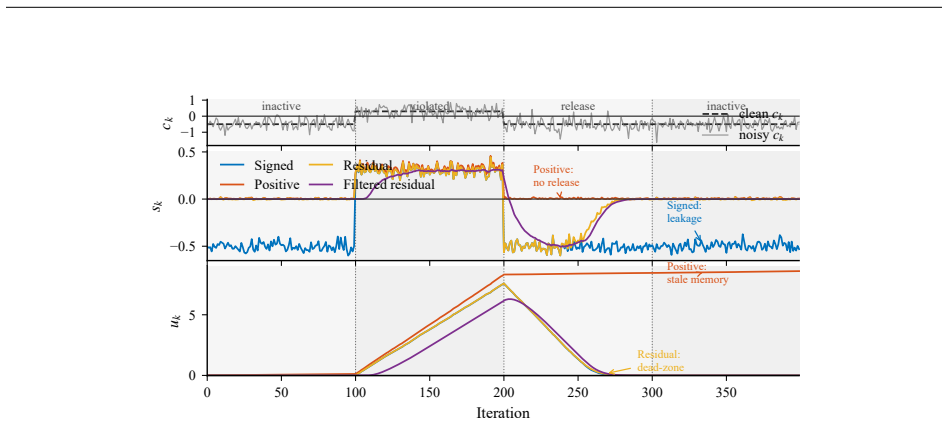
RCML reformulates multiplier updating as projected-pressure feedback. The central idea is to decompose the projected multiplier into an effective pressure signal for primal descent and a pressure-memory residual for finite-gain multiplier tracking. To handle heterogeneous and noisy observations, the residual-integral backbone is augmented with modular stochastic stabilization components. For the convex-affine backbone, finite-gain convergence is established, a stochastic residual bound is derived under mini-batch feedback, and the residual feedback law is shown to admit a local KKT-residual interpretation near regular KKT points of nonconvex problems.
What carries the argument
The projected-pressure feedback decomposition that separates the effective pressure signal from the pressure-memory residual.
If this is right
- Finite-gain convergence holds for the convex-affine backbone under the stated conditions.
- A bound on the stochastic residual is obtained under mini-batch feedback.
- The feedback law admits a local KKT-residual interpretation near regular KKT points of nonconvex problems.
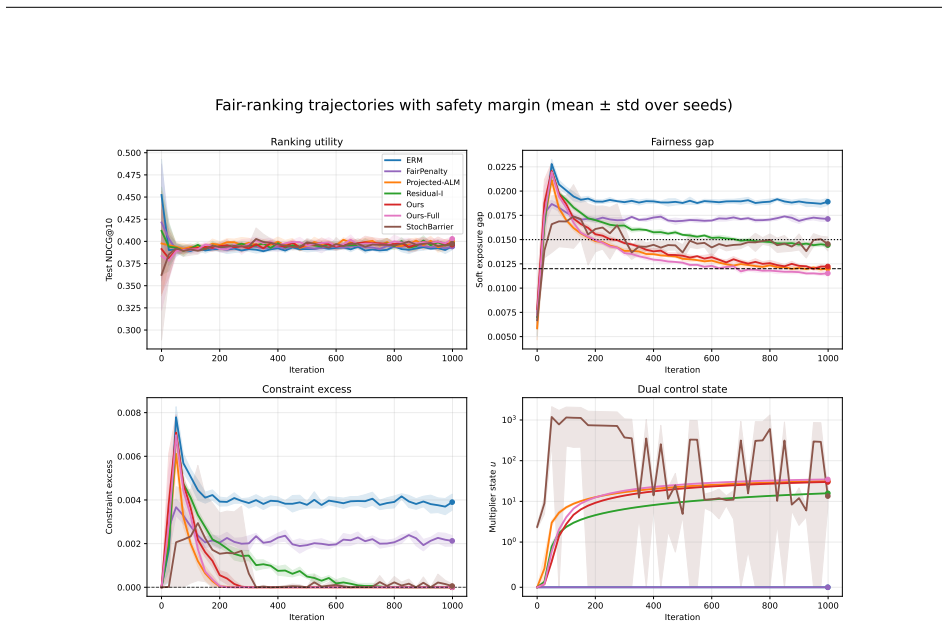
- Experiments across optimization, allocation, and fair-ranking tasks show improved feasibility control and multiplier stability with competitive objective performance.
Where Pith is reading between the lines
- The modular structure of the stabilization components suggests they could be swapped for other noise models not examined in the reported tasks.
- The local KKT interpretation points to a possible route for analyzing behavior on specific families of nonconvex constraints.
- The residual bound could be used to predict required batch sizes for target feasibility levels in allocation problems.
Load-bearing premise
The residual-integral backbone with modular stochastic stabilization components can robustly handle noise from mini-batch gradients and constraint estimates without invalidating the finite-gain convergence or the local KKT-residual interpretation.
What would settle it
Running RCML on a stochastic linear program with known optimal multipliers and verifying whether the multiplier tracking error remains within the derived finite-gain bound as mini-batch size decreases would falsify the claim if the bound is systematically violated.
Figures
read the original abstract
Stochastic constrained decision-making requires optimizing performance objectives while enforcing statistical requirements such as safety or fairness. However, standard primal--dual methods struggle to update multipliers robustly under stochastic mini-batch feedback, as the noise of mini-batch gradients and constraint estimates can be directly accumulated into the multiplier memory. To address this issue, we propose Residual-Controlled Multiplier Learning (RCML), which reformulates multiplier updating as projected-pressure feedback. The central idea is to decompose the projected multiplier into an effective pressure signal for primal descent and a pressure-memory residual for finite-gain multiplier tracking. To handle heterogeneous and noisy observations, we further augment this residual-integral backbone with modular stochastic stabilization components. For the convex-affine backbone, we establish finite-gain convergence, derive a stochastic residual bound under mini-batch feedback, and show that the residual feedback law admits a local KKT-residual interpretation near regular KKT points of nonconvex problems. Experiments across optimization, allocation, and fair-ranking tasks show that RCML improves feasibility control and multiplier stability while maintaining competitive objective performance. Code is released at https://anonymous.4open.science/r/RCML-3114/.
Editorial analysis
A structured set of objections, weighed in public.
Referee Report
Summary. The paper proposes Residual-Controlled Multiplier Learning (RCML) to improve multiplier robustness in stochastic constrained decision-making under mini-batch noise. It reformulates the multiplier update as projected-pressure feedback that decomposes the projected multiplier into an effective pressure signal for primal descent and a pressure-memory residual for finite-gain tracking. The residual-integral backbone is augmented with modular stochastic stabilization components (variance reduction, clipping, momentum). For the convex-affine backbone the authors establish finite-gain convergence, derive a stochastic residual bound, and give a local KKT-residual interpretation near regular KKT points; experiments on optimization, allocation and fair-ranking tasks report improved feasibility control and multiplier stability with competitive objective values. Code is released.
Significance. If the finite-gain and residual-bound results extend to the stabilized algorithm actually implemented, RCML would offer a principled way to decouple multiplier memory from mini-batch noise while preserving interpretability near KKT points. The explicit code release supports reproducibility. The current gap between the proven backbone and the full method, however, prevents the theoretical claims from directly supporting the experimental conclusions.
major comments (2)
- [Theory section (convex-affine backbone results)] Theory section (convex-affine backbone results): finite-gain convergence and the stochastic residual bound are established only for the residual-integral backbone without stabilization modules. No theorem, corollary or perturbation argument is given showing that these properties survive the addition of variance reduction, clipping or momentum terms under the same mini-batch model. Because the experiments deploy the full RCML algorithm, this omission is load-bearing for the central claim that RCML improves feasibility control while retaining the stated guarantees.
- [Experiments section] Experiments section: the reported improvements in feasibility and multiplier stability are obtained with the stabilized RCML variant, yet the only convergence and residual-bound statements apply to the unstabilized backbone. Without a bridging result or an ablation that isolates the effect of each stabilization module on the residual dynamics, it is unclear whether the observed gains are consistent with the finite-gain analysis or arise from heuristic modifications.
minor comments (1)
- [Abstract and nonconvex discussion] The abstract states that the residual feedback law admits a local KKT-residual interpretation for nonconvex problems, but the precise regularity conditions and neighborhood size are not restated in the main text; adding a short corollary or remark would clarify the scope.
Simulated Author's Rebuttal
We thank the referee for the careful reading and for highlighting the distinction between the proven convex-affine backbone and the full stabilized RCML algorithm. We address the comments point by point below and will revise the manuscript to improve clarity on the scope of the theoretical results.
read point-by-point responses
-
Referee: Theory section (convex-affine backbone results): finite-gain convergence and the stochastic residual bound are established only for the residual-integral backbone without stabilization modules. No theorem, corollary or perturbation argument is given showing that these properties survive the addition of variance reduction, clipping or momentum terms under the same mini-batch model. Because the experiments deploy the full RCML algorithm, this omission is load-bearing for the central claim that RCML improves feasibility control while retaining the stated guarantees.
Authors: We agree that the finite-gain convergence and stochastic residual bound are established only for the residual-integral backbone. The stabilization modules are introduced as modular, practical enhancements for handling heterogeneous noise, and the manuscript explicitly qualifies the theorems as applying to the backbone. A formal perturbation argument showing invariance under these modules is not provided. In revision we will add an explicit remark in Section 3 stating the precise scope of the theorems and a brief discussion of why the modular components (which act on the pressure signal without altering the residual-integral structure) are expected to preserve finite-gain tracking; we will also add an ablation isolating each module's effect on residual dynamics. revision: yes
-
Referee: Experiments section: the reported improvements in feasibility and multiplier stability are obtained with the stabilized RCML variant, yet the only convergence and residual-bound statements apply to the unstabilized backbone. Without a bridging result or an ablation that isolates the effect of each stabilization module on the residual dynamics, it is unclear whether the observed gains are consistent with the finite-gain analysis or arise from heuristic modifications.
Authors: The experiments use the complete RCML implementation. To strengthen the link between theory and practice we will revise the experimental section to include an ablation study that isolates the contribution of variance reduction, clipping, and momentum to the observed residual bounds and feasibility metrics. This will clarify that the core finite-gain behavior originates from the backbone while the modules provide additional robustness under the same mini-batch model. revision: yes
Circularity Check
No circularity; proofs explicitly scoped to backbone without reduction to inputs
full rationale
The provided text states finite-gain convergence, stochastic residual bound, and local KKT interpretation only for the convex-affine backbone, with modular stabilization components presented separately as augmentation. No equations or claims reduce a 'prediction' or bound to a fitted quantity by construction, no self-citations are load-bearing for the central premise, and no uniqueness theorems or ansatzes are imported from prior author work. The derivation chain is self-contained against the stated scope.
Axiom & Free-Parameter Ledger
invented entities (1)
-
pressure-memory residual
no independent evidence
Reference graph
Works this paper leans on
-
[1]
Advances in Neural Information Processing Systems (NeurIPS) , year =
Goh, Gabriel and Cotter, Andrew and Gupta, Maya and Friedlander, Michael , title =. Advances in Neural Information Processing Systems (NeurIPS) , year =
-
[2]
Agarwal, Alekh and Beygelzimer, Alina and Dud. A. Proceedings of the 35th International Conference on Machine Learning , volume =. 2018 , address =
2018
-
[3]
Proceedings of the 36th International Conference on Machine Learning , volume =
Cotter, Andrew and Gupta, Maya and Jiang, Heinrich and Srebro, Nathan and Sridharan, Karthik and Wang, Serena and Woodworth, Blake and You, Seungil , title =. Proceedings of the 36th International Conference on Machine Learning , volume =. 2019 , address =
2019
-
[4]
Journal of Machine Learning Research , volume =
Cotter, Andrew and Jiang, Heinrich and Gupta, Maya and Wang, Serena and Narayan, Taman and You, Seungil and Sridharan, Karthik , title =. Journal of Machine Learning Research , volume =
-
[5]
Chamon, Luiz F. O. and Ribeiro, Alejandro , title =. Advances in Neural Information Processing Systems (NeurIPS) , address =
-
[6]
arXiv preprint arXiv:2510.20995 , year =
Boero, Ignacio and Hounie, Ignacio and Ribeiro, Alejandro , title =. arXiv preprint arXiv:2510.20995 , year =
-
[7]
, title =
Wang, Mengdi and Bertsekas, Dimitri P. , title =. SIAM Journal on Optimization , volume =
-
[8]
Computational Optimization and Applications , volume =
Lan, Guanghui and Zhou, Zhiqiang , title =. Computational Optimization and Applications , volume =
-
[9]
SIAM Journal on Optimization , volume =
Xu, Yangyang , title =. SIAM Journal on Optimization , volume =
-
[10]
Computational Optimization and Applications , volume =
Jin, Lingzi and Wang, Xiao , title =. Computational Optimization and Applications , volume =
-
[11]
Mathematical Programming , volume =
Boob, Digvijay and Deng, Qi and Lan, Guanghui , title =. Mathematical Programming , volume =
-
[12]
Proceedings of the 39th International Conference on Machine Learning , volume =
Lu, Songtao , title =. Proceedings of the 39th International Conference on Machine Learning , volume =
-
[13]
, title =
Alacaoglu, Ahmet and Wright, Stephen J. , title =. Proceedings of the 27th International Conference on Artificial Intelligence and Statistics , volume =
-
[14]
arXiv preprint arXiv:2504.07607 , year =
Huang, Ruichuan and Zhang, Jiawei and Alacaoglu, Ahmet , title =. arXiv preprint arXiv:2504.07607 , year =
-
[15]
Transactions on Machine Learning Research , year =
Yang, Ming and Li, Gang and Hu, Quanqi and Lin, Qihang and Yang, Tianbao , title =. Transactions on Machine Learning Research , year =
-
[16]
INFORMS Journal on Computing , volume =
Zhang, Liwei and Zhang, Yule and Wu, Jia and Xiao, Xiantao , title =. INFORMS Journal on Computing , volume =
-
[17]
Computational Optimization and Applications , volume =
Li, Zichong and Chen, Pin-Yu and Liu, Sijia and Lu, Songtao and Xu, Yangyang , title =. Computational Optimization and Applications , volume =
-
[18]
Journal of Scientific Computing , volume =
Cui, Yawen and Wang, Xiao and Xiao, Xiantao , title =. Journal of Scientific Computing , volume =
-
[19]
Mathematical Programming , volume =
Na, Sen and Anitescu, Mihai and Kolar, Mladen , title =. Mathematical Programming , volume =
-
[20]
Rockafellar, R. T. , title =. Mathematics of Operations Research , volume =
-
[21]
, title =
Bertsekas, Dimitri P. , title =
-
[22]
and Saunders, Michael A
Murtagh, Bruce A. and Saunders, Michael A. , title =. Mathematical Programming Study , volume =
-
[23]
, title =
Nocedal, Jorge and Wright, Stephen J. , title =
-
[24]
Automatica , volume =
Feijer, Diego and Paganini, Fernando , title =. Automatica , volume =
-
[25]
Systems & Control Letters , volume =
Cherukuri, Ashish and Mallada, Enrique and Cort. Systems & Control Letters , volume =
-
[26]
and Mannor, Shie , title =
Tessler, Chen and Mankowitz, Daniel J. and Mannor, Shie , title =. Proceedings of the 7th International Conference on Learning Representations , address =
-
[27]
Proceedings of the 37th International Conference on Machine Learning , address =
Stooke, Adam and Achiam, Joshua and Abbeel, Pieter , title =. Proceedings of the 37th International Conference on Machine Learning , address =
-
[28]
and Lacoste-Julien, Simon and Gallego-Posada, Jose , title =
Sohrabi, Motahareh and Ramirez, Juan and Zhang, Tianyue H. and Lacoste-Julien, Simon and Gallego-Posada, Jose , title =. Proceedings of the 41st International Conference on Machine Learning , address =
-
[29]
and Pirrera, Simone and Regruto, Diego , title =
Cerone, Vito and Fosson, Sophie M. and Pirrera, Simone and Regruto, Diego , title =. IEEE Transactions on Automatic Control , volume =
-
[30]
Feedback control of Lagrange multipliers for non-smooth constrained optimization
Cerone, Vito and Fosson, Sophie M. and Pirrera, Simone and Re, Alessandro and Regruto, Diego , title =. arXiv preprint arXiv:2604.06511 , year =
work page internal anchor Pith review Pith/arXiv arXiv
-
[31]
ACM Transactions on Information Systems , volume =
J. ACM Transactions on Information Systems , volume =
-
[32]
Proceedings of the 24th ACM SIGKDD International Conference on Knowledge Discovery and Data Mining , address =
Singh, Ashudeep and Joachims, Thorsten , title =. Proceedings of the 24th ACM SIGKDD International Conference on Knowledge Discovery and Data Mining , address =
-
[33]
and Jiang, Xin and Wang, Qi , title =
Curtis, Frank E. and Jiang, Xin and Wang, Qi , title =. arXiv preprint arXiv:2408.16186 , year =
-
[34]
arXiv preprint arXiv:2503.10384 , year =
Dimitrieski, Naum and Cao, Jing and Ebenbauer, Christian , title =. arXiv preprint arXiv:2503.10384 , year =
-
[35]
Journal of Machine Learning Research , volume =
He, Chuan and Deng, Zhanwang , title =. Journal of Machine Learning Research , volume =
-
[36]
Proceedings of the 24th International Conference on Machine Learning , address =
Cao, Zhe and Qin, Tao and Liu, Tie-Yan and Tsai, Ming-Feng and Li, Hang , title =. Proceedings of the 24th International Conference on Machine Learning , address =
-
[37]
and Combettes, Patrick L
Bauschke, Heinz H. and Combettes, Patrick L. , publisher =
-
[38]
Robbins, Herbert and Siegmund, David , booktitle =
-
[39]
and Yin, G
Kushner, Harold J. and Yin, G. George , series =
-
[40]
Tyrrell and Wets, Roger J
Rockafellar, R. Tyrrell and Wets, Roger J. B. , series =
-
[41]
and Rockafellar, R
Dontchev, Asen L. and Rockafellar, R. Tyrrell , series =
-
[42]
, publisher =
Polyak, Boris T. , publisher =
-
[43]
The Annals of Mathematical Statistics , volume =
Robbins, Herbert and Monro, Sutton , title =. The Annals of Mathematical Statistics , volume =
-
[44]
, title =
Borkar, Vivek S. , title =
-
[45]
SIAM Journal on Optimization , volume =
Nemirovski, Arkadi and Juditsky, Anatoli and Lan, Guanghui and Shapiro, Alexander , title =. SIAM Journal on Optimization , volume =
-
[46]
Optimization Methods for Large-Scale Machine Learning , journal =
Bottou, L. Optimization Methods for Large-Scale Machine Learning , journal =
-
[47]
2003 , series =
Facchinei, Francisco and Pang, Jong-Shi , title =. 2003 , series =
2003
-
[48]
SIAM Journal on Optimization , volume =
Sequential Quadratic Optimization for Stochastic Optimization with Deterministic Nonlinear Inequality and Equality Constraints , author =. SIAM Journal on Optimization , volume =
-
[49]
SIAM Journal on Optimization , volume =
Fully Stochastic Trust-Region Sequential Quadratic Programming for Equality-Constrained Optimization Problems , author =. SIAM Journal on Optimization , volume =
-
[50]
IEEE Control Systems Letters , volume =
Stochastic Gradient Descent for Constrained Optimization Based on Adaptive Relaxed Barrier Functions , author =. IEEE Control Systems Letters , volume =
-
[51]
Stochastic Penalty-Barrier Methods for Constrained Machine Learning
Stochastic Penalty-Barrier Methods for Constrained Machine Learning , author =. arXiv preprint arXiv:2605.18618 , year =
work page internal anchor Pith review Pith/arXiv arXiv
-
[52]
, title =
Combettes, Patrick L. , title =. Studies in Computational Mathematics , volume =. 2001 , pages =
2001
discussion (0)
Sign in with ORCID, Apple, or X to comment. Anyone can read and Pith papers without signing in.