Arithmetic Symmetry in Ideal Prouhet-Tarry-Escott Solutions
Pith reviewed 2026-06-27 20:42 UTC · model grok-4.3
The pith
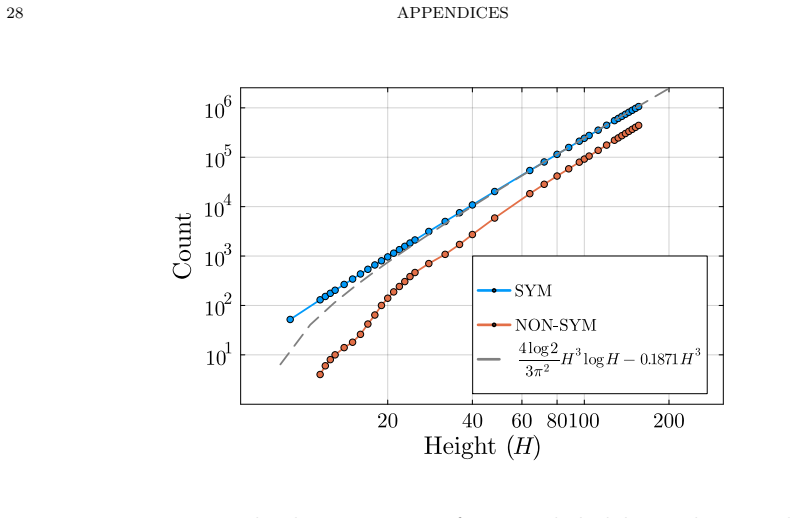
The symmetric locus in the ideal degree-three Prouhet-Tarry-Escott problem reduces exactly to the sum-of-two-squares equation and is counted by (4 log 2 / 3 π²) H³ log H + O(H³).
A machine-rendered reading of the paper's core claim, the machinery that carries it, and where it could break.
Core claim
For the full symmetric locus, N_sym(H) equals (4 log 2 / 3 π²) H³ log H + O(H³); the logarithmic enhancement arises directly from the second moment of the sum-of-two-squares representation function, and the symmetric solutions therefore form a large arithmetically structured subfamily of the ideal degree-three solution space.
What carries the argument
The reduction of symmetric ideal degree-three PTE equations to the sum-of-two-squares equation x² + y² = u² + v² subject to the stated parity conditions.
If this is right
- The number of symmetric solutions exceeds the naive H³ box-counting scale by a logarithmic factor.
- The entire symmetric locus is controlled by the arithmetic of representations as sums of two squares.
- This subfamily supplies an explicit, infinite collection of ideal degree-three solutions whose size is governed by classical number theory.
- Paired anomaly-free integral charge spectra are realized inside a number-theoretically natural subset of the solution space.
Where Pith is reading between the lines
- The same symmetry reduction may produce analogous logarithmic enhancements in higher-degree PTE problems.
- Other structured subfamilies of the full PTE solution space could be located by imposing additional linear or modular conditions.
- The asymptotic supplies a concrete benchmark against which exhaustive computer searches for small-height solutions can be validated.
Load-bearing premise
The symmetry condition reduces the ideal degree-three PTE equations exactly to the sum-of-two-squares equation subject only to the stated parity conditions, with no further obstructions that would alter the leading asymptotic.
What would settle it
An exact enumeration of all symmetric solutions with height up to several thousand that deviates from the predicted leading coefficient times H³ log H by more than the O(H³) term.
Figures
read the original abstract
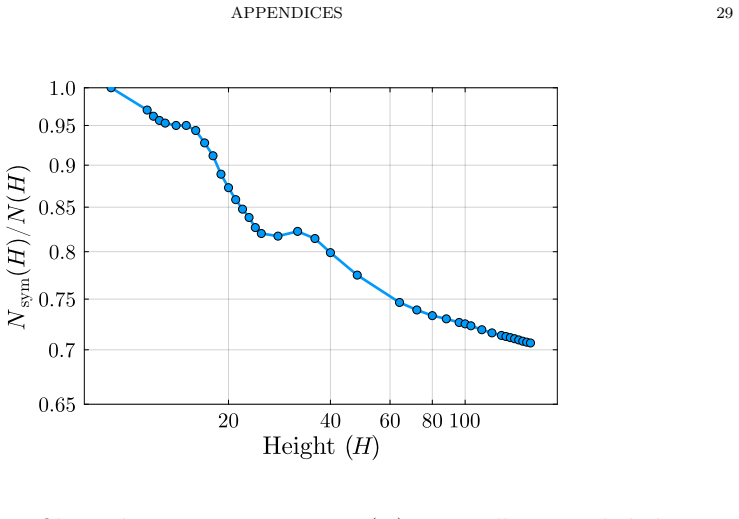
Motivated in part by anomaly cancellation for integral charge spectra in chiral gauge theory, we study the symmetric locus in the ideal degree-three Prouhet-Tarry-Escott problem. A symmetric integer solution is one whose entries are paired about a common center $c\in \frac12\mathbb Z$. This symmetry reduces the problem to a sum-of-two-squares equation, $x^2+y^2=u^2+v^2$, in integer variables, subject to the appropriate parity conditions. Thus the problem is governed by representations as sums of two squares. For the full symmetric locus, let $N_{\mathrm{sym}}(H)$ denote the number of nontrivial symmetric integer solutions of height at most $H$, counted with unordered multiset conventions and summed over the admissible centers. Then \begin{align*} N_{\mathrm{sym}}(H) = \frac{4\log 2}{3\pi^2}H^3\log H+O(H^3). \end{align*} The logarithmic enhancement comes from the second moment of the sum-of-two-squares representation function. In particular, the symmetric locus is larger than one would expect from the naive $H^3$ degree-weighted box-counting scale alone. This asymptotic identifies a large arithmetically structured subfamily of the ideal degree-three solution space, and suggests that paired anomaly-free integral charge spectra reflect a fundamental number-theoretic structure.
Editorial analysis
A structured set of objections, weighed in public.
Referee Report
Summary. The manuscript studies the symmetric locus of ideal degree-three Prouhet-Tarry-Escott solutions. It shows that pairing entries about a common center reduces the ideal PTE conditions exactly to the sum-of-two-squares equation x² + y² = u² + v² subject to parity constraints. It then counts the nontrivial symmetric solutions of height at most H (with unordered multiset conventions, summed over admissible centers) and derives the asymptotic N_sym(H) = (4 log 2 / 3 π²) H³ log H + O(H³), with the logarithmic factor arising from the second moment of the sum-of-two-squares representation function r_2.
Significance. If the reduction and counting argument hold, the result identifies a large arithmetically structured subfamily of ideal degree-three solutions whose size exceeds the naive H³ scale by a log H factor. The link to anomaly cancellation in chiral gauge theory is noted but not developed. The derivation rests on standard analytic number theory (second-moment asymptotics for r_2) rather than ad-hoc fitting, which is a strength.
minor comments (2)
- [§2] The abstract and introduction state the reduction to x² + y² = u² + v² but do not display the explicit parity conditions or the cancellation of odd-powered sums; a short displayed derivation in §2 would improve readability.
- [§4] The error term O(H³) absorbs diagonal, boundary, and distinctness contributions; a one-sentence remark on why these are indeed O(H³) rather than larger would clarify the argument without lengthening the paper.
Simulated Author's Rebuttal
We thank the referee for their positive assessment of the manuscript, including the recognition of the reduction to the sum-of-two-squares equation and the derivation of the asymptotic via the second moment of r_2. We appreciate the recommendation to accept.
Circularity Check
No circularity; derivation applies known external asymptotic to a self-contained reduction
full rationale
The paper reduces the symmetric PTE locus to the equation x² + y² = u² + v² under explicit parity conditions on the variables, then invokes the classical second-moment asymptotic ∑_{m≤X} r₂(m)² ∼ c X log X (with c = 4 log 2 / π² or an equivalent normalization) to obtain the stated count N_sym(H). This second-moment result is a standard theorem in analytic number theory, independent of the present work and externally verifiable. No parameter is fitted to the target count, no self-citation supplies the leading term, and the reduction itself is derived directly from the symmetry assumption without presupposing the final asymptotic. The derivation is therefore self-contained against external benchmarks.
Axiom & Free-Parameter Ledger
axioms (1)
- domain assumption Symmetric solutions reduce exactly to the equation x² + y² = u² + v² subject to the appropriate parity conditions.
Reference graph
Works this paper leans on
-
[1]
Prouhet’s 1851 Solution of the Tarry-Escott Problem of 1910,
E. M. Wright, “Prouhet’s 1851 Solution of the Tarry-Escott Problem of 1910,”The American Mathematical Monthly66(1959) no. 3, 199–201
1910
-
[2]
The Prouhet–Tarry–Escott Problem Revisited,
P. Borwein and C. Ingalls, “The Prouhet–Tarry–Escott Problem Revisited,” L’Enseignement Math´ ematique40(1994) 3–27
1994
-
[3]
Borwein,The Prouhet–Tarry–Escott Problem, pp
P. Borwein,The Prouhet–Tarry–Escott Problem, pp. 85–95. Springer New York, New York, NY, 2002.https://doi.org/10.1007/978-0-387-21652-2_11
-
[4]
A survey of The Prouhet-Tarry-Escott Problem and its Generalizations,
C. Shuwen, “A survey of The Prouhet-Tarry-Escott Problem and its Generalizations,” arXiv preprint arXiv:2506.11429(2025) .https://arxiv.org/abs/2506.11429
arXiv 2025
-
[5]
An Anomaly Free Version of Weinberg’s Model,
C. Bouchiat, J. Iliopoulos, and P. Meyer, “An Anomaly Free Version of Weinberg’s Model,”Phys. Lett. B38(1972) 519–523
1972
-
[6]
Anomaly-free sets of fermions,
P. Batra, B. A. Dobrescu, and D. Spivak, “Anomaly-free sets of fermions,”J. Math. Phys.47(2006) 082301,arXiv:hep-ph/0510181
Pith/arXiv arXiv 2006
-
[7]
New Chiral Fermions, a New Gauge Interaction, Dirac Neutrinos, and Dark Matter,
A. de Gouvˆ ea and D. Hern´ andez, “New Chiral Fermions, a New Gauge Interaction, Dirac Neutrinos, and Dark Matter,”JHEP10(2015) 046,arXiv:1507.00916
Pith/arXiv arXiv 2015
-
[8]
K. Nakayama, F. Takahashi, and T. T. Yanagida, “Number-Theory Dark Matter,”Phys. Lett. B699(2011) 360–363,arXiv:1102.4688
Pith/arXiv arXiv 2011
-
[9]
Revisiting the Number-Theory Dark Matter Scenario and the Weak Gravity Conjecture,
K. Nakayama, F. Takahashi, and T. T. Yanagida, “Revisiting the Number-Theory Dark Matter Scenario and the Weak Gravity Conjecture,”Phys. Lett. B790(2019) 218–224, arXiv:1811.01755
Pith/arXiv arXiv 2019
-
[10]
Hypercharge Quantisation and Fermat’s Last Theorem,
N. Lohitsiri and D. Tong, “Hypercharge Quantisation and Fermat’s Last Theorem,” SciPost Phys.8(2020) no. 1, 009,arXiv:1907.00514. 24 Y.-D. TSAI, J. LEE, AND F. TAKAHASHI
arXiv 2020
-
[11]
General Solution to the U(1) Anomaly Equations,
D. B. Costa, B. A. Dobrescu, and P. J. Fox, “General Solution to the U(1) Anomaly Equations,”Phys. Rev. Lett.123(2019) no. 15, 151601,arXiv:1905.13729
arXiv 2019
-
[12]
Chiral Abelian gauge theories with few fermions,
D. B. Costa, B. A. Dobrescu, and P. J. Fox, “Chiral Abelian gauge theories with few fermions,”Phys. Rev. D101(2020) no. 9, 095032,arXiv:2001.11991
arXiv 2020
-
[13]
Number Theory in Quantum Physics: Minicharged Particles and the Prouhet-Tarry-Escott Problem,
J. Lee, F. Takahashi, and Y.-D. Tsai, “Number Theory in Quantum Physics: Minicharged Particles and the Prouhet-Tarry-Escott Problem,”arXiv:2603.12320
-
[14]
Ideal solutions in the Prouhet–Tarry–Escott problem,
D. Coppersmith, M. J. Mossinghoff, D. Scheinerman, and J. M. VanderKam, “Ideal solutions in the Prouhet–Tarry–Escott problem,”Mathematics of Computation93 (2024) no. 349, 2473–2501,arXiv:2304.11254
arXiv 2024
-
[15]
G. H. Hardy and E. M. Wright,An Introduction to the Theory of Numbers. Oxford, fourth ed., 1975
1975
-
[16]
On Dirichlet Series for Sums of Squares,
J. M. Borwein and K.-K. S. Choi, “On Dirichlet Series for Sums of Squares,”The Ramanujan Journal7(2003) no. 1–3, 95–127
2003
-
[17]
The cubic case of the main conjecture in Vinogradov’s mean value theorem,
T. D. Wooley, “The cubic case of the main conjecture in Vinogradov’s mean value theorem,”Advances in Mathematics294(2016) 532–561,arXiv:1401.3150
arXiv 2016
-
[18]
Proof of the main conjecture in Vinogradov’s mean value theorem for degrees higher than three,
J. Bourgain, C. Demeter, and L. Guth, “Proof of the main conjecture in Vinogradov’s mean value theorem for degrees higher than three,”Annals of Mathematics184(2016) no. 2, 633–682,arXiv:1512.01565
Pith/arXiv arXiv 2016
-
[19]
Rational points on intersections of cubic and quadric hypersurfaces,
T. D. Browning, R. Dietmann, and D. R. Heath-Brown, “Rational points on intersections of cubic and quadric hypersurfaces,”Journal of the Institute of Mathematics of Jussieu14(2015) no. 4, 703–749,arXiv:1309.0147. AppendixA.The Full PTE Space and Vinogradov Mean Values The symmetric count proved above gives Nsym(H) = 4 log 2 3π2 H 3 logH+O(H 3).(A.1) Conje...
Pith/arXiv arXiv 2015
discussion (0)
Sign in with ORCID, Apple, or X to comment. Anyone can read and Pith papers without signing in.