Byzantine Cheap Talk: Adversarial Resilience and Topology Effects in LLM Coordination Games
Pith reviewed 2026-06-27 22:30 UTC · model grok-4.3
The pith
Coordination failure in LLM Stag Hunt games arises from agents' meta-reasoning about hidden adversarial information rather than from information loss.
A machine-rendered reading of the paper's core claim, the machinery that carries it, and where it could break.
Core claim
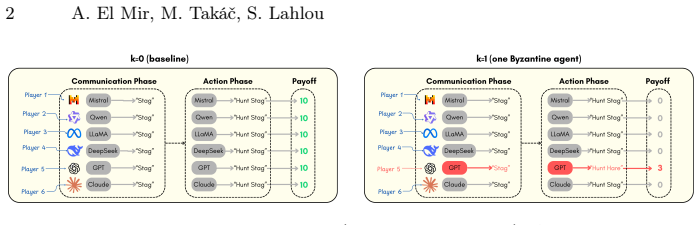
In experiments across six model families, Byzantine agents who signal cooperation but defect cause non-Byzantine agents to detect betrayal in one round yet fail to adapt collectively due to the unanimity payoff structure. Explicitly restricting communication topology collapses cooperation while applying the same restrictions silently preserves it. This establishes that coordination failure stems from agents' meta-reasoning about hidden information, not information loss itself. Two stable behavioral archetypes replicate across all model cohorts: Defection-Prone models that switch permanently after betrayal, and Cooperation-Persistent models that continue cooperating at significant individual
What carries the argument
The unanimity payoff structure of the Stag Hunt game, which requires all agents to choose cooperation for any to receive the high payoff and thereby blocks collective adaptation after detected defection.
If this is right
- Communication channels serve as vectors for adversarial injection that exploit meta-reasoning.
- Disclosing network topology to agents degrades coordination performance even in the absence of any adversary.
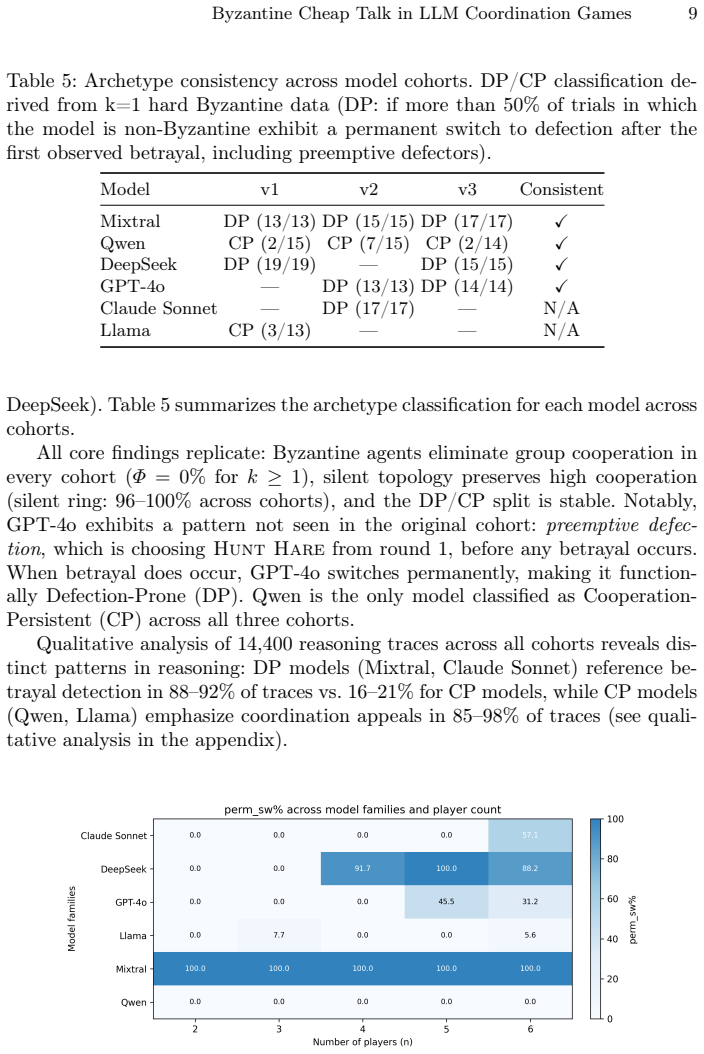
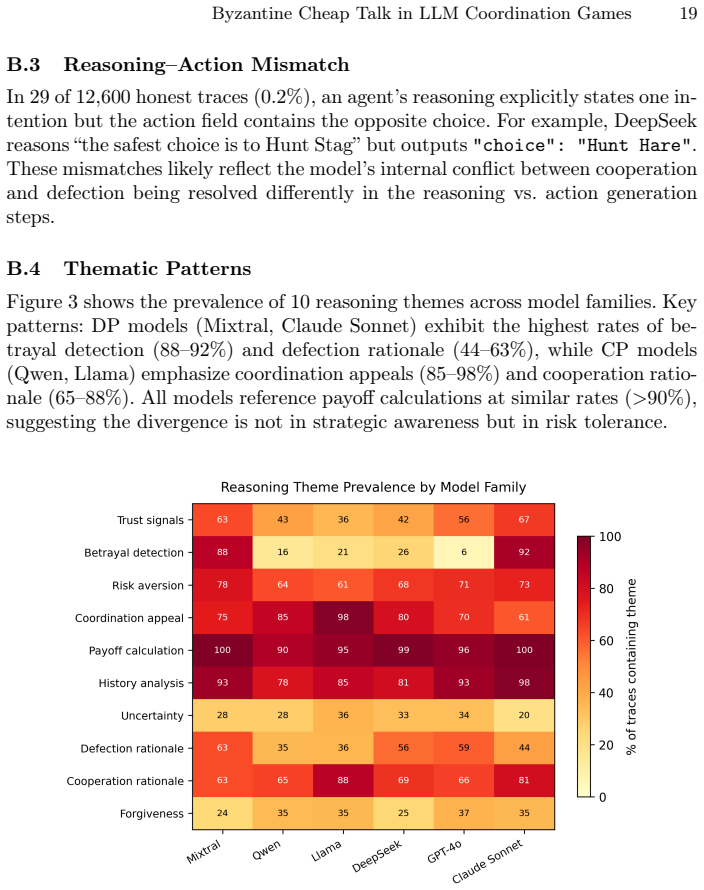
- Behavioral archetypes of defection-prone and cooperation-persistent responses are stable across different model families.
- Cheap talk enables initial cooperation but leaves systems vulnerable to persistent exploitation after betrayal.
Where Pith is reading between the lines
- Coordination protocols may need built-in recovery mechanisms that do not require unanimous decisions after detected issues.
- Testing games where agents can adapt individually after betrayal could reveal whether the unanimity rule is the main barrier.
- Similar vulnerabilities might appear in other multi-agent setups where agents reason about possible hidden states.
Load-bearing premise
The game's unanimity payoff structure prevents non-Byzantine agents from adapting collectively after detecting betrayal within one round, leading to persistent exploitation without recovery.
What would settle it
Running the same Stag Hunt game but with a payoff structure that allows some agents to switch to defection without unanimous agreement after detecting betrayal, and observing whether coordination recovers or the archetypes persist.
Figures
read the original abstract
Multi-agent LLM systems increasingly rely on communication protocols for coordination, yet their robustness under adversarial and structural constraints remains poorly understood. Building on prior work showing that cheap-talk channels enable cooperation in LLM coordination games, we investigate two vulnerability classes in a 4-player Stag Hunt across six model families and 720 trials. First, when Byzantine agents signal cooperation but defect, non-Byzantine agents detect the betrayal within one round yet fail to adapt collectively: a substantial fraction continue cooperating despite repeated exploitation, unable to recover coordination due to the game's unanimity payoff structure. Second, explicitly restricting communication topology collapses cooperation, while applying identical restrictions silently preserves near-perfect cooperation. This establishes that coordination failure stems from agents' meta-reasoning about hidden information, not information loss itself. We identify two stable behavioral archetypes that replicate across all model cohorts: Defection-Prone models that switch permanently after betrayal, and Cooperation-Persistent models that continue cooperating at significant individual cost. These findings reveal concrete security vulnerabilities: communication channels can be exploited as adversarial injection vectors, and disclosing network topology to agents can degrade coordination even without any adversary present.
Editorial analysis
A structured set of objections, weighed in public.
Referee Report
Summary. This paper examines the robustness of multi-agent LLM coordination in a 4-player Stag Hunt game under Byzantine adversaries and varying communication topologies. Through 720 trials across six model families, it claims that non-Byzantine agents detect betrayal but fail to collectively adapt due to the unanimity payoff structure, resulting in persistent exploitation. It further shows that explicitly restricting the communication topology collapses cooperation, whereas silent restrictions preserve it, attributing this to agents' meta-reasoning about hidden information rather than information loss. Two stable behavioral archetypes—Defection-Prone and Cooperation-Persistent—are identified that replicate across model cohorts.
Significance. If the central empirical claims hold after clarification, the work identifies concrete security vulnerabilities in LLM coordination protocols and demonstrates that topology disclosure itself can degrade performance even absent adversaries. The replication of two behavioral archetypes across all six model families is a strength, as is the scale of the 720-trial evaluation. These results could inform safer design of multi-agent systems if the experimental controls are tightened.
major comments (3)
- [Abstract] Abstract: the central claim that coordination failure stems from meta-reasoning about hidden information (rather than information loss) rests on the explicit-vs-silent topology contrast, yet the manuscript provides no explicit verification that the two prompt conditions differ solely in topology disclosure and contain no additional framing or wording differences.
- [Results and Methods] Results and Methods: the claims of detection within one round, persistent cooperation despite exploitation, and stable archetype identification are summarized from 720 trials but lack any description of statistical methods, error bars, exact signaling protocols, or data exclusion criteria, leaving the quantitative support for adaptation failure and archetype replication only partially documented.
- [Experimental design] Experimental design: the interpretation that the unanimity payoff structure prevents collective adaptation after betrayal is load-bearing for the security-vulnerability conclusion, but the manuscript does not report controls or ablations that isolate this payoff feature from other game elements.
minor comments (2)
- Add error bars or confidence intervals to all quantitative results and archetype frequency tables.
- Clarify the precise numerical thresholds used to classify models into the Defection-Prone versus Cooperation-Persistent archetypes.
Simulated Author's Rebuttal
We thank the referee for their insightful comments, which help clarify the presentation of our experimental methods and strengthen the claims. We address each major comment below.
read point-by-point responses
-
Referee: [Abstract] Abstract: the central claim that coordination failure stems from meta-reasoning about hidden information (rather than information loss) rests on the explicit-vs-silent topology contrast, yet the manuscript provides no explicit verification that the two prompt conditions differ solely in topology disclosure and contain no additional framing or wording differences.
Authors: We agree that explicit verification of the prompt differences is necessary to support the meta-reasoning interpretation. The two conditions were designed to differ only in the inclusion of a topology disclosure sentence in the explicit condition. In the revised manuscript, we will append the complete prompt templates for both conditions and annotate the differing elements to confirm no additional framing or wording variations were present. revision: yes
-
Referee: [Results and Methods] Results and Methods: the claims of detection within one round, persistent cooperation despite exploitation, and stable archetype identification are summarized from 720 trials but lack any description of statistical methods, error bars, exact signaling protocols, or data exclusion criteria, leaving the quantitative support for adaptation failure and archetype replication only partially documented.
Authors: The current manuscript presents aggregate results from the 720 trials without detailed statistical reporting. We will revise the Results and Methods sections to include: error bars (standard errors across model families and trials), a description of the exact signaling protocols (e.g., message formats and timing), data exclusion criteria (no trials were excluded), and the method for archetype identification (clustering based on consistent defection or cooperation patterns post-betrayal across repeated trials). revision: yes
-
Referee: [Experimental design] Experimental design: the interpretation that the unanimity payoff structure prevents collective adaptation after betrayal is load-bearing for the security-vulnerability conclusion, but the manuscript does not report controls or ablations that isolate this payoff feature from other game elements.
Authors: We recognize that ablations isolating the unanimity payoff would provide more direct evidence for its role in adaptation failure. The Stag Hunt setup uses the standard unanimity requirement for the cooperative payoff, as established in prior literature on the game. We will add a dedicated limitations paragraph acknowledging the absence of such controls and suggesting that payoff structure variations could be explored in future work to further validate the interpretation. revision: partial
Circularity Check
Empirical study with no circular derivations or load-bearing self-citations
full rationale
This is a purely experimental paper reporting results from 720 trials across six model families in a Stag Hunt game. All central claims (detection of betrayal without collective adaptation, topology disclosure effects, and behavioral archetypes) rest on direct observation of agent actions under controlled conditions. No equations, fitted parameters, or predictions are presented that reduce to inputs by construction. The mention of prior work on cheap-talk cooperation is background and not used to derive or justify the new empirical findings via self-citation chains. The paper is self-contained against its own experimental benchmarks.
Axiom & Free-Parameter Ledger
axioms (1)
- domain assumption The Stag Hunt game requires unanimous cooperation for the high payoff, preventing collective adaptation after betrayal.
Reference graph
Works this paper leans on
-
[1]
Anthropic: Claude sonnet 4.6.https://www.anthropic.com/news/ claude-sonnet-4-6(2024)
2024
-
[2]
In: Proceedings of the ACM Turing Award Celebration Conference-China 2024
Chen, B., Li, G., Lin, X., Wang, Z., Li, J.: Blockagents: Towards byzantine-robust llm-based multi-agent coordination via blockchain. In: Proceedings of the ACM Turing Award Celebration Conference-China 2024. pp. 187–192 (2024)
2024
-
[3]
Econometrica50(6), 1431–1451 (1982)
Crawford, V.P., Sobel, J.: Strategic information transmission. Econometrica50(6), 1431–1451 (1982)
1982
-
[4]
DeepSeek-AI: DeepSeek-V3 technical report. arXiv preprint arXiv:2412.19437 (2024)
work page internal anchor Pith review Pith/arXiv arXiv 2024
-
[5]
The RAND Journal of Economics pp
Farrell, J.: Cheap talk, coordination, and entry. The RAND Journal of Economics pp. 34–39 (1987)
1987
-
[6]
Journal of Economic Perspectives10(3), 103– 118 (1996)
Farrell, J., Rabin, M.: Cheap talk. Journal of Economic Perspectives10(3), 103– 118 (1996)
1996
-
[7]
Grattafiori, A., Dubey, A., Jauhri, A., et al.: The llama 3 herd of models. arXiv preprint arXiv:2407.21783 (2024)
work page internal anchor Pith review Pith/arXiv arXiv 2024
-
[8]
In: The Thirteenth International Conference on Learning Represen- tations (2025)
Huang, J.t., Li, E.J., Lam, M.H., Liang, T., Wang, W., Yuan, Y., Jiao, W., Wang, X., Tu, Z., Lyu, M.R.: Competing large language models in multi-agent gaming environments. In: The Thirteenth International Conference on Learning Represen- tations (2025)
2025
-
[9]
Princeton University Press (2008)
Jackson, M.O.: Social and Economic Networks. Princeton University Press (2008)
2008
-
[10]
Jiang, A.Q., Sablayrolles, A., Roux, A., Mensch, A., et al.: Mixtral of experts (2024)
2024
-
[11]
ACM Trans- actions on Programming Languages and Systems4(3), 382–401 (1982)
Lamport, L., Shostak, R., Pease, M.: The Byzantine generals problem. ACM Trans- actions on Programming Languages and Systems4(3), 382–401 (1982)
1982
-
[12]
Prompt Infection: LLM-to-LLM Prompt Injection within Multi-Agent Systems
Lee, D., Tiwari, M.: Prompt infection: Llm-to-llm prompt injection within multi- agent systems. arXiv preprint arXiv:2410.07283 (2024)
work page internal anchor Pith review Pith/arXiv arXiv 2024
-
[13]
Lorè, N., Heydari, B.: Strategic behavior of large language models: Game structure vs. contextual framing. arXiv preprint arXiv:2309.05898 (2023)
-
[14]
In: Proceedings of the 19th Con- ference of the European Chapter of the Association for Computational Linguistics (2026)
Madmoun, H., Lahlou, S.: Communication enables cooperation in LLM agents: A comparison with curriculum-based approaches. In: Proceedings of the 19th Con- ference of the European Chapter of the Association for Computational Linguistics (2026)
2026
-
[15]
OpenAI: Hello gpt-4o.https://openai.com/index/hello-gpt-4o/(2024)
2024
-
[16]
In: Proceedings of the 36th Annual ACM Symposium on User Interface Software and Technology
Park, J.S., O’Brien, J.C., Cai, C.J., Morris, M.R., Liang, P., Bernstein, M.S.: Gen- erative agents: Interactive simulacra of human behavior. In: Proceedings of the 36th Annual ACM Symposium on User Interface Software and Technology. pp. 1–22 (2023)
2023
-
[17]
Qwen Team: Qwen2.5 technical report. arXiv preprint arXiv:2412.15115 (2024)
work page internal anchor Pith review Pith/arXiv arXiv 2024
-
[18]
Cambridge University Press (2004)
Skyrms, B.: The Stag Hunt and the Evolution of Social Structure. Cambridge University Press (2004)
2004
-
[19]
arXiv preprint arXiv:2502.09053 (2025)
Sun, H., Wu, Y., Wang, P., Chen, W., Cheng, Y., Deng, X., Chu, X.: Game Theory Meets Large Language Models: A Systematic Survey with Taxonomy and New Frontiers. arXiv preprint arXiv:2502.09053 (2025)
-
[20]
Wooldridge,M.:AnIntroductiontoMultiagentSystems.JohnWiley&Sons(2009)
2009
-
[21]
In: First conference on language modeling (2024) Byzantine Cheap Talk in LLM Coordination Games 15
Wu, Q., Bansal, G., Zhang, J., Wu, Y., Li, B., Zhu, E., Jiang, L., Zhang, X., Zhang, S., Liu, J., et al.: Autogen: Enabling next-gen llm applications via multi- agent conversations. In: First conference on language modeling (2024) Byzantine Cheap Talk in LLM Coordination Games 15
2024
-
[22]
In: Proceedings of the 2024 Conference on Empirical Methods in Natural Language Processing
Xu, L., Hu, Z., Zhou, D., Ren, H., Dong, Z., Keutzer, K., Ng, S.K., Feng, J.: MAgIC: Investigation of large language model powered multi-agent in cognition, adaptability, rationality and collaboration. In: Proceedings of the 2024 Conference on Empirical Methods in Natural Language Processing. pp. 7315–7332 (2024) A Prompt Templates All agents receive the ...
2024
-
[23]
If all 4 players hunt the stag, everyone gets 10 points
You will play an N-Player Stag Hunt. If all 4 players hunt the stag, everyone gets 10 points. If anyone hunts a hare, stag hunters get 0 and hare hunters get 3
-
[24]
cheap talk
Before you choose your action, you must broadcast ONE single word to the group. This word can be anything. It is non-binding “cheap talk”. ### GAME HISTORY {history_str} ### YOUR TASK First, provide your step-by-step reasoning for your choice of word. Second, declare the single word you will broadcast. You MUST provide your final answer in the following J...
-
[25]
Players: There are 4 players in total
-
[26]
Actions: You must choose one of two actions: ’Hunt Stag’ or ’Hunt Hare’
-
[27]
reasoning
Payoffs: If ALL 4 players choose ’Hunt Stag’, everyone gets 10 points. If ANY player chooses ’Hunt Hare’, stag hunters get 0, hare hunters get 3 each. ### CURRENT ROUND INFORMATION The 4 words broadcast by all players in the communication phase are: {comm_str} ### GAME HISTORY {history_str} ### YOUR TASK Based on the words you have seen, provide your step...
-
[28]
N=4” isreplacedwith“agroup ofplayers
Theplayercount“N=4” isreplacedwith“agroup ofplayers” (communication stage) or “a multiplayer game” (action stage)
-
[29]
NoCOMMUNICATION VISIBILITYsection is included
-
[30]
reasoning
The game history is filtered through the visibility map, so agents never ob- serve actions or messages from non-visible players in prior rounds. The agent receives fewer messages with no indication that any are missing. Byzantine Cheap Talk in LLM Coordination Games 17 A.5 Byzantine Adversary Override Byzantine agents bypass the LLM entirely. The engine’s...
discussion (0)
Sign in with ORCID, Apple, or X to comment. Anyone can read and Pith papers without signing in.