Limits on primordial black holes from the extragalactic gamma-ray background; current status and future projections
Pith reviewed 2026-06-27 15:18 UTC · model grok-4.3
The pith
Extragalactic gamma-ray background data set the tightest limits on primordial black holes with masses from 10^14 to 10^17 grams.
A machine-rendered reading of the paper's core claim, the machinery that carries it, and where it could break.
Core claim
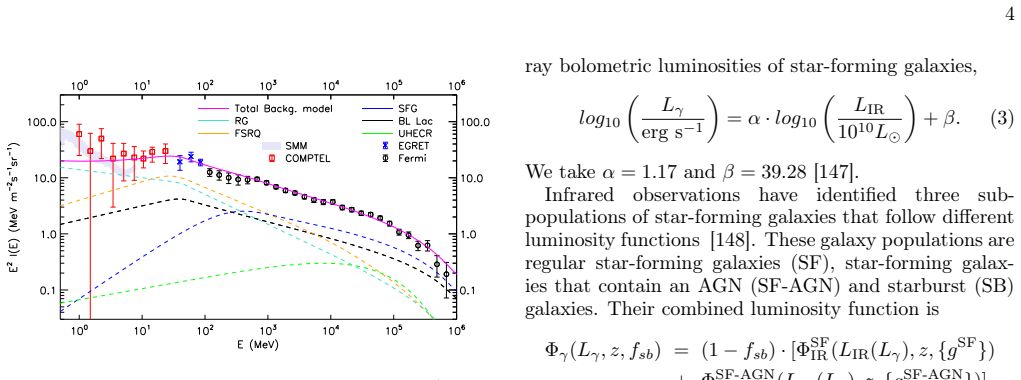
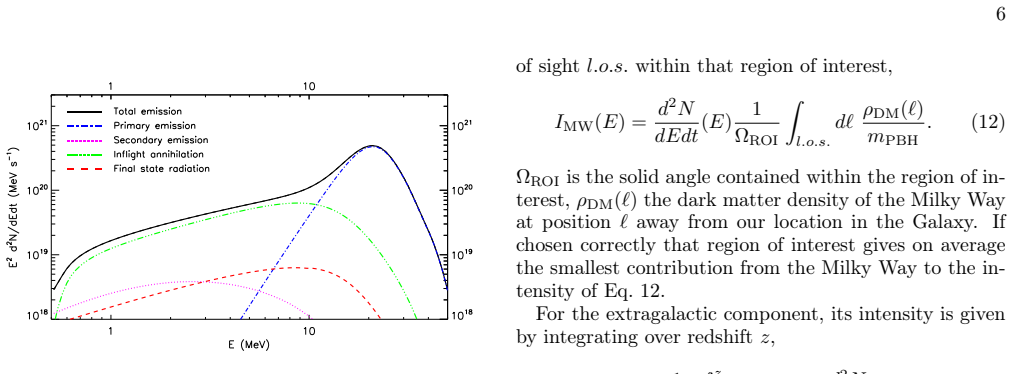
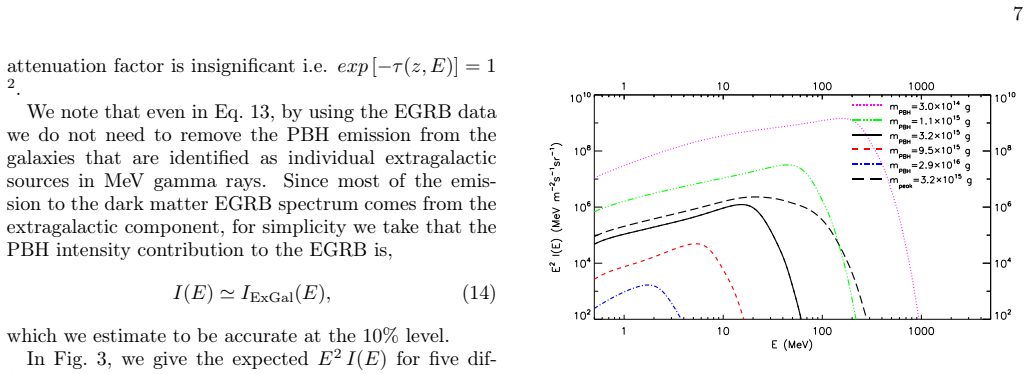
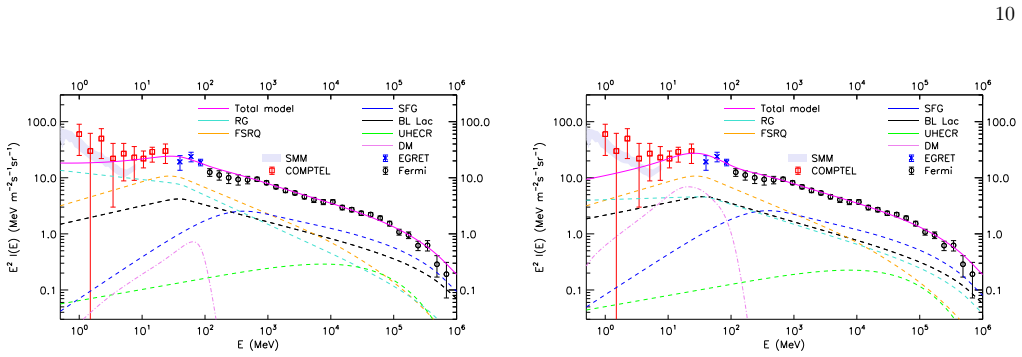
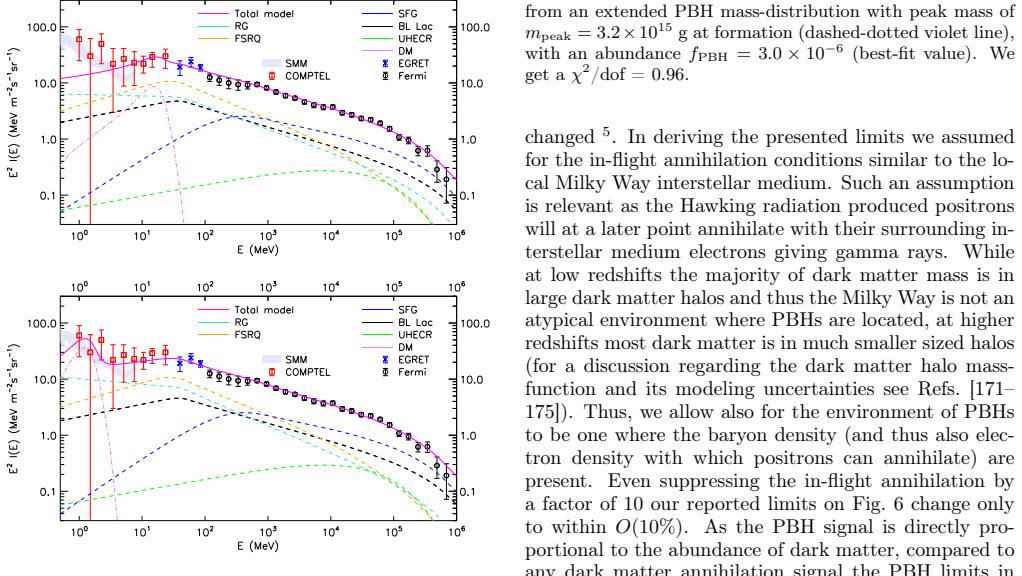
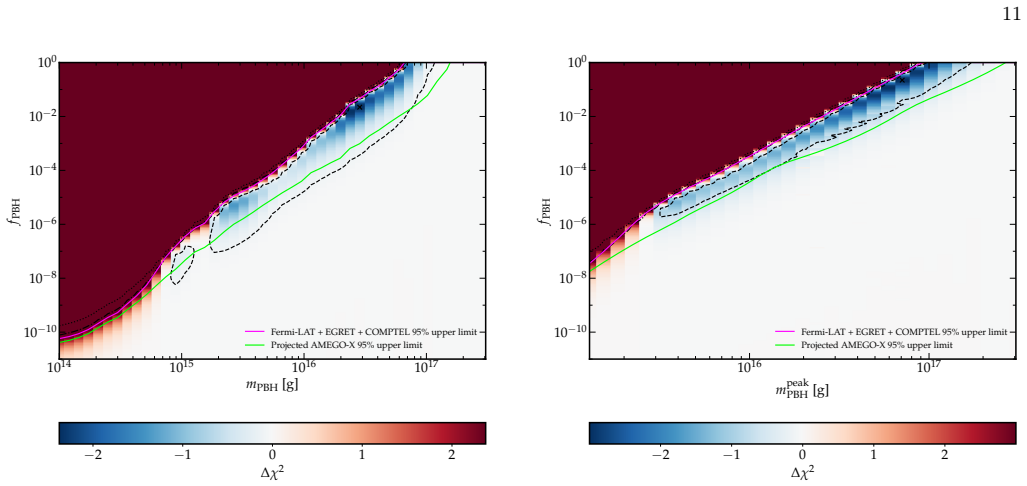
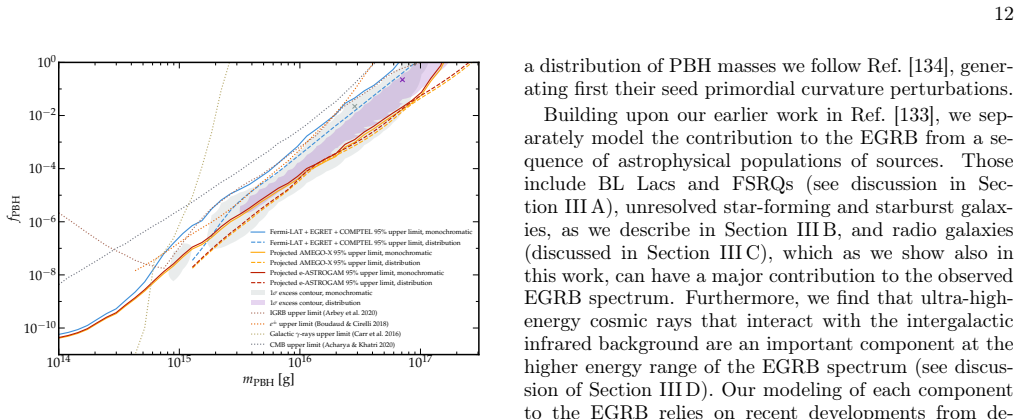
By modeling the extragalactic gamma-ray background from blazars, star-forming galaxies, radio galaxies, and ultra-high-energy cosmic rays, and subtracting that background from the observed fluxes measured between 0.5 MeV and 1 TeV, the data constrain the abundance of primordial black holes in the 10^14 to 10^17 g range. Updated calculations of black hole gamma-ray emission that incorporate direct Hawking radiation, hadronization and decay products, final state radiation, and positron annihilation in the interstellar medium are used. These constraints are the strongest among indirect dark matter probes for the mass range, and they apply to both monochromatic and extended mass distributions.
What carries the argument
Spectral subtraction of modeled contributions from known extragalactic sources to isolate any residual flux attributable to evaporating primordial black holes.
If this is right
- Primordial black holes in the 10^14 to 10^17 g mass window can form only a very small fraction of the dark matter density.
- The same tight bounds apply whether the black holes have a single mass or a broad distribution of masses.
- The extra low-energy gamma rays from final state radiation and positron annihilation make the upper limits stronger than earlier estimates.
- Future gamma-ray telescopes will reduce the allowed abundance of such black holes by another order of magnitude or more.
Where Pith is reading between the lines
- If the emission models hold, primordial black holes cannot explain the full dark matter density in this mass range.
- Combining the gamma-ray limits with microlensing or gravitational-wave searches could close remaining windows for these objects across a wider mass spectrum.
- Reductions in modeling uncertainty from better source catalogs would directly translate into stronger black hole bounds without new observations.
Load-bearing premise
The models for gamma-ray production by blazars, star-forming galaxies, radio galaxies, and ultra-high-energy cosmic ray interactions are accurate enough to leave no significant unaccounted background that could be mistaken for a primordial black hole signal.
What would settle it
A measurement showing that the total observed extragalactic gamma-ray flux between 0.5 MeV and 1 TeV exactly equals the sum of the modeled contributions from blazars, star-forming galaxies, radio galaxies, and cosmic ray interactions at every energy, with no excess remaining.
Figures
read the original abstract
Primordial black holes (PBHs), possibly formed from the collapse of early universe perturbations, will evaporate via Hawking radiation with a lifetime comparable to the age of the universe, if their mass is $O(10^{14})$ g. Such black holes can contribute to the observed gamma-ray fluxes in the MeV and GeV range. Using the observed extragalactic gamma-ray background (EGRB) from the \textit{Fermi} Large Area Telescope, the \textit{EGRET}, and the \textit{COMPTEL} telescopes that cover gamma-ray energies from 0.5 MeV to 1 TeV, we evaluate limits on the abundance of PBHs with masses of $10^{14}$ to $10^{17}$ g. We study both monochromatic and extended mass distributions of PBHs. To model the EGRB spectrum, we calculate the contribution from extragalactic sources including blazars, star-forming galaxies and radio galaxies and also account for ultra-high-energy cosmic rays that produce gamma rays when interacting with the infrared background. Our EGRB modeling uses information from the \textit{Fermi} gamma-ray point sources catalog, from observations at X-rays, the visible spectrum, the infrared and radio waves, and also accounts for modeling uncertainties and variations on the properties within each class of these sources. Moreover, we use recent work on the modeling of the PBHs' gamma-ray emission, that includes the direct Hawking radiation, gamma rays produced in the hadronization and decay of unstable particles, final state radiation and gamma rays from pair annihilations in the interstellar medium. As the contribution of final state radiation and the annihilation of positrons enhances the low-energy part of the produced gamma-ray spectra from PBHs, we find that the EGRB observations can set the tightest limits on their abundance among all indirect dark matter probes, within the mass range of interest.[abridged]
Editorial analysis
A structured set of objections, weighed in public.
Referee Report
Summary. The paper claims that observations of the extragalactic gamma-ray background (EGRB) from Fermi-LAT, EGRET, and COMPTEL (0.5 MeV to 1 TeV) can be used to derive the tightest limits to date on the PBH dark matter fraction f_PBH for masses 10^14–10^17 g (both monochromatic and extended distributions). This is achieved by subtracting modeled contributions from blazars, star-forming galaxies, radio galaxies, and UHECR interactions with the infrared background, then attributing any residual to PBH Hawking radiation (including direct emission, hadronization, final-state radiation, and positron annihilation in the ISM). The modeling incorporates multi-wavelength catalogs and accounts for source-property variations and uncertainties.
Significance. If the background subtraction is robust, the result would be significant because the low-energy enhancement from final-state radiation and positron annihilation allows EGRB to outperform other indirect probes (e.g., galactic gamma rays or neutrinos) in this mass window. The use of recent PBH emission spectra and multi-wavelength constraints on source classes is a strength that could make the limits more reliable than earlier EGRB analyses.
major comments (2)
- [EGRB modeling and PBH emission sections] The central claim that EGRB yields the tightest limits on f_PBH rests on the residual after background subtraction being smaller than limits from all other indirect probes. The abstract states that modeling uncertainties are accounted for via multi-wavelength catalogs, but no explicit quantification (e.g., systematic error bands on the blazar luminosity function or UHECR-IR background contribution) is provided to show that these systematics do not exceed the allowed PBH residual, particularly at low energies where the FSR/annihilation component dominates.
- [Results and discussion of limits] The assertion that the derived limits are the tightest requires a direct, apples-to-apples comparison (same mass range, same f_PBH definition) against prior indirect constraints. Without a dedicated figure or table overlaying the new EGRB bounds on existing limits from galactic center, dwarf galaxies, or other probes, it is not possible to verify that the EGRB residual truly produces a stronger bound once modeling systematics are folded in.
minor comments (2)
- Notation for the PBH mass function (monochromatic vs. extended) and the precise definition of f_PBH should be stated explicitly in the abstract or introduction for clarity.
- The energy range coverage (0.5 MeV–1 TeV) and instrument-specific data handling (e.g., how EGRET/COMPTEL points are combined with Fermi) would benefit from a brief methods summary or reference to a table of data points used.
Simulated Author's Rebuttal
We thank the referee for the constructive comments. We address each major point below and will revise the manuscript to incorporate explicit quantifications and comparisons as requested.
read point-by-point responses
-
Referee: [EGRB modeling and PBH emission sections] The central claim that EGRB yields the tightest limits on f_PBH rests on the residual after background subtraction being smaller than limits from all other indirect probes. The abstract states that modeling uncertainties are accounted for via multi-wavelength catalogs, but no explicit quantification (e.g., systematic error bands on the blazar luminosity function or UHECR-IR background contribution) is provided to show that these systematics do not exceed the allowed PBH residual, particularly at low energies where the FSR/annihilation component dominates.
Authors: We agree that explicit quantification of systematic uncertainties on the background components would strengthen support for the central claim. The manuscript already incorporates variations from multi-wavelength catalogs and source-property uncertainties in the modeling sections, but we will add dedicated systematic error bands (particularly for blazars and UHECR-IR contributions) in a revised version to demonstrate that these do not exceed the PBH residual at low energies. revision: yes
-
Referee: [Results and discussion of limits] The assertion that the derived limits are the tightest requires a direct, apples-to-apples comparison (same mass range, same f_PBH definition) against prior indirect constraints. Without a dedicated figure or table overlaying the new EGRB bounds on existing limits from galactic center, dwarf galaxies, or other probes, it is not possible to verify that the EGRB residual truly produces a stronger bound once modeling systematics are folded in.
Authors: We agree that a direct visual comparison is needed to verify the claim of tightest limits. The text discusses comparisons to other probes, but we will add a dedicated figure in the revised manuscript overlaying the EGRB-derived f_PBH limits (monochromatic and extended) against existing constraints from galactic center, dwarf galaxies, and other indirect probes, using consistent mass ranges and f_PBH definitions while folding in the updated systematics. revision: yes
Circularity Check
No significant circularity; derivation compares external data to independent background models
full rationale
The paper subtracts modeled contributions (blazars, star-forming galaxies, radio galaxies, UHECRs) derived from multi-wavelength catalogs and observations from measured EGRB spectra (Fermi, EGRET, COMPTEL) to bound PBH abundance. PBH spectra are taken from cited recent work on Hawking radiation plus FSR/annihilation; this is external input rather than a fit to the same EGRB data. No equation reduces to its own inputs by construction, no fitted parameter is relabeled as prediction, and no uniqueness theorem or ansatz is smuggled via self-citation. The central claim rests on the accuracy of the background subtraction against real telescope data, which is falsifiable and not self-referential.
Axiom & Free-Parameter Ledger
Reference graph
Works this paper leans on
-
[1]
The Hypothesis of Cores Retarded during Expansion and the Hot Cos- mological Model,
Ya. B. Zel’dovich and I. D. Novikov, “The Hypothesis of Cores Retarded during Expansion and the Hot Cos- mological Model,” Soviet Astronomy10, 602 (1967)
1967
-
[2]
Gravitationally collapsed objects of very low mass,
Stephen Hawking, “Gravitationally collapsed objects of very low mass,” Mon. Not. R. Astron. Soc.152, 75 (1971)
1971
-
[3]
Cosmological effects of primordial black holes,
G. F. Chapline, “Cosmological effects of primordial black holes,” Nature (London)253, 251–252 (1975)
1975
-
[4]
Primordial Black Holes as Dark Matter,
Bernard Carr, Florian Kuhnel, and Marit Sandstad, “Primordial Black Holes as Dark Matter,” Phys. Rev. D 94, 083504 (2016), arXiv:1607.06077 [astro-ph.CO]
Pith/arXiv arXiv 2016
-
[5]
Constraints on primordial black holes,
Bernard Carr, Kazunori Kohri, Yuuiti Sendouda, and Jun’ichi Yokoyama, “Constraints on primordial black holes,” Rept. Prog. Phys.84, 116902 (2021), arXiv:2002.12778 [astro-ph.CO]
Pith/arXiv arXiv 2021
-
[6]
Primordial black holes and the deuterium problem,
Ia. B. Zeldovich, A. A. Starobinskii, M. Iu. Khlopov, and V. M. Chechetkin, “Primordial black holes and the deuterium problem,” Soviet Astronomy Letters3, 110– 112 (1977)
1977
-
[7]
Primordial black holes and cosmological nucleosynthe- sis,
B. V. Vainer, O. V. Dryzhakova, and P. D. Naselskii, “Primordial black holes and cosmological nucleosynthe- sis,” Soviet Astronomy Letters4, 185–187 (1978)
1978
-
[8]
Primordial black holes and the deuterium abundance,
D. Lindley, “Primordial black holes and the deuterium abundance,” Mon. Not. R. Astron. Soc.193, 593–601 (1980)
1980
-
[9]
New cosmological constraints on primordial black holes,
B. J. Carr, Kazunori Kohri, Yuuiti Sendouda, and Jun’ichi Yokoyama, “New cosmological constraints on primordial black holes,” Phys. Rev. D81, 104019 (2010), arXiv:0912.5297 [astro-ph.CO]
Pith/arXiv arXiv 2010
-
[10]
CMB and BBN constraints on evaporating primordial black holesrevisited,
Sandeep Kumar Acharya and Rishi Khatri, “CMB and BBN constraints on evaporating primordial black holesrevisited,” JCAP06,018(2020),arXiv:2002.00898 [astro-ph.CO]
arXiv 2020
-
[11]
Thermalization of large energy release in the early Universe,
Jens Chluba, Andrea Ravenni, and Sandeep Kumar Acharya, “Thermalization of large energy release in the early Universe,” Mon. Not. Roy. Astron. Soc.498, 959– 980 (2020), arXiv:2005.11325 [astro-ph.CO]
arXiv 2020
-
[12]
Man Ho Chan and Chak Man Lee, “Constraining Pri- mordial Black Hole Fraction at the Galactic Centre us- ing radio observational data,” Mon. Not. Roy. Astron. Soc.497, 1212–1216 (2020), arXiv:2007.05677 [astro- ph.HE]
arXiv 2020
-
[13]
Constraints on primordial black holes from the Galactic gamma-ray background,
B. J. Carr, Kazunori Kohri, Yuuiti Sendouda, and Jun’ichi Yokoyama, “Constraints on primordial black holes from the Galactic gamma-ray background,” Phys. Rev. D94, 044029 (2016), arXiv:1604.05349 [astro- ph.CO]
Pith/arXiv arXiv 2016
-
[14]
Constrain- ing Primordial Black Hole Abundance with the Galac- tic 511 keV Line,
William DeRocco and Peter W. Graham, “Constrain- ing Primordial Black Hole Abundance with the Galac- tic 511 keV Line,” Phys. Rev. Lett.123, 251102 (2019), 14 arXiv:1906.07740 [astro-ph.CO]
arXiv 2019
-
[15]
Ranjan Laha, “Primordial Black Holes as a Dark Mat- ter Candidate Are Severely Constrained by the Galac- tic Center 511 keVγ-Ray Line,” Phys. Rev. Lett.123, 251101 (2019), arXiv:1906.09994 [astro-ph.HE]
arXiv 2019
-
[16]
Constraining primordial black hole masses with the isotropic gamma ray background,
Alexandre Arbey, Jérémy Auffinger, and Joseph Silk, “Constraining primordial black hole masses with the isotropic gamma ray background,” Phys. Rev. D101, 023010 (2020), arXiv:1906.04750 [astro-ph.CO]
arXiv 2020
-
[17]
X-ray and gamma-ray limits on the primordial black hole abundance from Hawk- ing radiation,
Guillermo Ballesteros, Javier Coronado-Blázquez, and Daniele Gaggero, “X-ray and gamma-ray limits on the primordial black hole abundance from Hawk- ing radiation,” Phys. Lett. B808, 135624 (2020), arXiv:1906.10113 [astro-ph.CO]
arXiv 2020
-
[18]
INTEGRAL constraints on primordial black holes and particle dark matter,
Ranjan Laha, Julian B. Muñoz, and Tracy R. Slatyer, “INTEGRAL constraints on primordial black holes and particle dark matter,” Phys. Rev. D101, 123514 (2020), arXiv:2004.00627 [astro-ph.CO]
arXiv 2020
-
[19]
Direct Detection of Hawking Radiation from Asteroid- Mass Primordial Black Holes,
Adam Coogan, Logan Morrison, and Stefano Profumo, “Direct Detection of Hawking Radiation from Asteroid- Mass Primordial Black Holes,” Phys. Rev. Lett.126, 171101 (2021), arXiv:2010.04797 [astro-ph.CO]
arXiv 2021
-
[20]
Near future MeV telescopes can dis- cover asteroid-mass primordial black hole dark matter,
Anupam Ray, Ranjan Laha, Julian B. Muñoz, and Regina Caputo, “Near future MeV telescopes can dis- cover asteroid-mass primordial black hole dark matter,” Phys. Rev. D104, 023516 (2021), arXiv:2102.06714 [astro-ph.CO]
arXiv 2021
-
[21]
A constraint on light primordial black holes from the interstellar medium temperature,
Hyungjin Kim, “A constraint on light primordial black holes from the interstellar medium temperature,” Mon. Not. Roy. Astron. Soc.504, 5475–5484 (2021), arXiv:2007.07739 [hep-ph]
arXiv 2021
-
[22]
Constraining Primordial Black Holes with Dwarf Galaxy Heating,
Philip Lu, Volodymyr Takhistov, Graciela B. Gelmini, Kohei Hayashi, Yoshiyuki Inoue, and Alexander Kusenko, “Constraining Primordial Black Holes with Dwarf Galaxy Heating,” Astrophys. J. Lett.908, L23 (2021), arXiv:2007.02213 [astro-ph.CO]
arXiv 2021
-
[23]
Voyager1e ± Fur- ther Constrain Primordial Black Holes as Dark Matter,
MathieuBoudaudandMarcoCirelli,“Voyager1e ± Fur- ther Constrain Primordial Black Holes as Dark Matter,” Phys. Rev. Lett.122, 041104 (2019), arXiv:1807.03075 [astro-ph.HE]
Pith/arXiv arXiv 2019
-
[24]
Tung X. Tran, Sarah R. Geller, Benjamin V. Lehmann, and David I. Kaiser, “Close encounters of the primor- dial kind: A new observable for primordial black holes as dark matter,” Phys. Rev. D110, 063533 (2024), arXiv:2312.17217 [astro-ph.CO]
arXiv 2024
-
[25]
New constraints on primordial black holes abundance from femtolensing of gamma-ray bursts,
A. Barnacka, J. F. Glicenstein, and R. Moderski, “New constraints on primordial black holes abundance from femtolensing of gamma-ray bursts,” Phys. Rev. D86, 043001 (2012), arXiv:1204.2056 [astro-ph.CO]
Pith/arXiv arXiv 2012
-
[26]
Femtolensing by Dark Matter Revisited,
Andrey Katz, Joachim Kopp, Sergey Sibiryakov, and Wei Xue, “Femtolensing by Dark Matter Revisited,” JCAP12, 005 (2018), arXiv:1807.11495 [astro-ph.CO]
Pith/arXiv arXiv 2018
-
[27]
Picolens- ing as a probe of primordial black hole dark matter,
Michael A. Fedderke and Sergey Sibiryakov, “Picolens- ing as a probe of primordial black hole dark matter,” Phys. Rev. D111, 063060 (2025), arXiv:2411.12947 [astro-ph.HE]
arXiv 2025
-
[28]
Microlensing constraints on primordial black holes with Subaru/HSC Andromeda observations,
Hiroko Niikuraet al., “Microlensing constraints on primordial black holes with Subaru/HSC Andromeda observations,” Nature Astron.3, 524–534 (2019), arXiv:1701.02151 [astro-ph.CO]
Pith/arXiv arXiv 2019
-
[29]
On the wave optics effect on primordial black hole constraints from optical microlensing search,
Sunao Sugiyama, Toshiki Kurita, and Masahiro Takada, “On the wave optics effect on primordial black hole constraints from optical microlensing search,” Mon. Not. Roy. Astron. Soc.493, 3632–3641 (2020), arXiv:1905.06066 [astro-ph.CO]
arXiv 2020
-
[30]
Revisit- ing constraints on asteroid-mass primordial black holes as dark matter candidates,
Paulo Montero-Camacho, Xiao Fang, Gabriel Vasquez, Makana Silva, and Christopher M. Hirata, “Revisit- ing constraints on asteroid-mass primordial black holes as dark matter candidates,” JCAP08, 031 (2019), arXiv:1906.05950 [astro-ph.CO]
arXiv 2019
-
[31]
Updated Constraints on Asteroid-Mass Primordial Black Holes as Dark Matter,
Nolan Smyth, Stefano Profumo, Samuel English, Tesla Jeltema, Kevin McKinnon, and Puragra Guhathakurta, “Updated Constraints on Asteroid-Mass Primordial Black Holes as Dark Matter,” Phys. Rev. D 101, 063005 (2020), arXiv:1910.01285 [astro-ph.CO]
arXiv 2020
-
[32]
Subaru-HSC through a different lens: Mi- crolensing by extended dark matter structures,
Djuna Croon, David McKeen, Nirmal Raj, and Zi- hui Wang, “Subaru-HSC through a different lens: Mi- crolensing by extended dark matter structures,” Phys. Rev. D102, 083021 (2020), arXiv:2007.12697 [astro- ph.CO]
arXiv 2020
-
[33]
Experimental Limits on Primordial Black Hole Dark Matter from the First 2 yr of Kepler Data,
Kim Griest, Agnieszka M. Cieplak, and Matthew J. Lehner, “Experimental Limits on Primordial Black Hole Dark Matter from the First 2 yr of Kepler Data,” As- trophys. J.786, 158 (2014), arXiv:1307.5798 [astro- ph.CO]
Pith/arXiv arXiv 2014
-
[34]
Constraints on Earth-mass primordial black holes from OGLE 5-year microlensing events,
Hiroko Niikura, Masahiro Takada, Shuichiro Yokoyama, Takahiro Sumi, and Shogo Masaki, “Constraints on Earth-mass primordial black holes from OGLE 5-year microlensing events,” Phys. Rev. D99, 083503 (2019), arXiv:1901.07120 [astro-ph.CO]
Pith/arXiv arXiv 2019
-
[35]
Limits on the Macho ContentoftheGalacticHalofromtheEROS-2Surveyof the Magellanic Clouds,
P. Tisserandet al.(EROS-2), “Limits on the Macho ContentoftheGalacticHalofromtheEROS-2Surveyof the Magellanic Clouds,” Astron. Astrophys.469, 387– 404 (2007), arXiv:astro-ph/0607207
Pith/arXiv arXiv 2007
-
[36]
Astrometric microlensing of primordial black holes with Gaia,
Himanshu Verma and Vikram Rentala, “Astrometric microlensing of primordial black holes with Gaia,” JCAP05, 045 (2023), arXiv:2208.14460 [astro-ph.GA]
arXiv 2023
-
[37]
Microlensing of X- ray Pulsars: a Method to Detect Primordial Black Hole Dark Matter,
Yang Bai and Nicholas Orlofsky, “Microlensing of X- ray Pulsars: a Method to Detect Primordial Black Hole Dark Matter,” Phys. Rev. D99, 123019 (2019), arXiv:1812.01427 [astro-ph.HE]
Pith/arXiv arXiv 2019
-
[38]
Miguel Zumalacarregui and Uros Seljak, “Limits on stellar-mass compact objects as dark matter from gravi- tational lensing of type Ia supernovae,” Phys. Rev. Lett. 121, 141101 (2018), arXiv:1712.02240 [astro-ph.CO]
Pith/arXiv arXiv 2018
-
[39]
Masamune Oguri, Jose M. Diego, Nick Kaiser, Patrick L. Kelly, and Tom Broadhurst, “Understand- ing caustic crossings in giant arcs: characteristic scales, event rates, and constraints on compact dark mat- ter,” Phys. Rev. D97, 023518 (2018), arXiv:1710.00148 [astro-ph.CO]
Pith/arXiv arXiv 2018
-
[40]
Andrew L. Miller, Nancy Aggarwal, Sébastien Clesse, and Federico De Lillo, “Constraints on planetary and asteroid-mass primordial black holes from continuous gravitational-wave searches,” Phys. Rev. D105, 062008 (2022), arXiv:2110.06188 [gr-qc]
arXiv 2022
-
[41]
Lyman-αForest Constraints on Primordial Black Holes as Dark Matter,
RiccardoMurgia, GiulioScelfo, MatteoViel, andAlvise Raccanelli, “Lyman-αForest Constraints on Primordial Black Holes as Dark Matter,” Phys. Rev. Lett.123, 071102 (2019), arXiv:1903.10509 [astro-ph.CO]
arXiv 2019
-
[42]
Waves from the Centre: Probing PBH and other Macroscopic Dark Matter with LISA,
Florian Kuhnel, Andrew Matas, Glenn D. Starkman, and Katherine Freese, “Waves from the Centre: Probing PBH and other Macroscopic Dark Matter with LISA,” Eur. Phys. J. C80, 627 (2020), arXiv:1811.06387 [gr- qc]
arXiv 2020
-
[43]
Sunao Sugiyama, Volodymyr Takhistov, Edoardo Vitagliano, Alexander Kusenko, Misao Sasaki, and Masahiro Takada, “Testing Stochastic Gravitational 15 Wave Signals from Primordial Black Holes with Op- tical Telescopes,” Phys. Lett. B814, 136097 (2021), arXiv:2010.02189 [astro-ph.CO]
arXiv 2021
-
[44]
Lensing of Fast Radio Bursts as a Probe of Compact Dark Matter,
Julian B. Muñoz, Ely D. Kovetz, Liang Dai, and Marc Kamionkowski, “Lensing of Fast Radio Bursts as a Probe of Compact Dark Matter,” Phys. Rev. Lett.117, 091301 (2016), arXiv:1605.00008 [astro-ph.CO]
Pith/arXiv arXiv 2016
-
[45]
Ranjan Laha, “Lensing of fast radio bursts: Future con- straints on primordial black hole density with an ex- tendedmassfunctionandanewprobeofexoticcompact fermion and boson stars,” Phys. Rev. D102, 023016 (2020), arXiv:1812.11810 [astro-ph.CO]
arXiv 2020
-
[46]
Constraints on compact dark matter with fast radio burst observations,
Kai Liao, S. B. Zhang, Zhengxiang Li, and He Gao, “Constraints on compact dark matter with fast radio burst observations,” Astrophys. J.896, L11 (2020), arXiv:2003.13349 [astro-ph.CO]
arXiv 2020
-
[47]
Huan Zhou, Zhengxiang Li, and Zong-Hong Zhu, “Ex- ploring Primordial Curvature Perturbation on Small Scales with the Lensing Effect of Fast Radio Bursts,” Astrophys. J.962, 11 (2024), arXiv:2311.15848 [astro- ph.CO]
arXiv 2024
-
[48]
The End of the MACHO Era, Revisited: New Limits on MACHO Masses from Halo Wide Binaries,
Miguel A. Monroy-Rodríguez and Christine Allen, “The End of the MACHO Era, Revisited: New Limits on MACHO Masses from Halo Wide Binaries,” Astrophys. J.790, 159 (2014), arXiv:1406.5169 [astro-ph.GA]
Pith/arXiv arXiv 2014
-
[49]
Constraints on MACHO Dark Matter from Compact Stellar Systems in Ultra-Faint Dwarf Galaxies,
Timothy D. Brandt, “Constraints on MACHO Dark Matter from Compact Stellar Systems in Ultra-Faint Dwarf Galaxies,” Astrophys. J. Lett.824, L31 (2016), arXiv:1605.03665 [astro-ph.GA]
Pith/arXiv arXiv 2016
-
[50]
Dynam- ics of Dwarf Galaxies Disfavor Stellar-Mass Black Holes as Dark Matter,
Savvas M. Koushiappas and Abraham Loeb, “Dynam- ics of Dwarf Galaxies Disfavor Stellar-Mass Black Holes as Dark Matter,” Phys. Rev. Lett.119, 041102 (2017), arXiv:1704.01668 [astro-ph.GA]
Pith/arXiv arXiv 2017
-
[51]
Obser- vation of Gravitational Waves from a Binary Black Hole Merger,
B. P. Abbottet al.(LIGO Scientific, Virgo), “Obser- vation of Gravitational Waves from a Binary Black Hole Merger,” Phys. Rev. Lett.116, 061102 (2016), arXiv:1602.03837 [gr-qc]
Pith/arXiv arXiv 2016
-
[52]
Population of Merging Compact Binaries Inferred Us- ing Gravitational Waves through GWTC-3,
R. Abbottet al.(KAGRA, VIRGO, LIGO Scientific), “Population of Merging Compact Binaries Inferred Us- ing Gravitational Waves through GWTC-3,” Phys. Rev. X13, 011048 (2023), arXiv:2111.03634 [astro-ph.HE]
Pith/arXiv arXiv 2023
-
[53]
Simeon Bird, Ilias Cholis, Julian B. Muñoz, Yacine Ali- Haïmoud, Marc Kamionkowski, Ely D. Kovetz, Alvise Raccanelli, and Adam G. Riess, “Did LIGO detect dark matter?” Phys. Rev. Lett.116, 201301 (2016), arXiv:1603.00464 [astro-ph.CO]
Pith/arXiv arXiv 2016
-
[54]
Primordial Black Hole Sce- nario for the Gravitational-Wave Event GW150914,
Misao Sasaki, Teruaki Suyama, Takahiro Tanaka, and Shuichiro Yokoyama, “Primordial Black Hole Sce- nario for the Gravitational-Wave Event GW150914,” Phys. Rev. Lett.117, 061101 (2016), [Erratum: Phys.Rev.Lett. 121, 059901 (2018)], arXiv:1603.08338 [astro-ph.CO]
Pith/arXiv arXiv 2016
-
[55]
Merger rate of primordial black- hole binaries,
Yacine Ali-Haïmoud, Ely D. Kovetz, and Marc Kamionkowski, “Merger rate of primordial black- hole binaries,” Phys. Rev. D96, 123523 (2017), arXiv:1709.06576 [astro-ph.CO]
Pith/arXiv arXiv 2017
-
[56]
Formation of Primordial Black Hole Binaries and Their Merger Rates,
Martti Raidal, Ville Vaskonen, and Hardi Veer- mäe, “Formation of Primordial Black Hole Binaries and Their Merger Rates,” inPrimordial Black Holes, edited by Christian Byrnes, Gabriele Franciolini, To- mohiro Harada, Paolo Pani, and Misao Sasaki (2025) arXiv:2404.08416 [astro-ph.CO]
arXiv 2025
-
[57]
Merger rate of primor- dial black holes,
Muhsin Aljaf and Ilias Cholis, “Merger rate of primor- dial black holes,” Phys. Rev. D113, 123001 (2026), arXiv:2512.12227 [astro-ph.HE]
arXiv 2026
-
[58]
Merger rate of a subdominant popula- tion of primordial black holes,
Bradley J. Kavanagh, Daniele Gaggero, and Gian- franco Bertone, “Merger rate of a subdominant popula- tion of primordial black holes,” Phys. Rev. D98, 023536 (2018), arXiv:1805.09034 [astro-ph.CO]
Pith/arXiv arXiv 2018
-
[59]
Conservative limits on primordial black holes from the LIGO-Virgo-KAGRA observations,
Mehdi El Bouhaddouti, Muhsin Aljaf, and Ilias Cho- lis, “Conservative limits on primordial black holes from the LIGO-Virgo-KAGRA observations,” (2025), arXiv:2502.00144 [astro-ph.CO]
arXiv 2025
-
[60]
Binary Black Holes population synthesis based on the current LVK observations,
Mehdi El Bouhaddouti, Ilias Cholis, and Muhsin Aljaf, “Binary Black Holes population synthesis based on the current LVK observations,” (2026), arXiv:2603.08785 [astro-ph.CO]
arXiv 2026
-
[61]
Planck 2018 results. VI. Cosmological parameters,
N. Aghanimet al.(Planck), “Planck 2018 results. VI. Cosmological parameters,” Astron. Astrophys.641, A6 (2020), [Erratum: Astron.Astrophys. 652, C4 (2021)], arXiv:1807.06209 [astro-ph.CO]
Pith/arXiv arXiv 2018
-
[62]
Planck 2018 results. V. CMB power spectra and likelihoods,
N. Aghanimet al.(Planck), “Planck 2018 results. V. CMB power spectra and likelihoods,” Astron. Astro- phys.641, A5 (2020), arXiv:1907.12875 [astro-ph.CO]
Pith/arXiv arXiv 2018
-
[63]
Massimo Ricotti, Jeremiah P. Ostriker, and Kather- ine J. Mack, “Effect of Primordial Black Holes on the Cosmic Microwave Background and Cosmological Pa- rameter Estimates,” Astrophys. J.680, 829 (2008), arXiv:0709.0524 [astro-ph]
Pith/arXiv arXiv 2008
-
[64]
Con- straint on the abundance of primordial black holes in dark matter from Planck data,
Lu Chen, Qing-Guo Huang, and Ke Wang, “Con- straint on the abundance of primordial black holes in dark matter from Planck data,” JCAP12, 044 (2016), arXiv:1608.02174 [astro-ph.CO]
Pith/arXiv arXiv 2016
-
[65]
Cos- mic microwave background limits on accreting primor- dial black holes,
Yacine Ali-Haïmoud and Marc Kamionkowski, “Cos- mic microwave background limits on accreting primor- dial black holes,” Phys. Rev. D95, 043534 (2017), arXiv:1612.05644 [astro-ph.CO]
Pith/arXiv arXiv 2017
-
[66]
Revisiting Primordial Black Holes Constraints from Ionization History,
Benjamin Horowitz, “Revisiting Primordial Black Holes Constraints from Ionization History,” (2016), arXiv:1612.07264 [astro-ph.CO]
Pith/arXiv arXiv 2016
-
[67]
CMB bounds on disk-accreting massive primordial black holes,
Vivian Poulin, Pasquale D. Serpico, Francesca Calore, Sebastien Clesse, and Kazunori Kohri, “CMB bounds on disk-accreting massive primordial black holes,” Phys. Rev. D96, 083524 (2017), arXiv:1707.04206 [astro- ph.CO]
Pith/arXiv arXiv 2017
-
[68]
Cosmic microwave background bounds on primordial black holes including dark mat- ter halo accretion,
Pasquale D. Serpico, Vivian Poulin, Derek Inman, and Kazunori Kohri, “Cosmic microwave background bounds on primordial black holes including dark mat- ter halo accretion,” Phys. Rev. Res.2, 023204 (2020), arXiv:2002.10771 [astro-ph.CO]
arXiv 2020
-
[69]
Black hole explosions?
S. W. Hawking, “Black hole explosions?” Nature (Lon- don)248, 30–31 (1974)
1974
-
[70]
Particle Creation by Black Holes,
S. W. Hawking, “Particle Creation by Black Holes,” Commun. Math. Phys.43, 199–220 (1975), [Erratum: Commun.Math.Phys. 46, 206 (1976)]
1975
-
[71]
Watanabeet al., AIP Conf
K. Watanabeet al., AIP Conf. Proc. 410, Fourth Comp- tonSymposium, ed.C.D.Dermer, M.S.Strickman, and J. D. Kurfess (New York: AIP), in press (1997)
1997
-
[72]
The cosmic diffuse gamma-ray background measured with comptel,
G. Weidenspointner, M. Varendorff, S. C. Kappa- dath, K. Bennett, H. Bloemen, R. Diehl, W. Hermsen, G. G. Lichti, J. Ryan, and V. Schönfelder, “The cosmic diffuse gamma-ray background measured with comptel,” AIP Conference Proceedings510, 467–470 (2000), https://pubs.aip.org/aip/acp/article- pdf/510/1/467/11675929/467_1_online.pdf
2000
-
[73]
EGRET Observations of the Extragalactic Gamma-Ray Emission,
P. Sreekumar, D. L. Bertsch, B. L. Dingus, J. A. Es- posito, C. E. Fichtel, R. C. Hartman, S. D. Hunter, G. Kanbach, D. A. Kniffen, Y. C. Lin, H. A. Mayer- 16 Hasselwander, P. F. Michelson, C. von Montigny, A. Mücke, R. Mukherjee, P. L. Nolan, M. Pohl, O. Reimer, E. Schneid, J. G. Stacy, F. W. Stecker, D. J. Thompson, and T. D. Willis, “EGRET Observations...
Pith/arXiv arXiv 1998
-
[74]
The spectrum of isotropic diffuse gamma-ray emission between 100 MeV and 820 GeV,
M. Ackermannet al.(Fermi-LAT), “The spectrum of isotropic diffuse gamma-ray emission between 100 MeV and 820 GeV,” Astrophys. J.799, 86 (2015), arXiv:1410.3696 [astro-ph.HE]
Pith/arXiv arXiv 2015
-
[75]
All-sky Medium En- ergy Gamma-ray Observatory: Exploring the Extreme Multimessenger Universe,
Regina Caputoet al.(AMEGO), “All-sky Medium En- ergy Gamma-ray Observatory: Exploring the Extreme Multimessenger Universe,” (2019), arXiv:1907.07558 [astro-ph.IM]
arXiv 2019
-
[76]
Science with e-ASTROGAM: A space mission for MeV–GeV gamma-ray astrophysics,
M. Tavaniet al.(e-ASTROGAM), “Science with e-ASTROGAM: A space mission for MeV–GeV gamma-ray astrophysics,” JHEAp19, 1–106 (2018), arXiv:1711.01265 [astro-ph.HE]
Pith/arXiv arXiv 2018
-
[77]
Physics Be- yond the Standard Model with BlackHawk v2.0,
Alexandre Arbey and Jérémy Auffinger, “Physics Be- yond the Standard Model with BlackHawk v2.0,” Eur. Phys. J. C81, 910 (2021), arXiv:2108.02737 [gr-qc]
arXiv 2021
-
[78]
John Carlini and Ilias Cholis, “GammaPBHPlotter: A publiccodeforcalculatingthecompleteHawkingevapo- ration gamma-ray spectra from primordial black holes,” (2025), arXiv:2508.19335 [astro-ph.HE]
arXiv 2025
-
[79]
The High-energy diffuse cosmic gamma-ray background ra- diation from blazars,
F. W. Stecker, M. H. Salamon, and M. A. Malkan, “The High-energy diffuse cosmic gamma-ray background ra- diation from blazars,” Astrophys. J. Lett.410, L71–L74 (1993)
1993
-
[80]
A sample-oriented catalogue of BL Lacertae objects
P. Padovani and P. Giommi, “A sample-oriented catalogue of BL Lacertae objects.” Mon. Not. R. As- tron. Soc.277, 1477–1490 (1995), arXiv:astro- ph/9511065 [astro-ph]
arXiv 1995
discussion (0)
Sign in with ORCID, Apple, or X to comment. Anyone can read and Pith papers without signing in.