Finite-Time Orientational Relaxation Restructures Collective Motion in Polar Active Matter
Pith reviewed 2026-06-27 11:49 UTC · model grok-4.3
The pith
Finite-time orientational relaxation acts as a control parameter that qualitatively restructures collective behavior in polar active matter.
A machine-rendered reading of the paper's core claim, the machinery that carries it, and where it could break.
Core claim
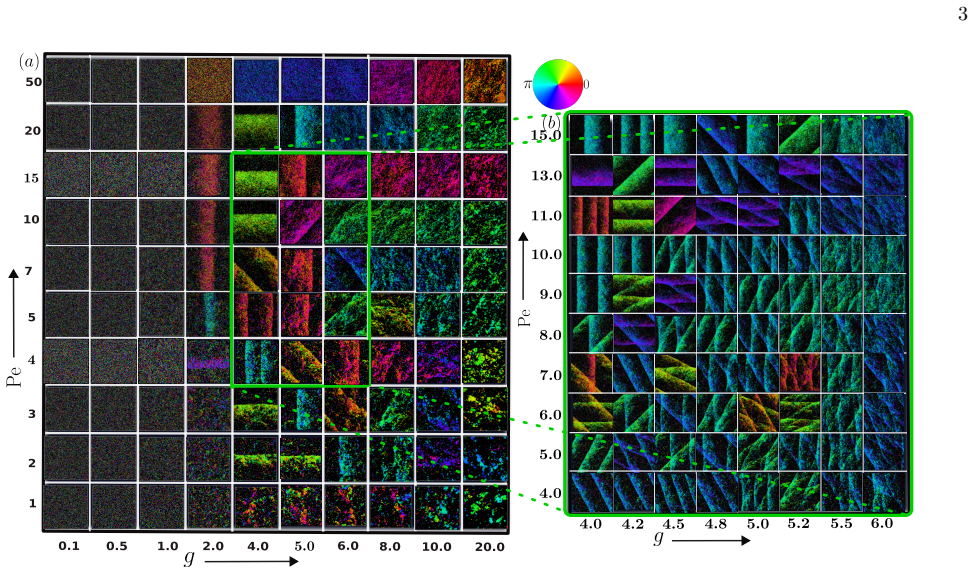
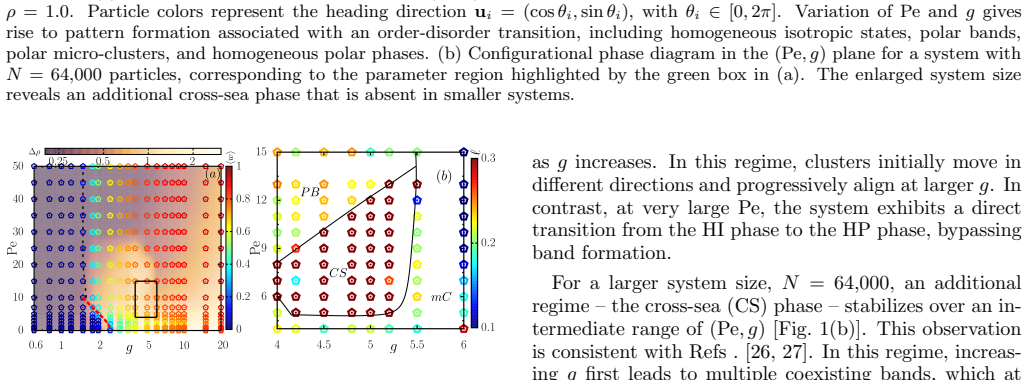
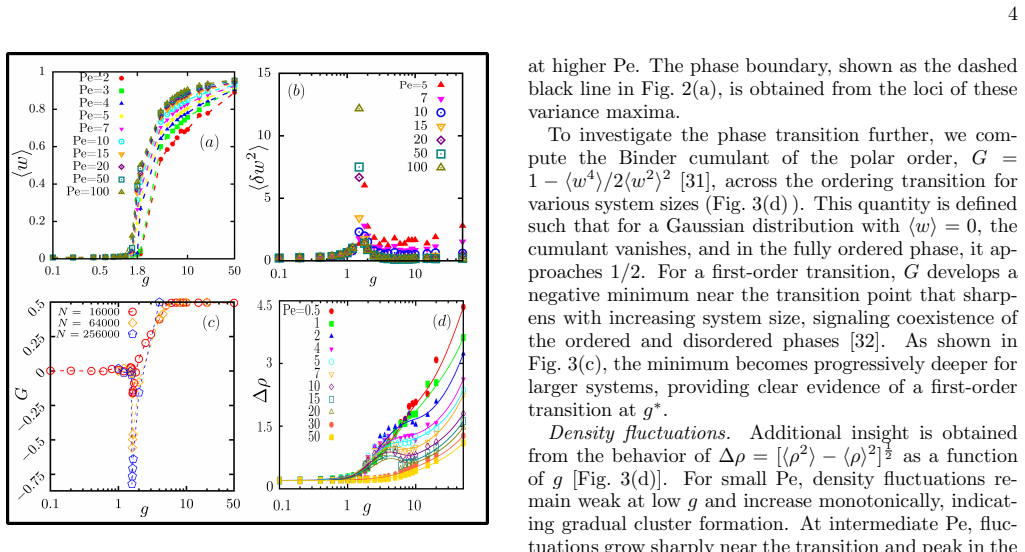
Increasing the alignment rate drives a sequence of transitions from a homogeneous isotropic state to polar bands, a cross-sea phase of intersecting bands, a homogeneous polar state, and ultimately a micro-clustered regime. The isotropic-to-polar transition is strongly first order, as evidenced by Binder cumulants and bimodal distributions of local polarization and density, indicating coexistence of gas-like and liquid-like regions. Near the onset of collective motion, band size increases with activity but depends non-monotonically on alignment rate.
What carries the argument
Langevin formulation of Vicsek-like particles with finite-rate relaxation toward the local mean direction, combining local consensus with XY-like orientational dynamics via alignment strength J and rotational diffusivity Dr.
Load-bearing premise
The introduced Langevin formulation with finite-rate relaxation toward local mean direction, together with the large-scale simulations, is sufficient to determine the nonequilibrium phase diagram without artifacts from finite system size or other numerical limitations.
What would settle it
A simulation or experiment that fails to produce the predicted sequence of phases, including the cross-sea regime and the strongly first-order character of the isotropic-to-polar transition, when alignment rate is varied at fixed activity.
Figures
read the original abstract
We introduce a Langevin formulation of Vicsek-like active particles in which orientations evolve through finite-rate relaxation toward the local mean direction, with alignment strength $J$ and rotational diffusivity $D_r$, thereby combining Vicsek-type local consensus with XY-like orientational dynamics. Using large-scale numerical simulations, we determine the nonequilibrium phase diagram as a function of activity and alignment rate. Increasing the alignment rate drives a sequence of transitions from a homogeneous isotropic state to polar bands, a cross-sea phase of intersecting bands, a homogeneous polar state, and ultimately a micro-clustered regime. The isotropic-to-polar transition is strongly first order, as evidenced by Binder cumulants and bimodal distributions of local polarization and density, indicating coexistence of gas-like and liquid-like regions. Near the onset of collective motion, band size increases with activity but depends non-monotonically on alignment rate. Further increasing the alignment rate drives the system through the cross-sea and homogeneous polar phases before enhanced density fluctuations lead to micro-clustering. Our results demonstrate that finite-time orientational relaxation acts as a control parameter that qualitatively restructures collective behavior in polar active matter.
Editorial analysis
A structured set of objections, weighed in public.
Referee Report
Summary. The manuscript introduces a Langevin formulation of Vicsek-like active particles in which orientations relax at finite rate toward the local mean direction (controlled by alignment strength J and rotational diffusivity Dr). Large-scale simulations are used to determine the nonequilibrium phase diagram versus activity and alignment rate, revealing a sequence of transitions: homogeneous isotropic to polar bands to cross-sea (intersecting bands) to homogeneous polar to micro-clustered. The isotropic-to-polar transition is identified as strongly first-order on the basis of Binder cumulants and bimodal distributions of local polarization and density; band size is reported to depend non-monotonically on alignment rate near onset.
Significance. If the reported phase sequence and first-order character survive the thermodynamic limit, the work demonstrates that finite-time orientational relaxation functions as an independent control parameter capable of qualitatively restructuring collective states in polar active matter, producing phases (cross-sea, micro-clustered) absent from instantaneous-alignment models. The explicit use of Binder cumulants to diagnose coexistence and the combination of Vicsek consensus with XY-like rotational dynamics constitute concrete, falsifiable additions to the active-matter literature.
major comments (1)
- [Numerical methods and phase-diagram results (implicit in the abstract description of large-scale simulations)] The central phase diagram and the claims of a first-order isotropic-polar transition together with non-monotonic band-size dependence rest on simulations performed in finite periodic boxes. No finite-size scaling analysis, Binder-cumulant crossings evaluated at multiple linear sizes L, or explicit checks that band wavelengths and cross-sea intersection statistics remain invariant under doubling of system size are reported. In Vicsek-like models such structures are known to be sensitive to boundary conditions; without these controls the reported sequence and transition order cannot yet be regarded as thermodynamic.
minor comments (1)
- [Abstract] The abstract states that the isotropic-to-polar transition is 'strongly first order' but does not indicate the range of system sizes over which the Binder cumulants and bimodality were observed.
Simulated Author's Rebuttal
We thank the referee for the careful reading of our manuscript and the constructive comments regarding the need to establish thermodynamic-limit behavior. We address the major comment below.
read point-by-point responses
-
Referee: [Numerical methods and phase-diagram results (implicit in the abstract description of large-scale simulations)] The central phase diagram and the claims of a first-order isotropic-polar transition together with non-monotonic band-size dependence rest on simulations performed in finite periodic boxes. No finite-size scaling analysis, Binder-cumulant crossings evaluated at multiple linear sizes L, or explicit checks that band wavelengths and cross-sea intersection statistics remain invariant under doubling of system size are reported. In Vicsek-like models such structures are known to be sensitive to boundary conditions; without these controls the reported sequence and transition order cannot yet be regarded as thermodynamic.
Authors: We agree that finite-size scaling analysis, including Binder-cumulant crossings at multiple system sizes and explicit checks of invariance under system-size doubling, is required to confirm that the reported phase sequence and first-order character persist in the thermodynamic limit. The original manuscript relied on large periodic simulation boxes but did not report such scaling studies. In the revised version we will incorporate a dedicated finite-size analysis section, presenting Binder cumulants for several linear sizes L, together with data confirming that band wavelengths and cross-sea statistics remain robust upon doubling the system size. This will directly address the concern about boundary-condition sensitivity. revision: yes
Circularity Check
No circularity: phase diagram obtained from direct simulation of new model
full rationale
The paper introduces a Langevin model with finite-rate orientational relaxation (parameters J and Dr) and determines the nonequilibrium phase diagram exclusively via large-scale numerical simulations. No analytical derivations, fitted parameters renamed as predictions, or self-citation chains are present; the reported transitions (isotropic to bands to cross-sea to homogeneous polar to micro-clustered) and first-order character (Binder cumulants, bimodal distributions) are outputs of the simulations rather than inputs by construction. The work is self-contained against external benchmarks.
Axiom & Free-Parameter Ledger
Reference graph
Works this paper leans on
-
[1]
M. C. Marchetti, J. F. Joanny, S. Ramaswamy, T. B. Liverpool, J. Prost, Madan Rao, and R. Aditi Simha. Hydrodynamics of soft active matter.Rev. Mod. Phys., 85:1143–1189, 2013
2013
-
[2]
The mechanics and statistics of active matter.Annu
Sriram Ramaswamy. The mechanics and statistics of active matter.Annu. Rev. Condens. Matter Phys., 1(1):323–345, 2010
2010
-
[3]
Pine, and Paul M
J´ er´ emie Palacci, Stefano Sacanna, Asher Preska Stein- berg, David J. Pine, and Paul M. Chaikin. Living crys- tals of light-activated colloidal surfers.Science, 339:936 – 940, 2013
2013
-
[4]
Vibrated polar disks: spontaneous motion, binary collisions, and collective dynamics.Soft Matter, 8(20):5629–5639, 2012
Julien Deseigne, S´ ebastien L´ eonard, Olivier Dauchot, and Hugues Chat´ e. Vibrated polar disks: spontaneous motion, binary collisions, and collective dynamics.Soft Matter, 8(20):5629–5639, 2012
2012
-
[5]
Long-lived giant number fluctuations in a swarm- ing granular nematic.Science, 317(5834):105–108, 2007
Vijay Narayan, Sriram Ramaswamy, and Narayanan Menon. Long-lived giant number fluctuations in a swarm- ing granular nematic.Science, 317(5834):105–108, 2007
2007
-
[6]
Self-propelled rods: Insights and perspectives for active matter.Annual Review of Con- densed Matter Physics, 11(1):441–466, 2020
Markus B¨ ar, Robert Gromann, Sebastian Heidenreich, and Fernando Peruani. Self-propelled rods: Insights and perspectives for active matter.Annual Review of Con- densed Matter Physics, 11(1):441–466, 2020
2020
-
[7]
Novel type of phase transi- tion in a system of self-driven particles.Physical review letters, 75(6):1226, 1995
Tam´ as Vicsek, Andr´ as Czir´ ok, Eshel Ben-Jacob, Inon Cohen, and Ofer Shochet. Novel type of phase transi- tion in a system of self-driven particles.Physical review letters, 75(6):1226, 1995
1995
-
[8]
Onset of collec- tive and cohesive motion.Phys
Guillaume Gr´ egoire and Hugues Chat´ e. Onset of collec- tive and cohesive motion.Phys. Rev. Lett., 92:025702, 2004
2004
-
[9]
Collective motion of self-propelled particles interacting without cohesion.Phys
Hugues Chat´ e, Francesco Ginelli, Guillaume Gr´ egoire, and Franck Raynaud. Collective motion of self-propelled particles interacting without cohesion.Phys. Rev. E, 77:046113, 2008
2008
-
[10]
Collective motion
Tam´ as Vicsek and Anna Zafeiris. Collective motion. Physics Reports, 517(3):71–140, 2012
2012
-
[11]
H. Chate. Dry aligning dilute active matter.Annual Review of Condensed Matter Physics, 11:189, 2020
2020
-
[12]
The physics of the vicsek model
Francesco Ginelli. The physics of the vicsek model. The European Physical Journal Special Topics, 225:2099– 2117, 2016
2099
-
[13]
Chate and B
H. Chate and B. Mahault. Dry, aligning, dilute, ac- tive matter: a synthetic and self-contained overview. In J. Tailleur, G. Gompper, M. C. Marchetti, J. M. Yeomans, and C. Salomon, editors,Active Matter and Nonequilibrium Statistical Physics, Lecture Notes of the Les Houches Summer School: Volume 112, September 2018, page 3. Oxford University Press, Oxford, 2022
2018
-
[14]
Long-range order in a two- dimensional dynamical xy model: how birds fly together
John Toner and Yuhai Tu. Long-range order in a two- dimensional dynamical xy model: how birds fly together. Physical review letters, 75(23):4326, 1995
1995
-
[15]
Flocks, herds, and schools: A quantitative theory of flocking.Phys
John Toner and Yuhai Tu. Flocks, herds, and schools: A quantitative theory of flocking.Phys. Rev. E, 58:4828– 4858, 1998
1998
-
[16]
Reanalysis of the hydrodynamic theory of fluid, polar-ordered flocks.Phys
John Toner. Reanalysis of the hydrodynamic theory of fluid, polar-ordered flocks.Phys. Rev. E, 86:031918, 2012
2012
-
[17]
J. Toner. Why walking is easier than pointing: Hydro- dynamics of dry active matter. In J. Tailleur, G. Gomp- per, M. C. Marchetti, J. M. Yeomans, and C. Sa- lomon, editors,Active Matter and Nonequilibrium Statis- tical Physics, Lecture Notes of the Les Houches Summer School: Volume 112, September 2018, page 52. Oxford University Press, Oxford, 2022
2018
-
[18]
Hy- drodynamics and phases of flocks.Annals of Physics, 318(1):170–244, 2005
John Toner, Yuhai Tu, and Sriram Ramaswamy. Hy- drodynamics and phases of flocks.Annals of Physics, 318(1):170–244, 2005
2005
-
[19]
Boltz- mann and hydrodynamic description for self-propelled particles.Physical Review E, 74(2):022101, 2006
Eric Bertin, Michel Droz, and Guillaume Gr´ egoire. Boltz- mann and hydrodynamic description for self-propelled particles.Physical Review E, 74(2):022101, 2006
2006
-
[20]
Hy- drodynamic equations for self-propelled particles: mi- croscopic derivation and stability analysis.Journal of Physics A: Mathematical and Theoretical, 42(44):445001, 2009
Eric Bertin, Michel Droz, and Guillaume Gr´ egoire. Hy- drodynamic equations for self-propelled particles: mi- croscopic derivation and stability analysis.Journal of Physics A: Mathematical and Theoretical, 42(44):445001, 2009
2009
-
[21]
Pattern formation in self-propelled particles with density-dependent motility.Physical review letters, 108(24):248101, 2012
FDC Farrell, MC Marchetti, D Marenduzzo, and J Tailleur. Pattern formation in self-propelled particles with density-dependent motility.Physical review letters, 108(24):248101, 2012
2012
-
[22]
Quantitative assessment of the toner and tu theory of polar flocks.Physical Review Letters, 123(21):218001, 2019
Benoˆ ıt Mahault, Francesco Ginelli, and Hugues Chat´ e. Quantitative assessment of the toner and tu theory of polar flocks.Physical Review Letters, 123(21):218001, 2019
2019
-
[23]
New universality class describes vicseks flocking phase in physical dimensions
Patrick Jentsch and Chiu Fan Lee. New universality class describes vicseks flocking phase in physical dimensions. Physical Review Letters, 133:128301, 2024
2024
-
[24]
From phase to microphase separation in flocking models: The essential role of nonequilibrium fluctuations.Physi- cal review letters, 114(6):068101, 2015
Alexandre P Solon, Hugues Chat´ e, and Julien Tailleur. From phase to microphase separation in flocking models: The essential role of nonequilibrium fluctuations.Physi- cal review letters, 114(6):068101, 2015. 12
2015
-
[25]
Solon and Julien Tailleur
Alexandre P. Solon and Julien Tailleur. Revisiting the flocking transition using active spins.Physical Review E, 92(4):042119, 2015
2015
-
[26]
Band structure in collective motion with quenched range of interaction
Biplab Bhattacherjee and S S Manna. Band structure in collective motion with quenched range of interaction. Physica A: Statistical Mechanics and its Applications, 531:121733, 2019
2019
-
[27]
Dry active matter exhibits a self-organized cross sea phase.Physical Review Letters, 125(18):188003, 2020
R¨ udiger K¨ ursten and Thomas Ihle. Dry active matter exhibits a self-organized cross sea phase.Physical Review Letters, 125(18):188003, 2020
2020
-
[28]
Altmann, and Fer- nando Peruani
Oleksandr Chepizhko, Eduardo G. Altmann, and Fer- nando Peruani. Optimal noise maximizes collective motion in heterogeneous media.Phys. Rev. Lett., 110:238101, 2013
2013
-
[29]
Collective behavior of chiral active matter: Pattern formation and enhanced flocking.Physical review letters, 119(5):058002, 2017
Benno Liebchen and Demian Levis. Collective behavior of chiral active matter: Pattern formation and enhanced flocking.Physical review letters, 119(5):058002, 2017
2017
-
[30]
Revisiting the emergence of order in active mat- ter.Soft Matter, 17(11):3113–3120, 2021
Oleksandr Chepizhko, David Saintillan, and Fernando Peruani. Revisiting the emergence of order in active mat- ter.Soft Matter, 17(11):3113–3120, 2021
2021
-
[31]
Applications of monte carlo methods to sta- tistical physics.Rep
K Binder. Applications of monte carlo methods to sta- tistical physics.Rep. Prog. Phys., 60:487559, 1997
1997
-
[32]
Reger, Manfred Scheucher, and Kurt Binder
Katharina Vollmayr, Joseph D. Reger, Manfred Scheucher, and Kurt Binder. Finite size effects at thermally-driven first order phase transitions: A phe- nomenological theory of the order parameter distri- bution.Zeitschrift f¨ ur Physik B Condensed Matter, 91(1):113125, 1993
1993
-
[33]
How reciprocity impacts ordering and phase separation in active nemat- ics?Soft Matter, 20:788, 2023
Arpan Sinha and Debasish Chaudhuri. How reciprocity impacts ordering and phase separation in active nemat- ics?Soft Matter, 20:788, 2023
2023
-
[34]
Fluctuation-induced first order transition to collective motion.Journal of Statistical Mechanics: The- ory and Experiment, 2024(8):084003, 2024
David Martin, Gianmarco Spera, Hugues Chat, Charlie Duclut, Cesare Nardini, Julien Tailleur, and Frdric van Wijland. Fluctuation-induced first order transition to collective motion.Journal of Statistical Mechanics: The- ory and Experiment, 2024(8):084003, 2024
2024
-
[35]
Emergent spatial struc- tures in flocking models: a dynamical system insight
Jean-Baptiste Caussin, Alexandre Solon, Anton Peshkov, Hugues Chat´ e, Thierry Dauxois, Julien Tailleur, Vin- cenzo Vitelli, and Denis Bartolo. Emergent spatial struc- tures in flocking models: a dynamical system insight. Physical review letters, 112(14):148102, 2014
2014
-
[36]
Solon, Jean-Baptiste Caussin, Denis Bar- tolo, Hugues Chat´ e, and Julien Tailleur
Alexandre P. Solon, Jean-Baptiste Caussin, Denis Bar- tolo, Hugues Chat´ e, and Julien Tailleur. Pattern for- mation in flocking models: A hydrodynamic description. Physical Review E, 92(6):062111, 2015
2015
-
[37]
Activity-induced phase transition and coarsening dynamics in dry apolar active nematics.Soft Matter, 20(40):8078–8088, 2024
Arpan Sinha and Debasish Chaudhuri. Activity-induced phase transition and coarsening dynamics in dry apolar active nematics.Soft Matter, 20(40):8078–8088, 2024
2024
-
[38]
Active nematics on a substrate: Giant number fluctua- tions and long-time tails.Europhysics Letters, 62(2):196, 2003
Sriram Ramaswamy, R Aditi Simha, and John Toner. Active nematics on a substrate: Giant number fluctua- tions and long-time tails.Europhysics Letters, 62(2):196, 2003
2003
-
[39]
A kinetic model and scaling properties of non-equilibrium clustering of self-propelled particles.New Journal of Physics, 15(6):065009, 2013
Fernando Peruani and Markus B¨ ar. A kinetic model and scaling properties of non-equilibrium clustering of self-propelled particles.New Journal of Physics, 15(6):065009, 2013
2013
-
[40]
H. P. Zhang, Avraham Beer, E.-L. Florin, and Harry L. Swinney. Collective motion and density fluctuations in bacterial colonies.Proceedings of the National Academy of Sciences, 107(31):1362613630, 2010
2010
-
[41]
Nonequilibrium phase transitions in mod- els of aggregation, adsorption, and dissociation.Phys Rev Lett, 81:3691, 1998
Satya N Majumdar, Supriya Krishnamurthy, and Mus- tansir Barma. Nonequilibrium phase transitions in mod- els of aggregation, adsorption, and dissociation.Phys Rev Lett, 81:3691, 1998
1998
-
[42]
Walczak, Lorenzo Del Castello, Francesco Ginelli, Stefania Melillo, Leonardo Parisi, Massimiliano Viale, Andrea Cavagna, and Irene Giardina
Thierry Mora, Aleksandra M. Walczak, Lorenzo Del Castello, Francesco Ginelli, Stefania Melillo, Leonardo Parisi, Massimiliano Viale, Andrea Cavagna, and Irene Giardina. Local equilibrium in bird flocks.Na- ture Physics, 12(12):11531157, 2016
2016
-
[43]
Hierarchical group dynamics in pigeon flocks.Nature, 464(7290):890893, 2010
M´ at´ e Nagy, Zsuzsa´Akos, Dora Biro, and Tam´ as Vicsek. Hierarchical group dynamics in pigeon flocks.Nature, 464(7290):890893, 2010
2010
-
[44]
Andrey Sokolov and Igor S. Aranson. Physical properties of collective motion in suspensions of bacteria.Physical Review Letters, 109(24):248109, 2012
2012
-
[45]
Baconnier, D
P. Baconnier, D. Shohat, C. Hernndez Lpez, C. Coulais, V. Dmery, G. Dring, and O. Dauchot. Selective and collective actuation in active solids.Nature Physics, 18(10):12341239, 2022
2022
-
[46]
Self-aligning polar active matter.Reviews of Modern Physics, 97(1):015007, 2025
Paul Baconnier, Olivier Dauchot, Vincent Dmery, Gus- tavo Dring, Silke Henkes, Cristin Huepe, and Amir Shee. Self-aligning polar active matter.Reviews of Modern Physics, 97(1):015007, 2025
2025
-
[47]
Berg and Douglas A
Howard C. Berg and Douglas A. Brown. Chemotaxis in escherichia coli analysed by three-dimensional tracking. Nature, 239(5374):500504, 1972
1972
-
[48]
Y. Katz, K. Tunstrom, C. C. Ioannou, C. Huepe, and I. D. Couzin. Inferring the structure and dynamics of interactions in schooling fish.Proceedings of the National Academy of Sciences, 108(46):1872018725, 2011
2011
-
[49]
Emergence of macroscopic directed motion in pop- ulations of motile colloids.Nature, 503(7474):9598, 2013
Antoine Bricard, Jean-Baptiste Caussin, Nicolas Desreumaux, Olivier Dauchot, and Denis Bartolo. Emergence of macroscopic directed motion in pop- ulations of motile colloids.Nature, 503(7474):9598, 2013
2013
discussion (0)
Sign in with ORCID, Apple, or X to comment. Anyone can read and Pith papers without signing in.