Democratising Camera Trap AI: An Open-Source Model for Detecting UK Mammals
Pith reviewed 2026-06-27 13:25 UTC · model grok-4.3
The pith
An open-source YOLO model detects 28 UK mammal and bird species in camera trap images with 0.984 mean average precision.
A machine-rendered reading of the paper's core claim, the machinery that carries it, and where it could break.
Core claim
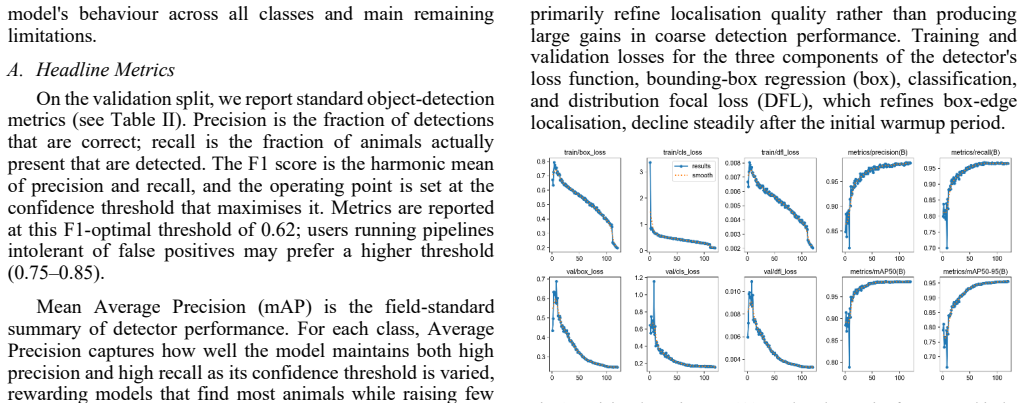
The authors trained a YOLO26x detector on a dataset of 48,165 labelled instances covering 31 classes including 28 UK mammal and bird species plus humans, poles, and vehicles. On a held-out validation set the model attains a mean average precision of 0.984 at IoU 0.5 and 0.956 at IoU 0.5-0.95, with precision 0.988 and recall 0.965. On a further unseen test split, per-species confidence scores range from 0.96 to 0.99 and the false-negative rate is 0.17 percent, mostly in challenging night-time or occluded images. The trained weights are released in ONNX format under a non-commercial licence together with local desktop and real-time camera support.
What carries the argument
YOLO26x object detector trained on a class-stratified 80/10/10 split of the 48,165-instance UK camera trap dataset.
If this is right
- Ecologists can run the detector locally on desktop computers without needing cloud services or machine learning expertise.
- The model supports real-time processing from camera traps in the field.
- Performance metrics hold on data from the training sites, providing a baseline for UK-specific fauna detection.
- The non-commercial licence allows free use by conservation groups while restricting commercial exploitation.
Where Pith is reading between the lines
- Performance on entirely new sites and camera setups remains untested and may require additional fine-tuning or data collection.
- Integration with existing biodiversity databases could automate species occurrence mapping at scale.
- Local processing reduces data transmission costs and privacy concerns associated with uploading images to commercial platforms.
Load-bearing premise
The high accuracy metrics were obtained on images from the same sites and cameras used to collect the training data.
What would settle it
Measuring the model's precision and recall on camera trap images collected from entirely new locations and camera models not represented in the training set.
Figures
read the original abstract
Camera traps have become a cornerstone of biodiversity monitoring, but the artificial intelligence that turns vast quantities of images into usable ecological data is often locked behind commercial platforms or trained on fauna that does not match that of the British Isles. In an attempt to remove barriers and increase uptake, we release an open-source object detection model for 31 classes, 28 common UK mammal and bird species, plus utility classes for humans, calibration poles, and vehicles, drawn from a curated dataset of 48,165 labelled instances assembled from multiple sites over a decade of operational deployment through Conservation AI and its successor, Trap Tracker. The model, a YOLO26x detector trained and tested on an 80/10/10 class-stratified split, achieves a mean Average Precision of 0.984 at Intersection over Union (IoU) of 0.5 (0.956 at IoU 0.5-0.95) on the held-out validation set, with precision 0.988 and recall 0.965. On an unseen held-out test split, mean per-species confidence ranged from 0.96 to 0.99 across the 31 classes, with a 0.17% false-negative rate concentrated in difficult night-time, distant, or occluded images. These metrics are from data from the same pool of sites and cameras as training, so performance at entirely new sites is left to future work. We release the trained weights in ONNX format under a non-commercial licence, with local desktop and real-time camera support, aimed explicitly at ecologists with no machine-learning experience. This release is a deliberate counterweight to the multiple paid for models that have developed over the last decade.
Editorial analysis
A structured set of objections, weighed in public.
Referee Report
Summary. The paper presents an open-source YOLO26x object detection model trained to detect 31 classes (28 UK mammal/bird species plus humans, calibration poles, and vehicles) from camera-trap images. The training set comprises 48,165 labelled instances collected over a decade from multiple UK sites via Conservation AI/Trap Tracker. Using a class-stratified 80/10/10 split, the model reports mAP 0.984 at IoU=0.5 (0.956 at IoU 0.5-0.95), precision 0.988 and recall 0.965 on the held-out validation set; per-class confidence on a further unseen test split ranges 0.96-0.99 with 0.17% false-negative rate. The authors explicitly state that all reported figures are from the same site/camera distribution as training and defer evaluation on entirely new sites to future work. Trained weights are released in ONNX format under a non-commercial licence together with desktop and real-time camera support.
Significance. If the reported metrics hold under the stated distribution, the release supplies a practical, locally runnable alternative to commercial camera-trap classifiers for UK fauna, directly addressing the accessibility barrier noted in the abstract. The explicit scope limitation (same-site performance only) and the provision of reproducible weights constitute strengths that increase the utility of the contribution for ecologists without machine-learning expertise.
minor comments (2)
- [Abstract] §Abstract and §Methods: the text refers both to a 'held-out validation set' and a separate 'unseen held-out test split'; a single sentence clarifying the exact 80/10/10 partition (train/val/test) and which split supplies the mAP numbers versus the per-class confidence numbers would remove any ambiguity.
- [Results] Table 1 (or equivalent results table): per-class AP values are not shown; adding a supplementary table or figure with the 31 individual APs would allow readers to verify that the mean is not driven by a few dominant classes.
Simulated Author's Rebuttal
We thank the referee for their positive review and recommendation to accept the manuscript.
Circularity Check
No significant circularity
full rationale
The paper reports standard empirical machine-learning results: a YOLO26x model is trained on an 80/10/10 class-stratified split of a curated image dataset and evaluated directly on the held-out validation and test portions, yielding mAP, precision, and recall figures. No equations, first-principles derivations, or predictions are presented that reduce by construction to fitted parameters or self-referential definitions. The manuscript explicitly flags that the reported numbers apply only to the same site/camera pool and leaves generalization to new sites for future work, avoiding any over-claim. No load-bearing self-citations, uniqueness theorems, or ansatzes appear in the provided text. The central claim is therefore a direct measurement on held-out data and remains self-contained against external benchmarks.
Axiom & Free-Parameter Ledger
free parameters (1)
- class-stratified 80/10/10 split
axioms (1)
- domain assumption Images from the same sites and cameras as training are a valid proxy for model evaluation
Reference graph
Works this paper leans on
-
[1]
An evaluation of camera traps for inventorying large -and medium -sized terrestrial rainforest mammals,
M. W. Tobler, S. E. Carrillo -Percastegui, R. Leite Pitman, R. Mares, and G. Powell, “An evaluation of camera traps for inventorying large -and medium -sized terrestrial rainforest mammals,” Animal conservation , vol. 11, no. 3, pp. 169 – 178, 2008
2008
-
[2]
Camera-trapping for conservation: a guide to best-practices,
O. R. Wearn and P. Glover -Kapfer, “Camera-trapping for conservation: a guide to best-practices,” WWF conservation technology series, vol. 1, no. 1, p. 181, 2017
2017
-
[3]
An open standard for camera trap data,
T. Forrester, T. O’Brien, E. Fegraus, P. A. Jansen, J. Palmer, R. Kays, J. Ahumada, B. Stern, and W. McShea, “An open standard for camera trap data,” Biodiversity data journal, no. 4, p. e10197, 2016
2016
-
[4]
Software to facilitate and streamline camera trap data management: A review,
S. Young, J. Rode -Margono, and R. Amin, “Software to facilitate and streamline camera trap data management: A review,” Ecology and Evolution , vol. 8, no. 19, pp. 9947 – 9957, 2018
2018
-
[5]
Snapshot Serengeti, high -frequency annotated camera trap images of 40 mammalian species in an African savanna,
A. Swanson, M. Kosmala, C. Lintott, R. Simpson, A. Smith, and C. Packer, “Snapshot Serengeti, high -frequency annotated camera trap images of 40 mammalian species in an African savanna,” Scientific data, vol. 2, no. 1, pp. 1–14, 2015
2015
-
[6]
Camera settings and biome influence the accuracy of citizen science approaches to camera trap image classification,
N. Egna, D. O’Connor, J. Stacy -Dawes, M. W. Tobler, N. Pilfold, K. Neilson, B. Simmons, E. O. Davis, M. Bowler, J. Fennessy, and others, “Camera settings and biome influence the accuracy of citizen science approaches to camera trap image classification,” Ecology and evolution , vol. 10, no. 21, pp. 11954–11965, 2020
2020
-
[7]
Automatically identifying, counting, and describing wild animals in camera-trap images with deep learning,
M. S. Norouzzadeh, A. Nguyen, M. Kosmala, A. Swanson, M. S. Palmer, C. Packer, and J. Clune, “Automatically identifying, counting, and describing wild animals in camera-trap images with deep learning,” Proceedings of the National Academy of Sciences, vol. 115, no. 25, pp. E5716– E5725, 2018
2018
-
[8]
Machine learning to classify animal species in camera trap images: Applications in ecology,
M. A. Tabak, M. S. Norouzzadeh, D. W. Wolfson, S. J. Sweeney, K. C. VerCauteren, N. P. Snow, J. M. Halseth, P. A. Di Salvo, J. S. Lewis, M. D. White, and others, “Machine learning to classify animal species in camera trap images: Applications in ecology,” Methods in Ecology and Evolution, vol. 10, no. 4, pp. 585–590, 2019
2019
-
[9]
Improving the accessibility and transferability of machine learning algorithms for identification of animals in camera trap images: MLWIC2,
M. A. Tabak, M. S. Norouzzadeh, D. W. Wolfson, E. J. Newton, R. K. Boughton, J. S. Ivan, E. A. Odell, E. S. Newkirk, R. Y. Conrey, J. Stenglein, and others, “Improving the accessibility and transferability of machine learning algorithms for identification of animals in camera trap images: MLWIC2,” Ecology and evolution, vol. 10, no. 19, pp. 10374–10383, 2020
2020
-
[10]
Identifying animal species in camera trap images using deep learning and citizen science,
M. Willi, R. T. Pitman, A. W. Cardoso, C. Locke, A. Swanson, A. Boyer, M. Veldthuis, and L. Fortson, “Identifying animal species in camera trap images using deep learning and citizen science,” Methods in Ecology and Evolution, vol. 10, no. 1, pp. 80–91, 2019
2019
-
[11]
A deep active learning system for species identification and counting in camera trap images,
M. S. Norouzzadeh, D. Morris, S. Beery, N. Joshi, N. Jojic, and J. Clune, “A deep active learning system for species identification and counting in camera trap images,” Methods in ecology and evolution, vol. 12, no. 1, pp. 150–161, 2021
2021
-
[12]
Deep learning object detection methods for ecological camera trap data,
S. Schneider, G. W. Taylor, and S. Kremer, “Deep learning object detection methods for ecological camera trap data,” in 2018 15th Conference on computer and robot vision (CRV), 2018, pp. 321–328
2018
-
[13]
Long -tailed Species Recognition in the NACTI Wildlife Dataset,
Z. Liu and T. Burghardt, “Long -tailed Species Recognition in the NACTI Wildlife Dataset,” arXiv preprint arXiv:2510.21657, 2025
arXiv 2025
-
[14]
Recognition in terra incognita,
S. Beery, G. Van Horn, and P. Perona, “Recognition in terra incognita,” in Proceedings of the European conference on computer vision (ECCV), 2018, pp. 456–473
2018
-
[15]
Robust ecological analysis of camera trap data labelled by a machine learning model,
R. C. Whytock, J. wieewski, J. A. Zwerts, T. Bara -Slupski, A. F. Koumba Pambo, M. Rogala, L. Bahaa -el-din, K. Boekee, S. Brittain, A. W. Cardoso, and others, “Robust ecological analysis of camera trap data labelled by a machine learning model,” Methods in Ecology and Evolution, vol. 12, no. 6, pp. 1080–1092, 2021
2021
-
[16]
C. Chalmers, P. Fergus, S. Wich, and A. C. Montanez, “Conservation AI: Live stream analysis for the detection of endangered species using convolutional neural networks and drone technology,” arXiv preprint arXiv:1910.07360, 2019
arXiv 1910
-
[17]
Harnessing artificial intelligence for wildlife conservation,
P. Fergus, C. Chalmers, S. Longmore, and S. Wich, “Harnessing artificial intelligence for wildlife conservation,” Conservation, vol. 4, no. 4, pp. 685 –702, 2024
2024
-
[18]
Trap Tracker: AI -Driven Wildlife Monitoring for Conservation
T. Tracker, “Trap Tracker: AI -Driven Wildlife Monitoring for Conservation.” 2026
2026
-
[19]
Efficient pipeline for camera trap image review,
S. Beery, D. Morris, and S. Yang, “Efficient pipeline for camera trap image review,” arXiv preprint arXiv:1907.06772, 2019
Pith/arXiv arXiv 1907
-
[20]
Camera Trap AI: SpeciesNet for Camera Trap Image Classification
T. Gadot and others, “Camera Trap AI: SpeciesNet for Camera Trap Image Classification.” Google AI for Nature and Wildlife Insights, 2024
2024
-
[21]
The megadetector: Large -scale deployment of computer vision for conservation and biodiversity monitoring,
S. Beery, “The megadetector: Large -scale deployment of computer vision for conservation and biodiversity monitoring,” California Institute of Technology, Pasadena, CA, USA, 2023
2023
-
[22]
Wildlife insights: A platform to maximize the potential of camera trap and other passive sensor wildlife data for the planet ,
J. A. Ahumada, E. Fegraus, T. Birch, N. Flores, R. Kays, T. G. O’Brien, J. Palmer, S. Schuttler, J. Y. Zhao, W. Jetz, and others, “Wildlife insights: A platform to maximize the potential of camera trap and other passive sensor wildlife data for the planet ,” Environmental Conservation, vol. 47, no. 1, pp. 1–6, 2020
2020
-
[23]
The DeepFaune initiative: a collaborative effort towards the automatic identification of European fauna in camera trap images ,
N. Rigoudy, G. Dussert, A. Benyoub, A. Besnard, C. Birck, J. Boyer, Y. Bollet, Y. Bunz, G. Caussimont, E. Chetouane, and others, “The DeepFaune initiative: a collaborative effort towards the automatic identification of European fauna in camera trap images ,” European Journal of Wildlife Research, vol. 69, no. 6, p. 113, 2023
2023
-
[24]
cameratrapR: An R package for estimating animal density using camera trapping data,
X. Li, H. Tian, Z. Piao, G. Wang, Z. Xiao, Y. Sun, E. Gao, and M. Holyoak, “cameratrapR: An R package for estimating animal density using camera trapping data,” Ecological Informatics, vol. 69, p. 101597, 2022
2022
-
[25]
Camelot –intuitive software for camera trap data management,
H. Hendry and C. Mann, “Camelot –intuitive software for camera trap data management,” BioRxiv, p. 203216, 2017
2017
-
[26]
AddaxAI: Simplifying camera trap image analysis with AI
A. D. Science, “AddaxAI: Simplifying camera trap image analysis with AI.” 2026
2026
-
[27]
Pytorch -wildlife: A collaborative deep learning framework for conservation,
A. Hernandez, Z. Miao, L. Vargas, S. Beery, R. Dodhia, P. Arbelaez, and J. M. L. Ferres, “Pytorch -wildlife: A collaborative deep learning framework for conservation,” arXiv preprint arXiv:2405.12930, 2024
arXiv 2024
-
[28]
DeepForestVision: Automated wildlife identification for camera traps of African tropical forests,
H. Magaldi, R. Cornette, J. J. Tibesigwa, R. Katumba, H. Rugonge, B. Amarasekaran, N. Anderson, N. Cappelle, A. W. Cardoso, D. Cornélis, and others, “DeepForestVision: Automated wildlife identification for camera traps of African tropical forests,” Ecological Solutions and Evidence, vol. 6, no. 4, p. e70167, 2025
2025
-
[29]
Yolo -animal: An efficient wildlife detection network based on improved yolov5,
D. Ma and J. Yang, “Yolo -animal: An efficient wildlife detection network based on improved yolov5,” in 2022 International Conference on Image Processing, Computer Vision and Machine Learning (ICICML) , 2022, pp. 464 – 468
2022
-
[30]
An evaluation of platforms for processing camera- trap data using artificial intelligence,
J. Vélez, W. McShea, H. Shamon, P. J. Castiblanco - Camacho, M. A. Tabak, C. Chalmers, P. Fergus, and J. Fieberg, “An evaluation of platforms for processing camera- trap data using artificial intelligence,” Methods in Ecology and Evolution, vol. 14, no. 2, pp. 459–477, 2023
2023
-
[31]
Animal Detect: Easy camera trap image analysis for wildlife teams
A. Detect, “Animal Detect: Easy camera trap image analysis for wildlife teams.” 2026
2026
-
[32]
Agouti: A platform for processing and archiving of camera trap images,
J. Casaer, T. Milotic, Y. Liefting, P. Desmet, and P. Jansen, “Agouti: A platform for processing and archiving of camera trap images,” Biodiversity Information Science and Standards, 2019
2019
-
[33]
Global disparity of camera trap research allocation and defaunation risk of terrestrial mammals,
B. Mugerwa, J. Niedballa, A. Planillo, D. Sheil, S. Kramer- Schadt, and A. Wilting, “Global disparity of camera trap research allocation and defaunation risk of terrestrial mammals,” Remote Sensing in Ecology and Conservation , vol. 10, no. 1, pp. 121–136, 2024
2024
-
[34]
People’s Trust for Endangered Species (PTES)
P. T. for Endangered Species, “People’s Trust for Endangered Species (PTES).”
-
[35]
The Mammal Society: Science -led conservation of British mammals
T. M. Society, “The Mammal Society: Science -led conservation of British mammals.”
-
[36]
National Biodiversity Network (NBN)
N. B. N. Trust, “National Biodiversity Network (NBN).”
-
[37]
MammalWeb: A citizen science platform for monitoring wild mammals using camera traps
MammalWeb, “MammalWeb: A citizen science platform for monitoring wild mammals using camera traps.”
-
[38]
Large -scale mammal monitoring: The potential of a citizen science camera-trapping project in the United Kingdom,
P.-Y. Hsing, R. A. Hill, G. C. Smith, S. Bradley, S. E. Green, V. T. Kent, S. S. Mason, J. Rees, M. J. Whittingham, J. Cokill, and others, “Large -scale mammal monitoring: The potential of a citizen science camera-trapping project in the United Kingdom,” Ecological Solutions and Evidence, vol. 3, no. 4, p. e12180, 2022
2022
-
[39]
State of Nature 2023 Partners
S. of Nature Partnership, “State of Nature 2023 Partners.” 2023
2023
-
[40]
Environment Act 2021
U. Parliament, “Environment Act 2021.” 2021
2021
-
[41]
UK Biodiversity Indicators: Priority Species — Relative Abundance
J. N. C. Committee, “UK Biodiversity Indicators: Priority Species — Relative Abundance.” JNCC on behalf of the Department for Environment, Food and Rural Affairs (Defra), 2024
2024
-
[42]
Indicators of Species Abundance in England
F. Department for Environment and R. Affairs, “Indicators of Species Abundance in England.” 2024
2024
-
[43]
Kunming -montreal global biodiversity framework,
U. CBD, “Kunming -montreal global biodiversity framework,” in Fifteenth meeting of the Conference of the Parties to the Convention on Biological Diversity (Part Two) Decision, 2022, vol. 15, no. 4
2022
-
[44]
The Kunming-Montreal Global Biodiversity Framework: what it does and does not do, and how to improve it,
A. C. Hughes and R. E. Grumbine, “The Kunming-Montreal Global Biodiversity Framework: what it does and does not do, and how to improve it,” Frontiers in Environmental Science, vol. 11, p. 1281536, 2023
2023
-
[45]
Automated detection of European wild mammal species in camera trap images with an existing and pre -trained computer vision model,
C. Carl, F. Schönfeld, I. Profft, A. Klamm, and D. Landgraf, “Automated detection of European wild mammal species in camera trap images with an existing and pre -trained computer vision model,” European journal of wildlife research, vol. 66, no. 4, p. 62, 2020
2020
-
[46]
Increasing citizen scientist accuracy with artificial intelligence on UK camera- trap data,
C. Sharpe, R. Hill, H. Chappell, S. Green, K. Holden, P. Fergus, C. Chalmers, and P. Stephens, “Increasing citizen scientist accuracy with artificial intelligence on UK camera- trap data,” Remote Sensing in Ecology and Conservation , vol. 11, no. 6, pp. 641–655, 2025
2025
-
[47]
Optimizing the Accuracy and Efficiency of Camera Trap Image Analysis: Evaluating AI Model Performance and a Semi -Automated Workflow,
K. Hitchcock, S. Tollington, R. W. Yarnell, L. J. Williams, K. Hamill, and P. Fergus, “Optimizing the Accuracy and Efficiency of Camera Trap Image Analysis: Evaluating AI Model Performance and a Semi -Automated Workflow,” Remote Sensing, vol. 18, no. 3, p. 502, 2026
2026
-
[48]
Comparison of a Computer Vision Model to a Human Observer in Detecting African Mammals in Camera Trap Images within a Safari Park,
N. Davies Walsh, C. Chalmers, P. Fergus, S. Longmore, B. Johnson, and S. Wich, “Comparison of a Computer Vision Model to a Human Observer in Detecting African Mammals in Camera Trap Images within a Safari Park,” bioRxiv, pp. 2025–6, 2025
2025
-
[49]
Towards context -rich automated biodiversity assessments: deriving AI-powered insights from camera trap data,
P. Fergus, C. Chalmers, N. Matthews, S. Nixon, A. Burger, O. Hartley, C. Sutherland, X. Lambin, S. Longmore, and S. Wich, “Towards context -rich automated biodiversity assessments: deriving AI-powered insights from camera trap data,” Sensors, vol. 24, no. 24, p. 8122, 2024
2024
-
[50]
Empirical evidence that diversionary feeding increases productivity in ground -nesting birds,
J. A. Bamber, C. Sutherland, K. Kortland, and X. Lambin, “Empirical evidence that diversionary feeding increases productivity in ground -nesting birds,” Proceedings of the Royal Society B: Biological Sciences , vol. 292, no. 2049, 2025
2049
-
[51]
YOLO26: key architectural enhancements and performance benchmarking for real -time object detection,
R. Sapkota, R. H. Cheppally, A. Sharda, and M. Karkee, “YOLO26: key architectural enhancements and performance benchmarking for real -time object detection,” arXiv preprint arXiv:2509.25164, 2025
arXiv 2025
-
[52]
Lessons and Open Questions from a Unified Study of Camera -Trap Species Recognition Over Time,
S. Jeon, H. Tian, L. Wang, Z. Mai, V. Bakshi, J. Hou, P. Zhang, A. Chowdhury, J. Gu, and W.-L. Chao, “Lessons and Open Questions from a Unified Study of Camera -Trap Species Recognition Over Time,” arXiv preprint arXiv:2603.20509, 2026
arXiv 2026
-
[53]
Empowering wildlife guardians: An equitable digital stewardship and reward system for biodiversity conservation using deep learni ng and 3/4G camera traps,
P. Fergus, C. Chalmers, S. Longmore, S. Wich, C. Warmenhove, J. Swart, T. Ngongwane, A. Burger, J. Ledgard, and E. Meijaard, “Empowering wildlife guardians: An equitable digital stewardship and reward system for biodiversity conservation using deep learni ng and 3/4G camera traps,” Remote sensing , vol. 15, no. 11, p. 2730, 2023
2023
-
[54]
Removing human bottlenecks in bird classification using camera trap images and deep learning,
C. Chalmers, P. Fergus, S. Wich, S. N. Longmore, N. D. Walsh, P. A. Stephens, C. Sutherland, N. Matthews, J. Mudde, and A. Nuseibeh, “Removing human bottlenecks in bird classification using camera trap images and deep learning,” Remote Sensing, vol. 15, no. 10, p. 2638, 2023
2023
-
[55]
AI-driven real-time monitoring of ground -nesting birds: a case study on curlew detection using YOLOv10,
C. Chalmers, P. Fergus, S. Wich, S. N. Longmore, N. D. Walsh, L. Oliver, J. Warrington, J. Quinlan, and K. Appleby, “AI-driven real-time monitoring of ground -nesting birds: a case study on curlew detection using YOLOv10,” Remote Sensing, vol. 17, no. 5, p. 769, 2025. APPENDIX A: SAMPLE TRAINING MOSAICS - SHOWING CONDITIONS THAT ANY UK CAMERA TRAP DEPLOYM...
2025
discussion (0)
Sign in with ORCID, Apple, or X to comment. Anyone can read and Pith papers without signing in.