Understanding and mitigating the risks of OpenClaw for non-technical users: A practical guide with Skill
Pith reviewed 2026-06-27 12:36 UTC · model grok-4.3
The pith
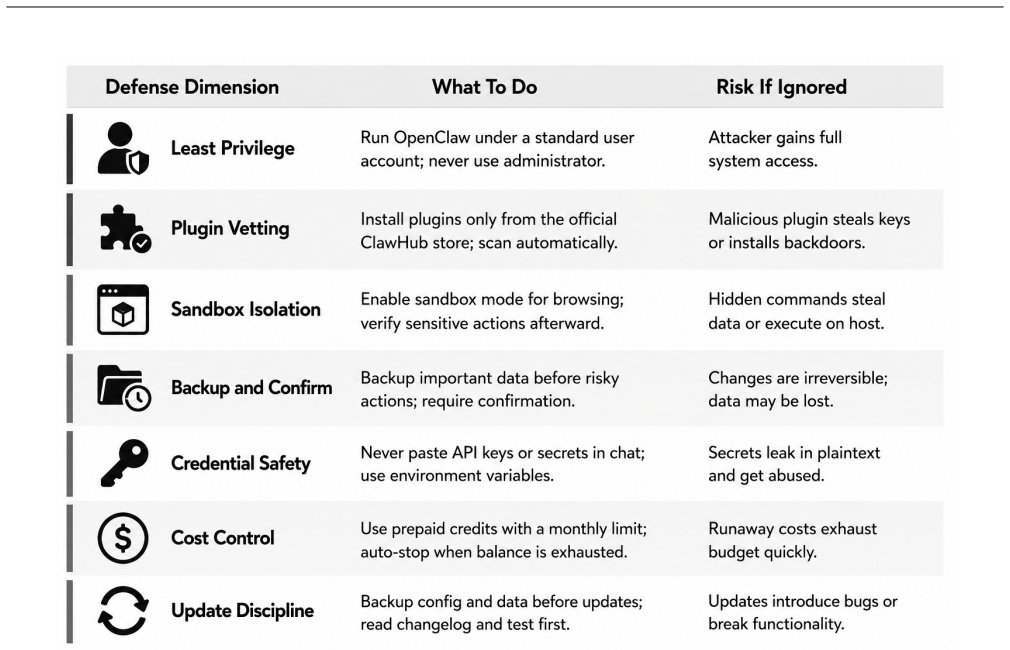
Non-technical users can lower OpenClaw risks by following plain-language steps on seven threats and using an automated Skill for security setups.
A machine-rendered reading of the paper's core claim, the machinery that carries it, and where it could break.
Core claim
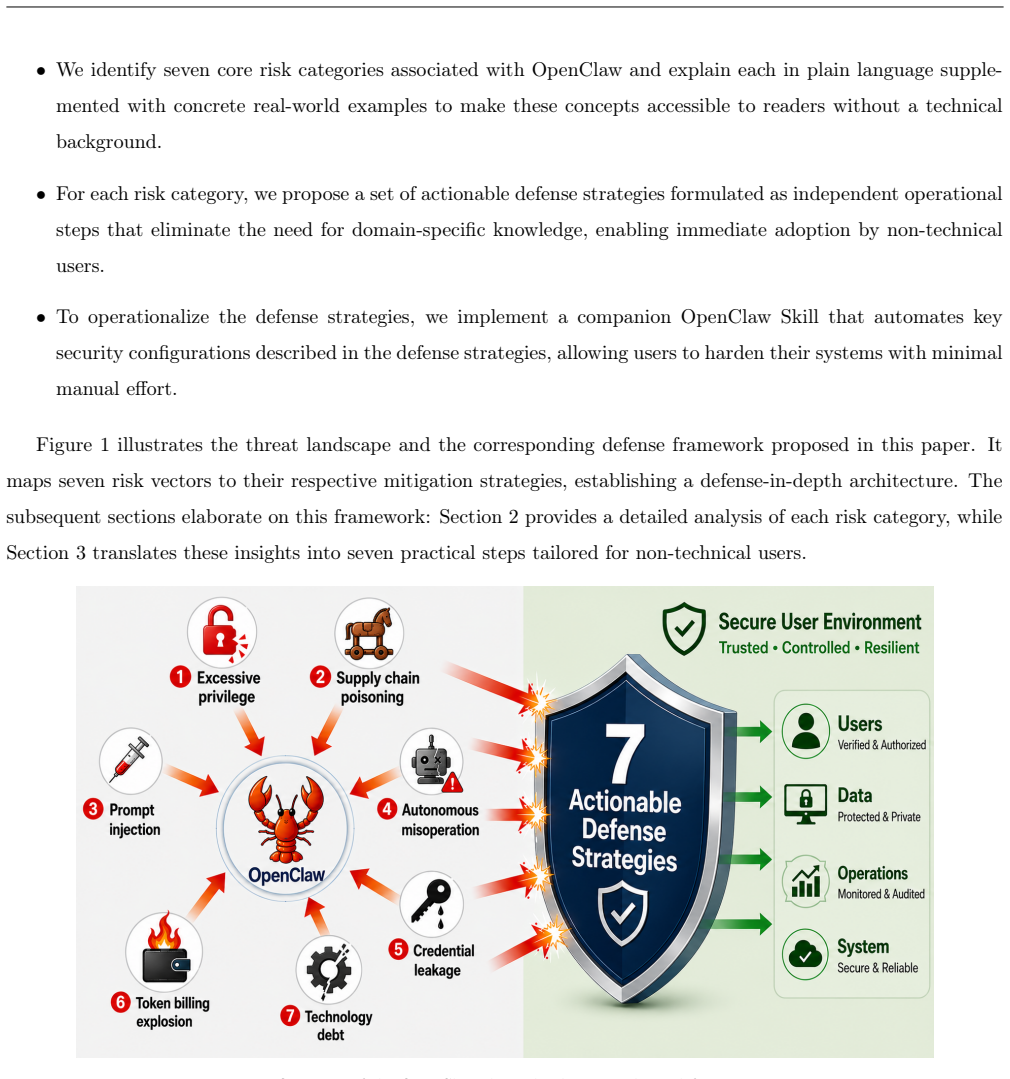
By identifying seven core risks that OpenClaw users may encounter, explaining each in plain language, distilling corresponding defensive strategies into clear operational steps, and providing a companion Skill that automates key security configurations, non-technical users can meaningfully participate in reducing the risks of intelligent agents through simple, practical actions.
What carries the argument
The companion OpenClaw Skill that automates security configurations, paired with seven categorized risks and their matching plain-language defensive steps.
If this is right
- Non-technical users gain the ability to understand and act on OpenClaw risks without needing expert knowledge.
- Protection against agent risks extends beyond security specialists to everyday users.
- The Skill reduces the need for manual setup, allowing users to apply defenses with minimal effort.
- Risk mitigation for intelligent agents becomes a set of repeatable, accessible actions rather than expert-only tasks.
Where Pith is reading between the lines
- If the Skill works as described, similar automated helpers could be built for other AI agent systems to reach broader audiences.
- Widespread use of such guides might push AI framework developers to include built-in security options that non-technical users can enable easily.
- Community-level adoption could lower the overall number of incidents tied to agent misuse by making basic protections standard practice.
Load-bearing premise
The seven listed risks are the main ones non-technical users face and that following the strategies plus running the Skill will actually reduce exposure to those risks.
What would settle it
A controlled test in which non-technical users who apply the guide and Skill show the same rate of security incidents as users who do not use them.
Figures
read the original abstract
OpenClaw has rapidly emerged as a transformative artificial intelligence (AI) agent framework, and its ability to autonomously execute complex, multi-step tasks has attracted an ever-growing and diverse user base. However, this capability comes with significant risks. While existing research has made important strides in characterizing these threats, such work is predominantly directed at technically sophisticated audiences. It remains largely inaccessible to non-technical users. This demographic now makes up an increasingly large and underserved portion of the community, yet it is these very users who most urgently need practical and straightforward guidance. In response, we bridge this gap through a series of interconnected efforts designed to lower the risk barrier for non-technical OpenClaw users. First, we identify and categorize seven core risks that OpenClaw users may encounter in daily usage, explaining each in plain language so that non-technical users can readily grasp the nature and potential consequences of these threats. Second, for each identified risk, we distill a set of corresponding defensive strategies into clear and actionable operational steps that are easy to follow. Third, to make protection even easier, we provide a companion OpenClaw Skill that automates key security configurations, enabling users to safeguard their systems with minimal manual intervention. Through this work, we demonstrate that safeguarding against the risks of intelligent agents need not be the exclusive domain of security experts, and that non-technical users can meaningfully participate in reducing these risks through simple, practical actions.
Editorial analysis
A structured set of objections, weighed in public.
Referee Report
Summary. The manuscript presents a practical guide for non-technical users of the OpenClaw AI agent framework. It identifies and categorizes seven core risks, distills defensive strategies into clear actionable steps for each, and provides a companion OpenClaw Skill to automate key security configurations. The central claim is that these efforts demonstrate non-technical users can meaningfully reduce risks through simple, practical actions.
Significance. If the identified risks are comprehensive and the strategies plus Skill are effective, the work could fill an accessibility gap by making security guidance available to non-expert users of autonomous AI agents.
major comments (2)
- [Abstract] Abstract: The claim that seven core risks were identified lacks any description of the methodology, data sources, or selection criteria used for risk discovery, which is load-bearing for the assertion that these are the risks 'non-technical users may encounter in daily usage'.
- [Abstract] Abstract: The demonstration that the strategies and Skill enable 'meaningful' risk reduction is unsupported, as no evaluation, user testing, before/after metrics, or implementation details for the Skill are provided to substantiate effectiveness.
minor comments (1)
- The title references a 'Skill' but the abstract supplies no details on its functionality, availability, or technical requirements.
Simulated Author's Rebuttal
We thank the referee for their constructive comments. We address each major point below and agree that revisions are needed to strengthen the manuscript.
read point-by-point responses
-
Referee: [Abstract] Abstract: The claim that seven core risks were identified lacks any description of the methodology, data sources, or selection criteria used for risk discovery, which is load-bearing for the assertion that these are the risks 'non-technical users may encounter in daily usage'.
Authors: We agree that the abstract and manuscript should describe how the seven risks were identified. The risks were derived from a review of prior AI agent security literature combined with analysis of OpenClaw's documented capabilities and reported usage scenarios. We will revise the abstract and add a dedicated 'Risk Identification' section explaining the sources consulted and the criteria applied (relevance to daily non-technical use and potential for harm). revision: yes
-
Referee: [Abstract] Abstract: The demonstration that the strategies and Skill enable 'meaningful' risk reduction is unsupported, as no evaluation, user testing, before/after metrics, or implementation details for the Skill are provided to substantiate effectiveness.
Authors: We acknowledge that the current version provides no quantitative evaluation or user testing to support the claim of 'meaningful' risk reduction. As the work is framed as a practical guide, the contribution rests on the accessibility of the strategies and Skill rather than empirical validation. We will add implementation details for the Skill to the main text and include a discussion of the design rationale for the mitigations. We cannot provide user study data or metrics, as none were collected; we will note this as a limitation and direction for future work. revision: partial
Circularity Check
No circularity: descriptive practical guide without derivations or self-referential reductions
full rationale
The paper presents a list of seven risks, distilled strategies, and a companion Skill as a practical guide for non-technical users. No equations, fitted parameters, derivations, or load-bearing self-citations appear in the provided text. The central claim is advanced by direct presentation of the guide itself rather than by any reduction to prior inputs or self-defined constructs. This matches the default case of a self-contained descriptive work with no circular steps.
Axiom & Free-Parameter Ledger
Reference graph
Works this paper leans on
-
[1]
title Careful adoption of agentic AI services \/
author Australian Signals Directorate’s Australian Cyber Security Centre (ASD’s ACSC) and the United States Cybersecurity and Infrastructure Security Agency (CISA) and National Security Agency (NSA) and the Canadian Centre for Cyber Security (Cyber Centre) and the New Zealand National Cyber Security Centre (NCSC-NZ) and the United Kingdom National Cyber S...
2026
-
[2]
author Bhardwaj, V. P. ( year 2026 ). title Formal analysis and supply chain security for agentic AI skills . journal arXiv preprint arXiv:2603.00195 \/
arXiv 2026
-
[3]
author Chen, T. , author Liu, D. , author Hu, X. , author Yu, J. , & author Wang, W. ( year 2026 ). title A Trajectory-Based Safety Audit of Clawdbot (OpenClaw) . journal arXiv preprint arXiv:2602.14364 \/
arXiv 2026
-
[4]
author Deng, X. , author Zhang, Y. , author Wu, J. , author Bai, J. , author Yi, S. , author Zou, Z. , author Xiao, Y. , author Qiu, R. , author Ma, J. , & author Chen, J. ( year 2026 ). title Taming OpenClaw: Security Analysis and Mitigation of Autonomous LLM Agent Threats . journal arXiv preprint arXiv:2603.11619 \/ ,
arXiv 2026
-
[5]
author Dong, B. , author Feng, H. , & author Wang, Q. ( year 2026 ). title Clawdrain: Exploiting Tool-Calling Chains for Stealthy Token Exhaustion in OpenClaw Agents . journal arXiv preprint arXiv:2603.00902 \/
arXiv 2026
-
[6]
author Greshake, K. , author Abdelnabi, S. , author Mishra, S. , author Endres, C. , author Holz, T. , & author Fritz, M. ( year 2023 ). title Not What You've Signed Up For: Compromising Real-World LLM-Integrated Applications with Indirect Prompt Injection . In booktitle Proceedings of the 16th ACM Workshop on Artificial Intelligence and Security \/ . :10...
-
[7]
author Hossain, I. , author Puppala, S. , author Lu, Z. , author Talukder, S. , & author Jiang, N. ( year 2026 ). title Benchmarking security risk detection and verification in open agentic skill ecosystems . journal arXiv preprint arXiv:2606.00925 \/
Pith/arXiv arXiv 2026
-
[8]
author Koc, V. , author Erichsen, P. , author Tomlinson, J. , author Rivera, A. , author Appel, M. , & author Paz, N. ( year 2026 ). title ClawHub Security Signals: When VirusTotal, Static Analysis, and SkillSpector Disagree . journal arXiv preprint arXiv:2606.01494 \/
Pith/arXiv arXiv 2026
-
[9]
( year 2026 )
author Krebs, B. ( year 2026 ). title How AI assistants are moving the security goalposts \/ . type Report . https://krebsonsecurity.com/2026/03/how-ai-assistants-are-moving-the-security-goalposts/
2026
-
[10]
, author Plate, H
author Ladisa, P. , author Plate, H. , author Martinez, M. , & author Barais, O. ( year 2023 ). title SoK: Taxonomy of attacks on open-source software supply chains . In booktitle 2023 IEEE Symposium on Security and Privacy (SP) \/
2023
-
[11]
Available: https://doi.org/10.1145/3560815
author Liu, P. , author Yuan, W. , author Fu, J. , author Jiang, Z. , author Hayashi, H. , & author Neubig, G. ( year 2023 ). title Pre-train, prompt, and predict: A systematic survey of prompting methods in natural language processing . journal ACM Computing Surveys \/ , volume 55 \/ , pages Article 195 . :10.1145/3560815
-
[12]
author Liu, S. , author Li, C. , author Wang, C. , author Hou, J. , author Chen, Z. , author Zhang, L. , author Liu, Z. , author Ye, Q. , author Hei, Y. , & author Zhang, X. ( year 2026 ). title ClawKeeper: Comprehensive safety protection for openclaw agents through skills, plugins, and watchers . journal arXiv preprint arXiv:2603.24414 \/
arXiv 2026
-
[13]
title Risk advisory on the secure use of OpenClaw \/
author National Computer Network Emergency Response Technical Team/Coordination Center of China ( year 2026 ). title Risk advisory on the secure use of OpenClaw \/ . type Report . https://www.cert.org.cn/publish/main/11/2026/20260312144519429724511/20260312144519429724511_.html
2026
-
[14]
title CVE-2026-25253 Detail \/
author National Vulnerability Database ( year 2026 ). title CVE-2026-25253 Detail \/ . type Report . https://nvd.nist.gov/vuln/detail/CVE-2026-25253
2026
-
[15]
title NVIDIA announces NemoClaw for the OpenClaw community
author NVIDIA Corporation ( year 2026 ). title NVIDIA announces NemoClaw for the OpenClaw community . https://nvidianews.nvidia.com/news/nvidia-announces-nemoclaw
2026
-
[16]
author Qiao, Y. , author Liu, D. , author Yang, H. , author Zhou, W. , & author Hu, S. ( year 2025 ). title Agent Tools Orchestration Leaks More: Dataset, Benchmark, and Mitigation . journal arXiv preprint arXiv:2512.16310 \/
Pith/arXiv arXiv 2025
-
[17]
( year 2026 )
author Schneider, C. ( year 2026 ). title AI agents as attack pivots: The new lateral movement A structural shift in cross-system compromise \/ . type Report . https://christian-schneider.net/blog/ai-agent-lateral-movement-attack-pivots/
2026
-
[18]
author Shan, Z. , author Xin, J. , author Zhang, Y. , & author Xu, M. ( year 2026 ). title Don't Let the Claw Grip Your Hand: A Security Analysis and Defense Framework for OpenClaw . journal arXiv preprint arXiv:2603.10387 \/
arXiv 2026
-
[19]
( year 2026 )
author Sheikh, H. ( year 2026 ). title Awesome OpenClaw use cases . https://github.com/hesamsheikh/awesome-openclaw-usecases
2026
-
[20]
( year 2025 )
author Sotiropoulos, J. ( year 2025 ). title OWASP top 10 for agentic applications – The benchmark for agentic security in the age of autonomous AI \/ . type Report . https://genai.owasp.org/2025/12/09/owasp-top-10-for-agentic-applications-the-benchmark-for-agentic-security-in-the-age-of-autonomous-ai/
2025
-
[21]
( year 2026 )
author Tal, L. ( year 2026 ). title Your Clawdbot (OpenClaw) AI assistant has shell access and one prompt injection away from disaster \/ . type Report . https://snyk.io/articles/clawdbot-ai-assistant/
2026
-
[22]
author Tan, J. , author Dou, Z. , author Yang, X. , author Hu, Y. , author Cheng, Y. , author Li, X. , & author Wen, J.-R. ( year 2026 ). title From prompt injection to persistent control: Defending agentic workspaces against trojan backdoors . journal arXiv preprint arXiv:2605.31042 \/
Pith/arXiv arXiv 2026
-
[23]
title OpenClaw surpasses React to become the most-starred software project on GitHub
author Tianzhou ( year 2026 ). title OpenClaw surpasses React to become the most-starred software project on GitHub . https://www.star-history.com/blog/openclaw-surpasses-react-most-starred-software/
2026
-
[24]
author Wang, Y. , author Ba, J. , author Liu, H. , author Pan, Y. , author Wei, J. , author Su, Z. , author Luan, T. H. , & author Du, L. ( year 2026 a ). title Security of OpenClaw agents: Fundamentals, threats, and countermeasures . journal arXiv preprint arXiv:2605.25435 \/
Pith/arXiv arXiv 2026
-
[25]
author Wang, Y. , author Gao, H. , author Niu, Z. , author Liu, Z. , author Zhang, W. , author Wang, X. , & author Lian, S. ( year 2026 b ). title A Systematic Security Evaluation of OpenClaw and Its Variants . journal arXiv preprint arXiv:2604.03131 \/
Pith/arXiv arXiv 2026
-
[26]
author Wang, Z. , author Tu, H. , author Zhang, L. , author Chen, H. , author Wu, J. , author Liu, X. , author Yuan, Z. , author Pang, T. , author Shieh, M. Q. , & author Liu, F. ( year 2026 c ). title Your agent, their asset: A real-world safety analysis of OpenClaw . journal arXiv preprint arXiv:2604.04759 \/
Pith/arXiv arXiv 2026
-
[27]
author Ying, Z. , author Yang, X. , author Wu, S. , author Song, Y. , author Qu, Y. , author Li, H. , author Li, T. , author Wang, J. , author Liu, A. , & author Liu, X. ( year 2026 ). title Uncovering Security Threats and Architecting Defenses in Autonomous Agents: A Case Study of OpenClaw . journal arXiv preprint arXiv:2603.12644 \/
arXiv 2026
discussion (0)
Sign in with ORCID, Apple, or X to comment. Anyone can read and Pith papers without signing in.