Influence of CeO₂MnO_x heterostructure on Hydrogen Peroxide Electrogeneration on Carbon-Based Catalysts
Pith reviewed 2026-06-27 12:29 UTC · model grok-4.3
The pith
Low loadings of CeO2 and CeO2MnOx on carbon achieve up to 90% H2O2 selectivity in the two-electron oxygen reduction reaction.
A machine-rendered reading of the paper's core claim, the machinery that carries it, and where it could break.
Core claim
CeO2 nanowires and CeO2MnOx heterostructures supported on carbon at 1-5% loadings enhance 2e- ORR activity, with the 1% CeO2MnOx/C and 3% CeO2/C variants delivering up to 90% H2O2 selectivity and elevated ring currents in RRDE measurements, because the low loading and MnOx modification optimize the balance between active sites, oxygen adsorption, and intermediate stabilization.
What carries the argument
The CeO2MnOx heterostructure with MnOx surface modification on CeO2 nanowires supported on carbon, which tunes hydrophilicity and active-site properties to favor selective 2e- ORR.
If this is right
- Low metal loadings of 1-3% suffice to reach high H2O2 selectivity, lowering catalyst cost.
- MnOx modification on CeO2 improves the trade-off between oxygen adsorption and peroxide desorption.
- Carbon-supported CeO2-based materials can replace noble-metal catalysts for green H2O2 electrosynthesis.
- Increased surface hydrophilicity from CeO2 oxygenated groups correlates with higher electrochemical activity.
Where Pith is reading between the lines
- The same low-loading heterostructure strategy might be tested on other carbon supports or with different transition-metal oxides to tune ORR selectivity further.
- If the catalysts prove stable over many hours, they could enable small-scale, on-site H2O2 generation for water treatment without transport of concentrated peroxide.
- Varying the Mn/Ce ratio within the heterostructure could reveal an optimal surface composition for maximum 2e- selectivity.
Load-bearing premise
The selectivity gains are caused by the CeO2MnOx heterostructure and MnOx modification rather than differences in particle dispersion, exact synthesis variables, or measurement effects.
What would settle it
RRDE experiments on the 1% CeO2MnOx/C and 3% CeO2/C materials that show H2O2 selectivity statistically indistinguishable from bare Vulcan XC-72 under identical conditions would falsify the claim.
Figures
read the original abstract
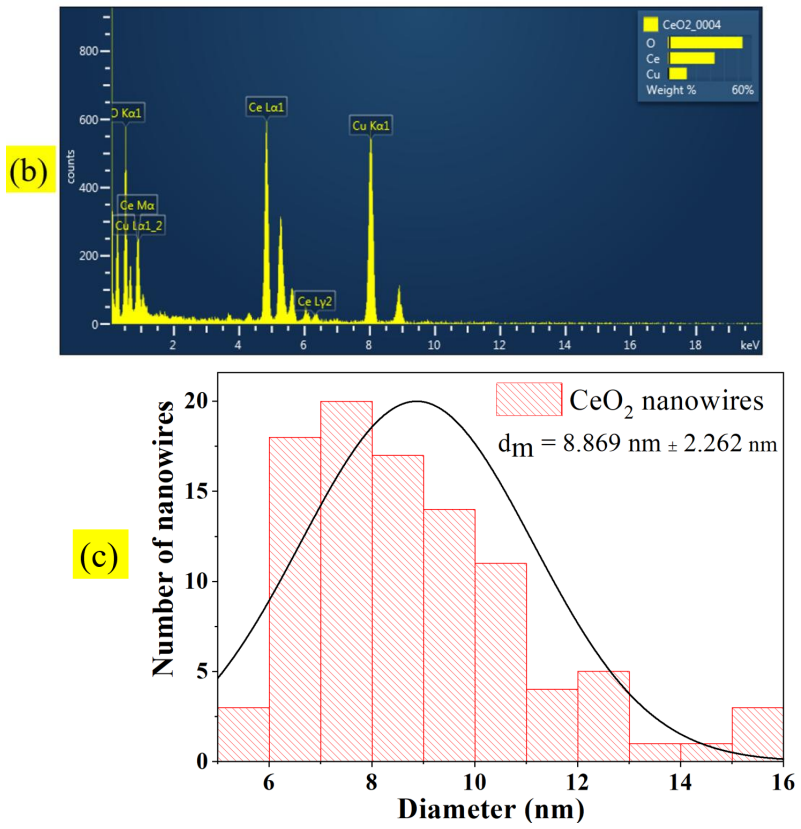
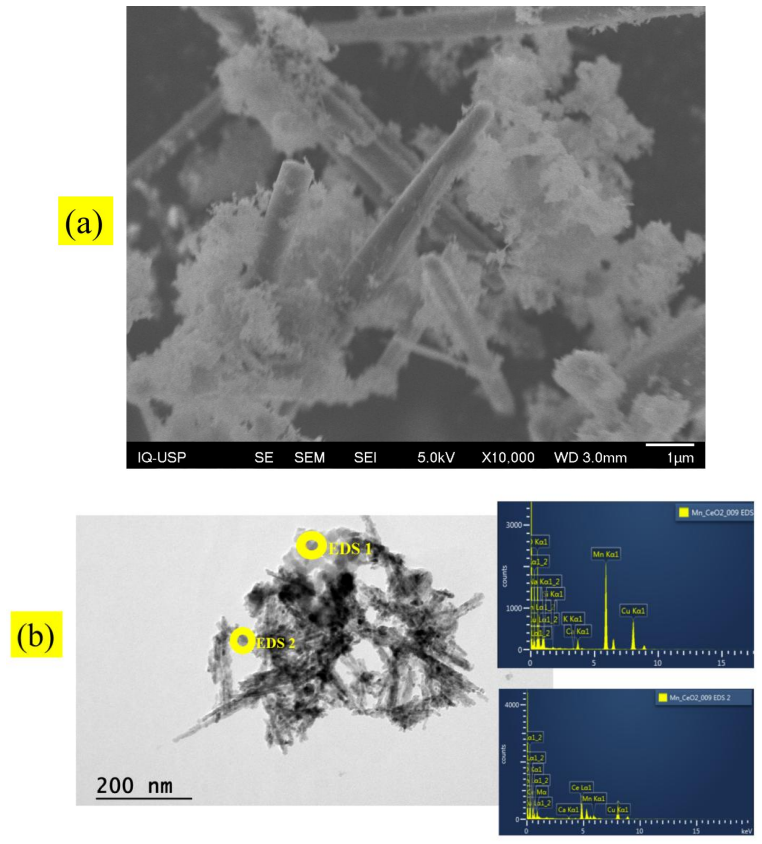
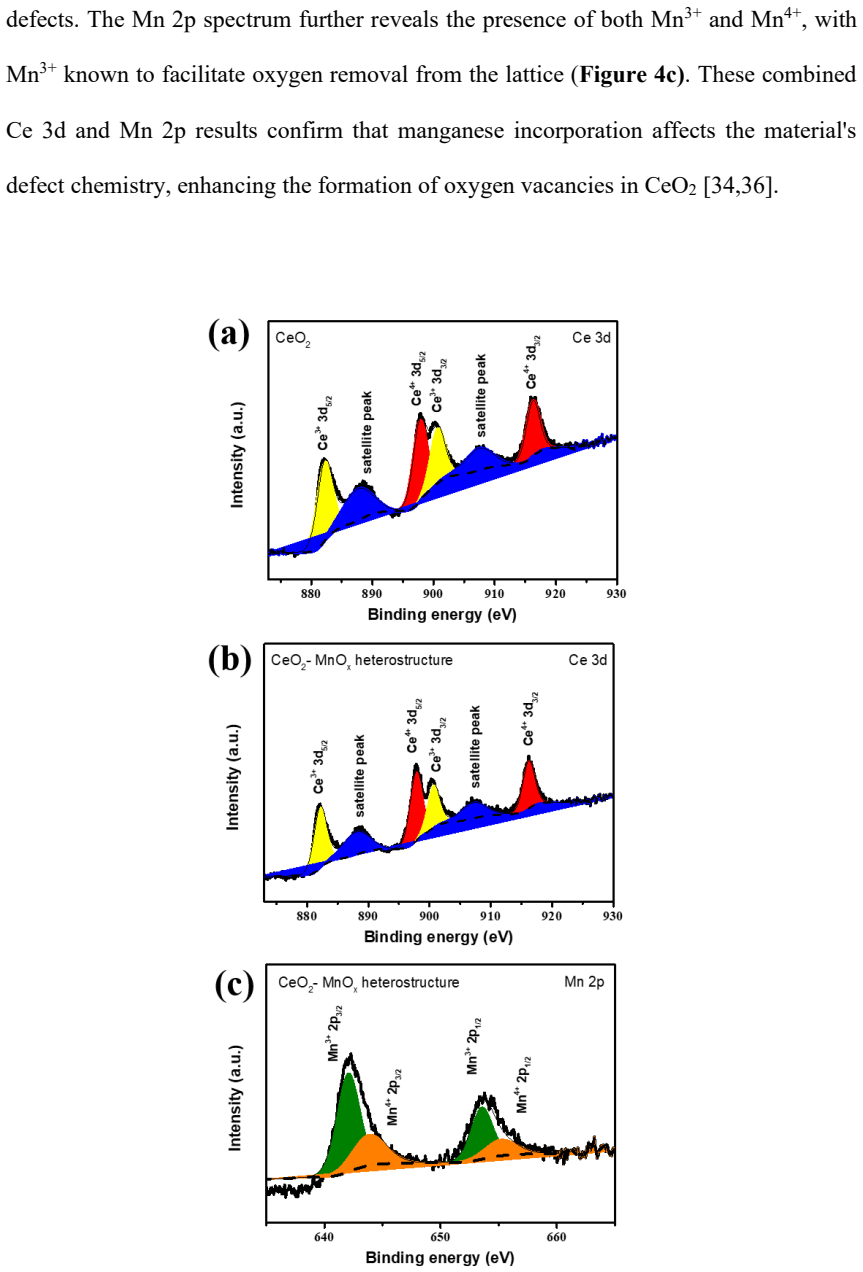
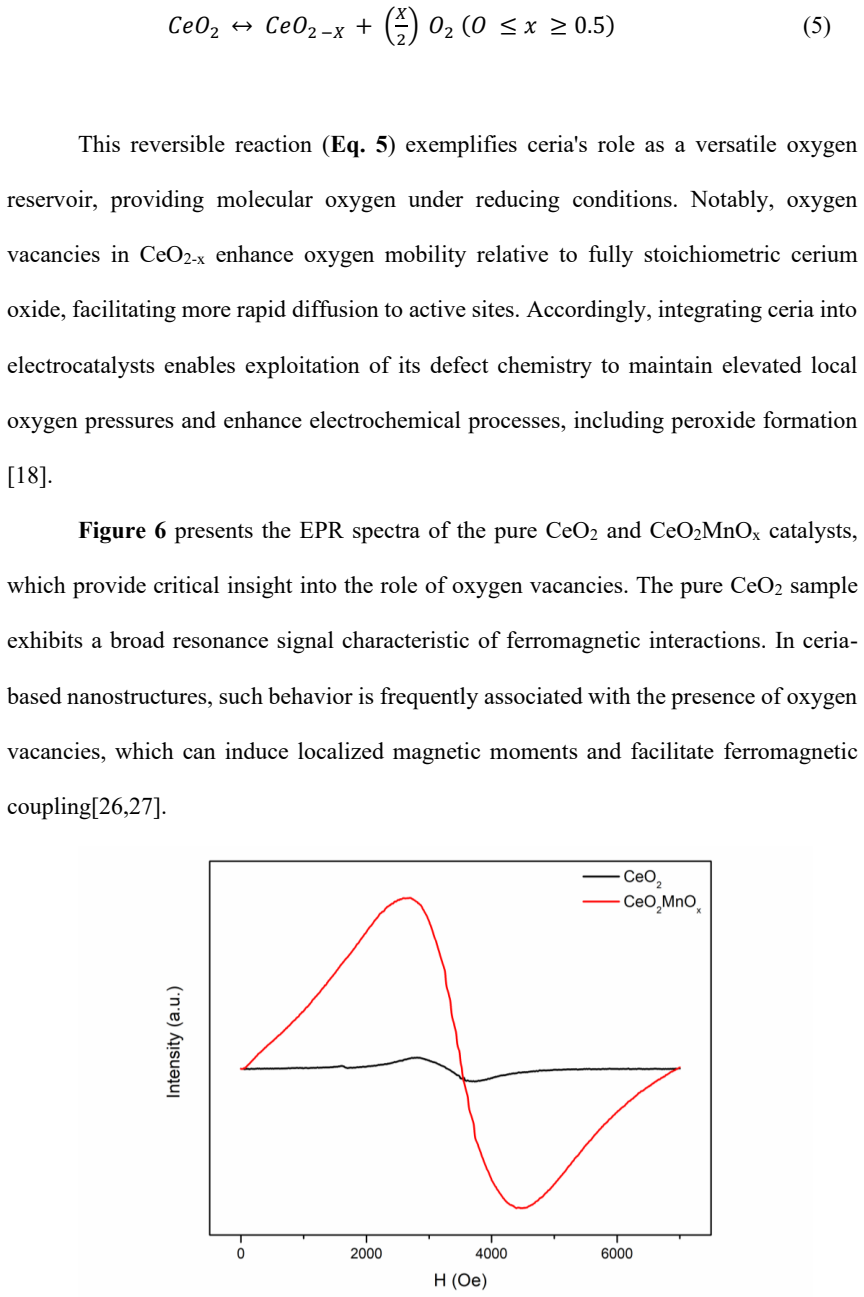
The sustainable electrogeneration of hydrogen peroxide (H2O2) via the two-electron oxygen reduction reaction (2e$^-$ ORR) represents a promising alternative to conventional production methods. In this study, CeO2 and CeO2MnOx nanoparticles were synthesized and supported on Vulcan XC-72 carbon at varying loadings (1, 3, and 5%), aiming to assess the lowest metal loading and high H2O2 electrosynthesis. Physicochemical characterizations confirmed the successful formation of CeO2 nanowires and the effectiveness of the MnOx surface modification. XRD, TEM, XPS, EPR, and contact angle analyses revealed that CeO2 loading increased surface hydrophilicity through the presence of oxygenated functional groups, thereby favoring electrochemical activity. On the other hand, all CeO2MnOx loadings were statistically equivalent to Vulcan XC-72 in terms of contact angle. Electrochemical evaluations using a rotating ring-disk electrode (RRDE) demonstrated enhanced ORR activity and high H2O2 selectivity for the 1% CeO2MnOx/C and 3% CeO2/C catalysts, achieving up to 90% selectivity and elevated ring currents. The results suggest that low metal loading and surface modification via MnOx improve the balance between active site exposure, oxygen adsorption, and intermediate stabilization, thus favoring the selective 2e$^-$ pathway. These findings support the development of cost-effective, non-noble-metal catalysts for green H2O2 production via electrosynthesis.
Editorial analysis
A structured set of objections, weighed in public.
Referee Report
Summary. The manuscript reports the synthesis of CeO2 nanowires and CeO2MnOx nanoparticles supported on Vulcan XC-72 carbon at 1%, 3%, and 5% loadings. Physicochemical characterization (XRD, TEM, XPS, EPR, contact angle) confirms particle formation and surface properties, while RRDE measurements show that the 1% CeO2MnOx/C and 3% CeO2/C catalysts achieve up to 90% H2O2 selectivity with elevated ring currents, attributed to low metal loading and MnOx modification favoring the selective 2e- ORR pathway.
Significance. If the reported selectivity gains prove robust and causally linked to the heterostructure, the work would contribute to the development of low-cost, non-noble-metal carbon-based catalysts for sustainable H2O2 electrosynthesis. The multi-technique characterization approach is standard and appropriate for the field, providing direct experimental evidence on surface hydrophilicity and particle morphology.
major comments (2)
- [Abstract and Electrochemical evaluations] Abstract and Electrochemical evaluations section: The central claim that 1% CeO2MnOx/C and 3% CeO2/C achieve up to 90% H2O2 selectivity due to the CeO2MnOx heterostructure and low loading is load-bearing but unsupported by error bars, replicate syntheses, batch-to-batch variability data, or explicit control experiments (e.g., MnOx-free CeO2 at identical loadings or unmodified carbon under matched synthesis conditions).
- [Physicochemical characterizations and contact angle analyses] Physicochemical characterizations and contact angle analyses: The finding that CeO2MnOx contact angles are statistically equivalent to Vulcan XC-72, without a described control series holding synthesis variables fixed while omitting MnOx, leaves open that RRDE ring-current elevation could arise from incidental changes in particle dispersion or surface oxygen groups rather than the intended heterostructure.
minor comments (2)
- [Abstract] The abstract states 'elevated ring currents' without quantitative values, disk current densities, or direct numerical comparison to baselines.
- The manuscript would benefit from inclusion of full RRDE datasets, statistical analysis, and supplementary information detailing exact synthesis protocols and measurement conditions.
Simulated Author's Rebuttal
We thank the referee for the constructive feedback and the recommendation for major revision. We address each major comment below, acknowledging where additional data or clarification is warranted while defending the manuscript's core findings on the basis of the presented multi-technique evidence.
read point-by-point responses
-
Referee: [Abstract and Electrochemical evaluations] Abstract and Electrochemical evaluations section: The central claim that 1% CeO2MnOx/C and 3% CeO2/C achieve up to 90% H2O2 selectivity due to the CeO2MnOx heterostructure and low loading is load-bearing but unsupported by error bars, replicate syntheses, batch-to-batch variability data, or explicit control experiments (e.g., MnOx-free CeO2 at identical loadings or unmodified carbon under matched synthesis conditions).
Authors: We agree that the absence of error bars and explicit replicate data weakens the statistical robustness of the 90% selectivity claim. The RRDE results are reported from representative measurements showing consistent trends with loading and MnOx modification, with the unmodified Vulcan XC-72 serving as the primary baseline control. We will revise the electrochemical section and figures to include error bars derived from triplicate RRDE experiments and will add a statement clarifying that all catalysts were prepared under identical synthesis conditions to control for batch variability. However, dedicated MnOx-free CeO2 controls at precisely matched loadings were not performed in the original study. revision: yes
-
Referee: [Physicochemical characterizations and contact angle analyses] Physicochemical characterizations and contact angle analyses: The finding that CeO2MnOx contact angles are statistically equivalent to Vulcan XC-72, without a described control series holding synthesis variables fixed while omitting MnOx, leaves open that RRDE ring-current elevation could arise from incidental changes in particle dispersion or surface oxygen groups rather than the intended heterostructure.
Authors: The contact-angle results are presented as measured values showing statistical equivalence for the CeO2MnOx series to the bare carbon support, while CeO2 alone increases hydrophilicity. All samples were synthesized using the same protocol with MnOx surface modification as the sole variable. We will revise the physicochemical characterization section to explicitly state that synthesis conditions were held fixed across the series and to discuss how the combined XRD, TEM, XPS, and EPR data support attribution to the heterostructure rather than incidental dispersion changes. A fully separate control series omitting MnOx while varying other parameters was not included. revision: partial
Circularity Check
No circularity: purely experimental study with no derivations or fitted predictions
full rationale
This is a purely experimental materials science paper describing nanoparticle synthesis, standard physicochemical characterization (XRD, TEM, XPS, EPR, contact angle), and RRDE electrochemical measurements. No equations, models, or first-principles derivations appear in the abstract or described content. Claims of up to 90% H2O2 selectivity rest on direct ring-current and disk-current data rather than any reduction to input parameters, self-citations, or ansatzes. The study is self-contained against external benchmarks (standard RRDE protocols and characterization methods), so no load-bearing step reduces by construction to its own inputs.
Axiom & Free-Parameter Ledger
free parameters (1)
- metal loadings (1%, 3%, 5%)
Reference graph
Works this paper leans on
-
[1]
R.J. Alves Felisardo, C.H. Magalhães Fernandes, G. de Oliveira Santiago Santos, M.R. de Vasconcelos Lanza, Unlocking the potential of in situ H2O2 generation in urine as a decentralized electro -sanitation strategy, Chemical Engineering Journal 507 (2025). https://doi.org/10.1016/j.cej.2025.160391
-
[2]
S.C. Perry, D. Pangotra, L. Vieira, L.I. Csepei, V. Sieber, L. Wang, C. Ponce de León, F.C. Walsh, Electrochemical synthesis of hydrogen peroxide from water and oxygen, Nat Rev Chem 3 (2019) 442 –458. https://doi.org/10.1038/s41570 -019- 0110-6
-
[3]
A.T. Murray, S. Voskian, M. Schreier, T.A. Hatton, Y. Surendranath, Electrosynthesis of Hydrogen Peroxide by Phase -Transfer Catalysis, Joule 3 (2019) 2942–2954. https://doi.org/10.1016/j.joule.2019.09.019
-
[4]
X. Huang, M. Song, J. Zhang, T. Shen, G. Luo, D. Wang, Recent Advances of Electrocatalyst and Cell Design for Hydrogen Peroxide Production, Nanomicro Lett 15 (2023). https://doi.org/10.1007/s40820-023-01044-2
-
[5]
A.B. Trench, C.M. Fernandes, J.P.C. Moura, L.E.B. Lucchetti, T.S. Lima, V.S. Antonin, J.M. de Almeida, P. Autreto, I. Robles, A.J. Motheo, M.R.V. Lanza, M.C. Santos, Hydrogen peroxide electrogeneration from O2 electroreduction: A review focusing on carbon electrocatalysts and environmental applications, Chemosphere 352 (2024). https://doi.org/10.1016/j.ch...
-
[6]
T.S. Lima, M.C. Santos, A.J. Motheo, Electrochemical generation of hydrogen peroxide using cerium oxide nanostructures supported on graphene: Synthesis, characterization, and application in wastewater treatment, Electrochim Acta 521 (2025). https://doi.org/10.1016/j.electacta.2025.145931
-
[7]
Z. Deng, Z. Gong, M. Gong, X. Wang, Defect Engineering on Commercial Carbon for Economical H2O2 Electrosynthesis Under Industrial -Relevant Conditions, Adv Funct Mater (2025). https://doi.org/10.1002/adfm.202512847
-
[8]
J.P.C. Moura, V.S. Antonin, A.B. Trench, M.C. Santos, Hydrogen peroxide electrosynthesis: A comparative study employing Vulcan carbon modification by different MnO2 nanostructures, Electrochim Acta 463 (2023). https://doi.org/10.1016/j.electacta.2023.142852
-
[9]
M.C. Santos, V.S. Antonin, F.M. Souza, L.R. Aveiro, V.S. Pinheiro, T.C. Gentil, T.S. Lima, J.P.C. Moura, C.R. Silva, L.E.B. Lucchetti, L. Codognoto, I. Robles, 4 M.R.V. Lanza, Decontamination of wastewater containing contaminants of emerging concern by electrooxidation and Fenton-based processes – A review on the relevance of materials and methods, Chemos...
-
[10]
Y. Liang, Y. Han, J. sha Li, J. Wang, D. Liu, Q. Fan, Wettability control in electrocatalyst: A mini review, Journal of Energy Chemistry 70 (2022) 643 –655. https://doi.org/10.1016/j.jechem.2021.09.005
-
[11]
L. Li, Z. Hu, Y. Kang, S. Cao, L. Xu, L. Yu, L. Zhang, J.C. Yu, Electrochemical generation of hydrogen peroxide from a zinc gallium oxide anode with dual active sites, Nat Commun 14 (2023). https://doi.org/10.1038/s41467-023-37007-9
-
[12]
L. Wu, Z. Zhou, Y. Xiao, Z. Xu, X. Li, Hydrogen evolution reaction activity and stability of sintered porous Ni -Cu-Ti-La2O3 cathodes in a wide pH range, Int J Hydrogen Energy 47 (2022) 11101 –11115. https://doi.org/10.1016/j.ijhydene.2022.01.019
-
[13]
J.A. Ali, K. Kolo, A.K. Manshad , A.H. Mohammadi, Recent advances in application of nanotechnology in chemical enhanced oil recovery: Effects of nanoparticles on wettability alteration, interfacial tension reduction, and flooding, Egyptian Journal of Petroleum 27 (2018) 1371 –1383. https://doi.org/10.1016/j.ejpe.2018.09.006
-
[14]
A. Borenstein, O. Hanna, R. Attias, S. Luski, T. Brousse, D. Aurbach, Carbon - based composite materials for supercapacitor electrodes: A review, J Mater Chem A Mater 5 (2017) 12653–12672. https://doi.org/10.1039/c7ta00863e
-
[15]
R. Ma, G. Lin, Y. Zhou, Q. Liu, T. Zhang, G. Shan, M. Yang, J. Wang, A review of oxygen reduction mechanisms for metal-free carbon-based electrocatalysts, NPJ Comput Mater 5 (2019). https://doi.org/10.1038/s41524-019-0210-3
-
[16]
F. Zhang, R. Ke, M. Liu, X. Zhang, Y. Wang, Y. Wang, Improved electrocatalytic performance of Fe/CeO2 bifunctional electrocatalyst by simultaneous H2O2 in - situ generation and activation, Chemical Engineering Journal Advances 9 (2022). https://doi.org/10.1016/j.ceja.2021.100231
-
[17]
W. Zhang, J. Li, Z. Wei, Carbon-based catalysts of the oxygen reduction reaction: Mechanistic understanding and porous structures, Chinese Journal of Catalysis 48 (2023) 15–31. https://doi.org/10.1016/S1872-2067(23)64427-4
-
[18]
M.H.M.T. Assumpcão, A. Moraes, R.F.B. De Souza, M.L. Calegaro, M.R.V. Lanza, E.R. Leite, M.A.L. Cordeiro, P. Hammer, M.C. Santos, Influence of the 5 preparation method and the support on H2O 2electrogeneration using cerium oxide nanoparticles, Electrochim Acta 111 (2013) 339 –343. https://doi.org/10.1016/j.electacta.2013.07.187
-
[19]
M.H.M.T. Assumpção, A. Moraes, R.F.B. De Souza, I. Gaubeur, R.T.S. Oliveira, V.S. Antonin, G.R.P. Malpass, R.S. Rocha, M.L. Calegaro, M.R.V. Lanza, M.C. Santos, Low content cerium oxide nanoparticles on carbon for hydrogen peroxide electrosynthesis, Appl Catal A Gen 411 –412 (2012) 1 –6. https://doi.org/10.1016/j.apcata.2011.09.030
-
[20]
V.S. Pinheiro, E.C. Paz, L.R. Aveiro, L.S. Parreira, F.M. Souza, P.H.C. Camargo, M.C. Santos, Ceria high aspect ratio nanostructures supported on carbon for hydrogen peroxide electrogeneration, Electrochim Acta 259 (2018) 865 –872. https://doi.org/10.1016/j.electacta.2017.11.010
-
[21]
V.S. Antonin, L.E.B. Lucchetti, F.M. Souza, V.S. Pinheiro, J.P.C. Moura, A.B. Trench, J.M. de Almeida, P.A.S. Autreto, M.R.V. Lanza, M.C. Santos, Sodium niobate microcubes decorated with ceria nanorods for hydrogen peroxide electrogeneration: An experimen tal and theoretical study, J Alloys Compd 965 (2023). https://doi.org/10.1016/j.jallcom.2023.171363
-
[22]
I. Trenque, G.C. Magnano, M.A. Bolzinger, L. Roiban, F. Chaput, I. Pitault, S. Briançon, T. Devers, K. Masenelli-Varlot, M. Bugnet, D. Amans, Shape-selective synthesis of nanoceria for degradation of paraoxon as a chemical warfare simulant, Physical Chemi stry Chemical Physics 21 (2019) 5455 –5465. https://doi.org/10.1039/c9cp00179d
-
[23]
C. Machado Fernandes, J.P.C. Moura, A.B. Trench, O.C. Alves, Y. Xing, M.R.V. Lanza, J.C.M. Silva, M.C. Santos, Magnetic field -enhanced two-electron oxygen reduction reaction using CeMnCo nanoparticles supported on different carbonaceous matrices, Mater To day Nano 28 (2024). https://doi.org/10.1016/j.mtnano.2024.100524
-
[24]
A.B. Trench, J.P.C. Moura, C.M. Fernandes, M.C. Santos, Effect of fluorine doping on the electrocatalytic properties of Nb2O5 for H2O2 electrogeneration, Journal of Electroanalytical Chemistry 992 (2025). https://doi.org/10.1016/j.jelechem.2025.119231
-
[25]
H. Estrade-Szwarckopf, XPS photoemission in carbonaceous materials: A “defect” peak beside the graphitic asymmetric peak, Carbon N Y 42 (2004) 1713 –1721. https://doi.org/10.1016/j.carbon.2004.03.005. 6
-
[26]
A.O. Santos, L.D. Martins, J.H.S. Mezavila, J.D.P. Serna, N.R. Checca, A.V.H. Soares, C.M. Fernandes, E.A. Ponzio, J.C.M. Silva, O.C. Alves, Temperature dependence of ferromagnetic behavior in ceria nanoparticles with cubic morphology, J Alloys Compd 965 (2023). https://doi.org/10.1016/j.jallcom.2023.171300
-
[27]
C. Machado Fernandes, A.O. Santos, V.S. Antonin, J.P.C. Moura, A.B. Trench, O.C. Alves, Y. Xing, J.C.M. Silva, M.C. Santos, Magnetic field-enhanced oxygen reduction reaction for electrochemical hydrogen peroxide production with different cerium oxide nanostructures, Chemical Engineering Journal 488 (2024). https://doi.org/10.1016/j.cej.2024.150947
-
[28]
J.P.C. Moura, L.E.B. Lucchetti, C.M. Fernandes, A.B. Trench, C.N. Lange, B.L. Batista, J.M. Almeida, M.C. Santos, Experimental and theoretical studies of WO3/Vulcan XC-72 electrocatalyst enhanced H2O2 yield ORR performed in acid and alkaline medium, J Env iron Chem Eng 12 (2024). https://doi.org/10.1016/j.jece.2024.113182
-
[29]
L.R. Aveiro, A.G.M. da Silva, V.S. Antonin, E.G. Candido, L.S. Parreira, R.S. Geonmonond, I.C. de Freitas, M.R.V. Lanza, P.H.C. Camargo, M.C. Santos, Carbon-supported MnO2 nanoflowers: Introducing oxygen vacancies for optimized volcano -type electrocatalyt ic activities towards H2O2 generation, Electrochim Acta 268 (2018) 101 –110. https://doi.org/10.1016...
-
[30]
U. Hübner, S. Spahr, H. Lutze, A. Wieland, S. Rüting, W. Gernjak, J. Wenk, Advanced oxidation processes for water and wastewater treatment – Guidance for systematic future research, Heliyon 10 (2024). https://doi.org/10.1016/j.heliyon.2024.e30402
-
[31]
T. O. Silva, J. Fernandez-Cascán, J. Isidro, C. Saez, M.R. Marcos, M.A. Rodrigo, Degradation of real lindane wastes using advanced oxidation technologies based on electrogenerated hydrogen peroxide, Process Safety and Environmental Protection 180 (2023) 535–543. https://doi.org/10.1016/j.psep.2023.10.031
-
[32]
I. Sánchez-Montes, G. O. S. Santos, T. O. Silva, R. Colombo, M. R. V. Lanza, An innovative approach to the application of electrochemical processes based on the in-situ generation of H2O2 for water treatment, J Clean Prod 392 (2023). https://doi.org/10.1016/j.jclepro.2023.136242. 7
-
[33]
M.S. Kronka, G. V. Fortunato, L. Mira, A.J. dos Santos, M.R.V. Lanza, Using Au NPs anchored on ZrO2/carbon black toward more efficient H2O2 electrogeneration in flow -by reactor for carbaryl removal in real wastewater, Chemical Engineering Journal 452 (202 3). https://doi.org/10.1016/j.cej.2022.139598
-
[34]
K. Ahmad, W. Raza, R.A. Khan, Fabrication of picric acid sensor using cerium oxide-modified glassy carbon electrode, Journal of Materials Science: Materials in Electronics 35 (2024). https://doi.org/10.1007/s10854-024-12621-5
-
[35]
R. Tholkappiyan, A.N. Naveen, K. Vishista, F. Hamed, Investigation on the electrochemical performance of hausmannite Mn3O4 nanoparticles by ultrasonic irradiation assisted co-precipitation method for supercapacitor electrodes, Journal of Taibah University for Science 12 (2018) 669 –677. https://doi.org/10.1080/16583655.2018.1497440
-
[36]
S.K. Alla, P. Kollu, S.S. Meena, H.K. Poswal, C.L. Prajapat, R.K. Mandal, N.K. Prasad, Investigation of magnetic properties for Hf4+ substituted CeO2 nanoparticles for spintronic applications, Journal of Materials Science: Materials in Electronics 29 (2018) 10614–10623. https://doi.org/10.1007/s10854-018-9125- x
-
[37]
M. Wang, K. Chen, J. Liu, Q. He, G. Li, F. Li, Efficiently enhancing electrocatalytic activity of α -MnO2 nanorods/N -doped ketjenblack carbon for oxygen reduction reaction and oxygen evolution reaction using facile regulated hydrothermal treatment, Catalysts 8 (2018). https://doi.org/10.3390/catal8040138
-
[38]
Kakazey, N
M. Kakazey, N. Ivanova, Y. Boldurev, S. Ivanov, G. Sokolsky, J.G. Gonzalez - Rodriguez, M. Vlasova, Electron paramagnetic resonance in MnO 2 powders and comparative estimation of electric characteristics of power sources based on them in the MnO 2 ±Zn system, n.d
-
[39]
W. Yang, M. Zhou, L. Liang, Highly efficient in -situ metal-free electrochemical advanced oxidation process using graphite felt modified with N -doped graphene, Chemical Engineering Journal 338 (2018) 700 –708. https://doi.org/10.1016/j.cej.2018.01.013
-
[40]
M.H.M.T. Assumpção, R.F.B. De Souza, D.C. Rascio, J.C.M. Silva, M.L. Calegaro, I. Gaubeur, T.R.L.C. Paixão, P. Hammer, M.R.V. Lanza, M.C. Santos, A comparative study of the electrogeneration of hydrogen peroxide using Vulcan 8 and Printex carbon supports, Carbon N Y 49 (2011) 2842 –2851. https://doi.org/10.1016/j.carbon.2011.03.014
-
[41]
S. Siahrostami, Selectivity trends in two-electron oxygen reduction: insights from two-dimensional materials, Chem Sci 16 (2025) 15926 –15934. https://doi.org/10.1039/d5sc04904k
-
[42]
Z. Wang, X. Duan, M.G. Sendeku, W. Xu, S.Y. Chen, B. Tian, W. Gao, F. Wang, Y. Kuang, X. Sun, Highly efficient paired H2O2 production through 2e− water oxidation coupled with 2e− oxygen reduction, Chem Catalysis 3 (2023). https://doi.org/10.1016/j.checat.2023.100672
-
[43]
N. Ma, Y. Xiong, Y. Wang, Y. Zhang, Q. Wang, S. Luo, J. Zhao, C. Huang, J. Fan, A review of advancements in theoretical simulation of oxygen reduction reaction and oxygen evolution reaction single -atom catalysts, Materials Today Sustainability 27 (2024). https://doi.org/10.1016/j.mtsust.2024.100876
discussion (0)
Sign in with ORCID, Apple, or X to comment. Anyone can read and Pith papers without signing in.