Bounding the Effect of HOD Assumptions on Small-Scale Clustering Constraints
Pith reviewed 2026-06-27 08:40 UTC · model grok-4.3
The pith
Small-scale galaxy clustering excludes far fewer cosmologies when halo occupation parameters are allowed to vary than when fixed.
A machine-rendered reading of the paper's core claim, the machinery that carries it, and where it could break.
Core claim
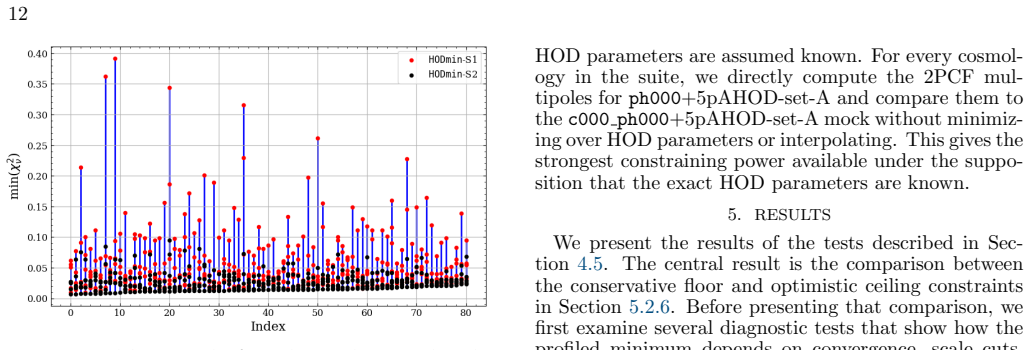
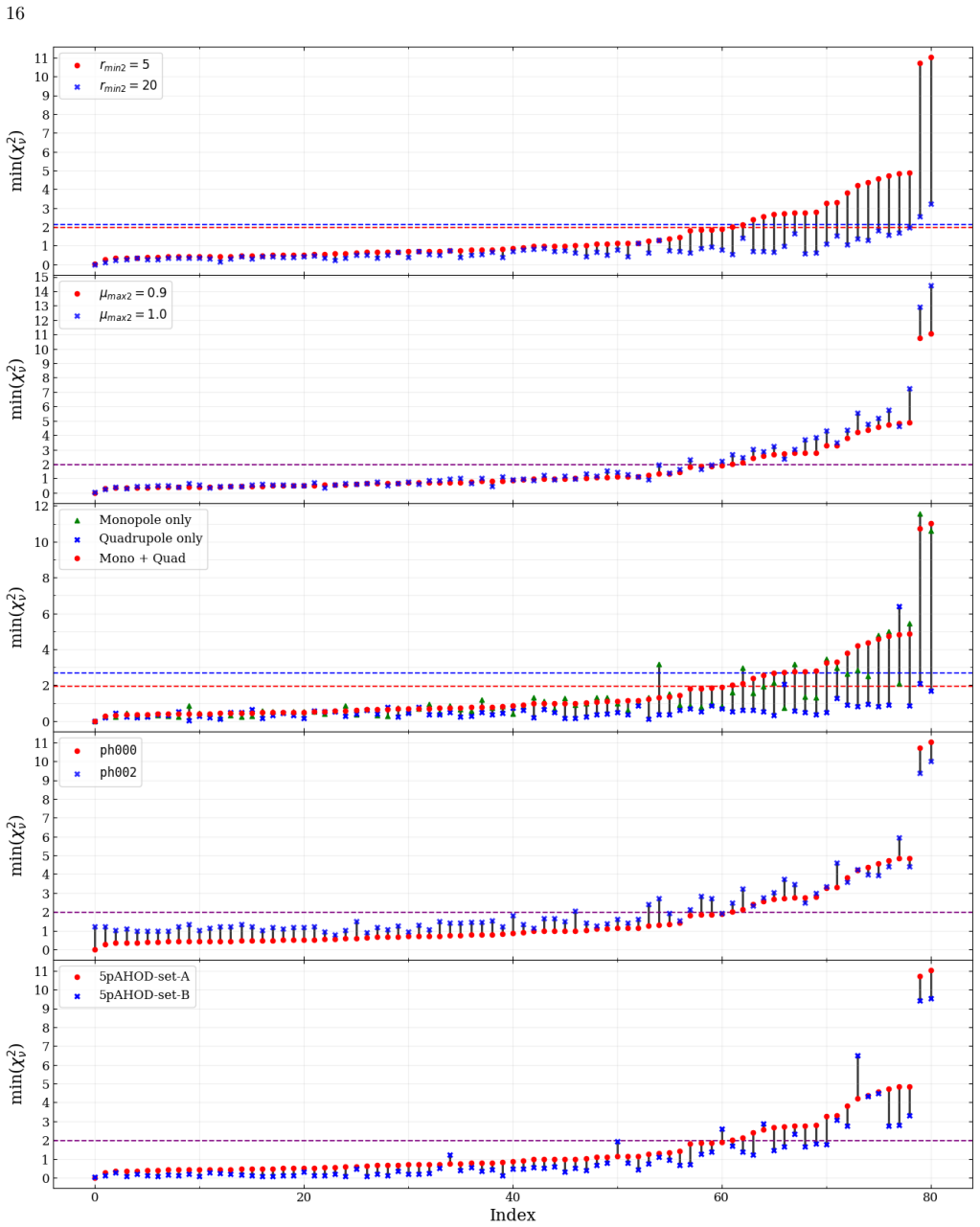
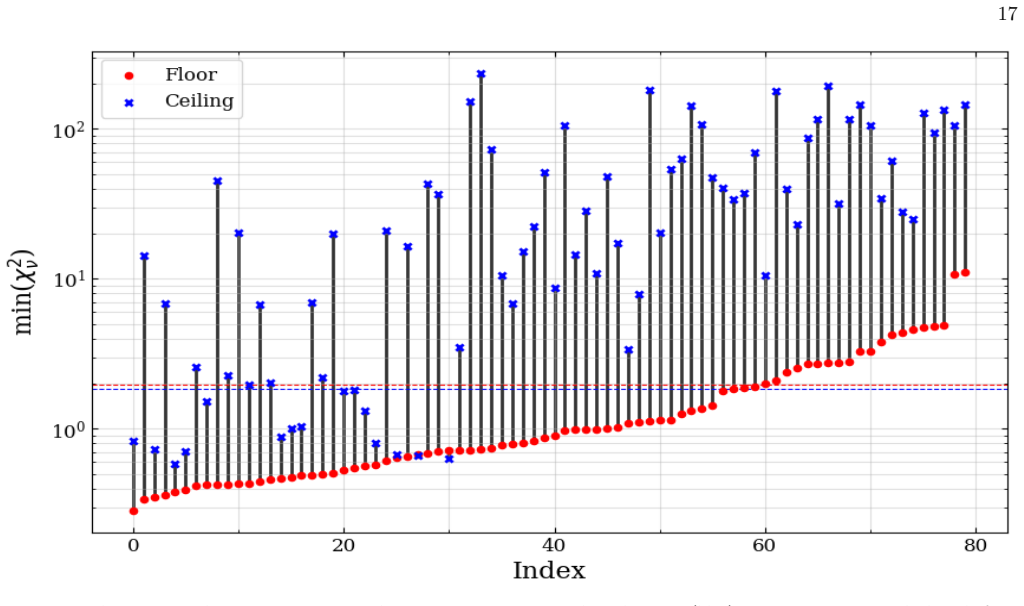
When the HOD parameters are profiled over with broad bounds, only 25 percent of the tested AbacusSummit cosmologies are excluded at 3 sigma by the Planck LCDM data vector; when the same parameters are fixed exactly, 81 percent are excluded.
What carries the argument
The floor treatment, which minimizes chi-squared over the five HOD parameters after imposing only broad initial bounds, versus the ceiling treatment that holds those parameters fixed.
If this is right
- Under conservative HOD assumptions many more cosmologies remain consistent with the data than under optimistic assumptions.
- The difference persists across variations in scale cuts, multipole inclusion, and mock phase.
- Strong small-scale clustering constraints require informative priors on the galaxy-halo connection.
- The same data vector can produce chi-squared values that differ by multiple orders of magnitude depending on the HOD treatment.
Where Pith is reading between the lines
- Analyses that aim to use small scales for cosmology will need independent constraints on HOD parameters or joint modeling that marginalizes them properly.
- If the true galaxy-halo relation varies with cosmology, even the floor case may overestimate the available constraining power.
- Combining small-scale clustering with other observables that help pin down HOD parameters could close the gap between the floor and ceiling results.
Load-bearing premise
The standard five-parameter HOD model with broad initial bounds is flexible enough to represent the true minimum information extractable from the clustering data.
What would settle it
Direct evidence that the galaxy-halo connection requires more than five parameters or depends on cosmology would mean the floor case no longer gives the actual minimum constraining power.
Figures
read the original abstract
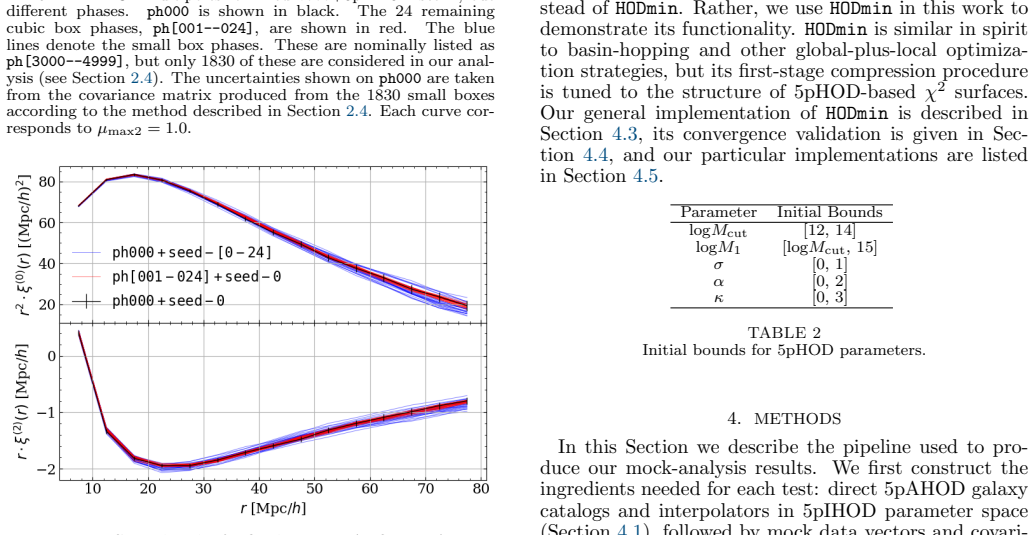
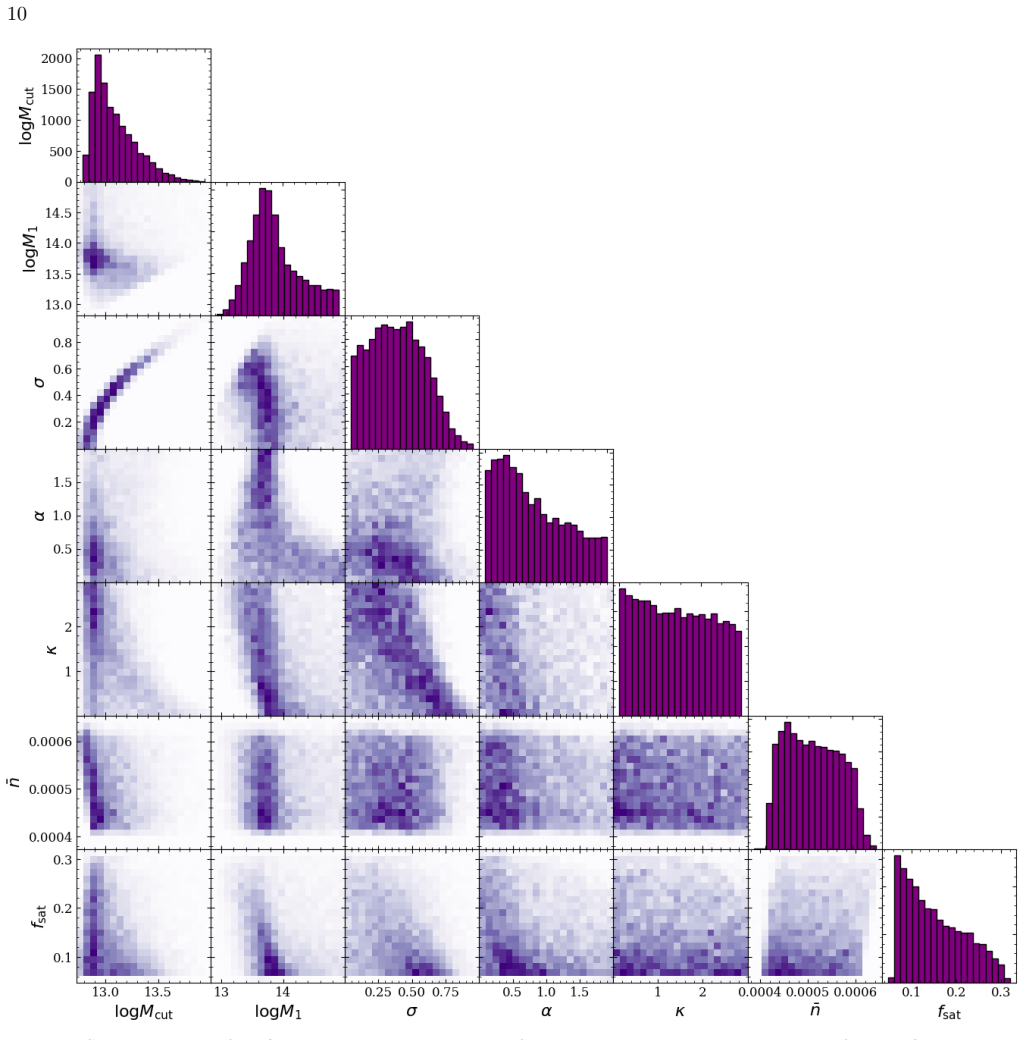
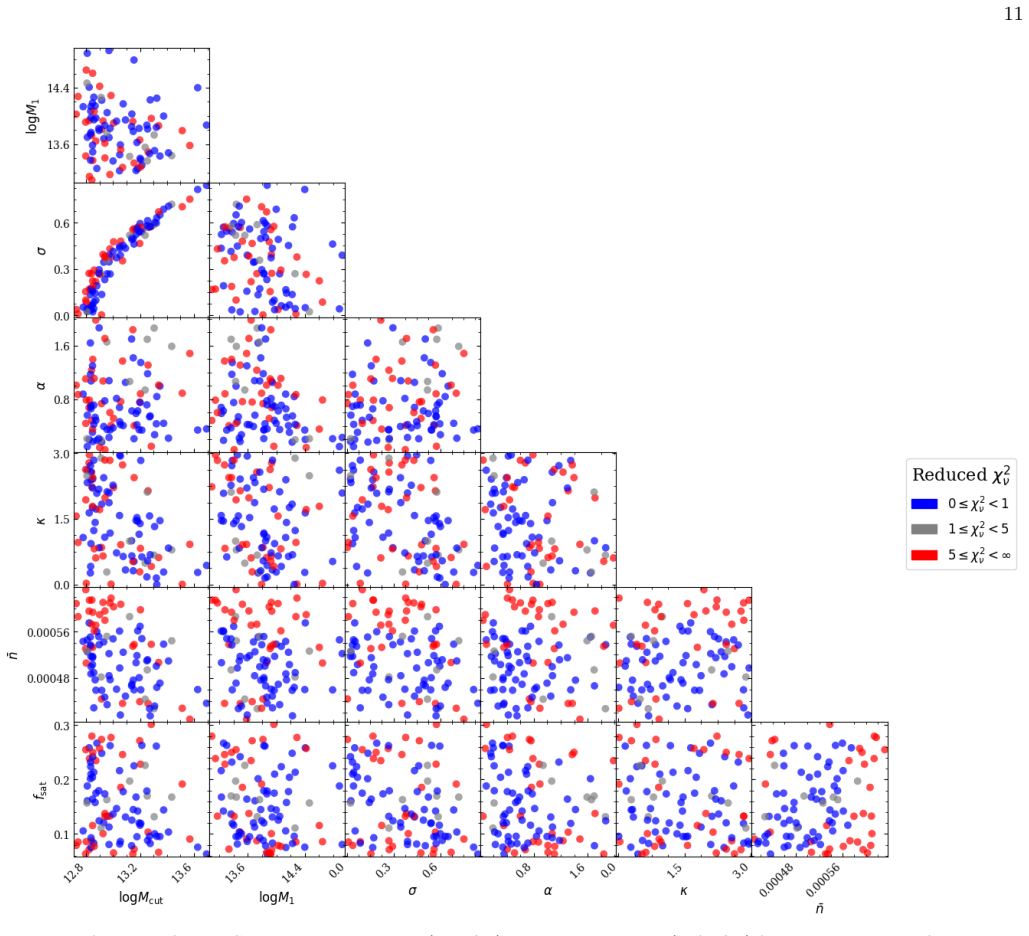
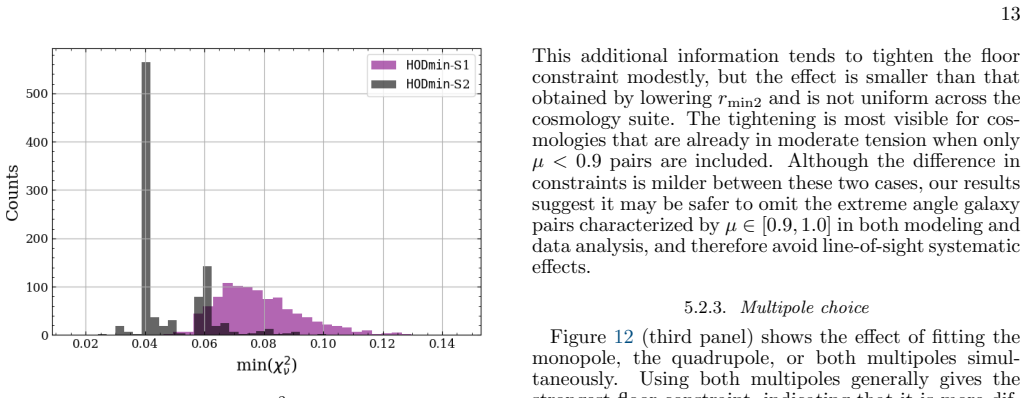
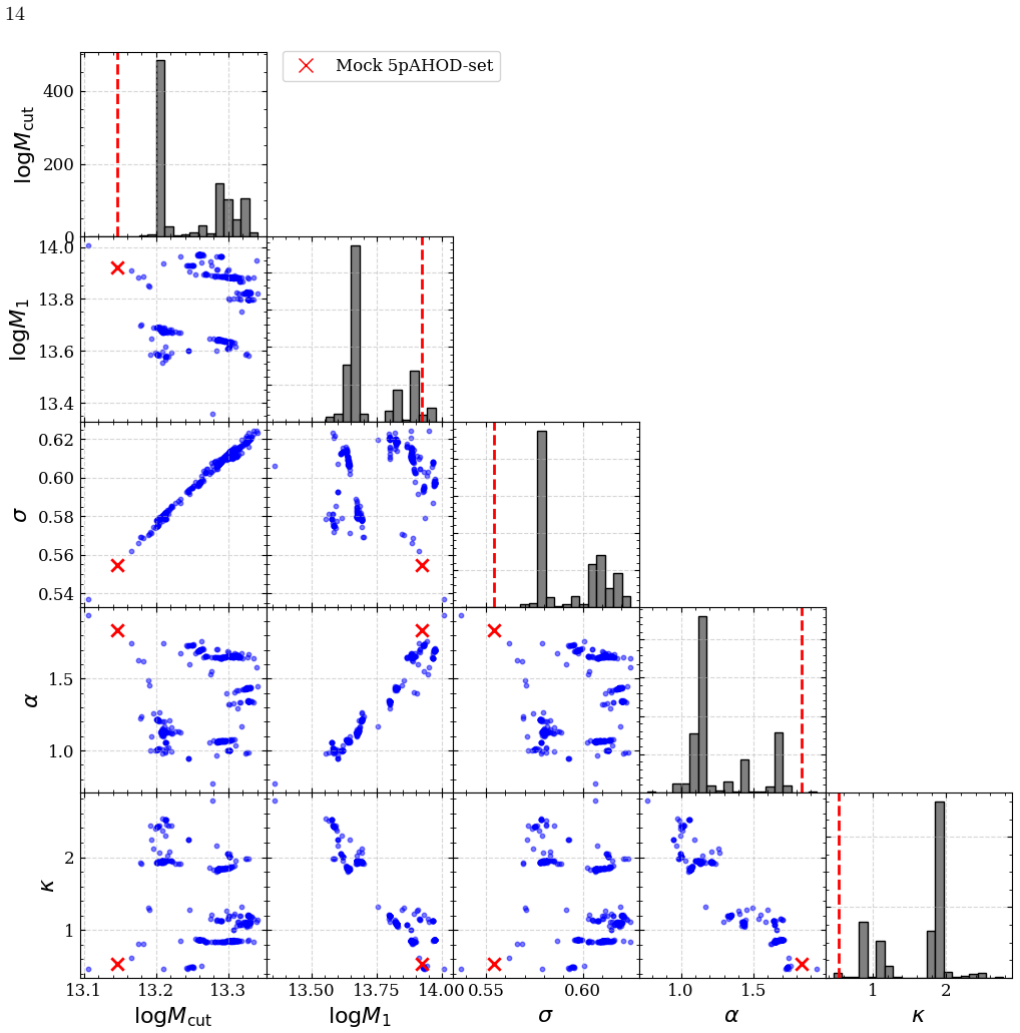
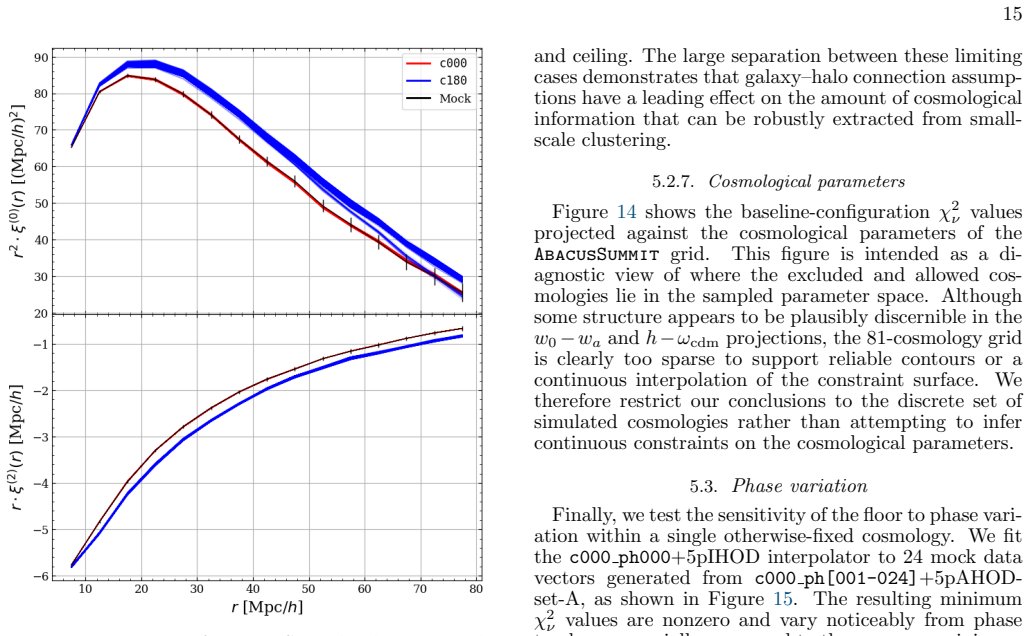
Small-scale galaxy clustering is expected to contain substantial cosmological information, but the extent to which this information constrains halo-based cosmologies independent of an assumed galaxy--halo connection remains unclear. We quantify this dependence using LRG-like mock galaxy catalogs built from 81 cosmologies in the {\tt \textsc{AbacusSummit}} suite. We analyze two-point correlation function multipoles on scales ranging from $5$--$80$ Mpc/$h$ and compare two limiting treatments, the \enquote{floor} and \enquote{ceiling}, of the standard five-parameter HOD model. In the conservative floor case, we impose only broad initial HOD bounds and profile over HOD parameters to determine the minimum constraining power available; we accomplish this with {\tt HODmin}, a two-stage global optimization algorithm written for minimizing $\chi^2$ in HOD space. In the optimistic ceiling case, we assume the HOD parameters are known exactly. We find a significant difference between the floor and ceiling when comparing against the same Planck $\Lambda$CDM mock data vector with identical modeling assumptions: for the floor, $25\%$ of the discrete {\tt \textsc{AbacusSummit}} cosmologies tested are excluded at $3\sigma$, whereas for the ceiling, $\sim81\%$ are excluded. Many cosmologies agree well with data in the floor, and yet in the ceiling are excluded by multiple orders of magnitude in $\chi^2$. We therefore observe the strength of small-scale clustering constraints depends heavily on the amount of prior HOD information assumed. We compare the sensitivity of this effect to various choices like scale cut, angle cut, multipole inclusion, mock phase, and mock HOD model. Our wide floor--ceiling bracket indicates that informative galaxy--halo priors are necessary for extracting strong small-scale clustering constraints.
Editorial analysis
A structured set of objections, weighed in public.
Referee Report
Summary. The paper analyzes small-scale galaxy clustering using LRG-like mocks from 81 AbacusSummit cosmologies. It compares two-point correlation function multipoles (5--80 Mpc/h) against a fixed Planck ΛCDM data vector under two limiting treatments of the standard five-parameter HOD model: a conservative 'floor' case that profiles over HOD parameters with broad initial bounds via a new two-stage optimizer (HODmin) to find minimum χ², and an optimistic 'ceiling' case that fixes the HOD parameters exactly. The central result is that 25% of the tested cosmologies are excluded at 3σ in the floor case versus ∼81% in the ceiling case, with many cosmologies fitting well under the floor but excluded by orders of magnitude under the ceiling. Sensitivity tests to scale cuts, multipoles, and mock choices are reported, leading to the conclusion that small-scale clustering constraints depend strongly on the amount of prior HOD information assumed.
Significance. If the central result holds, the work provides a concrete, quantitative demonstration that the cosmological information extractable from small-scale clustering is highly sensitive to galaxy--halo connection assumptions, using independent external mocks and a fixed reference data vector for a clean floor--ceiling bracket. The explicit exclusion fractions (25% vs. ∼81%) and reported sensitivity tests supply falsifiable benchmarks for future analyses. This highlights the practical necessity of informative HOD priors and supplies a methodological template (HODmin) for profiling over nuisance parameters in similar settings.
major comments (2)
- [Methods, HODmin optimizer] Methods, HODmin optimizer: The two-stage global optimization algorithm is load-bearing for the floor case χ² values that determine the 25% exclusion fraction, yet no validation (e.g., recovery of known minima on test functions, multiple random starts, or comparison to alternative minimizers) is described; without this, it is unclear whether the reported minima are reliably global or whether local minima inflate the floor χ² and thereby understate the exclusion rate.
- [HOD model description and floor definition] HOD model description and floor definition: The claim that the five-parameter HOD with broad initial bounds implements the 'minimum constraining power available' assumes this functional form spans all relevant galaxy--halo degrees of freedom. If the true connection requires additional parameters (assembly bias, velocity bias, or cosmology dependence) outside the five-parameter family, the profiled floor χ² values would be higher than the true minimum, so the reported 25% exclusion fraction would overstate the conservative limit and the floor--ceiling difference would not fully bracket the dependence on prior information.
Simulated Author's Rebuttal
We thank the referee for their constructive and detailed comments, which help clarify the scope and robustness of our results. We respond to each major comment below.
read point-by-point responses
-
Referee: [Methods, HODmin optimizer] The two-stage global optimization algorithm is load-bearing for the floor case χ² values that determine the 25% exclusion fraction, yet no validation (e.g., recovery of known minima on test functions, multiple random starts, or comparison to alternative minimizers) is described; without this, it is unclear whether the reported minima are reliably global or whether local minima inflate the floor χ² and thereby understate the exclusion rate.
Authors: We agree that validation of HODmin is essential to establish that the reported minima are global. In the revised manuscript we will add a dedicated subsection on optimizer validation. This will include: (i) recovery of known analytic minima on standard test functions, (ii) results from 50 independent random initializations per cosmology showing convergence to the same minimum within numerical tolerance, and (iii) direct comparison of HODmin results against scipy.optimize.differential_evolution on a subset of cosmologies. These tests will confirm that local minima do not inflate the floor χ² values. revision: yes
-
Referee: [HOD model description and floor definition] The claim that the five-parameter HOD with broad initial bounds implements the 'minimum constraining power available' assumes this functional form spans all relevant galaxy--halo degrees of freedom. If the true connection requires additional parameters (assembly bias, velocity bias, or cosmology dependence) outside the five-parameter family, the profiled floor χ² values would be higher than the true minimum, so the reported 25% exclusion fraction would overstate the conservative limit and the floor--ceiling difference would not fully bracket the dependence on prior information.
Authors: We thank the referee for this important qualification. Our floor is defined strictly as the minimum χ² attainable by profiling over the standard five-parameter HOD with broad initial bounds; it is therefore the minimum within that model family. We agree that if the true galaxy-halo connection requires additional parameters (assembly bias, velocity bias, or explicit cosmology dependence), the true minimum could be lower still. We will revise the text to state explicitly that the reported 25% exclusion fraction is the conservative limit within the five-parameter HOD, and we will add a short discussion of how extra degrees of freedom would further reduce the exclusion rate. This framing preserves the floor-ceiling bracket as a demonstration of sensitivity to HOD prior information while acknowledging the model limitation. revision: partial
Circularity Check
No circularity; central result from direct comparison on independent mocks
full rationale
The paper computes exclusion fractions (25% floor vs ~81% ceiling at 3σ) by comparing each of 81 AbacusSummit cosmologies to a fixed Planck ΛCDM mock data vector, profiling HOD parameters in the floor case via the HODmin optimizer to obtain minimum χ² values. These fractions are measured outputs of the χ² comparisons on external realizations rather than quantities defined by the HOD fits themselves. No self-definitional steps, fitted inputs renamed as predictions, or load-bearing self-citations appear in the derivation chain; the floor/ceiling bracket is a direct empirical measurement under stated modeling assumptions.
Axiom & Free-Parameter Ledger
free parameters (1)
- five HOD parameters
axioms (2)
- domain assumption The five-parameter HOD model is an adequate description of the galaxy-halo connection across the tested cosmologies
- domain assumption AbacusSummit mocks accurately represent the clustering signal for LRG-like galaxies in each cosmology
Reference graph
Works this paper leans on
-
[1]
Detection of the Baryon Acoustic Peak in the Large-Scale Correlation Function of SDSS Luminous Red Galaxies. , keywords =. doi:10.1086/466512 , archivePrefix =. astro-ph/0501171 , primaryClass =
work page internal anchor Pith review Pith/arXiv arXiv doi:10.1086/466512
-
[2]
DESI DR2 results. II. Measurements of baryon acoustic oscillations and cosmological constraints. , keywords =. doi:10.1103/tr6y-kpc6 , archivePrefix =. 2503.14738 , primaryClass =
work page internal anchor Pith review Pith/arXiv arXiv doi:10.1103/tr6y-kpc6
-
[3]
Stringent _ 8 constraints from small-scale galaxy clustering using a hybrid MCMC + emulator framework. , keywords =. doi:10.1093/mnras/stac1830 , archivePrefix =. 2203.11963 , primaryClass =
-
[4]
Modelling galaxy clustering on small scales to tighten constraints on dark energy and modified gravity. , keywords =. doi:10.1093/mnras/stw2602 , archivePrefix =. 1606.08054 , primaryClass =
work page internal anchor Pith review Pith/arXiv arXiv doi:10.1093/mnras/stw2602
-
[5]
DESI 2024 V: Full-Shape Galaxy Clustering from Galaxies and Quasars
DESI 2024 V: Full-Shape galaxy clustering from galaxies and quasars. , keywords =. doi:10.1088/1475-7516/2025/09/008 , archivePrefix =. 2411.12021 , primaryClass =
work page internal anchor Pith review Pith/arXiv arXiv doi:10.1088/1475-7516/2025/09/008 2024
-
[6]
Validation of the Scientific Program for the Dark Energy Spectroscopic Instrument. , keywords =. doi:10.3847/1538-3881/ad0b08 , archivePrefix =. 2306.06307 , primaryClass =
-
[7]
Cosmological Fisher forecasts for next-generation spectroscopic surveys. , keywords =. doi:10.1093/mnras/stad611 , archivePrefix =. 2301.02289 , primaryClass =
-
[8]
DESI 2024 VII: Cosmological Constraints from the Full-Shape Modeling of Clustering Measurements
DESI 2024 VII: cosmological constraints from the full-shape modeling of clustering measurements. , keywords =. doi:10.1088/1475-7516/2025/07/028 , archivePrefix =. 2411.12022 , primaryClass =
work page internal anchor Pith review Pith/arXiv arXiv doi:10.1088/1475-7516/2025/07/028 2024
-
[9]
DESI 2024 VI: Cosmological Constraints from the Measurements of Baryon Acoustic Oscillations
DESI 2024 VI: cosmological constraints from the measurements of baryon acoustic oscillations. , keywords =. doi:10.1088/1475-7516/2025/02/021 , archivePrefix =. 2404.03002 , primaryClass =
work page internal anchor Pith review Pith/arXiv arXiv doi:10.1088/1475-7516/2025/02/021 2024
-
[10]
Selecting samples of galaxies with fewer Fingers-of-God. , keywords =. doi:10.1088/1475-7516/2025/07/014 , archivePrefix =. 2501.10587 , primaryClass =
-
[11]
ABACUSHOD: a highly efficient extended multitracer HOD framework and its application to BOSS and eBOSS data. , keywords =. doi:10.1093/mnras/stab3355 , archivePrefix =. 2110.11412 , primaryClass =
-
[12]
Five per cent measurements of the growth rate from simulation-based modelling of redshift-space clustering in BOSS LOWZ. , keywords =. doi:10.1093/mnras/stab3111 , archivePrefix =. 2101.12261 , primaryClass =
-
[13]
The MegaMapper: A Stage-5 Spectroscopic Instrument Concept for the Study of Inflation and Dark Energy. arXiv e-prints , keywords =. doi:10.48550/arXiv.2209.04322 , archivePrefix =. 2209.04322 , primaryClass =
-
[14]
MUltiplexed Survey Telescope (MUST) Science White Paper I: Overview of Large-Scale Structure Cosmology in the Era of Stage-V Spectroscopic Surveys. arXiv e-prints , keywords =. doi:10.48550/arXiv.2411.07970 , archivePrefix =. 2411.07970 , primaryClass =
work page internal anchor Pith review Pith/arXiv arXiv doi:10.48550/arxiv.2411.07970
-
[15]
Astronomische Nachrichten , keywords =
The Maunakea Spectroscopic Explorer: Thousands of fibers, infinite possibilities. Astronomische Nachrichten , keywords =. doi:10.1002/asna.20230108 , archivePrefix =. 2307.07667 , primaryClass =
-
[16]
WST -- Widefield Spectroscopic Telescope: Motivation, science drivers and top-level requirements for a new dedicated facility. arXiv e-prints , keywords =. doi:10.48550/arXiv.2405.12518 , archivePrefix =. 2405.12518 , primaryClass =
-
[17]
Optimizing Roman survey design for CMB cross-correlation science
Cosmology from weak lensing, galaxy clustering, CMB lensing and tSZ: II. Optimizing Roman survey design for CMB cross-correlation science. arXiv e-prints , keywords =. doi:10.48550/arXiv.2411.04088 , archivePrefix =. 2411.04088 , primaryClass =
-
[18]
Euclid: The importance of galaxy clustering and weak lensing cross-correlations within the photometric Euclid survey. , keywords =. doi:10.1051/0004-6361/202038313 , archivePrefix =. 2005.00055 , primaryClass =
-
[19]
The Spectroscopic Stage-5 Experiment. arXiv e-prints , keywords =. doi:10.48550/arXiv.2503.07923 , archivePrefix =. 2503.07923 , primaryClass =
-
[20]
Interpreting large-scale redshift-space distortion measurements. , keywords =. doi:10.1111/j.1365-2966.2011.20169.x , archivePrefix =. 1102.1014 , primaryClass =
-
[21]
Effective Field Theory for Large Scale Structure. arXiv e-prints , keywords =. doi:10.48550/arXiv.2212.08488 , archivePrefix =. 2212.08488 , primaryClass =
-
[22]
Inhomogeneous cosmology and backreaction: Current status and future prospects
Inhomogeneous cosmology and backreaction: Current status and future prospects. International Journal of Modern Physics D , keywords =. doi:10.1142/S0218271817300117 , archivePrefix =. 1612.08222 , primaryClass =
work page internal anchor Pith review Pith/arXiv arXiv doi:10.1142/s0218271817300117
-
[23]
Is there proof that backreaction of inhomogeneities is irrelevant in cosmology?
Is there proof that backreaction of inhomogeneities is irrelevant in cosmology?. Classical and Quantum Gravity , keywords =. doi:10.1088/0264-9381/32/21/215021 , archivePrefix =. 1505.07800 , primaryClass =
work page internal anchor Pith review Pith/arXiv arXiv doi:10.1088/0264-9381/32/21/215021
-
[24]
Frontiers in Astronomy and Space Sciences , keywords =
Backreaction in Cosmology. Frontiers in Astronomy and Space Sciences , keywords =. doi:10.3389/fspas.2021.692198 , archivePrefix =. 2106.06043 , primaryClass =
-
[25]
ABACUSSUMMIT: a massive set of high-accuracy, high-resolution N-body simulations. , keywords =. doi:10.1093/mnras/stab2484 , archivePrefix =. 2110.11398 , primaryClass =
-
[26]
The AEMULUS Project. I. Numerical Simulations for Precision Cosmology. , keywords =. doi:10.3847/1538-4357/ab1085 , archivePrefix =. 1804.05865 , primaryClass =
work page internal anchor Pith review Pith/arXiv arXiv doi:10.3847/1538-4357/ab1085
-
[27]
Tests of redshift-space distortions models in configuration space for the analysis of the BOSS final data release. , keywords =. doi:10.1093/mnras/stu2460 , archivePrefix =. 1408.5435 , primaryClass =
work page internal anchor Pith review Pith/arXiv arXiv doi:10.1093/mnras/stu2460
-
[28]
A rigorous EFT-based forward model for large-scale structure
A rigorous EFT-based forward model for large-scale structure. , keywords =. doi:10.1088/1475-7516/2019/01/042 , archivePrefix =. 1808.02002 , primaryClass =
work page internal anchor Pith review Pith/arXiv arXiv doi:10.1088/1475-7516/2019/01/042 2019
-
[29]
Bayesian and frequentist investigation of prior effects in EFT of LSS analyses of full-shape BOSS and eBOSS data. , keywords =. doi:10.1103/PhysRevD.108.123514 , archivePrefix =. 2309.04468 , primaryClass =
-
[30]
Frequentist Cosmological Constraints from Full-Shape Clustering Measurements in DESI DR1. arXiv e-prints , keywords =. doi:10.48550/arXiv.2508.11811 , archivePrefix =. 2508.11811 , primaryClass =
-
[31]
Galaxy Evolution from Halo Occupation Distribution Modeling of DEEP2 and SDSS Galaxy Clustering
Galaxy Evolution from Halo Occupation Distribution Modeling of DEEP2 and SDSS Galaxy Clustering. , keywords =. doi:10.1086/521074 , archivePrefix =. astro-ph/0703457 , primaryClass =
work page internal anchor Pith review Pith/arXiv arXiv doi:10.1086/521074
-
[32]
Multitracer extension of the halo model: probing quenching and conformity in eBOSS. , keywords =. doi:10.1093/mnras/staa1956 , archivePrefix =. 1910.05095 , primaryClass =
-
[33]
Evidence for galaxy assembly bias in BOSS CMASS redshift-space galaxy correlation function. , keywords =. doi:10.1093/mnras/stab235 , archivePrefix =. 2010.04182 , primaryClass =
-
[34]
The DESI one-per cent survey: exploring the halo occupation distribution of luminous red galaxies and quasi-stellar objects with ABACUSSUMMIT. , keywords =. doi:10.1093/mnras/stae359 , archivePrefix =. 2306.06314 , primaryClass =
-
[35]
DESI luminous red galaxy samples for cross-correlations. , keywords =. doi:10.1088/1475-7516/2023/11/097 , archivePrefix =. 2309.06443 , primaryClass =
-
[36]
Annals of Physics , keywords =
Comparing <mml:math><mml:mrow><mml:mi> </mml:mi><mml:mi>CDM</mml:mi></mml:mrow></mml:math>, <mml:math><mml:mrow><mml:mi> </mml:mi><mml:mi>CDM</mml:mi></mml:mrow></mml:math>, and <mml:math><mml:mrow><mml:msub><mml:mrow><mml:mi> </mml:mi></mml:mrow><mml:mrow><mml:mn>0</mml:mn></mml:mrow></mml:msub><mml:msub><mml:mrow><mml:mi> </mml:mi></mml:mrow><mml:mrow><...
-
[37]
Planck 2018 results. VI. Cosmological parameters. , keywords =. doi:10.1051/0004-6361/201833910 , archivePrefix =. 1807.06209 , primaryClass =
work page internal anchor Pith review Pith/arXiv arXiv doi:10.1051/0004-6361/201833910 2018
-
[38]
The High Latitude Spectroscopic Survey on the Nancy Grace Roman Space Telescope. , keywords =. doi:10.3847/1538-4357/ac4973 , archivePrefix =. 2110.01829 , primaryClass =
-
[39]
Euclid Definition Study Report
Euclid Definition Study Report. arXiv e-prints , keywords =. doi:10.48550/arXiv.1110.3193 , archivePrefix =. 1110.3193 , primaryClass =
work page internal anchor Pith review Pith/arXiv arXiv doi:10.48550/arxiv.1110.3193
-
[40]
Overview of the Euclid mission
Euclid: I. Overview of the Euclid mission. , keywords =. doi:10.1051/0004-6361/202450810 , archivePrefix =. 2405.13491 , primaryClass =
-
[41]
Clustering in real space and in redshift space. , keywords =. doi:10.1093/mnras/227.1.1 , adsurl =
-
[42]
Linear Redshift Distortions: A Review
Linear Redshift Distortions: a Review. The Evolving Universe , year = 1998, editor =. doi:10.1007/978-94-011-4960-0_17 , archivePrefix =. astro-ph/9708102 , primaryClass =
work page internal anchor Pith review Pith/arXiv arXiv doi:10.1007/978-94-011-4960-0_17 1998
-
[43]
Redshift-Space Distortions, Pairwise Velocities and Nonlinearities
Redshift-space distortions, pairwise velocities, and nonlinearities. , keywords =. doi:10.1103/PhysRevD.70.083007 , archivePrefix =. astro-ph/0407214 , primaryClass =
work page internal anchor Pith review Pith/arXiv arXiv doi:10.1103/physrevd.70.083007
-
[44]
Testing cosmological structure formation using redshift-space distortions. , keywords =. doi:10.1111/j.1365-2966.2008.14211.x , archivePrefix =. 0808.0003 , primaryClass =
-
[45]
On average properties of inhomogeneous fluids in general relativity I: dust cosmologies
On Average Properties of Inhomogeneous Fluids in General Relativity: Dust Cosmologies. General Relativity and Gravitation , keywords =. doi:10.1023/A:1001800617177 , archivePrefix =. gr-qc/9906015 , primaryClass =
work page internal anchor Pith review Pith/arXiv arXiv doi:10.1023/a:1001800617177
-
[46]
Backreaction of inhomogeneities on the expansion: the evolution of cosmological parameters
Back reaction of inhomogeneities on the expansion: The evolution of cosmological parameters. , keywords =. doi:10.1103/PhysRevD.62.043525 , archivePrefix =. astro-ph/9912347 , primaryClass =
work page internal anchor Pith review Pith/arXiv arXiv doi:10.1103/physrevd.62.043525
-
[47]
Dark energy from back-reaction. , keywords =. doi:10.1088/1475-7516/2004/02/003 , archivePrefix =. astro-ph/0311257 , primaryClass =
work page internal anchor Pith review Pith/arXiv arXiv doi:10.1088/1475-7516/2004/02/003 2004
-
[48]
Accelerated expansion from structure formation
Accelerated expansion from structure formation. , keywords =. doi:10.1088/1475-7516/2006/11/003 , archivePrefix =. astro-ph/0607626 , primaryClass =
work page internal anchor Pith review Pith/arXiv arXiv doi:10.1088/1475-7516/2006/11/003 2006
-
[49]
On cosmic acceleration without dark energy
On cosmic acceleration without dark energy. New Journal of Physics , keywords =. doi:10.1088/1367-2630/8/12/322 , archivePrefix =. astro-ph/0506534 , primaryClass =
work page internal anchor Pith review Pith/arXiv arXiv doi:10.1088/1367-2630/8/12/322
-
[50]
Exact solution to the averaging problem in cosmology
Exact Solution to the Averaging Problem in Cosmology. , keywords =. doi:10.1103/PhysRevLett.99.251101 , archivePrefix =. 0709.0732 , primaryClass =
work page internal anchor Pith review Pith/arXiv arXiv doi:10.1103/physrevlett.99.251101
-
[51]
Does the growth of structure affect our dynamical models of the Universe? The averaging, backreaction, and fitting problems in cosmology. Reports on Progress in Physics , keywords =. doi:10.1088/0034-4885/74/11/112901 , archivePrefix =. 1109.2314 , primaryClass =
work page internal anchor Pith review Pith/arXiv arXiv doi:10.1088/0034-4885/74/11/112901
-
[52]
Annual Review of Nuclear and Particle Science , keywords =
Backreaction in Late-Time Cosmology. Annual Review of Nuclear and Particle Science , keywords =. doi:10.1146/annurev.nucl.012809.104435 , archivePrefix =. 1112.5335 , primaryClass =
-
[53]
Dark Energy from structure: a status report
Dark Energy from structure: a status report. General Relativity and Gravitation , keywords =. doi:10.1007/s10714-007-0554-8 , archivePrefix =. 0707.2153 , primaryClass =
work page internal anchor Pith review Pith/arXiv arXiv doi:10.1007/s10714-007-0554-8
-
[54]
Can the Acceleration of Our Universe Be Explained by the Effects of Inhomogeneities?
Can the acceleration of our universe be explained by the effects of inhomogeneities?. Classical and Quantum Gravity , keywords =. doi:10.1088/0264-9381/23/1/012 , archivePrefix =. gr-qc/0509108 , primaryClass =
work page internal anchor Pith review Pith/arXiv arXiv doi:10.1088/0264-9381/23/1/012
-
[55]
A new framework for analyzing the effects of small scale inhomogeneities in cosmology
New framework for analyzing the effects of small scale inhomogeneities in cosmology. , keywords =. doi:10.1103/PhysRevD.83.084020 , archivePrefix =. 1011.4920 , primaryClass =
work page internal anchor Pith review Pith/arXiv arXiv doi:10.1103/physrevd.83.084020
-
[56]
Examples of backreaction of small scale inhomogeneities in cosmology
Examples of backreaction of small-scale inhomogeneities in cosmology. , keywords =. doi:10.1103/PhysRevD.87.124037 , archivePrefix =. 1304.2318 , primaryClass =
work page internal anchor Pith review Pith/arXiv arXiv doi:10.1103/physrevd.87.124037
-
[57]
How well is our universe described by an FLRW model?
How well is our Universe described by an FLRW model?. Classical and Quantum Gravity , keywords =. doi:10.1088/0264-9381/31/23/234003 , archivePrefix =. 1407.8084 , primaryClass =
work page internal anchor Pith review Pith/arXiv arXiv doi:10.1088/0264-9381/31/23/234003
-
[58]
Cosmology with the EFTofLSS and BOSS: dark energy constraints and a note on priors. , keywords =. doi:10.1088/1475-7516/2023/01/028 , archivePrefix =. 2207.14784 , primaryClass =
-
[59]
Consistency of effective field theory analyses of the BOSS power spectrum. , keywords =. doi:10.1103/PhysRevD.107.123530 , archivePrefix =. 2208.05929 , primaryClass =
-
[60]
Mapping the galaxy-halo connection to the galaxy bias: implication to the HOD-informed prior. arXiv e-prints , keywords =. doi:10.48550/arXiv.2410.08998 , archivePrefix =. 2410.08998 , primaryClass =
-
[61]
Fast test to assess the impact of marginalization in Monte Carlo analyses and its application to cosmology. , keywords =. doi:10.1103/PhysRevD.106.063506 , archivePrefix =. 2203.16285 , primaryClass =
-
[62]
Analysis of unified galaxy power spectrum multipole measurements. , keywords =. doi:10.1093/mnras/stad2957 , archivePrefix =. 2307.07475 , primaryClass =
-
[63]
The Open Journal of Astrophysics , keywords =
Cosmology with 6 parameters in the Stage-IV era: efficient marginalisation over nuisance parameters. The Open Journal of Astrophysics , keywords =. doi:10.21105/astro.2301.11895 , archivePrefix =. 2301.11895 , primaryClass =
-
[64]
Cosmological constraints on early dark energy from the full shape analysis of eBOSS DR16. , keywords =. doi:10.1093/mnras/stae992 , archivePrefix =. 2312.01977 , primaryClass =
-
[65]
Full-shape analysis with simulation-based priors: Constraints on single field inflation from BOSS. , keywords =. doi:10.1103/PhysRevD.110.063538 , archivePrefix =. 2402.13310 , primaryClass =
-
[66]
HOD-informed prior for EFT-based full-shape analyses of LSS. , keywords =. doi:10.1088/1475-7516/2025/04/041 , archivePrefix =. 2409.12937 , primaryClass =
-
[67]
Accelerating Universes with Scaling Dark Matter
Accelerating Universes with Scaling Dark Matter. International Journal of Modern Physics D , keywords =. doi:10.1142/S0218271801000822 , archivePrefix =. gr-qc/0009008 , primaryClass =
work page internal anchor Pith review Pith/arXiv arXiv doi:10.1142/s0218271801000822
-
[68]
Exploring the Expansion History of the Universe
Exploring the Expansion History of the Universe. , keywords =. doi:10.1103/PhysRevLett.90.091301 , archivePrefix =. astro-ph/0208512 , primaryClass =
work page internal anchor Pith review Pith/arXiv arXiv doi:10.1103/physrevlett.90.091301
-
[69]
Report of the Dark Energy Task Force
Report of the Dark Energy Task Force. arXiv e-prints , keywords =. doi:10.48550/arXiv.astro-ph/0609591 , archivePrefix =. astro-ph/0609591 , primaryClass =
work page internal anchor Pith review Pith/arXiv arXiv doi:10.48550/arxiv.astro-ph/0609591
-
[70]
Limits of Quintessence. , keywords =. doi:10.1103/PhysRevLett.95.141301 , archivePrefix =. astro-ph/0505494 , primaryClass =
work page internal anchor Pith review Pith/arXiv arXiv doi:10.1103/physrevlett.95.141301
-
[71]
Mapping the Chevallier-Polarski-Linder parametrization onto Physical Dark Energy Models
Mapping the Chevallier-Polarski-Linder parametrization onto physical dark energy Models. , keywords =. doi:10.1103/PhysRevD.92.043001 , archivePrefix =. 1505.05781 , primaryClass =
work page internal anchor Pith review Pith/arXiv arXiv doi:10.1103/physrevd.92.043001
-
[72]
Figure of Merit for Dark Energy Constraints from Current Observational Data
Figure of merit for dark energy constraints from current observational data. , keywords =. doi:10.1103/PhysRevD.77.123525 , archivePrefix =. 0803.4295 , primaryClass =
work page internal anchor Pith review Pith/arXiv arXiv doi:10.1103/physrevd.77.123525
-
[73]
Velocity Bias from the Small Scale Clustering of SDSS-III BOSS Galaxies
Velocity bias from the small-scale clustering of SDSS-III BOSS galaxies. , keywords =. doi:10.1093/mnras/stu2120 , archivePrefix =. 1407.4811 , primaryClass =
work page internal anchor Pith review Pith/arXiv arXiv doi:10.1093/mnras/stu2120
-
[74]
Exploring the squeezed three-point galaxy correlation function with generalized halo occupation distribution models. , keywords =. doi:10.1093/mnras/sty1089 , archivePrefix =. 1802.10115 , primaryClass =
work page internal anchor Pith review Pith/arXiv arXiv doi:10.1093/mnras/sty1089
-
[75]
CORRFUNC - a suite of blazing fast correlation functions on the CPU. , keywords =. doi:10.1093/mnras/stz3157 , archivePrefix =. 1911.03545 , primaryClass =
-
[76]
A New Method to Correct for Fiber Collisions in Galaxy Two-Point Statistics
A New Method to Correct for Fiber Collisions in Galaxy Two-point Statistics. , keywords =. doi:10.1088/0004-637X/756/2/127 , archivePrefix =. 1111.6598 , primaryClass =
work page internal anchor Pith review Pith/arXiv arXiv doi:10.1088/0004-637x/756/2/127
-
[77]
The Effect of Fiber Collisions on the Galaxy Power Spectrum Multipole
The Effect of Fiber Collisions on the Galaxy Power Spectrum Multipoles. , keywords =. doi:10.1093/mnras/stx185 , archivePrefix =. 1609.01714 , primaryClass =
work page internal anchor Pith review Pith/arXiv arXiv doi:10.1093/mnras/stx185
-
[78]
Unbiased clustering estimation in the presence of missing observations
Unbiased clustering estimation in the presence of missing observations. , keywords =. doi:10.1093/mnras/stx2053 , archivePrefix =. 1703.02070 , primaryClass =
work page internal anchor Pith review Pith/arXiv arXiv doi:10.1093/mnras/stx2053
-
[79]
The completed SDSS-IV extended baryon oscillation spectroscopic survey: pairwise-inverse probability and angular correction for fibre collisions in clustering measurements. , keywords =. doi:10.1093/mnras/staa2344 , archivePrefix =. 2007.09005 , primaryClass =
-
[80]
The 2dF Galaxy Redshift Survey: correlation functions, peculiar velocities and the matter density of the Universe. , keywords =. doi:10.1046/j.1365-2966.2003.07063.x , archivePrefix =. astro-ph/0212375 , primaryClass =
discussion (0)
Sign in with ORCID, Apple, or X to comment. Anyone can read and Pith papers without signing in.