Unprecedented Constraints on Gas Flows at High Redshift Using Deep JWST/NIRSpec Observations from the LyC22, EXCELS, and AURORA Surveys
Pith reviewed 2026-06-27 08:45 UTC · model grok-4.3
The pith
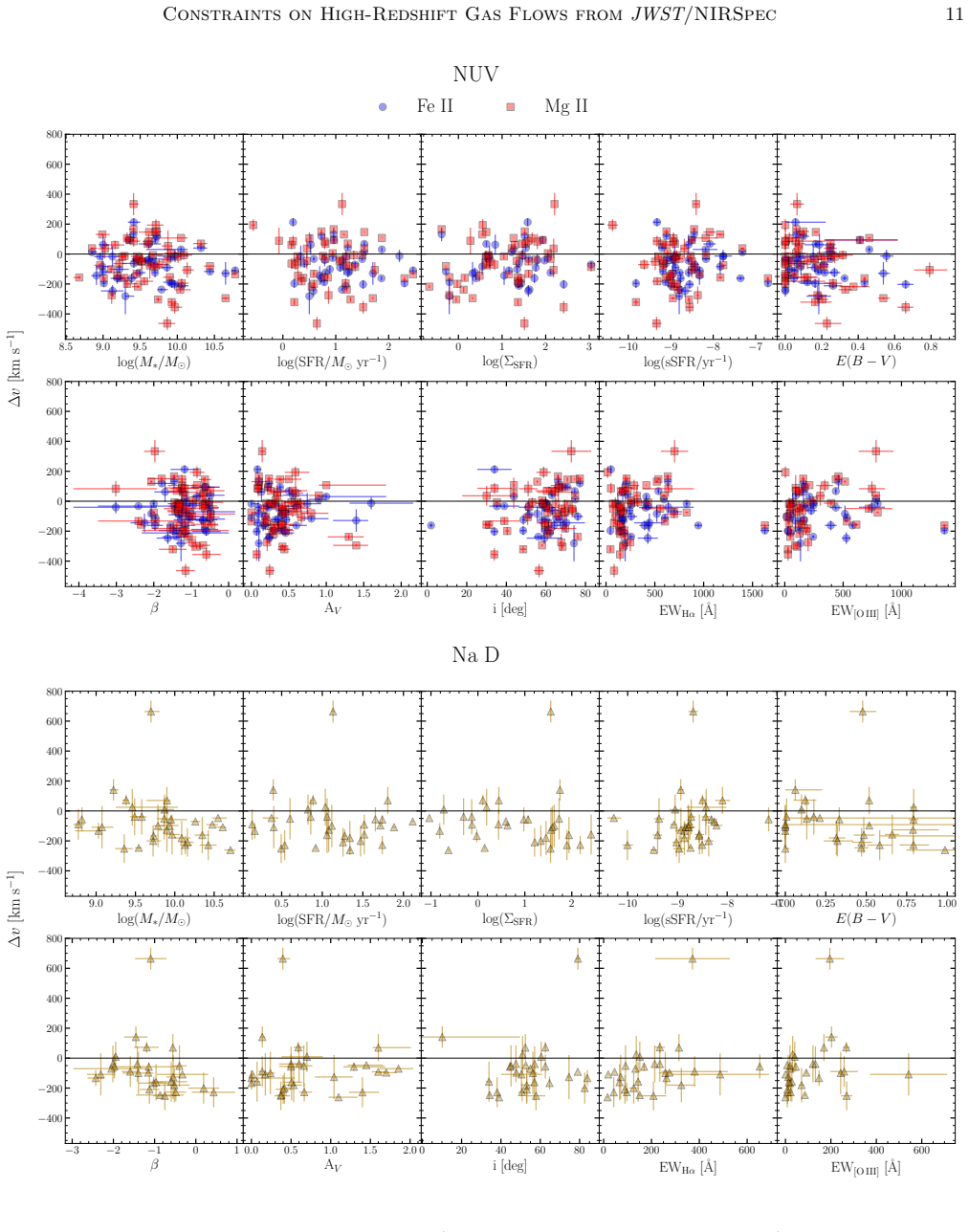
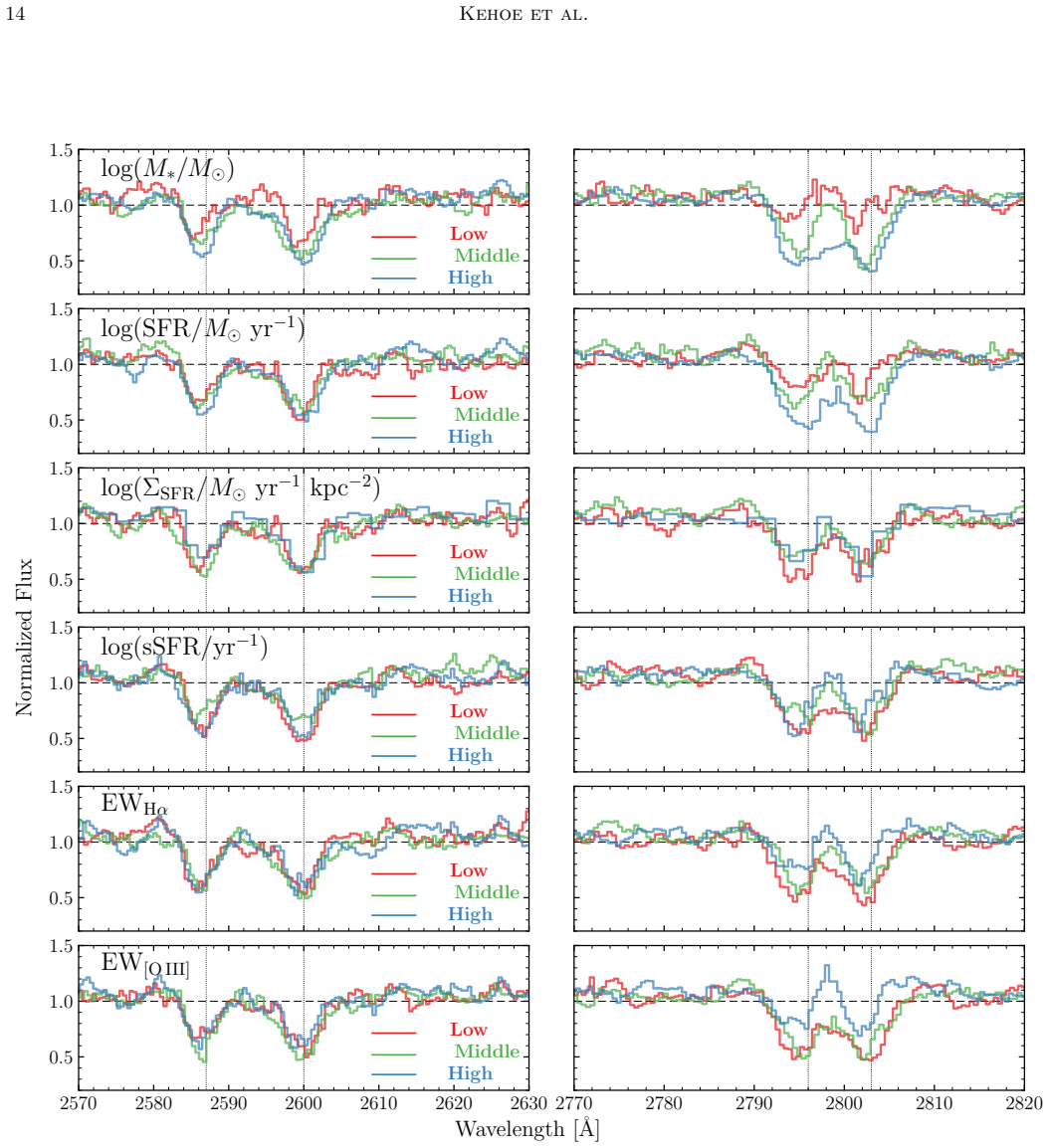
Absorption lines in z~3 star-forming galaxies depend on inclination, with face-on systems showing stronger absorption and faster outflows.
A machine-rendered reading of the paper's core claim, the machinery that carries it, and where it could break.
Core claim
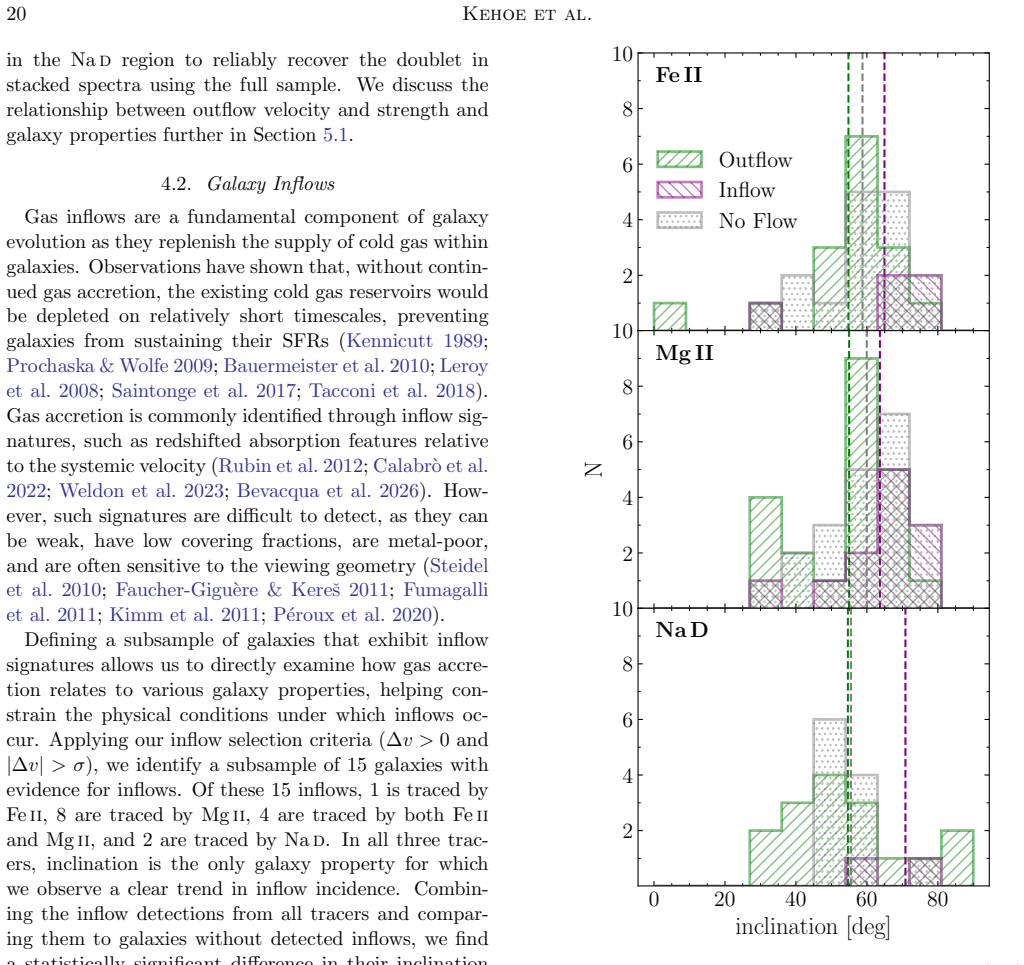
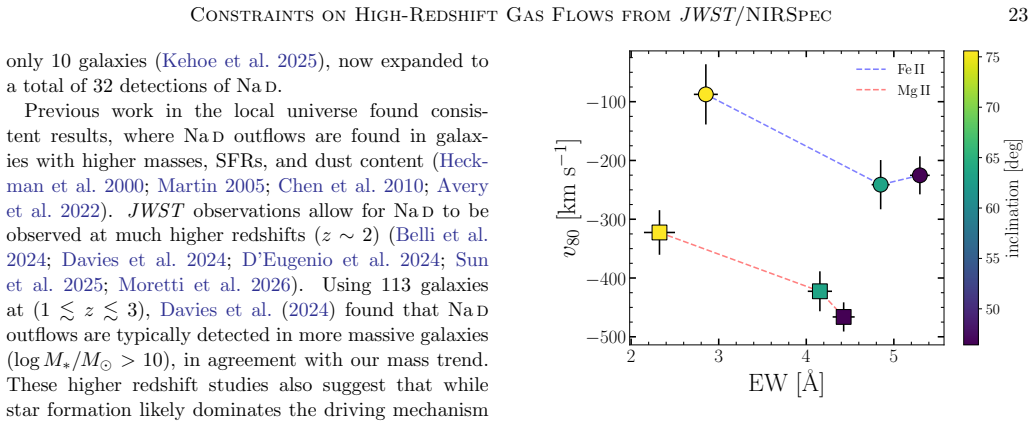
The paper presents the first evidence in z∼3 star-forming galaxies that properties of the absorption lines depend on galaxy inclination, with more face-on systems showing stronger absorption and higher outflow velocities, while inflowing gas is more frequently detected in more highly inclined galaxies. These trends are consistent with observations at z≲1 and predictions from cosmological simulations in which galactic winds are launched perpendicular to the galactic disks, while accretion occurs primarily along the disk plane.
What carries the argument
Inclination dependence of low-ionization absorption lines (Fe II, Mg II, Na D) as tracers of anisotropic galactic gas flows.
If this is right
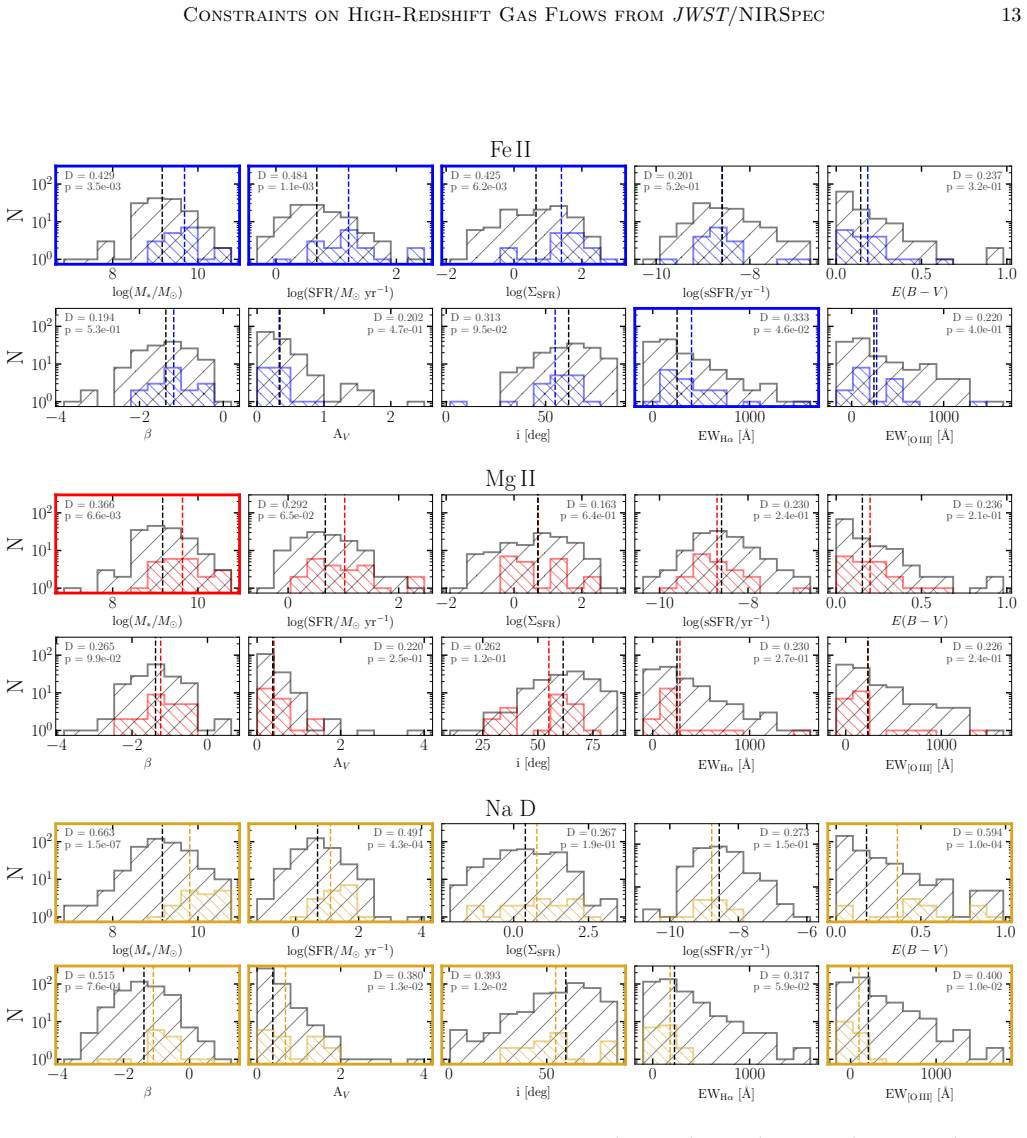
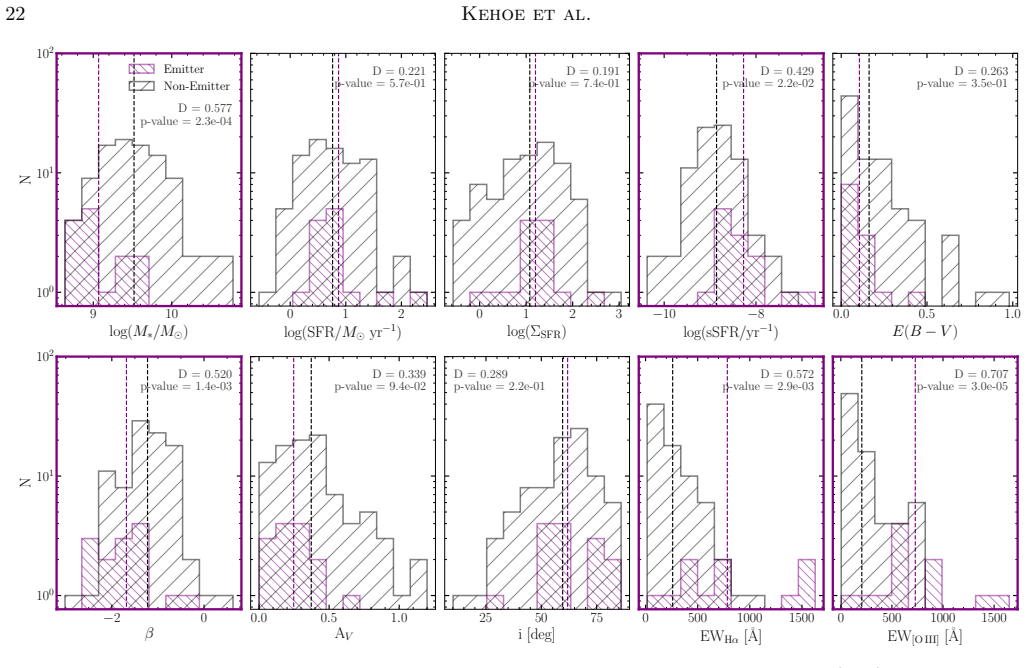
- Outflowing gas is detected more often in galaxies with higher stellar mass, star-formation rate, and surface density of star formation.
- Mg II emission, a sign of resonantly scattered photons, appears preferentially in lower-mass, lower-dust galaxies with elevated specific star-formation rates.
- The geometry of gas flows at z~3 matches the low-redshift pattern of bipolar winds and planar accretion.
- Orientation must be considered when converting observed absorption statistics into global outflow rates.
Where Pith is reading between the lines
- Surveys that do not control for inclination may mix face-on and edge-on systems and therefore underestimate or overestimate average outflow speeds.
- The same viewing-angle effect could influence the escape fraction of ionizing photons, linking gas-flow geometry to reionization-era observations.
- Future integral-field spectroscopy could test whether the velocity field itself is bipolar when resolved in individual galaxies.
Load-bearing premise
Galaxy inclinations measured from photometry or morphology are accurate enough to reveal true differences in gas-flow geometry.
What would settle it
Re-deriving inclinations for the same galaxies from higher-resolution imaging or kinematics and finding that the absorption strength and velocity trends with inclination disappear.
Figures
read the original abstract
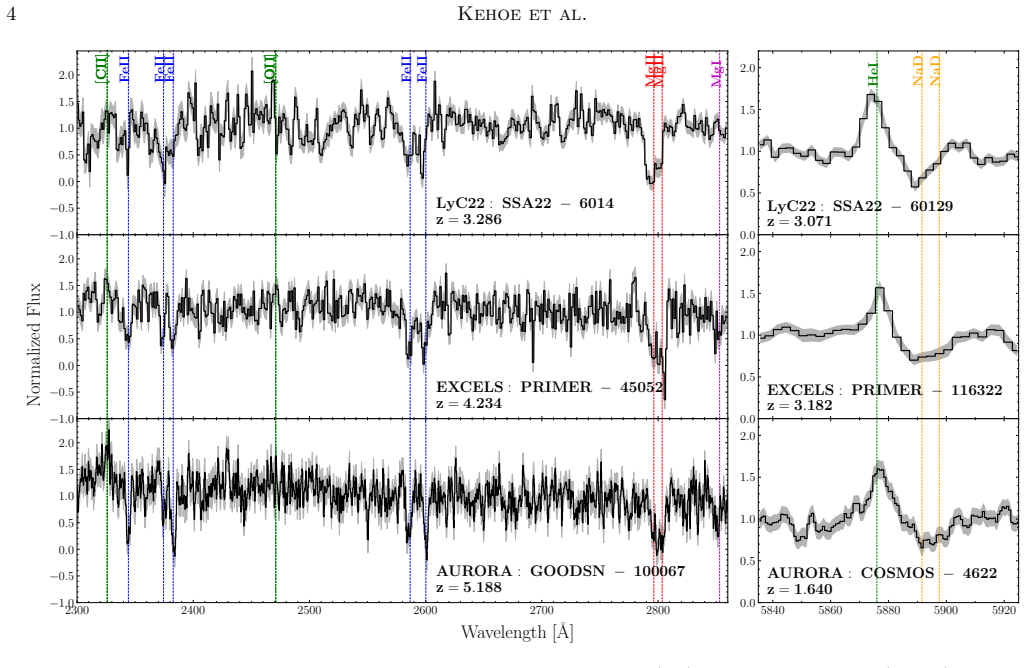
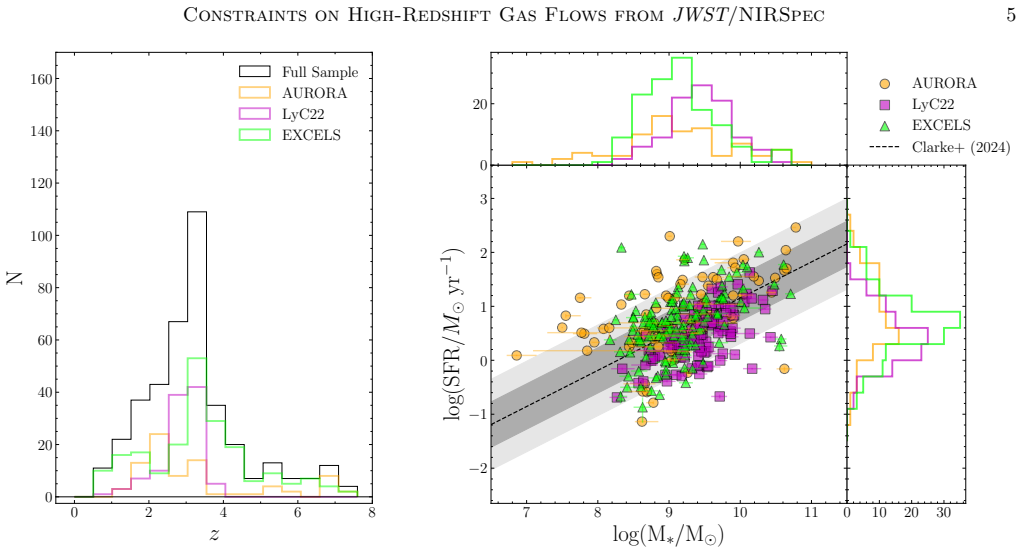
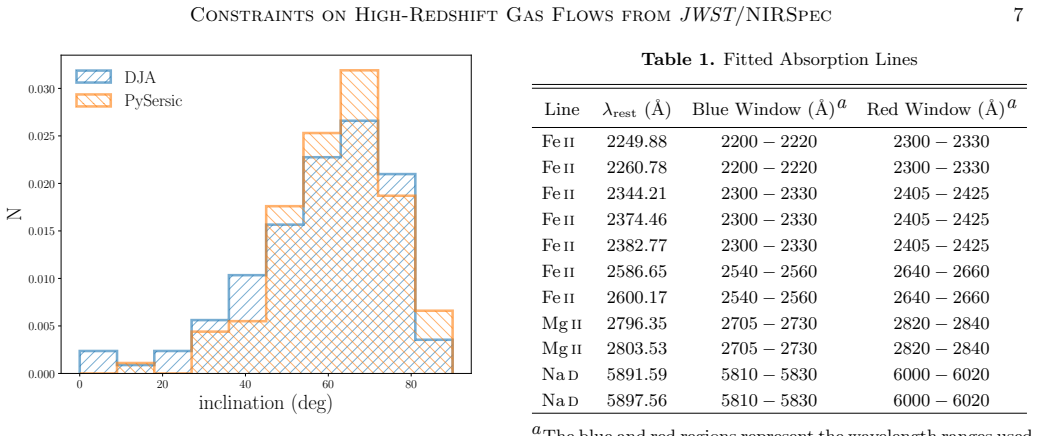
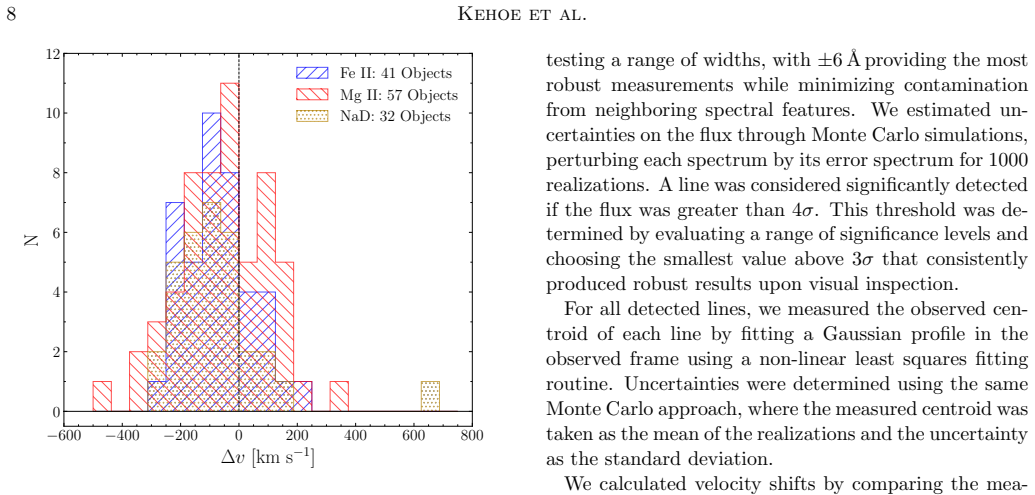
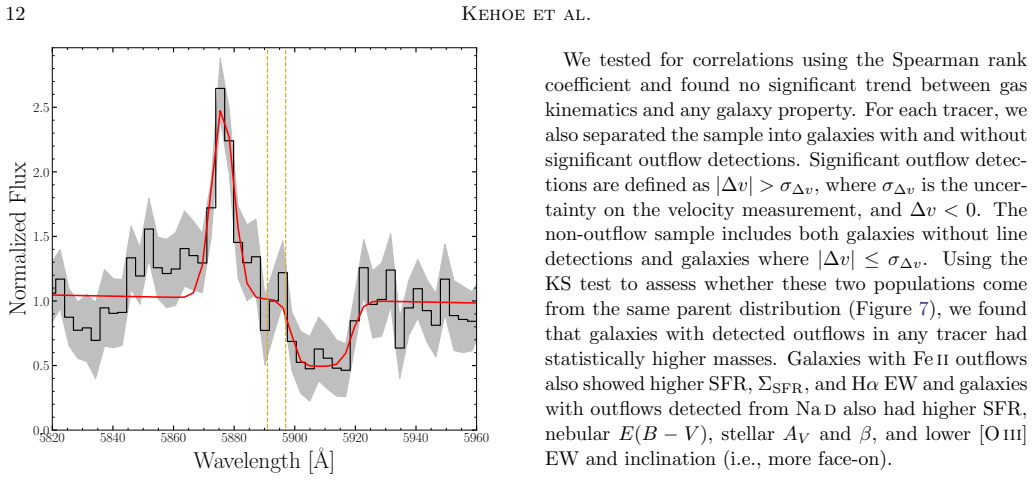
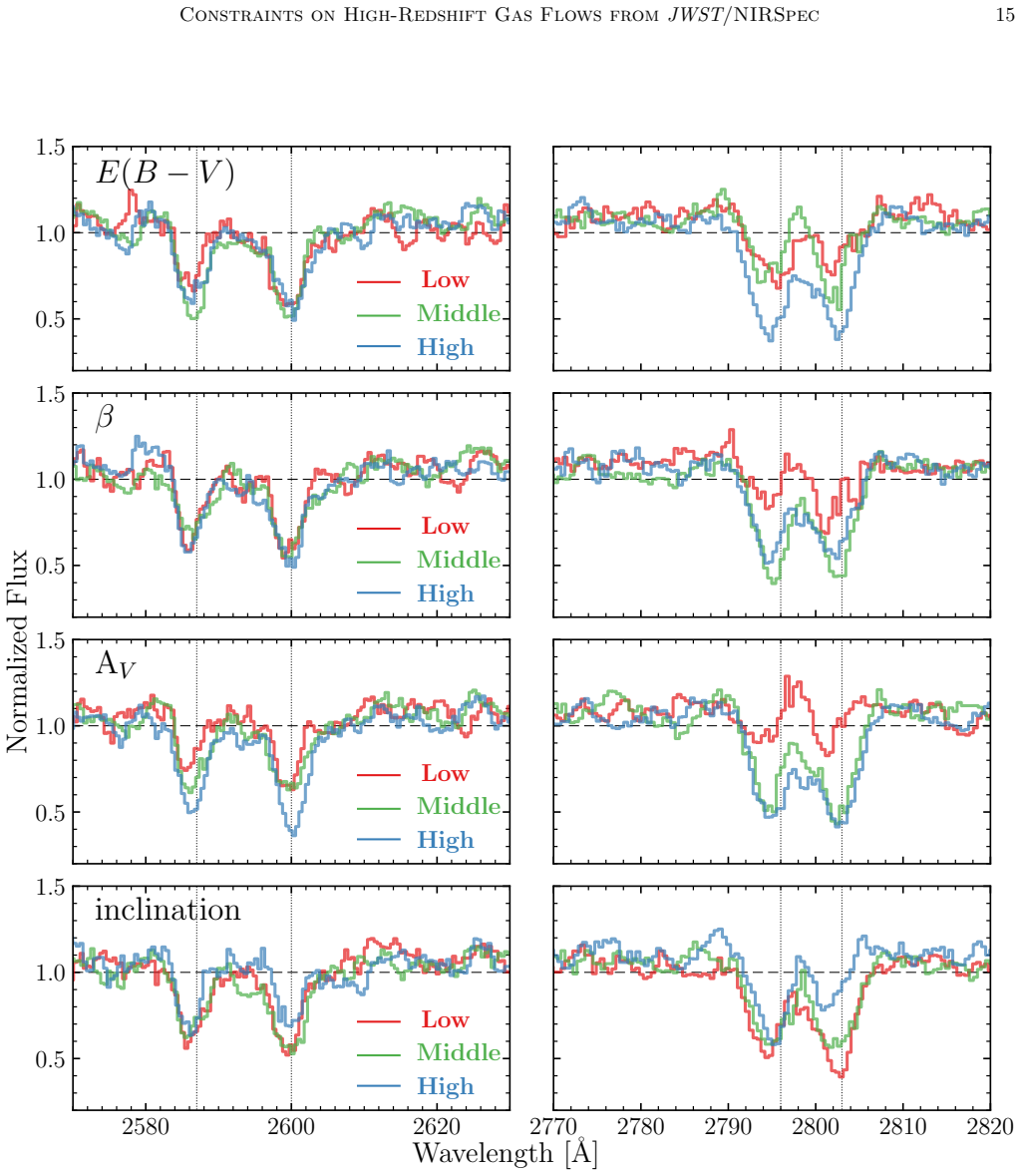
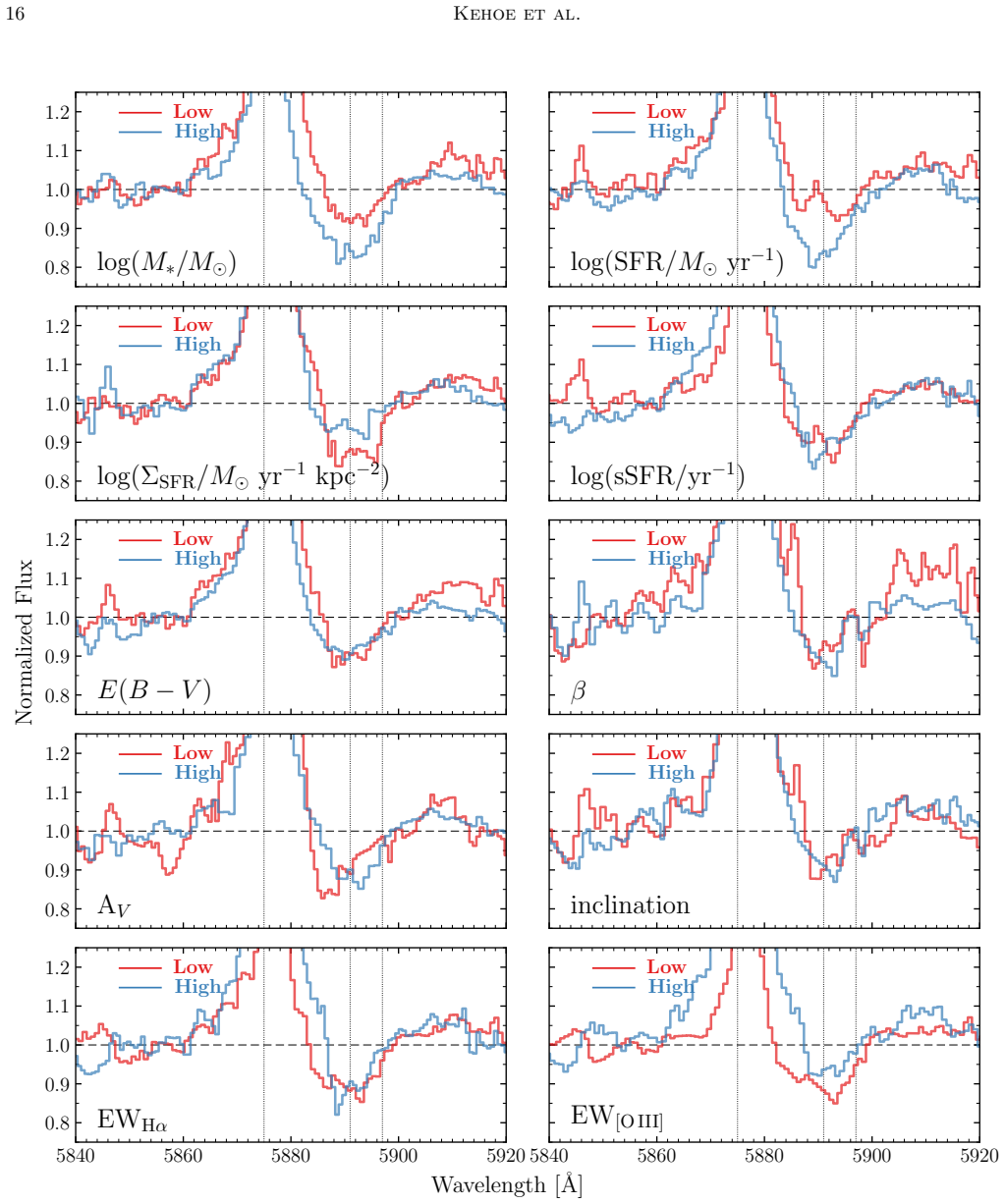
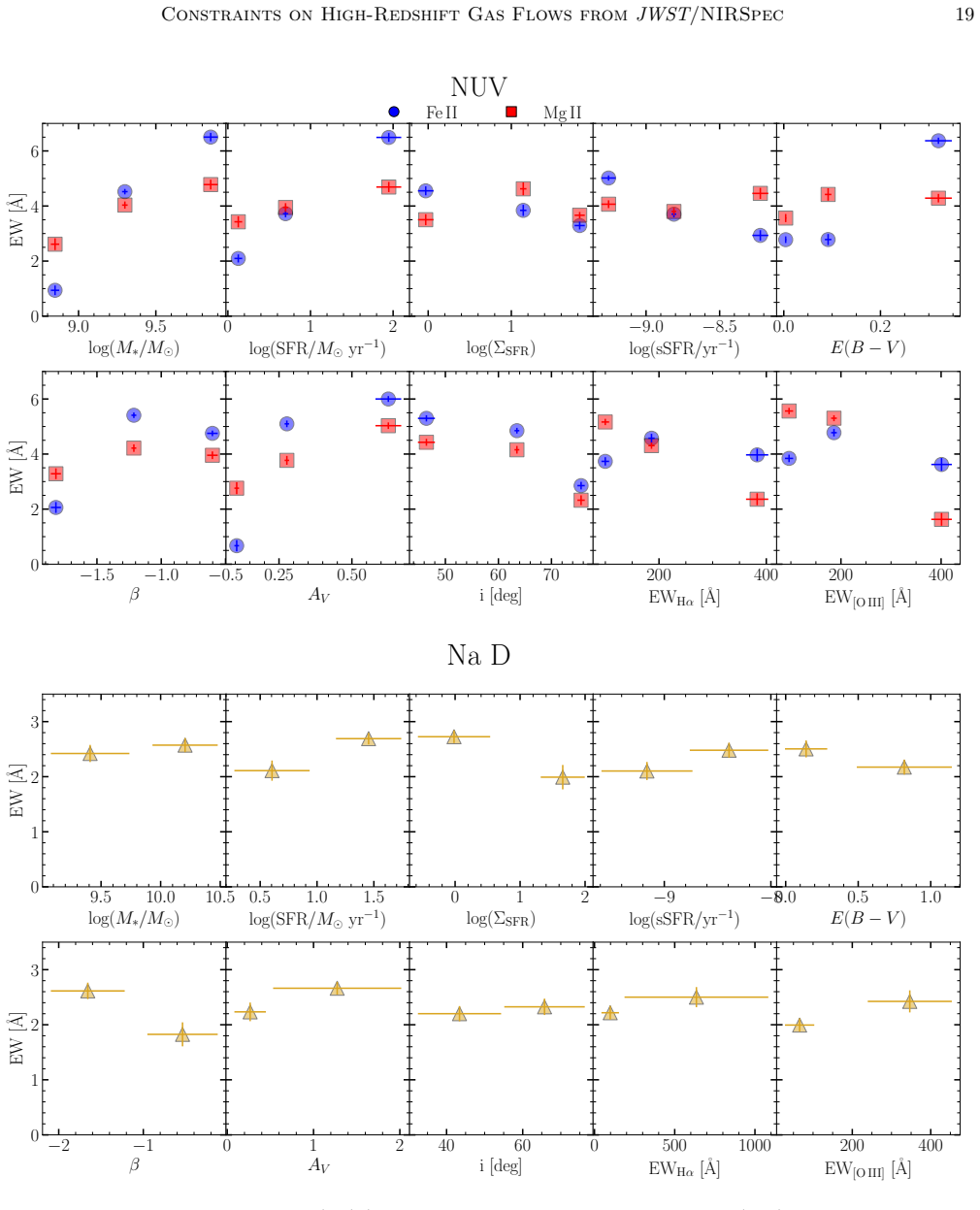
We investigate how low-ionization gas flows in typical star-forming galaxies at $z\sim3$ depend on galaxy intrinsic properties and viewing angle. For this analysis we use JWST/NIRSpec observations of rest-frame near-UV Fe II and Mg II absorption, and rest-frame optical Na D absorption. This study combines galaxies from the LyC22, EXCELS, and AURORA surveys and contains 176, 197, and 315 galaxies, respectively, with Fe II, Mg II, and Na D coverage. Based on both individual and composite spectra, we find no statistically significant correlations between outflow velocity and galaxy properties. However, galaxies with detected outflows tend towards higher stellar masses, SFR, and $\Sigma_{\rm SFR}$ than those without outflows, suggesting that the two samples are not drawn from the same parent population. Finally, we additionally find that Mg II emission is preferentially detected in galaxies with lower stellar mass and $A_V$, and higher sSFR, consistent with conditions that favor the escape of resonantly scattered line and ionizing continuum radiation. We present the first evidence in $z\sim3$ star-forming galaxies that properties of the absorption lines depend on galaxy inclination, with more face-on systems showing stronger absorption and higher outflow velocities, while inflowing gas is more frequently detected in more highly inclined galaxies. These trends are consistent with observations at $z\lesssim1$ and predictions from cosmological simulations in which galactic winds are launched perpendicular to the galactic disks, while accretion occurs primarily along the disk plane.
Editorial analysis
A structured set of objections, weighed in public.
Referee Report
Summary. The manuscript analyzes JWST/NIRSpec rest-frame near-UV Fe II and Mg II and optical Na D absorption in 176–315 z∼3 star-forming galaxies drawn from the LyC22, EXCELS, and AURORA surveys. It reports no statistically significant correlations between outflow velocity and galaxy properties, but finds that galaxies with detected outflows have higher stellar mass, SFR, and Σ_SFR. It additionally claims the first evidence at z∼3 that absorption-line properties depend on inclination, with face-on systems showing stronger absorption and higher outflow velocities while inflows are more common in edge-on systems; these trends are stated to match lower-redshift observations and cosmological simulations.
Significance. If the inclination trends are robust, the result supplies the first direct observational link between viewing angle and wind/accretion geometry at z∼3, extending z≲1 findings and supporting simulations in which outflows are launched perpendicular to disks. The multi-survey sample and use of multiple absorption species are strengths; however, the absence of reported error bars, completeness corrections, and inclination-method validation in the provided abstract limits immediate assessment of the central claim.
major comments (2)
- [Inclination Analysis] Inclination measurement section: the headline result that absorption properties depend on inclination requires that the adopted inclination proxy (presumably axis ratios or morphological fits) faithfully traces viewing angle. At z∼3, galaxies are typically irregular and clumpy; the manuscript must therefore quantify uncertainties, test for systematic biases from star-forming clumps, dust, or PSF effects, and demonstrate that the reported trends survive these uncertainties. Without such validation the physical interpretation is at risk.
- [Results on Outflow Detection] Outflow detection and sample comparison (results section): the claim that galaxies with and without outflows are not drawn from the same parent population rests on trends in stellar mass, SFR, and Σ_SFR. The manuscript must report the precise statistical test, error bars on the measured quantities, and any completeness or selection-function corrections applied to the three survey subsamples; the current description provides sample sizes but no quantitative support for the population-difference statement.
minor comments (2)
- [Abstract / Mg II Emission Results] The abstract states that Mg II emission is preferentially detected in lower-mass, lower-A_V, higher-sSFR galaxies; the corresponding figure or table should include the quantitative significance of this preference and the selection criteria used to define the emission subsample.
- [Methods] Notation for velocity measurements (e.g., v_out, v_in) should be defined explicitly with reference to the line-profile fitting procedure and any adopted systemic redshift method.
Simulated Author's Rebuttal
We thank the referee for their constructive and detailed comments. We address each major comment below, indicating the revisions that will be incorporated.
read point-by-point responses
-
Referee: [Inclination Analysis] Inclination measurement section: the headline result that absorption properties depend on inclination requires that the adopted inclination proxy (presumably axis ratios or morphological fits) faithfully traces viewing angle. At z∼3, galaxies are typically irregular and clumpy; the manuscript must therefore quantify uncertainties, test for systematic biases from star-forming clumps, dust, or PSF effects, and demonstrate that the reported trends survive these uncertainties. Without such validation the physical interpretation is at risk.
Authors: We agree that robust validation of the inclination measurements is necessary to support the central claim. The manuscript derives inclinations from morphological axis ratios in available HST and JWST imaging. In the revised manuscript we will add a dedicated subsection that quantifies measurement uncertainties via Monte Carlo perturbations of the axis ratios, tests for biases introduced by clumpy star formation (by comparing results with and without clump masking where feasible), dust attenuation, and PSF effects (via simulated images). We will further demonstrate that the reported absorption-line trends versus inclination remain statistically significant after these perturbations, thereby strengthening the physical interpretation. revision: yes
-
Referee: [Results on Outflow Detection] Outflow detection and sample comparison (results section): the claim that galaxies with and without outflows are not drawn from the same parent population rests on trends in stellar mass, SFR, and Σ_SFR. The manuscript must report the precise statistical test, error bars on the measured quantities, and any completeness or selection-function corrections applied to the three survey subsamples; the current description provides sample sizes but no quantitative support for the population-difference statement.
Authors: The referee correctly notes that additional quantitative information is required. In the revised results section we will explicitly identify the statistical test applied (e.g., two-sample Kolmogorov-Smirnov test with reported p-values), include uncertainties or error bars on the median stellar mass, SFR, and Σ_SFR values for the outflow and non-outflow subsamples, and describe any completeness corrections or survey-specific selection functions applied to the LyC22, EXCELS, and AURORA data. These additions will supply the requested quantitative support for the population-difference statement. revision: yes
Circularity Check
No circularity: direct observational analysis of spectra and correlations
full rationale
The paper reports empirical measurements of absorption-line properties (Fe II, Mg II, Na D) from JWST/NIRSpec spectra across three surveys, followed by statistical correlations with galaxy properties including stellar mass, SFR, and inclination. No derivations, equations, or predictions are presented that reduce by construction to fitted parameters or self-citations; the inclination trends are stated as observational findings compared to lower-redshift data and simulations. The analysis is self-contained against external benchmarks and contains no load-bearing self-citation chains or ansatzes.
Axiom & Free-Parameter Ledger
axioms (1)
- domain assumption Absorption lines from Fe II, Mg II, and Na D trace low-ionization gas flows in galaxies
Reference graph
Works this paper leans on
-
[1]
R., Wuyts, S., F¨ orster Schreiber, N
Avery, C. R., Wuyts, S., F¨ orster Schreiber, N. M., et al. 2022, Monthly Notices of the Royal Astronomical Society, 511, 4223, doi: 10.1093/mnras/stac190
-
[2]
2010, The Astrophysical Journal, 717, 323, doi: 10.1088/0004-637X/717/1/323
Bauermeister, A., Blitz, L., & Ma, C.-P. 2010, The Astrophysical Journal, 717, 323, doi: 10.1088/0004-637X/717/1/323
-
[3]
Belli, S., Park, M., Davies, R. L., et al. 2024, Nature, 630, 54, doi: 10.1038/s41586-024-07412-1
-
[4]
2020, in Astronomical Society of the Pacific Conference Series, Vol
Bertin, E., Schefer, M., Apostolakos, N., et al. 2020, in Astronomical Society of the Pacific Conference Series, Vol. 527, Astronomical Data Analysis Software and Systems XXIX, ed. R. Pizzo, E. R. Deul, J. D. Mol, J. de Plaa, & H. Verkouter, 461
2020
-
[5]
Bevacqua, D., Marchesini, D., Saracco, P., et al. 2026, The Astrophysical Journal, 997, 189, doi: 10.3847/1538-4357/ae247c
-
[6]
2021, ApJ, 919, 38, doi: 10.3847/1538-4357/ac1108
Birrer, S. 2021, ApJ, 919, 38, doi: 10.3847/1538-4357/ac1108
-
[7]
2022, PSFr: Point Spread Function reconstruction, Astrophysics Source Code Library, record ascl:2210.005
Vyvere, L. 2022, PSFr: Point Spread Function reconstruction, Astrophysics Source Code Library, record ascl:2210.005. http://ascl.net/2210.005
2022
-
[8]
Bordoloi, R., Lilly, S. J., Knobel, C., et al. 2011, ApJ, 743, 10, doi: 10.1088/0004-637X/743/1/10
-
[9]
, archivePrefix = "arXiv", eprint =
Bordoloi, R., Lilly, S. J., Hardmeier, E., et al. 2014, ApJ, 794, 130, doi: 10.1088/0004-637X/794/2/130
-
[10]
Bradshaw, E. J., Almaini, O., Hartley, W. G., et al. 2013, MNRAS, 433, 194, doi: 10.1093/mnras/stt715
-
[11]
, archivePrefix = "arXiv", eprint =
Brook, C. B., Governato, F., Roˇ skar, R., et al. 2011, Monthly Notices of the Royal Astronomical Society, 415, 1051, doi: 10.1111/j.1365-2966.2011.18545.x Calabr` o, A., Pentericci, L., Talia, M., et al. 2022, A&A, 667, A117, doi: 10.1051/0004-6361/202244364
-
[12]
Calzetti, D., Armus, L., Bohlin, R. C., et al. 2000, ApJ, 533, 682, doi: 10.1086/308692
work page internal anchor Pith review doi:10.1086/308692 2000
-
[13]
Cardelli, J. A., Clayton, G. C., & Mathis, J. S. 1989, ApJ, 345, 245, doi: 10.1086/167900 28Kehoe et al
-
[14]
Carnall, A. C., Leja, J., Johnson, B. D., et al. 2019, The Astrophysical Journal, 873, 44, doi: 10.3847/1538-4357/ab04a2
-
[15]
Carnall, A. C., McLure, R. J., Dunlop, J. S., & Dav´ e, R. 2018, Monthly Notices of the Royal Astronomical Society, 480, 4379, doi: 10.1093/mnras/sty2169
work page internal anchor Pith review doi:10.1093/mnras/sty2169 2018
-
[16]
Carnall, A. C., Cullen, F., McLure, R. J., et al. 2024, MNRAS, 534, 325, doi: 10.1093/mnras/stae2092
-
[17]
Carniani, S., Venturi, G., Parlanti, E., et al. 2024, A&A, 685, A99, doi: 10.1051/0004-6361/202347230
-
[18]
Chabrier, G. 2003, PASP, 115, 763, doi: 10.1086/376392
work page internal anchor Pith review doi:10.1086/376392 2003
-
[19]
Chang, S.-J., & Gronke, M. 2024, Monthly Notices of the Royal Astronomical Society, 532, 3526, doi: 10.1093/mnras/stae1664
-
[20]
, archivePrefix = "arXiv", eprint =
Chen, Y.-M., Tremonti, C. A., Heckman, T. M., et al. 2010, AJ, 140, 445, doi: 10.1088/0004-6256/140/2/445
-
[21]
X., Schaerer, D., Gazagnes, S., & Henry, A
Chisholm, J., Prochaska, J. X., Schaerer, D., Gazagnes, S., & Henry, A. 2020, MNRAS, 498, 2554, doi: 10.1093/mnras/staa2470
-
[22]
, archivePrefix = "arXiv", eprint =
Chisholm, J., Tremonti, C. A., Leitherer, C., & Chen, Y. 2017, Monthly Notices of the Royal Astronomical Society, 469, 4831, doi: 10.1093/mnras/stx1164
-
[23]
2024, Monthly Notices of the Royal Astronomical Society, 532, 2463, doi: 10.1093/mnras/stae1586
Choustikov, N., Katz, H., Saxena, A., et al. 2024, Monthly Notices of the Royal Astronomical Society, 532, 2463, doi: 10.1093/mnras/stae1586
-
[24]
Clarke, L., Shapley, A. E., Sanders, R. L., et al. 2024, ApJ, 977, 133, doi: 10.3847/1538-4357/ad8ba4
-
[25]
Conroy, C., Gunn, J. E., & White, M. 2009, ApJ, 699, 486, doi: 10.1088/0004-637X/699/1/486
work page internal anchor Pith review doi:10.1088/0004-637x/699/1/486 2009
-
[26]
L., Belli, S., Park, M., et al
Davies, R. L., Belli, S., Park, M., et al. 2024, MNRAS, 528, 4976, doi: 10.1093/mnras/stae327 D’Eugenio, F., P´ erez-Gonz´ alez, P. G., Maiolino, R., et al. 2024, Nature Astronomy, 8, 1443, doi: 10.1038/s41550-024-02345-1 Di Matteo, T., Springel, V., & Hernquist, L. 2005, Nature, 433, 604, doi: 10.1038/nature03335
-
[27]
Du, X., Shapley, A. E., Topping, M. W., et al. 2021, ApJ, 920, 95, doi: 10.3847/1538-4357/ac1273
-
[28]
J., Willott, C., Alberts, S., et al
Eisenstein, D. J., Willott, C., Alberts, S., et al. 2026, ApJS, 283, 6, doi: 10.3847/1538-4365/ae3163
-
[29]
Eldridge, J. J., Stanway, E. R., Xiao, L., et al. 2017, Publications of the Astronomical Society of Australia, 34, e058, doi: 10.1017/pasa.2017.51
work page internal anchor Pith review doi:10.1017/pasa.2017.51 2017
-
[30]
Erb, D. K. 2015, Nature, 523, 169, doi: 10.1038/nature14454
-
[31]
Erb, D. K., Quider, A. M., Henry, A. L., & Martin, C. L. 2012, The Astrophysical Journal, 759, 26, doi: 10.1088/0004-637X/759/1/26 Faucher-Gigu` ere, C.-A., & Kereˇ s, D. 2011, Monthly Notices of the Royal Astronomical Society: Letters, 412, L118, doi: 10.1111/j.1745-3933.2011.01018.x
-
[32]
2018, A&A, 617, A62, doi: 10.1051/0004-6361/201833281
Feltre, A., Bacon, R., Tresse, L., et al. 2018, A&A, 617, A62, doi: 10.1051/0004-6361/201833281
-
[33]
Fielding, D., Quataert, E., Martizzi, D., & Faucher-Gigu` ere, C.-A. 2017, Monthly Notices of the Royal Astronomical Society: Letters, 470, L39, doi: 10.1093/mnrasl/slx072
-
[34]
2017, A&A, 608, A7, doi: 10.1051/0004-6361/201731499
Finley, H., Bouch´ e, N., Contini, T., et al. 2017, A&A, 608, A7, doi: 10.1051/0004-6361/201731499
-
[35]
Flury, S. R., Jaskot, A. E., Ferguson, H. C., et al. 2022a, ApJS, 260, 1, doi: 10.3847/1538-4365/ac5331 —. 2022b, ApJ, 930, 126, doi: 10.3847/1538-4357/ac61e4
-
[36]
and Lang, Dustin and Goodman, Jonathan , year=
Foreman-Mackey, D., Hogg, D. W., Lang, D., & Goodman, J. 2013, PASP, 125, 306, doi: 10.1086/670067
-
[37]
, archivePrefix = "arXiv", eprint =
Fumagalli, M., Prochaska, J. X., Kasen, D., et al. 2011, MNRAS, 418, 1796, doi: 10.1111/j.1365-2966.2011.19599.x F¨ orster Schreiber, N. M.,¨Ubler, H., Davies, R. L., et al. 2019, The Astrophysical Journal, 875, 21, doi: 10.3847/1538-4357/ab0ca2
-
[38]
2024, A&A, 691, A213, doi: 10.1051/0004-6361/202450654
Garel, T., Michel-Dansac, L., Verhamme, A., et al. 2024, A&A, 691, A213, doi: 10.1051/0004-6361/202450654
-
[39]
2020, A&A, 639, A85, doi: 10.1051/0004-6361/202038096
Izotov, Y. 2020, A&A, 639, A85, doi: 10.1051/0004-6361/202038096
-
[40]
2025, Monthly Notices of the Royal Astronomical Society, 540, 2331, doi: 10.1093/mnras/staf768
Gazagnes, S., Chisholm, J., Endsley, R., et al. 2025, Monthly Notices of the Royal Astronomical Society, 540, 2331, doi: 10.1093/mnras/staf768
-
[41]
2025, A&A, 699, A343, doi: 10.1051/0004-6361/202555504
Genin, A., Shuntov, M., Brammer, G., et al. 2025, A&A, 699, A343, doi: 10.1051/0004-6361/202555504
-
[42]
2011, The Astrophysical Journal, 743, 95, doi: 10.1088/0004-637X/743/1/95
Giavalisco, M., Vanzella, E., Salimbeni, S., et al. 2011, The Astrophysical Journal, 743, 95, doi: 10.1088/0004-637X/743/1/95
-
[43]
2013, Monthly Notices of the Royal Astronomical Society, 434, 1151, doi: 10.1093/mnras/stt1060
Burkert, A. 2013, Monthly Notices of the Royal Astronomical Society, 434, 1151, doi: 10.1093/mnras/stt1060
-
[44]
The Astrophysical Journal , author =
Gordon, K. D., Clayton, G. C., Misselt, K. A., Landolt, A. U., & Wolff, M. J. 2003, The Astrophysical Journal, 594, 279, doi: 10.1086/376774
-
[45]
Guo, Y., Bacon, R., Bouch´ e, N. F., et al. 2023, Nature, 624, 53, doi: 10.1038/s41586-023-06718-w
-
[46]
Guseva, N. G., Izotov, Y. I., Fricke, K. J., & Henkel, C. 2013, A&A, 555, A90, doi: 10.1051/0004-6361/201221010 —. 2019, A&A, 624, A21, doi: 10.1051/0004-6361/201834935
-
[47]
J., Saldana-Lopez, A., Citro, A., et al
Hayes, M. J., Saldana-Lopez, A., Citro, A., et al. 2025, ApJ, 982, 14, doi: 10.3847/1538-4357/adaea1 Constraints on High-Redshift Gas Flows fromJWST/NIRSpec29
-
[48]
2015, ApJ, 809, 147, doi: 10.1088/0004-637X/809/2/147
Overzier, R., & Leitherer, C. 2015, ApJ, 809, 147, doi: 10.1088/0004-637X/809/2/147
-
[49]
Heckman, T. M., Armus, L., & Miley, G. K. 1990, ApJS, 74, 833, doi: 10.1086/191522
-
[50]
Heckman, T. M., & Borthakur, S. 2016, ApJ, 822, 9, doi: 10.3847/0004-637X/822/1/9
-
[51]
2000, The Astrophysical Journal Supplement Series, 129, 493, doi: 10.1086/313421
Armus, L. 2000, The Astrophysical Journal Supplement Series, 129, 493, doi: 10.1086/313421
-
[52]
A., Scarlata, C., Verhamme, A., & Erb, D
Henry, A., Berg, D. A., Scarlata, C., Verhamme, A., & Erb, D. 2018, ApJ, 855, 96, doi: 10.3847/1538-4357/aab099
-
[53]
Ho, S. H., Martin, C. L., Kacprzak, G. G., & Churchill, C. W. 2017, The Astrophysical Journal, 835, 267, doi: 10.3847/1538-4357/835/2/267
-
[54]
Hopkins, P. F., Cox, T. J., Kereˇ s, D., & Hernquist, L. 2008, The Astrophysical Journal Supplement Series, 175, 390, doi: 10.1086/524363
-
[55]
I., Chisholm, J., Worseck, G., et al
Izotov, Y. I., Chisholm, J., Worseck, G., et al. 2022, MNRAS, 515, 2864, doi: 10.1093/mnras/stac1899
-
[56]
Izotov, Y. I., Schaerer, D., Thuan, T. X., et al. 2016, MNRAS, 461, 3683, doi: 10.1093/mnras/stw1205
-
[57]
I., Worseck, G., Schaerer, D., et al
Izotov, Y. I., Worseck, G., Schaerer, D., et al. 2021, Monthly Notices of the Royal Astronomical Society, 503, 1734, doi: 10.1093/mnras/stab612
-
[58]
Jaskot, A. E., & Oey, M. S. 2013, ApJ, 766, 91, doi: 10.1088/0004-637X/766/2/91
-
[59]
Kacprzak, G. G. 2017, in Astrophysics and Space Science
2017
-
[60]
430, Gas Accretion onto Galaxies, ed
Library, Vol. 430, Gas Accretion onto Galaxies, ed. A. Fox & R. Dav´ e, 145, doi: 10.1007/978-3-319-52512-97
-
[61]
Kacprzak, G. G., Churchill, C. W., & Nielsen, N. M. 2012, ApJL, 760, L7, doi: 10.1088/2041-8205/760/1/L7
-
[62]
2022, Monthly Notices of the Royal Astronomical Society, 515, 4265, doi: 10.1093/mnras/stac1437
Katz, H., Garel, T., Rosdahl, J., et al. 2022, Monthly Notices of the Royal Astronomical Society, 515, 4265, doi: 10.1093/mnras/stac1437
-
[63]
Kehoe, E., Shapley, A. E., Schreiber, N. M. F., et al. 2024, ApJ, 976, 28, doi: 10.3847/1538-4357/ad7ebb
-
[64]
Kehoe, E., Shapley, A. E., Sanders, R. L., et al. 2025, The Astrophysical Journal, 994, 170, doi: 10.3847/1538-4357/ae10b3
-
[65]
Kennicutt, Jr., R. C. 1989, ApJ, 344, 685, doi: 10.1086/167834
-
[66]
Kimm, T., Slyz, A., Devriendt, J., & Pichon, C. 2011, MNRAS, 413, L51, doi: 10.1111/j.1745-3933.2011.01031.x
-
[67]
Kornei, K. A., Shapley, A. E., Martin, C. L., et al. 2012, ApJ, 758, 135, doi: 10.1088/0004-637X/758/2/135 —. 2013, ApJ, 774, 50, doi: 10.1088/0004-637X/774/1/50
-
[68]
Kriek, M., van Dokkum, P. G., Labb´ e, I., et al. 2009, The Astrophysical Journal, 700, 221, doi: 10.1088/0004-637X/700/1/221
-
[69]
Kroupa, P. 2001, Monthly Notices of the Royal Astronomical Society, 322, 231, doi: 10.1046/j.1365-8711.2001.04022.x
-
[70]
Law, D. R., Steidel, C. C., Shapley, A. E., et al. 2012, The Astrophysical Journal, 759, 29, doi: 10.1088/0004-637X/759/1/29 Le Reste, A., Scarlata, C., Hayes, M. J., et al. 2025, ApJS, 280, 27, doi: 10.3847/1538-4365/adf227
-
[71]
2024, A&A, 687, A73, doi: 10.1051/0004-6361/202449362
Leclercq, F., Chisholm, J., King, W., et al. 2024, A&A, 687, A73, doi: 10.1051/0004-6361/202449362
-
[72]
2011, The Astronomical Journal, 141, 37, doi: 10.1088/0004-6256/141/2/37
Calzetti, D. 2011, The Astronomical Journal, 141, 37, doi: 10.1088/0004-6256/141/2/37
-
[73]
K., Walter, F., Brinks, E., et al
Leroy, A. K., Walter, F., Brinks, E., et al. 2008, The Astronomical Journal, 136, 2782, doi: 10.1088/0004-6256/136/6/2782
-
[74]
2026, ApJL, 1000, L3, doi: 10.3847/2041-8213/ae48ee
Lyu, C., Yu, H., Wang, E., et al. 2026, ApJL, 1000, L3, doi: 10.3847/2041-8213/ae48ee
-
[75]
Martin, C. L. 2005, ApJ, 621, 227, doi: 10.1086/427277
-
[76]
Martin, C. L., Shapley, A. E., Coil, A. L., et al. 2012, ApJ, 760, 127, doi: 10.1088/0004-637X/760/2/127 —. 2013, ApJ, 770, 41, doi: 10.1088/0004-637X/770/1/41
-
[77]
Moretti, L., Belli, S., Rudie, G. C., et al. 2026, A&A, 707, A146, doi: 10.1051/0004-6361/202556336
-
[78]
Murray, N., M´ enard, B., & Thompson, T. A. 2011, The Astrophysical Journal, 735, 66, doi: 10.1088/0004-637X/735/1/66
-
[79]
2019, MNRAS, 490, 3234, doi: 10.1093/mnras/stz2306
Nelson, D., Pillepich, A., Springel, V., et al. 2019, MNRAS, 490, 3234, doi: 10.1093/mnras/stz2306
work page internal anchor Pith review doi:10.1093/mnras/stz2306 2019
-
[80]
F., Genzel, R., F¨ orster-Schreiber, N
Newman, S. F., Genzel, R., F¨ orster-Schreiber, N. M., et al. 2012, The Astrophysical Journal, 761, 43, doi: 10.1088/0004-637X/761/1/43
discussion (0)
Sign in with ORCID, Apple, or X to comment. Anyone can read and Pith papers without signing in.