Mass Varying Neutrino Oscillation in Teleparallel Gravity
Pith reviewed 2026-06-27 06:47 UTC · model grok-4.3
The pith
Coupling a scalar to torsion in teleparallel gravity gives neutrinos a density-dependent mass that shifts solar oscillation probabilities.
A machine-rendered reading of the paper's core claim, the machinery that carries it, and where it could break.
Core claim
In the Cartan teleparallel formulation of gravity, a scalar field coupled to the torsion tensor can acquire an environment dependent effective mass. This gives rise to a screening effect: Inside dense bodies such as the Sun, the scalar field is suppressed, causing the mass varying neutrino mass to vary with local density. The mechanism modifies the standard MSW resonance condition in a distinct way, leading to detectable shift in the flavor conversion probability. Using data from solar neutrino experiments the torsion-scalar coupling parameters are constrained.
What carries the argument
Torsion-induced screening of a scalar field that produces a density-dependent neutrino mass.
If this is right
- The resonance condition for neutrino flavor conversion is altered by a term that depends on the torsion-scalar coupling.
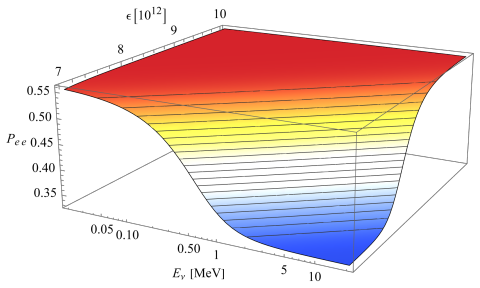
- The shift in conversion probability is large enough to be compared with existing solar neutrino data.
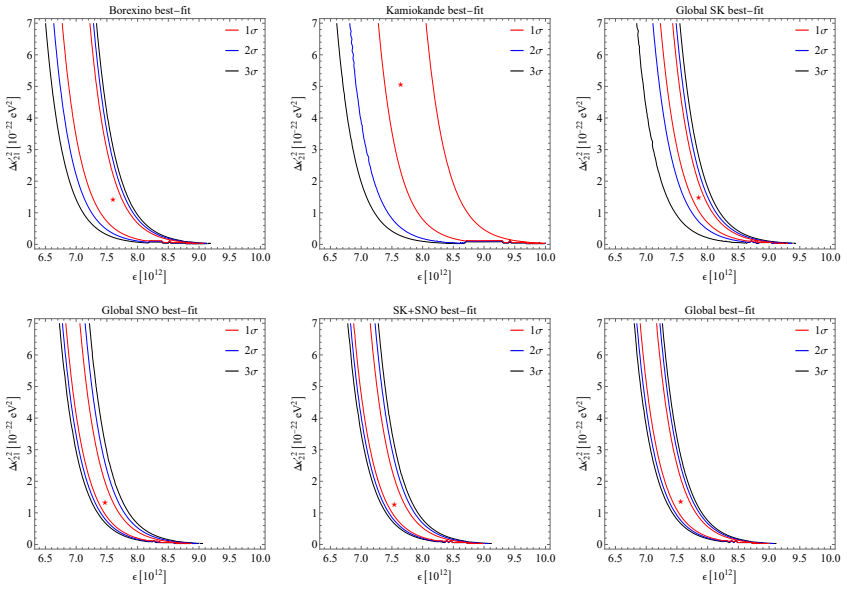
- Constraints on the torsion-scalar coupling strength follow directly from Super-Kamiokande, Borexino and SNO measurements.
- The same density-dependent mass effect supplies a concrete observational test of teleparallel gravity.
Where Pith is reading between the lines
- The mechanism could be examined in other high-density settings such as core-collapse supernovae where neutrino oscillations are also observed.
- If the screening scale is comparable to stellar densities, analogous effects might appear in laboratory neutrino beams passing through dense targets.
- The approach opens a route to constrain teleparallel modifications using any environment where both density and neutrino flavor evolution can be measured.
Load-bearing premise
The scalar field coupled to the torsion tensor acquires an environment-dependent effective mass that directly translates into a density-dependent neutrino mass capable of altering observable oscillation probabilities.
What would settle it
Solar neutrino flavor conversion probabilities that match the standard MSW prediction with no measurable extra shift would rule out the torsion-screening mechanism.
Figures
read the original abstract
In the Cartan teleparallel formulation of gravity, a scalar field coupled to the torsion tensor can acquire an environment dependent effective mass. This gives rise to a screening effect: Inside dense bodies such as the Sun, the scalar field is suppressed, causing the mass varying neutrino mass to vary with local density. We investigate the impact of this torsion-induced screening on solar neutrino oscillations. The mechanism modifies the standard MSW resonance condition in a distinct way, leading to detectable shift in the flavor conversion probability. Using data from solar neutrino experiments (Super-Kamiokande, Borexino, SNO), we place constraints on the torsion-scalar coupling parameters. Our work provides concrete test of teleparallel gravity through mass varying neutrino oscillations.
Editorial analysis
A structured set of objections, weighed in public.
Referee Report
Summary. The manuscript proposes that in the Cartan teleparallel formulation of gravity, a scalar field coupled to the torsion tensor acquires an environment-dependent effective mass, producing a screening effect inside dense bodies such as the Sun. This leads to density-dependent neutrino masses that modify the standard MSW resonance condition in a distinct way, resulting in observable shifts in solar neutrino flavor conversion probabilities. Constraints on the torsion-scalar coupling parameters are placed using data from Super-Kamiokande, Borexino, and SNO.
Significance. If the central claims were substantiated with explicit derivations and reproducible calculations, the work would provide a concrete, falsifiable test of teleparallel gravity via neutrino oscillations and could link modified gravity to astrophysical observables. However, the absence of any derivations, equations, or analysis details means the significance cannot be assessed at present.
major comments (1)
- The manuscript as provided consists solely of the abstract; no derivations, explicit equations, error analysis, or data-selection criteria are shown. This prevents any evaluation of whether the claimed distinct modification to the MSW resonance condition is supported or whether the constraints on the torsion-scalar coupling parameters are robust.
Simulated Author's Rebuttal
We thank the referee for their report. We address the major comment below.
read point-by-point responses
-
Referee: The manuscript as provided consists solely of the abstract; no derivations, explicit equations, error analysis, or data-selection criteria are shown. This prevents any evaluation of whether the claimed distinct modification to the MSW resonance condition is supported or whether the constraints on the torsion-scalar coupling parameters are robust.
Authors: We agree that the version reviewed consists only of the abstract and therefore lacks the explicit derivations, equations, error analysis, and data-selection criteria needed for evaluation. In the revised manuscript we will add the full derivation of the torsion-coupled scalar acquiring an environment-dependent mass, the resulting screening inside the Sun, the modified MSW resonance condition, the altered flavor-conversion probabilities, the statistical analysis of Super-Kamiokande, Borexino and SNO data, and the resulting bounds on the coupling parameters. revision: yes
Circularity Check
No significant circularity identified
full rationale
The provided material consists solely of the abstract; no equations, derivations, or data-analysis sections are available for inspection. Without explicit steps such as fitted parameters renamed as predictions or self-citations that reduce the central claim to unverified inputs, no load-bearing circular reductions can be exhibited. The abstract describes a model that modifies MSW resonance and constrains parameters with solar neutrino data, but this is a standard fitting procedure and does not meet the criteria for circularity (no quoted equation or self-citation chain that forces the result by construction). The derivation chain cannot be walked, so the default finding of no significant circularity applies.
Axiom & Free-Parameter Ledger
free parameters (1)
- torsion-scalar coupling parameters
axioms (1)
- domain assumption A scalar field coupled to the torsion tensor acquires an environment-dependent effective mass.
invented entities (1)
-
Scalar field coupled to torsion
no independent evidence
Reference graph
Works this paper leans on
-
[1]
Q. R. Ahmadet al.[SNO], Phys. Rev. Lett.89, 011301 (2002) [arXiv:nucl-ex/0204008 [nucl-ex]]
Pith/arXiv arXiv 2002
-
[2]
Fukuda et al
Y. Fukuda et al. [Super-Kamiokande], Nucl. Instrum. Meth. A501, 418-462 (2003)
2003
-
[3]
R. Fardon, A. E. Nelson and N. Weiner, JCAP10, 005 (2004) [arXiv:astro-ph/0309800 [astro-ph]]
Pith/arXiv arXiv 2004
-
[4]
X. J. Bi, B. Feng, H. Li and X. m. Zhang, Phys. Rev. D72, 123523 (2005) [arXiv:hep-ph/0412002 [hep-ph]]
Pith/arXiv arXiv 2005
-
[5]
J. Matias and C. P. Burgess, JHEP09, 052 (2005) [arXiv:hep-ph/0508156 [hep-ph]]
Pith/arXiv arXiv 2005
-
[6]
Resonant amplification of neutrino oscillations in matter and solar neutrino spectroscopy,
S. P. Mikheev and A. Y. Smirnov, “Resonant amplification of neutrino oscillations in matter and solar neutrino spectroscopy,” Nuovo Cim. C9, 17-26 (1986)
1986
-
[7]
Oscillations Among Three Neutrino Types and CP Violation,
L. Wolfenstein, “Oscillations Among Three Neutrino Types and CP Violation,” Phys. Rev. D18, 958- 960 (1978)
1978
-
[8]
Wolfenstein, Phys
L. Wolfenstein, Phys. Rev. D17, 2369-2374 (1978)
1978
-
[9]
Mikheyev and A.Yu
S.P. Mikheyev and A.Yu. Smirnov, Sov. J. Nucl. Phys.42, 913 (1985)
1985
-
[10]
G. J. Stephenson, Jr., J. T. Goldman and B. H. J. McKellar, Mod. Phys. Lett. A12, 2391-2398 (1997) [arXiv:hep-ph/9610317 [hep-ph]]
Pith/arXiv arXiv 1997
-
[11]
A. Halprin and C. N. Leung, Phys. Lett. B416, 361-364 (1998) [arXiv:hep-ph/9707407 [hep-ph]]
Pith/arXiv arXiv 1998
-
[12]
D. B. Kaplan, A. E. Nelson and N. Weiner, Phys. Rev. Lett.93, 091801 (2004) [arXiv:hep-ph/0401099 [hep-ph]]
Pith/arXiv arXiv 2004
-
[13]
V. Barger, P. Huber and D. Marfatia, Phys. Rev. Lett.95, 211802 (2005) [arXiv:hep-ph/0502196 [hep- ph]]
Pith/arXiv arXiv 2005
-
[14]
H. Mohseni Sadjadi and V. Anari, Phys. Rev. D95, no.12, 123521 (2017) [arXiv:1702.04244 [gr-qc]]
Pith/arXiv arXiv 2017
-
[15]
H. Mohseni Sadjadi and V. Anari, JCAP10, 036 (2018) [arXiv:1808.01903 [gr-qc]]
Pith/arXiv arXiv 2018
-
[16]
V. Anari and H. Mohseni Sadjadi, JCAP07, 043 (2022) [arXiv:2203.02467 [gr-qc]]
arXiv 2022
- [17]
-
[18]
M. Maziashvili, V. Tsintsabadze, Astropart. Phys.154, 102901 (2024) [arXiv:2302.00380 [astro-ph.CO]]
arXiv 2024
-
[19]
P. Q. Hung and H. Pas, Mod. Phys. Lett. A20, 1209-1216 (2005) [arXiv:astro-ph/0311131 [astro-ph]]. 16
Pith/arXiv arXiv 2005
-
[20]
A. W. Brookfield, C. van de Bruck, D. F. Mota and D. Tocchini-Valentini, Phys. Rev. D73, 083515 (2006) [erratum: Phys. Rev. D76, 049901 (2007)] [arXiv:astro-ph/0512367 [astro-ph]]
Pith/arXiv arXiv 2006
-
[21]
C. Q. Geng, C. C. Lee, M. Sami, E. N. Saridakis and A. A. Starobinsky, JCAP06, 011 (2017) [arXiv:1705.01329 [gr-qc]]
Pith/arXiv arXiv 2017
-
[22]
H. Mohseni Sadjadi and A. P. Khosravi, JCAP1804, 008 (2018) [arXiv:1711.06607 [hep-ph]]
Pith/arXiv arXiv 2018
-
[23]
Chakraborty, JCAP10, 019 (2015) [arXiv:1506.02647 [gr-qc]]
S. Chakraborty, JCAP10, 019 (2015) [arXiv:1506.02647 [gr-qc]]
Pith/arXiv arXiv 2015
-
[24]
H. Mohseni Sadjadi and H. Y. Ahmadabadi, Phys. Rev. D103, no.6, 065012 (2021) [arXiv:2012.03633 [hep-ph]]
arXiv 2021
-
[25]
H. Y. Ahmadabadi and H. Mohseni Sadjadi, Phys. Dark Univ.37, 101067 (2022) [arXiv:2111.03054 [hep-ph]]
arXiv 2022
-
[26]
H. Yazdani Ahmadabadi and H. Mohseni Sadjadi, Phys. Lett. B850, 138493 (2024) [arXiv:2201.02927 [hep-ph]]
arXiv 2024
-
[27]
H. Yazdani Ahmadabadi and H. Mohseni Sadjadi, Phys. Lett. B859, 139110 (2024) [arXiv:2209.13367 [hep-ph]]
arXiv 2024
-
[28]
H. Mohseni Sadjadi and H. Yazdani Ahmadabadi, Phys. Lett. B870, 139942 (2025) [arXiv:2510.00704 [hep-ph]]
arXiv 2025
-
[29]
J. Khoury and A. Weltman, Phys. Rev. D69, 044026 (2004) [arXiv:astro-ph/0309411 [astro-ph]]
Pith/arXiv arXiv 2004
-
[30]
C. Burrage and J. Sakstein, Living Rev. Rel.21, no.1, 1 (2018) [arXiv:1709.09071 [astro-ph.CO]]
Pith/arXiv arXiv 2018
-
[31]
P. Brax et al., Phys. Rev. D70, 123518 (2004) [arXiv:astro-ph/0408415]
Pith/arXiv arXiv 2004
-
[32]
K.Hinterbichler, J. Khoury, Phys. Rev. Lett.104, 231301 (2010) [arXiv:1001.4525 [hep-th]]
Pith/arXiv arXiv 2010
-
[33]
K. Hinterbichler, J. Khoury, A. Levy and A. Matas, Phys. Rev. D84, 103521 (2011) [arXiv:1107.2112 [astro-ph.CO]]
Pith/arXiv arXiv 2011
-
[34]
Constraints onf(T) Gravity from Solar Neutrino Conversion,
H. Yazdani Ahmadabadi and H. Mohseni Sadjadi, “Constraints onf(T) Gravity from Solar Neutrino Conversion,” [arXiv:2601.19550 [hep-ph]]
-
[35]
A. Capolupo, G. De Maria, S. Monda, A. Quaranta and R. Serao, Universe10, no.4, 170 (2024) [arXiv:2310.09309 [hep-ph]]
arXiv 2024
-
[36]
A. Capolupo, S. Monda, G. Pisacane, A. Quaranta and R. Serao, J. Phys. Conf. Ser.3017, no.1, 012049 (2025) [arXiv:2503.05851 [hep-ph]]
arXiv 2025
- [37]
-
[38]
Weitzenb¨ ock, Invarianten Theorie, (Nordhoff, Groningen, 1923)
R. Weitzenb¨ ock, Invarianten Theorie, (Nordhoff, Groningen, 1923)
1923
-
[39]
Aldrovandi and J
R. Aldrovandi and J. G. Pereira,Teleparallel Gravity: An Introduction, Springer Dordrecth, (2012)
2012
-
[40]
Teleparallel gravity: An Overview,
V. C. De Andrade, L. C. T. Guillen and J. G. Pereira, “Teleparallel gravity: An Overview,”[arXiv:gr- qc/0011087 [gr-qc]]
-
[41]
H. Mohseni Sadjadi, Phys. Rev. D87, 064028 (2013) [arXiv:1302.1180 [gr-qc]]
Pith/arXiv arXiv 2013
-
[42]
H. Mohseni Sadjadi, Phys. Rev. D92, no.12, 123538 (2015) [arXiv:1510.02085 [gr-qc]]
Pith/arXiv arXiv 2015
-
[43]
Mohseni Sadjadi, JCAP01, 031 (2017) [arXiv:1609.04292 [gr-qc]]
H. Mohseni Sadjadi, JCAP01, 031 (2017) [arXiv:1609.04292 [gr-qc]]
Pith/arXiv arXiv 2017
-
[44]
S. Bahamonde et. al., Rep. Prog. Phys. 86 026901 (2023), [arXiv:2106.13793 [gr-qc]]. 17
arXiv 2023
-
[45]
S. Nojiri, S.D. Odintsov and V. K.Oikonomou, Phys. Rept.692(2017), 1, [arXiv:1705.11098 [gr-qc]]
Pith/arXiv arXiv 2017
-
[46]
N. Tamanini and C. G. Boehmer, Phys. Rev. D86, 044009 (2012) [arXiv:1204.4593 [gr-qc]]
Pith/arXiv arXiv 2012
-
[47]
J. W. Maluf, Annalen Phys.525, 339-357 (2013) [arXiv:1303.3897 [gr-qc]]
Pith/arXiv arXiv 2013
-
[48]
M. L. Ruggiero and N. Radicella, Phys. Rev. D91, 104014 (2015) [arXiv:1501.02198 [gr-qc]]
Pith/arXiv arXiv 2015
-
[49]
C. Y. Cardall and G. M. Fuller, Phys. Rev. D55, 7960-7966 (1997) [arXiv:hep-ph/9610494 [hep-ph]]
Pith/arXiv arXiv 1997
-
[50]
L. Buoninfante, G. G. Luciano, L. Petruzziello and L. Smaldone, Phys. Rev. D101, 024016 (2020) [arXiv:1906.03131 [gr-qc]]
arXiv 2020
-
[51]
D. Piriz, M. Roy and J. Wudka, Phys. Rev. D54, 1587-1599 (1996) [arXiv:hep-ph/9604403 [hep-ph]]
Pith/arXiv arXiv 1996
-
[52]
S. K. Agarwallaet al.[Borexino], JHEP02, 038 (2020) [arXiv:1905.03512 [hep-ph]]
arXiv 2020
-
[53]
P. Mart´ ınez-Mirav´ e, S. M. Sedgwick and M. T´ ortola, Phys. Rev. D105, no.3, 035004 (2022) [arXiv:2111.03031 [hep-ph]]
arXiv 2022
-
[54]
Neutrino masses and mixings and...,
A. Strumia and F. Vissani, “Neutrino masses and mixings and...,” [arXiv:hep-ph/0606054 [hep-ph]]
-
[55]
J. N. Bahcall, A. M. Serenelli and S. Basu, Astrophys. J. Lett.621, L85-L88 (2005) [arXiv:astroph/0412440 [astro-ph]]
arXiv 2005
-
[56]
Fukudaet al.[Kamiokande], Phys
Y. Fukudaet al.[Kamiokande], Phys. Rev. Lett.77, 1683-1686 (1996)
1996
-
[57]
Hosakaet al.[Super-Kamiokande], Phys
J. Hosakaet al.[Super-Kamiokande], Phys. Rev. D73, 112001 (2006) [arXiv:hep-ex/0508053 [hep-ex]]
Pith/arXiv arXiv 2006
-
[58]
J. P. Cravenset al.[Super-Kamiokande], Phys. Rev. D78, 032002 (2008) [arXiv:0803.4312 [hep-ex]]
Pith/arXiv arXiv 2008
-
[59]
Abeet al.[Super-Kamiokande], Phys
K. Abeet al.[Super-Kamiokande], Phys. Rev. D83, 052010 (2011) [arXiv:1010.0118 [hep-ex]]
Pith/arXiv arXiv 2011
-
[60]
Abeet al.[Super-Kamiokande], Phys
K. Abeet al.[Super-Kamiokande], Phys. Rev. D94, no.5, 052010 (2016) [arXiv:1606.07538 [hep-ex]]
arXiv 2016
-
[61]
B. Aharmimet al.[SNO], Phys. Rev. C72, 055502 (2005) [arXiv:nucl-ex/0502021 [nucl-ex]]
Pith/arXiv arXiv 2005
-
[62]
B. Aharmimet al.[SNO], Phys. Rev. Lett.101, 111301 (2008) [arXiv:0806.0989 [nucl-ex]]
Pith/arXiv arXiv 2008
-
[63]
Agostiniet al.[Borexino], Phys
M. Agostiniet al.[Borexino], Phys. Rev. D101, no.6, 062001 (2020) [arXiv:1709.00756 [hep-ex]]
arXiv 2020
-
[64]
Agostiniet al.[BOREXINO], Nature562, no.7728, 505-510 (2018)
M. Agostiniet al.[BOREXINO], Nature562, no.7728, 505-510 (2018)
2018
-
[65]
Solar neutrinos and the solar composition problem,
C. Pena-Garay and A. Serenelli, “Solar neutrinos and the solar composition problem,” [arXiv:0811.2424 [astro-ph]]
-
[66]
Navaset al.[Particle Data Group], Phys
S. Navaset al.[Particle Data Group], Phys. Rev. D110, no.3, 030001 (2024)
2024
-
[67]
O. G. Miranda and H. Nunokawa, New J. Phys.17, no.9, 095002 (2015) [arXiv:1505.06254 [hep-ph]]
Pith/arXiv arXiv 2015
-
[68]
S. Kumaran, L. Ludhova, ¨O. Penek and G. Settanta, Universe7, no.7, 231 (2021) [arXiv:2105.13858 [hep-ex]]
arXiv 2021
-
[69]
P. F. de Salas, D. V. Forero, S. Gariazzo, P. Mart´ ınez-Mirav´ e, O. Mena, C. A. Ternes, M. T´ ortola and J. W. F. Valle, JHEP02, 071 (2021) [arXiv:2006.11237 [hep-ph]]
Pith/arXiv arXiv 2021
-
[70]
I. Esteban, M. C. Gonzalez-Garcia, M. Maltoni, I. Martinez-Soler, J. P. Pinheiro and T. Schwetz, JHEP 12, 216 (2024) [arXiv:2410.05380 [hep-ph]]
Pith/arXiv arXiv 2024
-
[71]
P. F. de Salas, D. V. Forero, C. A. Ternes, M. Tortola and J. W. F. Valle, Phys. Lett. B782, 633-640 (2018) [arXiv:1708.01186 [hep-ph]]
Pith/arXiv arXiv 2018
-
[72]
B. Aharmimet al.[SNO], Phys. Rev. C81, 055504 (2010) [arXiv:0910.2984 [nucl-ex]]. 18
Pith/arXiv arXiv 2010
-
[73]
G. Bellini, J. Benziger, D. Bick, S. Bonetti, G. Bonfini, M. Buizza Avanzini, B. Caccianiga, L. Cadonati, F. Calaprice and C. Carraro,et al.Phys. Rev. Lett.107, 141302 (2011) [arXiv:1104.1816 [hep-ex]]
Pith/arXiv arXiv 2011
-
[74]
B. Aharmimet al.[SNO], Phys. Rev. C88, 025501 (2013) [arXiv:1109.0763 [nucl-ex]]
Pith/arXiv arXiv 2013
-
[75]
A. Gandoet al.[KamLAND], Phys. Rev. D88, no.3, 033001 (2013) [arXiv:1303.4667 [hep-ex]]
Pith/arXiv arXiv 2013
-
[76]
Hyper-Kamiokande Design Report,
K. Abeet al.[Hyper-Kamiokande], “Hyper-Kamiokande Design Report,” [arXiv:1805.04163 [physics.ins- det]]
-
[77]
Hyper-Kamiokande construction status and prospects,
K. Abe and H. K. Tanaka, “Hyper-Kamiokande construction status and prospects,” Front. in Phys.12, 1378254 (2024)
2024
-
[78]
R. Acciarriet al.[DUNE],“Long-Baseline Neutrino Facility (LBNF) and Deep Underground Neutrino Experiment (DUNE): Conceptual Design Report, Volume 2: The Physics Program for DUNE at LBNF,” [arXiv:1512.06148 [physics.ins-det]]. 19
discussion (0)
Sign in with ORCID, Apple, or X to comment. Anyone can read and Pith papers without signing in.