Multi-Epoch X-Ray Detection of SLSN-I 2018bsz: Constraints on the Powering Mechanism and Ejecta Structure
Pith reviewed 2026-06-27 06:02 UTC · model grok-4.3
The pith
X-ray detections of SN 2018bsz across five epochs are inconsistent with a magnetar central engine but match early ejecta interaction with circumstellar material.
A machine-rendered reading of the paper's core claim, the machinery that carries it, and where it could break.
Core claim
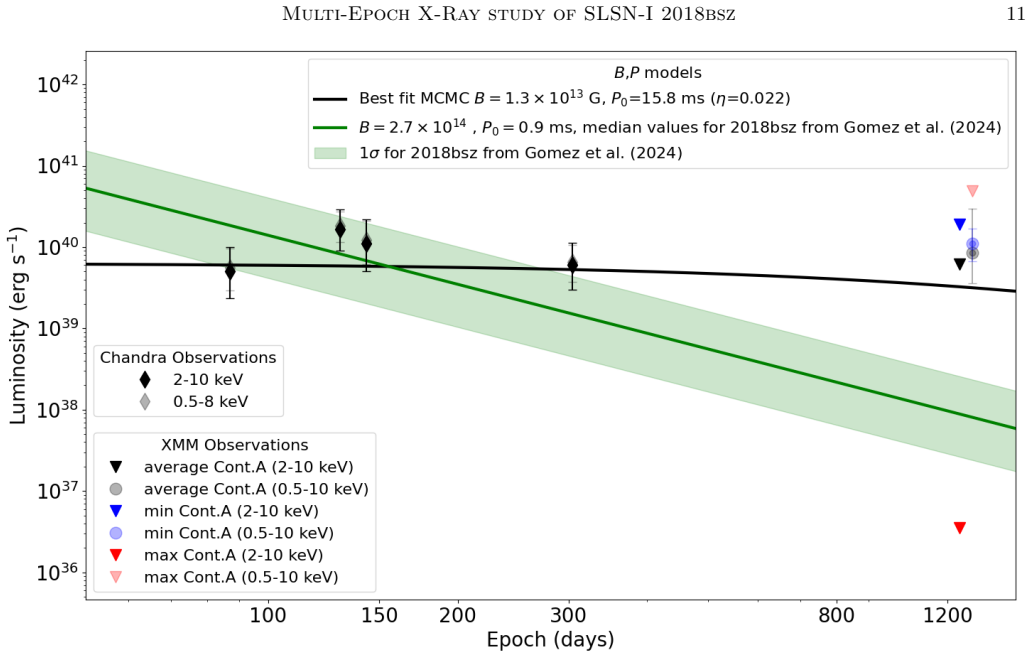
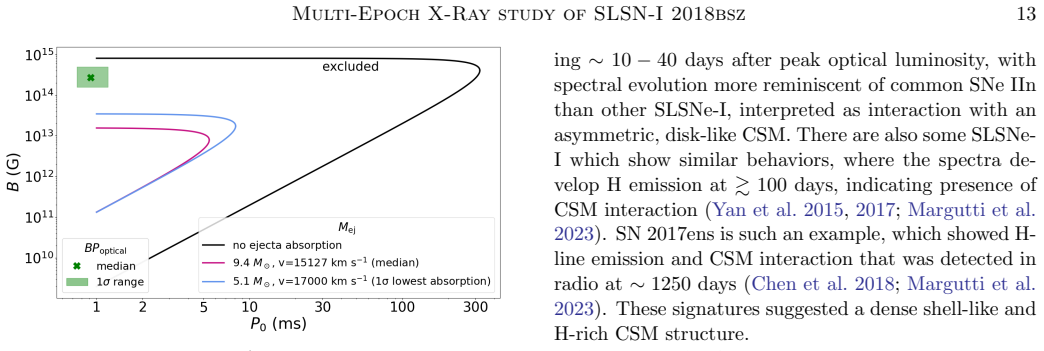
SN 2018bsz is detected in X-rays at all four Chandra epochs and tentatively in the later XMM observation. The luminosities and relatively flat light curve are not reproduced by a millisecond magnetar central engine, even before accounting for absorption by the ejecta; adding absorption widens the discrepancy. The observations are instead more readily explained by early-time interaction between the ejecta and circumstellar medium, with magnetar emission absorbed by the ejecta. This picture is consistent with the flat temporal evolution, previous optical results, and inferred mass-loss rates that match those of stripped supernovae that evolve into interacting systems.
What carries the argument
Multi-epoch X-ray light curve and spectral comparison to magnetar spin-down and ejecta-CSM interaction models, including the effects of absorption within the ejecta.
If this is right
- SN 2018bsz belongs to a distinct group of SLSNe-I in which interaction is required to produce the strong emission.
- The inferred mass-loss rates match those of stripped supernovae that later evolve into interacting systems.
- Magnetar emission is absorbed by the ejecta during the observed window, while interaction powers the detected X-rays.
- The flat light curve and luminosity evolution are signatures of early ejecta-CSM interaction rather than central-engine spin-down.
Where Pith is reading between the lines
- Similar X-ray monitoring of other nearby SLSNe-I could reveal how common early interaction is within the class.
- If interaction dominates a subset of SLSNe, their progenitors likely experienced enhanced mass loss shortly before explosion compared with non-interacting cases.
- Late-time X-ray observations beyond 1253 days could test whether magnetar emission eventually emerges once the ejecta become transparent.
Load-bearing premise
The X-ray source coincides with the supernova rather than nearby contaminants and the magnetar and interaction models correctly capture absorption and other relevant physics.
What would settle it
A deeper, higher-resolution X-ray image that shows the emission arises from a position offset from the supernova or from a separate contaminating source.
Figures
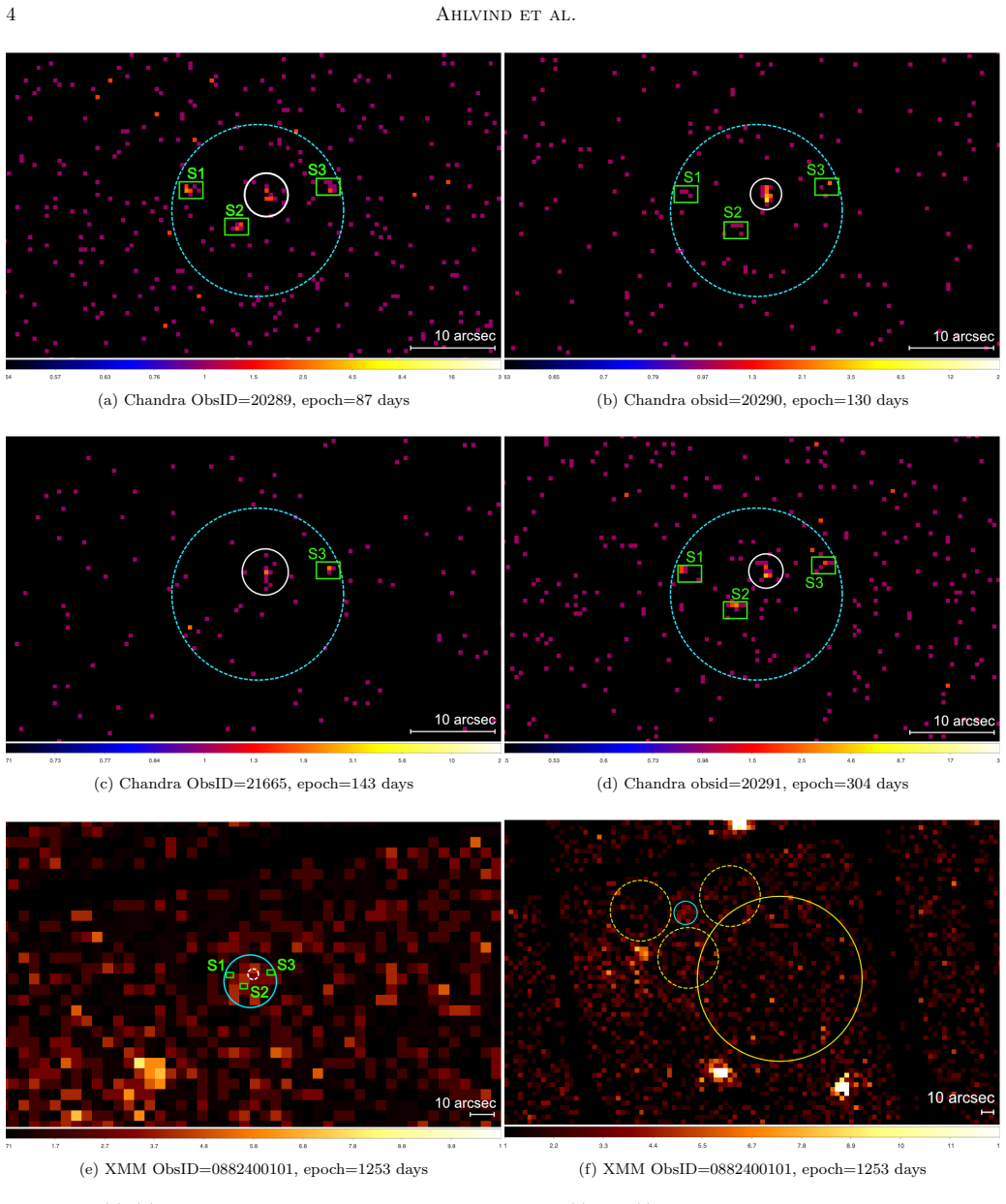
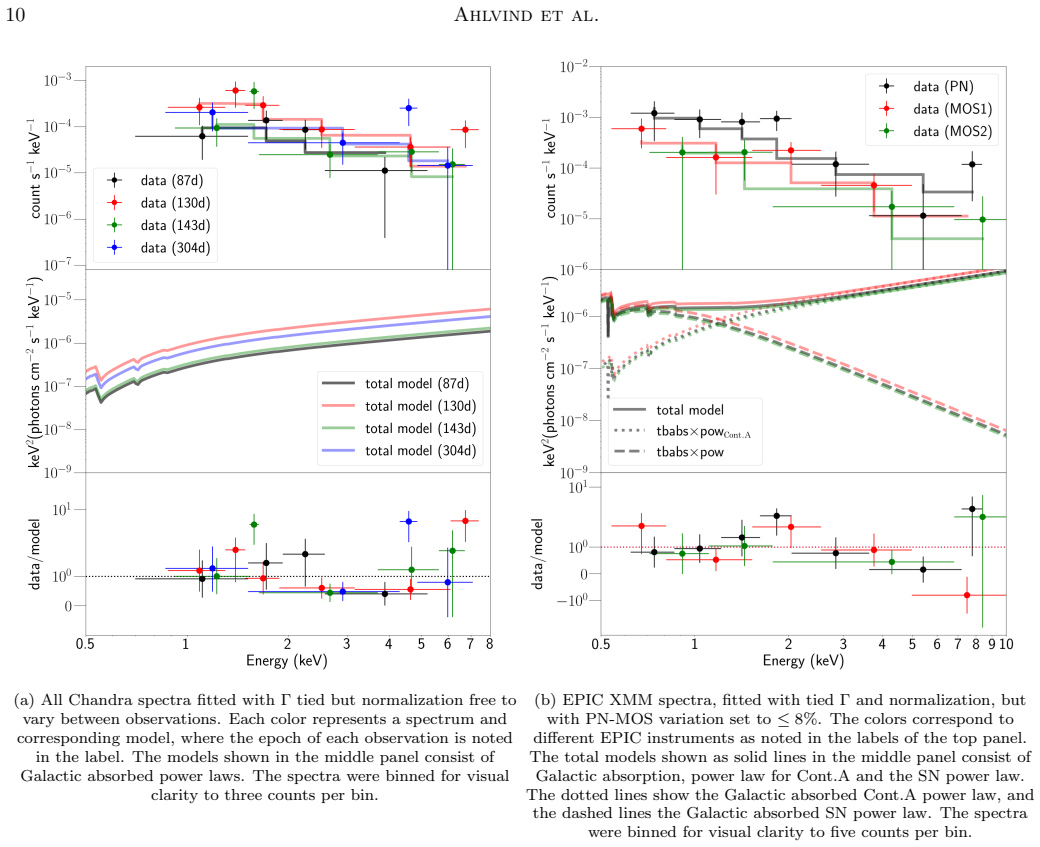
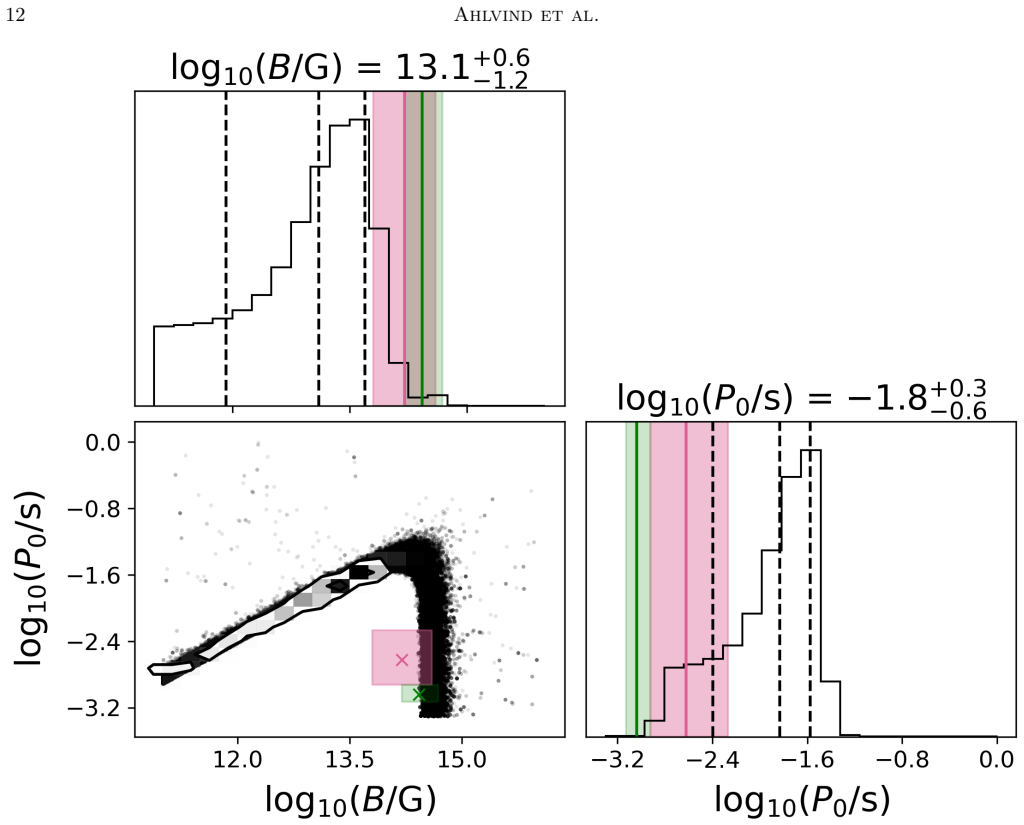
read the original abstract
SN 2018bsz is the closest known stripped superluminous supernova (SLSN-I) to date, making it an ideal laboratory for investigating the physical mechanisms powering this class of extreme explosions. We present a multi-epoch X-ray spectroscopic study of SN 2018bsz based on four Chandra observations followed by one XMM observation, spanning 87 to 1253 days after explosion. The source is detected at all Chandra epochs and is also tentatively detected in the late XMM observation, although more uncertain due to nearby contaminating sources. Regardless of the XMM detection, this makes SN 2018bsz the second X-ray detected SLSN-I and the third X-ray detected SLSN overall. We explore potential power sources for the observed X-ray emission and find that a millisecond magnetar central engine underpredicts most of the observed X-ray luminosities and fails to reproduce the relatively flat light curve. Accounting for ejecta absorption further increases the discrepancy. While asymmetries and magnetar-driven ionization could reduce the effective absorption, ionization breakout is expected years after our observational window. Instead, the observations are more readily explained by early-time interaction between the ejecta and the circumstellar medium, while the magnetar emission is absorbed by the ejecta. This scenario is supported by the flat temporal evolution, previous optical results, and inferred mass-loss rates which resemble those of stripped supernovae that later evolve into interacting systems. Our results thus favor the scenario where SN 2018bsz is part of a distinct group of SLSNe-I, where interaction is crucial for the strong emission.
Editorial analysis
A structured set of objections, weighed in public.
Referee Report
Summary. The manuscript reports multi-epoch X-ray detections of the stripped-envelope SLSN-I 2018bsz with Chandra (four epochs, 87–1253 d) and a tentative XMM detection. It compares the observed luminosities and flat light-curve shape against magnetar spin-down plus ejecta absorption and against ejecta-CSM interaction, concluding that the data favor early-time CSM interaction while magnetar emission remains absorbed, consistent with prior optical results and inferred mass-loss rates.
Significance. If the X-ray source is confirmed to be intrinsic, the work adds the second X-ray-detected SLSN-I and supplies direct constraints on powering mechanisms. The multi-epoch coverage and linkage to stripped SNe that later show interaction are strengths that would help delineate a distinct interaction-dominated subclass of SLSNe-I.
major comments (2)
- [Abstract / XMM observation] Abstract and XMM-epoch description: the detection is flagged as tentative owing to nearby contaminants. It is unclear whether analogous flux contributions from nearby sources affect any of the four Chandra epochs; if so, both the absolute luminosities and the claimed flat temporal evolution become unreliable, directly weakening the quantitative statement that magnetar models underpredict the data.
- [Model comparison section] Model-comparison discussion: the claim that magnetar spin-down plus ejecta absorption increases the discrepancy with the observed luminosities requires explicit reporting of the absorption optical-depth calculation, the adopted magnetar parameters (period, B-field, etc.), and the precise luminosity values with uncertainties used in the comparison; without these the central rejection of the magnetar scenario cannot be evaluated.
minor comments (2)
- A table listing net counts, exposure times, absorbed and unabsorbed fluxes, and luminosities (with 1σ errors) for each epoch would improve clarity and allow direct assessment of the flatness claim.
- The data-reduction steps (source extraction regions, background subtraction, pile-up checks, and handling of nearby sources) should be described in sufficient detail for reproducibility.
Simulated Author's Rebuttal
We thank the referee for their thorough review and constructive feedback on our manuscript. We address each major comment below and will incorporate clarifications and additional details in the revised version.
read point-by-point responses
-
Referee: [Abstract / XMM observation] Abstract and XMM-epoch description: the detection is flagged as tentative owing to nearby contaminants. It is unclear whether analogous flux contributions from nearby sources affect any of the four Chandra epochs; if so, both the absolute luminosities and the claimed flat temporal evolution become unreliable, directly weakening the quantitative statement that magnetar models underpredict the data.
Authors: We appreciate this concern regarding potential contamination. The Chandra observations benefit from significantly higher angular resolution than XMM-Newton, and our analysis confirms that the source position shows no detectable contribution from nearby contaminants in any of the four epochs; the detections are robust with source counts well above the local background. Nevertheless, to strengthen the presentation we will add an explicit discussion of the contaminant analysis for the Chandra data, including any upper limits on nearby source contributions and confirmation that the reported luminosities and flat light-curve shape remain unchanged. revision: yes
-
Referee: [Model comparison section] Model-comparison discussion: the claim that magnetar spin-down plus ejecta absorption increases the discrepancy with the observed luminosities requires explicit reporting of the absorption optical-depth calculation, the adopted magnetar parameters (period, B-field, etc.), and the precise luminosity values with uncertainties used in the comparison; without these the central rejection of the magnetar scenario cannot be evaluated.
Authors: We agree that the model comparison section would be strengthened by greater transparency. In the revised manuscript we will explicitly report the adopted magnetar parameters (initial spin period and magnetic field strength), the calculated ejecta absorption optical depths at each observational epoch, and the precise observed and model-predicted X-ray luminosities together with their uncertainties. These additions will allow readers to reproduce and evaluate the comparison directly. revision: yes
Circularity Check
Minor self-citation on optical support; X-ray model comparisons remain independent.
full rationale
The paper's central claim rests on direct comparison of observed Chandra and XMM X-ray luminosities and the flat light-curve shape against standard magnetar spin-down and ejecta-CSM interaction model predictions drawn from the literature. No parameters are fitted to the X-ray data itself, and the models are not redefined in terms of the present observations. The reference to 'previous optical results' is a minor self-citation that provides supporting context but does not carry the load of the X-ray-based preference for interaction. No self-definitional equations, fitted-input predictions, uniqueness theorems, or ansatz smuggling appear in the derivation chain.
Axiom & Free-Parameter Ledger
Reference graph
Works this paper leans on
-
[1]
2026, ApJ, 997, 180, doi: 10.3847/1538-4357/ae1d7c
Ahlvind, J., Larsson, J., & Alp, D. 2026, ApJ, 997, 180, doi: 10.3847/1538-4357/ae1d7c
-
[2]
2018, ApJ, 864, 175, doi: 10.3847/1538-4357/aad737
Alp, D., Larsson, J., Fransson, C., et al. 2018, ApJ, 864, 175, doi: 10.3847/1538-4357/aad737
-
[3]
Anderson, J. P., Pessi, P. J., Dessart, L., et al. 2018a, A&A, 620, A67, doi: 10.1051/0004-6361/201833725
-
[4]
Ansoldi, S., Antonelli, L. A., Antoranz, P., et al. 2016, A&A, 585, A133, doi: 10.1051/0004-6361/201526853
-
[5]
Arnaud, K. A. 1996, in Astronomical Society of the Pacific Conference Series, Vol. 101, Astronomical Data Analysis Software and Systems V, ed. G. H. Jacoby & J. Barnes, 17 Astropy Collaboration, Robitaille, T. P., Tollerud, E. J., et al. 2013, A&A, 558, A33, doi: 10.1051/0004-6361/201322068 Astropy Collaboration, Price-Whelan, A. M., Sip˝ ocz, B. M., et a...
-
[6]
2011, ApJ, 729, 12, doi: 10.1088/0004-637X/729/1/12
Boroson, B., Kim, D.-W., & Fabbiano, G. 2011, ApJ, 729, 12, doi: 10.1088/0004-637X/729/1/12
-
[7]
Brethauer, D., Margutti, R., Milisavljevic, D., et al. 2022, ApJ, 939, 105, doi: 10.3847/1538-4357/ac8b14
-
[8]
2018, The Astronomer’s Telegram, 11660, 1 16Ahlvind et al
Brimacombe, J., Castro, N., Clocchiatti, A., et al. 2018, The Astronomer’s Telegram, 11660, 1 16Ahlvind et al
2018
-
[9]
2019, ApJ, 874, 68, doi: 10.3847/1538-4357/ab0ae6
Chatzopoulos, E., & Tuminello, R. 2019, ApJ, 874, 68, doi: 10.3847/1538-4357/ab0ae6
-
[10]
Chatzopoulos, E., Wheeler, J. C., Vinko, J., Horvath, Z. L., & Nagy, A. 2013, ApJ, 773, 76, doi: 10.1088/0004-637X/773/1/76
-
[11]
2018, ApJL, 867, L31, doi: 10.3847/2041-8213/aaeb2e
Chen, T.-W., Inserra, C., Fraser, M., et al. 2018, ApJL, 867, L31, doi: 10.3847/2041-8213/aaeb2e
-
[12]
Chen, T. W., Brennan, S. J., Wesson, R., et al. 2021, arXiv e-prints, arXiv:2109.07942, doi: 10.48550/arXiv.2109.07942
-
[13]
H., Yan, L., Kangas, T., et al
Chen, Z. H., Yan, L., Kangas, T., et al. 2023, ApJ, 943, 42, doi: 10.3847/1538-4357/aca162
-
[14]
Cheng, K. S., Taam, R. E., & Wang, W. 2004, ApJ, 617, 480, doi: 10.1086/425295
-
[15]
Chevalier, R. A., & Fransson, C. 2017, in Handbook of Supernovae, ed. A. W. Alsabti & P. Murdin, 875, doi: 10.1007/978-3-319-21846-5 34 De Cia, A., Gal-Yam, A., Rubin, A., et al. 2018, ApJ, 860, 100, doi: 10.3847/1538-4357/aab9b6
-
[16]
, archivePrefix = "arXiv", eprint =
Blondin, S. 2012, MNRAS, 426, L76, doi: 10.1111/j.1745-3933.2012.01329.x
-
[17]
2013, ApJ, 772, 30, doi: 10.1088/0004-637X/772/1/30
Dexter, J., & Kasen, D. 2013, ApJ, 772, 30, doi: 10.1088/0004-637X/772/1/30
-
[18]
Dwarkadas, V. V. 2016, IAU Focus Meeting, 29B, 223, doi: 10.1017/S1743921316005019
-
[19]
2019, ApJL, 876, L10, doi: 10.3847/2041-8213/ab18a5
Eftekhari, T., Berger, E., Margalit, B., et al. 2019, ApJL, 876, L10, doi: 10.3847/2041-8213/ab18a5
-
[20]
2026, MNRAS, 547, stag306, doi: 10.1093/mnras/stag306
Eiden, K., & Kasen, D. 2026, MNRAS, 547, stag306, doi: 10.1093/mnras/stag306
-
[21]
Evans, I. N., Evans, J. D., Mart´ ınez-Galarza, J. R., et al. 2024, ApJS, 274, 22, doi: 10.3847/1538-4365/ad6319
-
[22]
2016, The Journal of Open Source Software, 1, 24, doi: 10.21105/joss.00024
Foreman-Mackey, D. 2016, The Journal of Open Source Software, 1, 24, doi: 10.21105/joss.00024
-
[23]
Foreman-Mackey, D., Hogg, D. W., Lang, D., & Goodman, J. 2013, PASP, 125, 306, doi: 10.1086/670067
-
[25]
Fruscione, A., McDowell, J. C., Allen, G. E., et al. 2006b, in Society of Photo-Optical Instrumentation Engineers (SPIE) Conference Series, Vol. 6270, Society of Photo-Optical Instrumentation Engineers (SPIE) Conference Series, ed. D. R. Silva & R. E. Doxsey, 62701V, doi: 10.1117/12.671760
-
[26]
2026, A&A, 707, A338, doi: 10.1051/0004-6361/202557673
Gkini, A., Fransson, C., Lunnan, R., et al. 2026, A&A, 707, A338, doi: 10.1051/0004-6361/202557673
-
[27]
2024, MNRAS, 535, 471, doi: 10.1093/mnras/stae2270
Gomez, S., Nicholl, M., Berger, E., et al. 2024, MNRAS, 535, 471, doi: 10.1093/mnras/stae2270
-
[28]
P., Heckman, T., Strickland, D., & Ptak, A
Grimes, J. P., Heckman, T., Strickland, D., & Ptak, A. 2005, ApJ, 628, 187, doi: 10.1086/430692
-
[29]
Harris, C. R., Millman, K. J., van der Walt, S. J., et al. 2020, Nature, 585, 357–362, doi: 10.1038/s41586-020-2649-2
-
[30]
A., Kasen, D., Lidman, C., et al
Howell, D. A., Kasen, D., Lidman, C., et al. 2013, ApJ, 779, 98, doi: 10.1088/0004-637X/779/2/98
-
[31]
2017, MNRAS, 468, 4642, doi: 10.1093/mnras/stx834
Inserra, C., Nicholl, M., Chen, T.-W., et al. 2017, MNRAS, 468, 4642, doi: 10.1093/mnras/stx834
-
[32]
Jerkstrand, A., Smartt, S. J., Inserra, C., et al. 2017, ApJ, 835, 13, doi: 10.3847/1538-4357/835/1/13
-
[33]
A., & Mandel, E
Joye, W. A., & Mandel, E. 2003, in Astronomical Society of the Pacific Conference Series, Vol. 295, Astronomical Data Analysis Software and Systems XII, ed. H. E
2003
-
[34]
Justham, S., Podsiadlowski, P., & Vink, J. S. 2014, ApJ, 796, 121, doi: 10.1088/0004-637X/796/2/121
-
[35]
2010, ApJ, 717, 245, doi: 10.1088/0004-637X/717/1/245
Kasen, D., & Bildsten, L. 2010, ApJ, 717, 245, doi: 10.1088/0004-637X/717/1/245
-
[36]
Kuncarayakti, H., Maeda, K., Ashall, C. J., et al. 2018, ApJL, 854, L14, doi: 10.3847/2041-8213/aaaa1a
-
[37]
2012, A&A, 541, A129, doi: 10.1051/0004-6361/201118498
Leloudas, G., Chatzopoulos, E., Dilday, B., et al. 2012, A&A, 541, A129, doi: 10.1051/0004-6361/201118498
-
[38]
Levan, A. J., Read, A. M., Metzger, B. D., Wheatley, P. J., & Tanvir, N. R. 2013, ApJ, 771, 136, doi: 10.1088/0004-637X/771/2/136
-
[39]
2008, ApJ, 682, 1166, doi: 10.1086/589495
Li, X.-H., Lu, F.-J., & Li, Z. 2008, ApJ, 682, 1166, doi: 10.1086/589495
-
[40]
Lunnan, R., Fransson, C., Vreeswijk, P. M., et al. 2018, Nature Astronomy, 2, 887, doi: 10.1038/s41550-018-0568-z
-
[41]
K., Forster, K., Grefenstette, B
Madsen, K. K., Forster, K., Grefenstette, B. W., Harrison, F. A., & Stern, D. 2017, ApJ, 841, 56, doi: 10.3847/1538-4357/aa6970
-
[42]
2007, ApJ, 666, 1069, doi: 10.1086/520054
Maeda, K., Tanaka, M., Nomoto, K., et al. 2007, ApJ, 666, 1069, doi: 10.1086/520054
-
[43]
Margutti, R., Chornock, R., Metzger, B. D., et al. 2018, ApJ, 864, 45, doi: 10.3847/1538-4357/aad2df
-
[44]
Margutti, R., Bright, J. S., Matthews, D. J., et al. 2023, ApJL, 954, L45, doi: 10.3847/2041-8213/acf1fd
-
[45]
Mauerhan, J. C., Filippenko, A. V., Zheng, W., et al. 2018, MNRAS, 478, 5050, doi: 10.1093/mnras/sty1307
-
[46]
A., Sullivan, M., Pian, E., Greiner, J., & Kann, D
Mazzali, P. A., Sullivan, M., Pian, E., Greiner, J., & Kann, D. A. 2016, MNRAS, 458, 3455, doi: 10.1093/mnras/stw512
-
[47]
D., Vurm, I., Hasco¨ et, R., & Beloborodov, A
Metzger, B. D., Vurm, I., Hasco¨ et, R., & Beloborodov, A. M. 2014, MNRAS, 437, 703, doi: 10.1093/mnras/stt1922 Multi-Epoch X-Ray study of SLSN-I 2018bsz17
-
[48]
2015, ApJ, 815, 120, doi: 10.1088/0004-637X/815/2/120
Milisavljevic, D., Margutti, R., Kamble, A., et al. 2015, ApJ, 815, 120, doi: 10.1088/0004-637X/815/2/120
-
[49]
Langer, N. 2015, A&A, 584, L5, doi: 10.1051/0004-6361/201527515 Nasa High Energy Astrophysics Science Archive Research Center (Heasarc). 2014a, HEAsoft: Unified Release of FTOOLS and XANADU, Astrophysics Source Code Library, record ascl:1408.004. http://ascl.net/1408.004 —. 2014b, HEAsoft: Unified Release of FTOOLS and
-
[50]
2017, ApJ, 850, 55, doi: 10.3847/1538-4357/aa9334
Nicholl, M., Guillochon, J., & Berger, E. 2017, ApJ, 850, 55, doi: 10.3847/1538-4357/aa9334
-
[51]
Nicholl, M., Smartt, S. J., Jerkstrand, A., et al. 2015, MNRAS, 452, 3869, doi: 10.1093/mnras/stv1522
-
[52]
Nicholl, M., Berger, E., Smartt, S. J., et al. 2016, ApJ, 826, 39, doi: 10.3847/0004-637X/826/1/39
-
[53]
2020, A&A, 637, A73, doi: 10.1051/0004-6361/201936097
Nyholm, A., Sollerman, J., Tartaglia, L., et al. 2020, A&A, 637, A73, doi: 10.1051/0004-6361/201936097
-
[54]
Ofek, E. O., Cameron, P. B., Kasliwal, M. M., et al. 2007, ApJL, 659, L13, doi: 10.1086/516749
-
[55]
Ofek, E. O., Fox, D., Cenko, S. B., et al. 2013, ApJ, 763, 42, doi: 10.1088/0004-637X/763/1/42
-
[56]
Ostriker, J. P., & Gunn, J. E. 1969, ApJ, 157, 1395, doi: 10.1086/150160
-
[57]
Owen, R. A., & Warwick, R. S. 2009, MNRAS, 394, 1741, doi: 10.1111/j.1365-2966.2009.14464.x
-
[58]
J., Lunnan, R., Sollerman, J., et al
Pessi, P. J., Lunnan, R., Sollerman, J., et al. 2025, A&A, 695, A142, doi: 10.1051/0004-6361/202452014
-
[59]
2022, A&A, 666, A30, doi: 10.1051/0004-6361/202243256
Pursiainen, M., Leloudas, G., Paraskeva, E., et al. 2022, A&A, 666, A30, doi: 10.1051/0004-6361/202243256
-
[60]
Quimby, R. M. 2014, in IAU Symposium, Vol. 296, Supernova Environmental Impacts, ed. A. Ray & R. A. McCray, 68–76, doi: 10.1017/S1743921313009253
-
[61]
M., Guainazzi, M., & Sembay, S
Read, A. M., Guainazzi, M., & Sembay, S. 2014, A&A, 564, A75, doi: 10.1051/0004-6361/201423422
-
[62]
The physics of compact objects
Shapiro, S. L., & Teukolsky, S. A. 1983, Black holes, white dwarfs and neutron stars. The physics of compact objects, doi: 10.1002/9783527617661
-
[63]
Shappee, B. J., Prieto, J. L., Grupe, D., et al. 2014, ApJ, 788, 48, doi: 10.1088/0004-637X/788/1/48
work page internal anchor Pith review doi:10.1088/0004-637x/788/1/48 2014
-
[64]
2016, ApJ, 833, 59, doi: 10.3847/1538-4357/833/1/59
Shibata, S., Watanabe, E., Yatsu, Y., Enoto, T., & Bamba, A. 2016, ApJ, 833, 59, doi: 10.3847/1538-4357/833/1/59
-
[65]
2014, ARA&A, 52, 487, doi: 10.1146/annurev-astro-081913-040025
Smith, N. 2014, ARA&A, 52, 487, doi: 10.1146/annurev-astro-081913-040025
-
[66]
2008, ApJ, 686, 467, doi: 10.1086/591021
Smith, N., Chornock, R., Li, W., et al. 2008, ApJ, 686, 467, doi: 10.1086/591021
-
[67]
Filippenko, A. V. 2011, MNRAS, 415, 773, doi: 10.1111/j.1365-2966.2011.18763.x
-
[68]
J., et al.\ 2006, , 666, 1116, doi:10.1086/519949
Smith, N., Li, W., Foley, R. J., et al. 2007, ApJ, 666, 1116, doi: 10.1086/519949
-
[69]
Frail, D. A. 2006, ApJ, 651, 1005, doi: 10.1086/507571
-
[70]
Sollerman, J., Fransson, C., Barbarino, C., et al. 2020, A&A, 643, A79, doi: 10.1051/0004-6361/202038960
-
[71]
Stanek, K. Z. 2018, Transient Name Server Discovery Report, 2018-655, 1
2018
-
[72]
Virtanen, P., Gommers, R., Oliphant, T. E., et al. 2020, Nature Methods, 17, 261, doi: 10.1038/s41592-019-0686-2
-
[73]
Willingale, R., Starling, R. L. C., Beardmore, A. P., Tanvir, N. R., & O’Brien, P. T. 2013, MNRAS, 431, 394, doi: 10.1093/mnras/stt175
-
[74]
2000, ApJ, 542, 914, doi: 10.1086/317016
Wilms, J., Allen, A., & McCray, R. 2000, ApJ, 542, 914, doi: 10.1086/317016
work page internal anchor Pith review doi:10.1086/317016 2000
-
[75]
Woosley, S. E. 2010, ApJL, 719, L204, doi: 10.1088/2041-8205/719/2/L204
-
[76]
2015, ApJ, 814, 108, doi: 10.1088/0004-637X/814/2/108
Yan, L., Quimby, R., Ofek, E., et al. 2015, ApJ, 814, 108, doi: 10.1088/0004-637X/814/2/108
-
[77]
Yan, L., Lunnan, R., Perley, D. A., et al. 2017, ApJ, 848, 6, doi: 10.3847/1538-4357/aa8993
discussion (0)
Sign in with ORCID, Apple, or X to comment. Anyone can read and Pith papers without signing in.