Timestamp-Aware Spatio-Temporal Graph Contrastive Learning for Network Intrusion Detection
Pith reviewed 2026-06-27 04:06 UTC · model grok-4.3
The pith
Timestamp-aware temporal graphs with multi-view contrastive learning let a self-supervised GNN match supervised performance on network intrusion detection.
A machine-rendered reading of the paper's core claim, the machinery that carries it, and where it could break.
Core claim
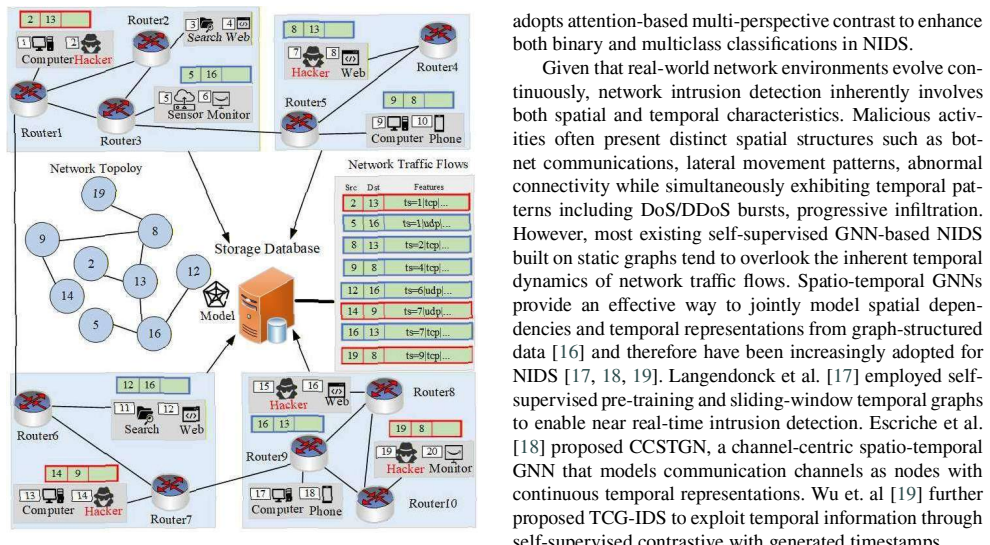
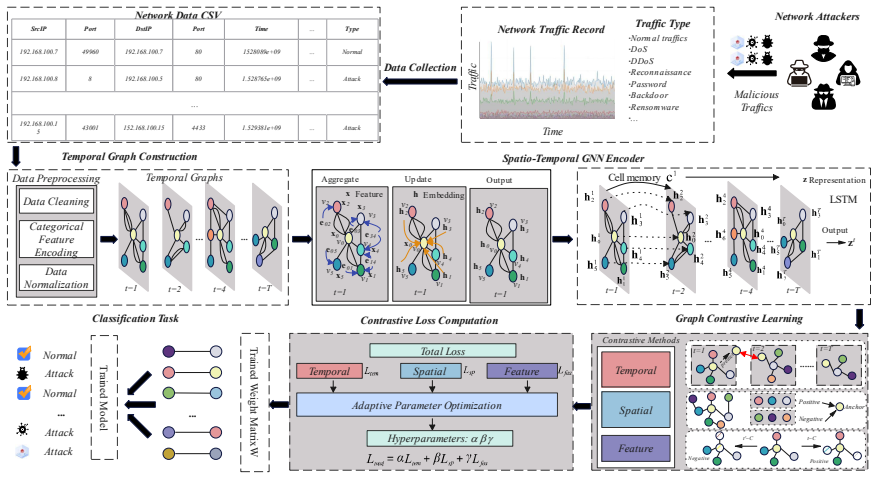
By constructing temporal graphs from network traffic according to timestamps and applying joint temporal-spatial-feature contrastive learning inside an E-GraphSAGE-LSTM encoder, the model learns representations that capture evolving attack patterns in a fully self-supervised way, reaching detection performance comparable to supervised state-of-the-art GNNs on four representative datasets while preserving computational efficiency.
What carries the argument
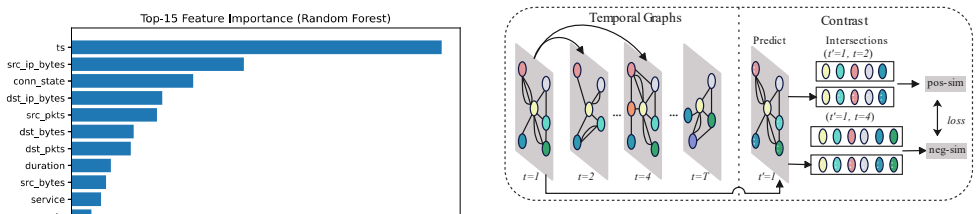
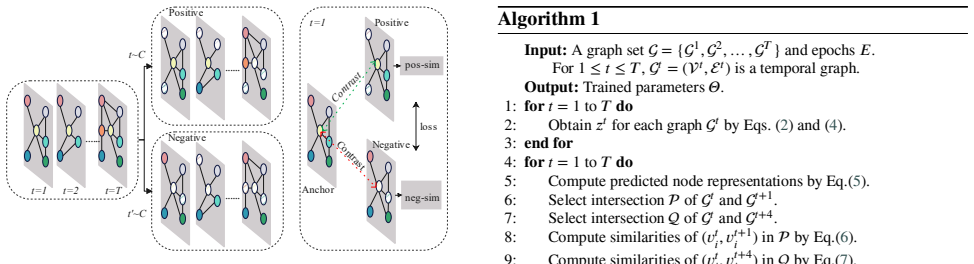
Multi-view graph contrastive learning performed jointly on temporal, spatial, and feature views of timestamp-derived temporal graphs, with gradient-norm adaptive loss weighting.
If this is right
- The model can adapt to evolving attack behaviors by exploiting timestamp-derived temporal continuity rather than treating flows as independent.
- Label requirements for training NIDS drop because the contrastive objectives operate without attack annotations.
- Detection remains efficient because the encoder avoids time-costly attention mechanisms.
- Representations gain robustness to unseen attacks through the combination of structural consistency and feature-level contrast.
- The adaptive weighting scheme automatically balances the three contrastive losses during training.
Where Pith is reading between the lines
- The same timestamp-graph construction could be tested on other streaming graph tasks such as fraud detection or sensor networks where event order matters.
- Replacing the LSTM component with a different recurrent or state-space model might further reduce latency while preserving the temporal contrast.
- The multi-view contrast could be extended to include an additional view derived from packet-level features if finer-grained data become available.
Load-bearing premise
That the temporal ordering of flows by their recorded timestamps supplies the faithful dependencies needed to separate normal from attack traffic in the learned representations.
What would settle it
On a held-out NIDS dataset with verified real timestamps, if the method fails to exceed existing self-supervised GNN baselines or to reach within a few percent of the supervised GNN accuracy while keeping similar runtime, the central performance claim would not hold.
Figures
read the original abstract
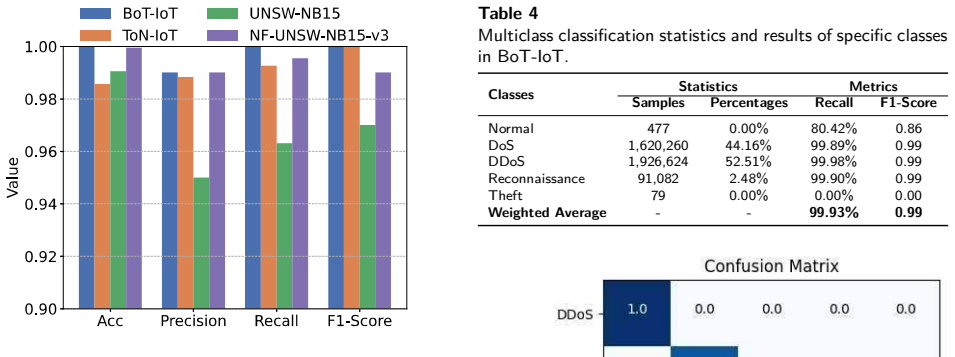
Given their effectiveness in modeling the relational structure among network traffic flows, graph neural networks (GNNs) have been widely adopted in network intrusion detection systems (NIDSs). However, most existing GNN-based NIDS approaches focus on the relational structure of traffic flows, and treat them as temporally independent, which limits their ability to cope with evolving attack behaviors. Moreover, their reliance on supervised or semi-supervised learning often restricts generalization to unseen attacks. To address these limitations, we propose a novel self-supervised GNN-based framework. To the best of our knowledge, the proposed model is among the first self-supervised GNN-based NIDS models to explicitly leverage real timestamps, which provides faithful temporal dependencies for representation learning. We first construct a series of temporal graphs from network traffic flows according to their timestamps, and then employ an E-GraphSAGE and LSTM based encoder to fully extract temporal information and spatial dependencies of network traffic, without introducing time-costly attention mechanisms. A multi-view graph contrastive learning (GCL) scheme is introduced, where temporal, spatial, and feature contrasts are jointly performed to capture temporal continuity, preserve structural consistency, and improve the generalization and robustness of the learned representations, respectively. In addition, a gradient-norm-based adaptive weighting strategy is designed to optimize the contrastive loss weights. Experimental results on four representative NIDS datasets with real timestamps demonstrate that our method significantly outperforms existing self-supervised approaches and achieves performance comparable to the supervised state-of-the-art GNN method, while maintaining high computational efficiency.
Editorial analysis
A structured set of objections, weighed in public.
Referee Report
Summary. The paper proposes a self-supervised GNN framework for NIDS that constructs a sequence of temporal graphs from network flows ordered by real timestamps, encodes them with an E-GraphSAGE+LSTM model, and applies multi-view contrastive learning (temporal, spatial, and feature views) with a gradient-norm adaptive weighting scheme. It claims this yields representations that significantly outperform prior self-supervised GNN methods and reach parity with supervised SOTA GNNs on four timestamped NIDS datasets while remaining computationally efficient.
Significance. If the empirical claims hold after verification, the work would be a meaningful contribution by being among the first to incorporate real timestamps into self-supervised spatio-temporal GCL for NIDS, avoiding attention overhead, and demonstrating improved generalization without labels. The multi-view contrast and adaptive weighting are concrete technical strengths that could be adopted more broadly.
major comments (2)
- [§3] §3 (Temporal Graph Construction): the assertion that ordering flows by timestamps supplies 'faithful temporal dependencies' for attack evolution is load-bearing for the performance attribution, yet the manuscript provides no time-binning procedure, sub-second handling, or diagnostic (e.g., ablation on shuffled timestamps or attack-phase alignment) to rule out collection artifacts or traffic-volume correlations.
- [Experimental results] Experimental results section (and abstract): performance claims of 'significantly outperforms' self-supervised baselines and 'comparable to supervised SOTA' are presented without reported data splits, statistical tests, error bars, or exact baseline implementations; this prevents verification that gains are attributable to the timestamp mechanism rather than implementation differences.
minor comments (2)
- [§4] Clarify whether E-GraphSAGE is a standard GraphSAGE variant or a custom extension, and provide the precise equations for the LSTM integration with the graph encoder.
- [§2] Add a short related-work paragraph distinguishing the proposed multi-view GCL from prior temporal GCL methods in other domains.
Simulated Author's Rebuttal
We thank the referee for the constructive comments, which highlight areas where additional detail will improve the clarity and verifiability of our contributions. We respond to each major comment below and indicate the revisions we will make.
read point-by-point responses
-
Referee: [§3] §3 (Temporal Graph Construction): the assertion that ordering flows by timestamps supplies 'faithful temporal dependencies' for attack evolution is load-bearing for the performance attribution, yet the manuscript provides no time-binning procedure, sub-second handling, or diagnostic (e.g., ablation on shuffled timestamps or attack-phase alignment) to rule out collection artifacts or traffic-volume correlations.
Authors: We agree that the manuscript would benefit from explicit details on temporal graph construction to support the claim of faithful temporal dependencies. In the revised version we will expand §3 to specify the time-binning procedure, sub-second timestamp handling, and include an ablation that shuffles timestamps while keeping other factors fixed. This will help isolate the contribution of real temporal ordering from potential collection artifacts or volume correlations. revision: yes
-
Referee: [Experimental results] Experimental results section (and abstract): performance claims of 'significantly outperforms' self-supervised baselines and 'comparable to supervised SOTA' are presented without reported data splits, statistical tests, error bars, or exact baseline implementations; this prevents verification that gains are attributable to the timestamp mechanism rather than implementation differences.
Authors: We concur that greater experimental rigor is required for reproducibility and to attribute gains specifically to the timestamp-aware components. The revised experimental section will report the exact data splits used, results averaged over multiple random seeds with standard error bars, statistical significance tests against baselines, and precise implementation details (including code references or hyper-parameter settings) for all compared methods. revision: yes
Circularity Check
No significant circularity; empirical framework with external validation
full rationale
The paper proposes a timestamp-aware spatio-temporal GCL framework for NIDS, constructs temporal graphs from flow timestamps, encodes with E-GraphSAGE+LSTM, applies multi-view contrastive losses, and reports experimental gains on four real-timestamp datasets. No derivation chain, equations, or predictions are present that reduce by construction to fitted inputs or self-citations. Central claims rest on direct empirical comparisons to self-supervised and supervised baselines rather than any self-definitional, fitted-input, or uniqueness-imported step. The work is self-contained against external benchmarks.
Axiom & Free-Parameter Ledger
Reference graph
Works this paper leans on
-
[1]
developed a networkanomaly detection framework based on continuous temporalgraph (CTG) neural network, which refines the specificinformation interactions, thus naturally incorporating newnode access behaviors into the feature extraction of CTGneural networks.These studies collectively highlight the importance ofjointly modeling spatial dependencies and temp...
-
[2]
0.054Ours0.032NEGAT+NEGSCToN-IoT0.115TCG-IDS 0.063Ours0.032NEGAT+NEGSCUNSW-NB150.550TCG-IDS 0.376Ours0.077NEGAT+NEGSCNF-UNSW-NB15-v30.045TCG-IDS 0.047Ours0.043contribution among the three components. The exclusion ofthe spatial module also results in noticeable performancedrops, although its impact is generally less severe thanthat of the temporal module....
Pith/arXiv arXiv 2019
-
[3]
K.-J. Chen, L. Liu, L. Jiang, J. Chen, Self-supervised dynamic graphrepresentation learning via temporal subgraph contrast, ACM Trans-actions on Knowledge Discovery from Data 18 (1) (2023) 1–20.[32] H. Wang, X. Di, Y . Wang, B. Ren, G. Gao, J. Deng, An intelligentdigital twin method based on spatio-temporal feature fusion for iotattack behavior identificat...
Pith/arXiv arXiv 2023
discussion (0)
Sign in with ORCID, Apple, or X to comment. Anyone can read and Pith papers without signing in.