REVIEW 2 major objections 51 references
A matrix free action of the Ashtekar-Lewandowski volume operator of loop quantum gravity
T0 review · 2 major / 0 minor · reviewed 2026-07-01 · grok-4.3
Pith's one-line read A matrix-free method applies the Ashtekar-Lewandowski volume operator using repeated local operator actions and linear solves without assembling dense matrices.
desk verdict This paper gives a matrix-free SRQ implementation of the AL volume operator that exactly preserves the kernel and reaches spin cutoffs far beyond dense methods. read the letter →
The pith
A machine-rendered reading of the paper's core claim, the machinery that carries it, and where it could break.
The reading
What carries the argument
Shifted-resolvent quadrature (SRQ) applied to the Balakrishnan-Stieltjes representation of the fourth root of the Brunnemann-Thiemann operator Q_v.
What would settle it
A numerical test at moderate spin values on a four-valent vertex where the exact dense volume operator is still computable and the SRQ action deviates from the exact action by more than the stated residual error bound.
Extended reading notes
Core claim
The volume operator is realized matrix-free by replacing the spectral fourth-root step with a shifted-resolvent quadrature drawn from the Balakrishnan-Stieltjes integral representation of (Q_v²)^{1/4}; the resulting operator requires only repeated applications of the locally computable Q_v together with solves against shifted positive operators and therefore never materializes the full recoupling matrix.
Load-bearing premise
The chosen quadrature nodes and weights for the Balakrishnan-Stieltjes integral produce a sufficiently accurate approximation to the fourth root of Q_v² for the error bounds and kernel preservation to hold in the intended applications.
Editorial extensions
If this is right
- Zero-volume states remain exactly annihilated by the approximate operator.
- Vertex expectation values converge rapidly with the number of quadrature nodes.
- The method combines directly with stochastic Lanczos quadrature to estimate volume spectral measures in fixed spin sectors without forming dense matrices.
- Monte Carlo sampling of volume distributions becomes feasible at spin cutoffs far beyond those accessible by dense linear algebra.
Reading between the lines
- The same SRQ framework could be applied to other fractional powers of geometric operators that appear in the Hamiltonian constraint.
- Sector-wise scaling bounds suggest the cost remains polynomial in the number of edges incident on a vertex even as valence grows.
- Embedding the method inside existing multi-shift Krylov solvers would allow simultaneous evaluation of the volume operator at many quadrature shifts.
Editorial analysis
A structured set of objections, weighed in public.
Referee Report
Summary. The paper develops a matrix-free action for the Ashtekar-Lewandowski volume operator in LQG. It employs the Brunnemann-Thiemann expression for the oriented volume density Q_v (whose matrix elements are generated locally via recoupling theory) together with the Balakrishnan-Stieltjes integral representation of (Q_v²)^{1/4}, discretized by shifted-resolvent quadrature (SRQ). The resulting operator uses only repeated applications of Q_v and shifted positive linear solves. The manuscript claims exact preservation of the volume kernel, supplies operator-norm and residual error estimates together with sector-wise scaling bounds, validates the method on an embedded K5 graph at small spin cutoffs against dense local-block operators, demonstrates Monte-Carlo estimates at 2j=250000, and shows compatibility with stochastic Lanczos quadrature for fixed-sector spectral measures.
Significance. If the SRQ error bounds remain controlled under spectrum accumulation at zero, the approach would remove a major computational bottleneck in LQG by permitting volume-operator actions and spectral estimates on high-valence vertices and large spin cutoffs without dense matrix materialization. The exact kernel preservation, compatibility with multi-shift Krylov solvers, and the provision of explicit (if conditional) error estimates constitute concrete strengths that could support downstream Hamiltonian-constraint and physical-state studies.
major comments (2)
- [Error estimates and sector-wise scaling bounds] The operator-norm and residual error estimates for the SRQ approximation to (Q_v²)^{1/4} are stated to be controlled by the distance of the spectrum of Q_v from the shift parameter and by the quadrature nodes. However, the AL volume spectrum accumulates at zero for high-valence vertices or large spins; the manuscript does not demonstrate that the chosen shift and node distribution resolve this accumulation uniformly enough to keep pointwise or expectation-value errors below the claimed bounds on physical states (even while the kernel is exactly preserved).
- [Numerical simulations and Monte-Carlo estimates] Validation is performed only against dense local-block operators at small spin cutoffs on the K5 graph. The Monte-Carlo demonstration at doubled-spin cutoff 2j=250000 therefore supplies no independent confirmation that the approximation error remains controlled in the regime where dense comparison is impossible.
Simulated Author's Rebuttal
We thank the referee for the careful reading and constructive comments. We respond point-by-point to the major comments below, proposing clarifications where they strengthen the manuscript without altering its core claims.
read point-by-point responses
-
Referee: [Error estimates and sector-wise scaling bounds] The operator-norm and residual error estimates for the SRQ approximation to (Q_v²)^{1/4} are stated to be controlled by the distance of the spectrum of Q_v from the shift parameter and by the quadrature nodes. However, the AL volume spectrum accumulates at zero for high-valence vertices or large spins; the manuscript does not demonstrate that the chosen shift and node distribution resolve this accumulation uniformly enough to keep pointwise or expectation-value errors below the claimed bounds on physical states (even while the kernel is exactly preserved).
Authors: The operator-norm and residual estimates follow directly from the Balakrishnan-Stieltjes representation and the SRQ error analysis, which depend on the distance to the chosen shifts and the quadrature nodes. The manuscript already supplies sector-wise scaling bounds that track the spectral accumulation within each fixed-spin sector. Because the kernel is preserved exactly, any physical state (whose support lies in the positive spectrum) inherits error control from the residual bounds on the positive part. We will add a short clarifying paragraph in the error-analysis section that explicitly ties the shift selection (adapted to the sector-minimal positive eigenvalue) to uniform control under accumulation, thereby addressing the referee’s request for explicit demonstration on physical states. revision: partial
-
Referee: [Numerical simulations and Monte-Carlo estimates] Validation is performed only against dense local-block operators at small spin cutoffs on the K5 graph. The Monte-Carlo demonstration at doubled-spin cutoff 2j=250000 therefore supplies no independent confirmation that the approximation error remains controlled in the regime where dense comparison is impossible.
Authors: The small-cutoff comparisons serve to verify that the SRQ implementation reproduces the exact dense action (including kernel preservation) where reference solutions exist. The 2j=250000 Monte-Carlo run demonstrates feasibility beyond dense materialization and is justified by the a-priori operator-norm and residual bounds derived earlier; these bounds are independent of matrix size and apply directly to the large-spin regime. While we cannot furnish an independent dense reference at that scale, the combination of exact small-scale agreement, theoretical error control, and exact kernel preservation constitutes the appropriate validation strategy for a matrix-free method. revision: no
Circularity Check
No circularity: derivation uses independent mathematical representations and external recoupling theory
full rationale
The paper constructs a matrix-free action of the AL volume operator from the Brunnemann-Thiemann expression for the oriented volume density Q_v (generated locally via recoupling theory) and the Balakrishnan-Stieltjes integral representation of (Q_v²)^{1/4}, discretized by shifted-resolvent quadrature. These inputs are standard external tools; the exact kernel preservation follows directly from the representation properties without redefining the target operator, and operator-norm/residual error estimates are derived from spectral distance to the shift parameter rather than from fitted data. Validation compares against independent dense local-block operators at small cutoffs, while the large-spin Monte-Carlo demonstration extends the same method without parameter tuning to the target spectrum. No self-citation chain is load-bearing, no ansatz is smuggled, and no prediction reduces to a fitted input by construction. The derivation chain is therefore self-contained against external benchmarks.
Assumptions & free parameters
free parameters (1)
- bound parameters for SRQ
assumptions (2)
- standard math Balakrishnan-Stieltjes representation of (Q_v^2)^{1/4}
- domain assumption Local generation of matrix elements of Q_v from recoupling theory
Cite this review
Pith. "Pith review of A matrix free action of the Ashtekar-Lewandowski volume operator of loop quantum gravity." pith.science (2026). https://pith.science/paper/HGBXLTQA
@misc{pith2026260618397,
  author       = {Pith},
  title        = {Pith review of: A matrix free action of the Ashtekar-Lewandowski volume operator of loop quantum gravity},
  year         = {2026},
  howpublished = {\url{https://pith.science/paper/HGBXLTQA}},
  note         = {Machine review of arXiv:2606.18397}
}
abstract
The Ashtekar-Lewandowski (AL) volume operator of loop quantum gravity is central to the Hamiltonian constraint, but its vertex action is usually obtained from dense spectral decompositions of finite recoupling matrices, obstructing numerical analysis on large kinematical Hilbert spaces or high-valence vertices. We formulate a matrix free action of the $SU(2)$ AL vertex volume operator in standard recoupling basis, making use of the Brunnemann-Thiemann expression for the oriented AL volume density $Q_{v}$ whose matrix elements can be generated locally from recoupling theory without forming the full matrix. Based on the Balakrishnan-Stieltjes representation of $(Q_{v}^{2})^{1/4}$ we approximate the volume by shifted-resolvent quadrature (SRQ). The resulting action uses only repeated applications of $Q_{v}$ and shifted positive linear solves, making it compatible with multi-shift Krylov methods. We prove exact preservation of the volume kernel, provide operator-norm and residual error estimates, discuss sector-wise scaling bounds, and validate the method on an embedded $K_{5}$ graph at small spin cutoffs against exact dense local-block operators. Numerical simulations show rapid convergence of vertex expectation values, controlled dependence on bound parameters, and exact preservation of zero-volume modes. We further demonstrate matrix free Monte Carlo estimates at doubled-spin cutoff $2j=250000$ beyond dense materialisation, and show that SRQ can be combined with stochastic Lanczos quadrature to estimate fixed-sector volume spectral measures without dense volume matrices.
Figures
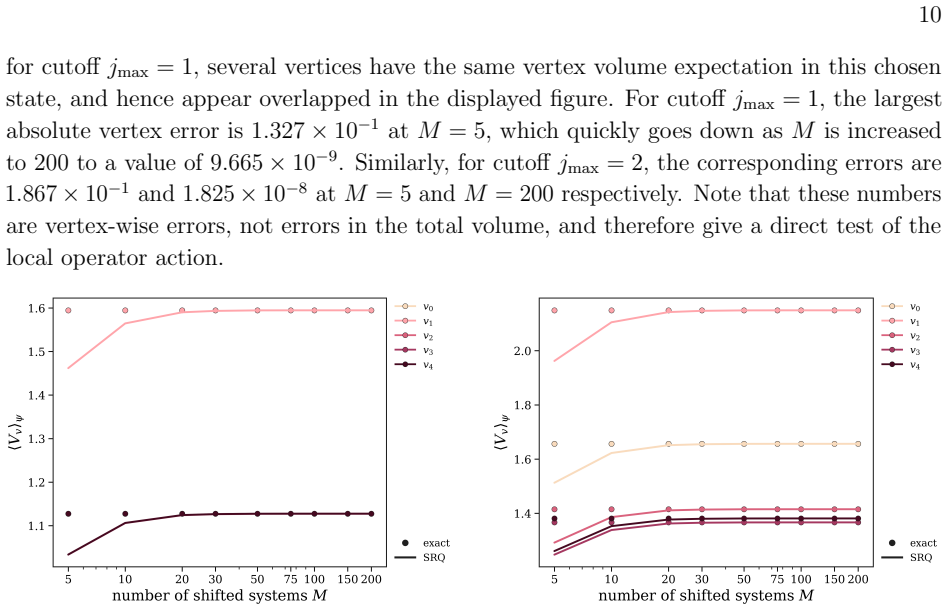
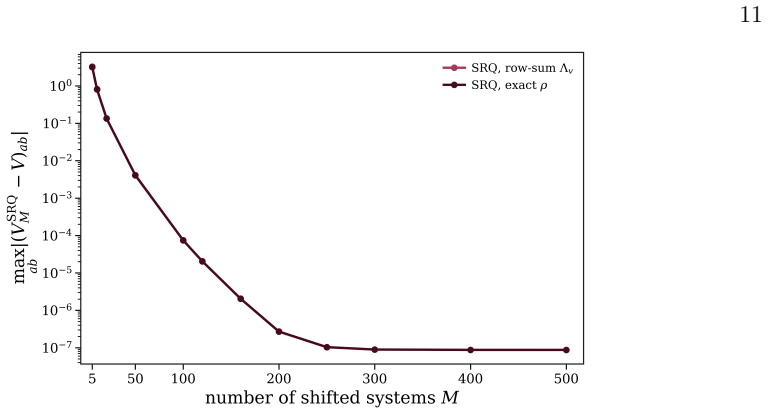
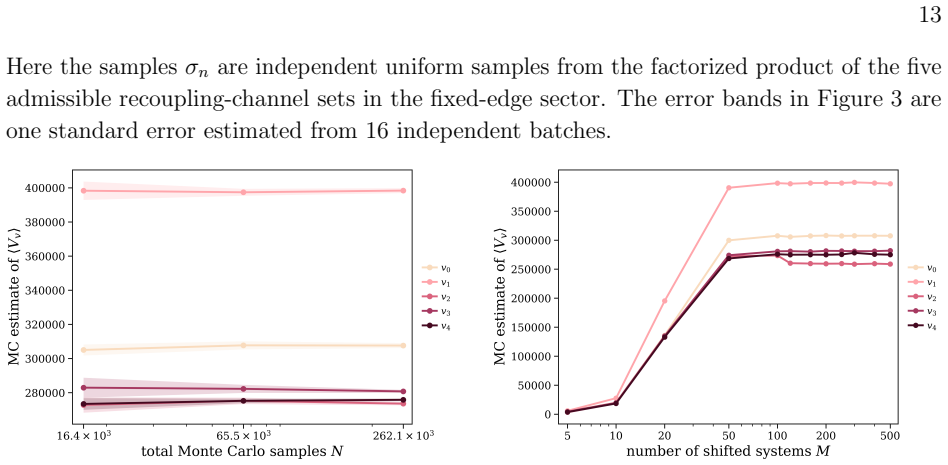
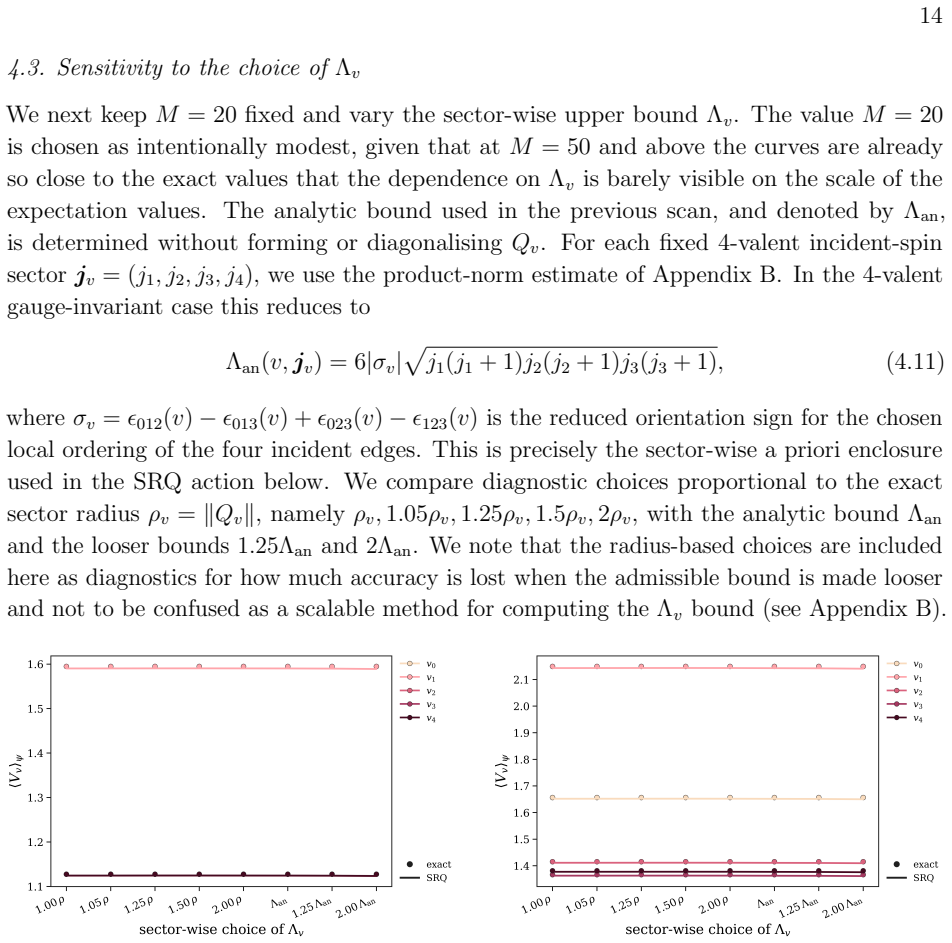
Figures from the paper (4 more)
Reference graph
Works this paper leans on
-
[1]
Rovelli C 1998 Loop quantum gravityLiving Rev. Rel.11 (PreprintarXiv:gr-qc/9710008)
work page Pith review arXiv 1998
-
[2]
Thiemann T 2001Introduction to Modern Canonical Quantum General Relativity(PreprintarXiv: gr-qc/0110034)
-
[3]
Thiemann T 2007Modern Canonical Quantum General RelativityCambridge Monographs on Mathematical Physics (Cambridge University Press) ISBN 978-0-511-75568-2, 978-0-521-84263-1
-
[4]
Ashtekar A and Lewandowski J 2004 Background independent quantum gravity: A Status reportClass. Quant. Grav.21R53 (PreprintarXiv:gr-qc/0404018)
work page Pith review arXiv 2004
- [5]
-
[6]
Rovelli C and Smolin L 1995 Discreteness of area and volume in quantum gravityNucl. Phys. B442 593–622 [Erratum: Nucl.Phys.B 456, 753–754 (1995)] (PreprintarXiv:gr-qc/9411005)
work page Pith review arXiv 1995
-
[7]
Quantum Theory of Gravity I: Area Operators
Ashtekar A and Lewandowski J 1997 Quantum theory of geometry. 1: Area operatorsClass. Quant. Grav.14A55–A82 (PreprintarXiv:gr-qc/9602046)
work page Pith review arXiv 1997
-
[8]
Ashtekar A and Lewandowski J 1998 Quantum theory of geometry. 2. Volume operatorsAdv. Theor. Math. Phys.1388–429 (PreprintarXiv:gr-qc/9711031)
work page Pith review arXiv 1998
Show all 51 references
-
[9]
Thiemann T 1996 Anomaly-free formulation of non-perturbative, four-dimensional Lorentzian quantum gravityPhys. Lett. B380257–264 (PreprintarXiv:gr-qc/9606088)
1996 arXiv
-
[10]
Thiemann T 1998 Quantum spin dynamics (QSD)Class. Quant. Grav.15839–873 (PreprintarXiv: gr-qc/9606089)
1998 arXiv
-
[11]
Thiemann T 1998 Quantum spin dynamics (QSD). II. The kernel of the Wheeler-Dewitt constraint operatorClass. Quant. Grav.15875–905 (PreprintarXiv:gr-qc/9606090)
1998 arXiv
-
[12]
Thiemann T 1998 Closed formula for the matrix elements of the volume operator in canonical quantum gravityJ. Math. Phys.393347–3371 (PreprintarXiv:gr-qc/9606091)
1998 arXiv
-
[13]
De Pietri R and Rovelli C 1996 Geometry eigenvalues and scalar product from recoupling theory in loop quantum gravityPhys. Rev. D542664–2690 (PreprintarXiv:gr-qc/9602023)
1996 arXiv
-
[14]
Guedes T L M, Mena Marug´ an G A, M¨ uller M and Vidotto F 2025 Taming thiemann’s hamiltonian constraint in canonical loop quantum gravity: Reversibility, eigenstates, and graph-change analysis Phys. Rev. D112026024 (PreprintarXiv:2412.20272)
2025
-
[15]
Guedes T L M, Mena Marug´ an G A, Vidotto F and M¨ uller M 2025 Computing the graph-changing dynamics of loop quantum gravityUniverse11387
2025
-
[16]
Sahlmann H and Sherif W 2024 Towards quantum gravity with neural networks: solving the quantum Hamilton constraint of U(1) BF theoryClass. Quant. Grav.41225014 (PreprintarXiv:2402.10622)
2024
-
[17]
Sahlmann H and Sherif W 2024 Towards quantum gravity with neural networks: solving quantum 23 Hamilton constraints of 3d Euclidean gravity in the weak coupling limitClass. Quant. Grav.41215006 (PreprintarXiv:2405.00661)
2024
-
[18]
Sahlmann H and Sherif W 2026 Finding and characterising physical states of Euclidean Abelianized loop quantum gravity using neural quantum states (PreprintarXiv:2604.14067)
2026 arXiv
-
[19]
M¨ akinen I, Sahlmann H and Sherif W 2026 Emergent Thiemann coherent states in the near-kernel sector of quantum reduced loop gravity (PreprintarXiv:2605.18625)
2026 arXiv
-
[20]
Brunnemann J and Thiemann T 2006 Simplification of the spectral analysis of the volume operator in loop quantum gravityClass. Quant. Grav.231289–1346 (PreprintarXiv:gr-qc/0405060)
2006 arXiv
-
[21]
Brunnemann J and Rideout D 2008 Properties of the volume operator in loop quantum gravity. I. Results Class. Quant. Grav.25065001 (PreprintarXiv:0706.0469)
2008 arXiv
-
[22]
Sahlmann H and Thiemann T 2006 Towards the QFT on curved space-time limit of QGR. 2. A concrete implementationClass. Quant. Grav.23909–954 (PreprintarXiv:gr-qc/0207031)
2006 arXiv
-
[23]
Giesel K and Thiemann T 2007 Algebraic Quantum Gravity (AQG). III. Semiclassical perturbation theoryClass. Quant. Grav.242565–2588 (PreprintarXiv:gr-qc/0607101)
2007 arXiv
-
[24]
Brunnemann J and Rideout D 2008 Properties of the volume operator in loop quantum gravity. II. Detailed presentationClass. Quant. Grav.25065002 (PreprintarXiv:0706.0382)
2008 arXiv
-
[25]
Thiemann T 2024 Non-perturbative quantum gravity in fock representationsPhysical Review D110 124023 (PreprintarXiv:2405.01212)
2024
-
[26]
Sorella S 1998 Green function Monte Carlo with stochastic reconfigurationPhys. Rev. Lett.804558–4561 (PreprintarXiv:cond-mat/9803107)
1998 arXiv
-
[27]
Sorella S 2001 Generalized Lanczos algorithm for variational quantum Monte CarloPhys. Rev. B64 024512 (PreprintarXiv:cond-mat/0009149)
2001 arXiv
-
[28]
Carleo G and Troyer M 2017 Solving the quantum many-body problem with artificial neural networks Science355602–606 (PreprintarXiv:1606.02318)
2017 arXiv
-
[29]
Baydin A G, Pearlmutter B A, Radul A A and Siskind J M 2018 Automatic differentiation in machine learning: a surveyJ. Mach. Learn. Res.181–43 (PreprintarXiv:1502.05767)
2018 arXiv
-
[30]
Bradbury J, Frostig R, Hawkins P, Johnson M J, Leary C, Maclaurin D, Necula G, Paszke A, VanderPlas J, Wanderman-Milne S and Zhang Q 2018 JAX: Composable transformations of Python+NumPy programs
2018
-
[31]
Amari S i 1998 Natural gradient works efficiently in learningNeural Comput.10251–276
1998
-
[32]
Math.10419–437
Balakrishnan A V 1960 Fractional powers of closed operators and the semigroups generated by them Pacific J. Math.10419–437
1960
-
[33]
Higham N J 2008Functions of Matrices: Theory and Computation(Philadelphia, PA: Society for Industrial and Applied Mathematics) ISBN 978-0-898716-46-7
-
[34]
Hale N, Higham N J and Trefethen L N 2008 Computing Aα, log(A), and related matrix functions by contour integralsSIAM J. Numer. Anal.462505–2523
2008
-
[35]
Trefethen L N and Weideman J A C 2014 The exponentially convergent trapezoidal ruleSIAM Rev.56 385–458
2014
-
[36]
Hestenes M R and Stiefel E 1952 Methods of conjugate gradients for solving linear systemsJ. Res. Natl. Bur. Stand.49409–436
1952
-
[37]
Saad Y 2003Iterative Methods for Sparse Linear Systems2nd ed (Philadelphia, PA: Society for Industrial and Applied Mathematics) ISBN 978-0-898715-34-7
-
[38]
Jegerlehner B 1996 Krylov space solvers for shifted linear systems (PreprintarXiv:hep-lat/9612014)
1996 arXiv
-
[39]
Frommer A and Gl¨ assner U 1998 Restarted GMRES for shifted linear systemsSIAM J. Sci. Comput.19 15–26
1998
-
[40]
Baumann M and van Gijzen M B 2015 Nested Krylov methods for shifted linear systemsSIAM J. Sci. Comput.37S90–S112
2015
-
[41]
Hutchinson M F 1990 A stochastic estimator of the trace of the influence matrix for laplacian smoothing splinesCommunications in Statistics - Simulation and Computation19433–450
1990
-
[42]
Golub G H and Meurant G 1994 Matrices, moments and quadratureNumerical Analysis 1993(Pitman 24 Research Notes in Mathematics Seriesvol 303) ed Griffiths D F and Watson G A (Harlow: Longman Scientific & Technical) pp 105–156
1994
-
[43]
Ubaru S, Chen J and Saad Y 2017 Fast estimation of tr(f(a)) via stochastic lanczos quadratureSIAM Journal on Matrix Analysis and Applications381075–1099
2017
-
[44]
Kwa´ snicki M 2017 Ten equivalent definitions of the fractional laplace operatorFractional Calculus and Applied Analysis207–51
2017
-
[45]
Horn R A and Johnson C R 2012Matrix Analysis2nd ed (Cambridge University Press) ISBN 978-0-521- 83940-2
-
[46]
Lanczos C 1950 An iteration method for the solution of the eigenvalue problem of linear differential and integral operatorsJ. Res. Natl. Bur. Stand.45255–282
1950
-
[47]
Saad Y 2011Numerical Methods for Large Eigenvalue Problemsrevised ed (Philadelphia: Society for Industrial and Applied Mathematics)
-
[48]
G¨ uttel S 2013 Rational krylov approximation of matrix functions: Numerical methods and optimal pole selectionGAMM-Mitteilungen368–31
2013
-
[49]
Knyazev A V 2001 Toward the optimal preconditioned eigensolver: locally optimal block preconditioned conjugate gradient methodSIAM J. Sci. Comput.23517–541
2001
-
[50]
Sleijpen G L G and van der Vorst H A 1996 A jacobi–davidson iteration method for linear eigenvalue problemsSIAM Journal on Matrix Analysis and Applications17401–425
1996
-
[51]
Convergence, error bounds and parameter selection This appendix presents the standard scalar and operator estimates used to choose the SRQ parameters
Nakatsukasa Y and Freund R W 2016 Computing fundamental matrix decompositions accurately via the matrix sign function in two iterations: The power of zolotarev’s functionsSIAM Review58461–493 Appendix A. Convergence, error bounds and parameter selection This appendix presents ...
2016
Reviewed July 1, 2026 · model on record in the stance chip above.
Discussion (0). Continue with ORCID to comment.